• Skip to primary navigation
  • Skip to main content
  • Skip to primary sidebar

Carnegie Museum of Natural History

One of the Four Carnegie Museums of Pittsburgh

  • Visit
    • Buy Tickets
    • Visitor Information
    • Exhibitions
    • Events
    • Dining at the Museum
    • Celebrate at the Museum
    • Powdermill Nature Reserve
    • Event Venue Rental
    • Gift Cards
  • Learn
    • Field Trips
    • Educator Information
    • Programs at the Museum
    • Bring the Museum to You
    • Guided Programs FAQ
    • Programs Online
    • Climate and Rural Systems Partnership
  • Research
    • Scientific Sections
    • Science Stories
    • Science Videos
    • Senior Science & Research Staff
    • Museum Library
    • Science Seminars
    • Scientific Publications
    • Specimen and Artifact Identification
  • About
    • Mission & Commitments
    • Directors Team
    • Museum History
  • Tickets
  • Give
  • Shop

Bugs

May 9, 2019 by wpengine

Honey Bees Hunt Bargains, Bumble Bees Go Gourmet

It is rewarding to receive questions and reports from people who turn to the staff at Powdermill Nature Reserve for information on nature in our area. Usually, we have a pretty good idea of what people are asking about, but once in a while visitors ask about something completely new to us. Last year, a visitor asked why he saw honey bees on his bird feeder in great numbers. The feeder was only stocked with bird seed. What were the bees doing?  We had no explanation. Recently, in the February 2019 issue of NY Conservationist, we read the answer. Mr. Gary Ennis provided a photo of the same phenomenon, and had the same question. According to beekeeper Bob Henke, during shipping and handling the seeds rub against each other and produce a fine powder similar to pollen, and the honey bees collect it as if it were pollen.
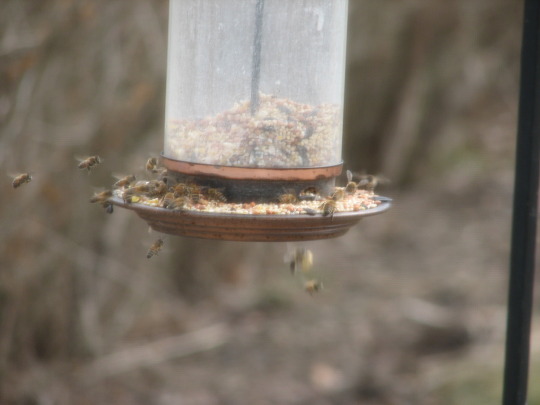
bees at a bird feeder
Photo credit: Gary Ennis.

But, why don’t we see other bees doing this?  Why are there no bumble bees on the feeder?  Bumble bees and other native bees sample the world one scout at a time, each bee making her own decisions. Researchers at Penn State showed that bumble bees monitor the nutritional value of the pollen they take, trying to keep an appropriate balance of protein versus lipids (fats, oils, and waxes.) If a certain plant produces pollen that has little lipid, then the bumble bee will favor pollen that is richer in lipids on future trips. This effort to balance their diet means that they specifically vary the pollen they harvest. It is as if they go to the grocery store and take a few items from the vegetable section, and a few from the dairy section, and a few from the bakery, creating a balanced plate on a daily basis.

On the other hand, honey bees are well-known for their ability to recruit to a good food source, and marshal large numbers of workers to harvest nectar or pollen. If an experienced scout finds a tree in bloom, she will recruit her sisters to that tree. They will go to that site directly without sampling other flowers on the way, and then return for another load, and another, and another.  This form of shopping is more like discovering that the grocery has potatoes on sale, and then buying 100 pounds of potatoes. Of course, a different scout will find a different resource, and she will recruit workers to harvest that in great numbers. As the weeks go by, the bees collect many different kinds of pollen, providing a broad selection for the nurse bees to feed the larvae. If we collect the separate loads of pollen from each returning bee: we see that each bee collected only one kind of pollen (all the same color), but different bees collected different pollen (many colors among the separate loads.)
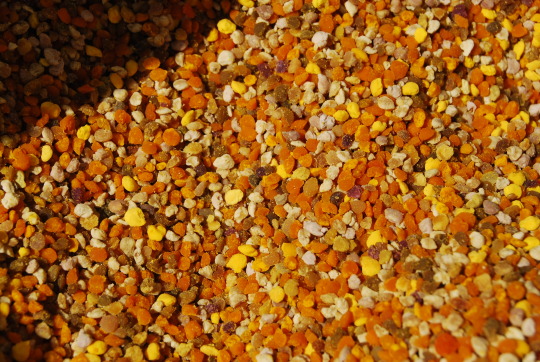
pollen
Photo Credit: Jodi Gertz

Aside from the importance of recruiting, the scout honey bees also make some effort to balance their diet, particularly regarding the important fatty acids, omega-3 and omega-6. Work by Hebrew University in Jerusalem has shown that if these nutrients are not eaten in an appropriate ratio, the bees learn poorly and do not remember what they learn. For example, bees with adequate omega-3 in their diets are much better at learning to associate an odor with a food reward compared to bees with no omega-3. Further, the bees with good nutrition remember what they learned the next day, whereas those with a poor diet forget. We are only just appreciating what this means for bee pollination of large monoculture crops. When the 1.2 million acres of almonds are in bloom in California, about 3 million commercial bee hives are there to pollinate them for several weeks. During this time, almond pollen is all the bees will get. Almond pollen has almost no omega-3 fatty acids. When these poor bees are moved to other sites, how long will it take them to learn what flowers are good, and will they remember?
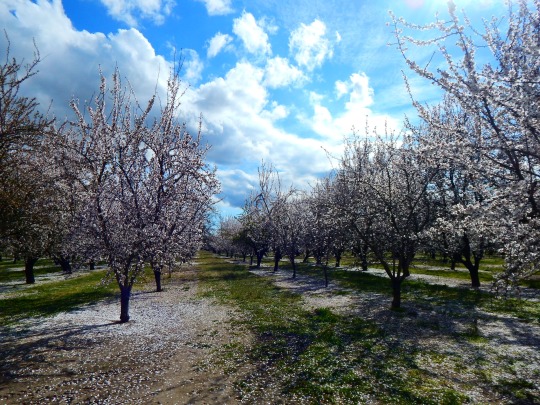
almond orchard in bloom

Thanks to NY Conservationist for allowing us to reprint the photo and retell the bird feeder story.

John Wenzel is the Director at Powdermill Nature Reserve, Carnegie Museum of Natural History’s environmental research center. Museum employees are encouraged to blog about their unique experiences and knowledge gained from working at the museum.
Filed Under: Blog Tagged With: Anthropocene, bees, John Wenzel, Powdermill Nature Reserve

April 10, 2019 by wpengine

Another Reason to Love Ladybugs

mealy bugs on plant

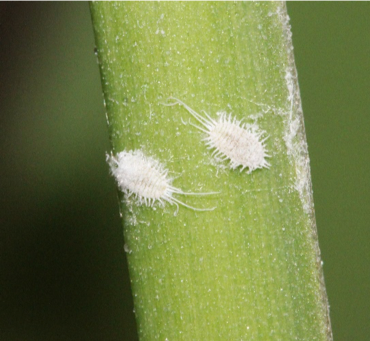
The Marsh Machine at Powdermill is great for recycling the nature center’s wastewater. It’s also great for building up huge populations of pests, such as aphids, scales, and mealy bugs (Picture 1). These plant-feeding insects thrive in the warm greenhouse environment, free from the natural predators they would encounter in an outdoor setting.

lady bugs crawling out of a canvas bag

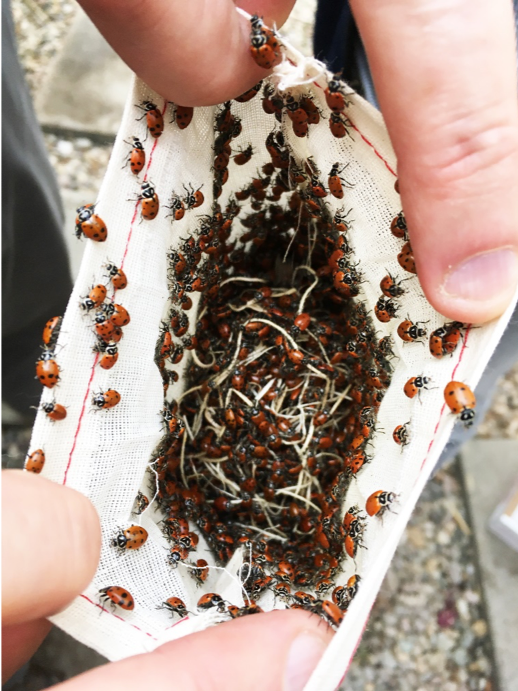
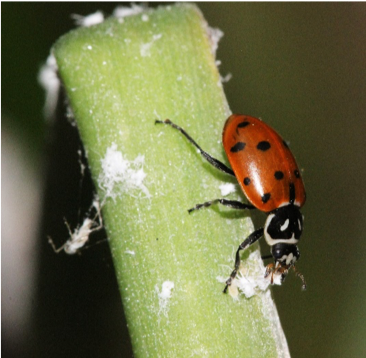
So what would be the logical solution to combatting these pests, which are highly destructive to the Marsh Machine plants that are working so hard to treat our wastewater? Bring the predators in, of course! The convergent ladybug (Hippodamia convergens), is a native predatory beetle that prefers just the types of insects that infest the Marsh Machine. We purchased 4,000 of these ladybugs (Picture 2) and have just released them into our greenhouse. The voracious predators immediately began their search and started feasting on a buffet of teeny bugs (Picture 3).

ladybug eating a mealy bug on a plant

According to our ladybug vendor, each adult ladybug can consume about 5,000 aphids in its lifetime! The adult females lay about 10-15 eggs a day, and the larvae that hatch out consume 50-60 aphids per day. At this rate, we anticipate our infestation will be under control in no time!

Note: While releasing ladybugs is an effective way to control greenhouse pests, releasing them outdoors generally results in the ladybugs flying away from the intended target, so keep this in mind when considering pest control options in your own backyard. Other options include eliminating the use of pesticides, which also kill the beneficial predators (and pollinators), and gardening with native plants, which are adapted to defend against native pests.

Andrea Kautz is a Research Entomologist at Carnegie Museum of Natural History’s Powdermill Nature Reserve. Museum employees are encouraged to blog about their unique experiences and knowledge gained from working at the museum.
Filed Under: Blog Tagged With: Andrea Kautz, Anthropocene, bugs, insects, Powdermill Nature Reserve

February 25, 2019 by wpengine

Bugs on Bugs on Bugs…on Birds

Big fleas have little fleas

Upon their backs to bite ‘em;

And little fleas have lesser fleas

And so, ad infinitum.

-Ogden Nash

Flat flies, louse flies, keds. The distinctive members of the fly family Hippoboscidae go by many names. All are obligate blood feeders found on mammals or birds and have a flattened body shape suitable for sliding in between the feathers and fur of their hosts. Their life history is as strange as their appearance, I assure you. While the vast majority of flies and other insects lay numerous eggs to reproduce, female hippoboscids prefer a more mammalian strategy. A single fertilized egg hatches within the female, and the developing larva is nourished within the mother through specialized “milk” glands until it is fully grown. The hugely swollen female then gives birth to a mature larva which immediately pupates, and later emerges as a winged adult hungry for a blood meal.

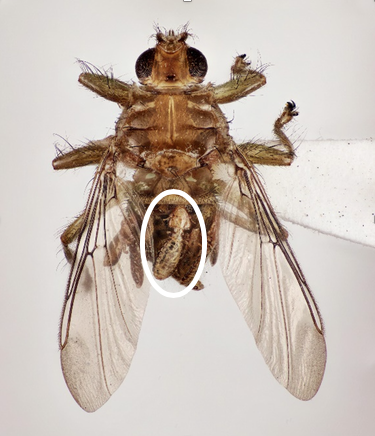
Hippoboscids are frequently encountered at the banding station at Powdermill Nature Reserve. Last year, most of the birds that were processed here were checked for these parasites, which were collected. Not much is known about these flies on songbirds as most of the research conducted deals with raptors. While identifying the flies under a microscope, we discovered these flies were often carrying some smaller bugs with them on their abdomens. These hitchhikers were bird lice and avian skin mites (see photos).

fly with white circle drawn around bird lice on abdomen
Dorsal view of a hippoboscid fly with several bird lice hitching a ride on its abdomen.


fly with white circle drawn around mites
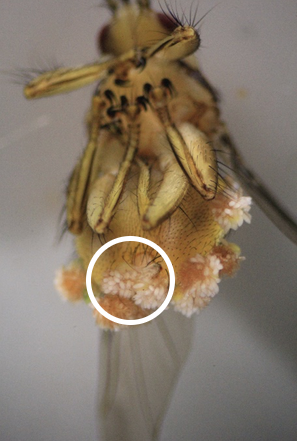
Ventral view of a hippoboscid fly carrying several female avian skin mites (Epidermoptidae), each surrounded by a cluster of white eggs.

Both of these small parasites are wingless and poor dispersers, but can conveniently get from bird to bird by riding on the hippoboscid flies, a strategy called phoresy. In the case of the skin mites, the females actually require a hippoboscid to reproduce. They attach themselves to the body of the fly and lay their eggs all around them in a clump. To add to the craziness, sometimes the mites attach to the lice which attach to the fly, which you find on birds. So there you have it. Bugs on bugs on bugs… on birds!

Andrea Kautz is a Research Entomologist at Carnegie Museum of Natural History’s Powdermill Nature Reserve. Museum employees are encouraged to blog about their unique experiences and knowledge gained from working at the museum.
Filed Under: Blog Tagged With: Andrea Kautz, avian research, Birds, bugs, Powdermill Nature Reserve

November 7, 2018 by wpengine

Why One Bug Just Won’t Do…

by Bob Androw

When visitors tour the insect collections in the Section of Invertebrate Zoology, the conversation often turns to numbers. How many rooms house the collection? Three, all quite full. How many total drawers are in those rooms? Well, roughly 30,000, at last count. How many specimens are in those drawers? We like to quote a figure of 13 million, give or take a few (but no one has counted recently). How many staff members are there to take care of all those bugs? Well – seven on a good day – that’s just 1,857,143 specimens per staff member…

And then the big questions always hit – why do you have so many specimens? Why do you have so many of the same species?

While there are many rarities represented by one to just a few specimens, the truth is that the majority of species are represented by several to many hundreds of individuals, referred to as a ‘series.’ So how do these series end up in the collection, and what is the purpose for multiple examples of individual species?

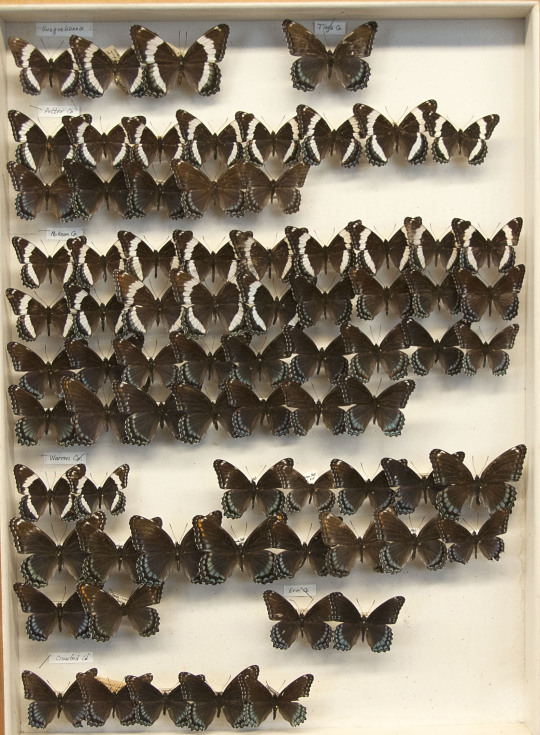
A simple answer, but not one that explains much, is that the age of the collection alone contributes to long series, especially of common species. Since its founding in 1896, if just a single red-spotted purple butterfly (Limenitis arthemis (Drury)), were deposited each year, 122 specimens would now be present. But the series of that common species probably numbers ten times that by now. So how, and why?

set of butterfly specimens

Over the years, museum staff have been active in traveling and collecting and were, and are, continually adding new materials to the collection. But an even greater number of specimens have come in the form of donations – entire collections, representing lifetimes of work, often come to us after their owner’s passing. These are sometimes from professional entomologists, but more often they are the legacy of non-professional, avocational collectors. These donated collections all vary drastically in their holdings, but common species are generally present, increasing the length of series of these taxa in the museum’s collection.

Back to all those red-spotted purples! Collected by a variety of people in a variety of places and times, they provide examples of the individual variation within the species, as well as critical locality and temporal documentation – or data – that help researchers understand the life history and distribution of the species. In these times of increasing global temperatures, the old data can be used as a baseline to compare against current information – does the butterfly still occur where it had in the past? Does it occur further north, now that the climes are more temperate in areas that used to be too cold? Or has it been pushed into higher elevations to evade hotter conditions in its historical habitat? By having large series, there is more data to help fill out the story of this butterfly species’ life history – past and present.

When those red-spotted purples were caught, the collectors were probably aware of what species they were – but what about species that cannot be easily identified in the field? The vast majority of insects are small to minute and cannot be identified until they are prepared and examined under a microscope. In the insect world, small size is coupled with enormous diversity. Entomologists regularly collect long series in the field to increase the odds of documenting more diversity – more specimens likely mean more species.

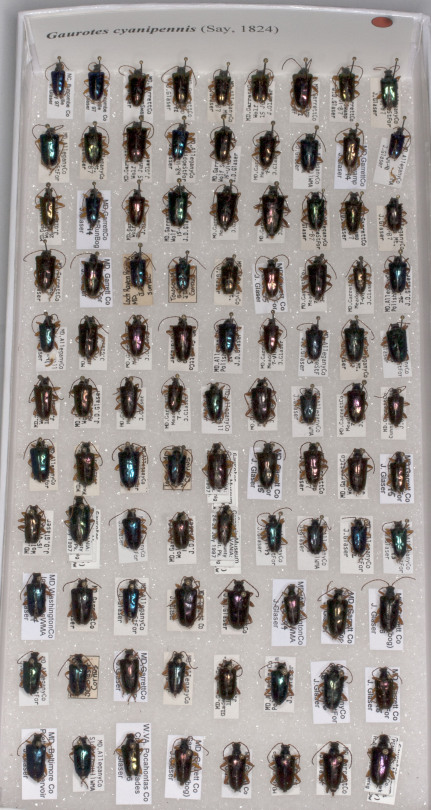
Not only is there a great diversity of species, but many insects exhibit variation within a species – in size, in color, and in differences between females and males. Populational differences are often evident within a species – sometimes to the extent that subspecies are described, discrete in their distribution and readily separated by physical characteristics. In the longhorned beetle Gaurotes cyanipennis (Say), individuals vary in color from blue to green to coppery to purple and all color forms can usually be found together in any given locality. But if you examine a long series of museum specimens you will notice the majority of specimens collected in the central third of Pennsylvania are all purple – rarely any other colors. The reason for this has not yet been determined, but by having long series of this common beetle, the trend can be seen, and questions can be asked.

set of longhorned beetle specimens

Insects can be collected by hand, one specimen at a time, but to more fully sample the biodiversity of a habitat, various types of traps can be deployed: pitfall traps; light traps; intercept and malaise traps; baited traps; with many specially designed to capture specific taxa. Traps allow for passive collecting over time, greatly increasing the volume, and diversity, of specimens compared to what a person could capture by hand. These trap samples can provide long series of specimens, insight into the biodiversity of a habitat and good data on population sizes. Select specimens are prepared, labeled and deposited in the collection and the remainder of the trap sample is archived to be available for future research. The specimens are not unlike the scores of books on a library’s shelves, their data labels all containing a little piece of the story about a living creature’s existence, documenting its occurrence in some place, at some time, on our planet.

So, when asked “why so many?”, the answer is multi-faceted: accumulation of specimens over time, from staff activity and donations of materials; the sheer biodiversity of insects composed of thousands of species; and long series documenting variation, distribution and seasonal occurrence. And chances are, as you read this, dozens more specimens are being added to the amazing insect collection at the Carnegie Museum of Natural History.

Bob Androw is a Scientific Preparator in Invertebrate Zoology. Museum employees are encouraged to blog about their unique experiences and knowledge gained from working at the museum.
Filed Under: Blog Tagged With: biodiversity, Bob Androw, Invertebrate Zoology

October 29, 2018 by wpengine

A Rainbow of Honeys

a rainbow of honeys in jars

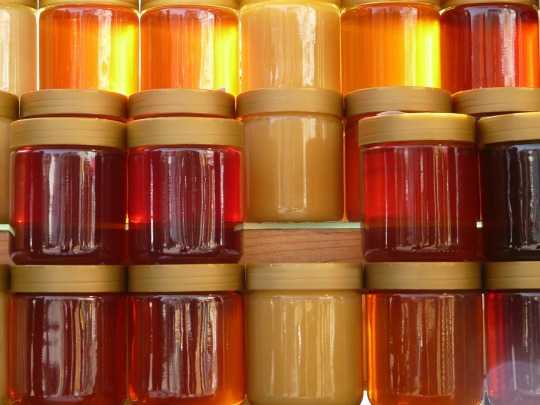
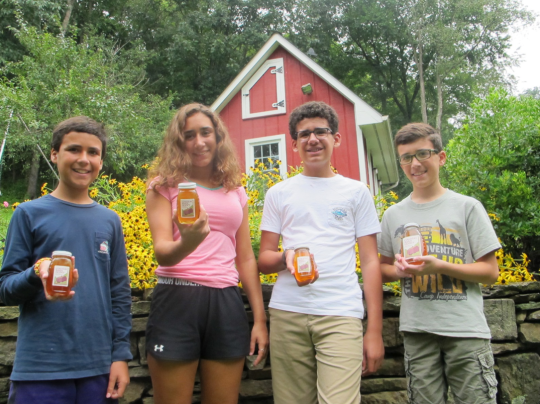
If you like to eat honey with breakfast, dessert, or tea, you can probably picture its bright color. You may think that all honey is the same but there are actually over 300 types of honey available in the United States with a wide range of colors.  To learn more about what makes up the color, we talked to Annabella (age 14), Joseph (age 13), Luca (age 11), and Nico (age 9) Zgurzynski, who help with their family’s honey business, Country Barn Farm, in Glenshaw, PA.

It’s all about the flowers.

The biggest influence on honey color is the type of flower the bee visits to collect nectar. Each plant’s nectar has different minerals and molecules that change the color of the honey it produces. For the Zygurzynski bees, flower trees including black locust, tulip poplar, and basswood make summer honey with a light golden color.  In the fall, dark brown honey comes from knotweed and goldenrod nectar. Big companies often blend different batches of honey together to get the amber color that people are used to.  At Country Barn Farm, the beekeepers are proud of the subtle color variations from each hive, and label their bottles to show it.

Your taste buds will notice, too.

With the difference in color also comes a difference in taste. Lighter honeys are most common in grocery stores, but if you only eat from the light end of the spectrum, you’re missing out. Darker honeys have a strong flavor, like molasses.  Nico, Joseph, and Annabella prefer the floral taste of clover honey.  Luca says fall honey is the best.

four kids holding jars of honey

Where is your honey from?

If you have honey at home, check the label to see where it was made. If the beekeepers can prove that 85% of the nectar came from a single flower source, that flower might be on the label too.  Can you find more than one kind of honey to sample? Close your eyes and see if you can taste the difference!

Did you know?

In 2012, a group of bees in France started producing honey in strange colors like blue and green. It turned out that instead of nectar, they were eating the waste from a Mars candy factory, the producer of M&M candies!


Explore nature together.  Visit Nature 360 for more activities and information.

Filed Under: Blog Tagged With: bees, Nature 360

October 29, 2018 by wpengine

What is a caterpillar database?

What is a caterpillar database? Curatorial Assistant in Invertebrate Zoology Catherine Giles introduces the larval collection and how it is organized. Learn how the section of Invertebrate Zoology collects and pickles specimens, then how they are stored and matched to a digital database of images and written notes.

Ask a Scientist is a video series where we ask our research staff questions about the millions of amazing objects and specimens stored in our museum collection. Tune in on YouTube, and submit your own questions via Twitter @CarnegieMNH!

Filed Under: Blog Tagged With: Ask a Scientist, caterpillars, Catherine Giles, Invertebrate Zoology

  • Page 1
  • Page 2
  • Go to Next Page »

sidebar

About

  • Mission & Commitments
  • Directors Team
  • Museum History

Get Involved

  • Volunteer
  • Membership
  • Carnegie Discoverers
  • Donate
  • Employment
  • Events

Bring a Group

  • Groups of 10 or More
  • Birthday Parties at the Museum
  • Field Trips

Powdermill

  • Powdermill Nature Reserve
  • Powdermill Field Trips
  • Powdermill Staff
  • Research at Powdermill

More Information

  • Image Permission Requests
  • Science Stories
  • Accessibility
  • Shopping Cart
  • Contact
  • Visitor Policies
One of the Four Carnegie Museums | © Carnegie Institute | Privacy Policy | Terms of Use | Accessibility
Rad works here logo