• Skip to primary navigation
  • Skip to main content
  • Skip to primary sidebar

Carnegie Museum of Natural History

One of the Four Carnegie Museums of Pittsburgh

  • Visit
    • Buy Tickets
    • Visitor Information
    • Exhibitions
    • Events
    • Dining at the Museum
    • Celebrate at the Museum
    • Powdermill Nature Reserve
    • Event Venue Rental
  • Learn
    • Field Trips
    • Educator Information
    • Programs at the Museum
    • Bring the Museum to You
    • Guided Programs FAQ
    • Programs Online
    • Climate and Rural Systems Partnership
  • Research
    • Scientific Sections
    • Science Stories
    • Science Videos
    • Senior Science & Research Staff
    • Museum Library
    • Science Seminars
    • Scientific Publications
    • Specimen and Artifact Identification
  • About
    • Mission & Commitments
    • Directors Team
    • Museum History
  • Tickets
  • Give
  • Shop

Kathleen

July 10, 2020 by Kathleen

Jurassic Days: Tyrannosaurus rex

Even though we have a soft spot for Dippy (Diplodocus carnegii) here at the Carnegie Museum of Natural History, Tyrannosaurus rex—the “king of the tyrant lizards”—is arguably the most famous dinosaur of all. T. rex was a fearsome theropod that weighed up to 9 tons, had a mouth full of razor-sharp, serrated teeth, and dominated what is now western North America during the Cretaceous period about 68 million years ago. But for all these ferocious credentials, T. rex’s closest living relative may surprise you. Take a moment or two to think about it. I’ll give you a hint, you may have eaten one of these in its nugget form at some point in your life. That’s right, the common chicken (gallus gallus domesticus), a slightly less intimidating animal! Was that your first guess?

Not only do T. rex and other dinosaurs share anatomical characteristics with birds—the wishbone, or furcula, for instance—but scientists in the twenty-first century have found molecular evidence to support the relationship, specifically from collagen proteins extracted from T. rex fossils, proteins that are strikingly similar to those found in modern birds. Scientists have also discovered through expressing the gene for feathers in embryonic alligator skin that feathers are highly modified scales. “It tastes like chicken,” the saying goes. But what does chicken taste like you ask? Perhaps a little like dinosaur.

While T. rex is a part of a fascinating evolutionary web that includes the birds we see today, the history of how T. rex got the name T. rex in the first place is no less fascinating. It all began in 1900, when the famous paleontologist Barnum Brown was quarrying in Wyoming for the American Museum of Natural History. Brown was looking for a triceratops skull to wow patrons back in New York City. Spoiler alert: he did not find the triceratops skull of his dreams. What he did find that autumn in Wyoming were the fossil remains of an enormous carnivore. Brown sent this new discovery back to the American Museum of Natural History where curator of vertebrate paleontology Henry Fairfield Osborn analyzed the unknown specimen, finally naming it Dynamosaurus imperiosus (literally, dynamic imperial lizard)—quite a tongue-twister.

Two years later, in 1902, Barnum Brown found another impressive cache of fossilized carnivore bones, this time in Montana. Osborn believed this second find to be a separate species from the first and called it Tyrannosaurs rex. Osborn published a scientific paper in 1905 officially naming and describing both theropods. However, after spending another year studying the two specimens, he came to the startling conclusion that they were one and the same species! Even legendary scientists have face-palm moments. Convention in the field of paleontology states that in such cases the first name sticks—but, lo and behold, Osborn had mentioned T. rex first in his 1905 paper. So, because of this seemingly small technicality, T. rex is T. rex…and not D. imperiosus. T. rex may be the most famous of the dinosaurs, but to this day it keeps its share surprises, both scientific and historical.

Written by: Nicholas Sauer is a Gallery Experiences Presenter and Natural History Interpreter
Filed Under: Blog Tagged With: Jurassic Days

July 9, 2020 by Kathleen

Jurassic Days: Camptosaurus

I remember visiting the museum often as a child. My favorite gallery was always Dinosaur Hall, now called Dinosaurs in Their Time. The gallery has changed a lot since I was a kid with specimens being displayed in ways that we now know to be scientifically accurate and even some specimens finally being displayed as free-standing mounts.

If you are exploring Dinosaurs in Their Time, as you pass underneath  Dippy’s (Diplodocus carnegii) tail you will spot a relatively small and seemingly unassuming dinosaur, Camptosaurus. While Camptosaurus  may not have the grand presence of Dippy or T. rex or the cuteness of baby Apatosaurus or Protoceratops it is still a remarkable specimen, with an interesting history.

Our specimen of Camptosaurus was discovered in 1922. It was on display for over 60 years, half embedded in the rock in which it was discovered. In 2005-2006, during renovations of the dinosaur exhibit, it was decided that Camptosaurus would be freed from the rock and turned into a free-standing mount. At that time, it was discovered that our Camptosaurus specimen was not Camptosaurus dispar like we thought. It was actually a species that had never been discovered before! Our specimen, described in 2008 by Kenneth Carpenter and Yvonne Wilson, is Camptosaurus aphanoecetes and it is the holotype, or the specimen that defines this species.  Its new scientific name is accurate- Camptosaurus means “flexible lizard” and aphanoecetes means “hiding in plain sight.”

Camptosaurus lived in the late Jurassic period, about 150 million years ago. It was an herbivore, or plant eating dinosaur. The wear on its teeth shows that it likely ate tough vegetation. It was originally thought to walk on all four limbs, but now we know that was able to walk on its hind limbs or all four limbs as needed. Camptosaurus  was the ancestor to later dinosaurs like iguanodonts and duck-billed dinosaurs.

Camptosaurus is a great demonstration of the fact that scientists are always learning. Paleontology, despite being the science of studying animals that existed long ago, is constantly changing and evolving. We discover new ancient species, sometimes hiding in plain sight, all the time.

Written by: Jo Tauber, Gallery Experience Coordinator

Filed Under: Blog Tagged With: Jurassic Days

July 9, 2020 by Kathleen

Jurassic Days: Cookie Excavation

Materials Needed

  • Paper towel
  • Paint brush/small brush of some type
  • Tooth picks
  • Paper and pencil
  • Chocolate chip cookie (or any type of cookie with bits like raisins, fruit, or other ingredients)

Filed Under: Blog Tagged With: activities, Crafts, Jurassic Days

July 8, 2020 by Kathleen

Jurassic Days: Quetzalcoatlus northropi

Soaring high over the tallest of treetops, snatching up an unlucky land-dweller for lunch, and emitting long screeches that echoed far and wide— these are a few of the images one could imagine when asked to think about pterosaurs. And, for some, this might be correct; smaller species of pterosaurs were easily capable of flight, hunting or even scavenging in many different ways. But for other species, an air of mystery remains. Pterosaurs tend to be far more complex than people think at first— for one, they aren’t even considered dinosaurs, despite living alongside them throughout the Mesozoic. For another, pterosaurs likely could have varied drastically in how they lived. We still have a long way to go before we figure out these winged reptiles, and perhaps none of them are as awe-inspiring as Quetzalcoatlus northropi, often considered one of the largest flying animals that ever existed.

Living throughout the late Cretaceous, Quetzalcoatlus northropi could grow to have a wingspan of up to 36 feet— about the size of a standard city bus. Early scientists estimated that this species of pterosaur may have weighed anywhere from 200 to 500 pounds. Like today’s birds, pterosaurs had hollow bones, which made them light enough to fly.

Scientists, however, are not sure if Quetzalcoatlus could take to the skies like its cousins. Even with special bones, a reptile as big as Quetzalcoatlus may have had a hard time getting up into the air. It isn’t always easy for us to know how an ancient animal might have lived during its time, but a Paleontologist can make educated guesses based on the bones that they study. Sometimes, the best clues lie in the animals that we have today; by comparing some of the features of Quetzalcoatlus to modern-day birds, Paleontologists have proposed a few different theories as to how one of the largest pterosaurs lived.

Quetzalcoatlus had a very long, sharp beak similar to the storks that we know today. Based on this observation, it is commonly thought that this pterosaur may have hunted small animals on the ground, similar to storks or hornbills. Supporting this hypothesis is the front and back limbs, which suggests to many modern scientists that Quetzalcoatlus may have been more suited to walking on land than we would expect. However, this alone does not rule out flight. A more recent study, aided in part by Chatham University’s Mike Habib, revealed through a computer model that Quetzalcoatlus could have been capable of flight, and likely flew in short bursts. This likely was used by Quetzalcoatlus before soaring, much like today’s vultures.

Even with modern technology, what we know about creatures like Quetzalcoatlus northropi still leaves plenty of mystery around the winged giant. Able to fly or not, there is no question that this pterosaur is a breathtaking reminder of the complex nature of the Mesozoic era.

Written by: Emma McGeary, Gallery Experience Presenter

Filed Under: Blog Tagged With: Jurassic Days

July 8, 2020 by Kathleen

Jurassic Days: Dino Statue Driving Tour

Dinosaurs became extinct 65 million years ago, but Pittsburgh is still a city of dinosaurs.  The giants still roam the city’s hills even outside of the museum.  In fact, you might see dinosaurs in your own neighborhood!

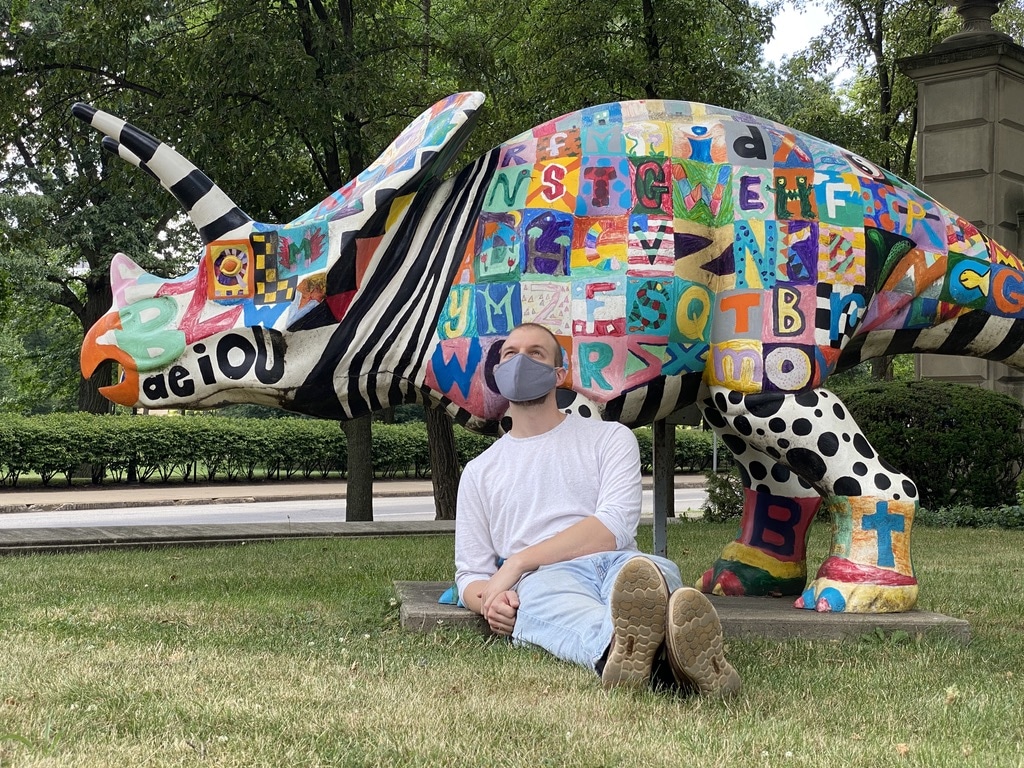
Carnegie Museum of Natural History released 100 dinosaur statues during DinoMite Days in the summer of 2003. Some of these dinosaurs have roamed far away, but others remain within the Pittsburgh area.  These aren’t ordinary dinosaurs, they’re spectacularly colorful and creative!  Designed by local artists and imaginative students, these dinosaurs are representative of the vibrant spirit of Pittsburgh and some of the ‘Burgh’s amazing local legends.

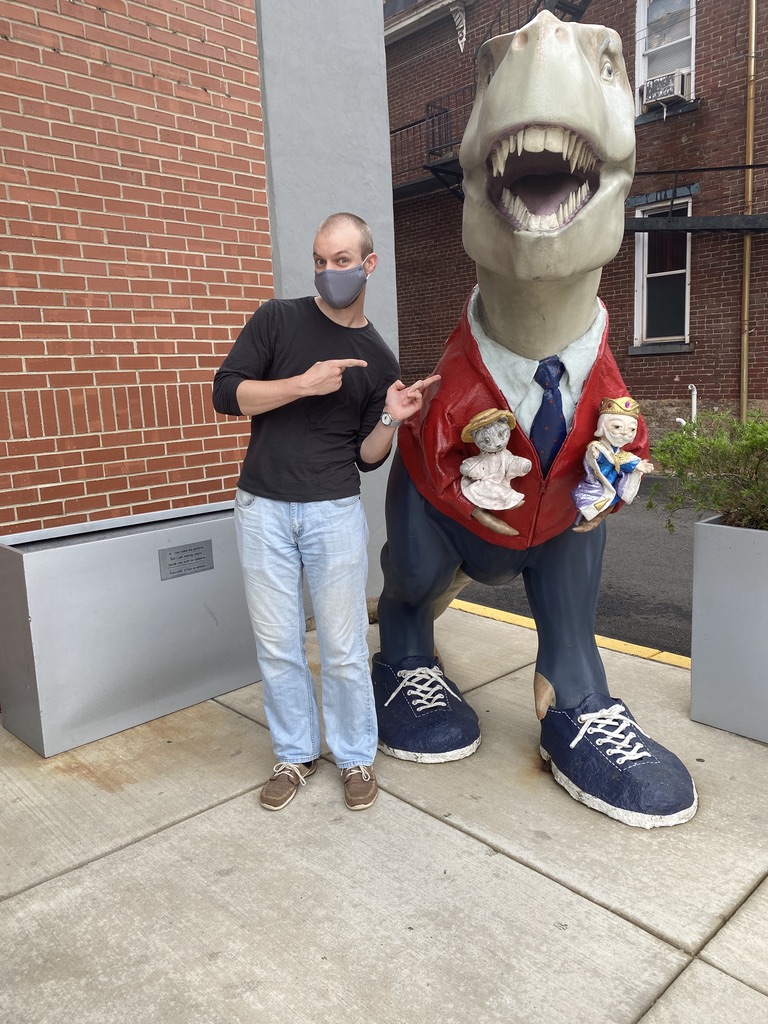
To commemorate the city’s dinosaurs this summer, consider visiting a few on a Dino Statue Driving Tour, or hunt for the elusive dinosaur statues not listed here.  The tour takes roughly two hours—timed with a stop for a photo at each dinosaur, but I’d recommend adding a snack break—and includes 15 dinosaurs. The DinoMite Days dinosaurs released in 2003 came in three standard shapes—Tyrannosaurus, Stegosaurus, and Torosaurus.  The dinosaurs were auctioned as part of a fundraiser for several local charities, including Carnegie Museum of Natural History’s Dinosaurs in Their Time exhibition.  They are currently privately owned and may be publicly displayed or kept indoors.  The dinosaurs have even ended up as part of other museums including the John Heinz History Center.  Some dedicated dinosaur hunters are trying to locate all 100 dinosaurs!

Note: While many of these dinosaurs are displayed as public art, some are owned by private individuals and should be approached with respect.  Please, be courteous when taking photographs and ask permission when necessary.  You may be required to wear a mask or participate in a health screening at some of these stops for public health safety precautions.

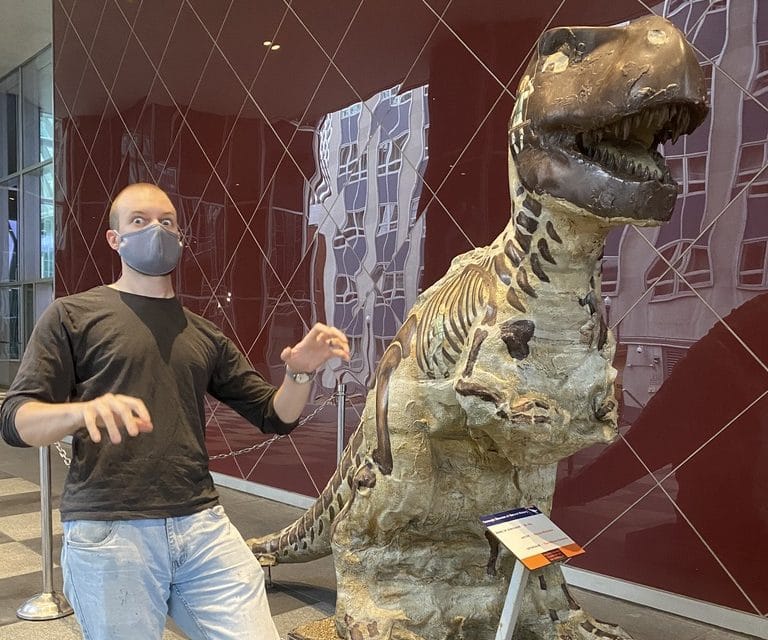
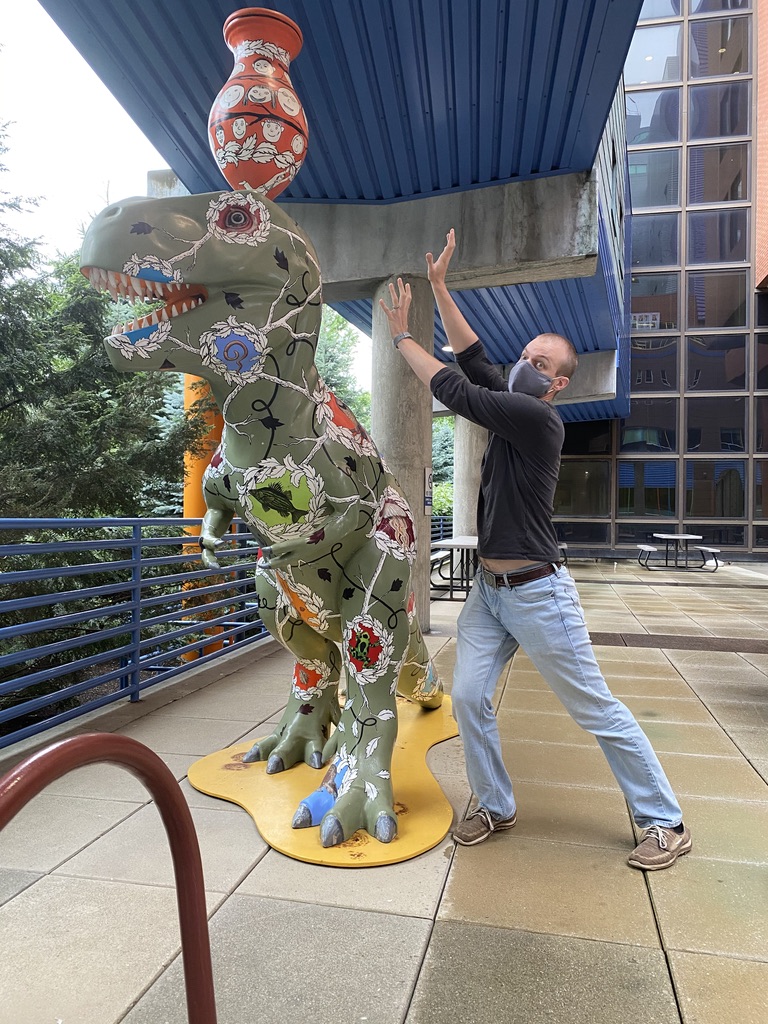
Aaron with Fredosaurus Rex Friday XIII

First Stop: Fredosaurus Rex Friday XIII
Coordinates: 40.429910, -79.975938

This king of the dinosaurs is dedicated to the friendliest neighbor, Mr. Rogers, and is conveniently located at the WQED headquarters on the South Side.  Another Mr. Rogers’ Neighborhood dino lives at the Fred Rogers Center in Latrobe, PA.

Aaron with Mr. Dig
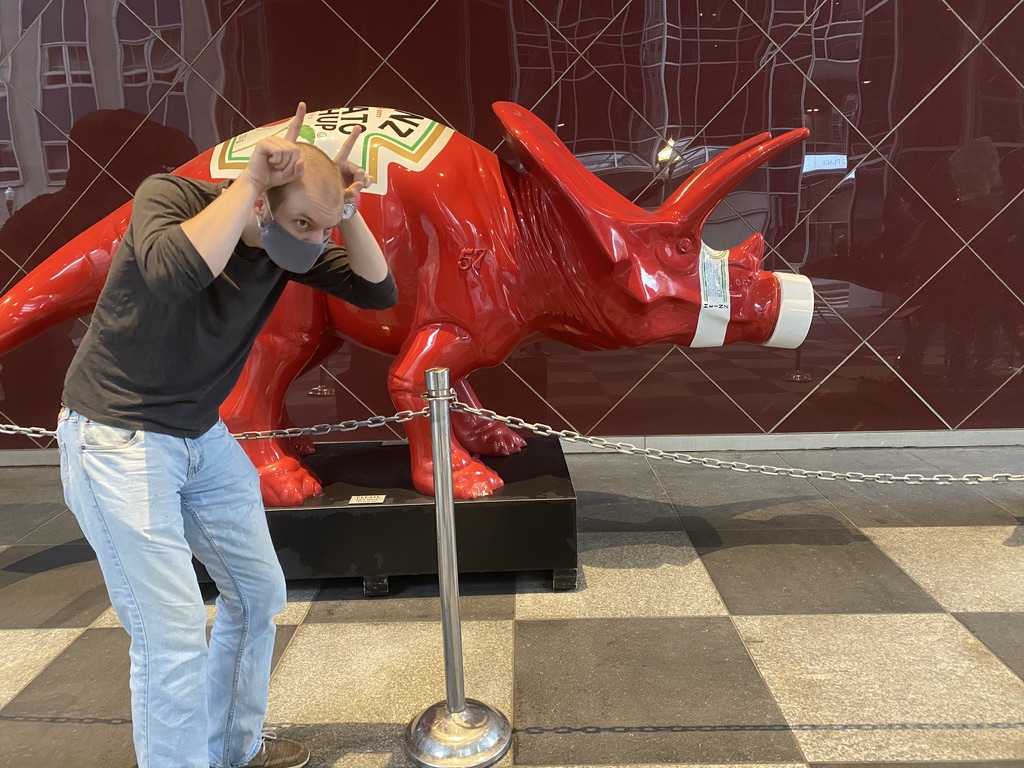
Ketchupsaurus
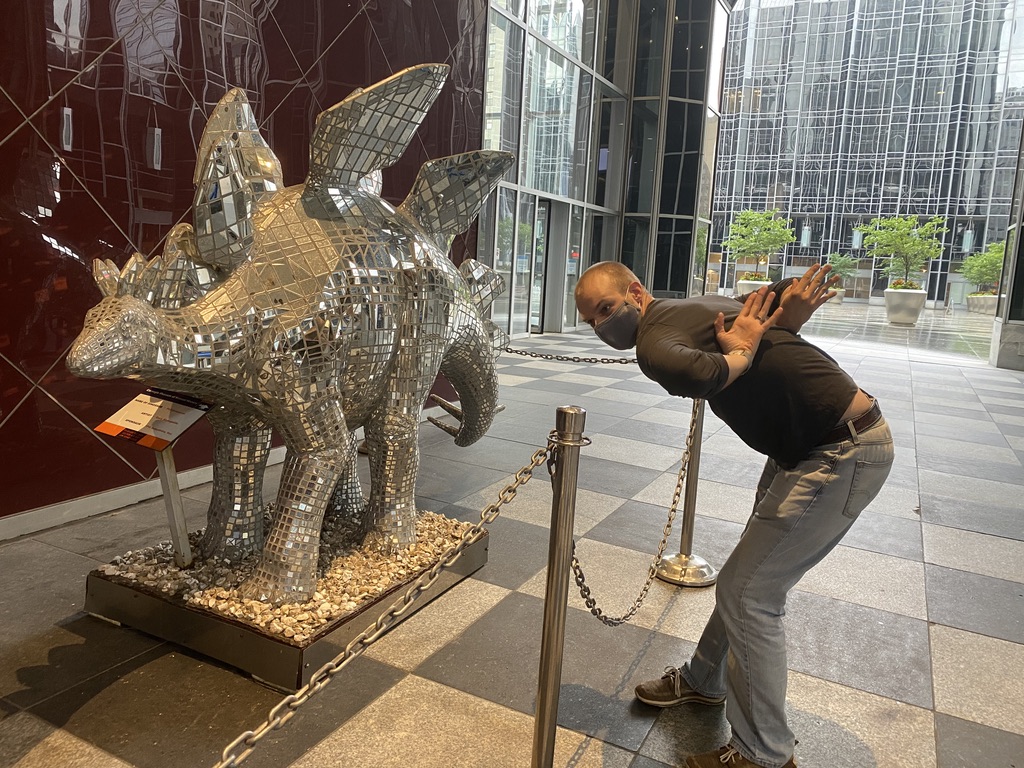
Philliposaurus

Second stop: PPG Plaza Dino Parade
Coordinates: 40.439766, -80.003858

The second stop has all three dinosaur models!  This dino parade is in PPG Plaza and includes Mr. Dig (T. Rex), Ketchupsaurus (Torosaurus), and Philliposaurus (Stegosaurus).  Philliposaurus is named for Phillip Johnson, one of the architects of the PPG Place building.

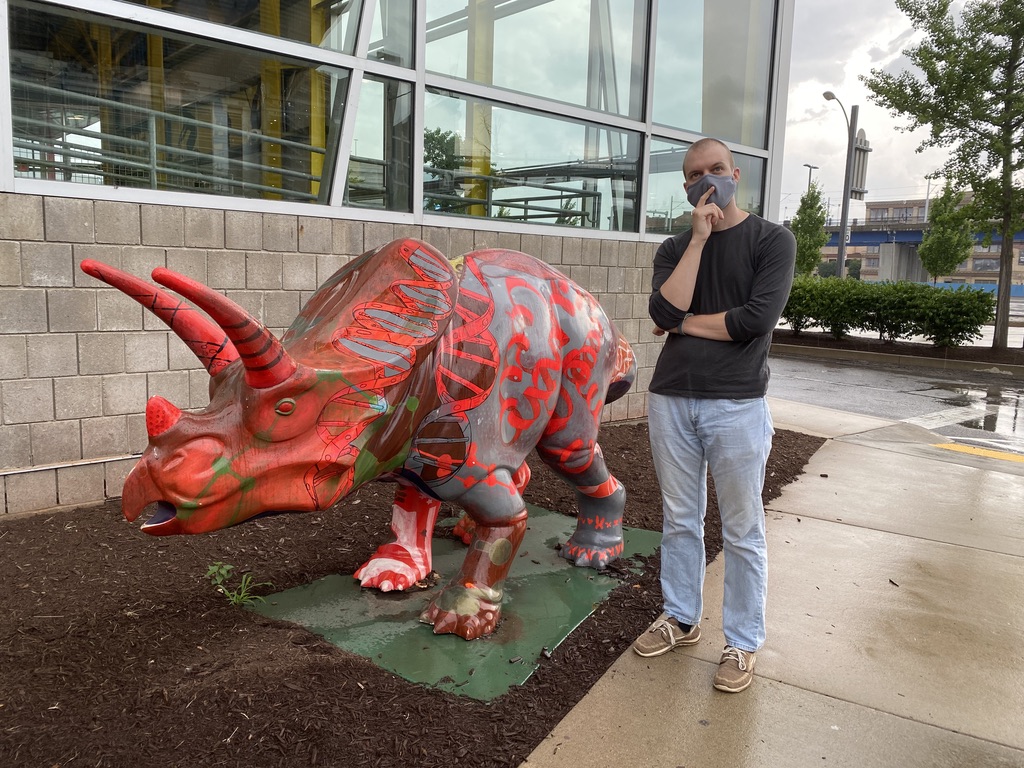
DNAsaurus

Third Stop: DNAsaurus
Coordinates: 40.446468, -80.018495


Our friends at the Carnegie Science Center host DNAsaurus, which is appropriately decorated with DNA strands and chromosomes. Bingo! Dino DNA!

Fourth Stop: Prehistoric Printasaurus
Coordinates: 40.460458, -79.980679

Located on Herrs Island, Printasaurus is a collage of patterns and geometric shapes that make one stylin’ dino.  You can park at Herrs Island North Park and take the Three Rivers Heritage Trail to find this dinosaur placed in a garden at the opposite end of the island.

Connections dinosaur statue

Fifth Stop: Connections
Coordinates: 40.466769, -79.952309

Children’s Hospital has a few dinosaurs, but Connections the T. Rex is visible from the outside.  This dinosaur celebrates the interconnectedness of all life.

Sixth Stop: Formerly Cogitatio Aeterna
Coordinates: 40.458010, -79.930777

This remodeled skeletal dinosaur is appropriately located at the Greater Pittsburgh Orthopaedic Associates building on Centre Avenue.

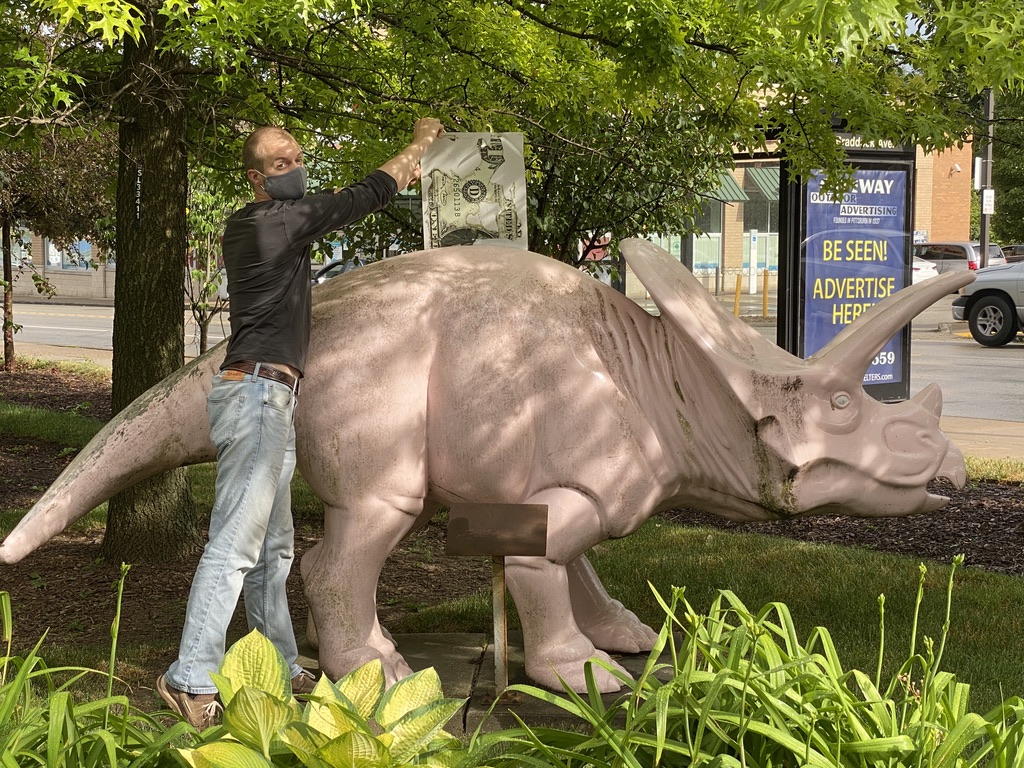
Bill Dollarsaurus

Seventh Stop: Bill Dollarsaurus
Coordinates: 40.447218, -79.894962

On the corner at the Shady Lane School you can find Bill Dollarsaurus.  Bill has a sister named Dolly who lives somewhere in the city.

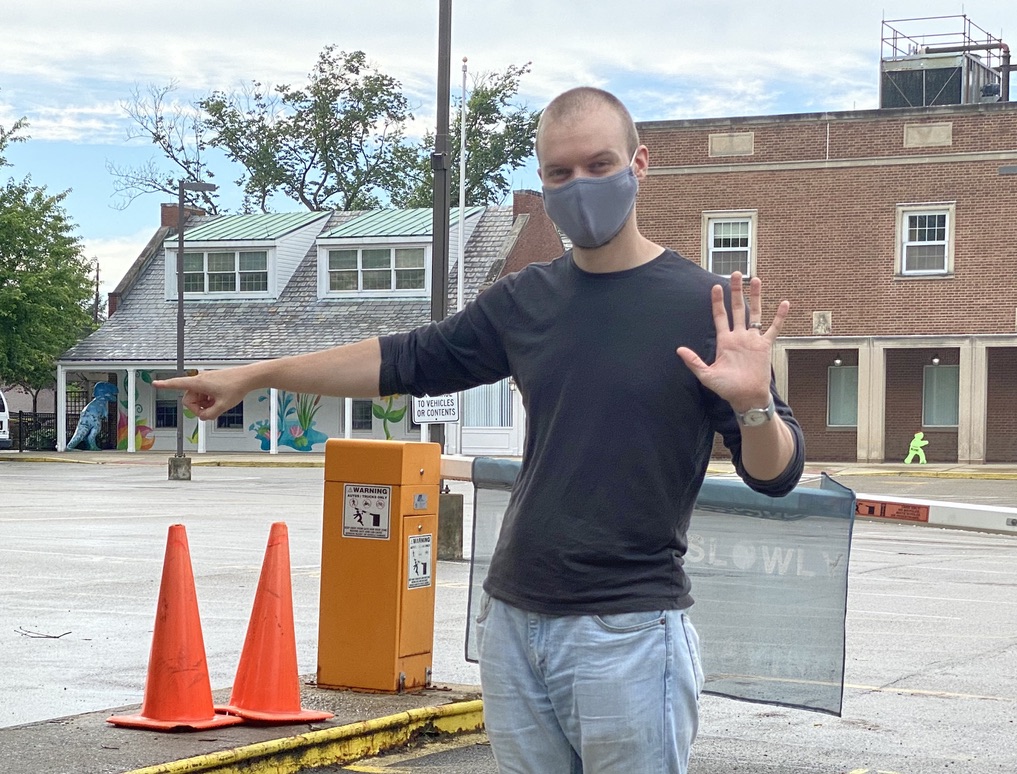
Amazing Hands Dinosaur Statue

Eighth Stop: Amazing Hands
Coordinates: 40.442526, -79.919394

An awesome garden-inspired dinosaur created by children at the Children’s Institute lives at the Squirrel Hill location.  Wave hello to this dinosaur from across the parking lot off of Northumberland Street.

The Children's Institute
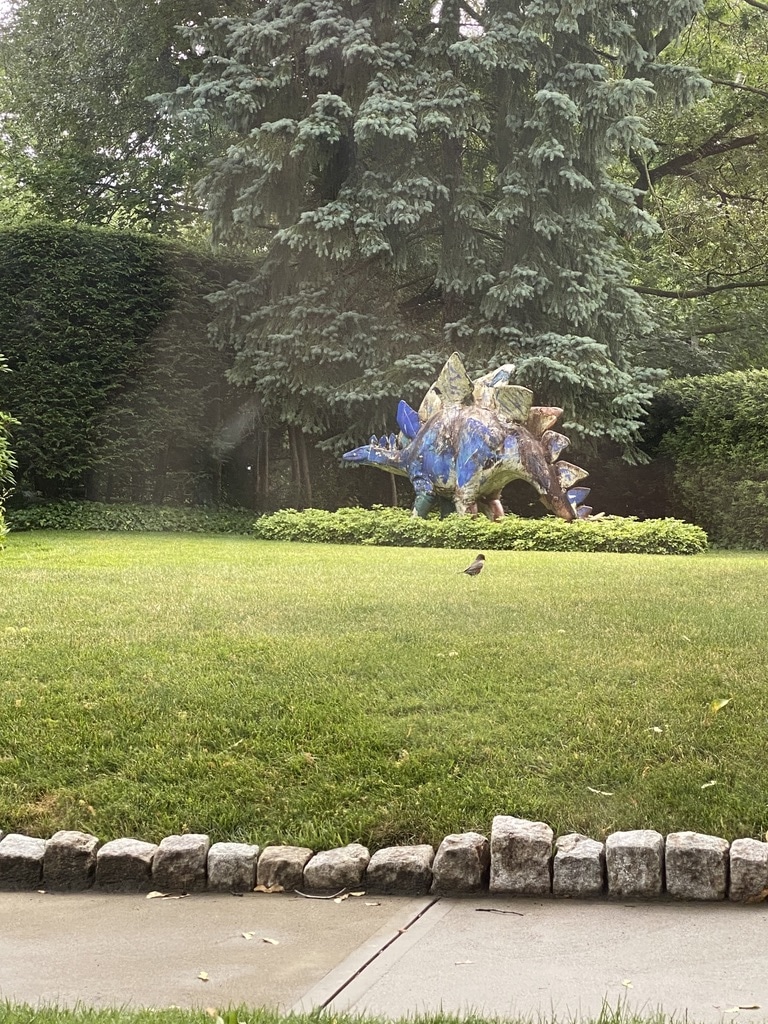
Spectrasaurus

Ninth Stop: Spectrasaurus
Coordinates: 40.450149, -79.945179

This dinosaur is located on private property at the corner of Ellsworth and Devonshire in Squirrel Hill.  Easily visible from the sidewalk, this colorful dinosaur was designed to mimic the bright warning colors of poisonous tree frogs.

Seymour-Sparklesaurus-aka-Sparky

Tenth Stop: Seymour Sparklesaurus “Sparky”
Coordinates: 40.448522, -79.953038

Located at and designed by the Western Pennsylvania School for Blind Children, Sparky features handprints and an oversized braille message: “stegosaurus.”

Alphabetosaurus
Dino-soar

Last Stop!
Coordinates: 40.443159, -79.949601

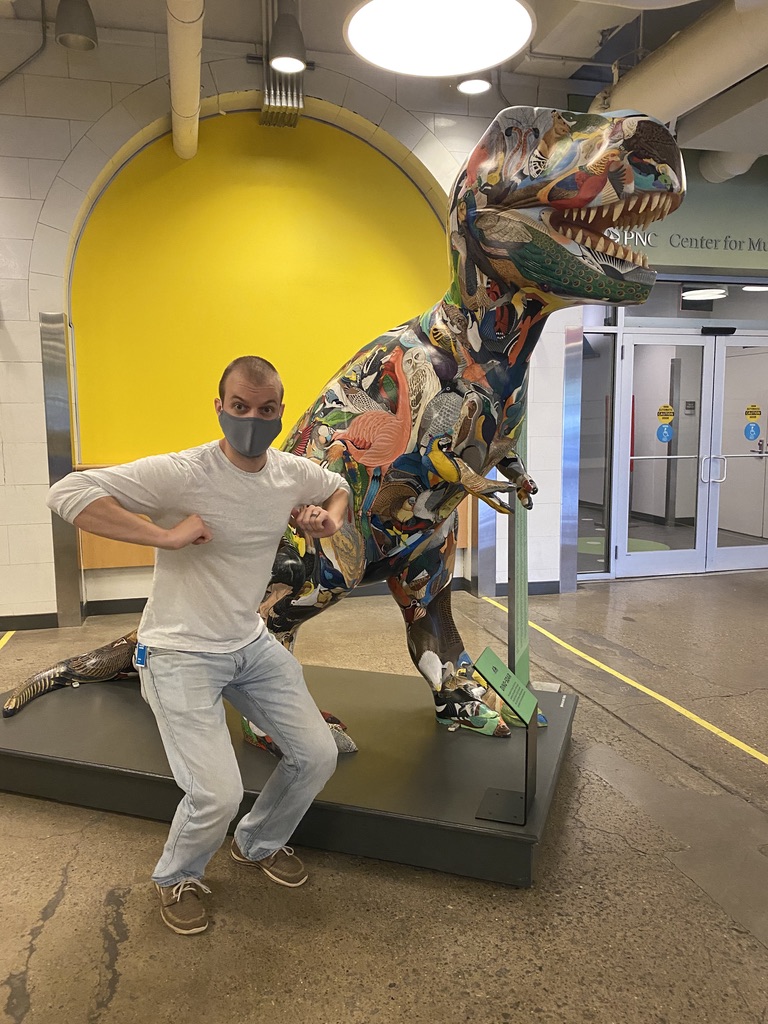
The final three dinosaurs on our tour happen to reside near the Carnegie Museum of Natural History (where else would dinosaurs be?).  Alphabetosaurus is across Forbes Avenue from the museum.  Dino-soar is inside of the Portal Entry to the museum and features many beautiful birds including Archaeopteryx, one of the first birds.

And our very last stop is Dippy the Diplodocus.  Though not a part of DinoMite Days, Dippy is a very special life-size model of a Diplodocus and is certainly an inspiring dinosaur statue.  Although all black, Dippy occasionally wears scarves, ties, and hats to fit in with the changing attitude of Pittsburgh.  Right now, Dippy is wearing a mask to help keep everyone safe.

Make sure to tag the Carnegie Museum of Natural History in photos you post to social media!

Written by: Aaron Young, Museum Educator

Filed Under: Blog Tagged With: activities, Jurassic Days

July 7, 2020 by Kathleen

Jurassic Days: Mighty Mosasaur

Let’s go on a trip! We’ll have to travel about 1,000 miles and roughly 66 million years to arrive on the rocky beach of the Western Interior Sea of Kansas. There is lush plant life with ancient birds and bugs buzzing around the water – we might feel as though we’ve been transported to the land of Oz! Better stop Toto before he leaps in for a swim though, it’s full of dangerous creatures!


One of the creatures in these waters were the Mosasaurs. These animals evolved from the same ancestor as today’s monitor lizards like Komodo Dragons and Water Monitors. Feeling the predation pressure from larger dinosaurs, this little lizard adapted to life in the water and soon became fully suited for life in the oceans as they developed the ability to give birth to live young, eliminating the need to lay eggs on land.

The mightiest of all the mosasaurs was Tylosaurus. They grew more than 45 feet long, making them the largest. Mosasaurs had a long and muscular tail that was vertically flattened, like a shark, that powered Tylosaurus through the water. This allowed them to ambush its prey with rapid bursts of acceleration. Paddle-like limbs helped steer their slim body, covered in lizard-like scales, through the water. (Image 1- illustration of blue Tylosaurus)

Tylosaurus skull

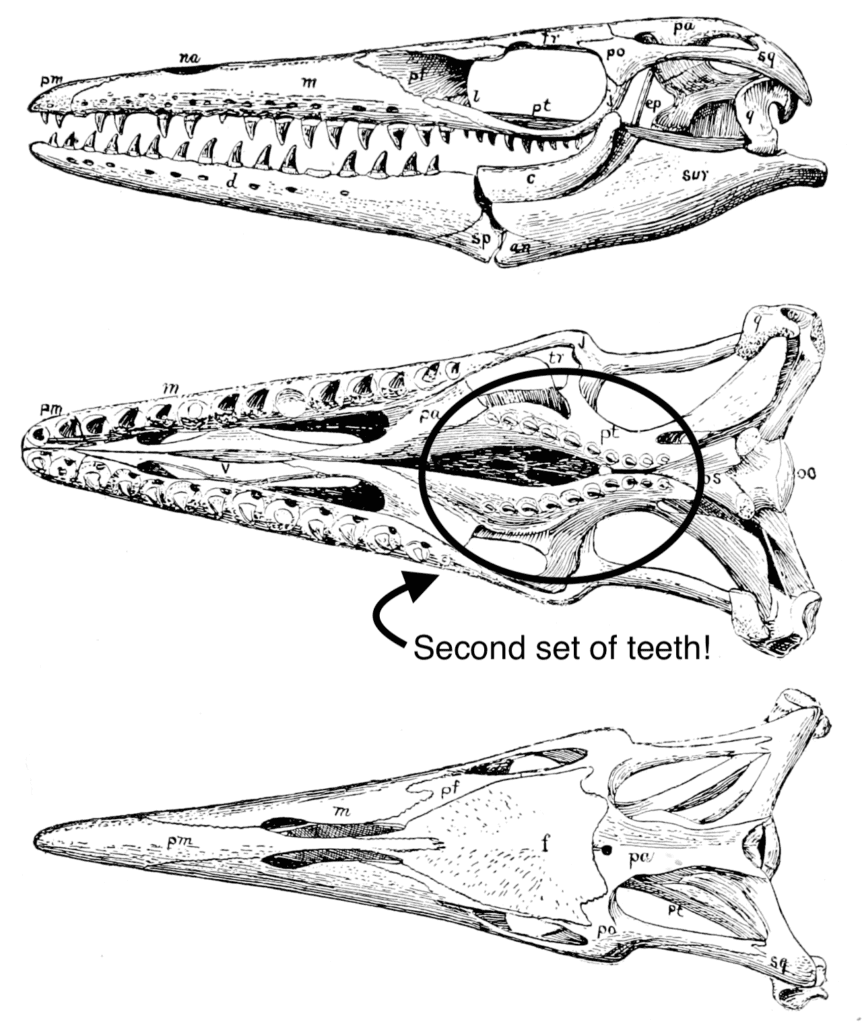
Tylosaurus was the deadliest hunter of the ancient seas, ready to seize and kill just about any smaller creature that crossed its path using jaws that were lined on each side with two rows of pointy, cone-shaped teeth. This reptile used its snout to locate prey, which, once inside the mosasaur’s jaws, was swallowed whole. When the sea monster opened wide for the final gulp, two extra rows of teeth on the roof of its mouth started digestion by shredding the prey as it was being swallowed.

Though not a dinosaur, Tylosaurus lived alongside them and went extinct around the same time. Many Tylosaurus remains have been found near the Great Plains in Nebraska and Kansas, which was once covered by a large ocean we went to visit. Don’t be fooled, we couldn’t swim in this ocean like we can in today’s waters

Written by: Abbey Hines, Museum Educator

Filed Under: Blog Tagged With: Jurassic Days

  • « Go to Previous Page
  • Page 1
  • Interim pages omitted …
  • Page 5
  • Page 6
  • Page 7
  • Page 8
  • Page 9
  • Interim pages omitted …
  • Page 13
  • Go to Next Page »

sidebar

About

  • Mission & Commitments
  • Directors Team
  • Museum History

Get Involved

  • Volunteer
  • Membership
  • Carnegie Discoverers
  • Donate
  • Employment
  • Events

Bring a Group

  • Groups of 10 or More
  • Birthday Parties at the Museum
  • Field Trips

Powdermill

  • Powdermill Nature Reserve
  • Powdermill Field Trips
  • Powdermill Staff
  • Research at Powdermill

More Information

  • Image Permission Requests
  • Science Stories
  • Accessibility
  • Shopping Cart
  • Contact
  • Visitor Policies
One of the Four Carnegie Museums | © Carnegie Institute | Privacy Policy | Terms of Use | Accessibility
Rad works here logo