• Skip to primary navigation
  • Skip to main content
  • Skip to primary sidebar

Carnegie Museum of Natural History

One of the Four Carnegie Museums of Pittsburgh

  • Visit
    • Buy Tickets
    • Visitor Information
    • Exhibitions
    • Events
    • Dining at the Museum
    • Celebrate at the Museum
    • Powdermill Nature Reserve
    • Event Venue Rental
  • Learn
    • Field Trips
    • Educator Information
    • Programs at the Museum
    • Bring the Museum to You
    • Guided Programs FAQ
    • Programs Online
    • Climate and Rural Systems Partnership
  • Research
    • Scientific Sections
    • Science Stories
    • Science Videos
    • Senior Science & Research Staff
    • Museum Library
    • Science Seminars
    • Scientific Publications
    • Specimen and Artifact Identification
  • About
    • Mission & Commitments
    • Directors Team
    • Museum History
  • Tickets
  • Give
  • Shop

Erin Southerland

November 26, 2025 by Erin Southerland

Remembering Bob Davidson

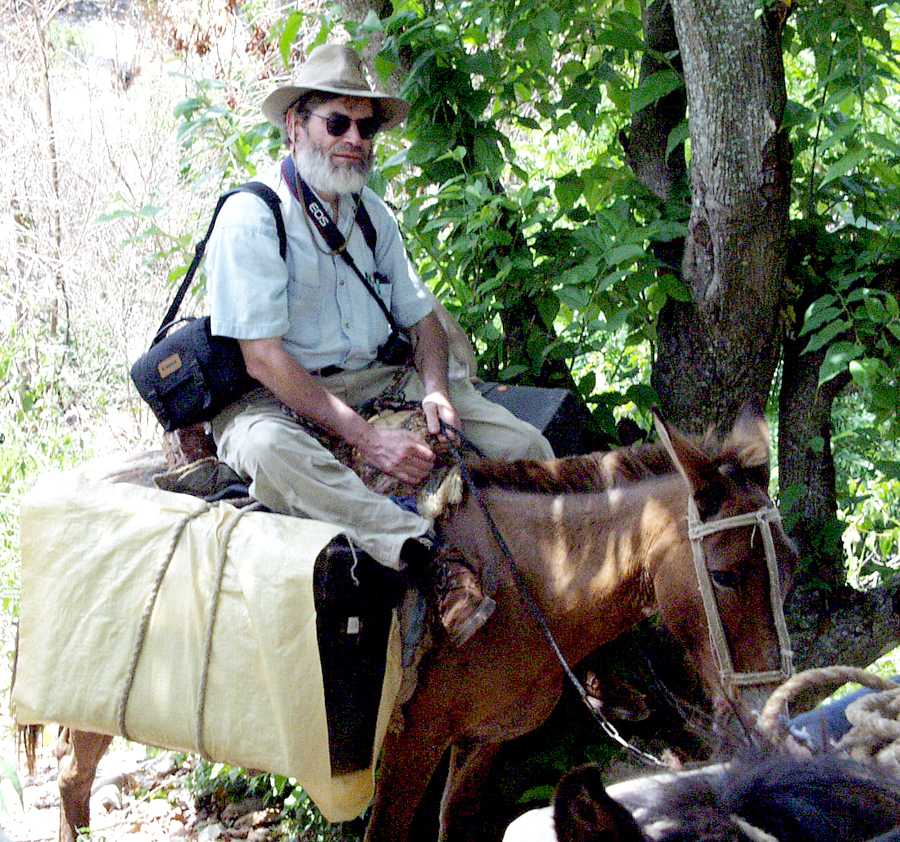
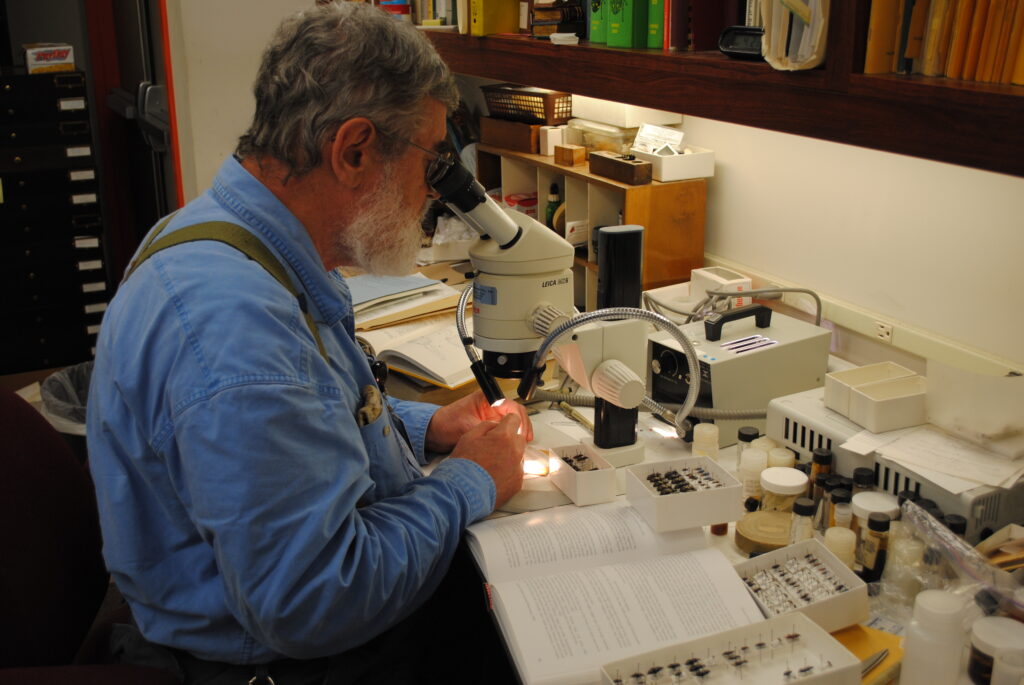
Bob Davidson shared what he loved. The long time Invertebrate Zoology Collection Manager at Carnegie Museum of Natural History died in his sleep on November 6, at the age of 77, five years after his formal retirement. For all those who knew him, news of his passing triggered a mental review of the subjects he shared with us through conversation, rant, written account, and mutual experience. In day-to-day life, Bob valued family, friends, classical music, theatre, literature, films, comedy, fine food, junk food, travel, the entire state of Vermont, a variety of fermented beverages, and, owing to his own service in Nepal, all fellow Peace Corps alumni.

Bob Davidson with the Invertebrate Zoology collection

As a scientist, and more specifically as an entomologist, Bob valued colleagues, well-curated museum collections, field work, written accounts of early field naturalists, anatomical information only accessible through high powered microscopes, functional headlamps, and the enormous family of ground dwelling beetles known collectively as carabids.

Some forty years ago, during a summer evening in the mountains of North Carolina, Bob demonstrated the connection between those last two categories. Along with Amy Henrici, then a Fossil Preparator for the Museum’s Section of Vertebrate Paleontology, and later section’s Collection Manager, I had accepted Bob’s invitation to assist him with beetle collecting in the Nantahala National Forest. The experience revealed how Bob’s passion for the tiny creatures he studied overrode consideration for decent meals. His dinner before our headlamp illuminated collecting foray in a forest understory of rhododendron consisted of two hamburgers, purchased many hours earlier in a lower elevation town, and re-heated on the dashboard of his aged Datsun by the windshield magnified rays of the setting sun.

In the dark woods Bob shared information beyond the need-to-know basics of how to distinguish our quarry, carabid beetles of the genus Scaphinotus, from any other nocturnal invertebrates we might encounter. Theoretically, according to his informal briefing, on any tree trunk we passed, the beam of our headlamps might reveal an example of the ongoing predator/prey interactions that have long shaped life on our planet. The dark, inch-long beetles we hoped to collect were snail eaters who frequently tracked their prey in trees by circling trunks to detect, and then resolutely follow, slime trails.

In the decades since, at science-promoting public events such as bioblitz surveys at city parks or behind-the-scenes programs at the Museum, I’ve often seen Bob take the same approach with people he’d just met, presenting the lives of overlooked creatures as endlessly interesting. In September 2019, Bob wrote an entertaining account about snail-eating beetles for the Museum’s blog. In re-reading this brief essay I can hear his voice and conjure the sounds and scents of a dark Appalachian mountain forest.

During Bob’s 40-year career at the Museum much of his fieldwork was conducted in locations far more exotic than North Carolina. For weeks, and on a few occasions months at a time, Bob was part of museum field crews in Cameroon, Ecuador, the Democratic Republic of Congo, the Dominican Republic, Haiti, and Tiawan. In considering the commonality among such far-flung collecting locations, Bob had a ready answer. “Most of the sites were chosen for salvage collecting: places out of the way, not collected much by other institutions, often difficult to access, and already on the chopping block for habitat destruction.” These out-of-country collecting efforts added hundreds of thousands of specimens to the Museum’s invertebrate zoology collection, each an authentic information unit to inform future conservation decisions, as well as ecology, genetics, and population studies.

After his retirement Bob continued to make scientific contributions by identifying carabid beetles for the National Ecological Observatory Network, a National Science Foundation funded project. Another particularly noteworthy retirement contribution involved Bob’s writing skills. Following the death in 2021 of Dr. John E. Rawlins, Curator Emeritus of the Museum’s Section of Invertebrate Zoology, Bob collaborated with Assistant Curator James Fetzner to create an Annals of Carnegie Museum volume honoring the 33-year museum career of the scientist many people knew simply as Moth Man.

John was leader for many of the Museum’s insect collecting expeditions to foreign lands, and in recounting some of the harrowing experiences of those adventures, Bob shares his thoughts, excitement, amusement, and sometimes pure terror. Through this memorial publication, adventure stories first shared in Pittsburgh around pitchers of beer in Oakland barrooms are now accessible to curious digitally savvy readers via a few keyboard clicks. In recounting a long 1984 expedition to Cameroon, Bob describes how, in John’s company he frequently found himself in situations where it wasn’t clear how to react, closing this observation with a particularly powerful example. “Or arriving in Paris on our way home, and finding that while we were ensconced on the southwest face of the volcano that June, a deadly gas cloud escaped on the northeast face and flowed down over one of the villages, killing everyone.”

For Bob’s friends and colleagues his passing has left us without a clear reaction pattern. In this situation, reading some of what he wrote to honor a friend and colleague is a positive step.

Pat McShea is Educator Emeritus at Carnegie Museum of Natural History.

Published November 26, 2025.

Filed Under: Blog

November 12, 2025 by Erin Southerland

Making Sense of Fossils from a Maryland Cave: A Carnegie Contribution

by Pat McShea
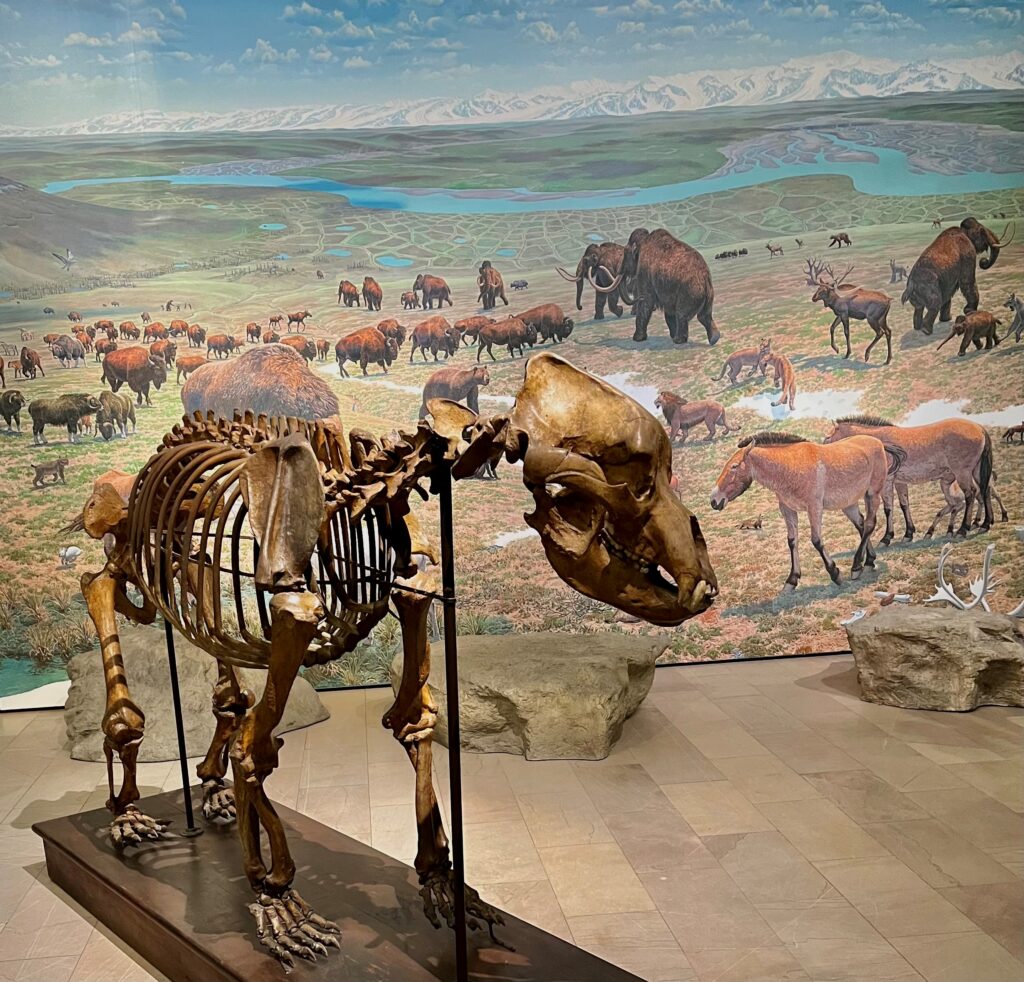
cave bear skeleton mount
In Cenozoic Hall the mounted skeleton of a Cave Bear from France lends perspective to a backing mural of large Ice Age mammals. Many of the museum’s Ice Age fossils were found closer to home, including some from a cave outside Cumberland, Maryland.

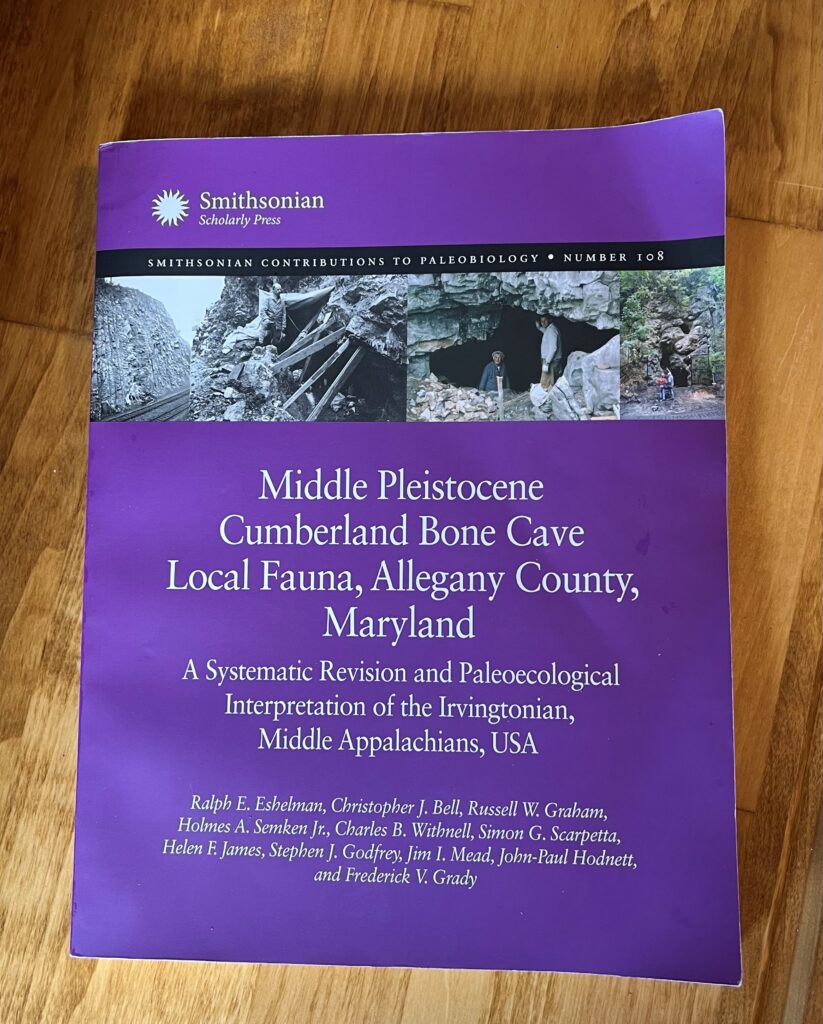
For paleontologists who specialize in interpreting fossil evidence from the Pleistocene, deposits in some Appalachian caves offer windows into the period of the past commonly referred to as the Ice Age. A recent Smithsonian Scholarly Press publication summarizing the discovery, collection, preparation, and interpretation of fossils from a cave in western Maryland strongly supports the window-into-the-past metaphor. The 305-page volume, a product of eleven co-authors, bears the long descriptive title, Middle Pleistocene Cumberland Bone Cave Local Fauna, Allegeny County, Maryland: A Systematic Revision and Paleoecological Interpretation of the Irvingtonian, Middle Appalachians, USA. Remarkably, this chronicle of fossil collecting expeditions mounted by five different organizations over more than a century is dedicated to John Edward Guilday, a Curator at Carnegie Museum of Natural History from 1951 until 1982, and the field crew of museum staff and volunteers who for decades assisted his research efforts.

The collective nature of knowledge presented in the publication makes the dedication particularly appropriate. The fauna list for the site’s vertebrate fossils alone includes 109 creatures ranging in size from mole to mastodon, and the deposition of these remains, over a period of several thousand years, happened more than 700,000 years ago. Deciphering information from such a rich fossil assemblage requires a detailed understanding of other fossil-rich caves, and Guilday’s deep knowledge of findings from sinkholes in Pennsylvania and caves in Tennessee, Kentucky, Virginia, and West Virginia, enabled him to recognize and interpret evidence for such past regional events as range extensions and contractions for various species and repeated changes in climate.

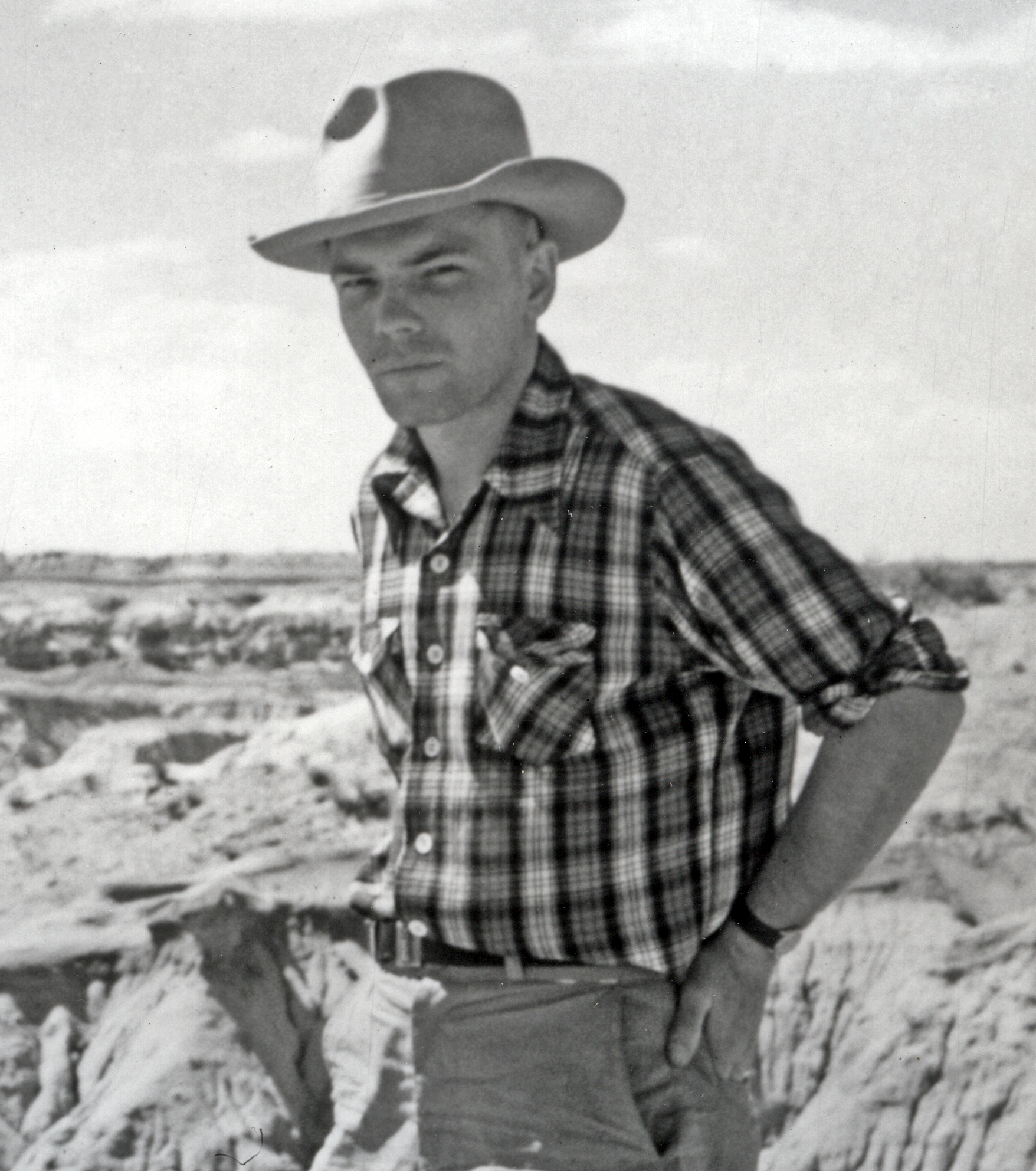
black and white photo of John Guilday
John Edward Guilday in an undated photograph by his wife Alice Guilday.

 The inclusion of the Carnegie Museum field crew in the dedication is particularly apt because Guilday never visited Cumberland Bone Cave or many other sites he studied. His life and career, which included serving in a battle-tested US Army infantry unit during World War II, were immeasurably altered in 1952 when at the age of twenty-seven he contracted polio. The virus tremendously reduced his strength, necessitating the periodic use of an iron lung in his home for the rest of his life. Guilday’s visits to the halls and offices of his established workplace were rare during the next three decades, but with the ceaseless assistance of his wife Alice, the creation of a functional paleo lab in the basement of the couple’s home, and the physical and intellectual contributions of a tireless field crew, he earned a reputation as one of the research strengths of Carnegie Museum of Natural History.

In making a thorough case for the importance of Cumberland Bone Cave to our understanding of past mid-Appalachian environments, the new publication also realistically presents much of the paleontological work at the site as a salvage operation. Little is known with certainty about how the cave, a multi-chambered cavity within a limestone ridge a few miles northwest of Cumberland, was discovered or explored. The story of its recognition as a fossil site is, however, well documented. Beginning in 1910, the Western Maryland Railroad cut a passage for a new line of tracks through the cave-bearing limestone ridge, destroying a significant portion of the subterranean feature. In 1912, when fossilized bone found among excavated rubble was presented to a paleontologist in Washington, D.C. at what is now the National Museum of Natural History, Smithsonian Institution, professional fossil collecting efforts were quickly organized. 

black and white photo of cave entrance
View of cave entrance on the south side of the railroad cut from the north side. Source: 1913 photograph by Raymond William Armbruster, Smithsonian Institution Archives.

A well-illustrated 15-page chapter chronologically profiles the subsequent paleontological investigations of still intact cave chambers, including the intermittent work by a Carnegie Museum of Natural History team between 1964 and 2006. The summary hints at the physical challenges of work in the cave’s tight quarters, notes the cooperation of the railroad company on several occasions when heavy equipment was required for excavation, and emphasizes the current importance of determining exactly where, within this railroad bisected site, particular crews collected fossils. This tally of organized human efforts, along with later chapters listings the fossils collected from the site, raises the very same question that puzzled dozens of investigating paleontologists: How did the remains of such a varied set of ancient creatures come to be deposited in Cumberland Bone Cave?

The author team presents three scenarios. 1) For creatures such as bats, bears, wolves, and peccaries, who used portions of the cave for dens or hibernation chambers, a natural death within their shelter could have eventually led to fossilization. 2) Vertical fissures connecting cave chambers to the ground surface above them functioned as pit traps, occasionally capturing creatures unlikely to otherwise visit the cave. 3) In actions ranging from roosting owls coughing-up pellets of vole bones to wolves bringing larger prey to waiting pups, predators who relied upon the cave for shelter repeatedly brought prey remains into the system.  A fourth scenario, involving bones washed into the cave, was rejected because recovered fossils lack evidence of water wear and sand and gravel are absent in cave matrix. 

The publication’s clarity in explaining ancient deposition and other complex puzzles related to Cumberland Bone Cave will hopefully serve an audience outside Pleistocene Paleontology. The physical labor, disciplined thought, and wide sharing of information outlined in the narrative and referenced in a 23-page biography, make the work a landmark example for any teacher or student interested in the methods of science. Fortunately, the publication is widely available. Copies can be electronically downloaded for free from Smithsonian Institution Scholarly Press.

cover of a book about Cumberland Bone Cave

Cumberland Bone Cave is no longer an active research site, but the fenced entrance of its main entrance draws the attention of bicyclists passing near the four-mile mark of the 150-mile Great Allegheny Passage trail. 

Pat McShea is Educator Emeritus at Carnegie Museum of Natural History.
Related Content

Hunting for Fossil Frogs in Wyoming

Type Specimens: What are they and why are they important?

Uprooted: Inside the Museum’s New Exhibition on Invasive Plants

Published November 12, 2025

Filed Under: Blog Tagged With: fossils, paleontology, Pat McShea, Science News

October 17, 2025 by Erin Southerland

Hopping Into the Bornean Rainforest

by Rohan Mandayam

As an aspiring field biologist, I long harbored several dreams that I hoped would come to fruition sometime in my post-undergraduate career. Among those goals was conducting research on frogs, which have fascinated me since a young age. I also dreamt of working in the field and studying tropical ecosystems, as the biodiversity found in the tropics is rivaled by no other region on Earth. Imagine my delight when I discovered that I would be spending two months in Borneo as a research assistant to Dr. Jennifer Sheridan, Carnegie Museum of Natural History’s Curator of Amphibians and Reptiles, studying frogs in tropical rainforest streams. June couldn’t arrive fast enough.

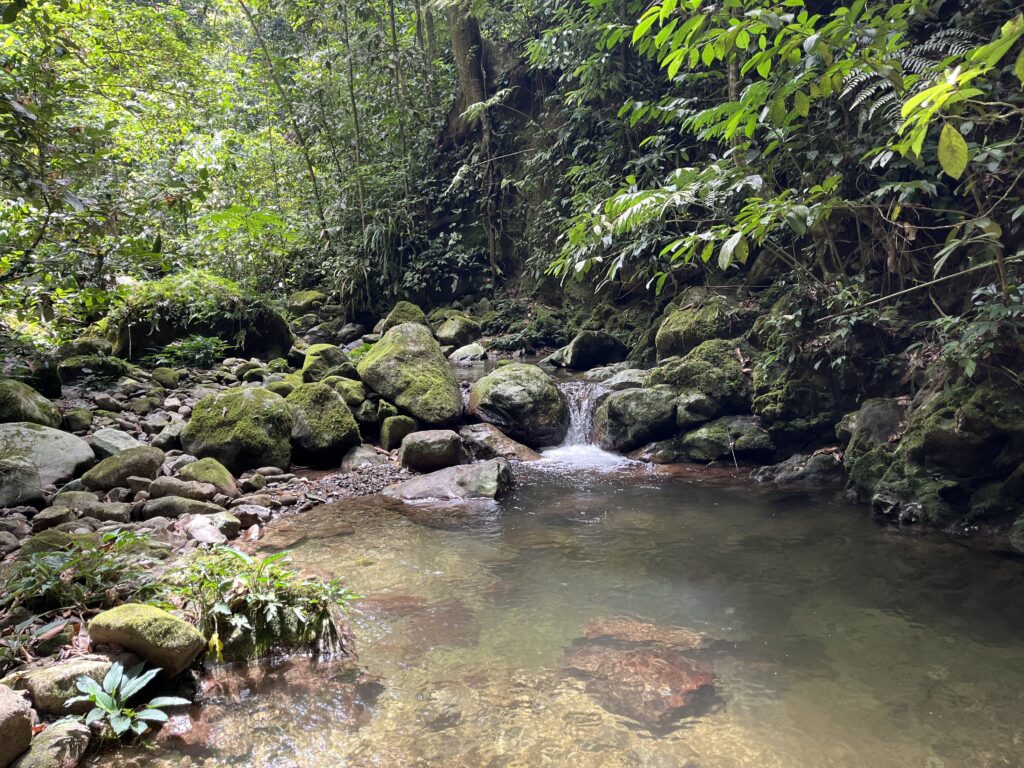
lush, rocky stream
One of our primary forest study streams, located in Ranau, Sabah, Malaysia.

The rainforests of Borneo are among the oldest in the world, known for their staggering concentration of biodiversity across species groups. With dipterocarp trees stretching over 80 meters into the canopy, orangutans rustling through the foliage, and crystal-clear streams rushing through the understory, my “office” for the summer was quite a sight to behold. Inhabiting those pristine streams and the forests surrounding them are Borneo’s nearly 200 species of frogs. In a region home to hornbills, clouded leopards, and one of the world’s most recognizable great apes, the choice to study small amphibians may not seem intuitive. However, frogs are an excellent study system for answering a wide breadth of biological questions, partly due to their high sensitivity to fluctuations in environmental conditions. Due to that sensitivity, studying frogs provides scientists with insights into the impacts of human-caused climate change and other anthropogenic factors on global ecosystems. Furthermore, amphibians remain the vertebrate group most threatened with extinction, and understanding amphibian ecology is critical to ensuring the conservation of those species into the future.

Our research this summer had two main focal areas. The first involved surveying frog populations in streams in different land-use types: primary forest, secondary forest, and agricultural land. We conducted visual encounter surveys of streams in each of those land-use types, noting each individual frog we saw and capturing it if possible. Carefully capturing the individuals allowed us to mark the frog (to establish whether we were recapturing individuals in subsequent surveys) and determine the sex, snout-vent length, and mass before releasing them. Repeated surveys on each of our study streams provided us with insight into the species richness and abundance of each frog community and enabled us to compare potential differences in our study variables across land-use types. 

The surveys presented several enjoyable learning curves. We identified all frog species we found using their scientific names, so I had to learn taxonomy for the first time, butchering many Latin pronunciations along the way. I also learned to use specific features of an individual frog, including toe pads, hand and foot webbing, and parotid gland shape, to distinguish between easily confused species. Through experience, I began to recognize where certain species preferred to sit or perch, which ranged from the rocky shoreline to branches several meters above the water. And, through many ill-fated attempts to capture the more jumpy members of the anuran (frog) community, I realized which frogs merited a more slow and cautious approach before diving in to grab them.

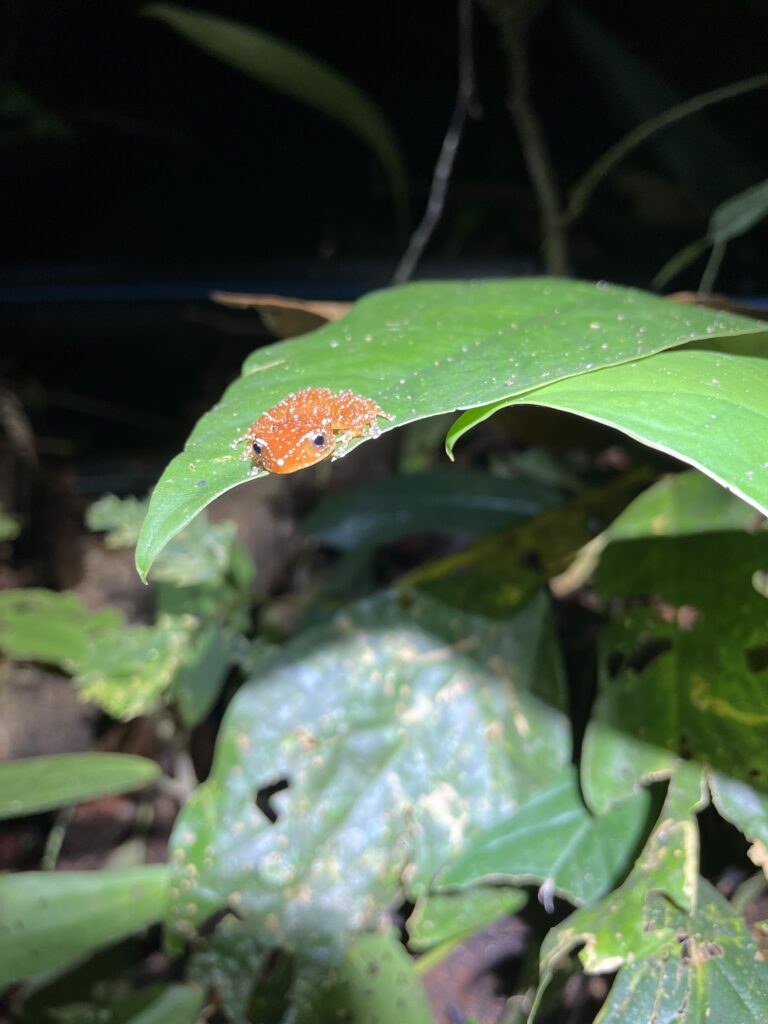
small orange frog on a large green leaf
The cinnamon tree frog (Nyctixalus pictus) is one of the most strikingly colored frogs in Borneo.

Our second research focus for this summer was to record as many frog calls as we could from each of our study streams. While we hope to use these recordings to analyze potential differences in frog calling behaviors across land-use types, this work also contributed to the larger purpose of growing the existing library of frog calls that exists for the island of Borneo. An eventual goal of Dr. Sheridan’s is to use call recordings to train AI models to identify which frogs are calling in a given “soundscape,” or audio recording, taken from a natural space. This would allow researchers to gauge the diversity of frog populations in a given region without having to perform intensive survey work, saving time and resources in the urgent quest to quantify amphibian biodiversity.

Call recording nights also provided numerous opportunities for me to practice the virtue of patience. There are few better lessons in biding your time than staring directly into the eyes of a frog that immediately ceased to call when the recorder was switched on but had been chirping away mere seconds before. On one memorable night, I sat next to a giant river toad (Phrynoidis juxtasper) for over half an hour as we enjoyed a peaceful and resolutely call-free silence. Fortunately, I managed to record numerous more cooperative individuals during my time in the field.

The final facet of our field work involved collecting a limited number of the frogs we encountered at our study streams. These frogs were anesthetized and prepared as specimens to be taken to either the Carnegie Museum of Natural History or to Sabah Parks, one of our local collaborators. Removing animals from the wild and putting them down definitely weighed on me, and I never took that work lightly. However, there are several reasons for collecting frogs in this manner. Collections-based research on frog body size (one of the most important features of a biological organism), specifically regarding whether the body size of a given species has changed over time, is only possible via analysis of preserved specimens of that species spanning a long time scale. Dr. Sheridan recently collaborated on a study that used museum specimens of the Fowler’s toad (Anaxyrus fowleri) to demonstrate that increases in precipitation and temperature between 1931 and 1998 were associated with decreased A. fowleri body size, an important finding given the drastic climatic changes that continue to occur globally today. In addition to its research value, collection allows scientists to document, for posterity, a small portion of the life on Earth from a given spatial and temporal location. This record has the potential to be used to answer future biological questions that we don’t even know to ask yet!

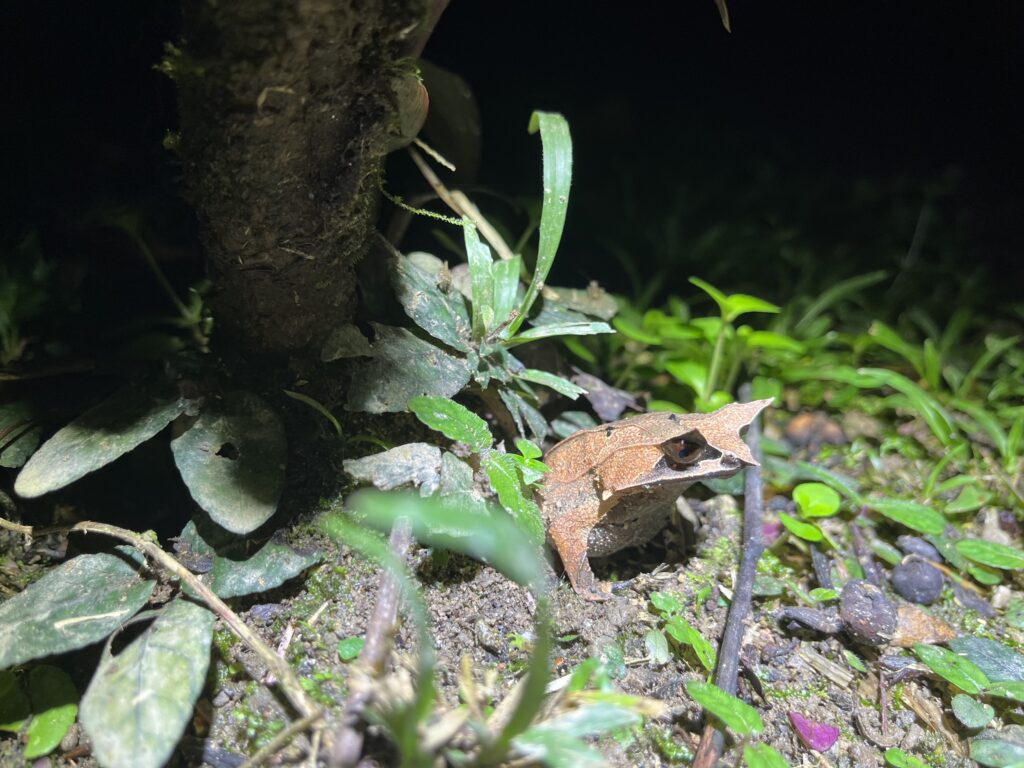
horned frog in a lush green environment
A juvenile Bornean horned frog (Megophrys nasuta). Horned frogs are easily recognizable by the flaps of skin (“horns”) protruding above their eyes.

My time working with our amazing team has sadly ended, but the field season will continue for several more weeks as my colleagues wrap up surveys and call recording in our third study region. It is impossible for me to reflect on those months without feeling incredibly grateful for the opportunity to participate in this project. There were so many small moments of joy: my teammate capturing a frog perched on an out-of-reach branch using only a five-meter bamboo stick and gentle coaxing; negotiating stream access with a village leader for two days, only to humorously realize we had a miscommunication about which body of water we actually wished to study; realizing that I had crossed the threshold of seeing over 50 species of frogs in my time in Borneo. Even after two months in the field, I continued to observe fauna I hadn’t seen previously, from river otters to trogons to enormous stick insects. The sheer wonder of experiencing such incredible natural spaces has reaffirmed my goal of ensuring their protection into the future. With Southeast Asia possessing the highest deforestation rates of anywhere in the world, it is more critical than ever to understand the biodiversity that we as conservationists seek to protect. This field season may be coming to a close, but the work is far from over.

Rohan Mandayam was a research assistant on Dr. Jennifer Sheridan‘s field team in Borneo, Malaysia.

Related Content

The Enduring Appeal of Snakes

Nerding Out Over Masting, or Why Unusual Plant Reproduction Excites Animal Ecologists

Field Time in Borneo

Published October 17, 2025

Filed Under: Blog Tagged With: amphibians and reptiles, Rohan Mandayam

August 25, 2025 by Erin Southerland

Uprooted: Inside the Museum’s New Exhibition on Invasive Plants

by Patrick McShea
museum label comparing grains of rice to seeds
An Uprooted display compares seed production differences between native and invasive plants.

Plants travel across time and territory as seeds. The movement of seeds, each one a tiny embryo packaged with stored food in a protective coating, can generally be attributed to one of five forces – gravity, wind, flowing water, spring-like ejection from the parent plant, or transport by animals, whether deliberately or accidentally. 

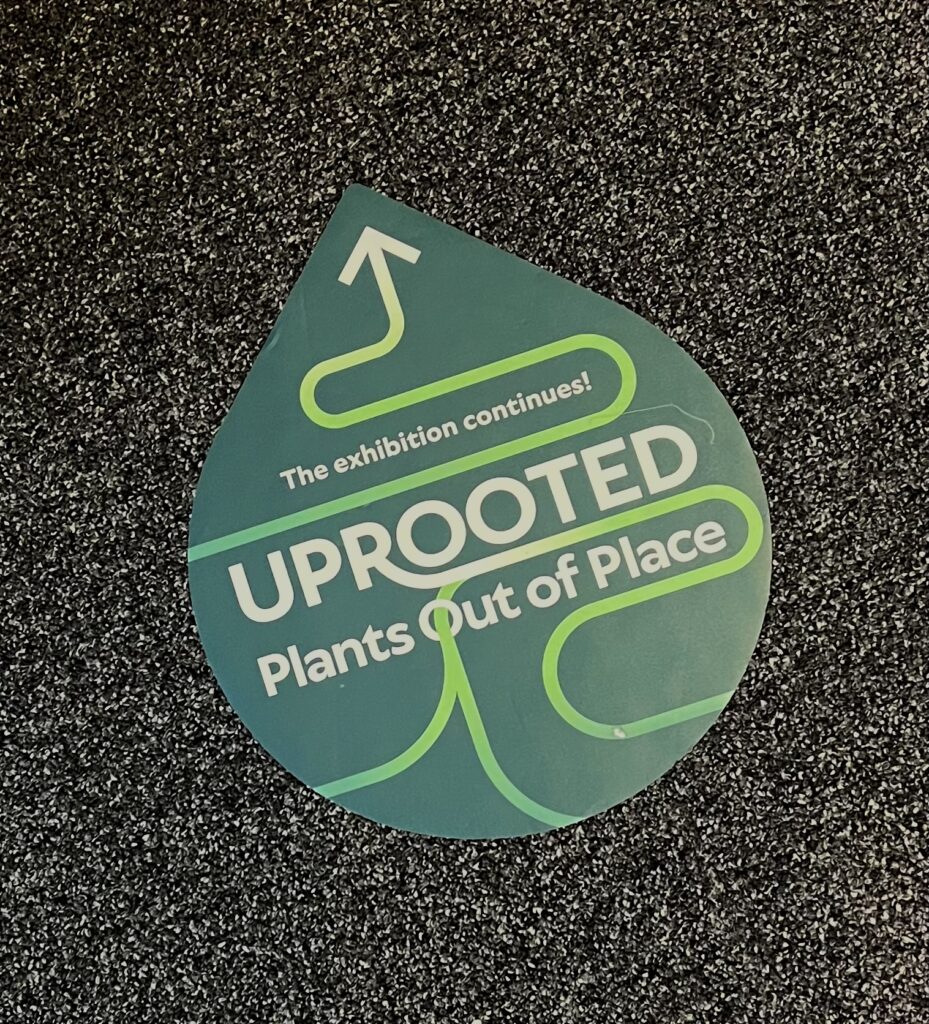
In Uprooted: Plants Out of Place, the new exhibition examining invasive plants from multiple perspectives, seed dispersal by humans, a subset of the fifth force, receives attention for its landscape altering impact. The exhibition occupies two sites within the museum, the Hall of Botany, and the third-floor balcony above Kamin Hall of Dinosaurs. In between, floor-mounted exhibition emblems serve as wayfinding guides between the sites. Visitors who follow these raindrop-shaped directional aids should consider the short walk and elevator ride or stair climb to represent the frequently unnoticed journeys by a whole category of organisms we mistakenly consider to be rooted and immobile.

Uprooted exhibition logo on carpet
The Uprooted emblem guides visitors between the exhibition’s two locations.

Just inside the entry to the Hall of Botany, an exhibition panel for Uprooted provides a definition of “native” that is crucial to understanding issues related to invasive plants. Plants don’t buy houses, but they do have ‘home’ ranges where they have grown for a long period of time. We call plants found in their home ranges native. Visual examples can greatly aid in the comprehension of a new term, and here the surrounding life-sized dioramas depicting plants native to Pennsylvania woodlands, Lake Erie beach margins, Florida swamp land, the Sonoran Desert, and an alpine meadow on Mount Ranier, provide tremendous, and frequently colorful, reinforcement.

On the same panel, below the bold-faced clarification, Passengers, not drivers, visitors are presented with another key definition: Introduced plants that cause harm to the environment or humans around them are called invasive species. Four such invasive species and their attendant problems are profiled in nearby free-standing displays that feature preserved plant material in the form of herbarium sheets, maps documenting invasive plant establishment and rapid expansion, examples of a single plant’s seed production, and explanations of why each was brought, as seed, cuttings, root stock, or whole plant, to our region of the world. Three of the species were deliberately introduced here because of perceived potential benefits. Callery pear (Pyrus calleryana) was introduced because of its beautiful flowers. Multiflora rose (Rosa multiflora) was a favored root stock for grafting and hedgerow creation. Garlic mustard (Alliaria petiolata) was valued as a culinary and medicinal herb. Stiltgrass (Microstegium vimnea), the fourth profiled plant, was introduced accidentally during an early 20th Century period when large quantities of the whole plant, including seedheads, served as disposable protective packaging for porcelain shipped from Asia.

Uprooted label on diorama glass

In sharing the stiltgrass story in the Hall of Botany, Uprooted makes powerful use of the unique space. On the left edge of the diorama that has depicted early summer beneath the canopy of a mature hemlock/northern hardwood forest for over 50 years, visitors will find a suggestion for a scene altering exercise. Imagine stiltgrass growing in this forest for several years – what would it look like? Would it be very different from what you see now? Because the information below this thought prompt notes the tendency of stiltgrass to choke out wildflowers and tree seedlings by forming dense mats, an initial mental alteration of the diorama scene might simply involve a drastic change in the look of the forest floor. However, for visitors who first study details in the meticulously recreated landscape and notice such details as the ovenbird standing just in front of its distinctive domed nest (lower right front corner), the sense of loss will be compounded. 

ovenbird in a diorama

A more hopeful and action-oriented approach awaits visitors on the third-floor balcony section of Uprooted. Here a video loop briefly introduces people from three local organizations working to mitigate the negative impacts of invasive plants, an interactive panel guides visitors to make informed purchases from plant nurseries, and an array of plant portraits by Japanese photographer Koichi Watanabe summarizes his study of conflicting cultural perspectives surrounding the plant known to science as Reynoutria japonica and locally termed Japanese knotweed. In the text panel explaining his approach, Watanabe provides a quote that is a fitting summary for this innovative exhibition: When people move, plants move with them.

Patrick McShea is Educator Emeritus at Carnegie Museum of Natural History.
Related Content

What’s in a Name? Japanese Knotweed or Itadori

City Nature Challenge: Noticing Invasive Plants

Collected On This Day: Callery Pear from October 11, 1979

Filed Under: Blog Tagged With: Pat McShea, Science News, Uprooted

June 30, 2025 by Erin Southerland

A Year in Review: Bird Banding 2024

by Annie Lindsay

During the 2024 calendar year, we operated Powdermill Avian Research Center’s (PARC) bird banding station for 184 days across all four seasons, during which we banded 9,415 new birds, processed 4,581 recaptured individuals, and released 9 birds unbanded. These 14,005 birds represented 125 species, one of which was new to Powdermill’s banding dataset. 

The banding station at PARC has been running year-round since June 1961 and has accumulated over 850,000 banding records of nearly 200 species, so a new species for the station is a relatively rare event. But let’s not get ahead of ourselves and spoil the surprise, which happened near the end of 2024.

At Powdermill, we band birds year-round, which is somewhat unique among banding stations. We increase our effort during the spring and fall migration seasons and band fewer days each week during the breeding season and winter. This helps us track seasonal events like arrival and departure timing of migratory species, onset of breeding activities, relative abundance of different species, site fidelity (whether individuals come back to the same breeding or wintering areas every year), and longevity. Banding year round also allows us to observe the seasonal progression of birds from familiar to fancy and back again. 

Each year, there are species or events that cause excitement among the banding crew. Some of them might be species that are uncommonly caught at Powdermill or difficult to see in the wild, some might be individuals that are earlier or later in the season than expected, some might be favorite species that we never tire of seeing, and some might be days with unusually high capture rates or big days. As each year comes to a close, we reflect on the highlights and compile a list of our favorite moments, of which 2024 had an abundance.

The first highlight of 2024 was a Red-shouldered Hawk that we caught and banded on January 24. A species that is a little too big for our songbird-size mist nets, raptors and other large birds generally bounce right out of the nets. This bird was holding on to a trammel line with its talons which gave the bander a split-second advantage. A species that seems to be expanding its range northward, Red-shouldereds can be found in southwest Pennsylvania year-round, although this is only the 6th ever banded at Powdermill.

As winter waned and we prepared for the spring migration season, we caught an unexpectedly early Gray Catbird on March 27, setting a record for the earliest catbird banded at Powdermill (the previous earliest banding record was on April 19). Spring progressed relatively normally until May 9 when we caught Powdermill’s ninth ever Swainson’s Warbler. This is a species that has historically bred in the southeastern part of the US but was confirmed as a breeding species in Pennsylvania (at Bear Run Nature Reserve just 30 minutes south of Powdermill) for the first time in the summer of 2023. These breeding records may represent a northward range shift for this species. 

The spring migration banding season ends at Powdermill at the end of May, but we continue to band, with reduced effort, through the summer. On June 7, we caught a Tennessee Warbler, a species that migrates annually between breeding sites across much of Canada and wintering grounds in the Caribbean, Central America, and northern South America. They are commonly found at Powdermill during the migration seasons when they stop over to rest and refuel between flights. Nearly all Tennessee Warblers have moved north of us by the end of May, making our June 7 capture the second latest spring record for this species in our dataset. There was something a bit unusual about this individual: it was molting feathers that suggested that it was undergoing the post-breeding molt, something that happens before, or sometimes during, the early stages of fall migration. Although there wasn’t time for this bird to have attempted breeding, perhaps something caused this individual to turn around and head south, representing the earliest (by more than a month!) fall migrant Tennessee Warbler in our dataset. 

Summer progressed relatively normally, but the lack of rain began to become noticeable as streams became trickles and small ponds dried up. By July each year, we begin to catch birds in their post-fledging period and our capture numbers increase, but we were not expecting to have one of the biggest summer banding days in our 63-year history when we caught 153 birds on July 17. For context, we were operating about 1/3 of the nets that we run during migration and had to close the nets early due to heat, so the 153-bird day was quite impressive and our third highest summer banding total. This was the beginning of a severe drought that gripped our region through much of the second half of the year, and the ponds near PARC held some of the only locally available drinking water for breeding and migrating birds. We suspect this concentrated birds in the banding area and increased capture rate in late summer and throughout fall.

The fall migration banding season begins in August as the current year’s fledglings begin to disperse and the first migrants begin to move south. Following the trend of a higher-than-usual concentration of birds in the banding area, we had several species with above average captures and two that broke the single-day high totals. On August 16, we caught 11 Blackburnian Warblers and on September 3 we caught 35 Ruby-throated Hummingbirds. Both species breed locally, but we catch the majority of individuals during the post-breeding and fall migration season.

The second half of September and the first half of October is the busiest part of the banding year, and interesting captures came in rapid succession during that period in 2024. Soras are a species of rail, a secretive marsh bird that is usually difficult to see, and that we average fewer than one capture per year. We caught a Sora on September 21 and a second one on September 24 – these were #22 and #23 in our dataset, and only once before did we catch two in one season.

Sora
Sora banded at PARC.

September 24 held the banding crew’s biggest highlight of the year: a Kirtland’s Warbler. Kirtland’s Warblers are one of the rarest species of wood warblers in North America – it was critically endangered with a population of about 167 pairs in the 1970s-80s. It is an Endangered Species Act success story: with habitat management and control of brood parasites, the species recovered to a healthy population of ~4,500-5,000 birds and was delisted in 2019. Although it’s not an abundant species, given its migratory route between breeding grounds in Michigan and wintering grounds in the Bahamas, we knew it was just a matter of time before one was spotted in southwest Pennsylvania. Remarkably, this was not the first Kirtland’s Warbler caught at Powdermill: one was banded on September 21, 1971 when the population was at its low point.

Kirtland's Warbler
Kirtland’s Warbler

Over the years, a few possible Bicknell’s Thrushes were banded at Powdermill, but it wasn’t until 2023 that two were definitively identified here. They’re difficult to identify because they look very similar to Gray-cheeked Thrush, but average a bit smaller and more reddish in color. On September 27, we caught and banded another, this one noticeably reddish and falling well within Bicknell’s measurements. Gray-cheeked and Bicknell’s Thrushes were considered the same species until 1995, when there was enough evidence (based on morphology, vocalizations, habitat, and migration patterns) to elevate Bicknell’s Thrush to full species status.

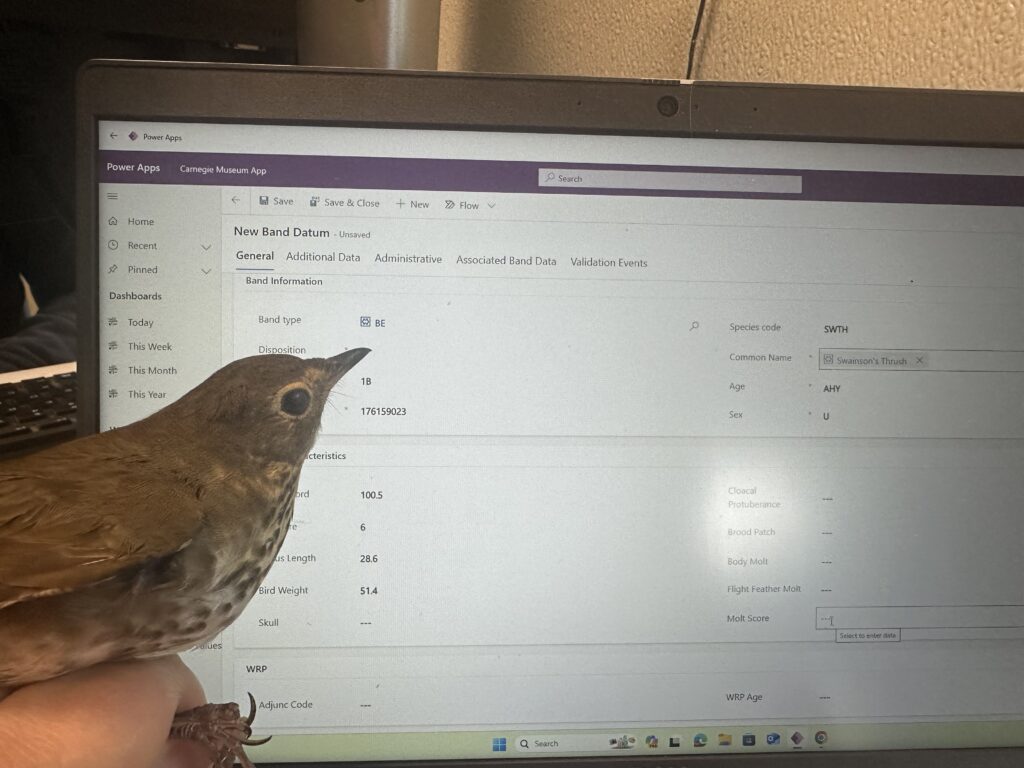
Fall migration would not be complete without a fat bird highlight. During the migration seasons, migratory songbirds increase their food intake so that they can deposit fat reserves that they use as a source of energy to fuel their overnight flights. Songbirds flap their wings continuously while they fly, so they require a lot of energy to accomplish their migrations. A Swainson’s Thrush that we caught on September 27 had accumulated impressive fat deposits, weighing in at 51.4 grams. Powdermill’s dataset contains over 17,000 Swainson’s Thrushes and only three have been heavier than this bird. A fat bird is a bird that is well prepared for migration!

Swainson’s Thrush with its banding data.

Old birds are interesting captures, and a Wilson’s Snipe that we caught on October 11 was just that. This individual was banded in 2019 and aged as a bird that hatched at least in 2017, if not earlier. Not only is this a notably old bird, but it had been recaptured three other times at Powdermill, providing us a peek into its life.

The fall migration banding season began to wane as October progressed, and our seasonal field techs’ last day was November 2.  But the surprises hadn’t stopped yet! In the morning, we caught an unusual Empidonax flycatcher (Empidonax is the genus of flycatchers that tend to pose identification challenges) – it was quite yellow on its underparts and the face proportions were not quite right for any of the species expected in the east. Further, an Empidonax flycatcher in southwest Pennsylvania this late in the year would be exceptionally rare. After a series of diagnostic measurements done independently by three of the banders on staff, we determined that this individual was a Western Flycatcher, a species found in the western part of the continent from the Rocky Mountains west to the Pacific Coast, and a species never before banded at Powdermill.

western flycatcher
Western Flycatcher

Later that evening, we set up nets to catch owls for Powdermill’s public Owling at the Moon event. Using audio lures, we attempted to catch Northern Saw-whet Owls and Eastern Screech-Owls. Successfully catching owls is very weather-dependent, and luck was on our side this year. Not only did we catch several individuals of our two target species, but we had a big surprise when we caught a Barred Owl, the second ever caught at Powdermill. The crew was excited to get to study this species in the hand and to share it with Owling at the Moon attendees.

Barred Owl

It was a busy but satisfying year, full of visitors and events, bird banding workshops, and interesting birds, and we look forward to what 2025 will bring!

Annie Lindsay is the Bird Banding Program Manager at Powdermill Nature Reserve, the environmental research center of Carnegie Museum of Natural History.
Read More Science Stories

(De)Forested Flight: An Eagle Scout Project at Powdermill

A Year in Review: Bird Banding 2023

Hummingbird Lessons

Filed Under: Blog Tagged With: Annie Lindsay, bird banding, Powdermill, Powdermill Nature Reserve

June 30, 2025 by Erin Southerland

(De)Forested Flight: An Eagle Scout Project at Powdermill

by Ollie Sparks

The first day I started volunteering as a high school Sophomore, I journeyed deep into the heavy woods of the Rector area, into a small building just off a gravel road with a sign out front that read “Powdermill Avian Research Center.” The light was on in the small, cinder block banding lab, and I could see some people through my breath materializing in front of me. It was close to 5:30 in the morning, something I was unprepared for in the middle of summer vacation. That was the first of many surprises to follow that day. 

As I accompanied the adults through net routes, watching them untangle birds caught in nets as easily as a practiced Rubix solver would twist a cube, I was amazed by the colors and sounds with each new bird. Some of these birds I recognized just from looking out my window: robins, blue jays, cardinals, and sparrows all made up the cast, but then came the birds I had never seen or heard of before, like an Ovenbird or a Northern Waterthrush. 

Once we returned to the research station, the building where my day’s journey began, each of the cotton bags containing a bird were clipped to a pulley system by a multitude of colored carabiners, and one by one they emerged from their bags, held safely and securely in the bander’s grip. My job was to record the bird’s data; important marks like wing length, age, sex, weight, species, and band size all went into the program. Afterward, the banders sent the birds on their way by releasing them out of a nearby window. It was such a quick system, necessary because of how many birds the banding team would bring in each day. 

Bird banding was not at all what I expected it to be, but there was something so enlightening about waking up, going to work like a responsible adult, and getting to spend my morning being in the wonderful outdoors. As a Boy Scout I had intermediate experience with campouts and tips for using the wilderness as a support for my life, so being immersed in it for extended periods of time while also getting to volunteer for important research really opened my eyes to a bigger world. I felt responsible for contributing, and respectful of my outdoor experiences. 

Over the next few years, I continued volunteering at Powdermill Avian Research Center (PARC), finding new birds and recording new kinds of data. This focus on wildlife, the experiences, and sense of adventure nudged me slowly toward the best decision I had ever made in my time working at Powdermill: asking to provide my Eagle Scout Project, titled “(De)Forested Flight,” to PARC. (De)Forested Flight aimed to clear overgrown vegetation around the net routes and provide nesting sites for local breeding birds. 

Ollie Sparks with his Eagle Scout project

During the summer months, the vegetation around the mist nets grows quickly, and sometimes higher than the nets, which can decrease capture rate. The banding crew maintains the habitat in the banding area so that it is consistent year after year, but timing is important: major vegetation trimming needs to happen before the birds’ breeding season to avoid the risk of destroying nests. It’s a big job and the crew needs a lot of help, so I organized a day for my BSA Troop to go to PARC and help cut vegetation in coordinated areas.

For the most impactful part of my Eagle project, I researched what cavity-nesting species breed at Powdermill and assembled 22 bird boxes for five species: Wood Ducks, Eastern Bluebirds, Eastern Screech Owls, Black-capped Chickadees, and Tree Swallows, and enlisted the help of the Troop to help hang them in appropriate habitat.

On April 15, 2025, Powdermill Nature Reserve hosted an Eagle Scout Ceremony for the completion of (De)Forested Flight. I handed out special awards to all the amazing members who attended the Ceremony, followed by an emotional speech about the incredible mentors and role models who helped shape my journey as I advanced from Scout all the way up through Eagle, my wonderful family, and my own Troop 372 for their help and devotion to my Eagle Project. Earlier that same day, the banding crew spotted an Eastern Bluebird visiting one of the nest boxes I hung up the previous summer as part of my Eagle project.

As I look back on completing my Eagle Project, I’m reminded of how important it is to get out and keep trying new things. I was extremely grateful for all the welcoming and acceptance the staff at PARC gave me, and my Eagle Project felt like a fitting way of giving back to the community I had become a part of. 

Ollie Sparks is a volunteer at Powdermill Avian Research Center and an Eagle Scout.

Read More Science Stories

A Year in Review: Bird Banding 2024

A Summer Internship at Powdermill

Hummingbird Lessons

Filed Under: Blog Tagged With: Ollie Sparks, Powdermill, Powdermill Nature Reserve

  • Page 1
  • Page 2
  • Page 3
  • Interim pages omitted …
  • Page 24
  • Go to Next Page »

sidebar

About

  • Mission & Commitments
  • Directors Team
  • Museum History

Get Involved

  • Volunteer
  • Membership
  • Carnegie Discoverers
  • Donate
  • Employment
  • Events

Bring a Group

  • Groups of 10 or More
  • Birthday Parties at the Museum
  • Field Trips

Powdermill

  • Powdermill Nature Reserve
  • Powdermill Field Trips
  • Powdermill Staff
  • Research at Powdermill

More Information

  • Image Permission Requests
  • Science Stories
  • Accessibility
  • Shopping Cart
  • Contact
  • Visitor Policies
One of the Four Carnegie Museums | © Carnegie Institute | Privacy Policy | Terms of Use | Accessibility
Rad works here logo