• Skip to primary navigation
  • Skip to main content
  • Skip to primary sidebar

Carnegie Museum of Natural History

One of the Four Carnegie Museums of Pittsburgh

  • Visit
    • Buy Tickets
    • Visitor Information
    • Exhibitions
    • Events
    • Dining at the Museum
    • Celebrate at the Museum
    • Powdermill Nature Reserve
    • Event Venue Rental
    • Gift Cards
  • Learn
    • Field Trips
    • Educator Information
    • Programs at the Museum
    • Bring the Museum to You
    • Guided Programs FAQ
    • Programs Online
    • Climate and Rural Systems Partnership
  • Research
    • Scientific Sections
    • Science Stories
    • Science Videos
    • Senior Science & Research Staff
    • Museum Library
    • Science Seminars
    • Scientific Publications
    • Specimen and Artifact Identification
  • About
    • Mission & Commitments
    • Directors Team
    • Museum History
  • Tickets
  • Give
  • Shop

Erin Southerland

August 25, 2025 by Erin Southerland

Uprooted: Inside the Museum’s New Exhibition on Invasive Plants

by Patrick McShea
museum label comparing grains of rice to seeds
An Uprooted display compares seed production differences between native and invasive plants.

Plants travel across time and territory as seeds. The movement of seeds, each one a tiny embryo packaged with stored food in a protective coating, can generally be attributed to one of five forces – gravity, wind, flowing water, spring-like ejection from the parent plant, or transport by animals, whether deliberately or accidentally. 

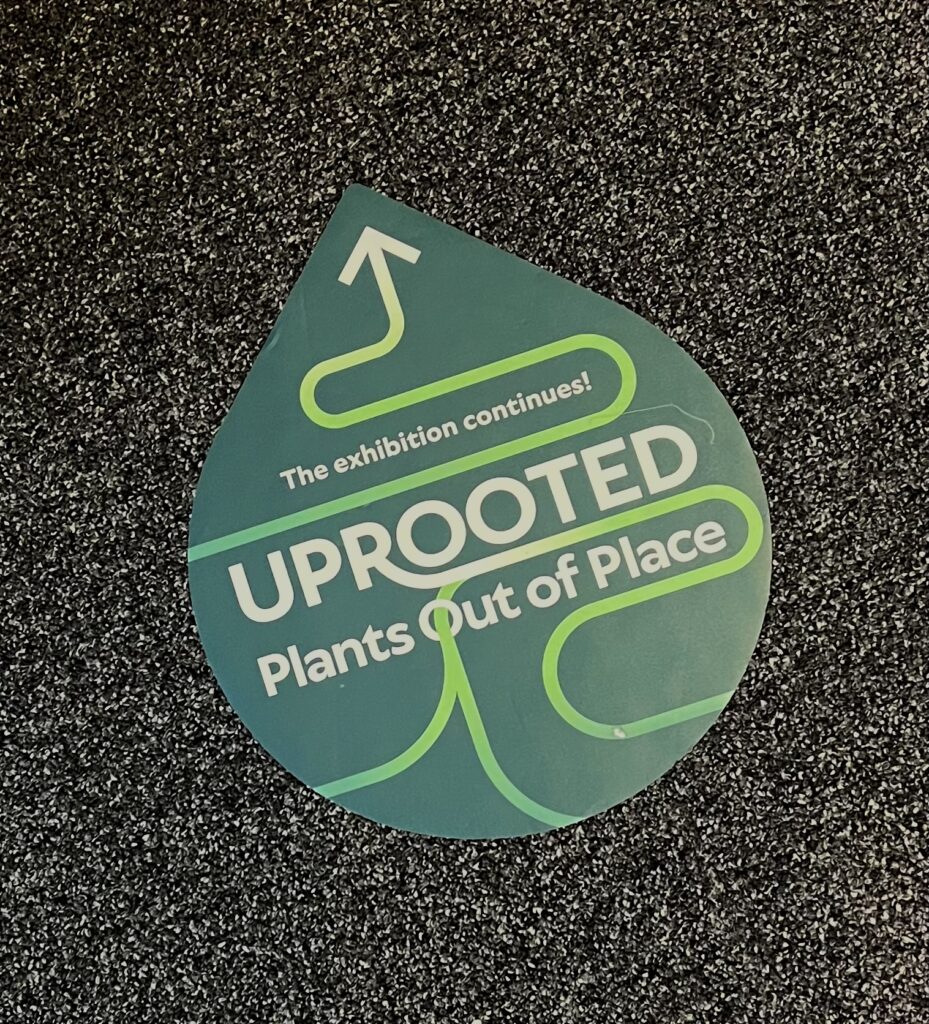
In Uprooted: Plants Out of Place, the new exhibition examining invasive plants from multiple perspectives, seed dispersal by humans, a subset of the fifth force, receives attention for its landscape altering impact. The exhibition occupies two sites within the museum, the Hall of Botany, and the third-floor balcony above Kamin Hall of Dinosaurs. In between, floor-mounted exhibition emblems serve as wayfinding guides between the sites. Visitors who follow these raindrop-shaped directional aids should consider the short walk and elevator ride or stair climb to represent the frequently unnoticed journeys by a whole category of organisms we mistakenly consider to be rooted and immobile.

Uprooted exhibition logo on carpet
The Uprooted emblem guides visitors between the exhibition’s two locations.

Just inside the entry to the Hall of Botany, an exhibition panel for Uprooted provides a definition of “native” that is crucial to understanding issues related to invasive plants. Plants don’t buy houses, but they do have ‘home’ ranges where they have grown for a long period of time. We call plants found in their home ranges native. Visual examples can greatly aid in the comprehension of a new term, and here the surrounding life-sized dioramas depicting plants native to Pennsylvania woodlands, Lake Erie beach margins, Florida swamp land, the Sonoran Desert, and an alpine meadow on Mount Ranier, provide tremendous, and frequently colorful, reinforcement.

On the same panel, below the bold-faced clarification, Passengers, not drivers, visitors are presented with another key definition: Introduced plants that cause harm to the environment or humans around them are called invasive species. Four such invasive species and their attendant problems are profiled in nearby free-standing displays that feature preserved plant material in the form of herbarium sheets, maps documenting invasive plant establishment and rapid expansion, examples of a single plant’s seed production, and explanations of why each was brought, as seed, cuttings, root stock, or whole plant, to our region of the world. Three of the species were deliberately introduced here because of perceived potential benefits. Callery pear (Pyrus calleryana) was introduced because of its beautiful flowers. Multiflora rose (Rosa multiflora) was a favored root stock for grafting and hedgerow creation. Garlic mustard (Alliaria petiolata) was valued as a culinary and medicinal herb. Stiltgrass (Microstegium vimnea), the fourth profiled plant, was introduced accidentally during an early 20th Century period when large quantities of the whole plant, including seedheads, served as disposable protective packaging for porcelain shipped from Asia.

Uprooted label on diorama glass

In sharing the stiltgrass story in the Hall of Botany, Uprooted makes powerful use of the unique space. On the left edge of the diorama that has depicted early summer beneath the canopy of a mature hemlock/northern hardwood forest for over 50 years, visitors will find a suggestion for a scene altering exercise. Imagine stiltgrass growing in this forest for several years – what would it look like? Would it be very different from what you see now? Because the information below this thought prompt notes the tendency of stiltgrass to choke out wildflowers and tree seedlings by forming dense mats, an initial mental alteration of the diorama scene might simply involve a drastic change in the look of the forest floor. However, for visitors who first study details in the meticulously recreated landscape and notice such details as the ovenbird standing just in front of its distinctive domed nest (lower right front corner), the sense of loss will be compounded. 

ovenbird in a diorama

A more hopeful and action-oriented approach awaits visitors on the third-floor balcony section of Uprooted. Here a video loop briefly introduces people from three local organizations working to mitigate the negative impacts of invasive plants, an interactive panel guides visitors to make informed purchases from plant nurseries, and an array of plant portraits by Japanese photographer Koichi Watanabe summarizes his study of conflicting cultural perspectives surrounding the plant known to science as Reynoutria japonica and locally termed Japanese knotweed. In the text panel explaining his approach, Watanabe provides a quote that is a fitting summary for this innovative exhibition: When people move, plants move with them.

Patrick McShea is Educator Emeritus at Carnegie Museum of Natural History.

Related Content

What’s in a Name? Japanese Knotweed or Itadori

City Nature Challenge: Noticing Invasive Plants

Collected On This Day: Callery Pear from October 11, 1979

Filed Under: Blog Tagged With: Pat McShea, Science News, Uprooted

June 30, 2025 by Erin Southerland

A Year in Review: Bird Banding 2024

by Annie Lindsay

During the 2024 calendar year, we operated Powdermill Avian Research Center’s (PARC) bird banding station for 184 days across all four seasons, during which we banded 9,415 new birds, processed 4,581 recaptured individuals, and released 9 birds unbanded. These 14,005 birds represented 125 species, one of which was new to Powdermill’s banding dataset. 

The banding station at PARC has been running year-round since June 1961 and has accumulated over 850,000 banding records of nearly 200 species, so a new species for the station is a relatively rare event. But let’s not get ahead of ourselves and spoil the surprise, which happened near the end of 2024.

At Powdermill, we band birds year-round, which is somewhat unique among banding stations. We increase our effort during the spring and fall migration seasons and band fewer days each week during the breeding season and winter. This helps us track seasonal events like arrival and departure timing of migratory species, onset of breeding activities, relative abundance of different species, site fidelity (whether individuals come back to the same breeding or wintering areas every year), and longevity. Banding year round also allows us to observe the seasonal progression of birds from familiar to fancy and back again. 

Each year, there are species or events that cause excitement among the banding crew. Some of them might be species that are uncommonly caught at Powdermill or difficult to see in the wild, some might be individuals that are earlier or later in the season than expected, some might be favorite species that we never tire of seeing, and some might be days with unusually high capture rates or big days. As each year comes to a close, we reflect on the highlights and compile a list of our favorite moments, of which 2024 had an abundance.

The first highlight of 2024 was a Red-shouldered Hawk that we caught and banded on January 24. A species that is a little too big for our songbird-size mist nets, raptors and other large birds generally bounce right out of the nets. This bird was holding on to a trammel line with its talons which gave the bander a split-second advantage. A species that seems to be expanding its range northward, Red-shouldereds can be found in southwest Pennsylvania year-round, although this is only the 6th ever banded at Powdermill.

As winter waned and we prepared for the spring migration season, we caught an unexpectedly early Gray Catbird on March 27, setting a record for the earliest catbird banded at Powdermill (the previous earliest banding record was on April 19). Spring progressed relatively normally until May 9 when we caught Powdermill’s ninth ever Swainson’s Warbler. This is a species that has historically bred in the southeastern part of the US but was confirmed as a breeding species in Pennsylvania (at Bear Run Nature Reserve just 30 minutes south of Powdermill) for the first time in the summer of 2023. These breeding records may represent a northward range shift for this species. 

The spring migration banding season ends at Powdermill at the end of May, but we continue to band, with reduced effort, through the summer. On June 7, we caught a Tennessee Warbler, a species that migrates annually between breeding sites across much of Canada and wintering grounds in the Caribbean, Central America, and northern South America. They are commonly found at Powdermill during the migration seasons when they stop over to rest and refuel between flights. Nearly all Tennessee Warblers have moved north of us by the end of May, making our June 7 capture the second latest spring record for this species in our dataset. There was something a bit unusual about this individual: it was molting feathers that suggested that it was undergoing the post-breeding molt, something that happens before, or sometimes during, the early stages of fall migration. Although there wasn’t time for this bird to have attempted breeding, perhaps something caused this individual to turn around and head south, representing the earliest (by more than a month!) fall migrant Tennessee Warbler in our dataset. 

Summer progressed relatively normally, but the lack of rain began to become noticeable as streams became trickles and small ponds dried up. By July each year, we begin to catch birds in their post-fledging period and our capture numbers increase, but we were not expecting to have one of the biggest summer banding days in our 63-year history when we caught 153 birds on July 17. For context, we were operating about 1/3 of the nets that we run during migration and had to close the nets early due to heat, so the 153-bird day was quite impressive and our third highest summer banding total. This was the beginning of a severe drought that gripped our region through much of the second half of the year, and the ponds near PARC held some of the only locally available drinking water for breeding and migrating birds. We suspect this concentrated birds in the banding area and increased capture rate in late summer and throughout fall.

The fall migration banding season begins in August as the current year’s fledglings begin to disperse and the first migrants begin to move south. Following the trend of a higher-than-usual concentration of birds in the banding area, we had several species with above average captures and two that broke the single-day high totals. On August 16, we caught 11 Blackburnian Warblers and on September 3 we caught 35 Ruby-throated Hummingbirds. Both species breed locally, but we catch the majority of individuals during the post-breeding and fall migration season.

The second half of September and the first half of October is the busiest part of the banding year, and interesting captures came in rapid succession during that period in 2024. Soras are a species of rail, a secretive marsh bird that is usually difficult to see, and that we average fewer than one capture per year. We caught a Sora on September 21 and a second one on September 24 – these were #22 and #23 in our dataset, and only once before did we catch two in one season.

Sora
Sora banded at PARC.

September 24 held the banding crew’s biggest highlight of the year: a Kirtland’s Warbler. Kirtland’s Warblers are one of the rarest species of wood warblers in North America – it was critically endangered with a population of about 167 pairs in the 1970s-80s. It is an Endangered Species Act success story: with habitat management and control of brood parasites, the species recovered to a healthy population of ~4,500-5,000 birds and was delisted in 2019. Although it’s not an abundant species, given its migratory route between breeding grounds in Michigan and wintering grounds in the Bahamas, we knew it was just a matter of time before one was spotted in southwest Pennsylvania. Remarkably, this was not the first Kirtland’s Warbler caught at Powdermill: one was banded on September 21, 1971 when the population was at its low point.

Kirtland's Warbler
Kirtland’s Warbler

Over the years, a few possible Bicknell’s Thrushes were banded at Powdermill, but it wasn’t until 2023 that two were definitively identified here. They’re difficult to identify because they look very similar to Gray-cheeked Thrush, but average a bit smaller and more reddish in color. On September 27, we caught and banded another, this one noticeably reddish and falling well within Bicknell’s measurements. Gray-cheeked and Bicknell’s Thrushes were considered the same species until 1995, when there was enough evidence (based on morphology, vocalizations, habitat, and migration patterns) to elevate Bicknell’s Thrush to full species status.

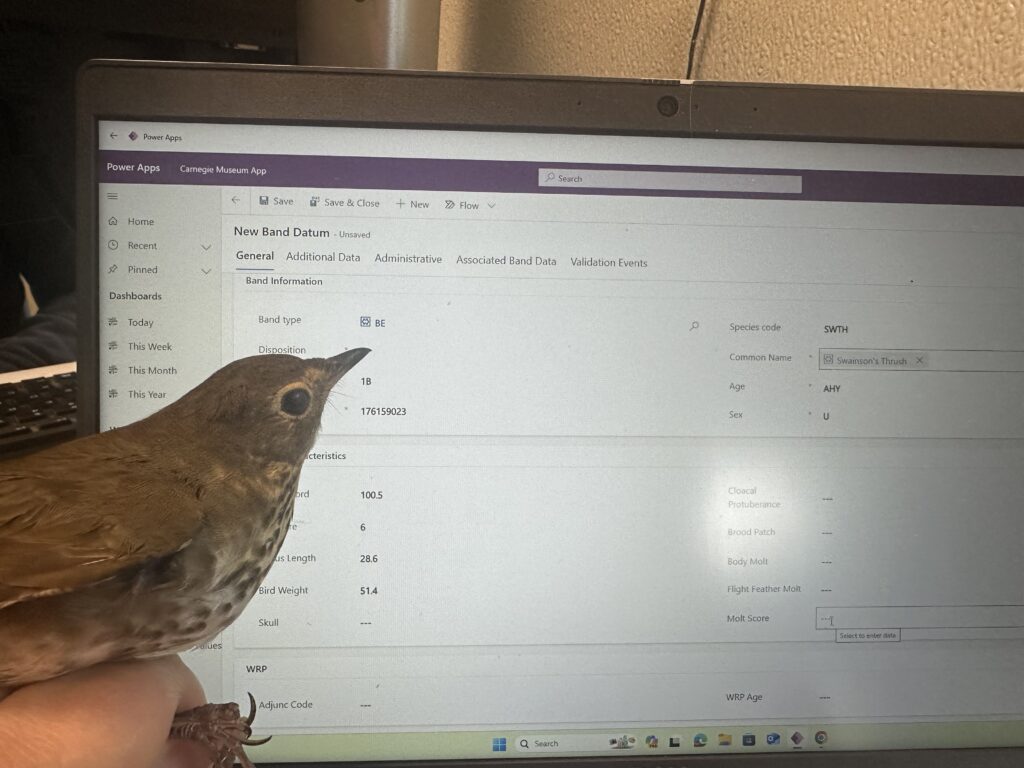
Fall migration would not be complete without a fat bird highlight. During the migration seasons, migratory songbirds increase their food intake so that they can deposit fat reserves that they use as a source of energy to fuel their overnight flights. Songbirds flap their wings continuously while they fly, so they require a lot of energy to accomplish their migrations. A Swainson’s Thrush that we caught on September 27 had accumulated impressive fat deposits, weighing in at 51.4 grams. Powdermill’s dataset contains over 17,000 Swainson’s Thrushes and only three have been heavier than this bird. A fat bird is a bird that is well prepared for migration!

Swainson’s Thrush with its banding data.

Old birds are interesting captures, and a Wilson’s Snipe that we caught on October 11 was just that. This individual was banded in 2019 and aged as a bird that hatched at least in 2017, if not earlier. Not only is this a notably old bird, but it had been recaptured three other times at Powdermill, providing us a peek into its life.

The fall migration banding season began to wane as October progressed, and our seasonal field techs’ last day was November 2.  But the surprises hadn’t stopped yet! In the morning, we caught an unusual Empidonax flycatcher (Empidonax is the genus of flycatchers that tend to pose identification challenges) – it was quite yellow on its underparts and the face proportions were not quite right for any of the species expected in the east. Further, an Empidonax flycatcher in southwest Pennsylvania this late in the year would be exceptionally rare. After a series of diagnostic measurements done independently by three of the banders on staff, we determined that this individual was a Western Flycatcher, a species found in the western part of the continent from the Rocky Mountains west to the Pacific Coast, and a species never before banded at Powdermill.

western flycatcher
Western Flycatcher

Later that evening, we set up nets to catch owls for Powdermill’s public Owling at the Moon event. Using audio lures, we attempted to catch Northern Saw-whet Owls and Eastern Screech-Owls. Successfully catching owls is very weather-dependent, and luck was on our side this year. Not only did we catch several individuals of our two target species, but we had a big surprise when we caught a Barred Owl, the second ever caught at Powdermill. The crew was excited to get to study this species in the hand and to share it with Owling at the Moon attendees.

Barred Owl

It was a busy but satisfying year, full of visitors and events, bird banding workshops, and interesting birds, and we look forward to what 2025 will bring!

Annie Lindsay is the Bird Banding Program Manager at Powdermill Nature Reserve, the environmental research center of Carnegie Museum of Natural History.

Read More Science Stories

(De)Forested Flight: An Eagle Scout Project at Powdermill

A Year in Review: Bird Banding 2023

Hummingbird Lessons

Filed Under: Blog Tagged With: Annie Lindsay, bird banding, Powdermill, Powdermill Nature Reserve

June 30, 2025 by Erin Southerland

(De)Forested Flight: An Eagle Scout Project at Powdermill

by Ollie Sparks

The first day I started volunteering as a high school Sophomore, I journeyed deep into the heavy woods of the Rector area, into a small building just off a gravel road with a sign out front that read “Powdermill Avian Research Center.” The light was on in the small, cinder block banding lab, and I could see some people through my breath materializing in front of me. It was close to 5:30 in the morning, something I was unprepared for in the middle of summer vacation. That was the first of many surprises to follow that day. 

As I accompanied the adults through net routes, watching them untangle birds caught in nets as easily as a practiced Rubix solver would twist a cube, I was amazed by the colors and sounds with each new bird. Some of these birds I recognized just from looking out my window: robins, blue jays, cardinals, and sparrows all made up the cast, but then came the birds I had never seen or heard of before, like an Ovenbird or a Northern Waterthrush. 

Once we returned to the research station, the building where my day’s journey began, each of the cotton bags containing a bird were clipped to a pulley system by a multitude of colored carabiners, and one by one they emerged from their bags, held safely and securely in the bander’s grip. My job was to record the bird’s data; important marks like wing length, age, sex, weight, species, and band size all went into the program. Afterward, the banders sent the birds on their way by releasing them out of a nearby window. It was such a quick system, necessary because of how many birds the banding team would bring in each day. 

Bird banding was not at all what I expected it to be, but there was something so enlightening about waking up, going to work like a responsible adult, and getting to spend my morning being in the wonderful outdoors. As a Boy Scout I had intermediate experience with campouts and tips for using the wilderness as a support for my life, so being immersed in it for extended periods of time while also getting to volunteer for important research really opened my eyes to a bigger world. I felt responsible for contributing, and respectful of my outdoor experiences. 

Over the next few years, I continued volunteering at Powdermill Avian Research Center (PARC), finding new birds and recording new kinds of data. This focus on wildlife, the experiences, and sense of adventure nudged me slowly toward the best decision I had ever made in my time working at Powdermill: asking to provide my Eagle Scout Project, titled “(De)Forested Flight,” to PARC. (De)Forested Flight aimed to clear overgrown vegetation around the net routes and provide nesting sites for local breeding birds. 

Ollie Sparks with his Eagle Scout project

During the summer months, the vegetation around the mist nets grows quickly, and sometimes higher than the nets, which can decrease capture rate. The banding crew maintains the habitat in the banding area so that it is consistent year after year, but timing is important: major vegetation trimming needs to happen before the birds’ breeding season to avoid the risk of destroying nests. It’s a big job and the crew needs a lot of help, so I organized a day for my BSA Troop to go to PARC and help cut vegetation in coordinated areas.

For the most impactful part of my Eagle project, I researched what cavity-nesting species breed at Powdermill and assembled 22 bird boxes for five species: Wood Ducks, Eastern Bluebirds, Eastern Screech Owls, Black-capped Chickadees, and Tree Swallows, and enlisted the help of the Troop to help hang them in appropriate habitat.

On April 15, 2025, Powdermill Nature Reserve hosted an Eagle Scout Ceremony for the completion of (De)Forested Flight. I handed out special awards to all the amazing members who attended the Ceremony, followed by an emotional speech about the incredible mentors and role models who helped shape my journey as I advanced from Scout all the way up through Eagle, my wonderful family, and my own Troop 372 for their help and devotion to my Eagle Project. Earlier that same day, the banding crew spotted an Eastern Bluebird visiting one of the nest boxes I hung up the previous summer as part of my Eagle project.

As I look back on completing my Eagle Project, I’m reminded of how important it is to get out and keep trying new things. I was extremely grateful for all the welcoming and acceptance the staff at PARC gave me, and my Eagle Project felt like a fitting way of giving back to the community I had become a part of. 

Ollie Sparks is a volunteer at Powdermill Avian Research Center and an Eagle Scout.

Read More Science Stories

A Year in Review: Bird Banding 2024

A Summer Internship at Powdermill

Hummingbird Lessons

Filed Under: Blog Tagged With: Ollie Sparks, Powdermill, Powdermill Nature Reserve

February 28, 2025 by Erin Southerland

Michael J. Bainbridge Wins the 2024 Carnegie Mineralogical Award

by Travis Olds, Assistant Curator of Minerals
March 4, 2025

I am pleased to announce Michael J. Bainbridge as the winner of the 2024 Carnegie Mineralogical Award. Established in 1987 through the generosity of The Hillman Foundation Inc., the award honors outstanding contributions in mineralogical preservation, conservation, and education.

Michael is the Assistant Curator of Mineralogy at the Canadian Museum of Nature in Ottawa. Over the course of his career, he has elevated the field of mineral photography, published in leading mineralogical publications, and contributed to groundbreaking works such as Minerals of the Grenville Province: New York, Ontario, and Québec.

Travis Olds and Michael Bainbridge holding the Carnegie Mineralogical Award.
Travis Olds and Michael Bainbridge holding the Carnegie Mineralogical Award at the Tucson Gem and Mineral Show.

Michael has blended art and science to preserve and showcase the beauty of minerals, inspiring collectors and researchers alike. He has immortalized some of the rarest and best-of-species minerals, and this award recognizes the many wonderful contributions he has made to mineral heritage through his lens. 

Among his achievements, Bainbridge’s mineral photography has been featured in important works, such as The Pinch Collection at the Canadian Museum of Nature, and numerous articles in Rocks and Minerals and The Mineralogical Record. His work has ensured that specimens of scientific and cultural significance are preserved and appreciated by future generations. As a co-author of Minerals of the Grenville Province, Bainbridge helped document the mineralogical heritage of one of North America’s most storied geological regions. His contributions to Mindat.org and numerous mineral symposia have further enriched the global mineralogical community.

“I love to teach, and I love to tell stories, but I think both are fueled by a desire to learn for myself,” said Michael, reflecting on his achievements. “I’ve always been technically minded but artistically inclined, so combining my passion for minerals with my love of photography has proven the perfect vehicle for me to pursue and share both the scientific and the aesthetic. It has afforded me access to some of the world’s great collections and sparked collaborations with some of the community’s most influential amateurs and professionals alike.

“Among my proudest accomplishments, the Pinch book stands in high relief. Pushing the boundaries of photomicroscopy in documenting some of the smallest and rarest specimens of Mont Saint-Hilaire has been both challenging and rewarding. Ensuring top-notch reproductions for Lithographie’s publications has proven a similarly worthy endeavor. The significant finds I have made as a field collector are also close to my heart. But seeing new people come to the hobby through doors I have helped to open—whether through the Recreational Geology Project or co-founding the new Ottawa Valley Mineral Club—has perhaps been the most rewarding of all.

“More than anything, I am grateful for the many opportunities to share what I have learned along the way. And now, I look forward to the next chapter in my career as I assist in curating Canada’s national collection at the Canadian Museum of Nature. I am truly honored and humbled by this recognition of my small part in helping to present and preserve the world’s mineralogical heritage for future generations.”

I had the honor of presenting the award to Michael at the Tucson Gem and Mineral Show on February 15, 2025. Congratulations, Michael! 

2025 Carnegie Mineralogical Award

Nominations are now being accepted for the 2025 Carnegie Mineralogical Award, and the deadline is November 15, 2025. Eligible candidates include educators, private mineral enthusiasts and collectors, curators, museums, mineral clubs and societies, mineral symposiums, universities, and publications. For information, contact Travis Olds, Assistant Curator, Section of Minerals & Earth Sciences, at 412-622-6568 or oldst@carnegiemnh.org.

Filed Under: Blog Tagged With: mineralogical award, minerals, minerals and earth sciences, Travis Olds

October 10, 2024 by Erin Southerland

Celebrating Indigenous Peoples’ Day 2024 in The Greater Pittsburgh Area  

by Amy Covell-Murthy, Archaeology Collection Manager and Head of the Section of Anthropology 

Indigenous Peoples’ Day is observed in many US cities and states alongside Columbus Day, and I would like to suggest some ways to observe the holiday for those who do not claim Indigenous heritage. As the Native American Graves Protection and Repatriation Act (NAGPRA) liaison at Carnegie Museum of Natural History (CMNH), I have the privilege of working closely with Indigenous people and communities on the research, repatriation, and standards of care for the cultural assemblages stewarded in the collection. It is my absolute pleasure to help provide a platform for authentic voices and Indigenous ways of knowing to be brought into the narratives, policies, and protocols that shape our vision for the future of the museum. 

In a state like Pennsylvania with no habitable federally recognized Indigenous land, Native people are all too often seen as existing only in the past, but many First Nations people live, work, and play right alongside us in the Greater Pittsburgh Area and beyond. Indigenous Peoples’ Day should not be a memorial, but a recognition of the important history and cultural heritage of those who are the past, present, and future caretakers of this land.  

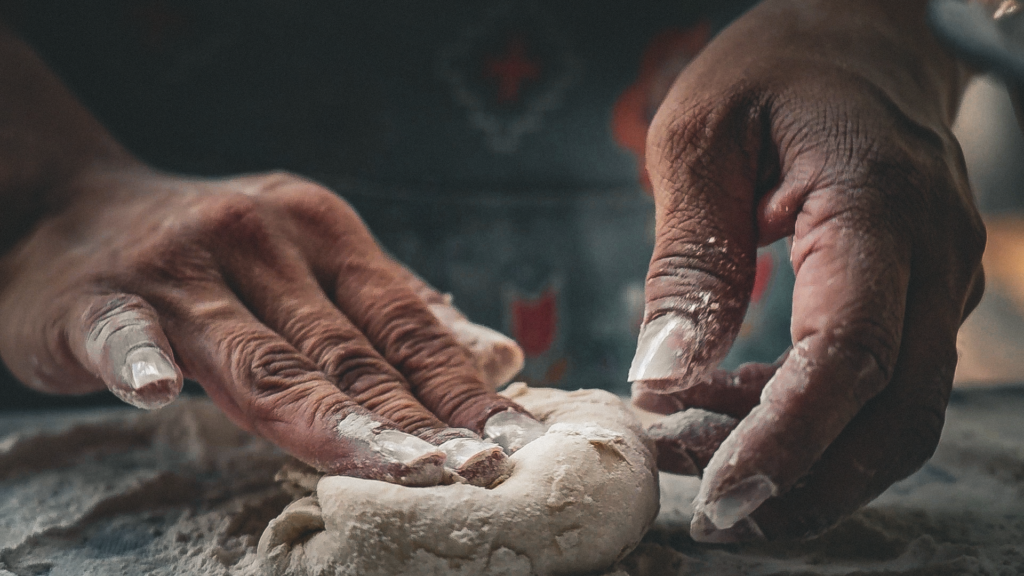
Preparing Fry Bread

Photo by: John E Rodgers/Ogahpah Communications 

Likewise, museum exhibits should reflect the present and future of Indigenous people, not only the past. The first iteration of a new exhibit series in the Alcoa Foundation Hall of American Indians opens on October 13 to commemorate repatriation work with the Quapaw Nation. Co-curators Betty Gaedtke and Carrie Vee Wilson worked together to bring their first-person stories to this new showcase that they have chosen to call Keeping Traditions Alive. Visiting the exhibit or one in your area is an excellent way to honor Indigenous Peoples’ Day.  

Here are some more ways to respectfully celebrate on October 14, 2024.  

Learn About the People Who Have Called Pittsburgh Home 

Many different cultural groups have occupied the Upper Ohio River Valley including but not limited to the Delaware/Lenape, the Haudenosaunee, the Shawnee, and the Wyandotte. The Osage Nation also claims origin in the Ohio River Valley, and you can learn about all these nations on their official websites. I also suggest hitting up your local library to check out books on these groups as well as the cultural traditions and ancestors who came before them. This region was home to those who are often referred to as the Adena, Hopewell, and Monongahela. But keep in mind, we have no idea what they called themselves.  

Here are some resources: 

Haudenosaunee Confederacy 

Delaware Tribe 

Absentee Shawnee Tribe

Wyandotte Nation 

The Osage Nation 

Educate Yourself About Indigenous History in Pennsylvania 

Many First Pennsylvanians were forced from their homelands and infected with unfamiliar diseases by colonizers. Later the first assimilation school was created in Carlisle, PA and used as a model for 24 more of these institutions whose primary goal was to force Indigenous children to abandon their Native languages and customs. In the 1960s, the building of the Kinzua Dam forced Seneca Nation citizens to move into the State of New York, breaking the 1794 Treaty of Peace and Friendship. Indigenous communities thrive despite these events and institutions, but it is important to recognize and not try to hide these gruesome parts of our shared American history. You can find more information about these examples on these websites:  

Kinzua Dam – Seneca Iroquois National Museum 

Removal History of the Delaware Tribe 

Indian Boarding Schools’ Traumatic Legacy, And The Fight To Get Native Ancestors Back 

Support Local Indigenous Groups  

The Council of Three Rivers American Indian Center (COTRAIC) is a regional intertribal nonprofit that promotes the socio-economic development of the Native American community and others who experience the same type of economic difficulties in the Greater Pittsburgh metropolitan area. One way to support them is to plan to attend their annual Pow Wow that is held in Dorseyville, just outside of Pittsburgh, in late September. Learn more about their Early Childhood Education, Native American Elders, Veterans, and Employment programs at COTRAIC.org and on their Facebook page.  

COTRAIC’s Singing Winds Food Pantry is an excellent resource to help people meet their food needs.  Learn more, donate, or sign up to receive support from the food pantry.

Honor the Land

Planting Native Pennsylvanian plants is a wonderful way to honor our connection to the Earth and to provide food and shelter for the diverse species who live here. You can learn about how Indigenous People use trees, ferns, flowers, vegetables, fruits, and grasses to enhance their quality of life. The Pennsylvania Department of Conservation and Natural Resources and the Audubon Society of Western Pennsylvania offer suggestions for those who are interested. 

Quapaw Pow wow Grand Entry, 2024. Photo by: John E Rodgers/Ogahpah Communications 

Support Indigenous Artists, Authors, Film Makers, and Musicians

You have so many options! The Canadian Broadcasting Corporation released a list of Indigenous musical artists to watch out for in 2024. My personal favorite this year is Sekawnee. Check out their video for the song “Nations” with frequent collaborators, Chasé Scanz and EfrainYB.  

Check out the Sundance Institute Indigenous Program that champions Indigenous-created stories in a global scale. 

The New York Public Library posted a wonderful resource for finding recent works by Indigenous authors. 

You can also support Indigenous artists by purchasing art through the online gift shop of the Seneca Iroquois National Museum/Onöhsagwë:de’ Cultural Center or take a drive up to purchase something in person and see the new longhouse that they’ve built behind the museum.    

Help Change Derogatory Mascots and Place Names

Sign petitions, attend community forums, and advocate for the changing of harmful stereotypes and offensive signage in our community. From the Cleveland Guardians to Hemlock Hollow Road, there are many instances of this happening around us.The Haudenosaunee Nationals Lacrosse Team, who hope to make it to the 2028 Olympics, changed their name in 2022 to reflect their collective identity. 

Consider Donating Time or Resources

The Seneca Iroquois National Museum/ Onöhsagwë:de’ Cultural Center is only a few hours’ drive from Pittsburgh and occasionally may be looking for volunteers. Check their website and follow their Instagram and Facebook accounts for more information. 

 If you are able, here are just a few organizations who can use your help. 

Advancing Indigenous People in STEM 

Native American Agriculture Fund 

NDN Collective 

Association of American Indian Affairs 

So, join me once again in celebrating the cultural diversity of Indigenous People throughout the history of our region. Remember that the best places to start educating yourself are local libraries and museums here in Pittsburgh or wherever you live.  

Amy L. Covell-Murthy (she/her) is the Archaeology Collection Manager/Head of the Section of Anthropology at Carnegie Museum of Natural History. 

Carnegie Museum of Natural History Blog Citation Information

Blog author: Covell-Murthy, Amy
Publication date: October 10, 2024

Share this post!

  • Share on Twitter Share on Twitter
  • Share on Facebook Share on Facebook
  • Share on Pinterest Share on Pinterest
  • Share on LinkedIn Share on LinkedIn
  • Share on Reddit Share on Reddit
  • Share via Email Share via Email

Filed Under: Blog Tagged With: Amy Covell-Murthy, Indigenous Peoples Day, Keeping Traditions Alive

August 16, 2024 by Erin Southerland

Natural History Collection Managers: The Stewards of Time Travel 

by Serina Brady and Mariana Marques

For centuries, naturalists have collected the living world with the primary goal of understanding the diversity and complexity of our planet. In vast shelves and cabinets located in natural history museums, we find a diversity of specimens used daily by researchers, students, naturalists, and conservationists from around the world. These collections are not just archives of the past, but they also play a crucial role in addressing present-day challenges. By documenting the diversity of life, natural history collections provide a wealth of information that can be used to tackle issues such as climate change, pandemics, pathogen dispersals, deforestation, habitat fragmentation, and biodiversity loss. They can be considered the world’s most comprehensive and complex library, serving as a valuable resource for understanding and addressing the health of our planet. 

Each specimen can be seen as a unique document or book recording an aspect of life on Earth at a particular time and place. They testify to the existence of a given species in a given locality and at a particular time, and they have a fundamental role as a guarantee of the scientific method: they allow objective observation that can be replicable. Natural history collections are an unparalleled source of information. For instance, a single bird or reptile specimen can provide data on its species, its habitat, its diet, and even its health. This wealth of information continues to allow researchers to understand better the past, the present, and the future of biodiversity, as well as the health of our planet – from local communities to the entire Earth.  

Carnegie Museum of Natural History Alcohol House, Collection of Amphibians and Reptiles. ©Photo by: Luis Ceríaco. 
Carnegie Museum of Natural History, Collection of Birds. ©Photo by: Luis Ceríaco. 

These collections are usually housed in natural history museums. These museums are research, conservation, education, and public outreach hubs. Their collections are not limited to public exhibitions; in fact, the majority are housed in storage locations, generally out of sight and knowledge of the public. The process of collecting and storing these specimens is methodical. Each specimen is carefully collected, identified, and cataloged, then stored in a controlled environment to ensure long-term preservation. This process ensures that these specimens, often fragile and irreplaceable, are protected and can continue to be used for research and education for future generations.  

Natural History Collections: a Tool to Face Global Changes 

How can a specimen collected more than 100 years ago still be relevant today? Historical collections, like the one housed at Carnegie Museum of Natural History, provide baseline data points. These initial measurements or observations serve as a starting point for future comparisons. By providing a snapshot of life on Earth at a particular time and place, these specimens allow us to study change over time. The first and most crucial step is to gather those baseline data points!  

From their early days, natural history collections’ primary goal was to inventory all life on Earth. However, with new cutting-edge technology, researchers can recover different data from historical specimens, data that the original collector didn’t even imagine. For example, when birds were collected from the U.S. Rust Belt, collectors didn’t realize that the specimens would be used to infer information about the history of pollution. Similarly, in the early twentieth century, the collectors of salamanders in the Appalachian woods didn’t even realize that some of those specimens were already infected with a pathogen that is devastating some of the world amphibian populations today.  

However, because specimens were collected, we can now map the expansion of this pathogen through time or trace the amount of black carbon in the air over time through birds’ feathers to help fight and understand climate change. Part of the job of Collection Managers like us is not just to preserve and maintain the existing collections, but also to anticipate and predict the questions future researchers will be asking. This proactive approach ensures we gather today’s data to answer tomorrow’s questions. Specimens collected over a century ago are actively used today to answer questions about current and future environmental changes.  

Specimens at the Carnegie Museum of Natural History collected during the early 1900s continued to have a significant role in research questions. These specimens give researchers insight into environmental changes through time, such as soot deposited on bird feathers or the presence of pathogens such as the chytrid fungus on amphibian populations across a specific time and place. Top: Two Eastern Towhee (Pipilo erythrophthalmus) specimens, one from 1895 (bottom) and the other from 1993 (top), showing the change in air quality over time (DuBay and Fuldner 2017). © Photo by Luis Ceríaco. Below: Amphibian specimen of Common Mudpuppy (Necturus maculosus) being swabbed by a student from the University of Pittsburgh (Richards-Zawacki Lab) to detect the presence of the amphibian chytrid fungus – Batrachochytrium dendrobatidis. ©Photo by: Rachel Verdi. 

New applications of technologies, such as computed tomography (CT) scans, provide novel insights and usages for specimens. CT scans allow a complete 3D model of a specimen, including access to its internal morphology without damaging it. Using next-generation sequencing, scientists can use fragmented and degraded DNA for advanced analyses such as phylogenetic and phylogeographic analysis. These specialized methods allow us to study species’ evolutionary relationships and geographic distribution. These advanced techniques are just some of the ways natural history collections are being used to push the boundaries of scientific knowledge.  

CT scans provide details of internal anatomy, presence of parasites, reproduction, etc., without damaging the specimen. CT scans are a significant technological advance for fields such as taxonomy, developmental and evolutionary biology, and studying functional morphology for natural history specimens. © Edward Stanley, Florida Museum of Natural History, University of Florida (oVert – OpenVertebrate project). 

A Biodiversity Backup 

Continuing to grow our collections is not only scientifically essential but undeniably needed. Currently, 1.8 million species have been formally described to science, although worldwide experts predict that around 8.75 million species still await to be discovered, described, and named. Given current extinction rates, we are racing against time to describe the remaining 86% of the world’s species, many of which may become extinct before we know they even existed! 

New species of birds, amphibians, reptiles, mammals, and insects continue to be discovered worldwide, sometimes based on specimens tucked away in a museum for decades! These collections are not just archives of the past but also living libraries that continue to grow and evolve as new species are discovered. Each new discovery adds to our understanding of the natural world and underscores the importance of these collections in documenting and preserving Earth’s biodiversity. These new specimens contribute to our most significant and longest dataset of the natural world. But just as a library that stops acquiring new books, a natural history collection that doesn’t add new specimens will eventually lose its scientific value and relevancy. If we don’t continue to add physical proof of today’s biodiversity, we create unfillable gaps in one of our most powerful natural history data sets. Today is tomorrow’s past, and natural history collections act as a biodiversity backup of our planet!  

Serina Brady is Collection Manager of Birds and Mariana Marques is Collection Manager of Amphibians and Reptiles at Carnegie Museum of Natural History.

Related Content

Risk Assessment, or How to Keep Your Collection Intact

Type Specimens: What Are They and Why Are They Important?

Staff Favorites: Dolls in the Museum’s Care

Carnegie Museum of Natural History Blog Citation Information

Blog author: Brady, Serina; Marques, Mariana
Publication date: August 16, 2024

Share this post!

  • Share on Twitter Share on Twitter
  • Share on Facebook Share on Facebook
  • Share on Pinterest Share on Pinterest
  • Share on LinkedIn Share on LinkedIn
  • Share on Reddit Share on Reddit
  • Share via Email Share via Email

Filed Under: Blog Tagged With: amphibians and reptiles, Birds, Mariana Marques, Science News, Serina Brady, SWK2

  • « Go to Previous Page
  • Page 1
  • Page 2
  • Page 3
  • Page 4
  • Interim pages omitted …
  • Page 24
  • Go to Next Page »

sidebar

About

  • Mission & Commitments
  • Directors Team
  • Museum History

Get Involved

  • Volunteer
  • Membership
  • Carnegie Discoverers
  • Donate
  • Employment
  • Events

Bring a Group

  • Groups of 10 or More
  • Birthday Parties at the Museum
  • Field Trips

Powdermill

  • Powdermill Nature Reserve
  • Powdermill Field Trips
  • Powdermill Staff
  • Research at Powdermill

More Information

  • Image Permission Requests
  • Science Stories
  • Accessibility
  • Shopping Cart
  • Contact
  • Visitor Policies
One of the Four Carnegie Museums | © Carnegie Institute | Privacy Policy | Terms of Use | Accessibility
Rad works here logo