• Skip to primary navigation
  • Skip to main content
  • Skip to primary sidebar

Carnegie Museum of Natural History

One of the Four Carnegie Museums of Pittsburgh

  • Visit
    • Buy Tickets
    • Visitor Information
    • Exhibitions
    • Events
    • Dining at the Museum
    • Celebrate at the Museum
    • Powdermill Nature Reserve
    • Event Venue Rental
  • Learn
    • Field Trips
    • Educator Information
    • Programs at the Museum
    • Bring the Museum to You
    • Guided Programs FAQ
    • Programs Online
    • Climate and Rural Systems Partnership
  • Research
    • Scientific Sections
    • Science Stories
    • Science Videos
    • Senior Science & Research Staff
    • Museum Library
    • Science Seminars
    • Scientific Publications
    • Specimen and Artifact Identification
  • About
    • Mission & Commitments
    • Directors Team
    • Museum History
  • Tickets
  • Give
  • Shop

Erin Southerland

March 21, 2022 by Erin Southerland

Facing Outward, Looking Ahead: Richard Serra’s “Carnegie” As Part Of An 125 Year Legacy Of Architecture and Outdoor Sculpture

by Albert D. Kollar and Mary Wilcop

On a sunny fall weekend last November 6th and 7th, a celebration honored the 125th Anniversary (1895 – 2020) of the founding of the Carnegie Library of Pittsburgh (1895) and the Carnegie Institute Extension, now Carnegie Museums of Pittsburgh, by philanthropist Andrew Carnegie (1835 – 1919)1 (fig. 1). 
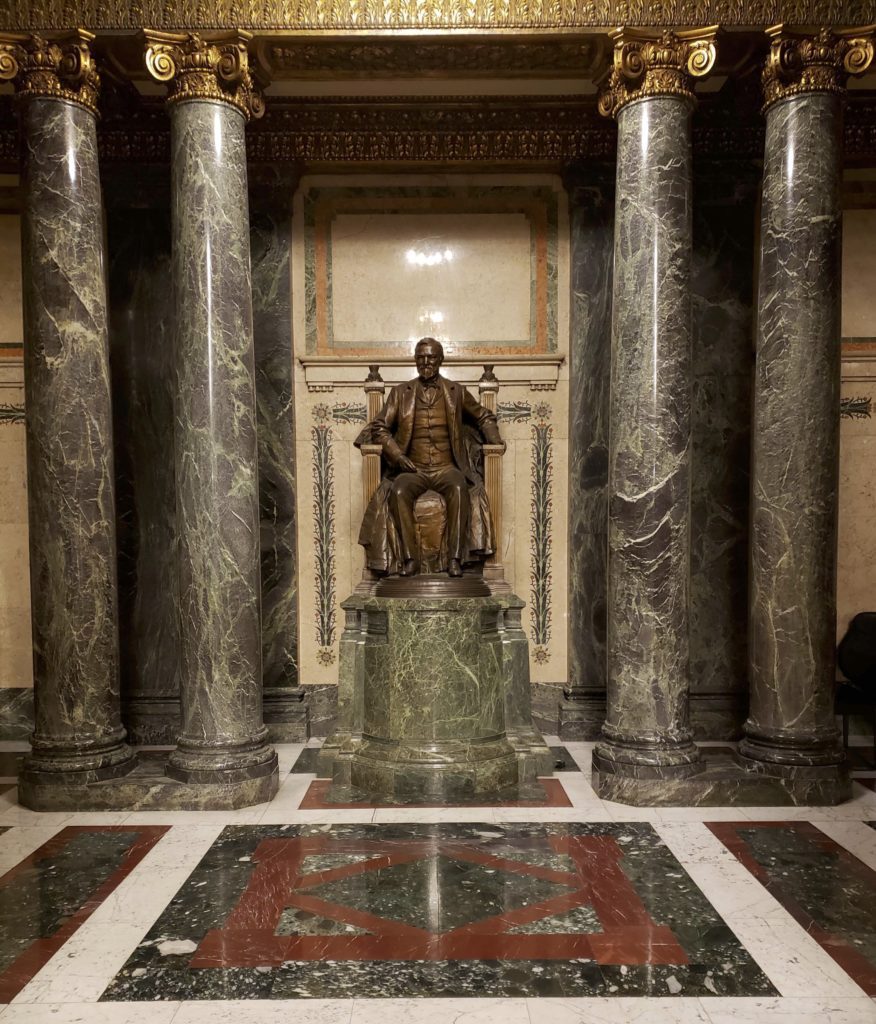
Sculpture of Andrew Carnegie in an ornate marble room.
Fig. 1: Andrew Carnegie, Music Hall Foyer

Although the event had been postponed for a year due to the COVID-19 pandemic, the 2021 “Crash the Carnegies” celebration was enjoyed by thousands of visitors. Inside the Oakland museums, families enjoyed artmaking, performance, and learning activities that paid homage to Carnegie Museums’ past 126 years. Fronting Forbes Avenue, the statues and art works that lend much to the understanding of all that’s presented inside, continued their silent vigil.

The Buildings

The long stretch of buildings along Forbes Avenue in the Oakland neighborhood of Pittsburgh is home to Carnegie Museum of Art, Carnegie Museum of Natural History, and Carnegie Music Hall. The entrance to the Carnegie Library of Pittsburgh, the furthest west section of the massive complex, faces the gateway to Schenley Park. The connected buildings that comprise this modern campus were constructed in three distinct phases (the first building in 1895, an extension in 1907, and the new Scaife wing in 1974)². A review of the history of the Carnegie Library and Institute buildings’ is available in the posts “CMP Travel Program and Section of Invertebrate Paleontology Promote the 125th Anniversary of the Carnegie Library of Pittsburgh With a Walking Tour” and “A Journey to France to Uncover the Mysteries of the Carnegie’s Grand Staircase.”
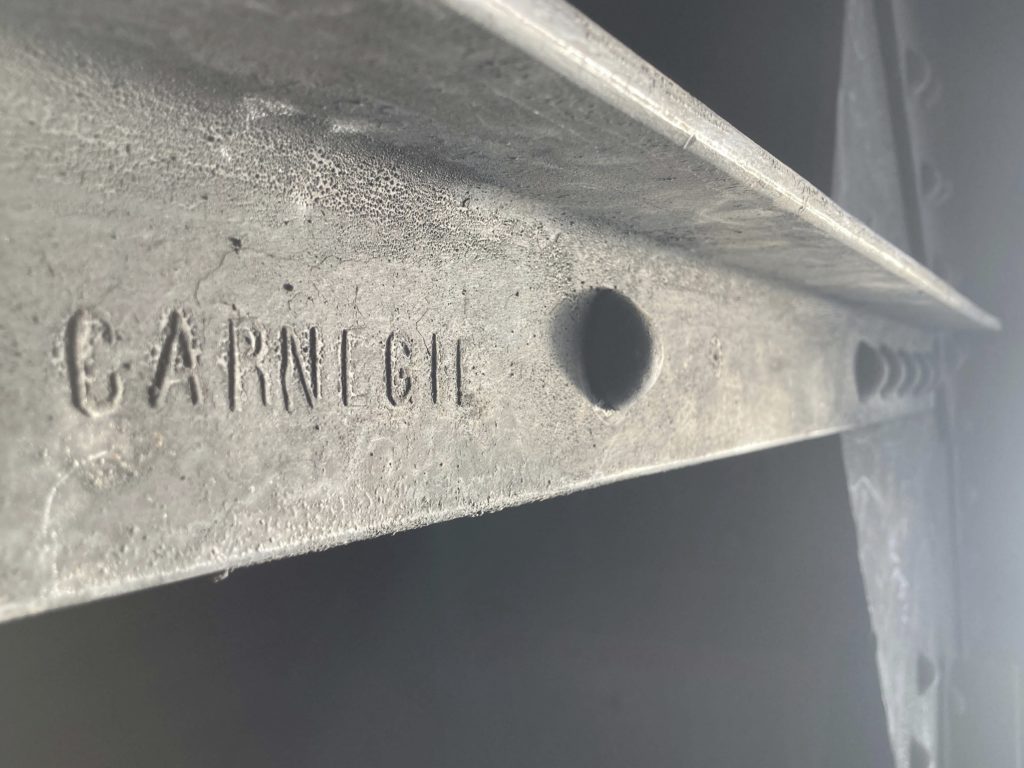
Close-up of a steel bar with the name Carnegie on it.
Fig. 2: View from inside the museum: a Carnegie Steel Company I-beam supporting the roof of the 1907 extension.

With 1895-era facades made of elegant light gray Berea sandstone mined from a  quarry in Amherst, Ohio 2, the Carnegie Library and Institute building proclaimed itself to Pittsburgh and the world at large as, in Andrew Carnegie’s own words, a “palace of culture.”3 The library was built, both financially and literally, by Carnegie Steel. Earlier, the company’s structural metal beams were used in Pittsburgh’s first skyscraper, the Carnegie Steel Building, a structure designed by Longfellow, Alden, and Harlow (Floyd 1993)5. The Carnegie Institute Extension (1907), undergirded by a steel support frame, used steel beams fabricated at the newly created United States Steel Corporation Homestead Works, formerly Carnegie Steel1 (fig 2). 

John Massey Rhind Bronze Statues
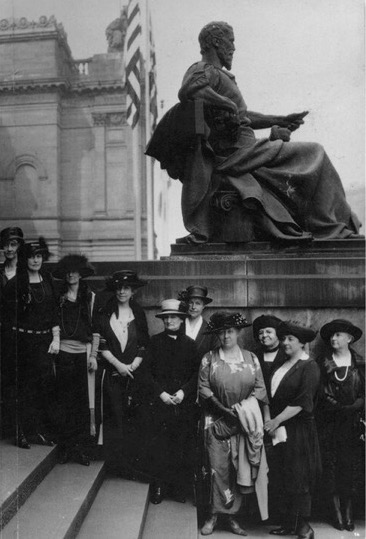
Historic black and white photo of a group of people in front of a statue of Michelangelo.
Fig. 3: Michelangelo Statue. Courtesy of Carnegie Library Archives.

With the completion of the Beaux-Arts style Carnegie Institute Extension, departments of music, art, literature, and science were established as distinct administrative divisions of Carnegie Institute and Library. These now lapsed distinctions are mirrored on the building’s exterior in the bronze sculptures collectively referred to as the Noble Quartet. Seated in classical Greek chairs made of Barre Granodiorite of Vermont2 are four male figures. The statues of Shakespeare (literature) and Bach (music) sit atop granodiorite slabs on either side of the main granodiorite staircase to the Music Hall entrance. Just east of them, at the entrance to the art and natural history museums, are seated Michelangelo representing art (fig. 3) and Galileo representing science.  
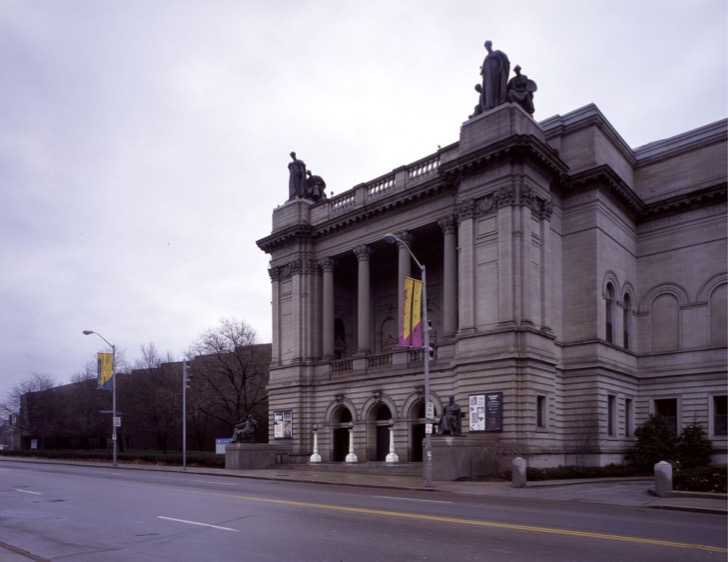
Classical style stone building on a cloudy day.
Fig. 4: Noble Quartet Muses

John Massey Rhind (1858 – 1936), a close friend of Andrew Carnegie, was commissioned by him to create these works along with four others that tower three stories above them from parapets on the edge of the building’s roof (fig. 4). Known as the Muses, these standing female figures represent allegorical spirits whose achievements equal those of their seated counterparts. The creation of eight largescale architectural figures to match the Classical style of the building was not an easy task. Statue models shaped in clay by the artist, were shipped from his New York studio to Italy to be cast in the lost-wax process, then returned for assembly and finishing6.

Sarah Scaife Gallery

In 1974, the footprint of the Oakland campus expanded once more with the opening of the Sarah Scaife Gallery. Designed by renowned New York City architect Edward Larrabee Barnes (1915-2004), with large spaces and high windows, the gallery exterior is in some ways a modern equivalent of the Beaux-Arts Carnegie Institute Extension3.

The new building was constructed in a more modernist style commensurate with the contemporary architectural styles at the time. Its interior is clad with Larvikite, a beautiful gray blue iridescent igneous rock from Larvik, Norway⁸. The exterior cladding is also Larvikite, but here the stone has a bronze iridescent color to create visual continuity between the radically different Beaux Art and modernist structures. 

By 1974, after nearly a century of atmospheric soot and pollutants from the steel mills and other modes of industrial and residential coal use, the old light gray Berea sandstone of the 1907 building darkened to a deep brown. This intended cohesion no longer exists because the sandstone underwent a major cleaning in 19899. Its original pale tone now stands in contrast to the naturally bronze-toned Larvikite. 

Richard Serra Carnegie Sculpture and COR-TEN Steel

In contrast to the bronze sculptures used in the 1907 Carnegie Extension, sculptures made of modern alloys of steel and aluminum are incorporated into the exterior plazas of the 1974 Sarah Scaife Gallery. The largest of these works is the Richard Serra Carnegie sculpture, which was installed as public art for the 1985 Carnegie International and was selected in a tie for that exhibition’s first prize10.
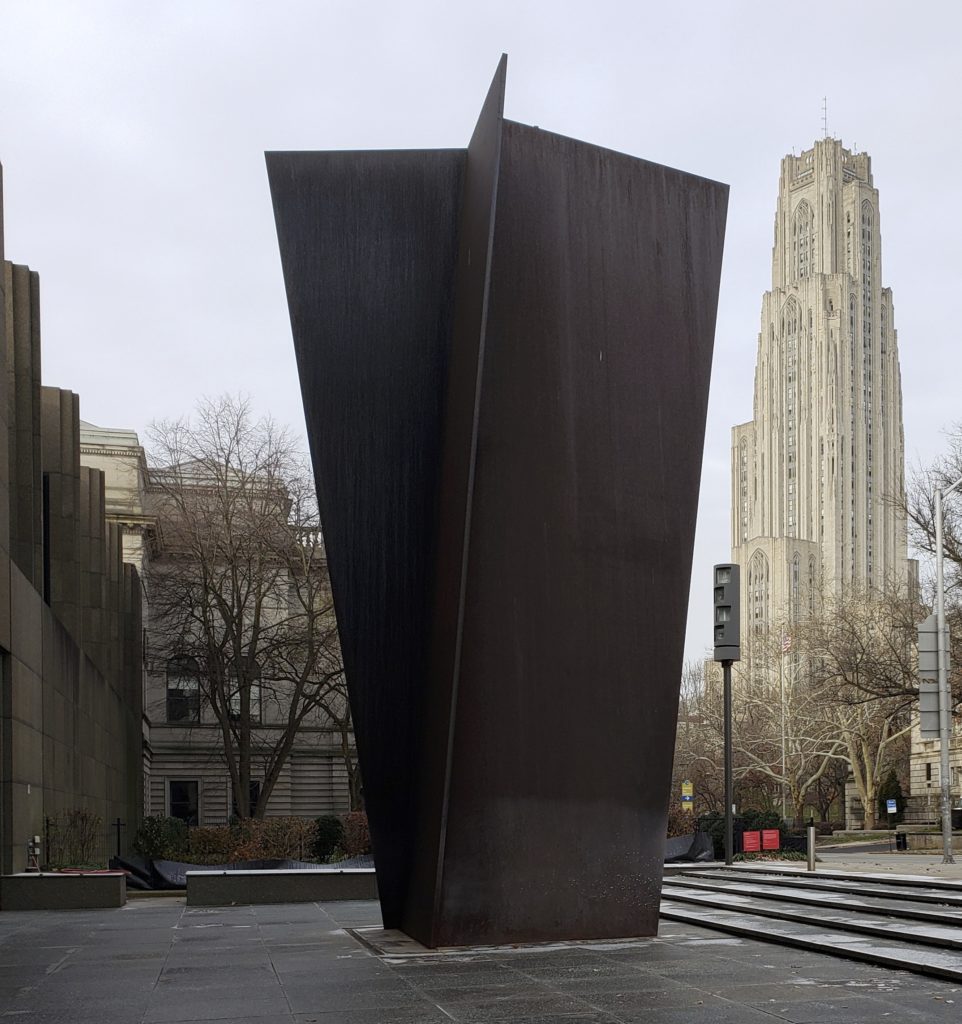
Richard Serra's Carnegie sculpture with the Cathedral of Learning framed in the background.
Fig. 5: Serra sculpture at CMOA

The 40-foot tower, made of four panels of 2.5-inch-thick COR-TEN steel with acute edges and corners, emerges from the Larvikite surface of the entrance plaza. The sculpture commands great sight lines with its height and profile echoing that of the nearby Cathedral of Learning, the University of Pittsburgh’s 42-story Gothic Revival, Art Deco tower (fig.5).

Steel skyscraper in downtown Pittsburgh.
Fig. 6: US Steel Tower. Image credit: Derek Jensen (Tysto).

COR-TEN is a proprietary high-strength, low-carbon steel alloy introduced by U.S. Steel Corporation in 1933. It features prominently in the company’s Pittsburgh headquarters, the U.S. Steel Tower, built in 1971 (fig. 6)¹². The name COR-TEN is an amalgam that references the product’s most notable properties, corrosion resistance and high tensile strength. The steel’s exceptional resistance to atmospheric corrosion negates the need for painting. After production, in a process that occurs over several months, a surface patina develops as the steel is exposed to wet and dry weather cycles. In many applications COR-TEN surfaces turn a reddish orange, but colors can vary from orange to brown depending, in part, on atmospheric conditions. Very fine surface oxidation layers can also build to create a rainbow-like iridescence, known as structural color – the same process that lends colorful beauty to peacock feathers and butterfly wings.

By the mid-1960s, the unique properties of COR-TEN attracted the interest of artists, especially those producing outdoor sculptures. Beverly Pepper, a sculptor known for her large-scale metal works, was introduced to COR-TEN’s properties while working at the U.S. Steel factory in Conshohocken, Pennsylvania. In 1964 she was the first sculptor to explicitly use COR-TEN as a sculptural medium11. Other artists soon followed, including Serra in the early 1970s. Although Serra was originally trained as a painter, he was already familiar with the working properties of steel. The artist’s father worked in steel mills and as a pipefitter. Later, Serra supported some of his schooling by working in steel mills14. 

By the time Serra’s design was conceived in 1985, only one company, the Lukens Steel Company, which operated the world’s widest rolling mill in the southeastern Pennsylvania town of Coatesville, could produce the large plates required for the commission. After production the plates were shipped across the state to a Pittsburgh-Des Moines Corporation plant on Neville Island, just outside Pittsburgh, for assembly.  

The Significance of Carnegie

In its sheer size and monolithic simplicity, Carnegie lends itself to many interpretations. Like the large institution it fronts, the sculpture can be experienced from walking around the outside and by standing within.

By the time of Carnegie’s installation, leaning metal plates were a feature of several of Serra’s public sculptures. For Carnegie, however, the plates were made both to lean and tilt diagonally, rather than being strictly vertical, a form Serra describes as “almost like a V or like lifting your arms up.”6 Implicitly, though perhaps unintentionally, this form and its materiality may speak to the original vision Andrew Carnegie expressed in an 1897 letter: “….not only our own country, but the civilized world will take note of the fact that our Dear Old Smoky Pittsburgh, no longer content to be celebrated only as one of the chief manufacturing centers[sic], has entered upon the path to higher things, and is before long […] also to be noted for her preeminence in the Arts and Sciences”16.

Symbolism. Alone in Carnegie

The bare steel, deliberately lacking any interior or exterior covering, stands prominently in the plaza asserting its own essentialness to the story of the museum.  
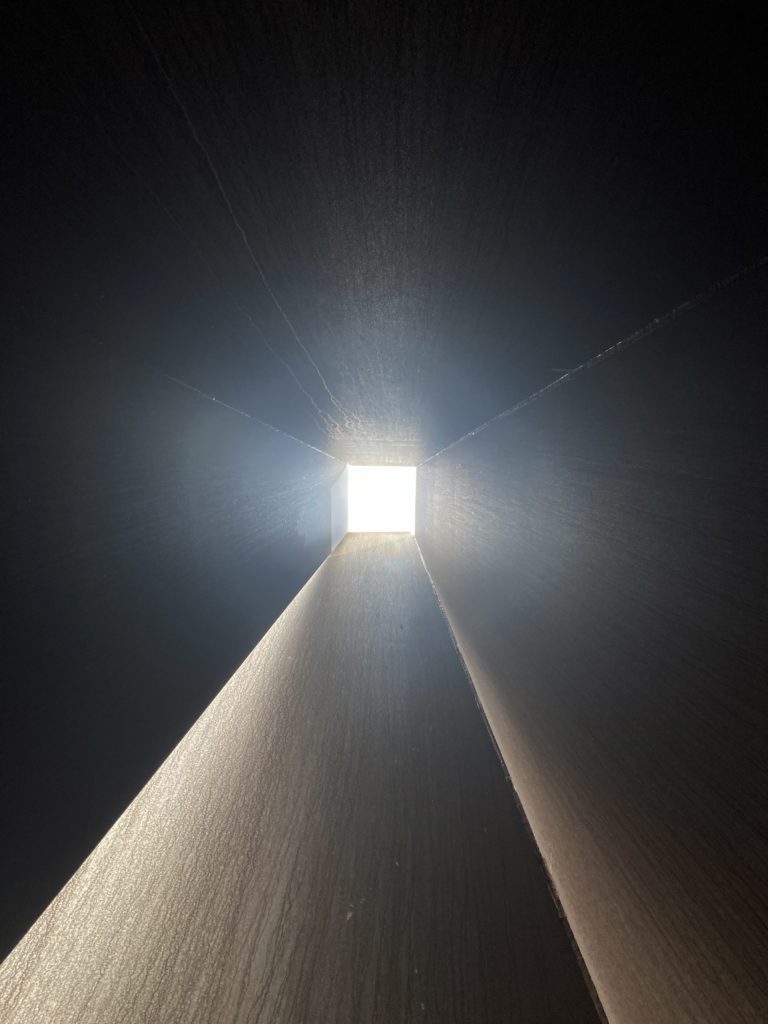
Fig. 7: View looking up from the interior of Carnegie.

To enter the sculpture’s interior from its Forbes Avenue side, visitors slide through a tapered passage between two plates. Once inside, even on the brightest summer days, several minutes are needed to adjust one’s eyes to overwhelming darkness of the interior. Following the walls upwards leads to a glowing view of the sky, blue or gray, depending upon the weather, and undoubtedly occasionally rose pink for some moments at dawn and dusk. The effect is intentionally physically and visually destabilizing (fig 7). 
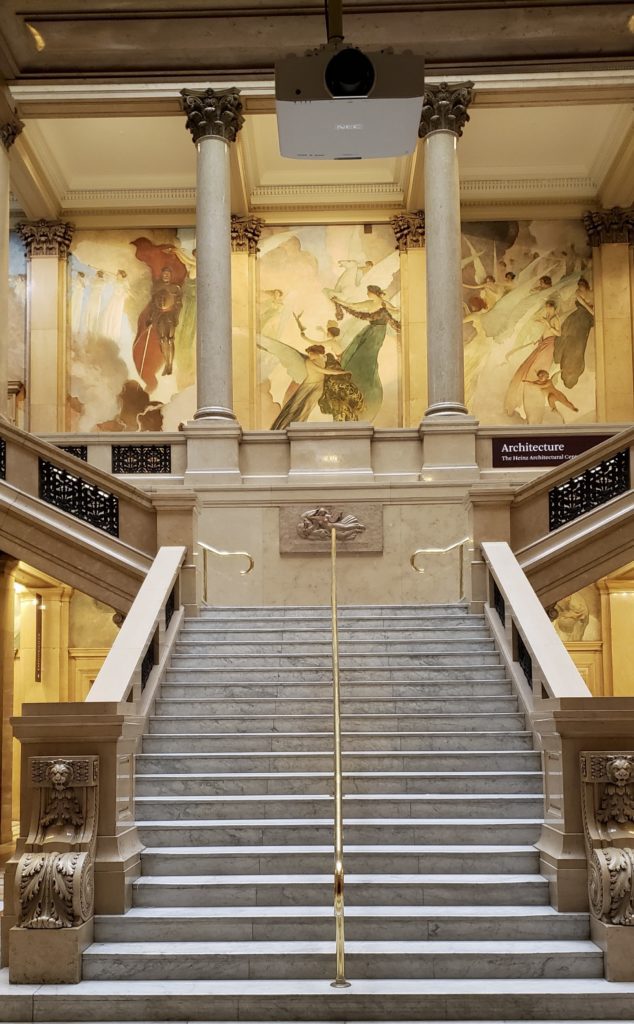
Ornate stone staircase
Fig. 8. Carnegie Grand Staircase

Some visitors experience entering the tower-like structure as a representation of a steel mill’s blast furnace. In this sense, the design functions as an extension of the John White Alexander Crowning of Labor murals in the Grand Staircase, which depict workers making steel in the first floor murals and, as the smoke rises to the second floor, reveal female spirits bringing the fruits of labor to a knight in steel armor who resembles Andrew Carnegie17 (fig. 8). 

Serra often hesitated to assign a single meaning to his sculptures, preferring their interpretation remain broad and therefore boundless. Still, in an interview with Art Historian Vicky Clark during the work’s installation, the artist struggled to completely separate the sculpture from its implicit connections to the museum and Pittsburgh. “There’s something about steelworkers and the tradition of steelworkers that means that they have a basic respect for how something is built. It becomes a metaphor for what the industry of the town has produced.” 6

Sculptures and Thought in the 21st Century

While John Massey Rhind’s Noble Quartet functions mainly as an embellishment to the building, with a specific interpretation dictated by Carnegie himself, the situating of Carnegie in the plaza speaks to the extent to which the function of art and architecture, near the end of the 20th century, had fundamentally changed. Rhind’s Quartet were positioned to sit along the sides of the Carnegie Institute’s original entryways, out of the path of visitors. Carnegie, in contrast, stands imposingly in front of the Scaife extension entrance, almost requiring entering patrons and passersby to engage with it.

Sculptures of the modern era, particularly those of architectural scale, create environments for individuals to think and reflect, without necessarily a prescribed end in mind. A viewer’s interaction with an artwork like Carnegie can feel obtuse; its faceless abstraction refuses to tell us what it is or how we should feel about it. This ambiguity, for Serra, however, is essential, because it means that “the piece has the potential to engage people with various meanings they might have.”6 Like the Quartet, Carnegie, speaks to the outside world about what we might find within. That is, that art, and the museum itself, serve as a site for contemplation and reflection—and not only about art.

Albert D. Kollar is the Collection Manager in the Section of Invertebrate Paleontology at Carnegie Museum of Natural History. Mary Wilcop is Associate Objects Conservator at Carnegie Museum of Art.

References

1Kollar, A.D. 2021. The Carnegie Library of Pittsburgh (1895) and Carnegie Institute Extension (1907): The Story of the Carnegie Building Stones and Architectural Design presented for the 125th “Crash the Carnegie” Celebration held in north wing of the Carnegie Library of Pittsburgh.

2Kollar, A.D., M. Feeley, A. Joyce Jr., R. Fedosick, K. Hughes, and A. Costanzo.  2020. Carnegie Institute Extension Connemara Marble: Cross-Atlantic Connections Between Western Ireland and Gilded Age Architecture in Pittsburgh, Pennsylvania. ACM, 86: 207-253.

3Gangewere, R. 2011. Palace of Culture Andrew Carnegie’s Museum and Library of Pittsburgh. University of Pittsburgh Press, 332p. 

4Kollar, A.D. and B. Tucker. 2020. CMP Travel Program and Section of Invertebrate Paleontology promotes the 125th Anniversary of the Carnegie Library of Pittsburgh with an outdoor walking tour. https://carnegiemnh.org/125th-anniversary-carnegie-library-of-pittsburgh-outdoor-walking-tour/

5Floyd, M.H. 1994. Architecture After Richardson, Regionalism before Modernism – Longfellow, Alden, and Harlow in Boston and Pittsburgh. The University of Chicago Press, Chicago. 546 pp. 

6 Clark, V. November 1985. “Richard Serra’s Carnegie, an unpublished interview.” http://vickyaclark.com/serra_interview.html

7Gangewere, R. 1992. What the Muses Hold. Carnegie Magazine, 13-17.

8Heldal, T., and G. B. Meyer & R. Dahl. 2015. Global stone heritage: Larvikite, Norway. 21-34. Geological Society, London, Special Publication, 407. 

9Gangewere, R. 1990. Cleaning The Carnegie. Carnegie Magazine, 31 – 35. 

10CARNEGIE Fall 2021. 125 Years: A History in Objects Continues.

11 Smithsonian Archives of American Art. July 1-2, 2009. Oral history interview with Beverly Pepper. Washington, DC: Smithsonian Institution. https://www.aaa.si.edu/download_pdf_transcript/ajax?record_id=edanmdm-AAADCD_oh_283468

12Jester 1995.

12USS Cor-Ten Steel. 1980. USS Cor-Ten High Strength Low-Alloy Steel. 

13https://www.aaa.si.edu/download_pdf_transcript/ajax?record_id=edanmdm-AAADCD_oh_283468

14 https://news.artnet.com/art-world/beverly-pepper-marlborough-contemporary-1470469

15 Lidji, E. 1985. CARNEGIE, Richard Serra. Carnegie International Article.

16Wall, J. F. 1970. Andrew Carnegie. University of Pittsburgh Press. 1137p.

 17Gangewere, R. personal communication.

Related Content

Understanding Fossil Fuels Through Carnegie Museums’ Exhibits

University of Michigan Helps Solve Century Old Fossil Mystery

A Century Ago, A Donor Walked Into the Carnegie Museum

Carnegie Museum of Natural History Blog Citation Information

Blog author: Kollar, Albert D.; Wilcop, Mary
Publication date: March 24, 2022
Share this post!

  • Share on Twitter Share on Twitter
  • Share on Facebook Share on Facebook
  • Share on Pinterest Share on Pinterest
  • Share on LinkedIn Share on LinkedIn
  • Share on Reddit Share on Reddit
  • Share via Email Share via Email

Filed Under: Blog Tagged With: Albert Kollar, Science News

March 11, 2022 by Erin Southerland

Tracking Pittsburgh’s Paddlefish

by Patrick McShea
Fake boat in a museum exhibition.

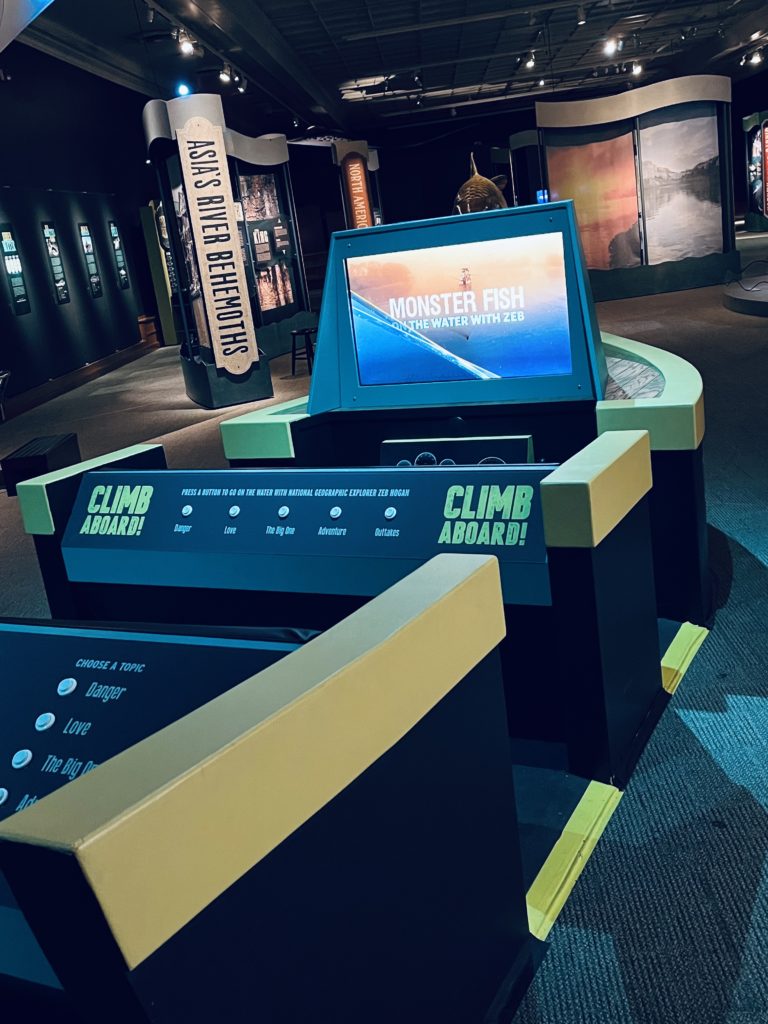
If your work involves the study of river fish, boats are essential tools. In Monster Fish: In Search of the Last River Giants, an exhibition developed and travelled by National Geographic, the vital role of watercraft as research platforms is acknowledged through an interactive display that resembles a boat. Here visitors are welcomed aboard a simulated 15-foot vessel to sit on bow-facing bench seats and watch on-the-water video clips of big fish and Dr. Zeb Hogan, host of the popular Nat Geo Wild show.

Small boat with large antennae on the water.

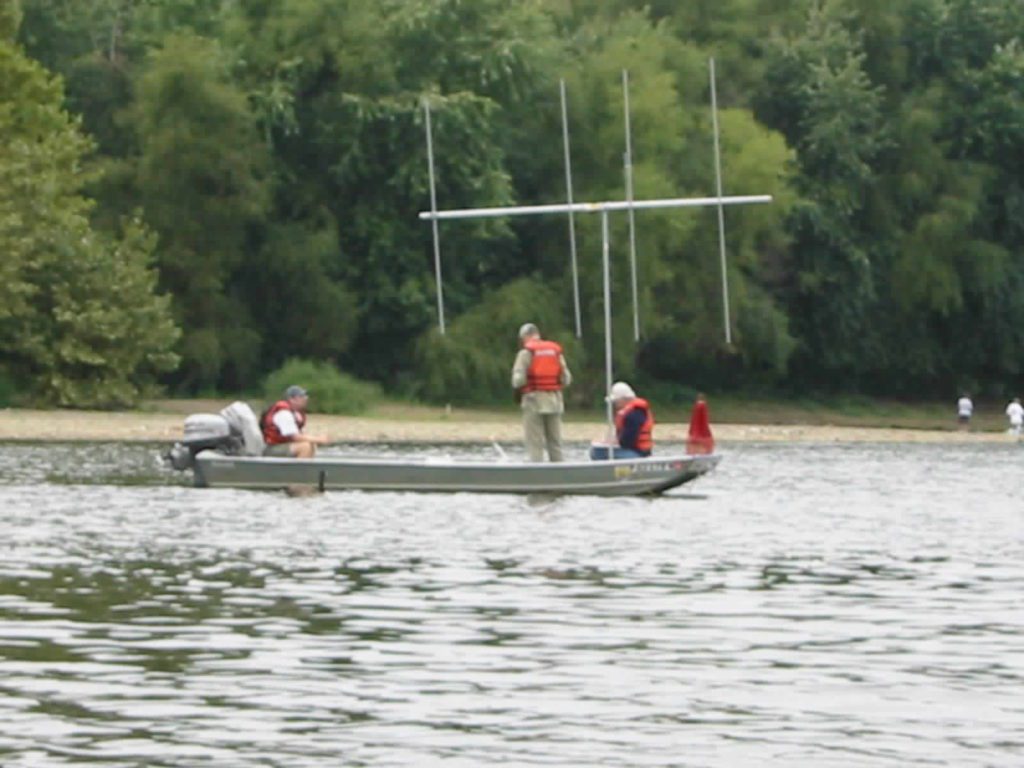
Back in 2002 and 2003, when fisheries biologist Patrick Barry and a small team of assistants relied upon a similar-sized boat to study the movements of American Paddlefish in Pittsburgh’s rivers, an antenna towered 15 feet above the craft.  “Other people on the rivers certainly noticed us when we were out on the water.” Barry explains, “The antenna made us pretty conspicuous.”  

There was nothing secret about the research, which was a collaborative effort involving the Pennsylvania Fish and Boat Commission, U.S. Geological Survey, U.S. Army Corps of Engineers, West Virginia Division of Natural Resources, California University of Pennsylvania, and Penn State University. There was, however, little local public knowledge about paddlefish, a native species that disappeared from the river system here in the 1920’s, and a creature whose fossil lineage dates back some 100 million years. Barry was then a fisheries science graduate student at Penn State, and his thesis research was intended to shed light on the limited success of paddlefish reintroduction efforts conducted by the PA Fish and Boat Commission during the early 1990s.

The project included targeted public outreach efforts. Barry created a bright yellow mini-poster bearing the headline “Have You Seen This Fish?” above a picture of his long-snouted thesis subject, and placed dozens of copies at marinas, boat launches, and fishing tackle shops along the sections of the Allegheny River and Ohio River in his study area. A pair of impressive paddlefish facts were shared below the picture – the creature’s potential to attain a length of seven feet, and a weight of up to 100 pounds – followed by a plea to release any paddlefish soon after capture, and to contact Barry with information about the circumstances of the catch.

Paddlefish sculpture in a museum.

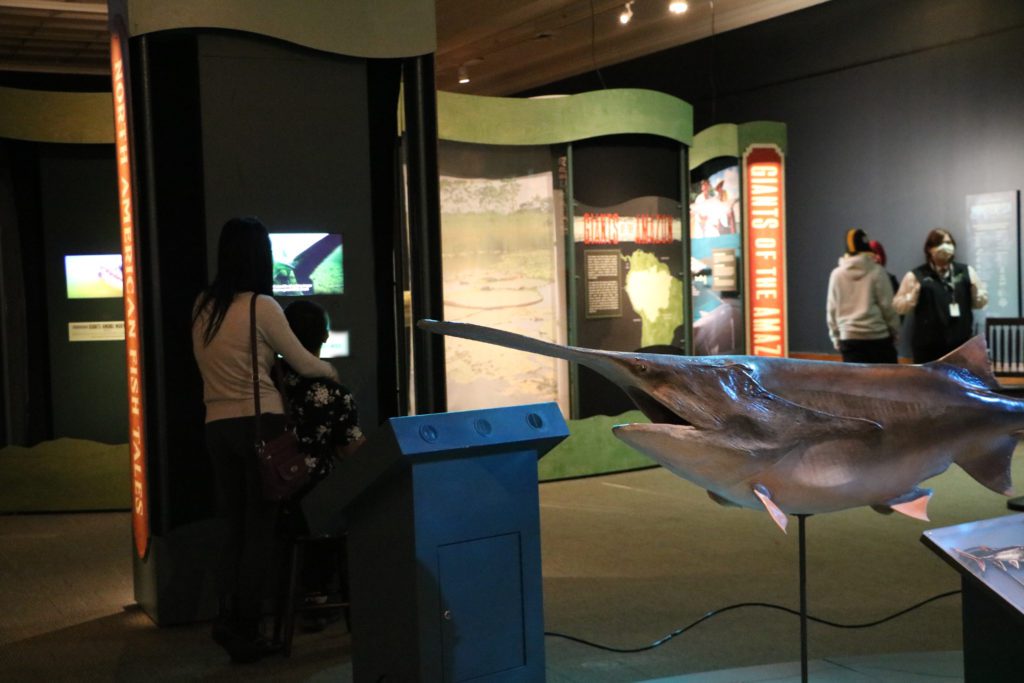
Visitors to Monster Fish are presented with far more information about the big river resident known to science as Polyodon spathula. A six-foot long American Paddlefish replica is the centerpiece of the exhibition’s North American sector, owing to the species’ wide distribution in most of the larger rivers in the Mississippi River Watershed. Off the model’s left flank is an information panel describing the eye-catching long bill as an extraordinary sensory organ, explaining the species’ plankton diet, and introducing a Yangtze River relative last seen in 2003, the Chinese Paddlefish. Off the fish’s right flank a video display titled “OPEN WIDE” shows how the creature’s widely opened mouth and comb-like bony interior function as an effective plankton-capturing screen.

The fish Barry worked with were far smaller than the exhibit model. Over the two years of his study he and his team released a total of 66 hatchery-reared juvenile paddlefish ranging, in “eye-to-tail length,” from 10 to 12 inches. Each had been fitted with pencil-thin battery-powered radio transmitters that weighed less than 2% of the fish’s body weight. Releases were staged in late September both years, and Barry’s goal, during the nine weeks following each event was to relocate, with the aid of the boat-mounted antenna, each fish every day. Each relocation, when recorded with the aid of a Global Positioning System (GPS) unit, added important information about dispersal distance, direction of movement, habitat preference, and overall survival.

Today Patrick Barry is Watershed Program Manager for the Bridger Teton National Forest in western Wyoming, where instead of relocating wandering fish, his daily goals are related to the implementation of policy and management of staff to provide clean water and sustainable forests for current and future needs. From his office in Afton, WY during a recent phone conversation he was happy to summarize his findings from Pittsburgh waters nearly two decades ago. He noted that days relocating tagged fish frequently stretched into nights of doing the same, and the routine during the study periods was to “get up the next day, and do it all over again.” 

He heard back from people who encountered his yellow mini-posters, and many of their reports reinforced a paddlefish behavior he had observed firsthand. “People in boats saw the fish in places where currents brought nutrient-rich waters up to the sunny surface, but these people were never in metal boats. They’d be in a fiberglass canoe, never an aluminum one. The long snout of the paddlefish contains sensors that can detect the electrical charge of anything metal in the water. You aren’t likely to see one if you’re in a metal-hulled boat.”

When asked about the long-term viability for paddlefish in Pittsburgh area waters, Barry pointed immediately to a longstanding gap in the species’ habitat requirements. “Historically the Pittsburgh’s rivers have been able to flood and recede, a cycle that creates gravel bars in some places. Paddlefish need gravel bars to spawn, and during the study we weren’t able to pinpoint a single suitable spawning spot it in the survey territory.”

Although Barry has worked professionally with our continent’s western trout and salmon species since his months on the water in Pittsburgh, his closing comments convey his continued fascination with paddlefish. “There’s a lot of current interest in the species’ sensory powers. A young paddlefish can detect the wingbeats of a single zooplankton in the water column and adjust its glide pattern to intercept and eat it.”

Patrick McShea works in the Education and Visitor Experience department of Carnegie Museum of Natural History. Museum employees are encouraged to blog about their unique experiences and knowledge gained from working at the museum.

Related Content

The Art of Making Fish Familiar

Rating River Residents On the Monster Scale

March Mammal Madness and Middle School Science Class

Carnegie Museum of Natural History Blog Citation Information

Blog author: McShea, Patrick
Publication date: March 29, 2022

Share this post!

  • Share on Twitter Share on Twitter
  • Share on Facebook Share on Facebook
  • Share on Pinterest Share on Pinterest
  • Share on LinkedIn Share on LinkedIn
  • Share on Reddit Share on Reddit
  • Share via Email Share via Email

Filed Under: Blog Tagged With: Monster Fish, Pat McShea

March 10, 2022 by Erin Southerland

March Mammal Madness and Middle School Science Class

by Patrick McShea

At one suburban Pittsburgh school, the tournament bracket sheets currently generating discussions have nothing to do with basketball. Since 2013, science teacher Christian Shane has strengthened science engagement among the seventh and eighth students he teaches at North Allegheny District’s Ingomar Middle School through participation in a group learning project designed by scientists and educators that borrows its organizational structure, timing, and alliterative name from the annual NCAA Division 1 Men’s Basketball Tournament.

March Mammal Madness is clearly a take on the far better known, March Madness, the branding name for the weeks-long college tournament whose single game elimination schedule, when plotted as a chart in advance of the start date, invites fans to use their background knowledge to predict, frequently as a bet or wager, the outcome of every game.

Participants in March Mammal Madness are also asked to make far-seeing predictions, but on theoretical battle encounters involving mainly mammals rather that basketball games. The online event began in 2013 as the idea of Dr. Katie Hinde, a researcher and Associate Professor at Arizona State University. Since its early days, tournament organizers have made great efforts to raise bracket-filling decisions beyond the realm of guess work through the creation of an extensive and easy to use website that is part of the Arizona State University Library system.  

Once the creatures selected for the annual competition are announced in late February, participants of all ages and academic backgrounds can visit the site to locate a range of accurate and up-to-date information about each species. At Ingomar Middle School, Christian’s students used the site as an aid in creating a series of Animal Research Trading Cards for all 65 of this year’s combatants. In seventh grade classes, online research of some combatants, including black bear, grizzly bear, coyote, mountain lion, and beaver, was bolstered by firsthand examination of mammal skulls borrowed from the CMNH Educator Loan Collection.   

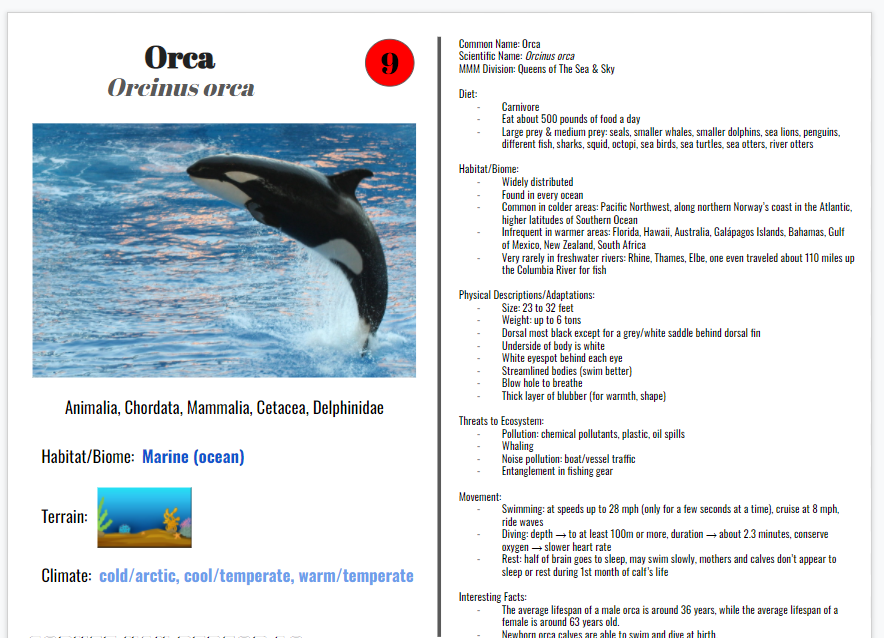
Playing card with the image of an orca and the following text: Orca Orcinus orca
Common Name: Orca Scientific Name: Orcinus orca MMM Division: Queens of The Sea & Sky
Diet:
Carnivore Eat about 500 pounds of food a day Large prey & medium prey: seals, smaller whales, smaller dolphins, sea lions, penguins, different fish, sharks, squid, octopi, sea birds, sea turtles, sea otters, river otters
Habitat/Biome:
Widely distributed Found in every ocean Common in colder areas: Pacific Northwest, along northern Norway's coast in the Atlantic, higher latitudes of Southern Ocean Infrequent in warmer areas: Florida, Hawaii, Australia, Galápagos Islands, Bahamas, Gulf of Mexico, New Zealand, South Africa Very rarely in freshwater rivers: Rhine, Thames, Elbe, one even traveled about 110 miles up the Columbia River for fish
Physical Descriptions/Adaptations:
Size: 23 to 32 feet Weight: up to 6 tons Dorsal most black except for a grey/white saddle behind dorsal fin Underside of body is white White eyespot behind each eye Streamlined bodies (swim better) Blow hole to breathe Thick layer of blubber (for warmth, shape)
Animalia, Chordata, Mammalia, Cetacea, Delphinidae
Habitat/Biome: Marine (ocean)
Threats to Ecosystem:
Pollution: chemical pollutants, plastic, oil spills Whaling Noise pollution: boat/vessel traffic Entanglement in fishing gear
Terrain:
Movement:
Swimming: at speeds up to 28 mph (only for a few seconds at a time), cruise at 8 mph, ride waves Diving: depth to at least 100m or more, duration about 2-3 minutes, conserve oxygen slower heart rate Rest: half of brain goes to sleep, may swim slowly, mothers and calves don't appear to sleep or rest during 1st month of calf's life
Climate: cold/arctic, cool/temperate, warm/temperate
Interesting Facts:
The average lifespan of a male orca is around 36 years, while the average lifespan of a female is around 63 years old. Newborn calves are able to swim and dive at birth
Orca Animal Research Trading Card

In summarizing his own recently completed bracket, Christian provides an example of an epic pinnacle encounter. “I went with the Alaska theme in picking Grizzly vs Orca, with Orca for the win! #TeamOrca.” Lest a battle example featuring two top-of-the-food-web predators gives a distorted view of the sound and fury of theoretical matches, this information from the “Frequently Asked Questions” section of the tournament website reminds participants that some matches wouldn’t make for good television:

The battles are NOT always “nature, red in tooth and claw.” Sometimes the winner “wins” by displacing the other at a feeding location, sometimes a powerful animal doesn’t attack because it is not motivated to.

Evidence that this year’s bracket has created middle school-level excitement among the scientists and educators at Carnegie Museum of Natural History arrived in a recent email reminder Curator of Mammals John Wible sent to colleagues participating in this year’s event:

Now in case you were befuddled by some of the common names used in the brackets (e.g., therapsid or pangolin) I have attached a listing of all the taxonomic names for the combatants. So for example, there are 8 species of pangolins and which one is the pangolin here . . . Smutsia gigantea, the giant pangolin from Africa.

In the first two rounds, I remind you that the location of the battle is in the home habitat of the higher seeded (with the lower number!) combatant. From round 3 on, there is one of four random environments for the battles announced before the battle.

Providing greater public insight into how scientists think about the world we all share is in fact one of the broader impacts of March Mammal Madness. Last year, in a research paper documenting the event’s development, reach, and benefits, the creative team responsible for March Mammal Madness offered this insight:

Scientists situate ourselves in the domain of data collection framed by hypotheses and predictions as we speculate about the world(s) around us. But fundamentally these are just grown-up words for ideas hewn from imagination and the creative combination of what is known to journey into the unknown. March Mammal Madness is collective, “performance science” – the stories of animals, told creatively with awe for the natural world. We celebrate species and the ecosystems they inhabit, the scientists who conduct studies, and the funders who make the research possible.  (https://elifesciences.org/articles/65066#s7)

As the March Mammal Madness tournament progresses, you’ll be able to follow some commentary from CMNH scientists and educators on Twitter @CarnegieMNH.

Teachers who would like to follow the overall tournament may also want to use #2022MMMk12 with their students for a more student-friendly twitter feed.

Patrick McShea works in the Education and Visitor Experience department of Carnegie Museum of Natural History. Museum employees are encouraged to blog about their unique experiences and knowledge gained from working at the museum.

Related Content

World Pangolin Day

March Mammal Madness 2019

Don’t Overlook the Lichens

Carnegie Museum of Natural History Blog Citation Information

Blog author: McShea, Patrick
Publication date: March 10, 2022

Share this post!

  • Share on Twitter Share on Twitter
  • Share on Facebook Share on Facebook
  • Share on Pinterest Share on Pinterest
  • Share on LinkedIn Share on LinkedIn
  • Share on Reddit Share on Reddit
  • Share via Email Share via Email

Filed Under: Blog Tagged With: Education, mammals, Pat McShea

March 10, 2022 by Erin Southerland

St. Patrick and Our Fear and Fascination With Snakes

by Patrick McShea

Through the lens of natural history, the legend of a Fifth Century Christian Missionary driving the snakes of Ireland into the sea has no factual basis. Ireland was snake-less territory long before the man now known to the world as Saint Patrick arrived on the scene, a condition attributable to the massive glacial ice sheet that covered the island and surrounding territories beginning approximately 26,000 years ago. In the centuries since the ice melted, as the Irish landscape became hospitable to various plants and animals, the surrounding cold Atlantic waters prevented the migration of snakes from nearby lands.

Colorful stained glass window depicting St. Patrick.
“Saint Patrick (stained glass)” by jcbwalsh is marked with CC BY-NC 2.0.

If St. Patrick’s enduring reputation as a reptile wrangler can be best explained by reference to religious symbolism, his legendary feat remains a testament to the long-standing fear and fascination humans have for snakes. Proof of this two-fold regard can also be found in the myths that persist in places where encounters with snakes are commonplace.

Colorful stylized snake
2022 logo for the St. Patrick’s Festival in Dublin, Ireland

In Pennsylvania, where 21 species of snakes are considered to be native, a considerable amount of misinformation about our legless neighbors has developed during the Commonwealth’s 235-year history. Most of myths can be easily addressed – hoop snakes, creatures capable of holding their tails in their mouths to roll down hills, simply do not exist; the source of the cucumber smell some people associate with copperheads might be a habitat odor created by the rot of decaying bark and other vegetation; and snakes are simply not physically equipped to dig their own extensive tunnel systems. 

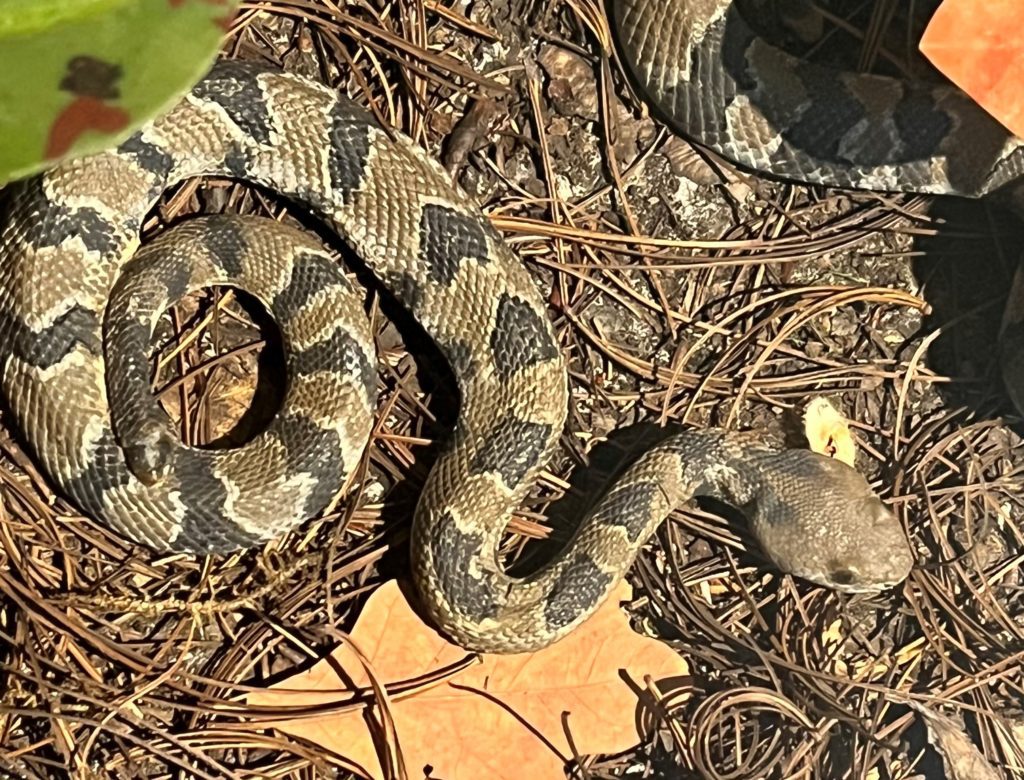
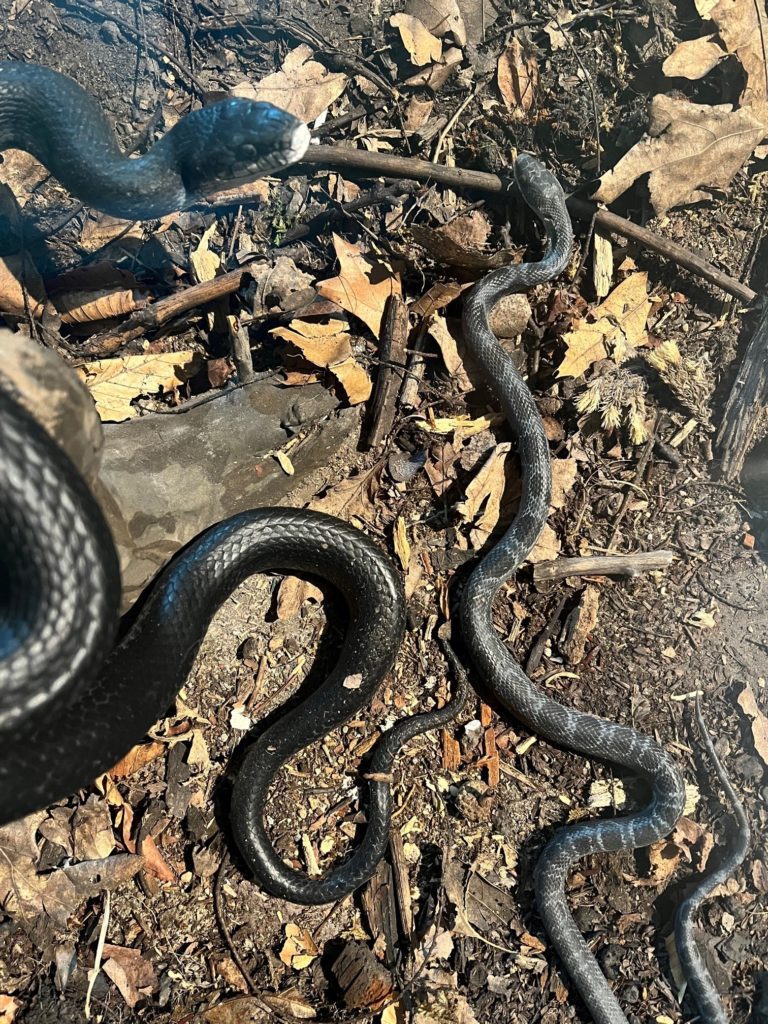
One particularly persistent myth involves interbreeding between timber rattlesnakes (Crotalus horridus), one of three venomous species found in Pennsylvania, and black rat snakes (Pantherophis alleghaniensis), a common species that frequently draws human attention because of its tree climbing abilities. Young black rat snakes have a banded pattern that has repeatedly led some human observers to speculate about rattlesnake ancestry.

Museum display of timber rattlesnakes.
In the display of Pennsylvania’s venomous snakes, a tiny button of a rattle is visible on the tail end of this nine-inch-long timber rattlesnake.

The Pennsylvania snake displays on the Daniel G. & Carole L. Kamin T. rex. Overlook are the perfect place to develop the type of memory image required identify a young black rat snake, and perhaps minimize the attendant anxiety of an unexpected future encounter. 

Museum display of black rat snakes.
A display of Pennsylvania’s non-venomous snakes includes a juvenile black rat snake (right) next to a larger and darker adult.

Patrick McShea works in the Education and Visitor Experience department of Carnegie Museum of Natural History. Museum employees blog about their unique experiences and knowledge gained from working at the museum.

Related Content

What is a Shamrock?

Section of Minerals and Earth Sciences Celebrates Being Lucky!

The Enduring Appeal of Snakes

Carnegie Museum of Natural History Blog Citation Information

Blog author: McShea, Patrick
Publication date: March 11, 2022

Share this post!

  • Share on Twitter Share on Twitter
  • Share on Facebook Share on Facebook
  • Share on Pinterest Share on Pinterest
  • Share on LinkedIn Share on LinkedIn
  • Share on Reddit Share on Reddit
  • Share via Email Share via Email

Filed Under: Blog Tagged With: Pat McShea, Science News

March 8, 2022 by Erin Southerland

Reptiles, and Amphibians, and Bones? Oh My!

by Anais Haftman

I am a fourth year biology student at Duquesne University who has had the pleasure to work in the Section of Amphibians and Reptiles since 2021. Most of my time working in the section has been dedicated to cleaning the bones of specimens in the collection to ensure proper long-term preservation. With over 7,000 osteology (skeletal) specimens in the section, bone cleaning can be a tedious task. With the help of the museum’s Conservator Gretchen Anderson, and Collection Manager of Amphibians and Reptiles Stevie Kennedy-Gold, the long process of conserving and improving the quality of the osteologic specimens has been a breeze.

Why is a clean osteology collection important? 

Conservation of specimens (wet and dry) in research collections is of the of the utmost importance because each specimen is a time and place record of species occurrence that can be re-examined as necessary. Some specimens are notable for having informed past research, and all specimens are held in public trust for their potential to inform current and future research. Because our specimens are routinely loaned out to researchers for use in studies, we work to ensure that their work is not diminished by ensuring the highest quality specimens possible. As the quality of a specimen decreases, the quality of information received from it also decreases. 

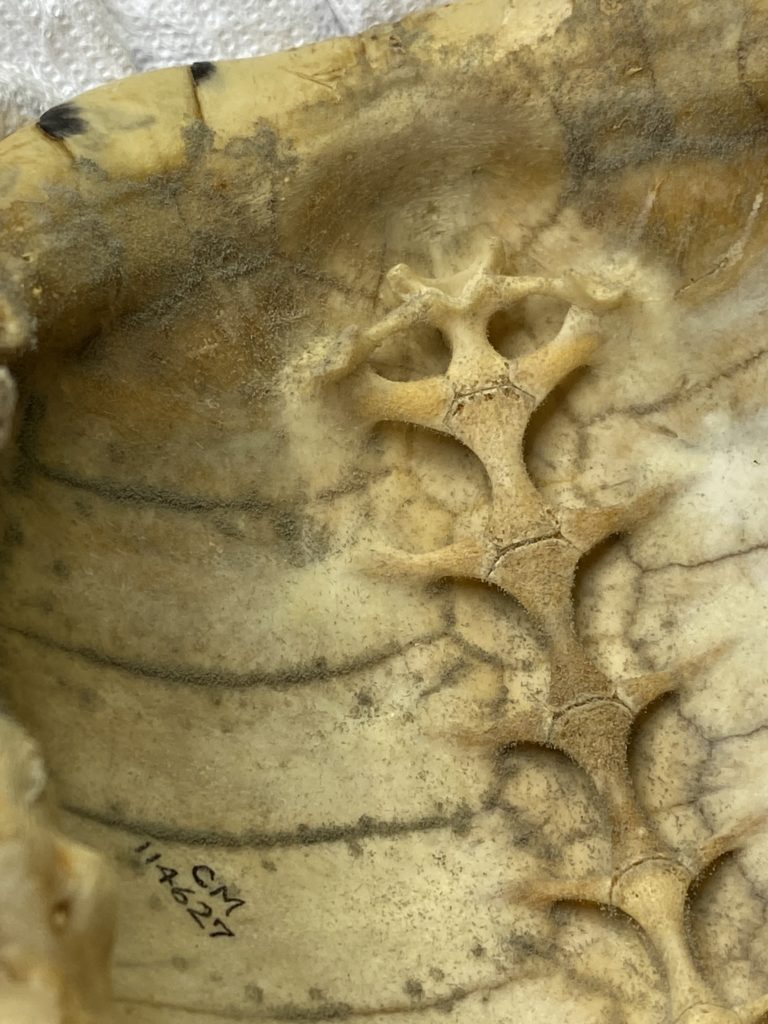
Close up of a turtle shell with the specimen number CM 114627 on it.
There’s no separating a turtle’s backbone from its shell, even for cleaning purposes. Photo by Stevie Kennedy-Gold.

What makes the osteology specimens unclean?

One of the most common culprits behind our need to clean bones are dermestid beetle larvae. But wait, why in the world would there be beetles in the bone boxes? Dermestid beetle larvae are commonly used to eat flesh and cartilage off specimens before they are added to the collection. During this process sometimes a larva or two wiggle themselves into small holes in the bones and are not seen when the bugs are cleaned off prior to storage. In these cases, we simply remove any long dead hitch-hiker larvae we find.

Sometimes natural oils and fats also remain on bones after the initial dermestid cleaning. In these cases, the cleaning process becomes more complicated. The most common circumstance that creates a need for cleaning, however, is the presence of inactive mold on specimens. Most of the time this issue can be easily solved by using a simple paint brush or Q-tip. But other times, particularly on large sturdy bones, I needed to put in a good amount of elbow grease!

How is the bone cleaning done?

Gretchen taught Stevie and I all we needed to know to properly clean bone specimens. The first step is always to visually inspect the specimen and record its condition. We make sure to write down its identifying collection number, what species it is, whether it’s a whole skeleton or only parts, if there were dermestid larvae still present on the specimen, and much more.

Person cleaning bones with a vacuum.
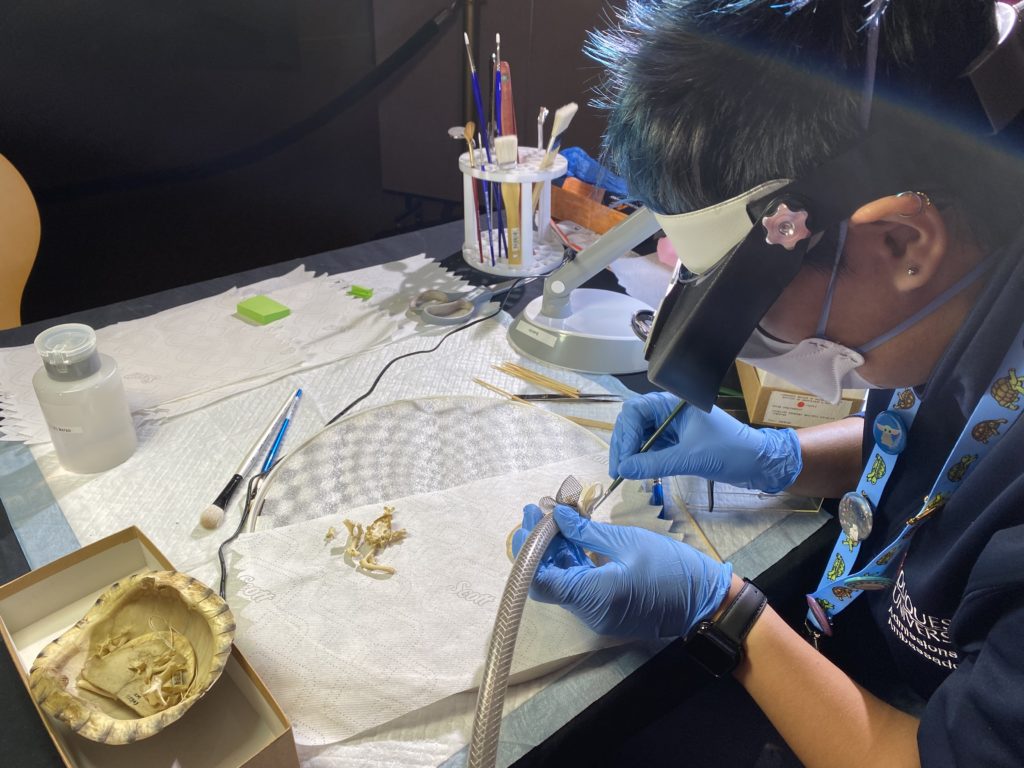
The author using the vacuum tube to clean bones. Photo by Stevie Kennedy-Gold.

Once the data collection on the initial quality is complete, the cleaning can begin. We initially use a Nilfisk HEPA vacuum tube (a device we named R2-D2) to clean any inactive mold from the bones. Wearing protective masks, we manually loosen the mold and push it into the vacuum using paint brushes. Once the mold is removed, we are able to inspect the bones for presence of larvae or secreted oils. If there are larvae present, we carefully remove them with tweezers and put them in our “bug box.” If there are oils present, a Q-tip is used to clean it off. For smaller bones, such as individual vertebrae, a soak in 70% ethanol is often part of the cleaning process. 

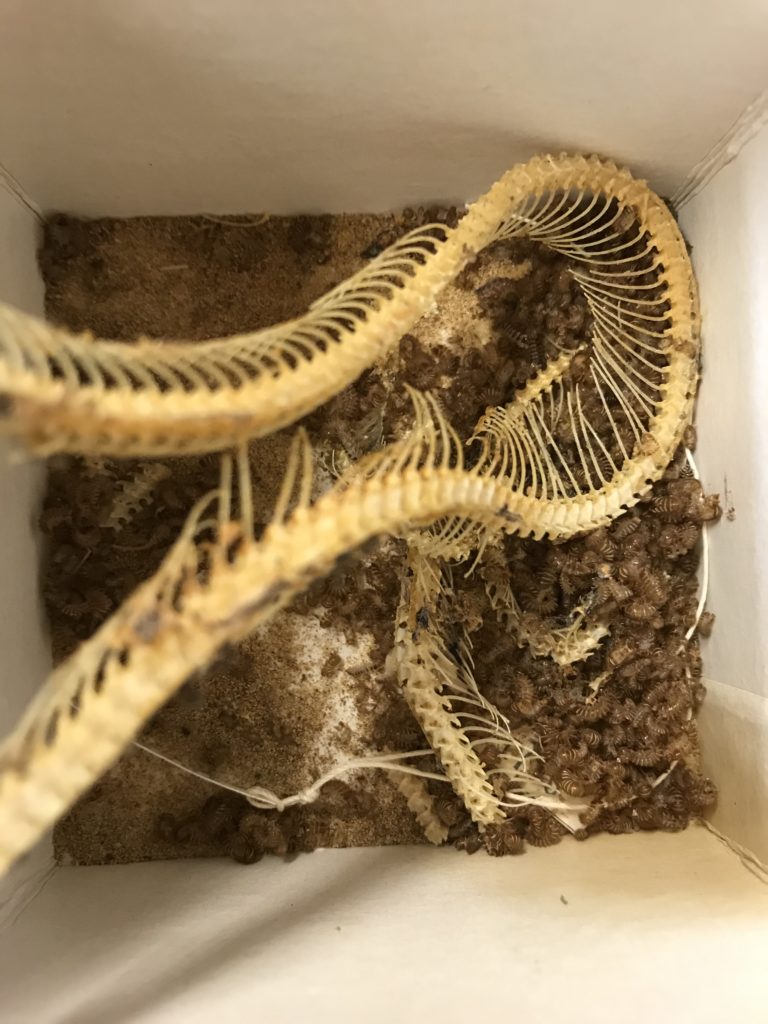
Snake vertebrae in a container from above
The delicate ribs and vertebrae of a snake require a delicate cleaning touch. Photo by Stevie Kennedy-Gold.

Depending on the quality and size of the osteological specimen, it can take anywhere from fifteen minutes to an hour to clean completely. Overall, much of the work to preserve osteologic specimens happens behind the scenes. This vital work is an example of the never-ending important tasks performed by both staff and volunteers that make the museum an important resource for scientific research.

Anais Haftman is a biology student at Duquesne University and works in the Section of Amphibians and Reptiles at the museum. Museum staff, volunteers, and interns blog about their unique experiences and knowledge gained from working at the museum. 

Related Content

Digital Developments: Why Archiving and Herpetology Go Hand-in-Hand

Photos of Fluid-Preserved Specimens: A Different Kind of Portrait

Saddle Cleaning

Carnegie Museum of Natural History Blog Citation Information

Blog author: Haftman, Anais
Publication date: March 8, 2022

Share this post!

  • Share on Twitter Share on Twitter
  • Share on Facebook Share on Facebook
  • Share on Pinterest Share on Pinterest
  • Share on LinkedIn Share on LinkedIn
  • Share on Reddit Share on Reddit
  • Share via Email Share via Email

Filed Under: Blog Tagged With: amphibians and reptiles, Anais Haftman, Science News

March 2, 2022 by Erin Southerland

Antarctica and the Anthropocene: Novel Species to the Polar South and Their Ecological Impact

by Nicholas Sauer

For better or worse, humans have left an impact on every corner of the globe, and Antarctica is no exception. One of the ways humans have altered Antarctica’s unique environment is by unintentionally introducing new plant and animal species to the continent. The presence on the continent of human-introduced novel species can be interpreted as a mark of the Anthropocene, a term scientists use for the recent decades during which human activities have created environmental impacts great enough to constitute distinct geological and earth system change, and a new era in the Earth’s history. While most novel species do not survive Antarctica’s polar elements, a few do. As of 2021, there were eleven known novel invertebrate species, including insects and mollusks, thriving on the more hospitable coastal areas of Antarctica. For context, there are 163 species of bivalves, 568 species of gastropods, and three species of insects that currently make the continent home. Of the three insect species, only the midge B. antarctica, flightless and measuring under a centimeter long, is native to Antarctica. Novel species while not always intrinsically dangerous to their new homes and neighbors, have the potential to change their adopted ecosystems in profound and unforeseen ways.

Antarctica

Eretmoptera murphyi – a novel midge to Antarctica changes nutrient cycling

One of the most fascinating of Antarctica’s human-introduced invertebrate species is the midge Eretmoptera murphyi, that has made Signy Island, Antarctica home since the 1960s. This species of midge inadvertently made its way to the polar South as a stowaway on a scientific expedition focused on plant transplantation. The insects found Signy Island well-suited for colonization: they have no predators there, can survive “ice entrapment,” continue to respire when in water, and produce larvae unfazed by freezing temperatures. The fact that the species is parthenogenetic—that is, reproduces without fertilization—also eases its survival. Each new generation emerges from the soil and melting ice over the course of the summer season and then disperses on the wind, expanding the species’ range. Today the density of some E. murphyi populations on Signy exceed that of any other insect population on the island. 

Furthermore, the midge discovered an excellent food source in the island’s abundant peat deposits. E. murphyi consumes the peat and then excretes it as nitrogen-rich soil. In the area that the midge occupies, the amount of nitrogen in the soil matches what a scientist could expect to find in soil surrounding a seal colony. The novel midge’s excretion of nitrogen is “opening nutrient cycling bottlenecks” on the island says Jesamine Bartlett, a scientist studying E. murphyi on Signy. Bartlett compares the species to an earthworm regarding its creation of nutrient-rich soil. However, per Bartlett, the island has never before hosted a creature that performed such a role to her knowledge. It remains to be seen just how this heightened level of nitrogen in the soil—which acts as a fertilizer—could alter the abundance of the island’s plant populations, particularly that of mosses, hair grass, and pearlwort. In addition to its potential effect on Signy’s flora, scientists caution that E. murphyi could eventually outcompete and displace the island’s pre-existing insect populations, particularly that of B. antarctica, Antarctica’s only endemic insect species and one that can only reproduce via fertilization. Because it is parthenogenetic and reproduces more easily, scientists are curious to see if the novel midge E. murphyi could one day prove heartier than the native species, and what the presence of the novel midge means for Signy Island’s biodiversity in the long-term.

How Are Novel Species Introduced to Antarctica?

Species such as E. murphyi spread into new territories traveling with humans, often via the laces and tread of shoes, acting as literal living components of our footprint. Seeds of non-native plants hitch a ride to new habitats on human travelers’ clothes. In fact, each tourist unknowingly brings on average an estimated nine seeds with them to Antarctica according to Stephen Chown of Stellenbosch University in South Africa. In 2010 there were approximately 40,000 tourists who visited the continent. That’s potentially 360,000 novel seeds introduced to Antarctica in just one year, though most will not successfully establish themselves. According to a study led by researchers from Monash University in Australia, only sixteen percent of Important Bird Areas in Antarctica are found in regions “negligibly impacted” by humans. These scholars and conservationists argue that the image of Antarctica as “remote” is unhelpful and obscures the profound impact humans have on its coastal regions, regions that contain the continent’s greatest biodiversity. The goal of the team’s research is to encourage Antarctic Treaty nations to take concrete steps to further protect Antarctica’s natural environment and wildlife. As a landmass not under the jurisdiction of any one nation, Antarctica’s ecological protection hinges on global cooperation.

More than ever before, maintaining Antarctica’s unique ecosystems—safeguarding the continent’s biosecurity—is of paramount importance. The scientific community and the ecotourism industry are making efforts to adhere stringently to the Antarctic Treaty, the Antarctic Conservation Act, and Antarctic Science and Tourism Conservation Act, international agreements in place to protect the continent’s delicate ecology and facilitate ethical research and tourism. Per these agreements, travelers to Antarctica are prohibited from bringing seeds, plants, or animals including insects onto the continent. Travelers are also barred from bringing probiotics and SCOBY (symbiotic culture of bacteria and yeast), a key ingredient of kombucha and yogurt. Both products contain “biologically viable organisms”—bacteria—that could have an adverse effect on the Antarctic environment if left uncontrolled. Under the Antarctic treaties, cargo en route to Antarctica  must be thoroughly inspected and sanitized before being shipped and unloaded. Customs inspectors from treaty-member nations are on the lookout for rotting fruits and vegetables, food scraps, spores, mold, soil, living animals, and signs of living animals like wasps’ nests, and a vast array of other “biosecurity risk material.” The United States’ Antarctic Program Participant Guide asks that prospective researchers make sure that “there are no seeds or other plant parts caught in Velcro, no mud on boots, and no grass inside cuffs.” Even the smallest of novel organic materials onboard ship or onboard a traveler’s sleeve have the potential to impact Antarctica’s isolated environment. 

Antarctica in the Anthropocene 

In the profoundly interconnected world of the Anthropocene, people have introduced many novel species to Antarctica, be they mollusks attached to a ship’s hull, seeds stuck to a scientist’s parka, or midges clinging to a hiking boot or plant specimen. Novel species cause direct changes to the local ecology, and the impacts may be getting more dire, as the continent is also being altered by human-caused global climate change. Already Antarctica is warming five times as fast as the global average, and its ice sheets are melting  (with grim consequences to the coastal regions everywhere as sea levels rise). Global climate change can only be solved through people and nations working collaboratively to reduce dependence on fossil fuels. And in the meantime in Antarctica, as we travel deeper into the twenty-first century, the scientific community and governments around the world are learning to be more mindful of the human impact on Earth’s southernmost continent and searching for ways—such as better biosecurity—to keep Antarctica’s unique ecology as intact and resilient as possible.

Nicholas Sauer is a Gallery Experience Presenter in CMNH’s Life Long Learning Department. Museum staff, volunteers, and interns are encouraged to blog about their unique experiences and knowledge gained from working at the museum. 

References

“Antarctica.” National Geographic. 2021. <https://www.nationalgeographic.org/encyclopedia/antarctica/>.

“Antarctica more widely impacted by humans than previously thought.” Sciencedaily.com. 17 July 2020. <https://www.sciencedaily.com/releases/2020/07/200717120155.htm>.

Bartlett, Jesamine, et al. “An insect invasion of Antarctica: the past, present and future distribution of Eretmoptera murphyi (Diptera, Chironomidae) on Signy Island.” Insect      Conservation and Diversity, vol. 13, January 2020. <https://onlinelibrary.wiley.com/doi/full/10.1111/icad.12389>. 

Garcia, Sierra. “Antarctica Is Warming. Are Invasive Species on the Way?” Jstor.org. 28 June 2021. <https://daily.jstor.org/antarctica-is-warming-are-invasive-species-on-the-way/>.

Lucibella, Michael. “Insects in the Extreme: What the Genes of Antarctica’s Tough Little Midge             Can Tell Us.” The Antarctic Sun. 29 June 2020. <https://antarcticsun.usap.gov/science/4427/>.

Perkins, Sid. “Antarctica Threatened by Alien Seed Invasion.” Wired.com. 3 March 2012. <https://www.wired.com/2012/03/antarctica-plant-seeds/>.

Scharping, Nathaniel. “Even Antarctica has Invasive Species.” Discovermagazine.com. 19 Dec. 2018. <https://www.discovermagazine.com/environment/even-antarctica-has-invasive-species>.

Sexton, Chrissy. “Non-Native Insect Species Become a Major Threat in Antarctica.” Earth.com. 19 Dec. 2018. <https://www.earth.com/news/non-native-insect-species-antarctica/>.

Shukla, Priya. “Tourists are Bringing Invasive Species to Antarctica.” Forbes.com. 27 Dec. 2021. < https://www.forbes.com/sites/priyashukla/2021/12/27/tourists-are-bringing-invasive-species-to-antarctica/?sh=1244b66f3bc8>.

Solly, Meilan. “How Antarctica’s Only Native Insect Survives the Freezing Temperatures.” Smithsonian Magazine. 10 Sept. 2019. <https://www.smithsonianmag.com/smart- news/how-antarcticas-only-insect-resident-survives-freezing-temperatures-180973087/>.

“33 Antarctic Species We Love and Must Protect: Part 1.” Pew Charitable Trusts. 16 Sept. 2014. <https://www.pewtrusts.org/en/research-and-analysis/fact-sheets/2014/09/counting-          downtoccamlr#:~:text=Antarctic%20mollusks,new%20species%20have%20been%20dis         covered.>.

“United States Antarctic Program Participant Guide: 2018-2020 Edition.” National Science Foundation. June 2018. < https://www.usap.gov/USAPgov/travelAndDeployment/documents/ParticipantGuide_2018-20.pdf>.

“What is Biosecurity?” Australian Antarctic Program. 14 July 2020. <https://www.antarctica.gov.au/antarctic-operations/travel-and-logistics/cargo-and-      freight/biosecurity-measures/what-is-biosecurity/>.

“What is Biosecurity Risk Material (BRM)?” Australian Antarctic Program. 14 July 2020.<https://www.antarctica.gov.au/antarctic-operations/travel-and-logistics/cargo-and-          freight/biosecurity-measures/biosecurity-risk-material/>.

Related Content

Pittsburgh’s Moths Reflect Human Impact of Industry

Climate Change Never Takes a Holiday: The Phenomenon of the Pizzly Bear

Magnificent Frigatebirds: The Flying Pirates of the Caribbean

Carnegie Museum of Natural History Blog Citation Information

Blog author: Sauer, Nicholas
Publication date: March 2, 2022

Share this post!

  • Share on Twitter Share on Twitter
  • Share on Facebook Share on Facebook
  • Share on Pinterest Share on Pinterest
  • Share on LinkedIn Share on LinkedIn
  • Share on Reddit Share on Reddit
  • Share via Email Share via Email

Filed Under: Blog Tagged With: Nicholas Sauer, We Are Nature 2

  • « Go to Previous Page
  • Page 1
  • Interim pages omitted …
  • Page 15
  • Page 16
  • Page 17
  • Page 18
  • Page 19
  • Interim pages omitted …
  • Page 24
  • Go to Next Page »

sidebar

About

  • Mission & Commitments
  • Directors Team
  • Museum History

Get Involved

  • Volunteer
  • Membership
  • Carnegie Discoverers
  • Donate
  • Employment
  • Events

Bring a Group

  • Groups of 10 or More
  • Birthday Parties at the Museum
  • Field Trips

Powdermill

  • Powdermill Nature Reserve
  • Powdermill Field Trips
  • Powdermill Staff
  • Research at Powdermill

More Information

  • Image Permission Requests
  • Science Stories
  • Accessibility
  • Shopping Cart
  • Contact
  • Visitor Policies
One of the Four Carnegie Museums | © Carnegie Institute | Privacy Policy | Terms of Use | Accessibility
Rad works here logo