• Skip to primary navigation
  • Skip to main content
  • Skip to primary sidebar

Carnegie Museum of Natural History

One of the Four Carnegie Museums of Pittsburgh

  • Visit
    • Buy Tickets
    • Visitor Information
    • Exhibitions
    • Events
    • Dining at the Museum
    • Celebrate at the Museum
    • Powdermill Nature Reserve
    • Event Venue Rental
  • Learn
    • Field Trips
    • Educator Information
    • Programs at the Museum
    • Bring the Museum to You
    • Guided Programs FAQ
    • Programs Online
    • Climate and Rural Systems Partnership
  • Research
    • Scientific Sections
    • Science Stories
    • Science Videos
    • Senior Science & Research Staff
    • Museum Library
    • Science Seminars
    • Scientific Publications
    • Specimen and Artifact Identification
  • About
    • Mission & Commitments
    • Directors Team
    • Museum History
  • Tickets
  • Give
  • Shop

Andrew McAfee

August 12, 2019 by wpengine

Travels with a Sketchbook: A Natural History Artist’s Observations at the Museum

Carnegie Museum of Natural History has a large and expansive collection of artifacts, oddities, and wonders. It also has its fair share of mounted animals and skeletons on display, which makes it an ideal spot for the wandering artist. Where else can an artist study both extinct and extant species up close and in great detail? If, like me, you’re an illustrator who loves to draw animals, you could, for example, grab your sketchbook and head to the museum’s Bird Hall to get a close look at the flightless dodo (Raphus cucullatus). Driven to extinction by European colonists during the 1600s, early artists’ renderings provide some of the best evidence for the dodo’s appearance in life. Perhaps surprisingly, this bird is now known to be closely related to pigeons!
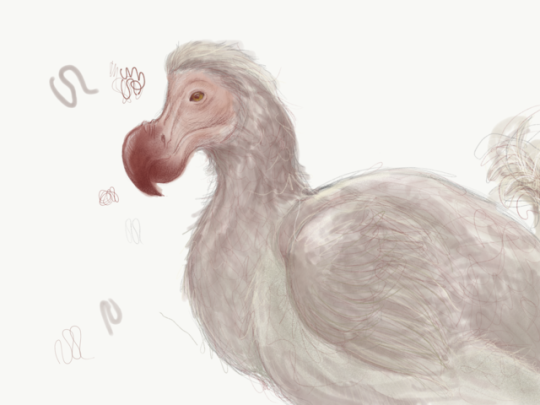
Dodo (Raphus cucullatus) in Bird Hall at Carnegie Museum of Natural History. Sketch by the author.

If your tastes are more prehistoric, check out the museum’s sprawling Dinosaurs in Their Time exhibition. Travel back in time to ancient seas and imagine the graceful movements of the plesiosaur Dolichorhynchops bonneri while the giant carnivorous mosasaur Tylosaurus proriger hovers ominously above you. These marine reptile groups vanished in the mass extinction that also wiped out non-avian dinosaurs roughly 66 million years ago.
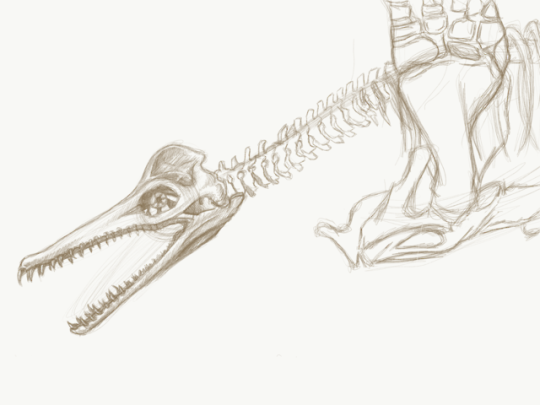
Skeleton of the short-necked plesiosaur Dolichorhynchops bonneri in the Dinosaurs in Their Time exhibition at Carnegie Museum of Natural History. Sketch by the author.

Or perhaps you’re more interested in observing and sketching modern day animals? If so, visit the Hall of North American Wildlife and Hall of African Wildlife on the museum’s second floor. Get up close and personal with the Nile crocodile (Crocodylus niloticus) trio and capture their anatomy in detail. It’s the safest way to do so – not to mention the only way to do so here in Western Pennsylvania! (Reports of alligators in our rivers notwithstanding.)
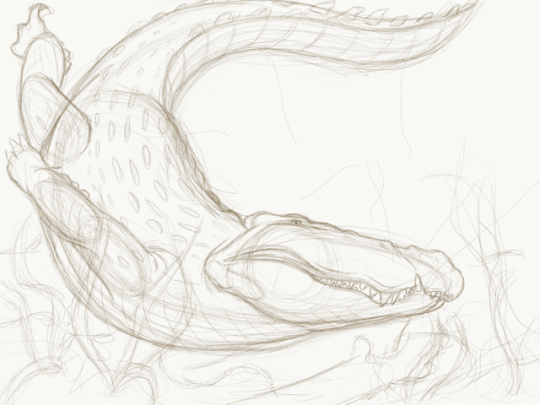
Nile crocodile (Crocodylus niloticus) in the Hall of African Wildlife at Carnegie Museum of Natural History. Sketch by the author.

So, my fellow artists and nature lovers, as I hope this post has shown, there are scores of species to inspire you here at the museum. Grab your sketchbook and come on over!

Hannah Smith is an intern working with Scientific Illustrator Andrew McAfee in the Section of Vertebrate Paleontology at Carnegie Museum of Natural History. Museum employees, interns, and volunteers are encouraged to blog about their unique experiences and knowledge gained from working at the museum.

Related Content

Celebrating Women in the Natural History Art Collection

Art and the Animal

New Vision of Old Rock Art

Carnegie Museum of Natural History Blog Citation Information

Blog author: Smith, Hannah
Publication date: August 12, 2019

Share this post!

  • Share on Twitter Share on Twitter
  • Share on Facebook Share on Facebook
  • Share on Pinterest Share on Pinterest
  • Share on LinkedIn Share on LinkedIn
  • Share on Reddit Share on Reddit
  • Share via Email Share via Email

Filed Under: Blog Tagged With: Andrew McAfee, bird hall, Birds, dinosaurs in their time, fossils, Hall of African Wildlife, Vertebrate Paleontology

July 27, 2018 by wpengine

My Guildey Pleasure

By Andrew McAfee

As the Scientific Illustrator for the Section of Vertebrate Paleontology at Carnegie Museum of Natural History, I spend most of my time in the museum interpreting and representing the paleontologists’ work in visual form. Most of this work takes place at a desk with a computer. But as a member of the Guild of Natural Science Illustrators (GNSI), I spend one week per year away from the desk, learning new techniques in the field and sharing a few of my own.

The GNSI is an organization of scientists and science illustrators founded in 1968 by illustrators at the Smithsonian Institution in Washington, DC. The purpose of the GNSI is to advance science illustration by facilitating the exchange of ideas, knowledge, and techniques among its members.

Every year around July, the GNSI has a conference that brings members from all around the world together for a week of plenary speakers, technique expositions, lectures, and workshops. It’s a wonderful opportunity to commune with colleagues in the field of scientific illustration and acquire new perspectives and technical abilities.

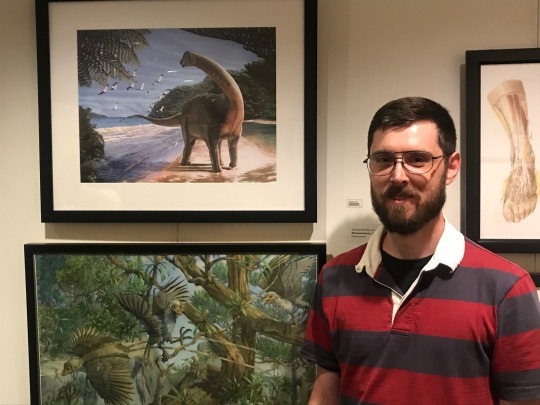
Andrew McAfee with his digital painting of Mansourasaurus 
Andrew McAfee with his digital painting of Mansourasaurus (upper left) on display in GNSI’s 50th anniversary exhibition, Visualize: Art Revealing Science, at AAAS headquarters. Photo: Reid Psaltis.

I joined the GNSI in 2013 and have not missed a conference since. This year’s event marked the 50th anniversary of the Guild’s formation and represented a homecoming, returning to Washington, DC. As a part of our anniversary celebration, the American Association for the Advancement of Science (AAAS)—known for, among other things, publishing one of the world’s foremost scientific journals, Science—hosted our annual members’ juried exhibition.

This year I was honored to have two pieces selected for exhibition in the show: my reconstructions of the recently-named dinosaurs Mansourasaurus shahinae and Tratayenia rosalesi, both completed at Carnegie Museum of Natural History under the guidance of paleontologist Matt Lamanna. I was proud to represent the museum and it was gratifying to see my work sharing walls with the stellar work of my colleagues in the AAAS gallery.

Visualize: Art Revealing Science, the 50th anniversary GNSI exhibit, will be on display at AAAS headquarters until October 15, 2018.

Andrew McAfee is Scientific Illustrator for the Section of Vertebrate Paleontology at Carnegie Museum of Natural History. Museum employees are encouraged to blog about their unique experiences and knowledge gained from working at the museum.

Filed Under: Blog Tagged With: Andrew McAfee, dinosaur, dinosaurs, dinosaurs in their time, paleontology, Vertebrate Paleontology

March 29, 2018 by wpengine

Time Travel… No Flux Capacitor Required

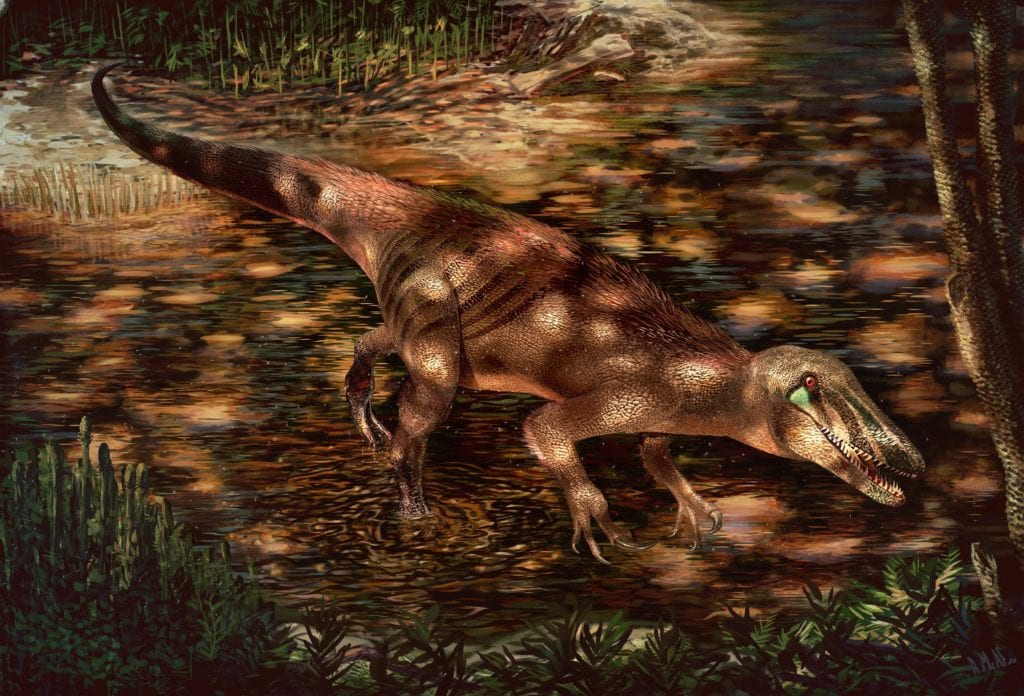
drawing of the dinosaur crossing a stream in its natural habitat
The newly discovered meat-eating dinosaur Tratayenia rosalesi crosses a stream in what is now northern Patagonia, Argentina some 85 million years ago.
Credit: Andrew McAfee, Carnegie Museum of Natural History.

By Matt Lamanna

I’m a child of the 1980s. When I was a kid, one of my favorite movies was Back to the Future, where Doc Brown turns a car into a time machine that sends Marty McFly into the past. I’d watch that movie and think, “How cool would it be if time travel were real?” We could go back in time and, say, hear Abraham Lincoln deliver the Gettysburg Address, or watch Michelangelo paint the ceiling of the Sistine Chapel. We could gaze in wonder at the Great Pyramid under construction, marvel at a herd of passing mammoths, or witness a ‘Lucy’-like creature take humanity’s first steps. We could even go all the way back to the Mesozoic Era – the Age of Dinosaurs.

Sadly—spoiler alert!—time travel is still not possible, at least not in the literal way that the creators of Back to the Future imagined. But there is another way to see dinosaurs in the flesh. One only needs a talented artist.

Over the years, I’ve had the good fortune to have worked with many artists to (virtually) bring dinosaurs and other extinct creatures back to life. From my old buddy the ‘Wookiee’ Jason Poole, to dynamic husband-and-wife duo Bob Walters and Tess Kissinger, to dino-sculptors extraordinaire Dan Pickering, Gary Staab, and Bruce Mohn, to rising stars Taylor Maggiacomo and Lindsay Wright, and others, each of these gifted natural history artists has graciously shared their time and talent to help my scientific collaborators and I breathe life into ancient bones.

Two artists deserve special mention here. For more than a decade, from 2004 to 2015, I was blessed to be able to work with Mark Klingler, the long-time Scientific Illustrator here in Carnegie Museum of Natural History’s Section of Vertebrate Paleontology. Mark and I worked together to give the world its first look at many new fossil discoveries, such as the semi-truck-sized dinosaur Sarmientosaurus, the bizarre ‘Chicken from Hell’ Anzu, and the ~120 million-year-old bird Gansus.

Mark gave the museum and I one final gift prior to his departure in 2015: he hosted an intern, Andrew McAfee, then a newly minted graduate of the Science Illustration program at Cal State University Monterey Bay. Andrew continued to volunteer at the museum after Mark left, and did such a fantastic job that, in 2016, we hired him as Vertebrate Paleontology’s new Scientific Illustrator.

Like Mark before him, Andrew is meticulous when it comes to reconstructing a prehistoric species and its habitat. Case in point: our hot-off-the-presses predatory dinosaur from Patagonia, Tratayenia, which was formally announced by my Argentine collaborators and I yesterday morning. Tratayenia is a fascinating dinosaur, and was undoubtedly a terrifying beast in life, but unfortunately, we paleontologists don’t have very much of it – its fossils are pretty incomplete. So how, you ask, was Andrew able to produce the image above?

Well, he and I first had to build a picture of the dinosaur itself. Tratayenia is a megaraptorid, a group of mysterious hunters that roamed South America, Australia, and probably other Southern Hemisphere continents during the Cretaceous, the third and final time period of the Mesozoic Era. Using the bones of other megaraptorids, we made educated guesses as to what the missing pieces of the Tratayenia skeleton may have looked like. From there, we used our knowledge of the closest living relatives of dinosaurs—birds—to put meat, skin, and feathers back on the bones; in other words, to reconstruct the parts of the body that are rarely found as fossils. Finally, since we have almost no idea what color Tratayenia may have been, I encouraged Andrew to get creative here. The pattern he came up with seems suited to an animal that probably relied on stealth and camouflage to ambush its prey.

After we had Tratayenia to the point where it looked ready to jump off the screen and bite us, it was then time to put the animal back into its 85-million-year-old world. To do so, I scoured the scientific literature on the rock formation that yielded the bones of the new dinosaur, looking for clues as to what its ancient environment was like and what other species called it home. Andrew painted several of these plants and animals into his reconstruction. Look for a thigh bone of the giant herbivorous dinosaur Traukutitan and plants such as ferns, horsetails, flowering herbs, and a conifer belonging to the group Cheirolepidiaceae.

We can’t go back in time to the Age of Dinosaurs, not really at least. But through the skill and vision of natural history artists, working in tandem with paleontologists, we can catch glimpses of what these extraordinary animals and their long-vanished worlds may have been like. Andrew and I are already revving up the DeLorean for our next trip to the Mesozoic.

Matt Lamanna is a paleontologist and the principal dinosaur researcher at Carnegie Museum of Natural History. Museum employees are encouraged to blog about their unique experiences and knowledge gained from working at the museum.

Read more about Tratayenia on Reuters.

Filed Under: Blog Tagged With: Andrew McAfee, dinosaur, Matt Lamanna

sidebar

About

  • Mission & Commitments
  • Directors Team
  • Museum History

Get Involved

  • Volunteer
  • Membership
  • Carnegie Discoverers
  • Donate
  • Employment
  • Events

Bring a Group

  • Groups of 10 or More
  • Birthday Parties at the Museum
  • Field Trips

Powdermill

  • Powdermill Nature Reserve
  • Powdermill Field Trips
  • Powdermill Staff
  • Research at Powdermill

More Information

  • Image Permission Requests
  • Science Stories
  • Accessibility
  • Shopping Cart
  • Contact
  • Visitor Policies
One of the Four Carnegie Museums | © Carnegie Institute | Privacy Policy | Terms of Use | Accessibility
Rad works here logo