• Skip to primary navigation
  • Skip to main content
  • Skip to primary sidebar

Carnegie Museum of Natural History

One of the Four Carnegie Museums of Pittsburgh

  • Visit
    • Buy Tickets
    • Visitor Information
    • Exhibitions
    • Events
    • Dining at the Museum
    • Celebrate at the Museum
    • Powdermill Nature Reserve
    • Event Venue Rental
  • Learn
    • Field Trips
    • Educator Information
    • Programs at the Museum
    • Bring the Museum to You
    • Guided Programs FAQ
    • Programs Online
    • Climate and Rural Systems Partnership
  • Research
    • Scientific Sections
    • Science Stories
    • Science Videos
    • Senior Science & Research Staff
    • Museum Library
    • Science Seminars
    • Scientific Publications
    • Specimen and Artifact Identification
  • About
    • Mission & Commitments
    • Directors Team
    • Museum History
  • Tickets
  • Give
  • Shop

Blogs about the Anthropocene

Scientists use fossils and other traces to understand how the planet changed over time. In the past these changes were caused by forces like volcanic eruptions and shifts in oceans currents. Now there’s a new force of nature shaping the planet: humans. The effects on air, land, and water are significant enough that scientists propose we are a new geological time – the Anthropocene – or age of Humans.

These blogs are about the many facets of human impact on the Earth, documenting this new age.

September 21, 2018 by wpengine

Happy International Peace Day!

by Nicole Heller

At Carnegie Museum of Natural History, and with the upcoming Carnegie International, we are thinking a lot these days about the Earth and humanity, both the amazing cultural diversity and forms of human expression and knowledge, and also the sustainability challenges that have emerged with more than seven billion people and growing.

One story you might enjoy is about a group of adventurers who planted a newly designed flag of the Earth at the Arctic today after a three-month sailing journey. They planted this flag in hopes of inspiring others to join together locally and globally to re-think how we can better care for each other, and our collective home. A mission we share as we explore the Anthropocene at the museum. Check out the video about it here.

Nicole Heller is Curator of the Anthropocene for Carnegie Museum of Natural History. Museum employees are encouraged to blog about their unique experiences working at the museum.
Filed Under: Blog Tagged With: Anthropocene

September 13, 2018 by wpengine

Wet Weekend!

by Joylette Portlock

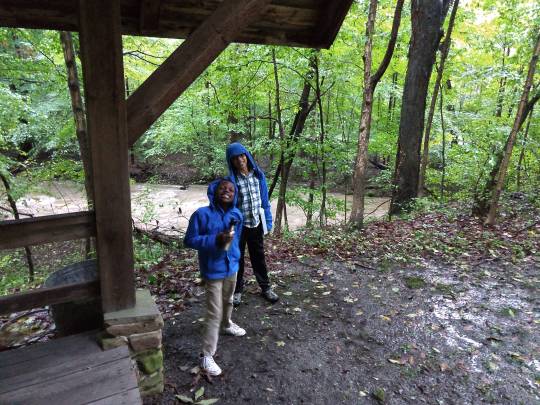
I had the chance to visit Powdermill Nature Reserve over the weekend. Yes, this past weekend, the one where it rained for three days almost continuously across a multi-state area. I took my kids with me, and we had a blast; after all, “rain is a grown-up problem.”* I have to say, the woods always feel so alive to me during/right after a hard rain. The world feels full of promise and power. As we watched Powdermill Run, swollen and wild, churning, cutting a new path through the woods after floods this summer, I thought of the power of water, to nourish, to sweep clean, and to cause damage.

kids in the rain

And, because being a grownup requires other grownup thoughts, I thought of the water in my basement, and considered, again, the costly prospect of installing a French drain around the house.

If you’re feeling like there seems to be more water than ever before, you’re not wrong. Climate change, one of the most significant challenges of the Anthropocene, is shifting the way water moves around the planet. It is resulting in more precipitation in places and at times where we don’t need it; a global phenomenon that is felt locally.

KDKA reported that this past Sunday in Pittsburgh was the second wettest day ever recorded in the area and we’ve already passed the yearly average rainfall. In other words, every drop from this point out in 2018 puts us closer to an annual “wettest ever” status, too.

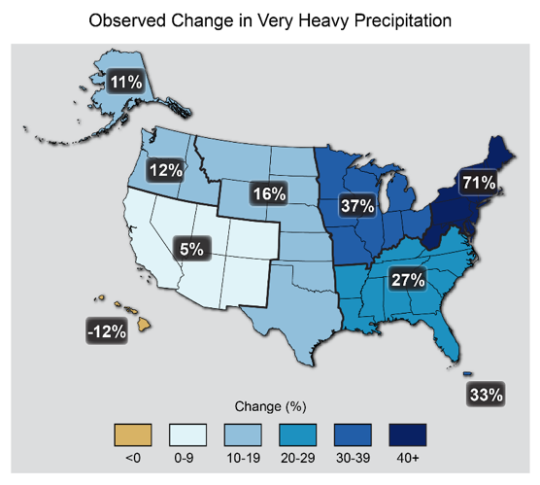
Our downpour this weekend is part of a trend. Since the 1950s, the amount of water falling during heavy downpours in this part of the U.S. has increased by 71%, per the 2014 National Climate Assessment, and that’s an increase that is definitely more than the natural variation:

The map shows percent increases in the amount of precipitation falling in very heavy events (defined as the heaviest 1% of all daily events) from 1958 to 2012 for each region of the continental United States; Adapted from: Global Climate Change Impacts in the United States.

This may come as a surprise – we usually talk about global warming in terms of heat waves and hurricanes – but climate scientists have known about these precipitation effects, which have a big impact even in non-coastal areas, for some time. It’s a big deal for flooding risk (and in areas like Pittsburgh, with a combined sewer-stormwater system, for water quality).

wow gif with LeVar Burton

In other words, it’s not just my basement at risk.

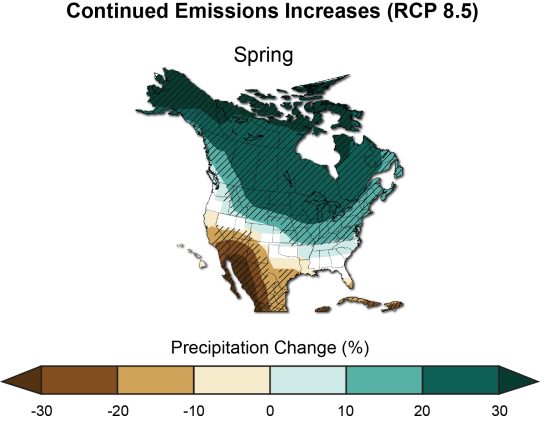
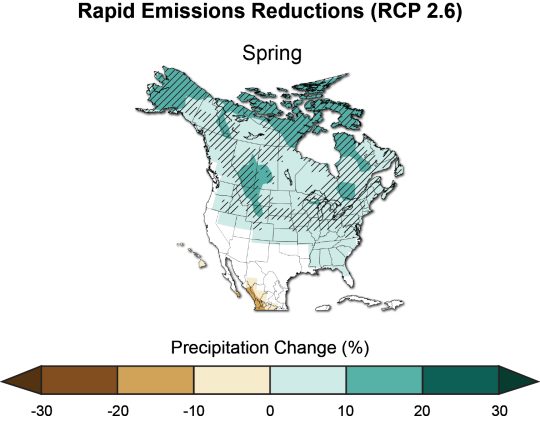
However, the forecast doesn’t have to be gloomy. Also from the National Climate Assessment: our actions right now make a difference, globally and locally. These maps show the projected difference in annual springtime precipitation, by 2090, if we take steps to dramatically reduce our impact on our climate now vs. if we don’t:

Springtime in 2090, Business as usual
Kenneth E. Kunkel, Cooperative Institute for Climate and Satellites – NC


Springtime in 2090, with changes
Kenneth E. Kunkel, Cooperative Institute for Climate and Satellites – NC

Grown-up problems, indeed. Playing in the rain can be very fun. And the world is full of promise and power. But perhaps Powdermill Run isn’t the only thing that requires a new path forward.

*Said to me by a summer camp counselor at the Pittsburgh Zoo and Aquarium in 2017 when I dropped my son off for camp on a rainy day.

Joylette Portlock, Ph.D., is associate director of science and research at Carnegie Museum of Natural History. She is also executive director of Communitopia, a nonprofit focused on climate change communication, and holds many other roles in the community. Museum employees are encouraged to blog about their unique experiences and knowledge gained from working at the museum.

From the National Climate Assessment website:

The National Climate Assessment summarizes the impacts of climate change on the United States, now and in the future.

A team of more than 300 experts guided by a 60-member Federal Advisory Committee produced the report, which was extensively reviewed by the public and experts, including federal agencies and a panel of the National Academy of Sciences.

Filed Under: Blog Tagged With: Anthropocene, climate change, Powdermill, Powdermill Nature Reserve, water

September 7, 2018 by wpengine

Collected on This Day in 2016: Japanese Stiltgrass

by Mason Heberling

Japanese Stiltgrass specimen

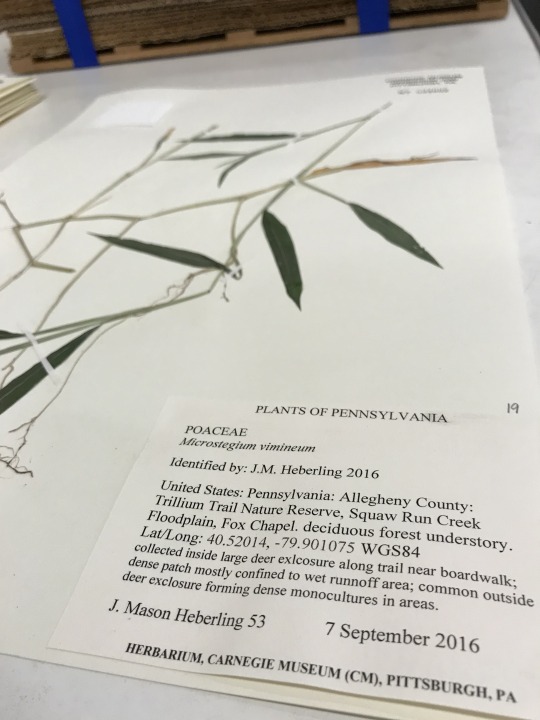
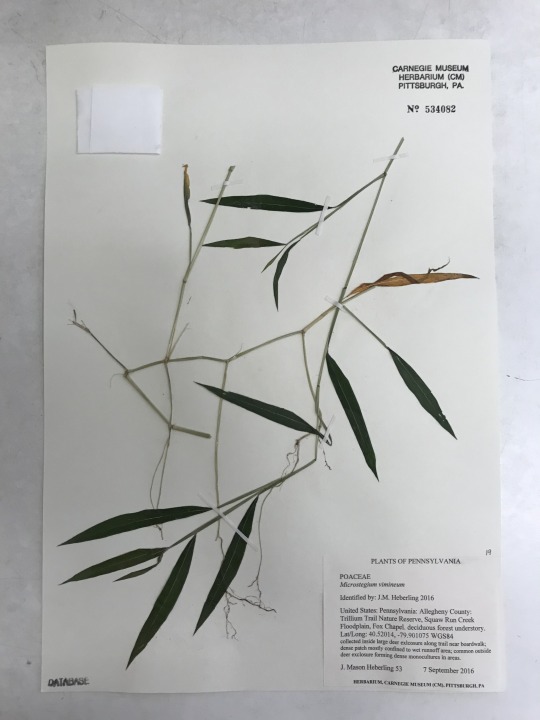
It is now a common plant in forests across Pennsylvania, but it wasn’t always.  This specimen of Japanese stiltgrass (Microstegium vimineum) was collected on September 7, 2016 by Mason Heberling (me!) at Trillium Trail, Fox Chapel, PA.  Native to East Asia, Japanese stiltgrass is an annual grass that is said to have first been introduced accidentally to Knoxville, Tennessee around 1919, used as packing material for porcelain dishes from China.  It has since become a major invasive species, spreading across forests of Eastern North America.  It is commonly found along trails, forest roads, and floodplains.  It has been shown to be facilitated by deer overabundance.  A recent study of unconventional gas well pads (such as “fracking”) in Pennsylvania by Penn State researchers found that recent hydraulic fracturing activities facilitates stiltgrass invasion (Barlow et al., 2017 Journal of Environmental Management).  Japanese stiltgrass is especially common in disturbed moist forests, where available light in the understory is higher.  Therefore, it often carpets the forest floor in disturbed forests.  High densities of deer have also been shown to facilitate stiltgrass invasions.  In fact, much of this research was done at Trillium Trail by Susan Kalisz (then at University of Pittsburgh, now at University of Tennessee Knoxville).  They used fences to exclude deer and found that stiltgrass was not present in fenced plots, but abundant when deer were allowed access. The Kalisz lab actively remains at Trillium Trail.

Japanese Stiltgrass specimen
Once  you  learn  to  recognize  this  grass,  you  are  likely  to  see  it  everywhere  in  forests  and  forest  edges  in  Western  Pennsylvania.  It  is  especially  obvious  in  the  Fall,  when  it  flowers  and  has  reached  its  peak  growth.  Note  the  faint  white  line  along  the  center  of  the  leaf  blades.

Although collected only two years ago, I was surprised to find that this specimen was the oldest Japanese stiltgrass specimen collected in Allegheny county!  There is a chance it had been collected earlier and exists in another herbarium. It was said to be uncommon (possibly absent) at Trillium Trail until 2002.

Japanese Stiltgrass
Microstegium  vimineum  carpeting  the  forest  floor  outside  deer  fences  at  Trillium  Trail.

What will our forests look like in another 10 years?  Herbarium specimens are important, verifiable sources to document our changing flora.  And ultimately, help conserve our flora.

Mason Heberling is a Postdoctoral Research Fellow in the Section of Botany at the Carnegie Museum of Natural History. Museum employees are encouraged to blog about their unique experiences working at the museum.

Filed Under: Blog Tagged With: Anthropocene, Botany, collected on this day, herbarium, Mason Heberling

September 4, 2018 by wpengine

Smoke Scenery

by Pat McShea

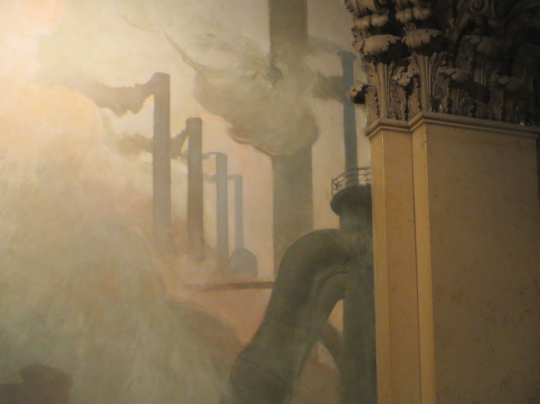
Detail from The Apotheosis of Pittsburgh mural by John White Alexander

A museum educator from Norway offered a novel way to interpret We Are Nature: Living in the Anthropocene. “This should be part of the story.” explained Bergsveinn Thorssonas he gestured at century-old steel industry scenes depicted in second-floor portions of the multi-level grand staircase mural painted by John White Alexander.

Thorsson, a PhD student who is studying how museums present current environmental issues, was fascinated by the smoky scenes and their marble pillar frames. “Owning our industrial history is important to understanding our current situation.” he added before conceding that he didn’t have advice for accomplishing such a task.

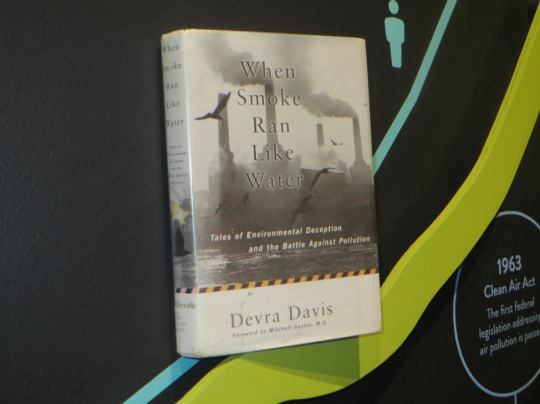
A copy of When Smoke Ran Like Waterpositioned at the 1948 mark on the population and atmospheric carbon level graph in We Are Nature
A copy of When Smoke Ran Like Water positioned at the 1948 mark on the population and atmospheric carbon level graph in We Are Nature

Since 2002, an excellent book-form model of industrial acknowledgement has existed in When Smoke Ran Like Water, by Donora, Pennsylvania native Devra Davis. The book, which Davis summarizes as an argument for “a fundamentally new way of thinking about health and the environment,” begins with a recounting of the most significant air pollution disaster in the United States – the build-up in Donora, some 25 miles southeast of Pittsburgh, during a five-day period in late October 1948, of a toxic fog of steel and zinc industry emissions that resulted in 20 deaths and 600 hospitalizations.

In Davis’s account, family histories, with all their hopes, accomplishments, and compromises, are central to the tragedy. A quote from her mother captures a common attitude toward the smoky scenery: “Look, today they might call it pollution. Back then it was just a living.”

Patrick McShea works in the Education and Visitor Experience department of Carnegie Museum of Natural History. Museum employees are encouraged to blog about their unique experiences and knowledge gained from working at the museum.

Filed Under: Blog Tagged With: Anthropocene, Pittsburgh, pollution, We Are Nature, We Are Nature 2, We Are Nature: Living in the Anthropocene

August 20, 2018 by wpengine

The Company We Keep

By Steve Tonsor

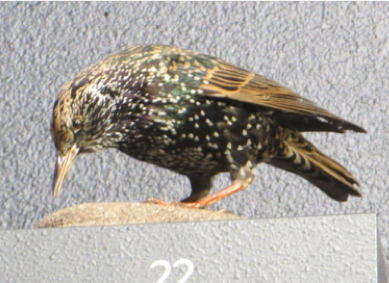
bird specimen

2500 years ago, Aesop wrote “We are known by the company we keep.” We experience the truth of this aphorism every day in our communities.  Have you ever considered that our communities include more than our human company? (If not, take a spin through our exhibit We Are Nature before it closes September 3.)

In recent times, we’ve talked as though we are walled off from the natural world, talking of “man vs. nature,” the “built urban landscape” vs. the “natural world.”  Yet, urban centers teem with life, not the same life to be found in a wilderness, but a rich and fascinating web of life nonetheless.  In fact, we aren’t even so numerically dominant in the urban ecosystem as we might think.  For example, common starlings, purposefully introduced birds, are ubiquitous in urban settings and according to biologist Menno Schilthuisen1 are now about equal in number with humans in North America.

In a less purposeful way, we’ve invited in all the creatures in our urban communities, by providing what is necessary for their survival.  The pigeons in our parks and urban squares were originally birds of Mediterranean and North African cliffs.  After humans began to dwell in those cliffs, and then constructed cliff-like buildings, the pigeons moved with us into the nouveaux cliffs of the urban ecosystem.  So it is with so many creatures, finding urban analogs to their wilder environments2.

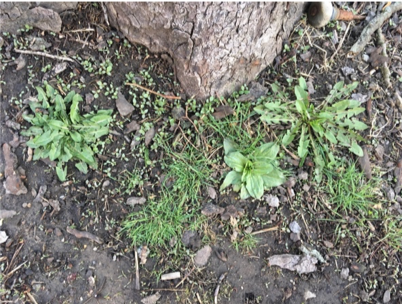
urban nature - weeds

We have invited in weeds by providing niches, literally in the urban concrete, and so they decorate the urban wastelands with the reminder that life will find a way. Are not the untended spots of the city more beautiful when adorned with weeds than they would be if old doorknobs and cigarette butts were the only decorations?

Over time, more and more creatures find a way into the emerging urban ecosystem. Whose cities are these?  Our attitudes toward the new entrants has varied from laissez faire to downright hostile, yet these creatures are a reflection of our nature.  We are known by the company we keep. We could be more accepting of our guests, and more deliberate and intentional about how we live and what creatures we as a consequence invite into our community3.  Let’s talk about that.

21,Schilthuizen, Menno. 2018. Darwin Comes to Town: How the Urban Jungle Drives Evolution. MacMillan 304 pp. ISBN: 9781250127822

3 Cooper, C. B., J. Dickinson, T. Phillips, and R. Bonney. 2007. Citizen science as a tool for conservation in residential ecosystems. Ecology and Society 12(2): 11. [online] URL: http://www.ecologyandsociety.org/vol12/iss2/art11/

Steve Tonsor is Director of Science at the Carnegie Museum of Natural History. Museum employees are encouraged to blog about their unique experiences and knowledge gained from working at the museum.

Filed Under: Blog Tagged With: Anthropocene, We Are Nature

August 20, 2018 by wpengine

Millions, Billions, and Trillions

By Chase D. Mendenhall

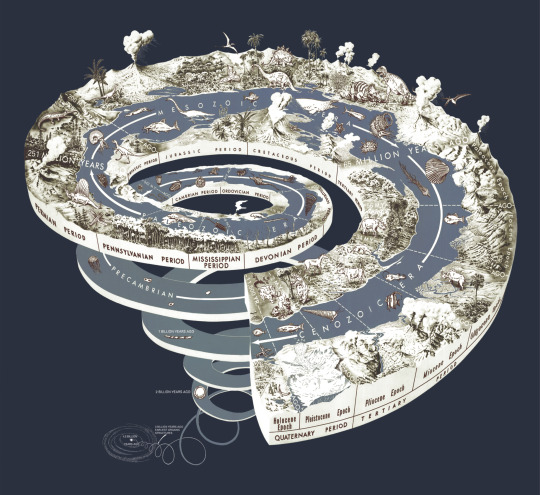
diagram of geologic time

President Trump has 53,800,000 followers on Twitter. The popular song Despacito has 5,400,000,000 views on YouTube. And, the computer giant, Apple, is worth nearly $1,000,000,000,000.

Millions, billions, and trillions are numbers we hear and see regularly nowadays, but the value of these giant numbers can get lost in all the zeros.

Comprehending these values is key to understanding natural history, but there are a couple tricks to put things into perspective.

For example, the earliest undisputed evidence of life, fossilized bits of Archean bacteria, are about 3.5-billion years old. To wrap your brain around this giant number, it is helpful to convert these large numbers into a human experience, say, an average human lifespan in the USA. Today, people can expect to live to be about 78-years old, or about 2.5 billion seconds. In other words, if you wanted to live for 3.5 billion seconds, you would be 110 years.

When biologists like me throw around numbers, like, “for 150 million years birds have been flying,” it is helpful to think of 150 million seconds as almost 5 years.

Chase Mendenhall is Assistant Curator of Birds, Ecology, and Conservation at Carnegie Museum of Natural History. Museum employees are encouraged to blog about their unique experiences and knowledge gained from working at the museum.

Filed Under: Blog Tagged With: Anthropocene, geology, paleontology

  • « Go to Previous Page
  • Page 1
  • Interim pages omitted …
  • Page 10
  • Page 11
  • Page 12
  • Page 13
  • Page 14
  • Interim pages omitted …
  • Page 16
  • Go to Next Page »

sidebar

About

  • Mission & Commitments
  • Directors Team
  • Museum History

Get Involved

  • Volunteer
  • Membership
  • Carnegie Discoverers
  • Donate
  • Employment
  • Events

Bring a Group

  • Groups of 10 or More
  • Birthday Parties at the Museum
  • Field Trips

Powdermill

  • Powdermill Nature Reserve
  • Powdermill Field Trips
  • Powdermill Staff
  • Research at Powdermill

More Information

  • Image Permission Requests
  • Science Stories
  • Accessibility
  • Shopping Cart
  • Contact
  • Visitor Policies
One of the Four Carnegie Museums | © Carnegie Institute | Privacy Policy | Terms of Use | Accessibility
Rad works here logo