• Skip to primary navigation
  • Skip to main content
  • Skip to primary sidebar

Carnegie Museum of Natural History

One of the Four Carnegie Museums of Pittsburgh

  • Visit
    • Buy Tickets
    • Visitor Information
    • Exhibitions
    • Events
    • Dining at the Museum
    • Celebrate at the Museum
    • Powdermill Nature Reserve
    • Event Venue Rental
  • Learn
    • Field Trips
    • Educator Information
    • Programs at the Museum
    • Bring the Museum to You
    • Guided Programs FAQ
    • Programs Online
    • Climate and Rural Systems Partnership
  • Research
    • Scientific Sections
    • Science Stories
    • Science Videos
    • Senior Science & Research Staff
    • Museum Library
    • Science Seminars
    • Scientific Publications
    • Specimen and Artifact Identification
  • About
    • Mission & Commitments
    • Directors Team
    • Museum History
  • Tickets
  • Give
  • Shop

anthropology

February 14, 2019 by wpengine

Looking at Love in Ancient Egypt

With Valentine’s Day here, it’s hard to ignore all of the chocolate displays in stores and the sappy movies on TV – some might say that love had been commercialized for companies to make a quick buck. While they may be right about America in 2019, the same cannot be said about the ancient Egyptians.  The Egyptians are credited with a lot.  They built the pyramids, they mummified bodies and had giant elaborate tombs.  One thing that people might not think about as often is how the Egyptians experienced love, marriage, and even infidelity and divorce.

Our first stop on the love train is the story of Isis and Osiris – two of the most famous gods of ancient Egypt.
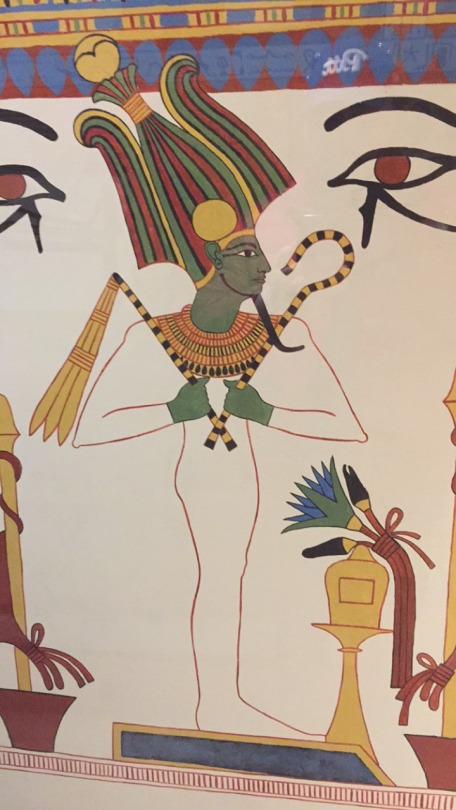
image of Osiris

As seen in this image from the Walton Hall of Ancient Egypt here at the Carnegie Museum of Natural History, Osiris is depicted as green-skinned, and he looks like a mummy! These are attributes unique to Osiris and they come from the story of himself and Isis.  Osiris was reigning as king, and his brother Set was not too happy about it.  So, he killed Osiris, tore his body into a bunch of pieces and strew them all over Egypt.  In her mourning, Osiris’ wife Isis traveled far and wide to gather all of the pieces of her husband to eventually put them all back together and had a child with him.  That child was Horus, who would then go on to avenge his father and kill his uncle.  If that’s not love, then I don’t know what is.

Our second stop is on the topic of marriage in ancient Egypt.  In American culture today, weddings are huge expensive parties that include entire families, huge cakes, and poufy dresses.  This is not anything like marriages in ancient Egypt.  Early marriages consisted of a woman entering a man’s house with whatever goods that they had agreed upon and the husband signing some paperwork.  Often marriages were arranged, but there is evidence that importance was placed on a loving couple, like love poems and songs found at the workers village of Deir el-Medina.  The people living in this area were usually tomb builders or painters, like Sennedjem, the owner of the tomb in Egypt on which our reconstruction is based.
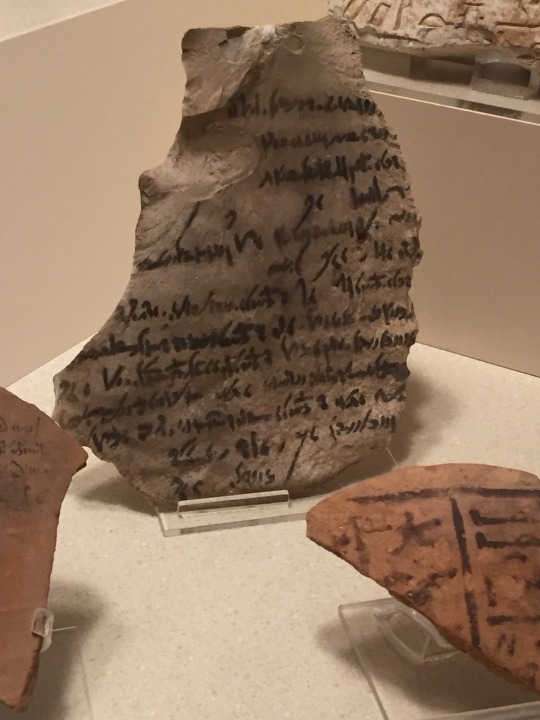
text on pottery shard from ancient Egypt

Love poems from Deir el-Medina could be found on similar surfaces as those on display in Walton Hall, like these shards of stone and ostraca (shards of pottery). Sometimes shards like these were used like “scratch paper” and discarded, leaving them for archaeologists to find.  According to Cameron Walker at National Geographic, these poems turned simple daily tasks such as catching fish into metaphors for their love.

Marriage was supposed to be everlasting for a good pair.  If you were faithful to your spouse and a good spouse overall, you could find them waiting for you in the afterlife.  If you were not good to them, you might not see them, or you might not even get to the afterlife at all.  But, Egyptian society was quite sophisticated, if things didn’t work out in life, there were options for divorce.  If either the husband or wife was dissatisfied, they could initiate a divorce, and the settlement was seemingly as simple as the marriage.  Some paperwork was signed, and assets were divided upon agreements during the marriage.  One important pillar of marriage was fidelity.  If a spouse was found to be unfaithful to their partner it would be seen as grounds for a divorce.

Overall, the Egyptians placed emphasis on being faithful and being a loving spouse.  But at least in the realm of the gods, there were cases of love that transcend our comprehension.  Let’s be honest, who would really go all over and find pieces of their dead spouse…anyone?  So, all in all the ancient Egyptians might seem to be a mysterious people but in the aspects of love and marriage they are really just like everyone else.  We are all just people looking for love and, in the case where we can’t find it, cheap sweets to tide us over.

Anthony Kamler is a volunteer in the Section of Anthropology. Museum employees and volunteers are encouraged to blog about their unique experiences working at the museum! 
Filed Under: Blog Tagged With: ancient egypt, anthropology, egypt, Erin Peters, Walton Hall of Ancient Egypt

August 21, 2018 by wpengine

Saddle Cleaning

by Ruth Fauman-Fichman

In the Section of Collection Care and Conservation at the Carnegie Museum of Natural History there are thousands of artifacts that silently scream for treatment. They wait patiently for their turn to be noticed. Some have been waiting for close to a hundred years, having gathered dirt and soot from their years ago acquisition by the museum. If it weren’t for Conservator Gretchen Anderson’s dogged dedication, many would still be waiting. They all harbor secrets, some easier to figure out than others. Many came to the museum long ago with limited information about themselves, tucked into dark corners.

At the “Annex” (the informal name for the O’Neill Research Center) one afternoon I found myself sitting in front of a sawhorse covered over with degrading plastic.  I had seen and moved around four of these sawhorses over the last year, always hearing from Ms. Anderson: “we can’t deal with these yet, but soon!” Now, as a result of a successful grant proposal to the National Endowment for the Humanities to upgrade the storage capabilities of the Anthropology holdings, I would finally be able to inspect and conduct a light cleaning of the contents underneath.

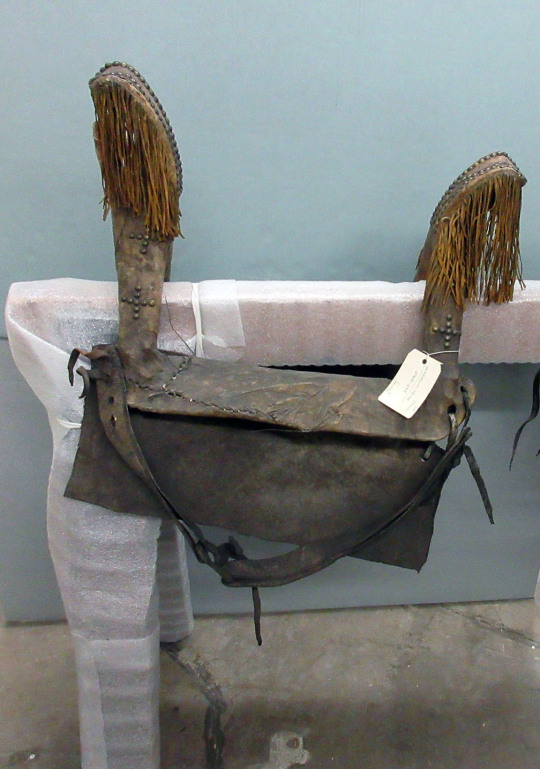
Woman’s saddle, before treatment.  
Woman’s saddle, before treatment.

With its non-archival plastic cover now discarded, the sawhorse hid a soot-black North American Indian woman’s saddle. What an ugly disappointment, I initially thought. What was it made of? Animal, vegetable, mineral? The only way to know was to carefully begin, using soft brushes. Almost immediately a surprise surfaced. This saddle was not just some indistinct blob! It was made of a combination of wood, antler, leather, brass ornaments and COLOR!

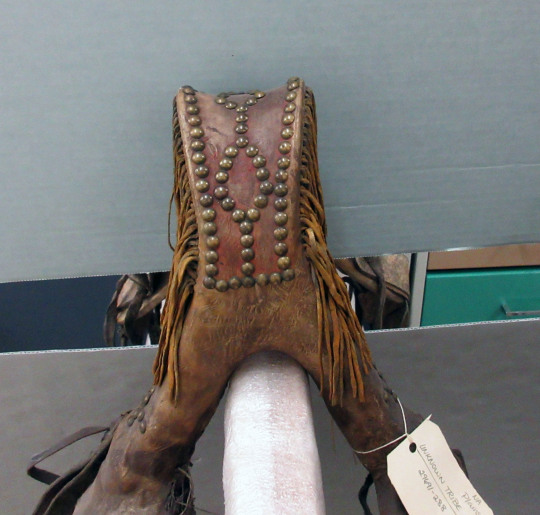
Brushing the top of the front tasseled pommel suddenly revealed intentional red ochre staining around the decoratively placed brass studs embedded in a cross pattern. Further careful cleaning changed the grey suede tassels to a luminous mustard-color. The same was revealed on the back pommel. Suddenly this non-descript saddle had personality and power! No longer disappointing, the rest of the six hours I spent cleaning this piece made me feel connected to the person who might have used it.

I carefully cleaned the rest of the piece over several sessions with soot sponges.  The seat and pommels were made of wood and antler, covered in leather sewn together with sinew. I noticed the tanned leather thongs used to tie each piece of the saddle together and attach to leather cinches placed around the belly of the small pony or horse.  The thongs were degrading practically to a powder with even limited handling from what Anderson and Collections Manager Deborah Harding called “red rot.” The woman who sat on this pony or horse shielded her thighs from being rubbed raw by rectangular pieces of leather attached to the saddle body with leather thongs. The “leathered” side of the rectangular piece rested against the pony and the suede side against the rider. Careful cleaning on the suede side revealed red stains. Red ochre? Horse blood? Something else?

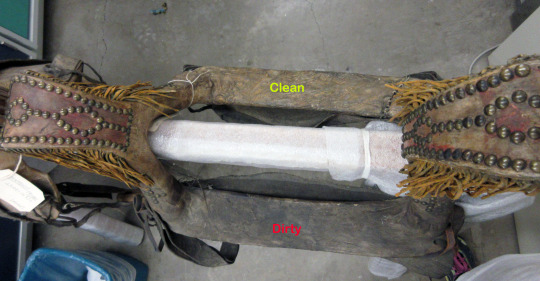
Half-cleaned saddle
Half of the saddle has been cleaned.  Note the color difference between the dirty side and cleaned side.  The majority of this is soot from years of exposure to Pittsburgh air pollution.


saddle horn after cleaning
Close-up of the saddle horn after cleaning.  The red ochre color was completely obliterated by soot.


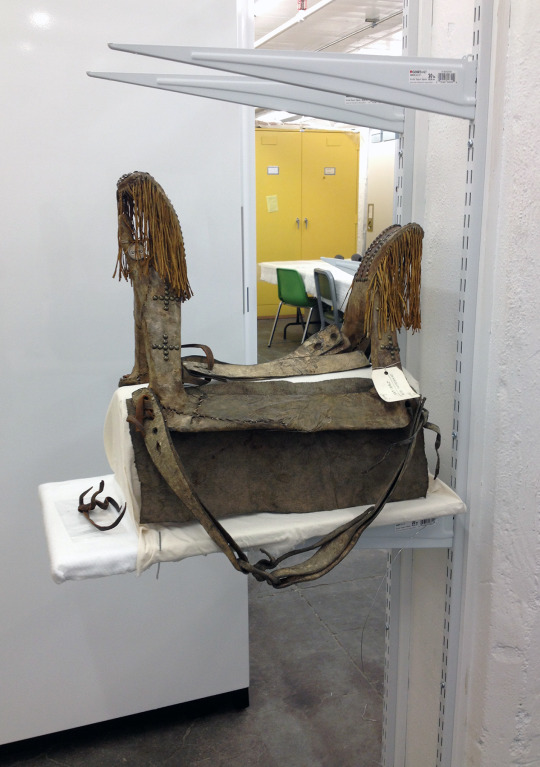
While there is little information in the accession record to tell us anything about the original owner of this saddle, from cleaning it carefully I was able to determine that this saddle was well used. It was a privilege to handle it and let it speak to me for a little while. In its cleaner state, it now rests on a horse-like bed of archival materials that will not further degrade its fragile materials and I will be making a cover for it and its three other saddle companions in the near future.

saddle in storage
The saddle on its new storage mount.

Ruth Fauman-Fichman is a volunteer at the Carnegie Museum of Natural History.

Filed Under: Blog Tagged With: anthropology, conservation, Pittsburgh

August 20, 2018 by wpengine

Pennsylvania Archaeology, Fluted Points, and One Snazzy Bolo Tie

By Amy L. Covell-Murthy

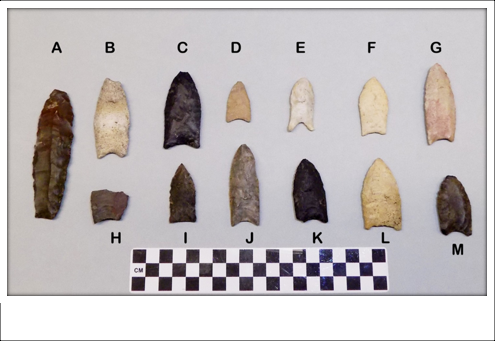
The Section of Anthropology houses a collection boasting 1.5 million artifacts. What you may not know is that most of those artifacts come from right here in Western Pennsylvania. It would be impossible to talk about Pennsylvania archaeology without mentioning Dr. Stanley W. Lantz. Dr. Lantz worked as a field and staff archaeologist at Carnegie Museum of Natural History from 1965-1990 and has continued as a research associate ever since his retirement.  Before making archaeology his life’s work, Dr. Lantz was an Army Air Force, Staff Sargent, B-17 waist-gunner and photographer, and he owned his own supermarket and building business. His 10-year archaeological survey of 23 counties of Western Pennsylvania encompassed the drainage of the Upper Ohio Valley, and allowed him to record 365 Paleo-Indian artifact finds from 210 sites. In The Pennsylvania Fluted Point Survey, Dr. Lantz and Gary Fogelman display over 1600 photographs and over 100 illustrations of fluted points of the Eastern Woodlands. Below are some of the points that Dr. Lantz donated to CMNH that he used in the book.

fluted points

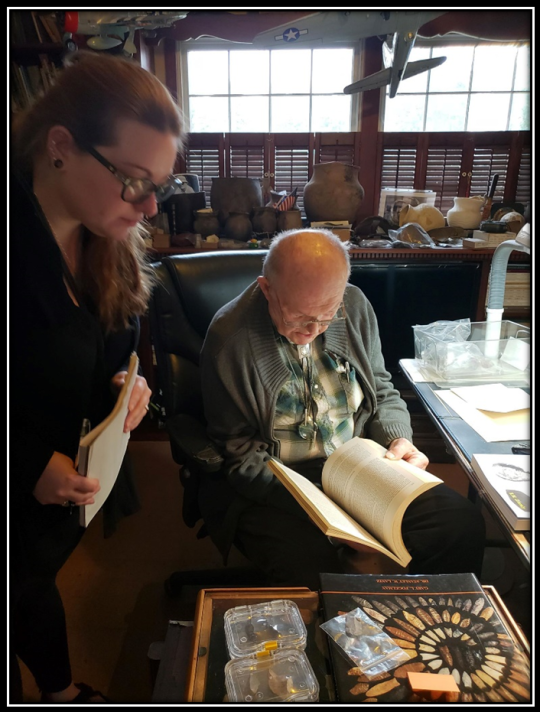
In May 2018, Dr. Lantz kindly assisted three CMNH anthropology interns with a poster that they presented at the 89thAnnual Meeting of the Society for Pennsylvania Archaeology, regarding the process of locating Clovis points in a site-specific museum collection. Clovis points, dating to the Early Paleoindian Period, 10,000-16,000 BP, are the earliest fluted styles found in North America. Rebecca Stewart, Brittany Creely, and Liana Thies were awarded second place. Liana is pictured in this photo with Dr. Lantz who is sporting his signature bolo tie.

Dr. Lantz and Liana

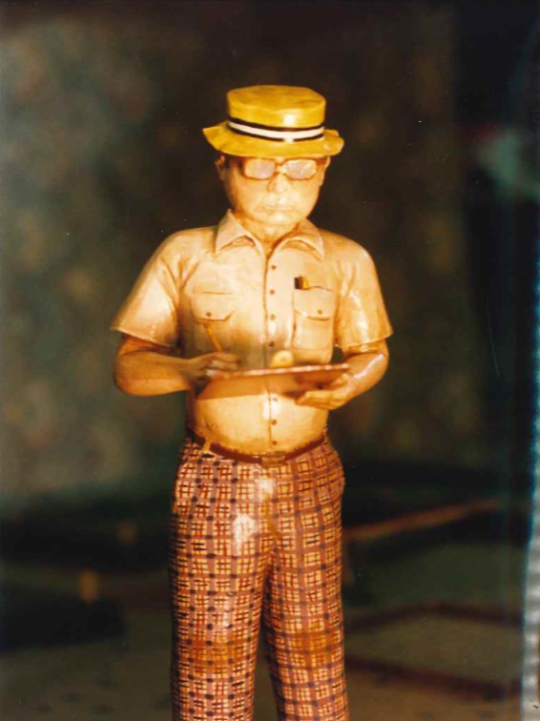
Dr. Lantz can be found on exhibit outside of the Anthropology Halls on the third floor. Look for his likeness in the Iroqouis longhouse diorama. He is missing his tie, but keep an eye out for his plaid pants! Fun Fact: Someone stole Dr. Lantz’s plaid polyester pants and buried them in a secret location so that he wouldn’t be able to wear them anymore.

Dr. Lantz likeness

Amy L. Covell-Murthy is the Archaeology Collection Manager at Carnegie Museum of Natural History. Museum employees are encouraged to blog about their unique experiences and knowledge gained from working at the museum.

Filed Under: Blog Tagged With: anthropology, archaeology, pennsylvania

August 8, 2018 by wpengine

Hei-tiki Figurines

By Deborah Harding

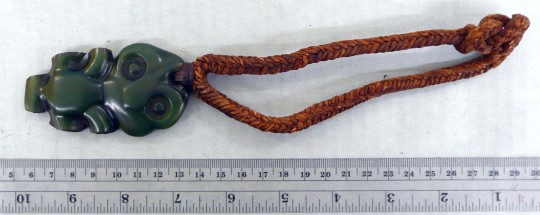
Hei-tiki figurines made by the Maori people of New Zealand have had several origins and meanings attributed to them over the years. It may refer to the First Man, Tiki; some have speculated that the curious proportions are those of an unborn child.

Tikis are carved in stone and wood, in various sizes. The hei-tikis are designed to be worn around the neck. Originally carved very laboriously from hard greenstone, modern versions are also made in plastic and other materials for the tourist trade. The eye rings were often filled with red sealing wax.

Hei-tiki figurine

Our hei-tiki came to us from the collection of Charles Spang, a manufacturer from Etna. He collected it probably in the mid-19thcentury, and his collection was later donated by his children in 1906. Unfortunately, the arms and legs are broken off.

About ten years ago, a Maori visitor to the collections remarked with surprise on the presence of the braided neck cord. Evidently it is rare to find the cord still intact. He couldn’t tell us what the fiber was, but it’s done in a 16-strand round braid.

Deborah Harding is the collection manager of the Section of Anthropology at Carnegie Museum of Natural History. Museum employees are encouraged to blog about their unique experiences and knowledge gained from working at the museum.

Filed Under: Blog Tagged With: anthropology, museums

February 5, 2018 by wpengine

Carnegie Museum of Natural History’s Section of Anthropology

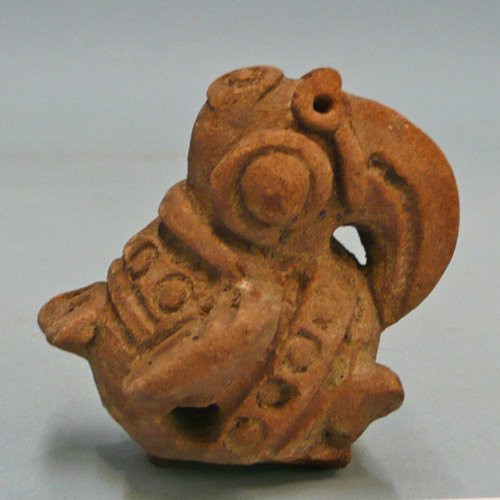
ceramic artifact from Costa Rica

Carnegie Museum of Natural History’s Section of Anthropology has the finest collection of archaeological material from Costa Rica outside of that country.

It is also the first collection that was scientifically excavated by curator Carl V. Hartman, between 1903 and 1908.

It includes carved stone benches and statuary, small jade pendants and beads, and a great variety of ceramics, including effigy whistles.

One pendant, a jade bat, is considered the finest piece of jade ever found in Costa Rica. It is due to be loaned to the Getty Museum and the Metropolitan Museum of Art later this year.

Filed Under: Blog Tagged With: anthropology

May 22, 2017 by wpengine

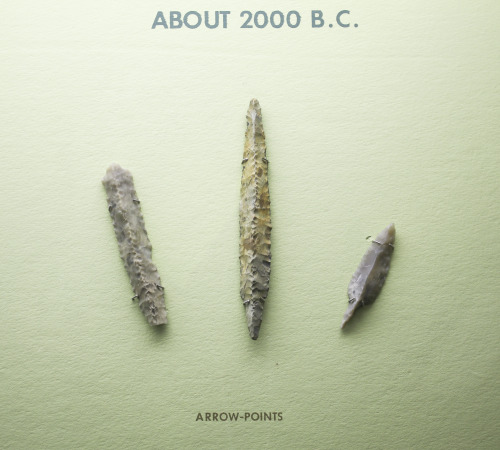
Arrow points made in eastern Sweden and Finland

Collection of three arrow points made of stone
Arrow points made in eastern Sweden and Finland around 2000 B.C.

Filed Under: Blog Tagged With: anthropology

  • « Go to Previous Page
  • Page 1
  • Interim pages omitted …
  • Page 3
  • Page 4
  • Page 5
  • Page 6
  • Page 7
  • Page 8
  • Go to Next Page »

sidebar

About

  • Mission & Commitments
  • Directors Team
  • Museum History

Get Involved

  • Volunteer
  • Membership
  • Carnegie Discoverers
  • Donate
  • Employment
  • Events

Bring a Group

  • Groups of 10 or More
  • Birthday Parties at the Museum
  • Field Trips

Powdermill

  • Powdermill Nature Reserve
  • Powdermill Field Trips
  • Powdermill Staff
  • Research at Powdermill

More Information

  • Image Permission Requests
  • Science Stories
  • Accessibility
  • Shopping Cart
  • Contact
  • Visitor Policies
One of the Four Carnegie Museums | © Carnegie Institute | Privacy Policy | Terms of Use | Accessibility
Rad works here logo