• Skip to primary navigation
  • Skip to main content
  • Skip to primary sidebar

Carnegie Museum of Natural History

One of the Four Carnegie Museums of Pittsburgh

  • Visit
    • Buy Tickets
    • Visitor Information
    • Exhibitions
    • Events
    • Dining at the Museum
    • Celebrate at the Museum
    • Powdermill Nature Reserve
    • Event Venue Rental
    • Gift Cards
  • Learn
    • Field Trips
    • Educator Information
    • Programs at the Museum
    • Bring the Museum to You
    • Guided Programs FAQ
    • Programs Online
    • Climate and Rural Systems Partnership
  • Research
    • Scientific Sections
    • Science Stories
    • Science Videos
    • Senior Science & Research Staff
    • Museum Library
    • Science Seminars
    • Scientific Publications
    • Specimen and Artifact Identification
  • About
    • Mission & Commitments
    • Directors Team
    • Museum History
  • Tickets
  • Give
  • Shop

anthropology

December 15, 2020 by wpengine

An Indigenous Presence: Cultural Survivance and Contemporary American Indian Art & Design

Museum exhibitions, especially those featuring cultural items, can sometimes give the impression of cultures or peoples frozen in time. Behind the scenes, however, CMNH is a flurry of active research and knowledge production. Work to link our collections and exhibitions to the present moment is vital.

As an art historian who studies modern and contemporary art, I often think about the connections over time and space between historic objects. Lately, I’ve been thinking about many of the American Indian belongings we have on display in Alcoa Hall, and contemporary art. This contemplation reveals the influence American Indian artists have exerted and continue to exert on the American art world.

In the early 20th century, Indian artists were instrumental in the formation of American modernism. Artists such as Awa Tsireh (San Ildefonso Pueblo), the members of the Kiowa Five (Spencer Asah, James Auchiah, Jack Hokeah, Stephen Mopope, Monroe Tsatoke and Lois Smoky), Angel De Cora (Ho-Chunk), and potter Maria Martinez (San Ildefonso Pueblo) influenced the growing trends of abstraction and patterning that defined modernist painting in the United States. These artists, along with other American Indian artists and artisans helped establish the US as a growing center of modernism in competition with Europe. Despite having their contributions and innovations undercut or co-opted by Euro-American artists and collectors, Native artists continued to produce artwork as acts of survivance. Survivance, a concept developed by cultural theorist Gerald Vizenor, is an expression of active presence. The term denotes a response to the attempted cultural and physical genocide of Native peoples in the United States that is beyond simple survival, but involves acts of resistance that declare a dynamic presence – often combining traditional ways of knowing with contemporary technologies that are specific to an individual or tribal affiliation.

Later in the century, Native artists continued to define the American art scene. Artists like Fritz Scholder (Luiseno), Kevin Red Star (Apsáalooke), Edgar Heap of Birds (Cheyanne and Arapaho), and Jaune Quick-to-See Smith (Salish) continued (and continue) to challenge the mythology of the Indian in American imaginary.  These artists, whose creations have been collected and exhibited by major museums across the country, also view their art as a form of resistance. Their work can therefore be understood as acts of survivance.

Contemporary American Indian artists are still grappling with the politics of representation, regularly fighting stereotypes while also working to preserve the cultural knowledge that the settler state tried to destroy through forced assimilation. Because of these complicated and often violent histories, it is important that, most of us, as descendants of settlers, think critically about Native inspired designs in the objects or clothing we buy. Instead of coopting from indigenous cultures, shop from companies that employ Native designers. Better yet, buy directly from Native artists who are demonstrating how traditional knowledge and ways of making are thriving in the 21st century. Featured below are just a few of the artists whose work is connected to the cultural forms and belongings on display in Alcoa Hall. Many of them also have great items for sale on their websites – just in time to find some special holiday gifts!
image
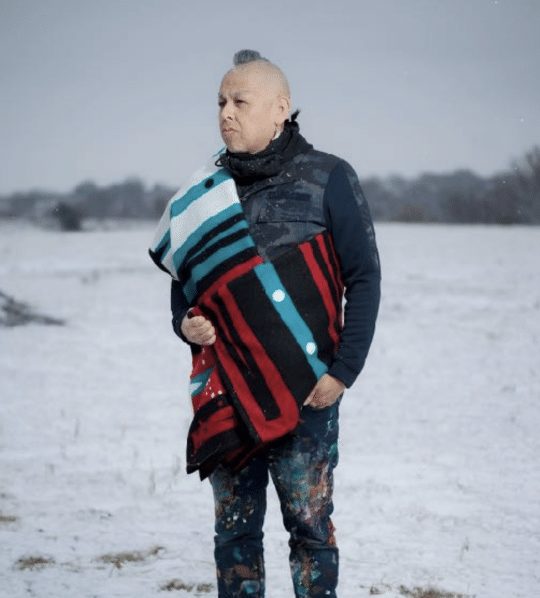
Bunky Echo-Hawk. Image credit: Ryan Redcorn

Bunky Echo-Hawk (Pawnee and Yakima) is a painter and designer who has worked with companies such as Nike and Pendleton to design Plains Indian inspired products and fundraise for Native organizations. His eye-catching and exciting work plays with indigenizing popular culture and addressing environmental racism while reinterpreting Plains Indian oral history and record keeping traditions, like winter counts, through his live painting performances. To learn more about winter counts, visit the display in Alcoa Hall featuring the Carnegie Winter Count by Dr. Thomas Red Owl Haukaas. Echo-Hawk was also the subject of a recent episode of American Masters, the PBS documentary series. Check out his website to browse some of the great prints and stickers he has for sale.
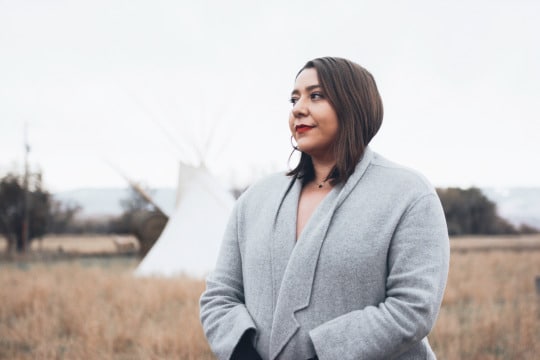
Bethany Yellowtail

Bethany Yellowtail (Apsáalooke and Northern Cheyenne) is the brilliant designer behind B. Yellowtail, a fashion brand launched in 2015. Her work is intimately connected with her social justice work in Indian Country. Her website features indigenously designed goods as well as her own collections – inspired by Apsáalooke traditions, like elk tooth dresses and ribbon skirts. Her clothing functions as wearable art that demonstrates the power and resilience of Native women and matrilineal cultural systems. I’ve purchased some of their cloth face masks – the proceeds of which benefit Native communities suffering from COVID-19. I’m confident you’ll find something you love on B. Yellowtail’s website.

John Isiah Pepion (Blackfoot) understands the ceremonial importance of making artwork, including its healing power. Pepion’s paintings, drawings, and designs are inspired by traditional practices such as winter counts and ledger drawings. Ledger art dates to the 1850s, when ledger books became one of the primary materials available to Plains Indians, especially to those imprisoned in forts as prisoners of war during the 19th-century Indian wars, without access to traditional materials like bison hides. Pepion’s work in this medium serves as cultural preservation, keeping him and his artwork tied to Blackfoot history and to Blackfoot ancestral lands. His website features original artwork, prints, and all sorts of items with his designs including scarves, stationery, blankets, and jewelry.
image
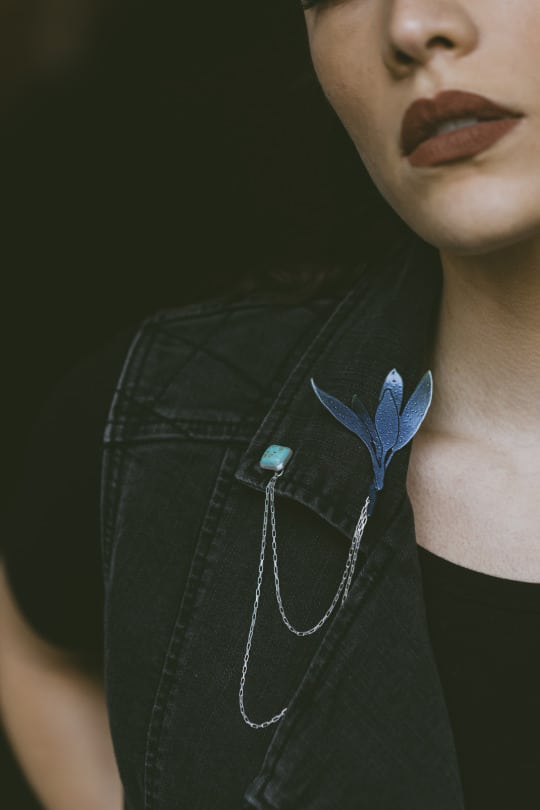
Sage Protection Pin by Margaret Jacobs. Image credit: Taylor Robinson.

Margaret Jacobs (Akwesasne Mohawk) is a sculptor and jewelry designer who works primarily in steel and pewter. Her forms are primarily abstract, but the material represents not only strength and resistance, but also references the history of Mohawk iron workers, featured in Alcoa Hall. Her abstract forms play between the organic and man-made, connecting color and shape with storytelling and family histories. You can find her sculpture or jewelry, which truly functions as wearable art, on her website.

It is important to note that Carnegie Museum of Natural History, and much of Western Pennsylvania, is on the traditional lands and waterways of the Seneca, Lenape (Delaware), and the people we refer to as the Monongahela (their autonym is currently unknown). These lands and waters were also important to the Shawnee, Wyandotte, and Osage nations. These lands carry the histories of these people from before their forced removal and through their struggles and triumphs for survivance well into the present moment. To find out more about the Seneca Nation (including about Seneca artists) visit the Seneca-Iroquois National Museum or Ganondagan Seneca Art & Culture Center. To learn more about the Lenape, go to the Delaware Nation or the Delaware Tribe of Indians. Or visit the Museum of Indian Culture, in Allentown, PA.

Jessica Landau has a joint appointment as Assistant Curator of Anthropology and Archaeology at Carnegie Museum of Natural History and as a Lecturer in Curatorial Studies in the History of Art & Architecture at University of Pittsburgh. Museum employees are encouraged to blog about their unique experiences and knowledge gained from working at the museum.
Related Content

Seldom Seen – Archaeological Textiles in the Eastern US

Americal Eel

Museum Conservation: Cleaning a Kayak

Filed Under: Blog Tagged With: anthropology, Jessica Landau, Museum from Home, Science News

November 18, 2020 by wpengine

Seldom seen—archaeological textiles in the eastern United States

In my very first “Introduction to Anthropology” class, the professor, a cultural anthropologist, tried to steer us away from archaeology by telling us it was a childish pursuit for those who liked to play in the mud and hunt for treasure. That sounded like it was right up my alley.  I ended up spending my summers and an internship term working in Plymouth, Massachusetts, doing historical archaeology.  In addition, I also spent a lot of time in the collections of the college anthropology museum, found that I especially loved working with textiles and basketry, and eventually learned to weave both.

Working in the eastern United States, it’s hard to find archaeological textiles; the very world is against it. Acid soils and a temperate climate create conditions where little organic material survives to be studied, except in the rare instances of charred material or pieces in contact with copper, or still rarer, textiles deposited in dry caves. Even then the evidence is usually fragile and fragmentary.

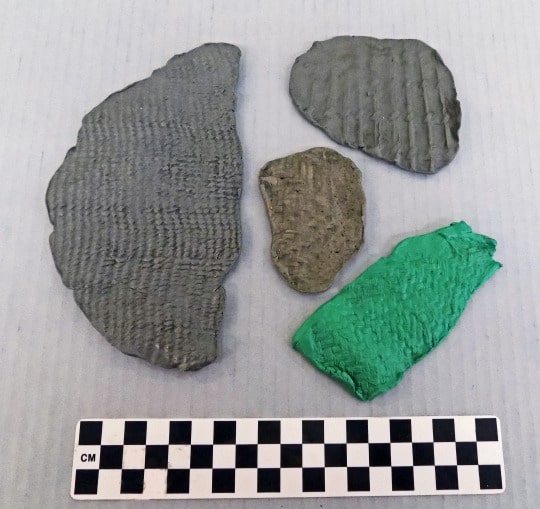
What eastern archaeologists find is a lot of pottery, and luckily for us, much of it has been impressed with cordage or fabric. As part of the pottery making process, clay coils were consolidated by being beaten with a wooden paddle, a tool frequently wrapped with cordage or fabric. This technique may have initially developed to create decoration, but the resulting roughened surface also made for a better grip, and the increased surface area caused pots to heat quicker in cooking.

Archaeologists study the long-vanished textiles by making durable impressions of pottery surfaces with modeling clay or dental impression material. The information revealed through the thorough study of such impressions is not limited to the determination of just what type of cord or textile was used in making the original object.

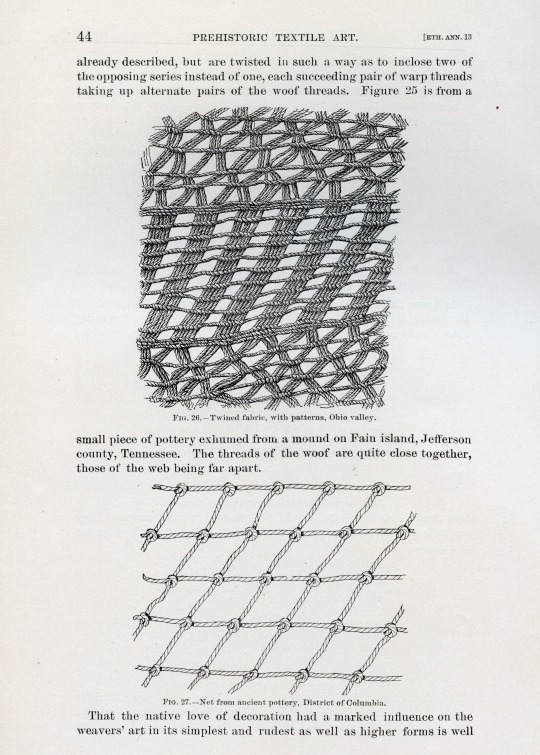
The making of pottery impressions to look at textiles was first published by the pioneering archaeologist, W.H. Holmes, in “Prehistoric Textile Art of the Eastern United States.” Holmes started his scientific career as an illustrator, and included schematic drawings of the textile structures in his article.

image
Textile illustrations by Holmes.

When I worked at what is now the Florida Museum of Natural History, I got interested in the earliest pottery found in Florida, from what is known as the Orange culture. Dating from about 1500 BCE, these distinctive pieces were thick and very simply decorated. Their most interesting feature, at least to me, was that the clay pot bottoms had been pounded flat on matting, and the applied force made deep impressions. At least three different techniques were used, with variations and patterns within each, including several different matting materials.

Mat impressions from flat-bottomed pots, Tick Island, Volusia County, FL.

In one instance, a thick pot sherd had a smooth top surface, but a deep dent in the bottom; evidence the potter hadn’t removed a small pebble that was under the mat before the pot making.

Many studies have been done since W.H. Holmes, looking at such things as direction of the twist in cordage—a majority of right-handed or left-handed twist could indicate a culture-wide preference. Similar twist types in neighboring geographic areas might indicate related cultural or kin groups, while different twist types could indicate a cultural boundary. The type of material used [soft fiber, hard rods, flat cane-like splints] may indicate cultural preference, or perhaps the materials available in the immediate environment.

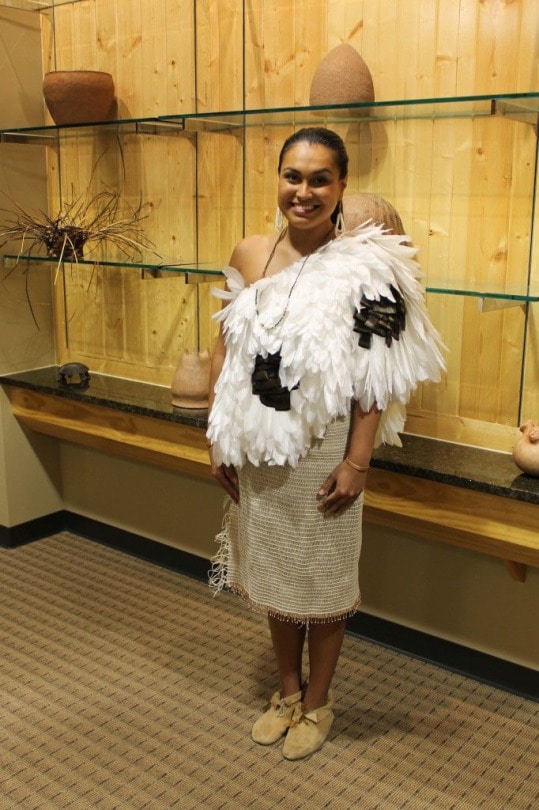
One study by Dr. Penelope Drooker, Mississippian Village Textiles at Wickliffe, introduced me both to some incredible textile impressions in pottery and the information that can be gleaned from them. Drooker’s work also analyzed and illustrated some textiles preserved in dry caves of eastern Tennessee, part of the Cherokee people’s ancestral lands. Among the materials she studied were skirts and bags from the Cliffty Creek Cave, artifacts now housed at the Smithsonian Institution. Working with the Museum of the Cherokee Indian in Cherokee, NC, I was able to re-introduce members of the tribe to one of the oldest weaving techniques of their ancestors. A few tribal members have visited the Smithsonian to photograph Cliffty Creek Cave pieces [as have I], and are now making skirts for use in festivals and pageants. Several are making decorated bags for their own use, and for sale.

Kara Martin McKinney wearing reproduction of Cliffty Creek Cave skirt, and reproduction woman’s feather cape. Image Credit: Scott McKie, reporter for the Cherokee One Feather weekly newspaper in Cherokee, NC.

One of the great things about textiles or pottery is that you could spend your entire life studying them, and still not learn all that these materials embody–techniques, cultural traditions, and art, all rolled into one. My grandfather, who kept his faculties up to his death in his mid-90s, said, “The day you stop learning is the day you start to die.” I try to live by that.

Deborah Harding is the Collection Manager of the Section of Anthropology at Carnegie Museum of Natural History. Museum employees are encouraged to blog about their unique experiences and knowledge gained from working at the museum.
References and further reading:

Drooker, Penelope Ballard 1992  Mississippian village textiles at Wickliffe,  University of Alabama Press: Tuscaloosa and London

Holmes, W. H. 1896 “Prehistoric Textile Art of the Eastern United States” Thirteenth Annual Report of the Bureau of American Ethnology to the Secretary of the Smithsonian Institution 1891–1892, Government Printing Office Washington, pages 3–46.

Milanich, Jerald T. and Charles H. Fairbanks 1980 Florida Archaeology Academic Press: New York

Petersen, James B [editor] 1996 A most indispensable art: native fiber industries from Eastern North America, University of Tennessee Press: Knoxville

http://www.phmc.state.pa.us/portal/communities/archaeology/native-american/early-middle-woodland-period.html

Related Content

The Unseen Museum: Ka’apor Necklace

Super Science: The Virtual Amazon

Ancient Egypt Through its Pottery

Filed Under: Blog Tagged With: anthropology, Deborah Harding, Museum from Home, Science News

October 29, 2020 by wpengine

Did Neanderthals Make Musical Instruments?

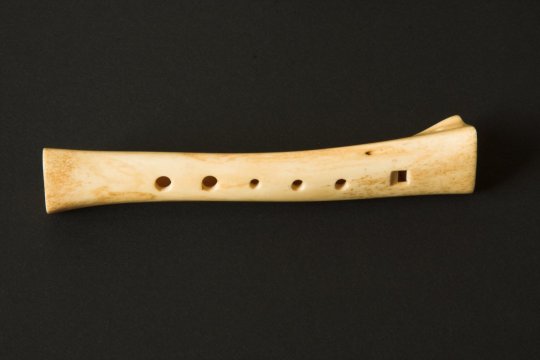
bone flute on black background

Do you like to listen to music? Have you ever admired the skill of a musician? Maybe you even know how to play an instrument yourself. Unsurprisingly, humans (Homo sapiens) have enjoyed this rewarding art for all of recorded history. In fact, the earliest evidence of musical instrument construction dates back to the great unknown ages of prehistory.

In 1995, researchers excavating deposits thought to be between 40,000 and 60,000 years old in a cave called Divje Babe (which translates to “Witch Cave”) in Slovenia found the femur (a leg bone) of a juvenile cave bear with an unusual line of small holes perforating one side. The find was recognized as being a fragment of a flute-like musical instrument. Due to the age and location of the discovery, the manufacture of the flute was attributed to Homo neanderthalensis (the Neanderthals) rather than Homo sapiens!

This discovery was extremely important in shaping our view of the Neanderthals, another species of hominid with which we share a common ancestor. Prior to this, they were often viewed as brutish, animalistic, and wholly incapable of aesthetic sensibilities. However, if they made musical instruments and played them for entertainment or ritual purposes, these activities mean that the Neanderthals were creating a complex culture reminiscent of our own when they went extinct around 40,000 years ago for reasons still unclear. The ability to modify a material so that it can then be used to create a variety of pitches implies, in the minds of some researchers, greater motor ability and a higher capacity for abstract thought.

There are many skeptics, however. Some posit that the holes in the bones are the result of hyenas making a meal of a juvenile cave bear, while others point to uncertainty about exactly when the perforations in the bone were created. Perhaps the interpretation of a modified bone as a musical instrument is all exaggeration brought on by our desire to relate to those who came so long before us. As of this writing, the scientific community is still undecided about how the holes into the bone were created and when it happened. There are two things we can all agree on, though: we hope someday to uncover the true origin of the Divje Babe bone flute, and musical instruments certainly rank among the greatest inventions of members of the genus Homo.

Niko Borish is a Teen Volunteer in the Education Department. Museum employees, volunteers, and interns are encouraged to blog about their unique experiences and knowledge gained from working at the museum.
Works Cited

Montagu, J. (2017, June 20). How Music and Instruments Began: A Brief Overview of the Origin and Entire Development of Music, from Its Earliest Stages (A. Nikolsky, Ed.). Frontiers in Sociology. Retrieved September 5, 2020, from https://www.frontiersin.org/articles/10.3389/fsoc.2017.00008/full

National Museum of Slovenia (Ed.). (n.d.). Neanderthal flute. Narodni Muzej Slovenije. Retrieved September 5, 2020, from https://www.nms.si/en/collections/highlights/343-Neanderthal-flute

The Royal Society. (2015, April 9). Are Neanderthal bone flutes the work of Ice Age hyenas? Phys.org. Retrieved September 5, 2020, from https://phys.org/news/2015-04-neanderthal-bone-flutes-ice-age.html

University of Wisconsin (Ed.). (2017). Neanderthal jam. The Why Files. Retrieved September 5, 2020, from https://whyfiles.org/114music/4.html

Related Content

Ancient Egypt Through its Pottery

Archaeology Merit Badge: Who Had More Fun, Me or the Boy Scouts?

History of Teddy Bears

Filed Under: Blog Tagged With: anthropology, Education, Educators, volunteers

July 31, 2019 by wpengine

Dressing Fleas

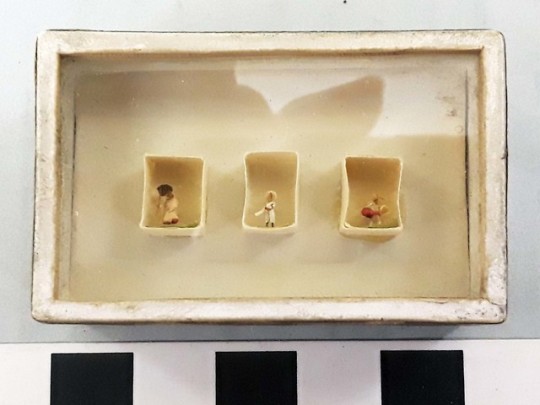
box of three dressed fleas

“If we do not mass produce products, we vie with one another
in the difficult, exquisite and useless art of dressing fleas”

Octavio Paz [diplomat, poet, writer, winner of 1990 Nobel Prize in Literature]

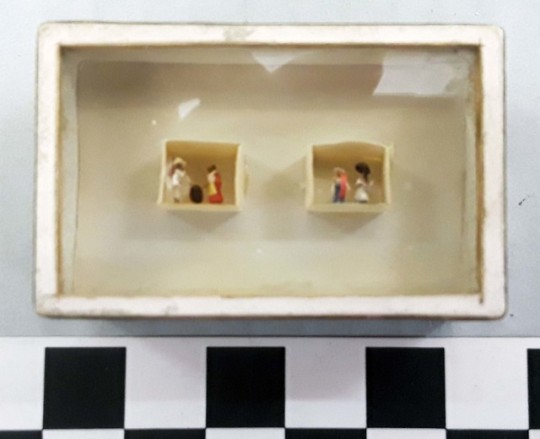
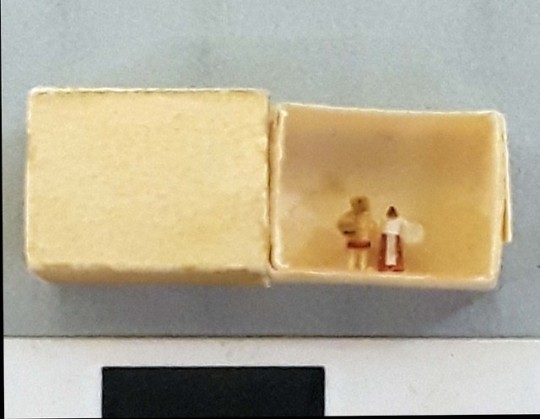
The art of dressing fleas in costumes and creating tiny tableaus began in Mexico in the 19th century, centered around the state of Guanjuato. Some people believe that Pulgas Vestidas (dressed fleas) began being made in convents; they went on to become a craft done by ordinary people. Eventually they became something to sell to tourists. Dressed fleas were still being created well into the 1930s, the most popular forms being bride and groom or farmer and wife sets. Some were as elaborate as an entire mariachi band, complete with instruments.

One set of dressed fleas from the Carnegie Museum of Natural History collection. Each block underneath this box represents just one centimeter! 

In the 1920s Octavio Paz called it a “difficult art, exquisite and useless,” and added, “I shall never be one to disparage this amazing skill, since where spiritual health is concerned, building a skyscraper and adorning a flea are each as monstrous as the other.” A British entomologist, Tim Cockerill, has taught himself how to make them, and includes a modern bride and groom set on his website.

pair of dressed fleas in a box

The museum’s three sets of dressed fleas were acquired in the 1930s, and donated by different people in the late 20th century. They are part of an extensive collection of ethnographic and historic dolls. They are a must-see for anyone having a behind-the-scenes tour of the Anthropology storage areas. Dressed fleas are a prime example of human ingenuity and skill, even if a reason for being is not immediately obvious.

Deborah Harding is the collection manager of the Section of Anthropology at Carnegie Museum of Natural History. Museum employees are encouraged to blog about their unique experiences and knowledge gained from working at the museum.
Filed Under: Blog Tagged With: Anthropocene, anthropology, archaeology, art, Deborah Harding, insects

June 28, 2019 by wpengine

Students, Research Associates, and Volunteers: Anthropology’s Real Treasure

The Anthropology Department is very fortunate to have a strong core of dedicated volunteers, research associates, and students. Without their valuable assistance, we would have a very hard time maintaining the quality of collection care and excellence in public engagement for which we feel immense amounts of pride. We’ve hosted volunteers for many years; some have specific interests which can help to augment our knowledge base, and others simply love the museum and want to help in any way that they can. Students come to us mostly from nearby universities, but occasionally from farther away. We have a long-standing partnership with Duquesne University to fulfill their Masters of Public History Collection Management internships. We’ve hosted students from the University of Pittsburgh, California University of Pennsylvania, Clarion University of Pennsylvania, Indiana University of Pennsylvania, Humboldt University (California), University College (London), and even students from China, the Netherlands, Australia, and Costa Rica. Our Research Associates fill in knowledge gaps that we lack in the section and use the collections to further their research and contribute to the academic world. Their expertise covers a wide range of topics from zooarchaeology and Eastern Woodlands archaeology to ethnology and cultural anthropology.

I’d like to toot a few horns regarding the annual meeting for the Society for Pennsylvania Archaeology, which was held in Uniontown, PA on April 5-7th, 2019. Two of our distinguished research associates were interviewed for an oral history project being conducted by representatives of PennDOT, the State Historic Preservation Office of Pennsylvania, and the Carnegie Museum of Natural History.  Dr. Mark McConaughy and Dr. William C. Johnson sat down to talk about their unique experiences with the history of archaeology in Pennsylvania. They also presented papers at the conference along with many other research associates. The collection at CMNH was mentioned in 75% of the papers given all weekend!

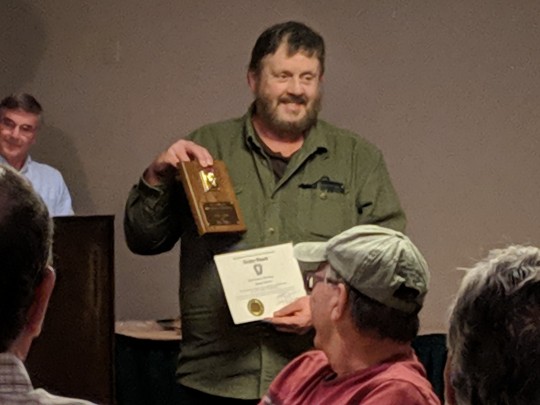
Three of our outstanding students/volunteers were presented awards at the banquet. Mr. James Barno has been a volunteer in the section for two years. He began as an intern from California University of Pennsylvania and has remained a volunteer since his graduation. He was given this year’s Archey Award, which is presented to members of the Society able to devote only spare time to their archaeological interests. It is given for some significant contribution (or contributions) over an appreciable period toward the unselfish furtherance of archaeology. We’re very proud of him!

James Barno holding the award

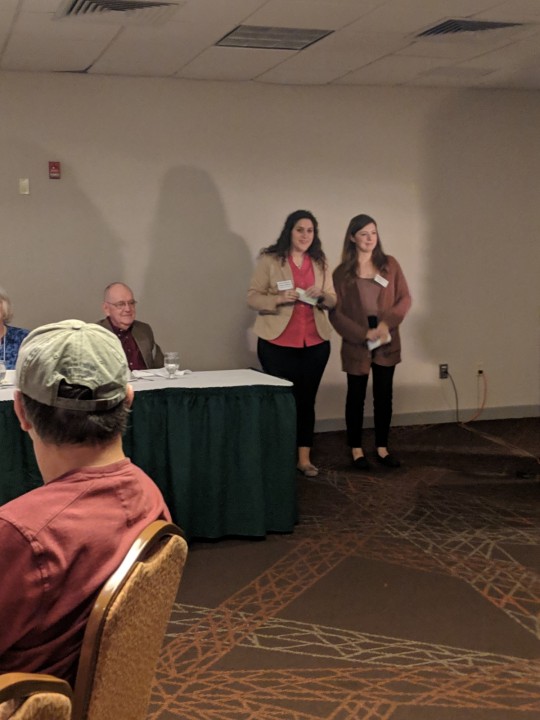
Also awarded were two James W. Hatch Scholarships for students presenting at the conference. One went to Tamara Alchoufete, who is our current work-study student from the University of Pittsburgh, and the other went to Indiana University of Pennsylvania graduate student and CMNH volunteer, Kristina Gaugler. Ms. Gaugler was also awarded the W. Fred Kinsey Scholarship, which is given to a student who presents a single authored paper at the meetings. It comes with a complimentary Society for Pennsylvania Archaeology membership and free conference banquet, along with a stipend for research expenses. Congratulations to both!

Tamara Alchoufete and Kristina Gaugler at the award ceremony

Cultivating an interest in professional development is something that we can offer to our students and volunteers, besides valuable museum related skills training. Volunteers, students, and research associates are truly our most valuable treasure.

More information on how to volunteer with CMNH can be found here: https://carnegiemnh.org/visitor/things-to-do/volunteer/

More information on the Society for Pennsylvania Archaeology can be found here: https://www.pennsylvaniaarchaeology.com/

Amy L. Covell-Murthy is the Archaeology Collection Manager at Carnegie Museum of Natural History. Museum employees are encouraged to blog about their unique experiences and knowledge gained from working at the museum.
Filed Under: Blog Tagged With: Amy Covell-Murthy, anthropology, Research Associates, volunteers, western pennsylvania

March 6, 2019 by wpengine

The Origins of El Niño and the rise of Peruvian Civilization: The Mollusk that made Jim Richardson’s Career

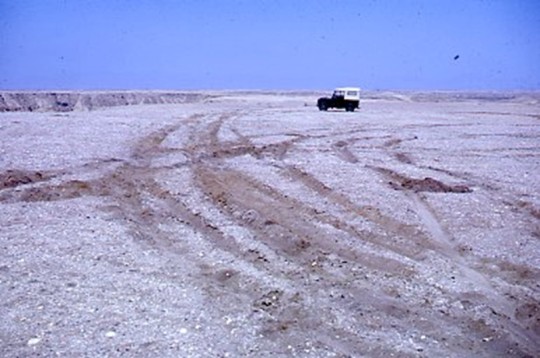
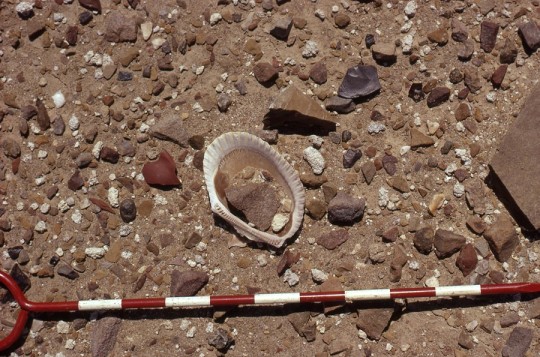
In 1965 I went to the far north coast of Peru to the petroleum town of Talara to conduct dissertation research. In my survey of archaeological sites, I discovered the stratified site of Siches (10,000-4,000 BP), which had an assemblage of mangrove mollusks. This was startling to shell experts since the southern distribution of mangrove environments is now 120 miles north in southern Ecuador. So, how to explain this thermally-anomalous Mollusca assemblage (TAMA) existing in a stark desert landscape? With further research I published articles in 1981 and 1983 in the Annals of Carnegie Museum, proposing that there must have been a change in the ocean current system off this desert coast relating to El Niño (ENSO). By the early 1980’s our research team, devoted to explaining the distribution of other TAMAS at sites as far south as Lima, included Research Associate Dan Sandwiess of the University of Maine and Jack Donahue and Bud Rollins of Pitt’s Geology Department. In 1986, in the Journal of Geoarchaeology we published the article The Birth of El Niño: Geoarchaeological Evidence and Implications, which outraged oceanographers and geologists. They said, “How can you change the ocean current system of the eastern Pacific to explain the presence of your weird shells?” We kept plugging away at this line of research and in 1996 we published in Science, Geoarchaeological Evidence from Peru for a 5000 Years BP. Onset of El Niño.  In 2006 Sandweiss and I published Climate Change, El Niño, and the Rise of Complex Society on the Peruvian Coast during the Middle Holocene in a Dumbarton Oaks volume devoted to archaeological research on El Niño. Further documentation of the dramatic changes in the ocean current off the coast of Peru comes from the analysis of fish fauna from Siches by Research Associates Betsy Reitz and Dan Sandwiess in the Bulletin of the Florida State Museum 2019.

Siches Site Before Excavation 1965

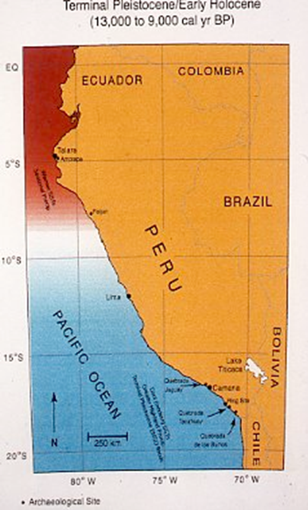
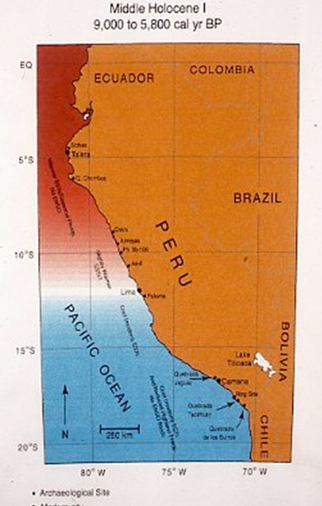
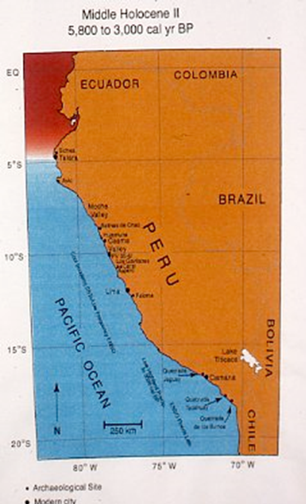
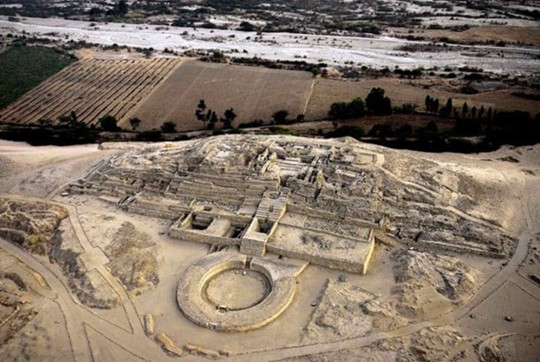
In a nutshell, the results of over 50 years of research at coastal sites from Ecuador to Chile provides the following scenario: El Niño was present but of unknown frequency from 13,000 to 8,800, absent or rare between 8,800 to 5,800, infrequent from 5,800 to 3,200, obtaining its modern recurrence intervals about 3,200 years ago. This research on El Niño, the weather catastrophe that impacts not only the Central Andes but is felt around the world as floods and droughts, has revolutionized our thinking on the development of the first civilization in South America, centered on the Peruvian north coast. Circa 5,800 years the warm current washing the Peruvian coast north of Lima was replaced with the cold Peru (Humboldt) current, which brought with it the huge resource of schooling fish, making Peru one of the richest fishing grounds in the world. These fish resources became the foundation for the rise of temple centers on the north coast, on which Research Associate Michael Moseley based his theory of the maritime foundations of Peruvian civilization. All other civilizations are agriculturally based.

Changes in Peruvian Ocean Current System


Caral, Supe Valley, North Coast. Temple Complex 5000 BCE

It is amazing that the discovery of insignificant mangrove shells at Siches became the basis for not only proving that El Niño is only 5,800 years old, but provided the causal factors for the origin of Peru’s first civilization. This research just shows that if you live long enough, decades of research will finally pay off with incredible results.

The Shell That Changed Jim’s Life.

James B. Richardson III is the Emeritus Chief Curator of the Section of Anthropology and Emeritus Professor of Anthropology at the University of Pittsburgh. Museum employees are encouraged to blog about their unique experiences and knowledge gained from working at the museum.
Filed Under: Blog Tagged With: anthropology, Jim Richardson, mollusks

  • « Go to Previous Page
  • Page 1
  • Page 2
  • Page 3
  • Page 4
  • Page 5
  • Page 6
  • Interim pages omitted …
  • Page 8
  • Go to Next Page »

sidebar

About

  • Mission & Commitments
  • Directors Team
  • Museum History

Get Involved

  • Volunteer
  • Membership
  • Carnegie Discoverers
  • Donate
  • Employment
  • Events

Bring a Group

  • Groups of 10 or More
  • Birthday Parties at the Museum
  • Field Trips

Powdermill

  • Powdermill Nature Reserve
  • Powdermill Field Trips
  • Powdermill Staff
  • Research at Powdermill

More Information

  • Image Permission Requests
  • Science Stories
  • Accessibility
  • Shopping Cart
  • Contact
  • Visitor Policies
Stay in the loop! Sign up for our newsletter(s).
One of the Four Carnegie Museums | © Carnegie Institute | Privacy Policy | Terms of Use | Accessibility
Rad works here logo