• Skip to primary navigation
  • Skip to main content
  • Skip to primary sidebar

Carnegie Museum of Natural History

One of the Four Carnegie Museums of Pittsburgh

  • Visit
    • Buy Tickets
    • Visitor Information
    • Exhibitions
    • Events
    • Dining at the Museum
    • Celebrate at the Museum
    • Powdermill Nature Reserve
    • Event Venue Rental
  • Learn
    • Field Trips
    • Educator Information
    • Programs at the Museum
    • Bring the Museum to You
    • Guided Programs FAQ
    • Programs Online
    • Climate and Rural Systems Partnership
  • Research
    • Scientific Sections
    • Science Stories
    • Science Videos
    • Senior Science & Research Staff
    • Museum Library
    • Science Seminars
    • Scientific Publications
    • Specimen and Artifact Identification
  • About
    • Mission & Commitments
    • Directors Team
    • Museum History
  • Tickets
  • Give
  • Shop

bird

November 2, 2018 by wpengine

Doves of Peace

by Chase Mendenhall

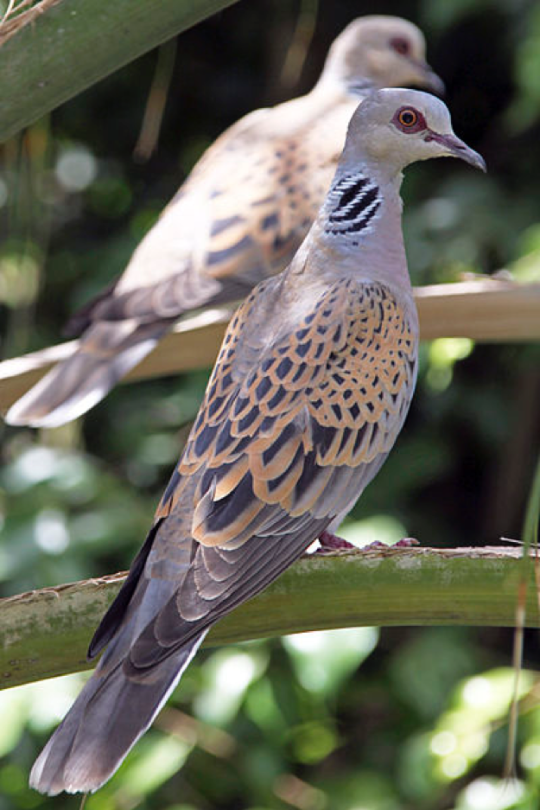
two doves on branches

In the wake of a tragedy that took the lives of 11 people in Pittsburgh, we reflect on the the collections housed at the Carnegie Museum of Natural History and find comfort among the doves — symbols of the people of Israel (Song of Songs Rabbah 2:14). Doves are of immense importance symbolizing human souls, sacrifice, and peace.

From the collection we share the European Turtledove (Streptopelia turtur) because it is listed as a species vulnerable to extinction and frequently written about in cultural texts. In fact, it was the stamina and swiftness of the Turtledove that aided Noah in his search for the holy land after the floods (Genesis 8:11). It is also the Turtledove’s loyalty as a mate that mused William Shakespeare to write poetry of an ideal love between a Turtledove and a Phoenix. But, perhaps the most fitting description and scientific namesake of the Turtledove is its cooing call, or the biblical Hebrew word “turtur,” which is a sound of mourning and a call for universal peace.

Together, we mourn the loss of so many innocent lives in Squirrel Hill and hope for peace alongside loved ones and family.

Chase Mendenhall is Assistant Curator of Birds, Ecology, and Conservation at Carnegie Museum of Natural History. Museum employees are encouraged to blog about their unique experiences and knowledge gained from working at the museum.
Filed Under: Blog Tagged With: bird, Birds, Chase Mendenhall

May 31, 2018 by wpengine

Raptor Watch

By Pat McShea

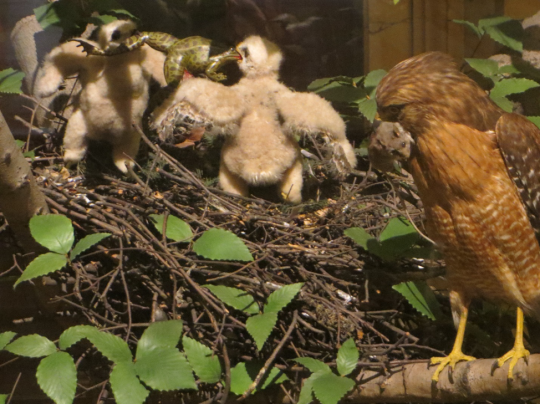
Raptor diorama

Raptor nests become more visually familiar territory every year. Whether you favor Bald Eagles or Peregrine Falcons, strategically-placed cameras in the immediate Pittsburgh area can bring the real-time life and death drama of nesting season to the screen of any internet connected device.

The website of the Audubon Society of Western Pennsylvania is the gateway to cameras monitoring two local Bald Eagle nests, and the website of the National Aviary provides access to the video feed of a Peregrine Falcon nest high on the University of Pittsburgh’s Cathedral of Learning.  Internet searches under terms such as “bird of prey nest cams” will dramatically widen options for both geographic territory and the variety of raptor species under camera surveillance.

Local nest cam action declines at this time of year as the young birds’ early flying attempts increasingly place them far out of camera range. No such development occurs within a recently restored historic diorama now located at the base of the museum’s Grand Staircase.  Here, in a scene taxidermist Joseph Santens constructed from the Red-shouldered Hawks and nest he collected in McKean County in 1911, it’s always feeding time.

What’s the value of this traditional museum diorama compared to the seasonal live action that web cameras so easily provide?

In our digital age the exhibit’s highest value might involve its assemblage of associated materials. Every museum specimen with accurate data about where it came from and when it was collected can be regarded as a three-dimensional voucher of time and place conditions that can be repeatedly re-examined –  whole, or in any of its minute chemical components.

The hundred-and-seven-year-old nest scene from northwestern Pennsylvania is a time capsule from a period when the technology of nest cams could not even be imagined.

Patrick McShea works in the Education and Visitor Experience department of Carnegie Museum of Natural History. Museum employees are encouraged to blog about their unique experiences and knowledge gained from working at the museum.
 

Related Content

A Taste for Metal

A Match Made by Coevolution

What’s in the Rivers?

Carnegie Museum of Natural History Blog Citation Information

Blog author: McShea, Patrick
Publication date: May 31, 2018

Share this post!

  • Share on Twitter Share on Twitter
  • Share on Facebook Share on Facebook
  • Share on Pinterest Share on Pinterest
  • Share on LinkedIn Share on LinkedIn
  • Share on Reddit Share on Reddit
  • Share via Email Share via Email

Share this post!

  • Share on Twitter Share on Twitter
  • Share on Facebook Share on Facebook
  • Share on Pinterest Share on Pinterest
  • Share on LinkedIn Share on LinkedIn
  • Share on Reddit Share on Reddit
  • Share via Email Share via Email

Filed Under: Blog Tagged With: bird, Birds, Pat McShea

May 22, 2018 by wpengine

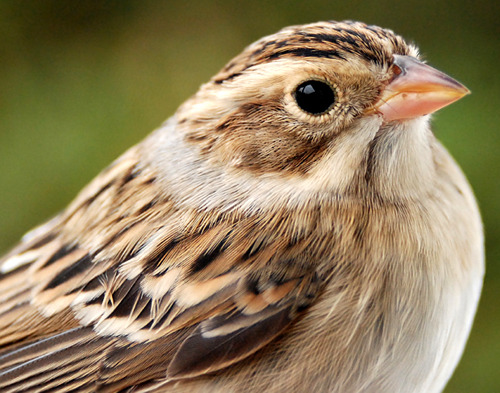
Clay-colored Sparrow

Clay-colored sparrow

A rarity to Powdermill, this sparrow usually breeds in shrublands, field edges, and thickets across the northern prairies.


Powdermill Nature Reserve’s avian research center is part of Carnegie Museum of Natural History’s biological research station in Rector, Pennsylvania.  The research center operates a bird banding station, conducts bioacoustical research, and performs flight tunnel analysis with the goal of reducing window collisions.


Filed Under: Blog Tagged With: bird, bird banding, Powdermill, Powdermill Nature Reserve

April 16, 2018 by wpengine

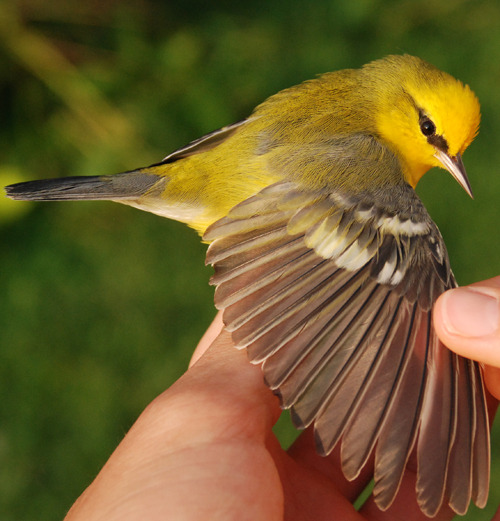
Male Blue-winged Warbler

Male Blue-winged Warbler, a brown and yellow bird

This species is relatively uncommon at Powdermill.  The lack of a molt limit in the alula feathers (A1,A2,A3) indicates this is an adult bird. Its closest relative, the Golden-winged Warbler, is much less common. The rapidly declining Golden-winged Warbler is currently being petitioned to be granted Federal protection under the Endangered Species Act.


Powdermill Nature Reserve’s avian research center is part of Carnegie Museum of Natural History’s biological research station in Rector, Pennsylvania.  The research center operates a bird banding station, conducts bioacoustical research, and performs flight tunnel analysis with the goal of reducing window collisions.


Filed Under: Blog Tagged With: bird, bird banding, parc

April 16, 2018 by wpengine

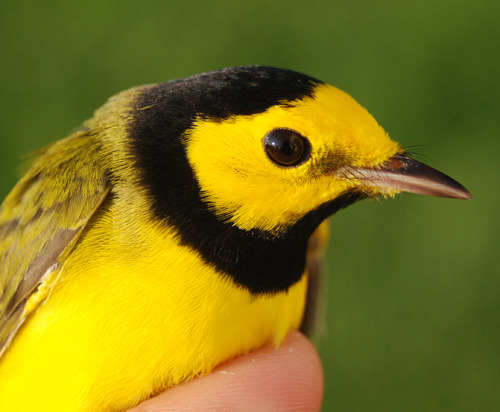
Male Hooded Warbler

Male Hooded Warbler, a bright yellow and black bird

The age of this bird is usually identifiable with a quick examination of the throat feathers.  If the black throat has extensive yellow tipping it is a hatching-year and if it lacks this tipping (or has very little) it is an after-hatching-year.


Powdermill Nature Reserve’s avian research center is part of Carnegie Museum of Natural History’s biological research station in Rector, Pennsylvania.  The research center operates a bird banding station, conducts bioacoustical research, and performs flight tunnel analysis with the goal of reducing window collisions.


Filed Under: Blog Tagged With: bird, bird banding, parc

April 14, 2018 by wpengine

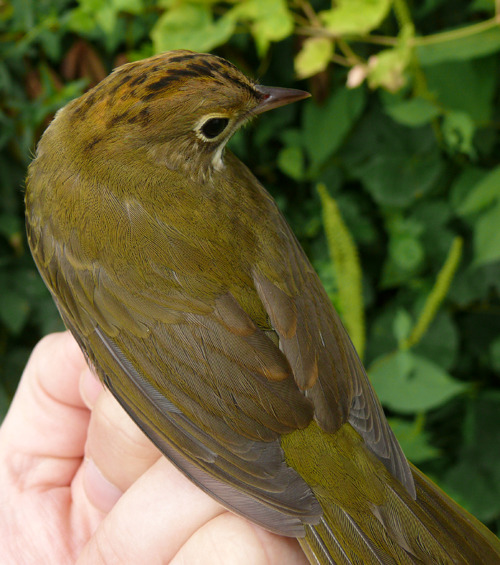
Ovenbird

ovenbird shown from the back

Although the young and adult birds have essentially the same general plumage, there are some slight differences. The rusty tipping on this bird’s tertials identify it as a hatching-year bird (adults lack the rusty tipping). By spring this tipping frequently is worn off, and age is best determined by using the presence or absence of a molt limit.  As in many birds, the shape of the tail also can be useful in ageing warblers.


Powdermill Nature Reserve’s avian research center is part of Carnegie Museum of Natural History’s biological research station in Rector, Pennsylvania.  The research center operates a bird banding station, conducts bioacoustical research, and performs flight tunnel analysis with the goal of reducing window collisions.


Filed Under: Blog Tagged With: bird, bird banding, parc

  • Page 1
  • Page 2
  • Page 3
  • Go to Next Page »

sidebar

About

  • Mission & Commitments
  • Directors Team
  • Museum History

Get Involved

  • Volunteer
  • Membership
  • Carnegie Discoverers
  • Donate
  • Employment
  • Events

Bring a Group

  • Groups of 10 or More
  • Birthday Parties at the Museum
  • Field Trips

Powdermill

  • Powdermill Nature Reserve
  • Powdermill Field Trips
  • Powdermill Staff
  • Research at Powdermill

More Information

  • Image Permission Requests
  • Science Stories
  • Accessibility
  • Shopping Cart
  • Contact
  • Visitor Policies
One of the Four Carnegie Museums | © Carnegie Institute | Privacy Policy | Terms of Use | Accessibility
Rad works here logo