• Skip to primary navigation
  • Skip to main content
  • Skip to primary sidebar

Carnegie Museum of Natural History

One of the Four Carnegie Museums of Pittsburgh

  • Visit
    • Buy Tickets
    • Visitor Information
    • Exhibitions
    • Events
    • Dining at the Museum
    • Celebrate at the Museum
    • Powdermill Nature Reserve
    • Event Venue Rental
  • Learn
    • Field Trips
    • Educator Information
    • Programs at the Museum
    • Bring the Museum to You
    • Guided Programs FAQ
    • Programs Online
    • Climate and Rural Systems Partnership
  • Research
    • Scientific Sections
    • Science Stories
    • Science Videos
    • Senior Science & Research Staff
    • Museum Library
    • Science Seminars
    • Scientific Publications
    • Specimen and Artifact Identification
  • About
    • Mission & Commitments
    • Directors Team
    • Museum History
  • Tickets
  • Give
  • Shop

bird hall

January 18, 2017 by wpengine

Baltimore Orioles in Pittsburgh

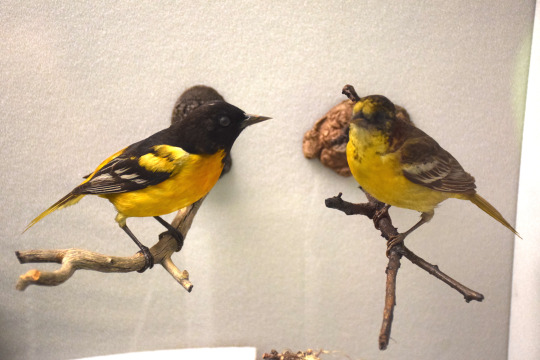
taxidermy mounts of Baltimore Orioles (Icterus galbula)

These taxidermy mounts of Baltimore Orioles (Icterus galbula) in Bird Hall show the differences in coloring between males and females, or sexual dimorphism.

These birds are known for their brightly colored plumage and their sock-shaped nests that hang from branches, which are on display just below.
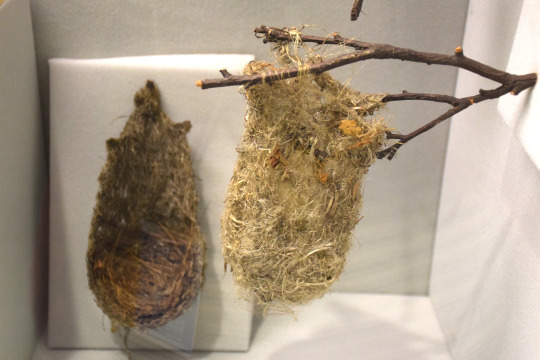
Oriole nests

Baltimore Orioles’ whistling songs are one of the first heard in spring in eastern North American forests.

They prefer dark-colored, ripe fruit. They eat by piercing fruit with their beaks, which reflexively open to allow them to easily access what is inside.
Filed Under: Blog Tagged With: bird hall, Birds

December 21, 2016 by wpengine

Art in Bird Hall

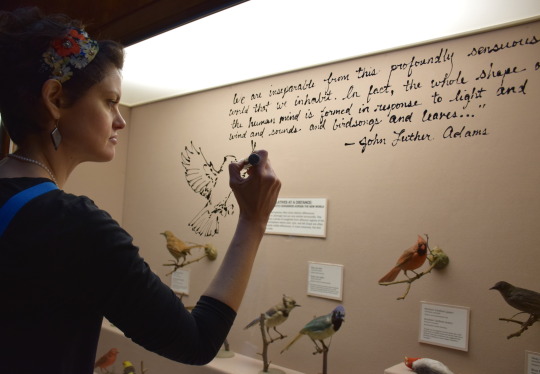
Ashley Cecil writing poetry on glass in front of bird taxidermy
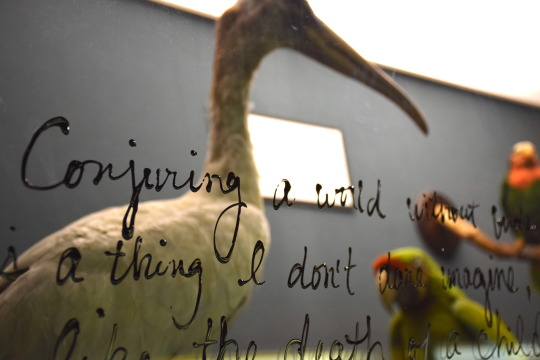
poetry written on glass in front of stork

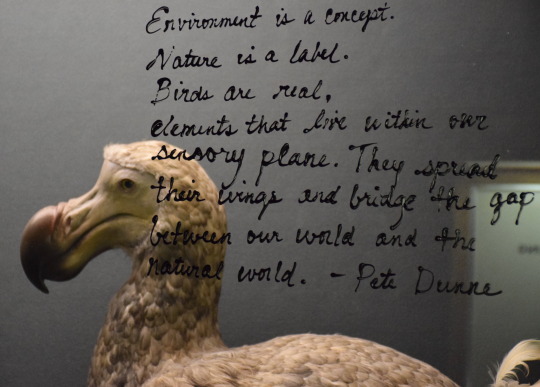
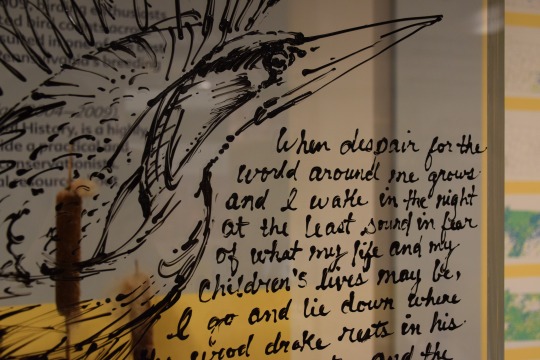
If you walk through Bird Hall this month, you might notice that there are more than just specimens on display.

Artist in Residence Ashley Cecil has been drawing birds and writing poems, song lyrics, and quotes about birds, conservation, and nature on the glass displays cases that hold hundreds of specimens. Ashley worked with museum scientists who shared quotes and works of art that inspired them to enter their fields and study birds.

There are poems by Emily Dickinson and Wendell Berry, lyrics by John Lennon and Paul McCartney, and quotes from famous ornithologists. One case features a line from a Dickinson poem…

“I hope you love birds too. It is economical. It saves going to heaven.”


Ashley Cecil is the artist in residence at Carnegie Museum of Natural History. Through her residence at the museum, Ashley is creating art inspired by nature and exploring the nexus of art and science.

poem written on glass in front of dodo replica
drawing of a bird on glass

Filed Under: Blog Tagged With: art, bird hall, Birds

October 26, 2016 by wpengine

Comparing Pictures to Mounts

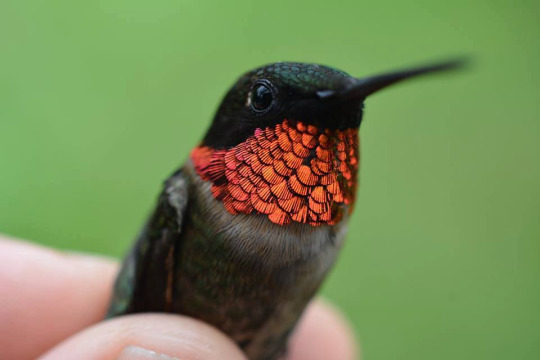
ruby throated hummingbird
The Ruby-throated hummingbird, which has iridescent, fuchsia feathers on its neck, a dark green head, and a long black beak.

Each week, staff at Powdermill Nature Reserve staff posts stunning,
high-resolution photos of birds that land in their nets on their Facebook page.

The photos show detailed characteristics of local birds, like the
subtle coloring of a Common Yellowthroat or the sharp beak of a Pine
Siskin, that are hard to see as they fly above.

Powdermill is Carnegie Museum of Natural History’s environmental
research center in Rector Pa, where thousands of birds are identified, banded,
and released each year. As they band, research staffers often snap pictures
that highlight the huge variety of different birds flying through Western
Pennsylvania’s skies.

One favorite is the Ruby-throated hummingbird, which has
iridescent, fuchsia feathers on its neck that abut a dark green heads and long
black beak.

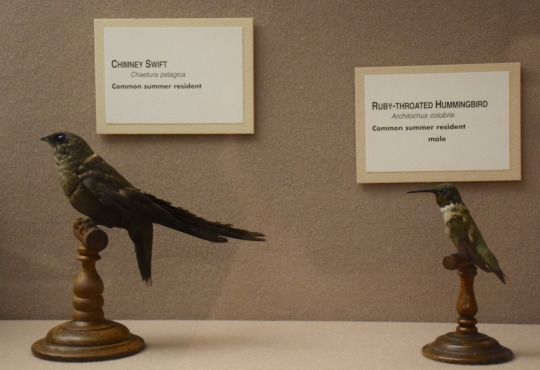
Comparing the Powdermill pictures to Bird Hall in the museum
is an interesting exercise. For example, Powdermill’s high resolution pictures let
you appreciate each and every line of the hummingbird’s bright feathers. But in
the museum, to see a taxidermy mount of a ruby throated humming bird
helps you grasp the miniscule size of these little birds that don’t often grow
larger than 3.5 inches.

Powdermill’s pictures and Bird Halls specimens work
in tandem to encourage us to pause and consider tiny players in our huge
local ecosystem, helping us all foster a little more appreciation for the
natural world.

taxidermied birds
Specimens on display in Bird Hall at Carnegie Museum of Natural History

Filed Under: Blog Tagged With: avian research, bird hall, Birds, museums, Pittsburgh, Powdermill

June 22, 2016 by wpengine

What’s up with the dead birds?

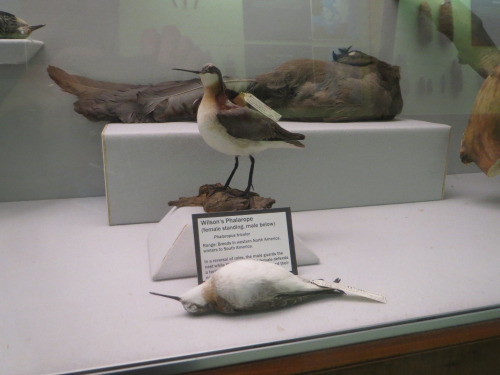
A study skin displayed below a taxidermy mount in Bird Hall.

by Patrick McShea

Museum visitors sometimes offer spontaneous testimony to the deceptive power of taxidermy.

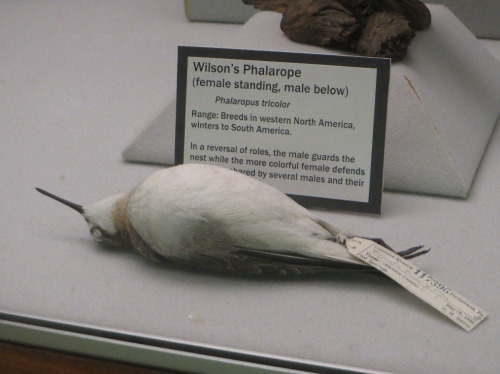
“There’s a dead bird!” is a comment frequently voiced by people encountering a bird specimen lying on its back in Bird Hall, such as the Wilson’s phalarope pictured below. These specimens, so often called “dead birds”, are actually called study skins.

study skin of a Wilson's Palarope bird

Study skins are a traditional form of specimen preparation for birds in scientific collections. Unlike taxidermy mounts, which attain a pretense of life through concealed body forms, strategically positioned wires,
and glass eyes of the appropriate size and color, the cotton-stuffed study skins appear lifeless.

The more than 154,000 bird study skins in the museum’s research collection have all undergone similar preparation. For each specimen the full skin of the bird was carefully removed from the underlying muscle,
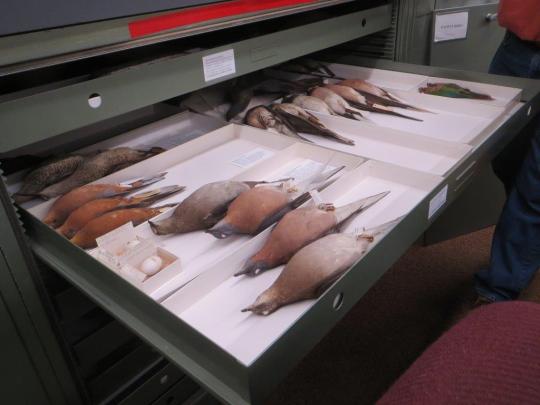
skeleton core, and internal organs, preserving every feather of the creature. Such Uniform preparation creates a standard for comparisons of features between both similar and strikingly different specimens. In addition, the low profile of study skins allows for their storage in shallow cabinet drawers in the manner of the passenger pigeon study skins pictured below.

bird study skins in a drawer

Although taxidermy mounts far outnumber study skins in Bird Hall display cases, the “skins” play an important role by representing the most numerous form of preserved specimens in the museum’s vast bird collection. Whether or not adjacent taxidermy mounts seem more alive because they share display space with the skins is something you may judge for yourself during your next museum visit.

Patrick McShea works in the Education and Visitor Experience department of Carnegie Museum of Natural History. Museum employees are encouraged to blog about their unique experiences of working at the museum.

Carnegie Museum of Natural History Blog Citation Information

Blog author: Patrick McShea
Publication date: June 22, 2016

Share this post!

  • Share on Twitter Share on Twitter
  • Share on Facebook Share on Facebook
  • Share on Pinterest Share on Pinterest
  • Share on LinkedIn Share on LinkedIn
  • Share on Reddit Share on Reddit
  • Share via Email Share via Email

Filed Under: Blog Tagged With: bird hall, Birds, museums, nature, Patrick McShea, Pittsburgh, research

May 27, 2016 by wpengine

100-year-old Postcard: The Original Social Media

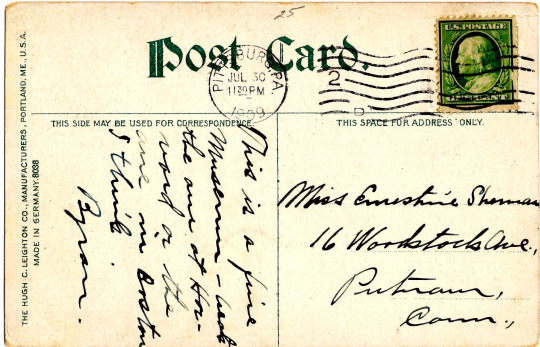
Postcard with handwritten address and message in fancy script
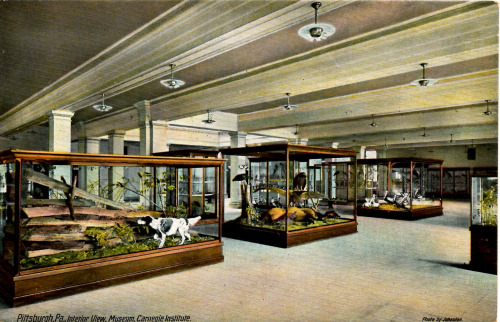
Historic Hall CMNH

How did word get around about Carnegie Museum of Natural History before Facebook, Twitter, and Snapchat?
Postcards of course!

Steve Rogers, our collection manager of Section of Birds and Section of Amphibians and Reptiles, purchased a classic Carnegie Museum postcard that’s more than 100 years old on eBay years ago, and recently scanned and shared it in preparation for a talk he’ll give at the National Taxidermists Association meeting in Seven Springs next month.

The front of the postcard shows dioramas that include an old Count Noble exhibit that was sent to Kentucky about 15 years ago, the condor case with the elk, and the pelican case which was dismantled around 2000.

The back of the card reads…

This is a fine Museum – beats the one at Harvard or the one in Boston I think, Brian”

It is postmarked 1909, not long after we expanded the museum from the original Carnegie Institute.

Maybe our Tumblr and Facebook posts will be rediscovered 100 years from now. Either way, we’re always excited to share cool pieces of Carnegie history!

Filed Under: Blog Tagged With: bird hall, diorama, Pittsburgh, Stephen Rogers, taxidermy

May 11, 2016 by wpengine

Front Line Birds

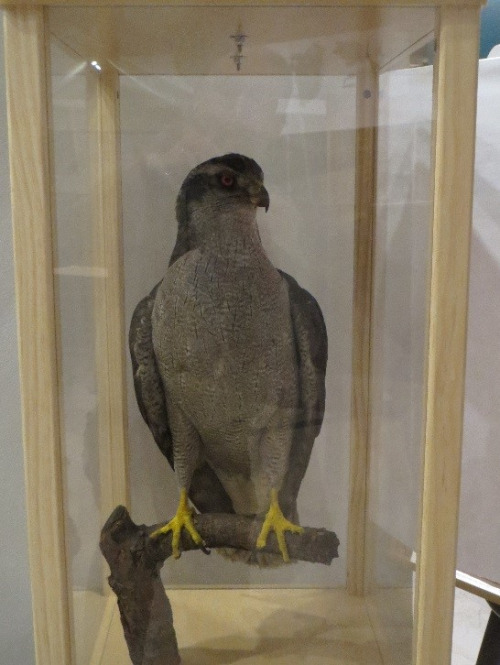
hawk in a display case
Carnegie Museum of Natural History’s taxidermied Goshawk

By Patrick McShea

Best-selling books aren’t usually discussed during our daily 15-minute customer service personnel briefings.

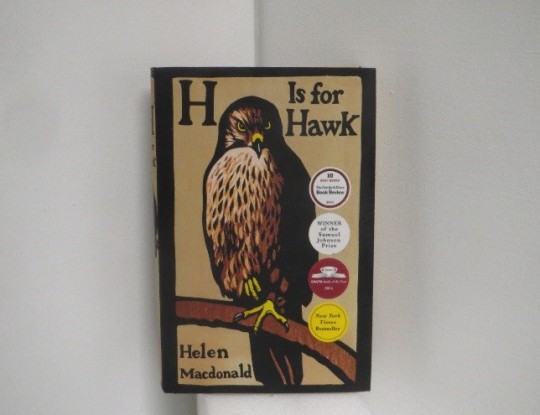
During a recent briefing focused on the museum’s extensive loan program,  an old taxidermy mount in a new portable display case steered discussion to H Is for Hawk, the award winning 2014 non-fiction work by Helen Macdonald.

“That’s a Goshawk?” exclaimed one staff member, pointing to the life-like preserved remains of a big gray and white raptor perched in a 28 inch high plexi-glass sided box. “The bird is huge!” She went on to explain that as part of a book club, she had been reading, if not always enjoying, H is for Hawk, which features a young Goshawk as pivotal character.

As someone then halfway through the book I was able to affirm the narrative’s difficult passages and take advantage of the fleeting teachable moment. H Is for Hawk can be a tough read because it addresses grief and depression and the historically frequent misinterpretation of the lessons people should take from highly adapted predators. I pointed out that the stuffed bird that was in front of us presented several physical adaptations for the efficient capture and killing of prey.

Whether you’ve read the book or not, you can gain a fuller appreciation for the physical attributes of birds of prey by closely examining the taxidermy mounts of hawks and owls currently on display at Carnegie Museum of Natural History’s interactive exhibition Discovery Basecamp, which is on the first floor of the museum.

H Is for Hawk
H Is for Hawk book

Additional information about the CMNH loan program can be found at: http://www.carnegiemnh.org/programs/loan/

As part of the Pittsburgh Arts and Lectures series, Helen Macdonald will speak at Carnegie Music Hall on January 30, 2017: http://pittsburghlectures.org/2015-16-literary-evenings/

Patrick McShea works in the Education and Visitor Experience department of Carnegie Museum of Natural History. Museum employees are encouraged to blog about their unique experiences and knowledge gained from working at the museum.

Filed Under: Blog Tagged With: bird hall, museums, Patrick McShea, taxidermy

  • « Go to Previous Page
  • Page 1
  • Page 2
  • Page 3
  • Page 4
  • Page 5
  • Go to Next Page »

sidebar

About

  • Mission & Commitments
  • Directors Team
  • Museum History

Get Involved

  • Volunteer
  • Membership
  • Carnegie Discoverers
  • Donate
  • Employment
  • Events

Bring a Group

  • Groups of 10 or More
  • Birthday Parties at the Museum
  • Field Trips

Powdermill

  • Powdermill Nature Reserve
  • Powdermill Field Trips
  • Powdermill Staff
  • Research at Powdermill

More Information

  • Image Permission Requests
  • Science Stories
  • Accessibility
  • Shopping Cart
  • Contact
  • Visitor Policies
One of the Four Carnegie Museums | © Carnegie Institute | Privacy Policy | Terms of Use | Accessibility
Rad works here logo