• Skip to primary navigation
  • Skip to main content
  • Skip to primary sidebar

Carnegie Museum of Natural History

One of the Four Carnegie Museums of Pittsburgh

  • Visit
    • Buy Tickets
    • Visitor Information
    • Exhibitions
    • Events
    • Dining at the Museum
    • Celebrate at the Museum
    • Powdermill Nature Reserve
    • Event Venue Rental
  • Learn
    • Field Trips
    • Educator Information
    • Programs at the Museum
    • Bring the Museum to You
    • Guided Programs FAQ
    • Programs Online
    • Climate and Rural Systems Partnership
  • Research
    • Scientific Sections
    • Science Stories
    • Science Videos
    • Senior Science & Research Staff
    • Museum Library
    • Science Seminars
    • Scientific Publications
    • Specimen and Artifact Identification
  • About
    • Mission & Commitments
    • Directors Team
    • Museum History
  • Tickets
  • Give
  • Shop

Botany Blogs

These blogs are written about and by our Section of Botany researchers. The herbarium at the museum which contains approximately 3,000 type specimens--specimens that define an entire plants' species. These type specimens only represent about 0.6 % of the collection.

Mason Heberling, head of the section, regularly shares herbarium specimens that have been "Collected on this day" in history.

June 11, 2018 by wpengine

Land snails in Mt Lebanon: BioBlitz confirms rare species and finds two additional gastropod species in urban parks

Tim Pearce (Curator of Collections, Mollusks) surveyed land snails in a BioBlitz organized this past weekend by the Mt. Lebanon Nature Conservancy at Robb Hollow Park in Mt. Lebanon. Other members of Carnegie Museum of Natural History who participated in the BioBlitz were Bonnie and Joe Isaac (Collection Manager and volunteer, respectively, Botany).

Pearce targeted five locations in Robb Hollow Park and found 10 species of gastropods, including a rare species, and two species that had not been found in Mt. Lebanon during previous BioBlitzes in 2003 and 2005 at Bird Park and Twin Hills Park. The two new records were the introduced slug Arion intermedius (common name: Hedgehog Arion) and a minute native snail, Columella simplex (High-spire Column).
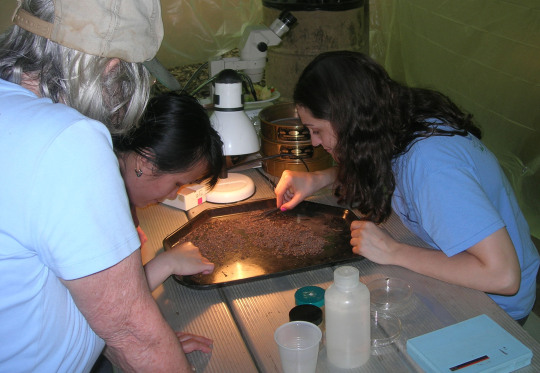
BioBlitz participants picking minute snails from a leaf litter sample.
Duquesne University students Josie (left) and Dannielle (right) picking minute snails from a leaf litter sample during the BioBlitz.


The most exciting snail find is the rare snail, Glyphyalinia raderi (Maryland Glyph), living in Robb Hollow Park. This native species has been found in Pennsylvania only 18 times previously, in six counties in the southwestern part of the state. Most of the localities are associated with limestone in undisturbed natural areas, so the finding of this snail in Robb Hollow Park this year and in Twin Hills Park in 2005 are big surprises. Why is a rare snail living in these non-pristine urban parks? Furthermore, it is almost never found alive, but the two individuals seen in Robb Hollow park were both alive.

Ten species is a bit on the low side for a snail survey, but is better than Pearce expected. When he collected the samples, he noticed that (non-native) earthworms had consumed most of the duff layer of dead leaves, leaving very little food and living space for snails, so he initially didn’t have high hopes for finding many species. But he found ten, and happily, most of the snail species are native. “In urban settings, I often find a large proportion of introduced species, usually from Europe,” said Pearce. “But in Robb Hollow Park, seven of the ten species are native, which is a pretty good proportion.”

Timothy A. Pearce, PhD, is the head of the mollusks section at Carnegie Museum of Natural History.

Museum employees are encouraged to blog about their unique experiences and knowledge gained from working at the museum.
Filed Under: Blog Tagged With: Botany, mollusks, Tim Pearce

May 23, 2018 by wpengine

Poison Ivy Potency?

By Rachael Carlberg

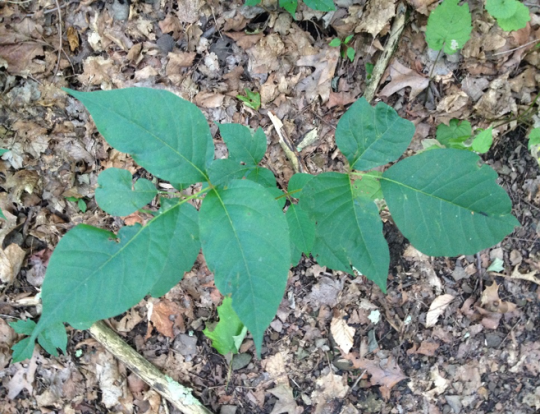
Poison ivy

When prompted with the phrase “climate change,” people often think of increasing temperatures, melting ice, and flooding shores. While global temperatures are on the rise, the story of humanity’s impact on the environment is much more complex.  As carbon dioxide levels in the atmosphere rise, and temperatures increase, we face unanticipated changes to the world around us.

Poison ivy, for example, grows larger in our changing climate. Higher levels of carbon dioxide in the atmosphere cause increases in photosynthesis, allowing plants like poison ivy to grow more and produce larger leaves. In carbon-rich conditions the vine also creates more toxic forms of urushiol, the oil that causes an allergic reaction in people.

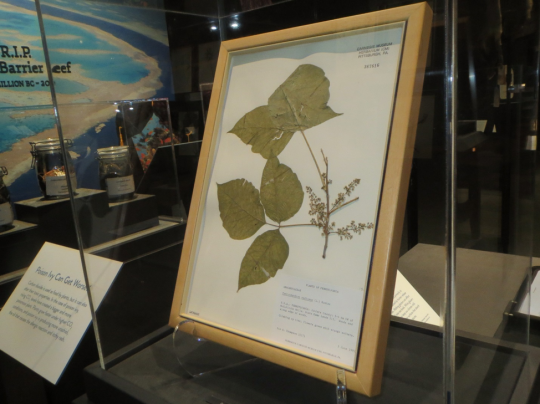
Preserved poison ivy

Preserved poison ivy displayed in We Are Nature.

You might be thinking, if higher levels of carbon dioxide mean higher levels of photosynthesis, won’t all plants benefit?  The problem is that increased levels of carbon dioxide don’t impact all plants in the same way.  Vines like poison ivy can reap the rewards of increased photosynthesis with more leaf area because, unlike upright plants, they don’t need to devote as many resources to structural support like trunks and thick branches.

As an intern in the Education department of Carnegie Museum of Natural History, Rachael Carlberg wrote blog posts related to ideas presented in We Are Nature. Museum employees are encouraged to blog about their unique experiences of working at the museum.    

Filed Under: Blog Tagged With: Anthropocene, Botany, We Are Nature, We Are Nature 2, We Are Nature: Living in the Anthropocene

May 18, 2018 by wpengine

Myrtle, a Royal Favorite for Wedding Bouquets

Which plants are worthy of inclusion in a Royal Wedding? We’ll see tomorrow, but we know one plant that’s nearly guaranteed to appear in the festivities: myrtus communis, simply called myrtle.

Meghan Markle’s bouquet will likely include myrtle from Queen Victoria’s own garden, which has been tended for over 170 years. Every Royal bride since Queen Victoria has carried myrtle.

Myrtle symbolizes love and hope, perfect sentiments for any bridal bouquet.

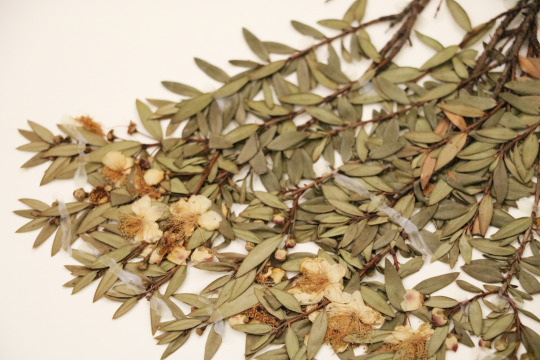
Dried myrtle

We have numerous dried myrtle specimens in the museum collection. The most appropriate one for a Royal Wedding bouquet is this one from Earthworks Greenhouse, Arlington, VA in 1980. It even cascades down the page.

Filed Under: Blog Tagged With: Botany

May 10, 2018 by wpengine

Plant Blindness

By Patrick McShea

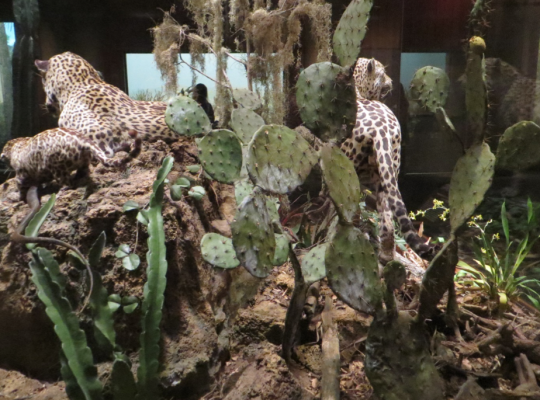
Cactus

Plant Blindness refers to the inability to see or notice the plants in one’s own environment. The term was coined twenty years ago by two botanists, Elizabeth Schussler, of the Ruth Patrick Science Educator Center in Aiken, South Carolina, and James Wandersee, of Louisiana State University in Baton Rouge. The common condition, according to the pair, results in a chronic inability to recognize the importance of plants in the biosphere and in human affairs.

Fortunately, not all of us are afflicted. As evidence, CMNH Conservator Gretchen Anderson recounts a touching interaction she observed while conducting exhibit restoration work within the museum’s second floor Hall of North American Wildlife. From a just-opened elevator door a five-year old made a headlong dash to the diorama featuring a pair of mature jaguars and their three cubs. “LOOK Dad!” he called back to his father while pointing into the display, “CACTUS!”

For additional information about Plant Blindness, visit: https://plantsocieties.cnps.org/index.php/about-main/plant-blindness

Patrick McShea works in the Education and Visitor Experience department of Carnegie Museum of Natural History. Museum employees are encouraged to blog about their unique experiences and knowledge gained from working at the museum.
Filed Under: Blog Tagged With: Botany, cactus, Hall of North American Wildlife, Patrick McShea

February 27, 2018 by wpengine

Celebrating Carnegie History: Dr. Andrey Avinoff

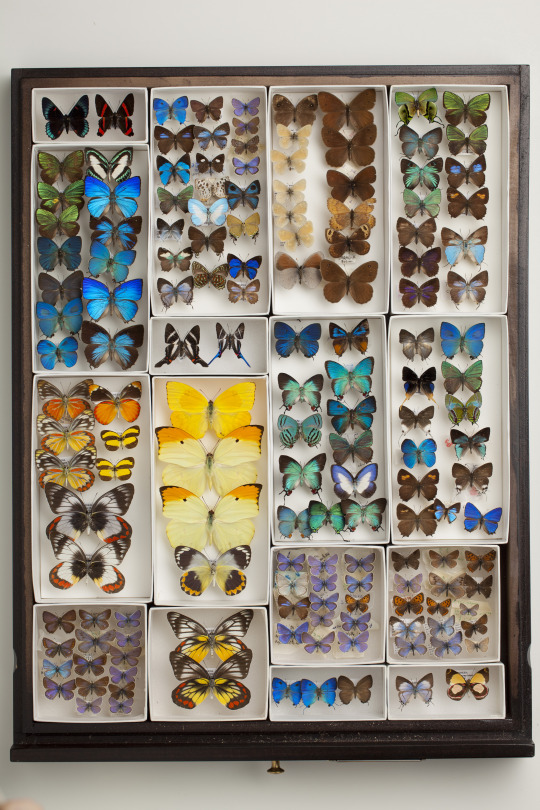
butterfly and moth collection

Since Carnegie Museum of Natural History was founded in the late 1800s, it has been the home of an impressive group of alumni scientists who made great progress in their fields. One in this group who stands out is Dr. Andrey Avinoff, the director of the museum from 1926-1946.

Dr. Avinoff’s career began in Russia, where he studied geographical variation in moths and butterflies across different mountain ranges in Asia. He studied how smaller sub-ranges of the Himalayas led to the prevention of interbreeding in some species, but allowed it in others, depending on the geography and geology of the specific area. As he put it, “the study of variation divorced from geographical distribution is futile.”

Throughout his studies, he amassed a huge collection of specimens, but his collection was appropriated and held by the Zoological Institute of the Russian Academy of Sciences.

When he began his tenure at Carnegie Museum of Natural History, Dr. Avinoff virtually replicated his moth and butterfly collection through financed expeditions and trades with other collectors.

Dr. Avinoff was also an avid artist; “I bow to scientific fact until 5 o’clock,” he said. In 1941, he brought his two passions together and began the ambitious project to collect, describe, and illustrate the flora of western Pennsylvania. Partnering with the curator of Botany at the time, Otto E. Jennings, living plants were found growing wild, then brought to the museum for Dr. Avinoff to capture in paint. When the specimens were no longer needed for painting, they were dried and pressed to be saved in the herbarium.

Dr. Avinoff’s paintings were published in the book Wildflowers of Western Pennsylvania and the Upper Ohio Basin, which was printed in 1953.


Throughout the month of September, Carnegie Museum of Natural History is celebrating Pittsburghers living longer and better through enriching cultural engagement. We will be reflecting on cool pieces of museum history on our blog and social media and offering a series of programming at the museum that will range from dancing to specialized tours, geared towards visitors who are 45 and older. Visit our website for more information and programming details.

Filed Under: Blog Tagged With: Andrey Avinoff, Botany, Invertebrate Zoology, museum history

February 15, 2018 by wpengine

Collected on Valentine’s Day, 1996

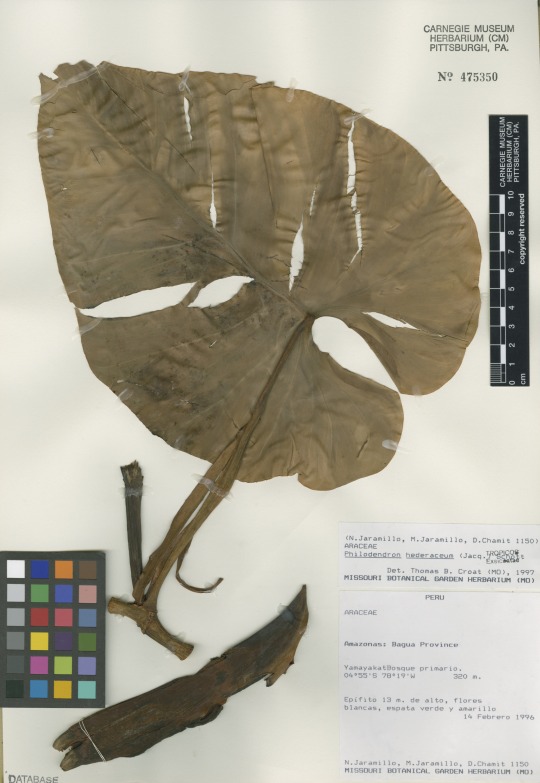
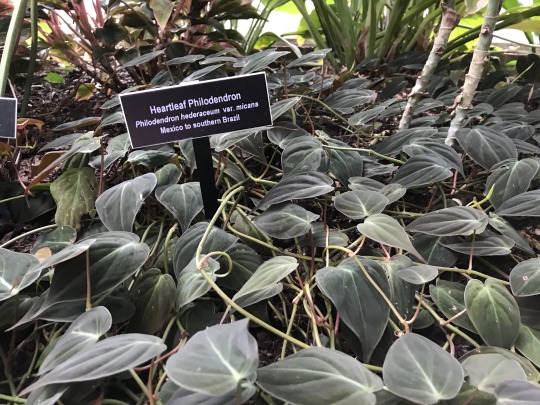
heartleaf philodendron (Philodendron hederaceum) collected on Valentine’s Day in Peru

Does this heart-shaped leaf look familiar?  22 years ago, this specimen of heartleaf philodendron (Philodendron hederaceum) was collected on Valentine’s Day in Peru. Almost certainly you have seen this species, but probably not in the wild.  Heart leaf philodendron is a very popular houseplant. This huge leaf on this specimen may look a bit different than those in your home, as the species rarely reaches maturity as a
houseplant.  Philodendrons have both juvenile and adult forms of their leaves, changing their form and size as they climb up a tree.

There are also many different species and varieties of philodendrons.

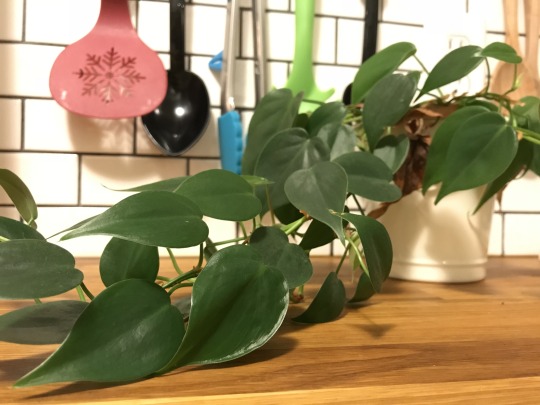
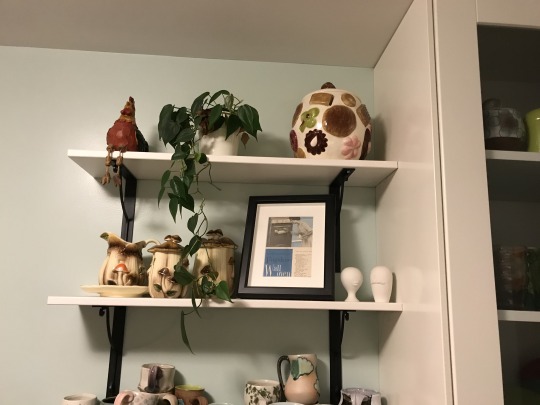
healthy green philodendron growing on a kitchen counter

Philodendron growing on a bookshelf
Philodendron in its newly found habitat in the Anthropocene. Philodendrons are incredibly popular as indoor plants, being easy to take care of and incredibly tolerant of low light conditions in your house. Philodendrons are toxic to pets. However, the NASA Clean Air Study has found philodendrons to filter out harmful chemicals and improve indoor air quality.

The name Philodendron comes from the Greek philo meaning “love” and dendron meaning “tree.”  The name doesn’t refer to the heart shaped leaves, but rather to its growth habit as a vine that climbs trees.  It is native to tropical Mexico, the Caribbean, and regions in South America.

Philodendron growing outside

Happy Valentine’s Day from this loving plant!

Filed Under: Blog Tagged With: Anthropocene, Botany, Mason Heberling

  • « Go to Previous Page
  • Page 1
  • Interim pages omitted …
  • Page 15
  • Page 16
  • Page 17
  • Page 18
  • Page 19
  • Interim pages omitted …
  • Page 28
  • Go to Next Page »

sidebar

About

  • Mission & Commitments
  • Directors Team
  • Museum History

Get Involved

  • Volunteer
  • Membership
  • Carnegie Discoverers
  • Donate
  • Employment
  • Events

Bring a Group

  • Groups of 10 or More
  • Birthday Parties at the Museum
  • Field Trips

Powdermill

  • Powdermill Nature Reserve
  • Powdermill Field Trips
  • Powdermill Staff
  • Research at Powdermill

More Information

  • Image Permission Requests
  • Science Stories
  • Accessibility
  • Shopping Cart
  • Contact
  • Visitor Policies
One of the Four Carnegie Museums | © Carnegie Institute | Privacy Policy | Terms of Use | Accessibility
Rad works here logo