• Skip to primary navigation
  • Skip to main content
  • Skip to primary sidebar

Carnegie Museum of Natural History

One of the Four Carnegie Museums of Pittsburgh

  • Visit
    • Buy Tickets
    • Visitor Information
    • Exhibitions
    • Events
    • Dining at the Museum
    • Celebrate at the Museum
    • Powdermill Nature Reserve
    • Event Venue Rental
    • Gift Cards
  • Learn
    • Field Trips
    • Educator Information
    • Programs at the Museum
    • Bring the Museum to You
    • Guided Programs FAQ
    • Programs Online
    • Climate and Rural Systems Partnership
  • Research
    • Scientific Sections
    • Science Stories
    • Science Videos
    • Senior Science & Research Staff
    • Museum Library
    • Science Seminars
    • Scientific Publications
    • Specimen and Artifact Identification
  • About
    • Mission & Commitments
    • Directors Team
    • Museum History
  • Tickets
  • Give
  • Shop

Botany Blogs

These blogs are written about and by our Section of Botany researchers. The herbarium at the museum which contains approximately 3,000 type specimens--specimens that define an entire plants' species. These type specimens only represent about 0.6 % of the collection.

Mason Heberling, head of the section, regularly shares herbarium specimens that have been "Collected on this day" in history.

July 10, 2018 by wpengine

Collected on This Day: Apocynum cannabinum

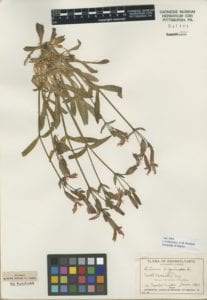
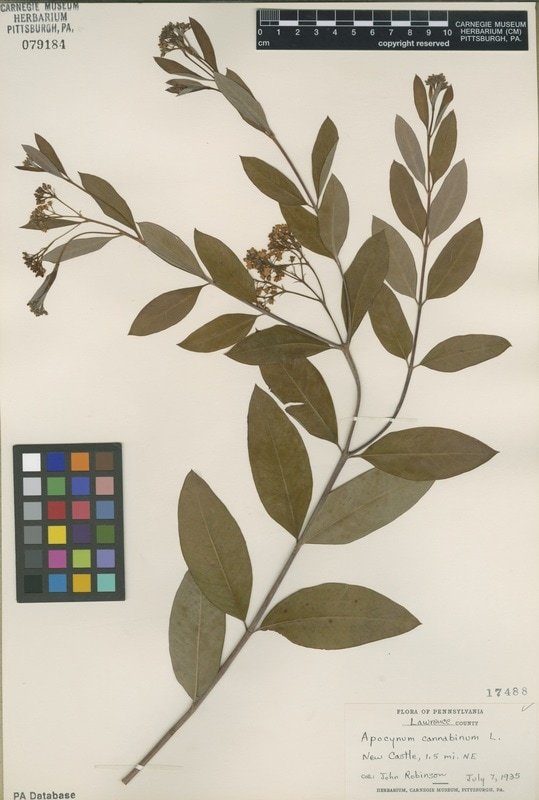
Hemp dogbane (Apocynum cannabinum) specimen

Collected on July 7, 1935, this specimen was found by John Robinson near New Castle, PA.  Hemp dogbane (Apocynum cannabinum) are important food plants for moth and butterfly larvae, and like other plants in the milkweed family, this plant is poisonous.  Its milk-like, sticky, latex sap contains cardiac glycosides that causes heart problems, rapid pulse, vomiting, and possible death.  This is especially of concern to pets and livestock, although dogbane is generally avoided. Hemp dogbane has a rich ethnobotanical history by Native Americans – its bark having been used for fiber (hence the “hemp” part of name), and roots, seeds, or leaves used for medicines to treat a wide variety of ailments. Hemp dogbane can be found in sparely wooded areas, ditches, and field edges across United States.

Botanists at Carnegie Museum of Natural History share pieces of the herbarium’s historical hidden collection on the dates they were discovered or collected. Check back for more!

Mason Heberling is Associate Curator of Botany at Carnegie Museum of Natural History.

Carnegie Museum of Natural History Blog Citation Information

Blog author: Heberling, Mason
Publication date: July 6, 2017

Share this post!

  • Share on Twitter Share on Twitter
  • Share on Facebook Share on Facebook
  • Share on Pinterest Share on Pinterest
  • Share on LinkedIn Share on LinkedIn
  • Share on Reddit Share on Reddit
  • Share via Email Share via Email

Filed Under: Blog Tagged With: Botany, collected on this day, herbarium, Mason Heberling, museums, plants

July 9, 2018 by wpengine

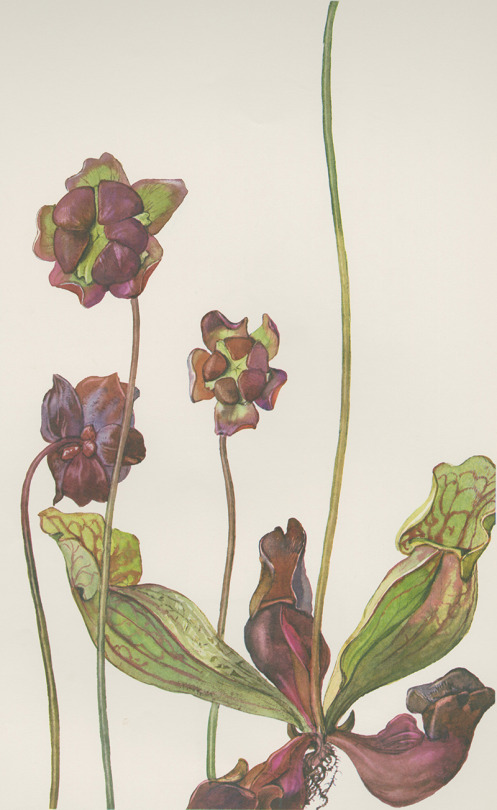
Illustrations of Flora in Western Pennsylvania

illustration of flowers

In 1941, Carnegie Museum of Natural History Director Andrey Avinoff began an ambitious project with friend and Curator of Botany Otto E. Jennings.

They wanted to describe and illustrate the flora of western Pennsylvania, based on Jennings’s lifelong study of the region. Jennings and his colleagues brought in the living plants, fresh and unwithered. Avinoff worked quickly to capture accurately the color and manner of growth. Many of these specimens were then dried, pressed, and placed as vouchers in the herbarium.

Selected Avinoff reprints are available in the Museum Store for purchase for $25.


Filed Under: Blog Tagged With: Andrey Avinoff, Botany, gift shop

July 3, 2018 by Kathleen

Grant Supports Digitization of Specimens in Carnegie Museum of Natural History’s Herbarium

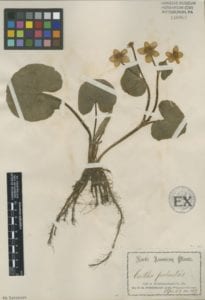
Oldest Allegheny County specimen collected in 1869Caltha palustris collected in 1874

 Carnegie Museum Herbarium specimens: (left) the oldest Allegheny County specimen collected in 1869 (right) Caltha palustris collected in 1874

Sanguinaria canadensis specimen

Sanguinaria canadensis specimen collected in 1905

Botanists from Carnegie Museum of Natural History (Pittsburgh, PA) received funding from the US National Science Foundation (NSF) totaling $173,614 to partner with the ongoing Mid-Atlantic Megalopolis (MAM) Project. Along with students and volunteers, Mason Heberling, Postdoctoral Research Fellow, and Bonnie Isaac, Collection Manager, of the Botany Department will be working with the team to digitize nearly 190,000 plant specimens in the museum’s collection to better understand plant life in urban environments. This three-year project begins August 1, 2018.

Carnegie Museum’s Herbarium (CM) is the major botanical facility in the Upper Ohio Valley region and ranks among the top 25 herbaria in North America. In addition to large holdings from the region dating back to the 1800s, the more than 540,000 vascular plant specimens include worldwide geographic and taxonomic representation.

The Mid-Atlantic Megalopolis (MAM) Project includes specimens from 13 institutions in Pennsylvania, New York, New Jersey, Delaware, Maryland, and District of Columbia. According to the MAM Project website, “The data mobilized in this effort will help us achieve a better scientific understanding of living urban systems, a critical need for urban planners, restoration ecologists, environmental engineers, (landscape) architects, and conservationists engaged in creating more sustainable and better designed cities, including the constructed and restored natural environments of our urban areas.”

The initial MAM Project’s focus was on the densely-populated urban corridor from Washington, D.C. to New York City. This funding to the Carnegie Museum of Natural history substantially expands the project’s scope by adding the unique industrial and environmental history of the Greater Pittsburgh Region. The addition of the Carnegie Museum Herbarium will increase the number of digitized specimens in the MAM Project by more than 25% (nearly 190,000 plant specimens).

A digital herbarium will be publicly available online, making plant specimens in the Carnegie Museum of Natural History, and the information within, accessible to researchers worldwide. Along with high-resolution images for nearly 190,000 plant specimens at the Carnegie Museum of Natural History, the project will mobilize additional data, including who collected the specimen, where it was collected it (including GPS coordinates), when it was collected, and more.

The project also funds activities that enhance the ongoing Anthropocene initiatives at the Carnegie Museum of Natural History, including programs in invasive species management, education of nature in the city, and museum exhibition. Taken together, this project will improve scientific and public understanding of urban environments, highlighting sustainability and the future of this increasingly common biome in the current era of environmental change.

Filed Under: Press Release, Scientific Sections Tagged With: Bonnie Isaac, Botany, Mason Heberling

June 25, 2018 by wpengine

Could Polyjuice Potion Be Real?

By Mason Heberling

“This is the most complicated potion I’ve ever seen. Lacewing flies, leeches, fluxweed, and knotgrass. Well, they’re easy enough.” –Hermione Granger

Polyjuice potion was one of the most critical potions in the Harry Potter series.  Polyjuice potion was difficult to concoct, but well worth the effort (and horrible taste). When brewed correctly, it allows the drinker to take the form of another person (or in the case of Hermione’s accidental brew…a cat).

As explained in the books, polyjuice potion is a complex mixture, that takes about a month to concoct.  For obvious reasons, the recipe is found in the Restricted Section of Hogwart’s Library.

Two of the ingredients are, in fact, real plants!

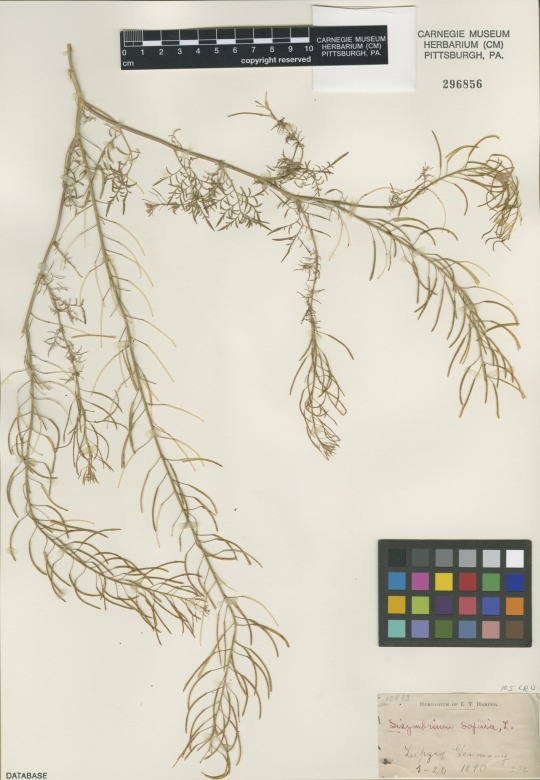
flixweed specimen

Shown here is “flixweed” (Descurainia Sophia), a plant in the mustard family (Brassicaceae), native to Europe and temperate Asia.  This specimen was collected in 1890 in Germany.

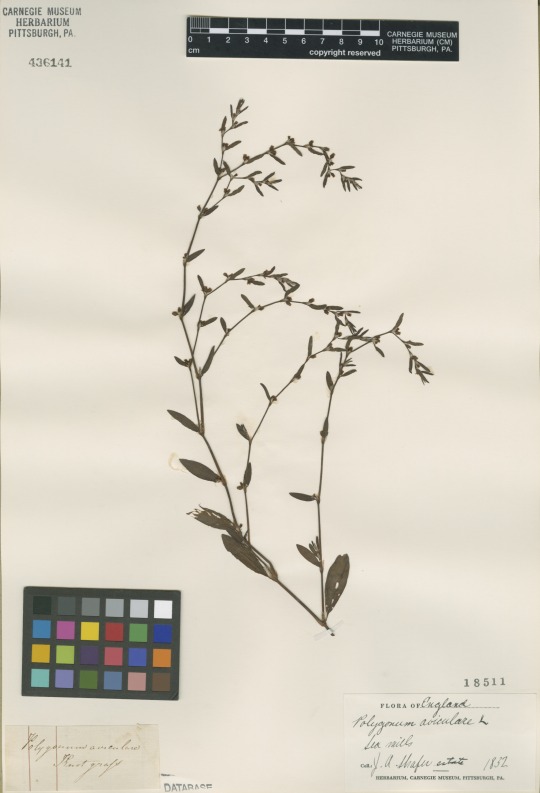
Another plant, crucial to Polyjuice potion, is “knotgrass.”  Knotgrass (or more commonly known in the US, “knotweed”) refers to species in the genus Polygonum in the buckwheat family (Polygonaceae). Shown here is a specimen of common knotgrass (Polygonum aviculare), collected in England in 1832.  This was 49 years before Dumbledore was even born!

knotgrass specimen

We don’t know who collected this specimen, but perhaps it was Nicolas Flamel, said to have made the sorcerer’s stone, who was 505 years old in 1832.

Learn more about Potions, Herbology, Care of Magical Creatures, and more at our upcoming 21+ Potterfest After Dark and brand new all ages Potterfest Theme Night. 

Filed Under: Blog Tagged With: Botany, Mason Heberling, plants

June 19, 2018 by wpengine

Collected on this Day: Alopecurus  myosuroides

By Mason Heberling

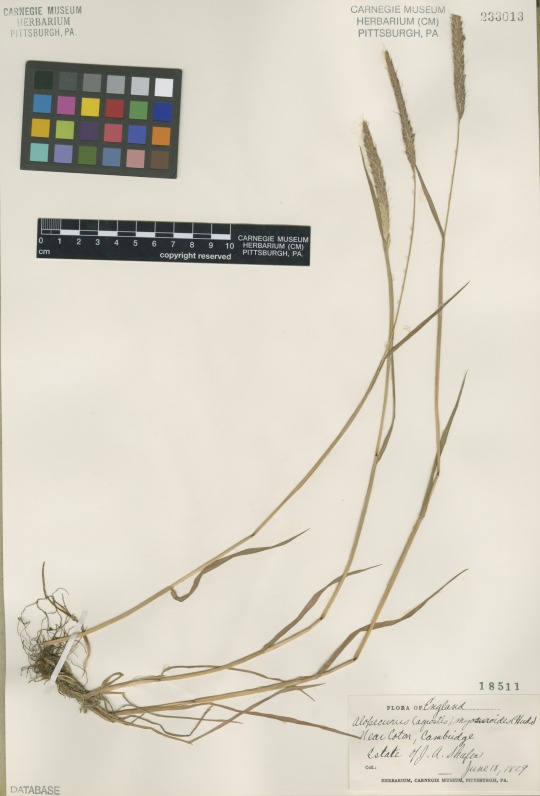
Alopecurus  myosuroides specimen

Herbarium specimens provide key insights into the Anthropocene.  In many cases, natural history collections are the only baseline we have to understand the widespread, complex effects of human activities on the earth systems over the past century.

This grass species shown here is of particular interest. This specimen was collected in Cambridge, England on June 18, 1829.  This grass species (Alopecurus myosuroides), commonly known as “slender meadow foxtail” or “black-grass,” is a major weed in farm fields (especially wheat and barley), and can significantly reduce crop yields.

Unwanted plants (“weeds”) have been an ongoing fight for humans since the dawn of agriculture.  The  “Green Revolution” (1930s-1960s) was a point in human history when agricultural production increased at an enormous rate and at unprecedented scales, aided  by technological developments in crop breeding, pesticides, herbicides, and fertilizers.  It has been one time point suggested to mark the “official” start of the Anthropocene, a proposed geological era defined by human activities.

Herbicides are commonly used to control weeds to increase crop yields.  With the increase of herbicides, some plant species have evolved resistance to these herbicides. In a cool study in PLoS ONE in 2013, Délye et al. did a DNA analysis of herbarium specimens collected from 1788 to 1975 to show that some individuals of this grass species already possessed the gene mutations associated with herbicide resistance well before herbicides were widely used!  They show that the use of herbicides selected for these individuals, such that those individuals with herbicide resistance are now more abundant.

Who would have thought these specimens would be used this way. There are so many known and yet to be known uses of herbaria.

The collector of this specimen back in 1829 certainly didn’t think it could be used to understand the evolution and effects of herbicide use over 175 years later!

Botanists at Carnegie Museum of Natural History share pieces of the herbarium’s historical hidden collection on the dates they were discovered or collected. Check back for more!

Filed Under: Blog Tagged With: Anthropocene, Botany, collected on this day, Mason Heberling

June 13, 2018 by wpengine

Coffee Specimens from Jamaica

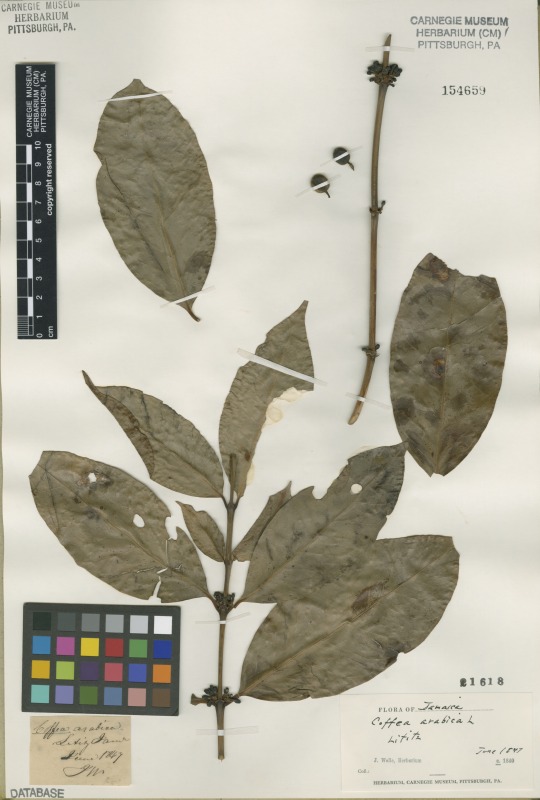
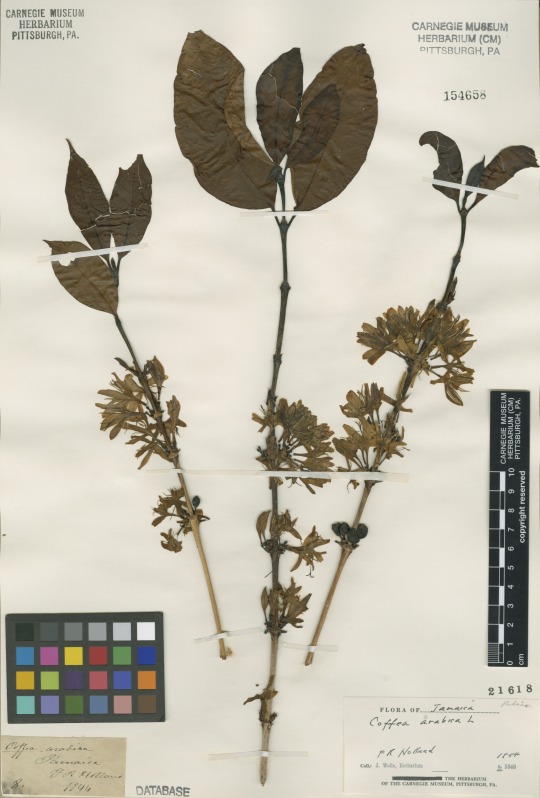
coffee plant specimen

This should wake you up! This specimen of coffee (Coffea arabica) was collected in June 1847 in Jamaica by Jacob Wolle.  Coffea arabica, the source of Arabica beans, is the main species of coffee consumed by humans, and is cultivated worldwide.  The coffee “bean” is the seed – the hard pit inside the coffee fruit.

Why does the Carnegie Museum have coffee specimens from Jamaica from the 1840s, you might ask?  Surprisingly, some of the oldest specimens in the Carnegie Museum herbarium were collected in Jamaica!  Jacob Wolle was the grandfather of William Holland, one of the first directors of the Carnegie Museum (from 1901-1922). Holland himself was born in Jamaica, where his father was a Moravian missionary. The CM herbarium has 2,514 specimens from Wolle’s collection, dating as far back as 1819!

The coffee specimen below, also from Jamaica, was collected by former Carnegie Museum director William Holland’s father, Francis R. Holland in 1844.

coffee plant specimen

This post was inspired by a group of artists from Vietnam whose art is inspired by coffee and coffee plantations.  They stopped by the herbarium earlier this year for inspiration.

Botanists at Carnegie Museum of Natural History share pieces of the herbarium’s historical hidden collection on the dates they were discovered or collected. Check back for more!

Filed Under: Blog Tagged With: Botany, coffee, plants

  • « Go to Previous Page
  • Page 1
  • Interim pages omitted …
  • Page 14
  • Page 15
  • Page 16
  • Page 17
  • Page 18
  • Interim pages omitted …
  • Page 28
  • Go to Next Page »

sidebar

About

  • Mission & Commitments
  • Directors Team
  • Museum History

Get Involved

  • Volunteer
  • Membership
  • Carnegie Discoverers
  • Donate
  • Employment
  • Events

Bring a Group

  • Groups of 10 or More
  • Birthday Parties at the Museum
  • Field Trips

Powdermill

  • Powdermill Nature Reserve
  • Powdermill Field Trips
  • Powdermill Staff
  • Research at Powdermill

More Information

  • Image Permission Requests
  • Science Stories
  • Accessibility
  • Shopping Cart
  • Contact
  • Visitor Policies
Stay in the loop! Sign up for our newsletter(s).
One of the Four Carnegie Museums | © Carnegie Institute | Privacy Policy | Terms of Use | Accessibility
Rad works here logo