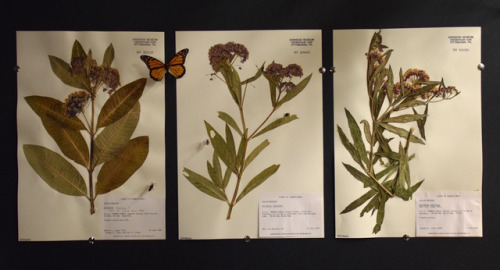
Specimens from these three species of milkweed can be found in the museum’s historic herbarium. Milkweed produces poisonous compounds that some insects like monarch butterflies use to their advantage.
Carnegie Museum of Natural History
One of the Four Carnegie Museums of Pittsburgh
These blogs are written about and by our Section of Botany researchers. The herbarium at the museum which contains approximately 3,000 type specimens--specimens that define an entire plants' species. These type specimens only represent about 0.6 % of the collection.
Mason Heberling, head of the section, regularly shares herbarium specimens that have been "Collected on this day" in history.
Specimens from these three species of milkweed can be found in the museum’s historic herbarium. Milkweed produces poisonous compounds that some insects like monarch butterflies use to their advantage.
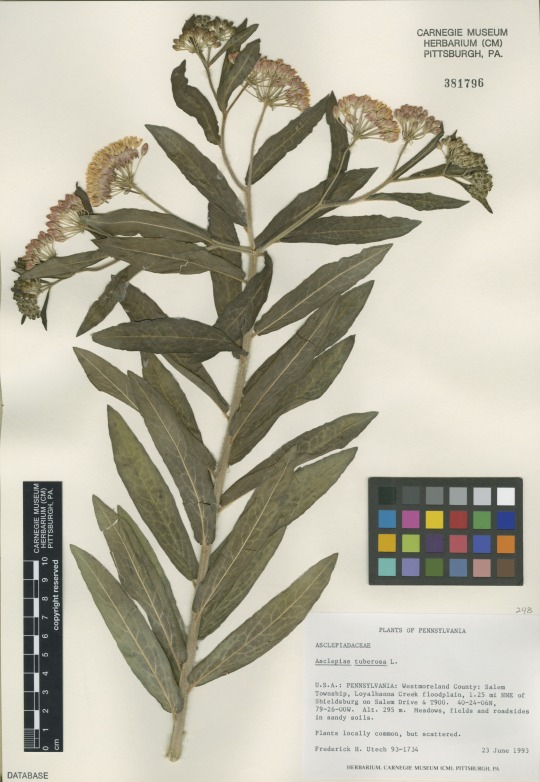
Collected on June 23, 1993, this specimen was found by Fred Utech near the Loyalhanna Creek in Salem Township, Pennsylvania.
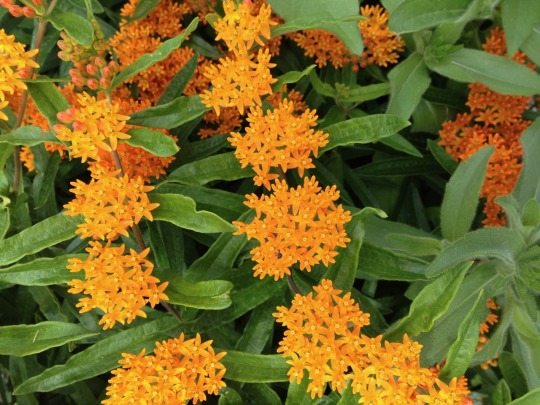
Do not let the common name affect your opinion of this plant! Butterfly weed (Aclepias tuberosa) is a beautiful plant, and the pollinators love the bright orange flowers. Native to eastern North America, it can be found in dry, full sun conditions. It is a great plant to add to your garden!
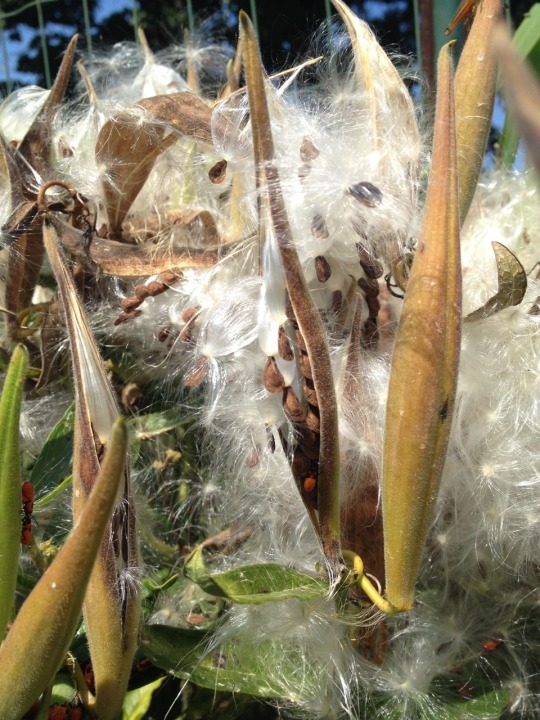
Like other milkweeds (butterfly weed is in the milkweed genus), butterfly weed flower clusters mature into seed pods, which eventual dry up to release airborne seeds in the late summer. The long, silk-like hairs (called pappi) have been used by Native Americans to make textiles.
Despite its looks, butterfly weed is poisonous to ingest. Like other milkweeds, this plant contains defensive chemicals called cardiac glycosides, which are poisonous to humans, livestock, and pets. Milkweeds vary in their toxicity depending on species and age of plant. Symptoms can include weakness, difficulty breathing, kidney damage, cardiac distress, pupil dilation, loss of muscle control, and respiratory paralysis.
Botanists at Carnegie Museum of Natural History share pieces of the herbarium’s historical hidden collection on the dates they were discovered or collected. Check back for more!
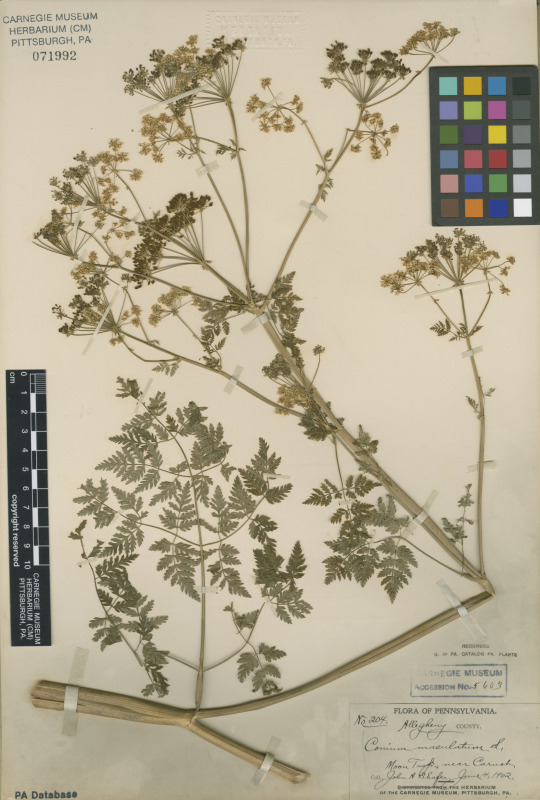
by Mason Heberling
Poison hemlock (Conium maculatum) was used to kill the Greek philosopher Socrates in 399 BC. All parts of the plant are
highly toxic, containing an alkaloid poison, coniine, which disrupts the central nervous system and can cause paralysis of respiratory muscles and death.
Although native to Europe, poison hemlock has been introduced to the United States and can be found in the Pittsburgh region.
Despite the name, it is not related to hemlock trees, but instead a member of the carrot family (Apiaceae). Carrot family members are often recognizable by their flowers, which are on stalks that spread from a common point to form umbrella-like
clusters (botanically called an “umbel”).
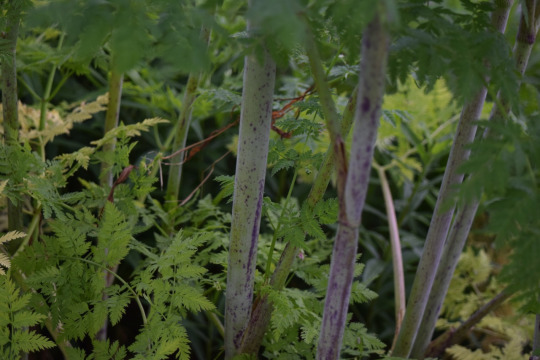
Keep an eye out for this species. It is blooming now in our region along roadsides and ditches. Towering at heights of over 9 feet, this plant is hard to miss if you look for it. Aside from its height, it can also be distinguished from similar species by the purple blotches on the stems. It is best to avoid contact with this species. It can be fatal if ingested and can
also cause skin irritations if touched.
This summer is all about poison at Carnegie Museum of Natural History. Staff will be sharing fascinating pieces of our collection that are toxic, poisonous, or venomous to celebrate our summer blockbuster exhibition The Power of Poison. For more information about this highly interactive, family-friendly exhibition, visit pop.carnegiemnh.org.
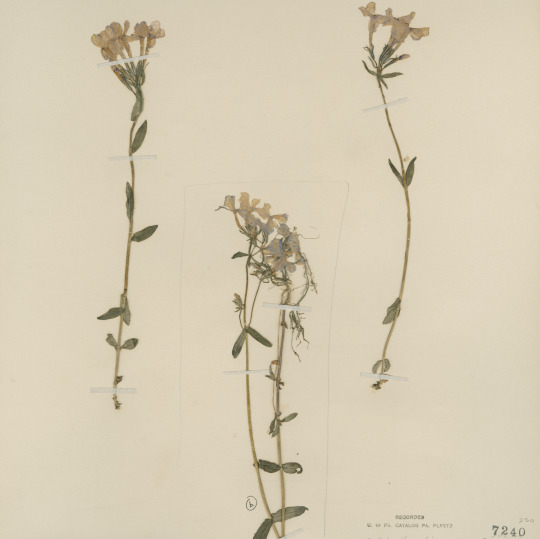
Collected in late May, 1923, this specimen was found by E.H. McClelland at Idlewild Park, near Ligonier, Pennsylvania. This herbarium sheet actually contains two different phlox species—Phlox stolonifera (creeping phlox) and Phlox divaricata (wild blue phlox). There are at least seven species of phlox native to Pennsylvania. Phlox is a popular choice among wildflower gardeners.
Phlox can be easily confused with Dame’s rocket (Hesperis matronalis), a non-native plant
in the mustard family that is common along many wooded streams and roadsides. An easy way to tell the difference is by the flowers—wild phlox has five petals while Dame’s rocket has four petals. Dame’s rocket is in the mustard family, whose flower petals characteristically form a cross (hence its former family name Cruciferae).
Botanists at Carnegie
Museum of Natural History share pieces of the herbarium’s historical hidden
collection on the dates they were discovered or collected. Check back for more!
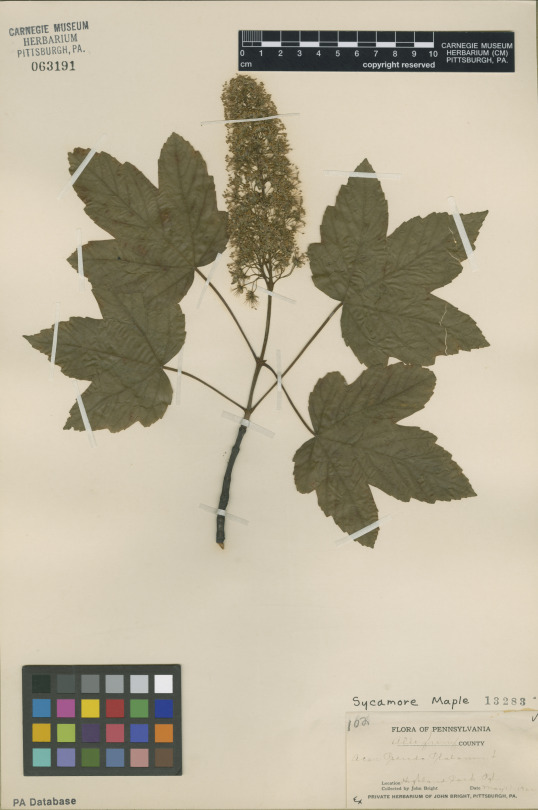
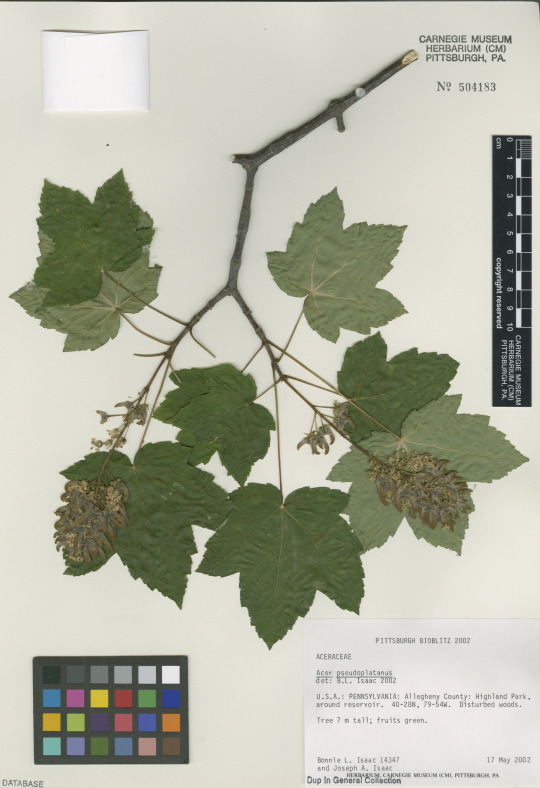
Both of these specimens were collected on May 17 in Pittsburgh’s Highland Park—but 50 years apart. John Bright collected the specimen on top in 1952. Fifty years later to the day, collection manager Bonnie Isaac unknowingly recollected the same species in the same location! If you look closely, you will notice the 1952 specimen did not yet produce seed by mid-May, while the 2002 specimen has already started developing the characteristic maple-like seeds. Due to increasing spring temperatures in recent decades, many plants tend to flower earlier, as shown through herbarium specimens.
Botanists at the museum are studying the impacts of human-caused environmental changes over the past century by following in the footsteps of past collectors. They are revisiting field sites on the same day to compare modern day plants to specimens collected over 100 years ago.
Sycamore maple (Acer pseudoplatanus) has been intentionally introduced across temperate regions, including the United States and New Zealand. It has since become invasive, meaning it actively spreads across the landscape and can cause ecological damage. It is less common than other invasive maples (such as Norway maple) in this region, but it is invasive in several sites in the Pittsburgh area.
Botanists at Carnegie Museum of Natural History share pieces of the herbarium’s historical hidden collection on the dates they were discovered or collected. Check back for more!
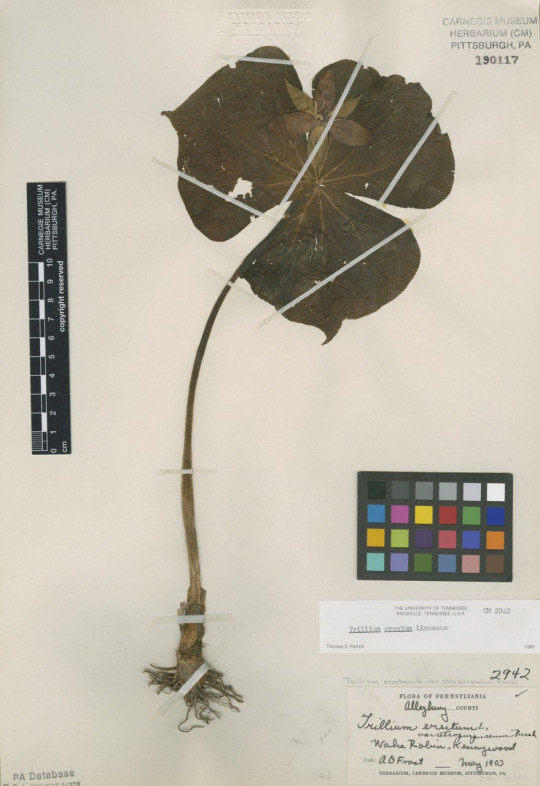
This Trillium erectum specimen was collected at Kennywood in May 1903. Found in forest understories in our region, Trillium erectum has several common names—red trillium (one form has deep maroon flower), wake robin (it is a sign of spring), and stinking benjamin/wet dog trillium (its flower smells of wet dog).
Botanists at Carnegie Museum of Natural History share pieces of the herbarium’s historical hidden collection on the dates they were discovered or collected. Check back for more!
