• Skip to primary navigation
  • Skip to main content
  • Skip to primary sidebar

Carnegie Museum of Natural History

One of the Four Carnegie Museums of Pittsburgh

  • Visit
    • Buy Tickets
    • Visitor Information
    • Exhibitions
    • Events
    • Dining at the Museum
    • Celebrate at the Museum
    • Powdermill Nature Reserve
    • Event Venue Rental
    • Gift Cards
  • Learn
    • Field Trips
    • Educator Information
    • Programs at the Museum
    • Bring the Museum to You
    • Guided Programs FAQ
    • Programs Online
    • Climate and Rural Systems Partnership
  • Research
    • Scientific Sections
    • Science Stories
    • Science Videos
    • Senior Science & Research Staff
    • Museum Library
    • Science Seminars
    • Scientific Publications
    • Specimen and Artifact Identification
  • About
    • Mission & Commitments
    • Directors Team
    • Museum History
  • Tickets
  • Give
  • Shop

Botany Blogs

These blogs are written about and by our Section of Botany researchers. The herbarium at the museum which contains approximately 3,000 type specimens--specimens that define an entire plants' species. These type specimens only represent about 0.6 % of the collection.

Mason Heberling, head of the section, regularly shares herbarium specimens that have been "Collected on this day" in history.

April 13, 2017 by wpengine

Collected on this Day in 1919

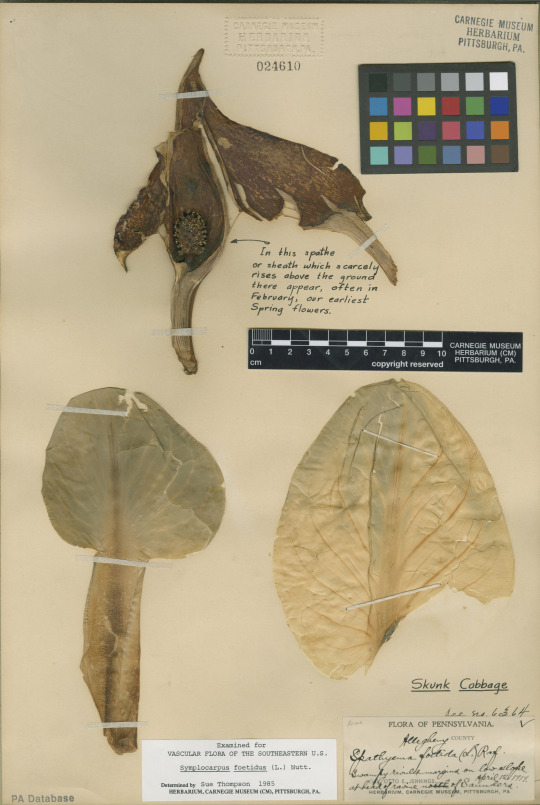
Skunk Cabbage specimen

Collected on April 12, 1919, this specimen was found by Otto Jennings “North of Saunders” in Allegheny County. Jennings was an extremely influential botanist, focusing on nearly all aspects of plants in our region. He made many contributions throughout his career, serving as the curator of botany, director of education, and eventually director of Carnegie Museum of
Natural History. He was also a professor and head of the Department of Biological Sciences at the University of Pittsburgh and advised many students. His legacy is his influence on the museum, botany, conservation, and environmental education.

Skunk cabbage grows in wet, forested areas across the eastern United States.  Although easily overlooked, it is one of the
earliest plants to flower in our region. Its flowers produce heat that melts the snow around it. The flowers smell like rotting meat, which attracts the flies that pollinate it. As the name suggests, the leaves smell like skunk when they are crushed.
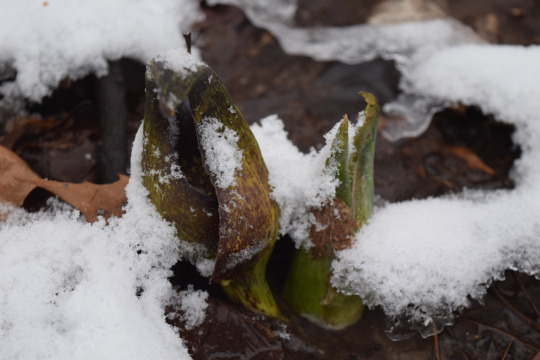
Skunk cabbage coming up in the snow

Botanists at Carnegie Museum of Natural History share pieces of the herbarium’s historical hidden collection on the dates they were discovered or collected. Check back for more!

Filed Under: Blog Tagged With: Botany, herbarium, Mason Heberling

April 4, 2017 by wpengine

Collected on this Day in 1983

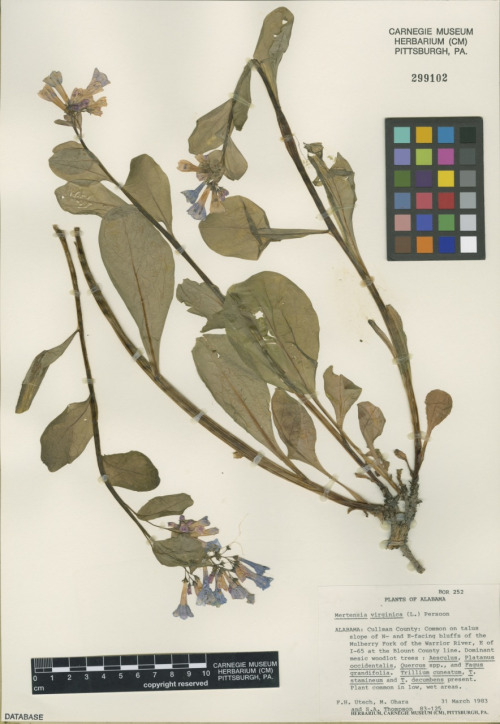
Herbarium specimen of Virginia bluebells (Mertensia virginica)

Collected on March 31, 1983, this specimen was found by Fred Utech and Masashi Ohara in Cullman County, Alabama. Fred was a curator of botany at the museum and studied the biology and evolutionary relationships among understory species of eastern
United States and east Asia. Native to forest understories across the eastern United States, Virginia bluebells (Mertensia
virginica
) are aptly named for their bell-shaped, blue flowers, although it is not just found in Virginia. It is a spring ephemeral species, meaning it emerges with beautiful blooms early in the spring during the short window before trees leaf out, and it disappears underground before summer. Fortunately, you can see this and other spring ephemerals any time of year at the museum in the Hall of Botany!


Botanists at Carnegie Museum of Natural History share pieces of the herbarium’s historical hidden collection on the dates they were discovered or collected. Check back for more!
Filed Under: Blog Tagged With: Botany, botany hall, Mason Heberling

March 17, 2017 by wpengine

What is a Shamrock?

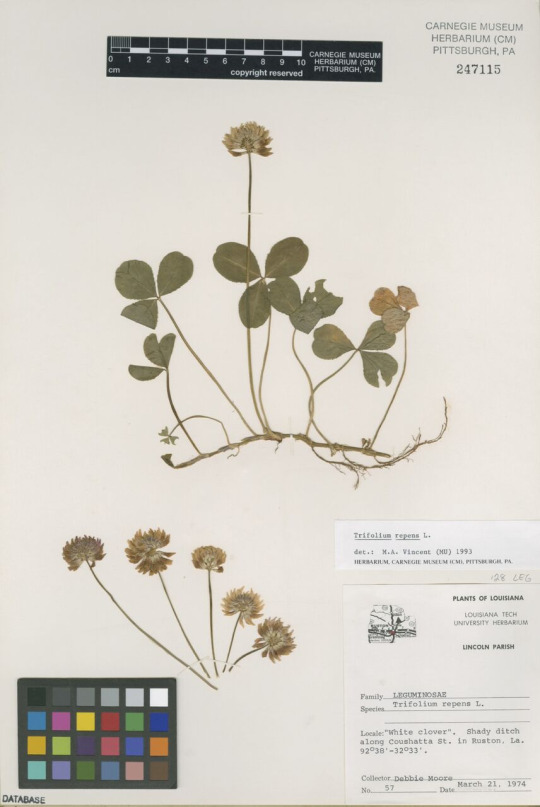
white clover
Trifolium repens (collected 1974 in Louisiana), aka white clover.

by Mason Heberling

What is a shamrock? There is no overwhelming scientific consensus on which species is the well-known Irish national emblem. There was survey of Irish botanists in the early 1890s asking which species was the true shamrock. A similar survey was repeated in 1988. The results suggest the shamrock is either Trifolium dubium (aka lesser trefoil) or Trifolium repens (aka white clover).

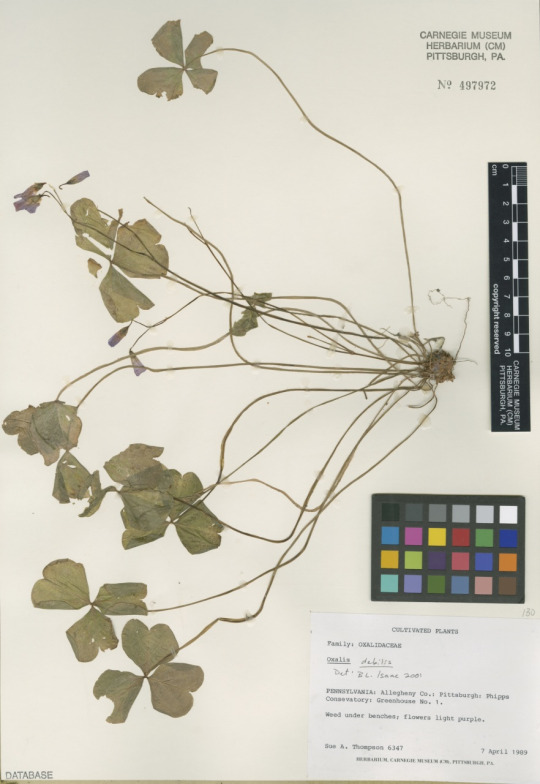
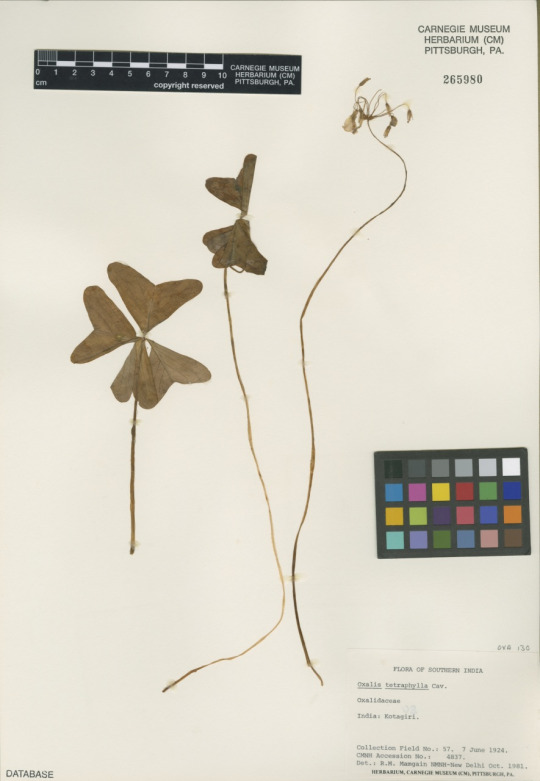
The plants commonly sold around St. Patrick’s Day as shamrocks or four-leaf clovers are in the plant genus Oxalis (wood sorrel), which belong to a different plant family than true clovers.

Trifolium dubium (collected 1961 in Pennsylvania), aka lesser trefoil.


Oxalis tetraphylla (collected 1981 in India), aka lucky clover, although not a true clover.


Oxalis debilis (collected 1989 in cultivation), aka pink woodsorrel.


Mason Heberling is a postdoctoral research associate at Carnegie Museum of Natural History. Museum employees are encouraged to blog about their unique experiences working with museum collections.

Related Content

Section of Minerals and Earth Sciences Celebrates Being Lucky!

Collected on This Day in 1957: Coltsfoot

Ask a Scientist: How do you find rare plants?

Share this post!

  • Share on Twitter Share on Twitter
  • Share on Facebook Share on Facebook
  • Share on Pinterest Share on Pinterest
  • Share on LinkedIn Share on LinkedIn
  • Share on Reddit Share on Reddit
  • Share via Email Share via Email

Filed Under: Blog Tagged With: Botany, collected on this day, Mason Heberling

March 13, 2017 by wpengine

Collected on this Day in 1830

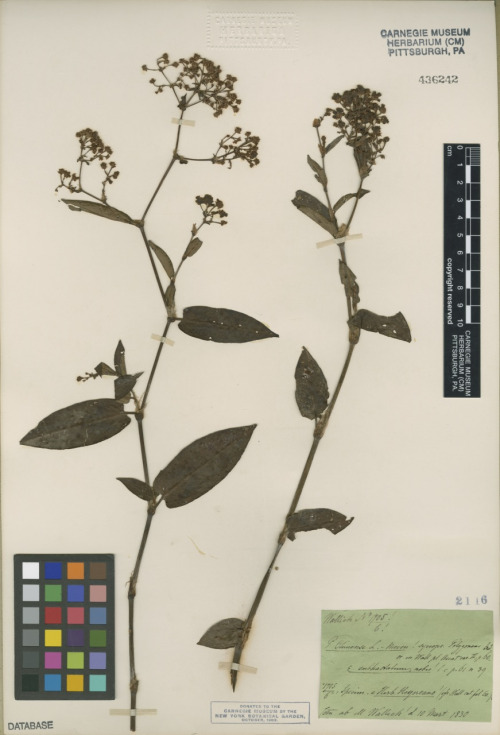
A specimine of olygonum chinense, Chinese knotweed, dried and pressed to paper
Collected on March 10, 1830, this specimen was found by Nathaniel Wallich, probably in India.  Polygonum chinense is also known as Chinese knotweed, although there are several species with that common name. This species is in the same family as many familiar plants, including Japanese knotweed, which is a widespread invasive plant in our area. Nathaniel Wallich (1786-1854) was an influential botanist from Denmark who worked much of his
life in India. Carnegie Museum of Natural History’s Herbarium includes 36 specimens from his collections, each over 180 years old.  If you thought your handwriting was hard to read, check out the label in the lower right!


Botanists at Carnegie Museum of Natural History share pieces of the herbarium’s historical hidden collection on the dates they were discovered or collected. Check back for more!

Filed Under: Blog Tagged With: Botany, herbarium, Mason Heberling

March 7, 2017 by wpengine

Scientists Live

Carnegie Museum of Natural History botanist Bonnie Isaac was live from the hidden collections last month!

Filed Under: Blog Tagged With: Bonnie Isaac, Botany, Scientists Live

February 27, 2017 by wpengine

Collected on this Day in 1976

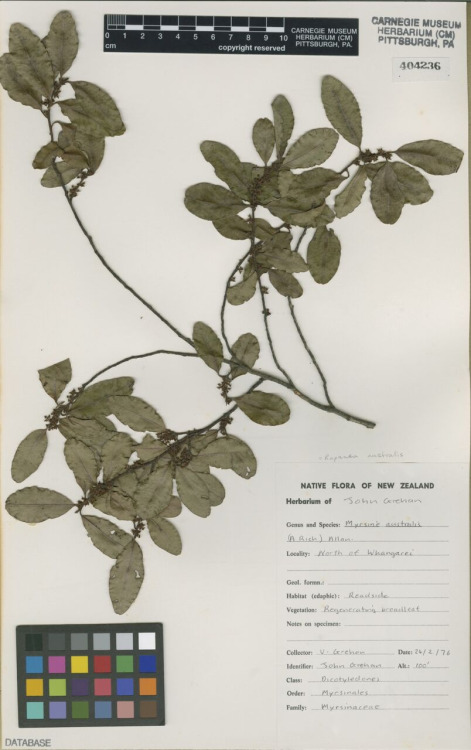
shrub species (Myrsine australis) specimen

Collected on February 24, 1976, this specimen was found by John Grehan near Whangarei, North Island, New Zealand. This shrub species (Myrsine australis) is endemic to New Zealand, meaning it is found only in New Zealand. New Zealand represents one of the most isolated regions of the world, with roughly 80% of its flowering plant species being endemic.


Botanists at Carnegie Museum of Natural History share pieces of the herbarium’s historical hidden collection on the dates they were discovered or collected. Check back for more!
Filed Under: Blog Tagged With: Botany, Mason Heberling

  • « Go to Previous Page
  • Page 1
  • Interim pages omitted …
  • Page 23
  • Page 24
  • Page 25
  • Page 26
  • Page 27
  • Page 28
  • Go to Next Page »

sidebar

About

  • Mission & Commitments
  • Directors Team
  • Museum History

Get Involved

  • Volunteer
  • Membership
  • Carnegie Discoverers
  • Donate
  • Employment
  • Events

Bring a Group

  • Groups of 10 or More
  • Birthday Parties at the Museum
  • Field Trips

Powdermill

  • Powdermill Nature Reserve
  • Powdermill Field Trips
  • Powdermill Staff
  • Research at Powdermill

More Information

  • Image Permission Requests
  • Science Stories
  • Accessibility
  • Shopping Cart
  • Contact
  • Visitor Policies
Stay in the loop! Sign up for our newsletter(s).
One of the Four Carnegie Museums | © Carnegie Institute | Privacy Policy | Terms of Use | Accessibility
Rad works here logo