• Skip to primary navigation
  • Skip to main content
  • Skip to primary sidebar

Carnegie Museum of Natural History

One of the Four Carnegie Museums of Pittsburgh

  • Visit
    • Buy Tickets
    • Visitor Information
    • Exhibitions
    • Events
    • Dining at the Museum
    • Celebrate at the Museum
    • Powdermill Nature Reserve
    • Event Venue Rental
  • Learn
    • Field Trips
    • Educator Information
    • Programs at the Museum
    • Bring the Museum to You
    • Guided Programs FAQ
    • Programs Online
    • Climate and Rural Systems Partnership
  • Research
    • Scientific Sections
    • Science Stories
    • Science Videos
    • Senior Science & Research Staff
    • Museum Library
    • Science Seminars
    • Scientific Publications
    • Specimen and Artifact Identification
  • About
    • Mission & Commitments
    • Directors Team
    • Museum History
  • Tickets
  • Give
  • Shop

City Nature Challenge

May 22, 2024 by Erin Southerland

Botanists Gone Wild! Perspectives from the Record-Breaking Finish for City Nature Challenge 2024

by Jessica Romano

Every spring people all over the world join in the City Nature Challenge, a global effort to safely document and identify nature through the free and easy-to-use iNaturalist app. For the seventh consecutive year, Carnegie Museum of Natural History staff were among the participants taking on the challenge in and around the Pittsburgh region – and in 2024, the results were record-breaking! Totals for regional participants, identifiers, observations, and number of species hit their highest in the history of the challenge, thanks to a combination of warm, dry spring weather and dedication from participants. Observations and identifications made during the challenge are shared with scientists around the world, helping to both document and better understand the diversity of species around us.

Here are the totals from the Pittsburgh Region City Nature Challenge 2024 (CNC) – which are all records for this region’s participation! 

Total participants who made observations: 643

Total participants who made identifications: 562

Total observations made: 10,050

Total species identified: 1,753

Total identifications: 16,875

Plants topped the list for observed species, with about 46% of the total, followed by insects with about 27% of the total. Other species identified but in smaller totals include fungi, birds, arachnids, mammals, reptiles, amphibians, and mollusks. 

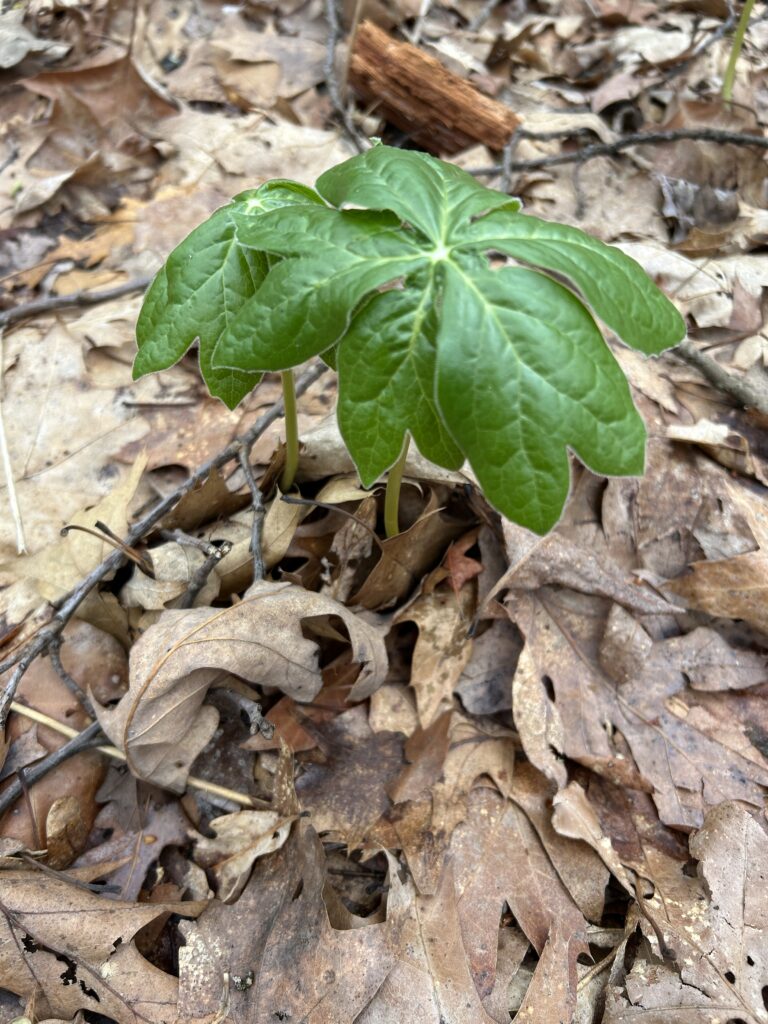
Mayapple (Podophyllum peltatum) took the top spot overall. This native plant species sprouts early in spring with long stems and umbrella-like leaves. The rest of the top 10 species are all plants, with the exception of the Red Admiral (Vanessa Atalanta), a beautiful butterfly with red bands on the wings. The most observed bird, the American Robin (Turdus migratorius),took spot 17, and at spot 26, the White-tailed Deer (Odocoileus virginianus) was the most observed mammal. 
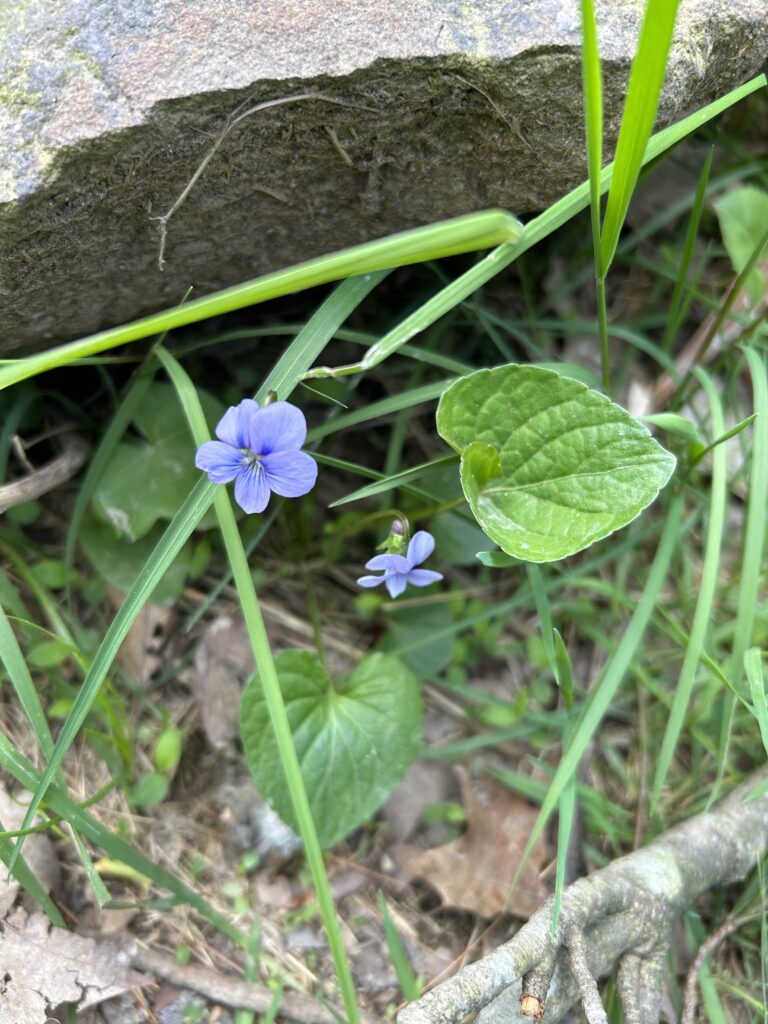
The lovely Common Blue Violet (Viola sororia) came in third place on the list of observed species.

With plants claiming nine of the top ten spots, it’s fitting to get perspective from the museum’s Section of Botany, who not only participate, but whose dedication puts them at the top of the list. Although they are literally professionals at looking for plants, the common message from the Botany staff is that anyone can do this challenge! The objective is to document nature all around us, from parks to neighborhood streets to city blocks and beyond. 

Reflections from the Section of Botany Scientists

Curatorial Assistant Alyssa Landa made a point to visit similar spots that she visited last year, as well as around her yard and street to look at things she walks past every day. “CNC is a great reminder to check out places near me,” Alyssa said. “The big thing for me this year is just the number of new-to-me species I was able to log, just by taking that little bit of extra time to pay attention to what’s around that I might not otherwise be drawn to or notice! This time of year is always really exciting to me, and CNC is a fun reminder that there’s still so much to learn. It’s also a reminder to revisit my old, well-known (plant) friends too.” And her efforts made a difference! Alyssa logged the second highest total identifications, putting her expertise to excellent use.

A steadfast champion for the City Nature Challenge, Associate Curator of Botany Mason Heberling uses the challenge to check out the woods nearby where he lives. “I get caught up in other things and forget to appreciate the hyper-local diversity, within walking distance,” Mason said. “I make it a point to visit the same woods by my house every CNC.” Despite travelling out of the area for much of the challenge, Mason logged nearly 100 local observations!

And then there’s Bonnie Isaac, the section’s Collection Manager. Although City Nature Challenge is not a competition, it’s worth noting and applauding Bonnie’s efforts – she logged the highest number of both observations and identifications in the Pittsburgh region this year! She made 607 observations, which totaled 343 different species, and identified a whopping 1,697 entries! Bonnie shared her reflections about the challenge and described why it’s so important to her.

“When I was young, I could not spend enough time outdoors. I was outside from sunup till sundown or until my folks came looking for me. My curiosity led me to want to know what everything I encountered was. One year one of my sisters gave me a Peterson field guide for Christmas. This led me to discover that there was a whole series of Peterson field guides. Thus began my collecting career. I had to have every Peterson Field Guide that came out. (I now have a complete set of Peterson Field Guides, leather bound editions.)  With these guides I could go out and try to identify everything I saw. I was in heaven. I am also a very competitive person. The City Nature Challenge takes what I love to do and makes it into a bit of a competition. I don’t live in the Pittsburgh City Nature Challenge region. I live in Lawrence County. During the pandemic the best I could do was help with identifying observations. Now that I can travel to the Pittsburgh region during the City Nature Challenge. Game on!” – Bonnie Isaac

Of Bonnie’s impressive collection of field guides, the first one she received was not plants, but animal tracks! It was written by Olaus J. Murie, a former employee of Carnegie Museum of Natural History who became a world famous biologist. Image credit: Bonnie Isaac.

For this year’s challenge, Bonnie visited Raccoon Creek State Park, Moraine State Park, Bradys Run Park, and Brush Creek Park. “The City Nature Challenge gives me a chance to get outside and see how many different things I can find,” Bonnie said. “Every year I challenge myself to find more species than I did the previous year. I also find identifying observations made by others somewhat satisfying. I get a chance to hone my identification skills and I get to see what others have found.”

Even for a botanist with decades of experience like Bonnie, each year brings surprises. “Every year there are surprises that I didn’t expect. I’ll discover that something is blooming that I didn’t think would be blooming yet, or I might find that someone found a plant growing in an area where I wouldn’t have expected it.”
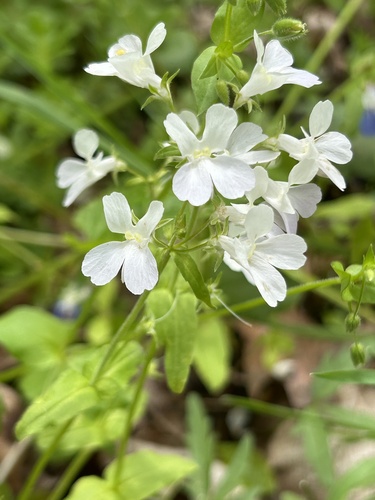
Bonnie has never seen an all-white Blue-eyed Mary (Collinsia verna). She was excited to see that iNaturalist user “bquail” found some during the challenge. Image credit: © bquail via iNaturalist, CC BY-NC

Bonnie continued, “The top observations tend to be some of the same things, many plants that are not native to the area. It’s the things with only a couple observations that I find the most interesting. It’s these unusual observations that keep me eager to see what nifty things are being found basically in our own backyards. It also keeps me energized to get out and find more and to look closer for the minute details that might separate one species from another.” 

The iNaturalist app also allows for recordings of bird song, frog calls, and other sounds. Bonnie connected with a user who identified a unique feature on one of her uploaded recordings. “One of the surprises for me was someone contacting me to let me know that one of my bird recordings had gray tree frogs singing in the background.”
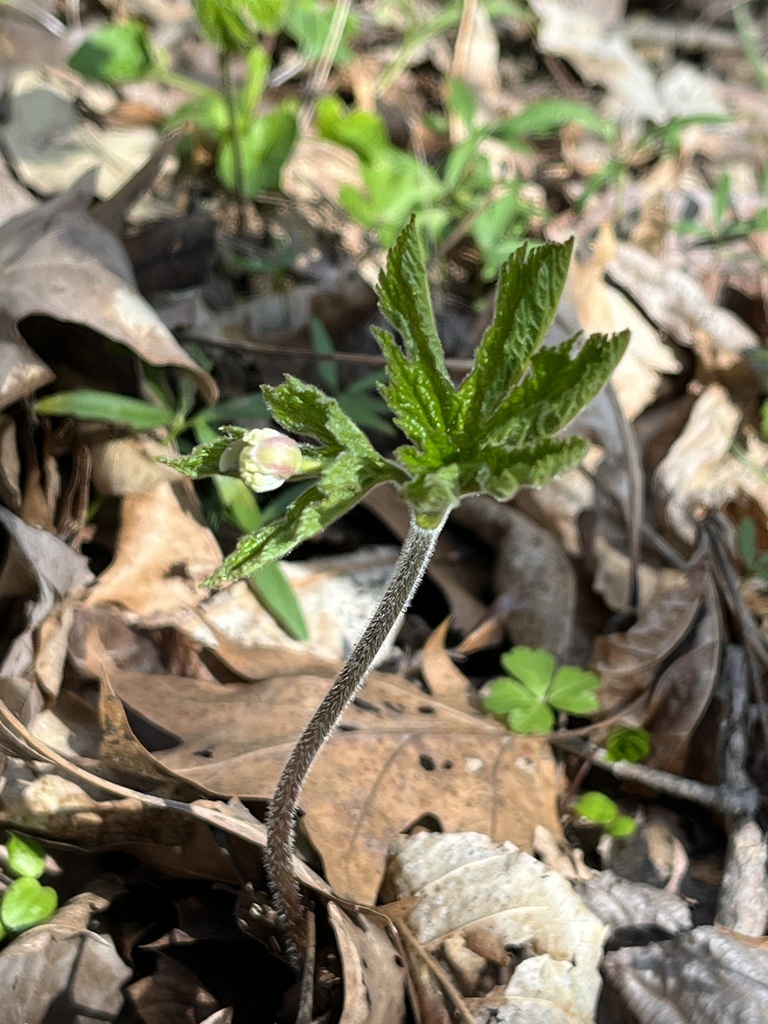
Bonnie’s favorite observation of 2024 was this Goldenseal, just coming into bloom. Image credit: Bonnie Isaac.

A Global Effort with Big Results

City Nature Challenge 2024 was not just a success in Pittsburgh – globally the number of cities participating increased to 690 this year, a big jump from 482 cities in 2023! Here are a few of the worldwide stats:

Total participants: 83,528 in 690 cities in 51 countries

Total observations made: 2.4 million

Total species identified: 65,682

The big winner across the board, with most observations, species, and participants is La Paz, Bolivia!

The City Nature Challenge returns next spring. Let’s see if we can build on the truly remarkable success of 2024!

Jessica Romano is Museum Education Writer at Carnegie Museum of Natural History.

Related Content

Snags, Logs, and the Importance of a Fallen Tree

City Nature Challenge: A 2022 Reflection

The City Nature Challenge Family Experience

Carnegie Museum of Natural History Blog Citation Information

Blog author: Romano, Jessica
Publication date: May 22, 2024
Share this post!

  • Share on Twitter Share on Twitter
  • Share on Facebook Share on Facebook
  • Share on Pinterest Share on Pinterest
  • Share on LinkedIn Share on LinkedIn
  • Share on Reddit Share on Reddit
  • Share via Email Share via Email

Filed Under: Blog Tagged With: Alyssa Landa, Bonnie Isaac, Botany, City Nature Challenge, Education, Jessica Romano, Mason Heberling

April 19, 2024 by Erin Southerland

City Nature Challenge: Noticing Invasive Plants 

by Rachel Reeb and Jessica Romano

This spring, thousands of people will join the City Nature Challenge, a global effort to document biodiversity safely and easily on the free iNaturalist app. Participating in the challenge is fun and rewarding – simply make observations of nature, take photos, and upload them to the app. The data collected during the challenge is shared with scientists around the world and helps them both document and better understand the diversity of species around us. This year’s challenge takes place April 25 through 28 for the observations, with a follow-up identification period from April 29 through May 1 when scientists and naturalists help observers properly identify the species they found. Participants will observe plants, insects, mammals, birds, mollusks, reptiles, amphibians, and more, right in their own neighborhoods. 

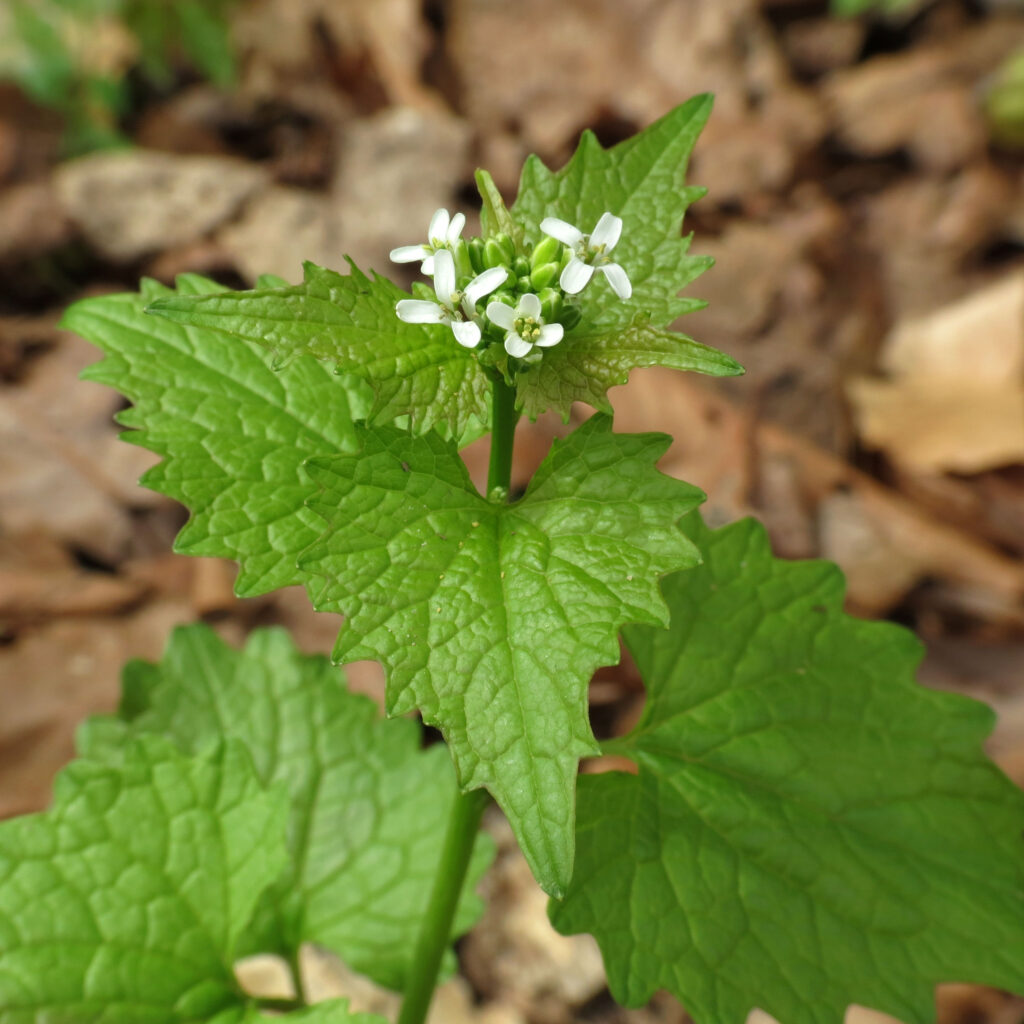
Alliaria petiolate, common name Garlic Mustard, is very commonly spotted during the City Nature Challenge and is easy to identify by its broad leaves and small white flowers. Credit: Katja Schulz from Washington, D. C., USA, CC BY 2.0, via Wikimedia Commons.

To help get us ready for this year’s challenge, Rachel Reeb, postdoctoral fellow in the Section of Botany at Carnegie Museum of Natural History, created this guide to finding and understanding invasive species of plants, including species like garlic mustard that is repeatedly one of the most often observed plants during the challenge. To get started, Rachel provided helpful definitions: 

Native or Indigenous species: Species that exist within an area due to natural evolution.

Introduced species: Species that have been introduced, by humans, to an area outside of its indigenous range. Roughly 25% of plant species in our environment are introduced.

Invasive species: A subset of introduced species which cause significant harm to the environment or human well-being. 

Naturalized species: A subset of introduced species which do not have demonstrated impacts on the environment or human well-being.

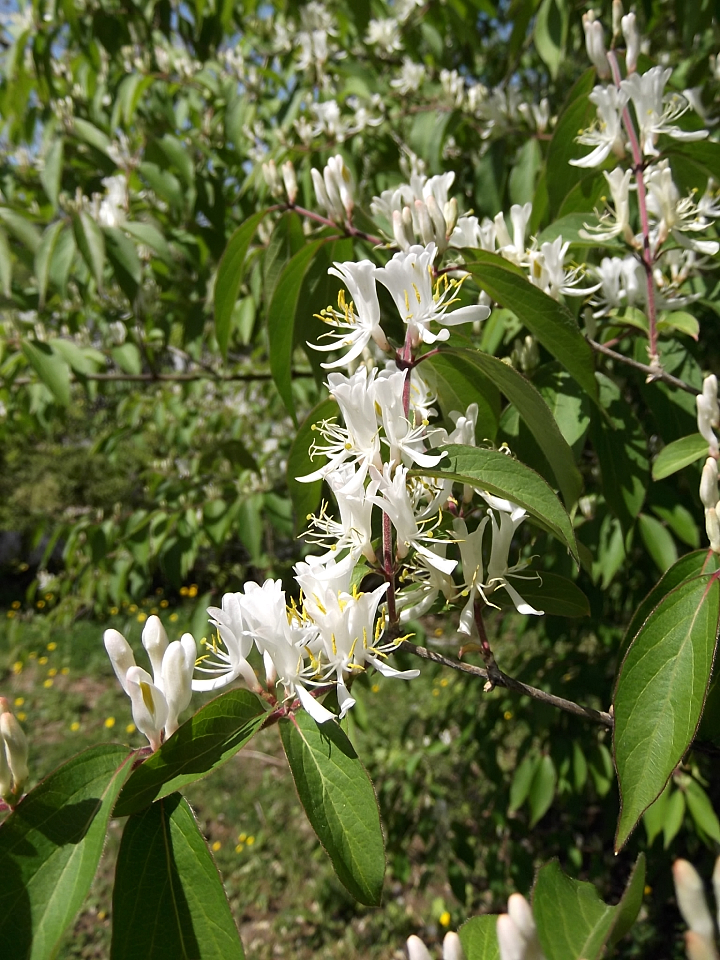
Lonicera maackii, known as the Amur Honeysuckle, originated in temperate areas of eastern Asia. Credit: Jay Sturner from USA, CC BY 2.0, via Wikimedia Commons.

Observing Invasive Plants

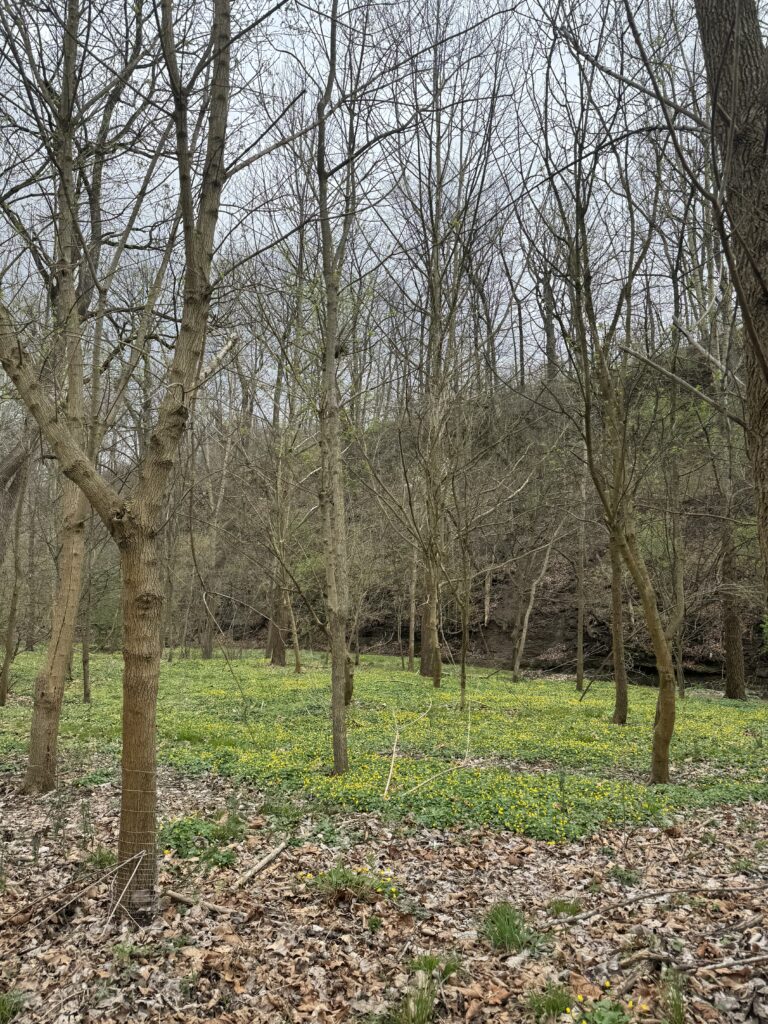
When is the best time to spot invasive plants? In the early stages of spring! Since introduced invasive plants evolved in a different part of the world, they often have unique life cycles that start and end at a different time than the rest of the plant community. Invasive species like garlic mustard, lesser celandine, periwinkle, multiflora rose, and Amur honeysuckle are some of the first to start their life cycles in the spring, providing a surprising pop of greenery to an otherwise dormant forest understory. This ‘head start’ in the growing season gives invasive plants an advantage because they gain priority access to soil nutrients and sunlight, while other plants are still dormant. 

Ficaria verna, or Lesser Celandine, blankets the ground in Frick Park. Credit: Rachel Reeb.

Unfortunately, what serves as an advantage for invasive plants is often a disadvantage to their neighbors, which now have a delayed start in the race to capture limited seasonal resources. Environmental experts in Pittsburgh are especially worried about the survival of rare native wildflowers, such as large white trillium, mayapple, and yellow trout lily. These plants, which have very specific habitat conditions and cannot easily relocate to new areas, are highly sensitive to changes in the environment and often cannot survive in areas where invasive plants are present.

During this year’s City Nature Challenge, we encourage you to take note of everything in nature, including the weeds. What do you notice about invasive plants in your area, like the timing of their life cycle, or how they interact with their neighbors? Have you ever wondered how these organisms came to be here? Many unwanted invasive plants were first introduced as popular garden center products. While some invasive species are now banned from sale, many can still be found in stores, like English ivy and Periwinkle vines.

Podophyllum peltatum, common name Mayapple, is a native species in Pennsylvania and sprouts early in spring, resembling little umbrellas on the landscape. Credit: Jessica Romano.

Here are helpful lists of species you may encounter in our area:

Invasive Species

  • Garlic Mustard 
  • Lesser Celandine
  • Knotweed 
  • Multiflora Rose
  • Amur Honeysuckle
  • Periwinkle / Vinca 
  • English Ivy 
  • Japanese Barberry 
  • Tree of heaven

Naturalized Species

  • Common Dandelion
  • White Clover

Native Spring Wildflowers 

  • Mayapple
  • Large White Trillium
  • Dutchman’s Breeches
  • Virginia Bluebells
  • Common Blue Violet
  • Yellow Trout Lily

How many of these species can you spot? Get your camera/phone/device and join the City Nature Challenge, April 25 through 28!

Rachel Reeb is a postdoctoral research fellow in the Section of Botany at Carnegie Museum of Natural History. Jessica Romano is Museum Education Writer at Carnegie Museum of Natural History.

Related Content

What’s in a Name? Japanese Knotweed or Itadori

Snags, Logs, and the Importance of a Fallen Tree

Using iNaturalist in the City Nature Challenge and Beyond

Filed Under: Blog Tagged With: Botany, City Nature Challenge, Education, Jessica Romano, Rachel Reeb, Uprooted

April 9, 2024 by Erin Southerland

Snags, Logs, and the Importance of a Fallen Tree

by Jessica Romano

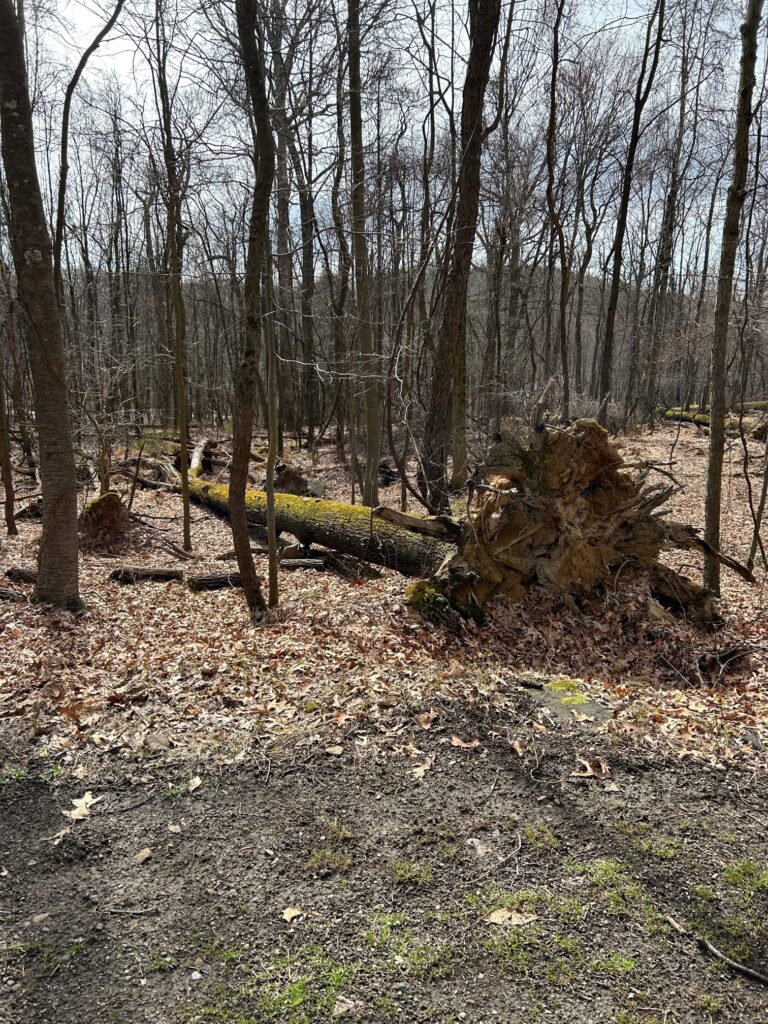
As the seasons change from winter to spring here in western Pennsylvania, a common sight on a recent walk included fallen and decomposing trees. Interesting to look at and begging to be photographed, these fallen trees also hold a very important role in the ecosystem. 

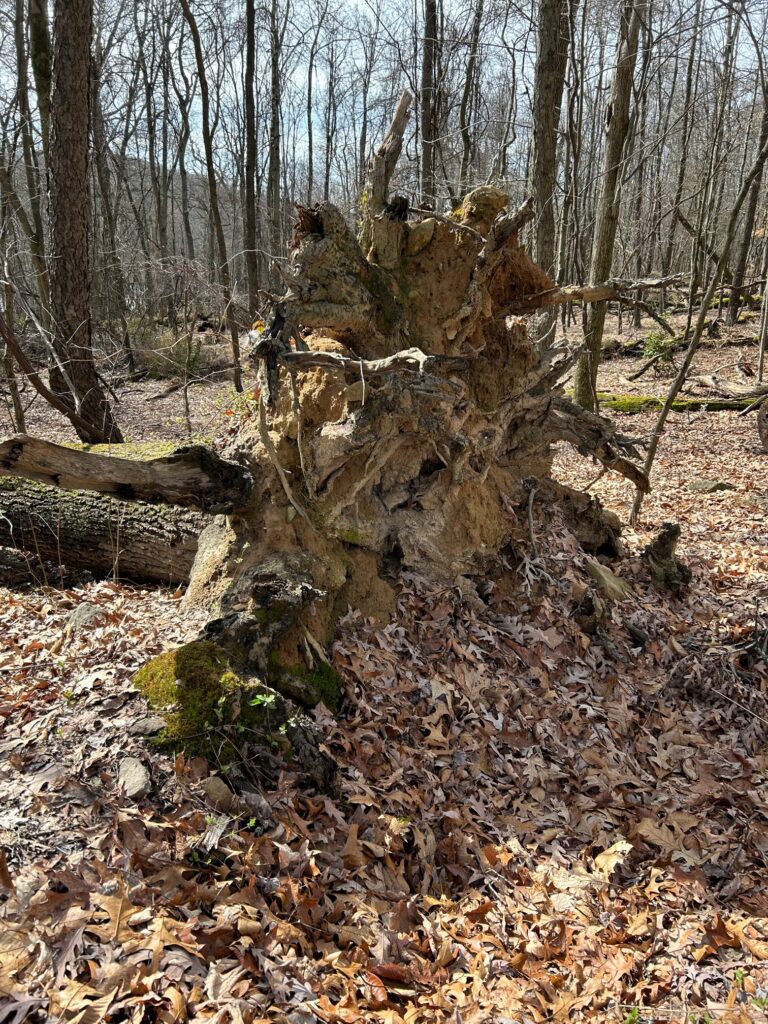
This uprooted tree shows the roots still attached, along a hiking trail in Hartwood Acres Park.

Dead and fallen trees are host to many forms of wildlife, some of which are easy to spot, like squirrels, woodpeckers, and snakes, while others may require a closer look to identify, including fungi, insects, and salamanders. These organisms use the trees for food and shelter, and as the tree decomposes further, the nutrients absorb into the soil and set up favorable conditions for new growth. This cycle is crucial to the health of forests – in fact, numerous species rely on this process to thrive. According to the National Wildlife Federation, “Dead trees provide vital habitat for more than 1,000 species of wildlife nationwide. They also count as cover and places for wildlife to raise young in the requirements for Certified Wildlife Habitat designation.” 

Dead trees are identified two ways:

Snag – a dead tree that is still standing upright while decomposing

Log – the part of a snag that has fallen or partially fallen to the ground

Snags and logs each contribute to a thriving ecosystem in different ways. Snags can have cavities that house mammals, birds, and insects, and can be used for storage or look-out points. Logs on the ground can also act as hiding spots and nests, and as they decompose they provide the nutrients that recycle back into the soil. For those curious for more details about which species in PA utilize snags and logs, Penn State Extension has a thorough list.

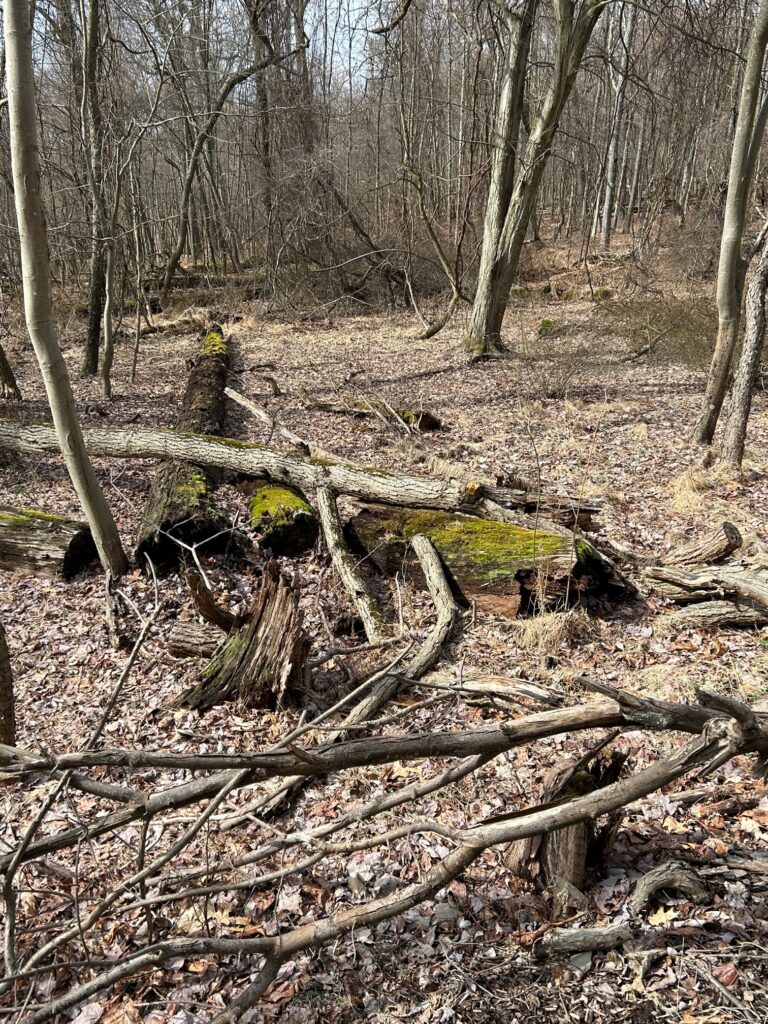
This group of logs shows varying points of decomposition and provides lots of spaces for wildlife to shelter.

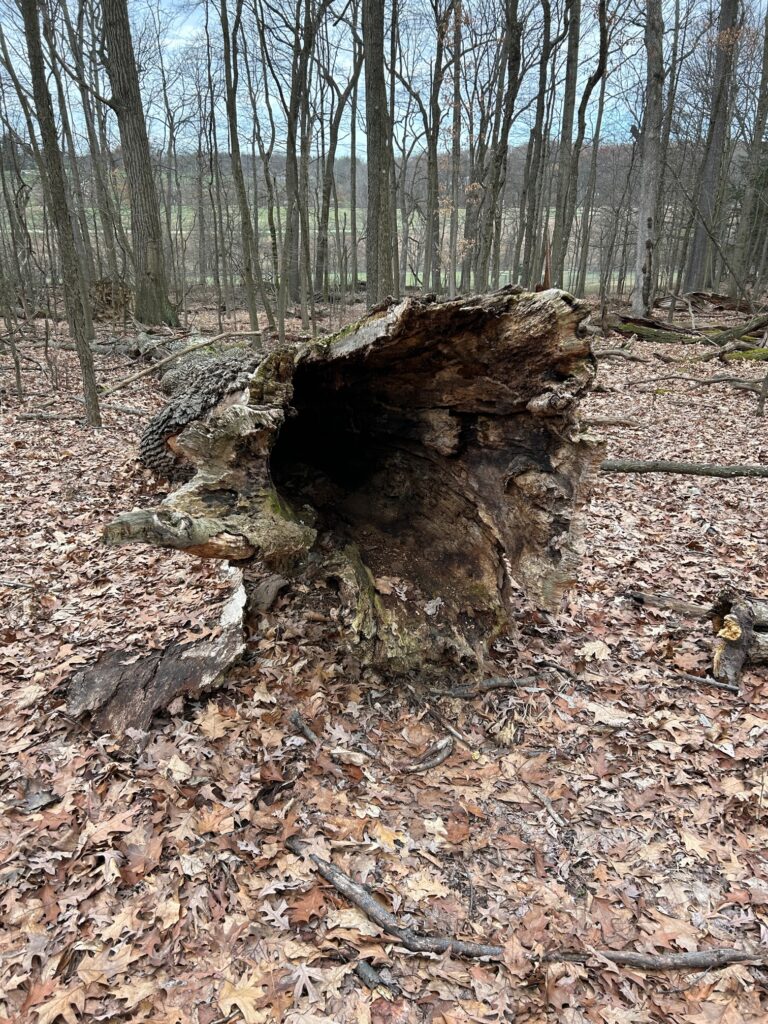
The photos used here were taken at Hartwood Acres, one of the Allegheny County Parks located in Hampton Township, north of Pittsburgh. Some trees appeared to be freshly uprooted, with the circumference of the base of the tree standing several feet high, while others had clearly been decomposing for quite some time, with the trunk completely hollowed out. 

This log is almost completely hollowed out, providing shelter for various types of wildlife. 
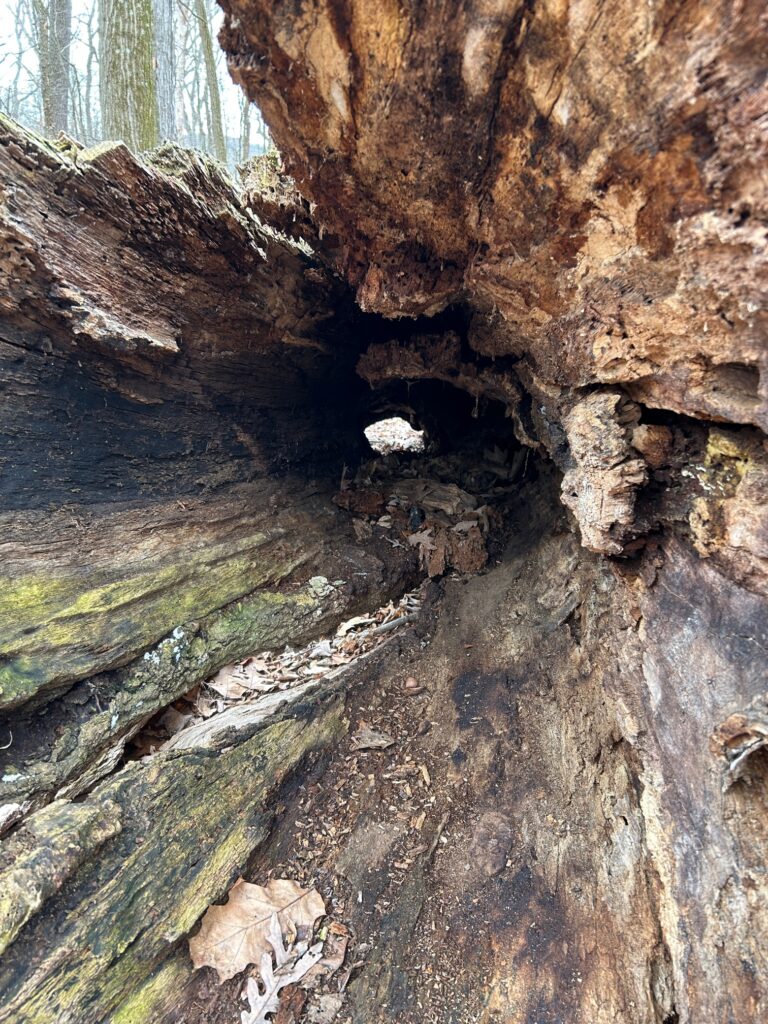
A close-up view shows the variety of textures from varying points of decomposition.

When a tree is uprooted from some type of disturbance event like a storm, it makes space for another topographical feature, pits and mounds. A pit forms in the space where the roots and soil are pulled up. Over time, the root mass decays and falls to the ground, creating a mound on the surface. This is called a micro-topographical feature because it forms around the base of a single tree. Pit-and-mound features create new habitats for wildlife and can often be used as breeding grounds for amphibians when water collects in the pit from runoff. The amount and frequency of mounds in forests can give clues to what caused the trees to fall, and even age of the forest as mounds form over extended periods of time.  

A close-up view of an uprooted tree shows the decaying roots and soil that form a pit underneath and will become a mound over time.

It’s not a coincidence that there are varying types of fallen trees in one park; forest experts monitor these fallen trees and follow guidelines for how many to leave in an area, at times clearing them to help control pests or other safety factors.

Keep in mind it can be dangerous to touch or climb on these fallen trees, especially if they appear rotted. The structure of the wood breaks down slowly but surely and the logs can be weaker than they appear. For that reason it’s better to admire the interesting sight from a distance or at least without touching it. As spring arrives and the tree canopy and forest understory fill in, a return trip will hopefully provide opportunity to spot some of the species benefitting from these fascinating snags and logs.

A perfect opportunity to search for fallen trees and the wildlife that utilizes the newly-created ecosystem is the City Nature Challenge. Using the free app iNaturalist, take and upload photos of nature from April 26 through 29, 2024 and help safely document biodiversity where you live! Learn more about the City Nature Challenge.

Jessica Romano is Museum Education Writer at Carnegie Museum of Natural History.

Sources

  1. National Wildlife Federation
  2. The Wildlife News
  3. Penn State Extension

Related Content

Using iNaturalist in the City Nature Challenge and Beyond

Teaching About Local Wildlife with the City Nature Challenge

Evidence Counts for Absent Creatures – City Nature Challenge

Carnegie Museum of Natural History Blog Citation Information

Blog author: Romano, Jessica
Publication date: April 9, 2024

Share this post!

  • Share on Twitter Share on Twitter
  • Share on Facebook Share on Facebook
  • Share on Pinterest Share on Pinterest
  • Share on LinkedIn Share on LinkedIn
  • Share on Reddit Share on Reddit
  • Share via Email Share via Email

Filed Under: Blog Tagged With: City Nature Challenge, Education, Jessica Romano

April 28, 2023 by Erin Southerland

Building Birding Skills

by Patrick McShea
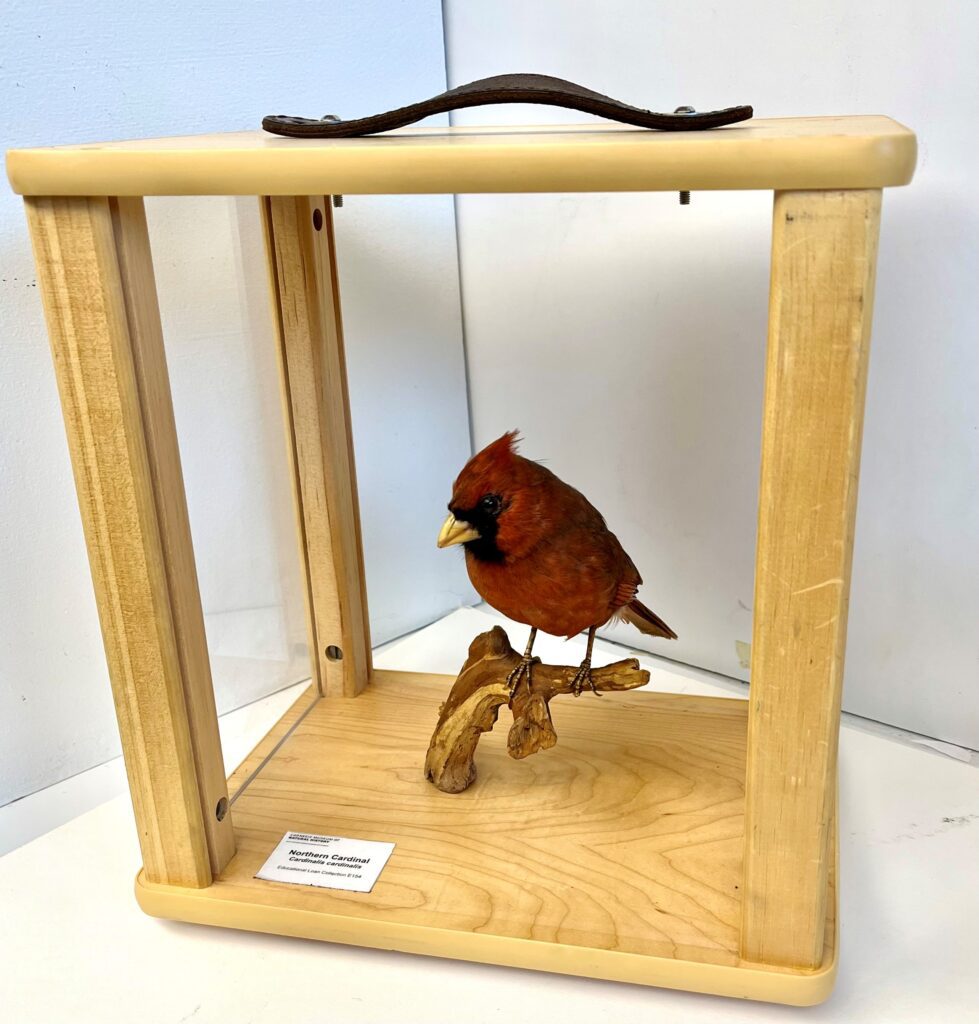
Cardinal from the CMNH Educator Loan Collection.

Today is National Go Birding Day, a designation that prompts questions about how best to become involved in such a do-anywhere activity. As a museum educator, my general advice for anyone seeking to develop bird observational skills is to regularly visit the expansive All About Birds website maintained by The Cornell Lab of Ornithology. 

However, when I stop to consider that many potential birders might lack regular internet access, or how my own life-long interest in birds began before I learned to read, alternate approaches gain importance. In light of these circumstances, recent advice from Nick G. Liadis, Avian Conservation Biologist, and founder of the organization, Bird Lab, has universal relevance.

“I almost always start any educational program by asking the question: Did you see a bird today? The answer is almost always ‘yes’ by most of the participants, even children as young as four-years-old. It’s a great springboard into birding/bird-related conversations. It all unfolds from there.”

Nick, whose bird research experience includes past appointments at Point Reyes Bird Observatory in California, and the Museum’s Powdermill Avian Research Center, was explaining the approach he successfully used last summer when he accepted the challenge of presenting the broad topics of birds and bird migration to the 4 – 13-year-old participants in Art in the Garden, a six-week summer camp at the Borland Garden, a community garden and green space in Pittsburgh’s East Liberty neighborhood.

 “We’d often talk about a bird’s behavior: If it was singing, where was it perched? Had you seen it before etc. Then I’d talk about how different species have different preferences. Some like living next to people. Some like to be on the tops of trees, and some like to be on the ground etc. This helped to reinforce the beautiful fact that birds are everywhere. That observation really resonates with people.”

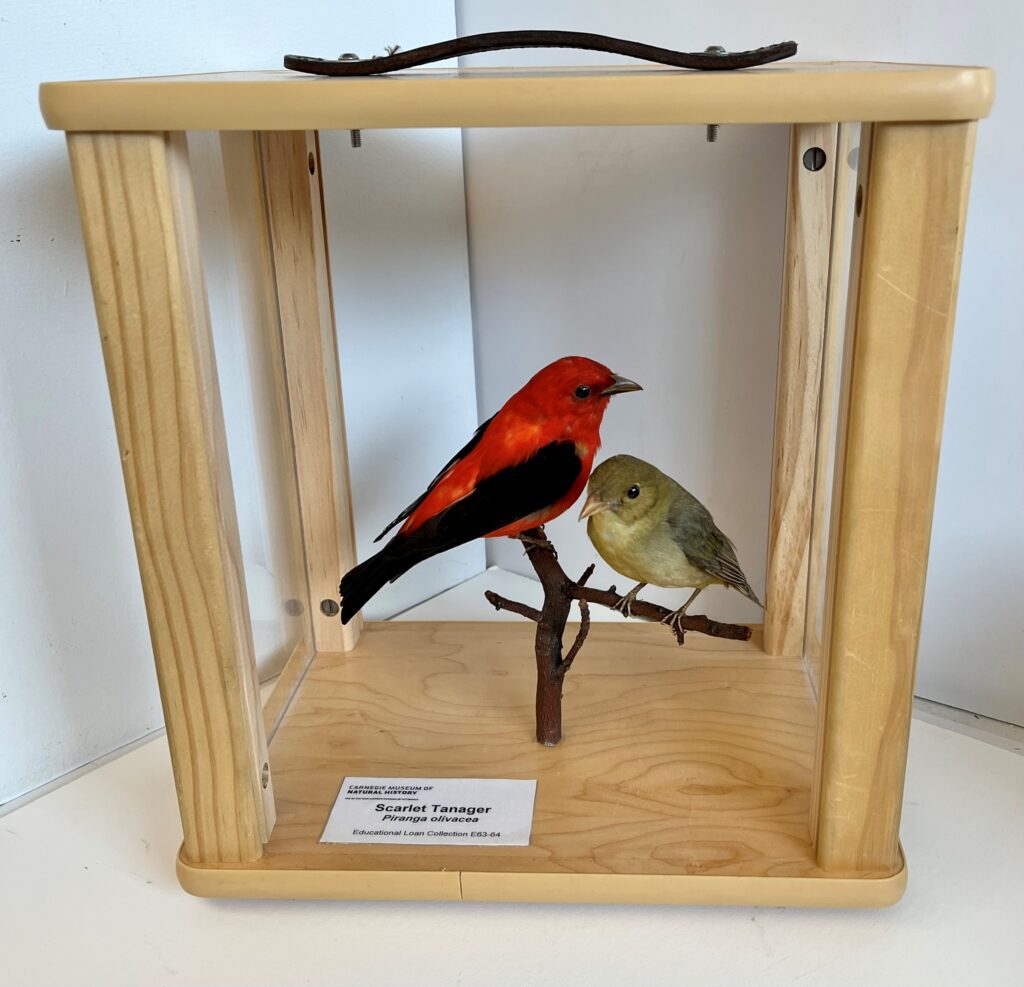
Nick borrowed encased taxidermy mounts from the Museum’s Educator Loan Collection for use in some camp sessions, but magazine pictures of birds, field guide images, and especially, the taxidermy mounts of the Museum’s Bird Hall, can also stimulate discussion. Nick simply asked campers to report what they noticed about the preserved birds. “Often their observations were about the feathers. But then we’d talk about the beak and the feet. Those observations helped them to connect the bird to a habitat type or a food preference, and follow-up conversations were about how places as specific as backyards, treetops, or even tree trunks met the needs of some birds.”

Taxidermy mounts of a male and female Scarlet Tanager.

A story involving a Zoom call provides anecdotal evidence of how well the birding skills of some campers developed under Nick’s guidance last summer. “One of the kids in the camp was on a Zoom call with his grandparents, who happened to be outside. A red bird flew into view and the kid recognized it as a male Scarlet Tanager! He saw the bird as different from the all-red cardinals. He even noted the black wings.”

Paying attention to the number and variety of birds you notice today is a fine way to participate in National Birding Day. The electronic resources of The Cornell Lab of Ornithology will become more useful after any observations you’re able to make. More birding resources are listed below.

Three Rivers Birding Club

Audubon Society of Western Pennsylvania

Erie Bird Observatory

National Aviary

Patrick McShea is an Educator at Carnegie Museum of Natural History.

Related Content

Using iNaturalist in the City Nature Challenge and Beyond

Chimney Swift Conservation

Lights Out for Birds

Carnegie Museum of Natural History Blog Citation Information

Blog author: McShea, Patrick
Publication date: April 29, 2023

Share this post!

  • Share on Twitter Share on Twitter
  • Share on Facebook Share on Facebook
  • Share on Pinterest Share on Pinterest
  • Share on LinkedIn Share on LinkedIn
  • Share on Reddit Share on Reddit
  • Share via Email Share via Email

Filed Under: Blog Tagged With: Birds, City Nature Challenge, Pat McShea

May 3, 2022 by Erin Southerland

City Nature Challenge: A 2022 Reflection

by Patrick McShea

This year marked the fifth consecutive year that CMNH has sponsored the City Nature Challenge (CNC). One benefit of participation in the annual global event is a better understanding of the animals, plants, and fungi in our own neighborhoods. The submission of photo observations via the iNaturalist app, or Seek, a related app for younger audiences, can spark curiosity among students and teachers that lasts far longer than the prescribed four-day observation period.

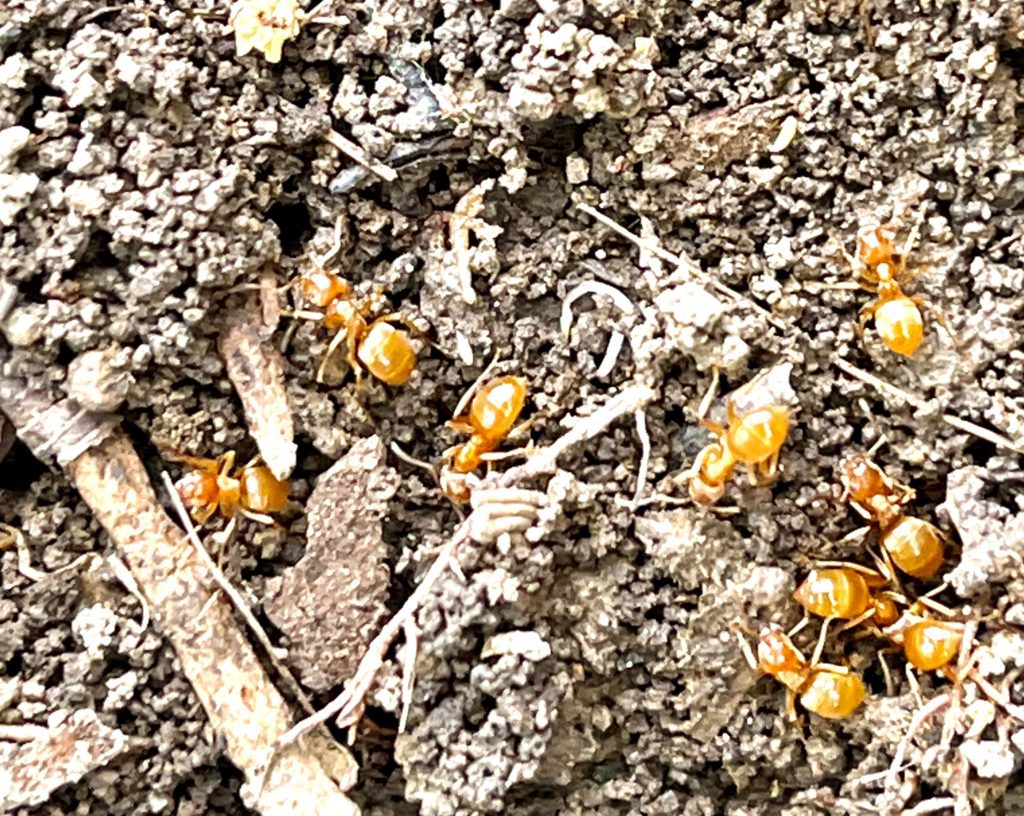
As a participant in last year’s CNC, I learned about citronella ants when iNaturalist quickly generated a tentative identification for a trio of tiny yellow creatures photographed beneath a plate-sized rock in a backyard flowerbed. A subsequent information search on the Penn State Extension website provided some fascinating information about the largely subterranean species. Citronella ants get their common name from the lemon verbena or citronella odor they emit when threatened. For food, the harmless ants rely upon honeydew secreted by root-feeding aphids. The ants’ tending of the soft-bodied aphids resembles the management of cows by dairy farmers.

Citronella ants in the dirt

This information served me well earlier this year when I was asked to speak with a dozen five- and six-year-olds in the museum’s Hall of Botany. As we sat in front of the Pennsylvania Forest diorama, I challenged the group to imagine something we couldn’t see – the tangle of tree roots beneath the display’s massive American beech. When the children’s root descriptions indicated basic understanding of the living network, I told them about root-feeding aphids and citronella ants.

During this year’s City Nature Challenge, I again documented the ants in the backyard flower bed. In appreciation for providing me with a new way to interpret a long-established museum exhibit, I replaced their sheltering rock with great care.

Related Content

Using iNaturalist in the City Nature Challenge and Beyond

The City Nature Challenge Family Experience

Expanding the Scope of Environmental Education

Carnegie Museum of Natural History Blog Citation Information

Blog author: McShea, Patrick
Publication date: May 3, 2022

Share this post!

  • Share on Twitter Share on Twitter
  • Share on Facebook Share on Facebook
  • Share on Pinterest Share on Pinterest
  • Share on LinkedIn Share on LinkedIn
  • Share on Reddit Share on Reddit
  • Share via Email Share via Email

Filed Under: Blog Tagged With: Carnegie Museum of Natural History, City Nature Challenge, Pat McShea

April 18, 2022 by Erin Southerland

Using iNaturalist in the City Nature Challenge and beyond

by Patrick McShea

Participation in this year’s City Nature Challenge (CNC), April 28–May 1, 2023, is a great way to familiarize yourself with iNaturalist, an innovative cell phone app that powers the annual biological survey of metropolitan areas across the globe. Mastery of the easy-to-use technology during this self-paced bioblitz-style event can create positive outcomes long after the Pittsburgh CNC concludes and in places far beyond the event’s six county territory.          

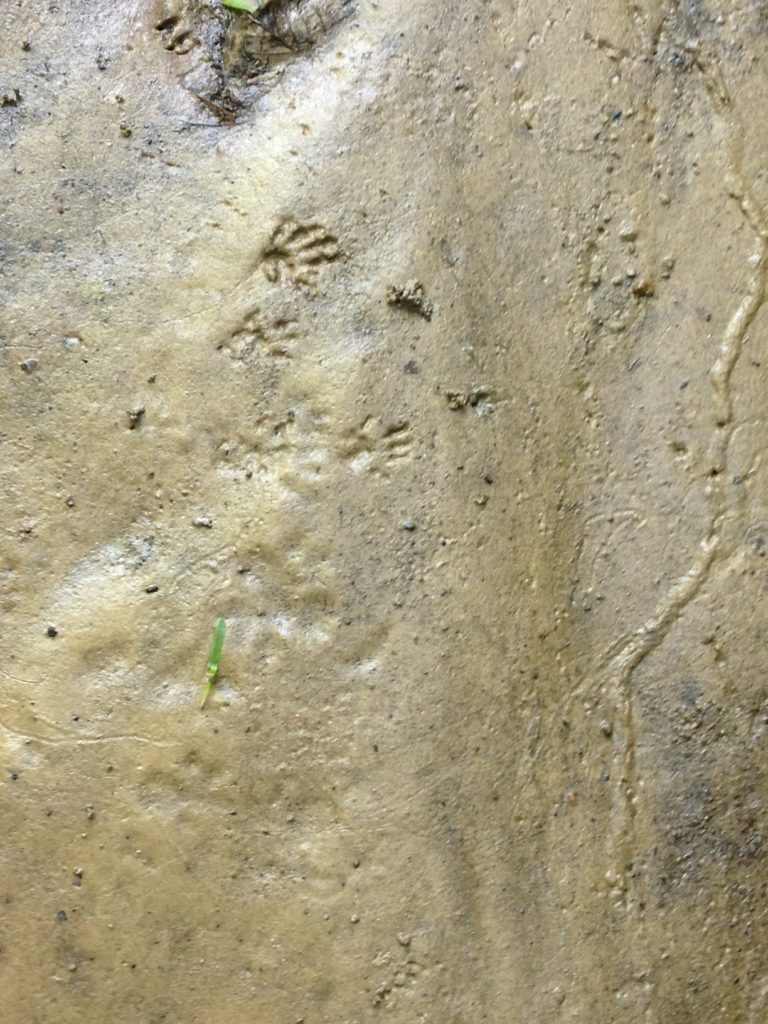
Raccoon tracks in the mud.
During the City Nature Challenge participants can identify observations, such as these raccoon tracks, or rely upon iNaturalist to identify them.

Although 2023 will be the sixth consecutive year for Carnegie Museum of Natural History to serve as a CNC city organizer agency, I didn’t become an active participant in the event until 2021. In 2021, I was among 446 participants who, in using our phone cameras to take and submit pictures, documented 7,045 observations of free-living plants, animals, and fungi in Allegheny, Armstrong, Beaver, Butler, Washington, and Westmoreland Counties. Our collective efforts verified and geo-referenced the presence of 1,219 different species at various locations in the surveyed territory.

My contributions, which came from four half-hour periods over as many days, amounted to only 29 observations, and for each of them I was able to include an accurate name of the observed subject in the submission form’s “What did you see?” line. iNaturalist, which is a joint initiative of the California Academy of Sciences and the National Geographic Society, functions amazingly well in identifying submitted images even when this question is ignored. The app provides users with impressive evidence of its image recognition capabilities by quickly supplying identification suggestions. This digital wizardry is only a starting point, however, because iNaturalist defines itself as “an online social network of people sharing biodiversity information to help each other learn about nature.” 

Whether an observation is tentatively identified by the observer or through the powerful software, higher levels of identification certainty occur hours, weeks, or even months later when other users, who are focused on identifying observations, verify, refine, or even challenge identifications. Consistent verification by such reviewers can raise observations to “research grade,” indicating possible use in future scientific investigations.

Because I didn’t pay close attention to the network aspects of iNaturalist during the CNC, appreciation for my phone’s transformation into far more than a multi-category field guide came months later and more than 500 miles to the northeast during an early fall vacation in the Adirondack Park.

Moth on a branch.
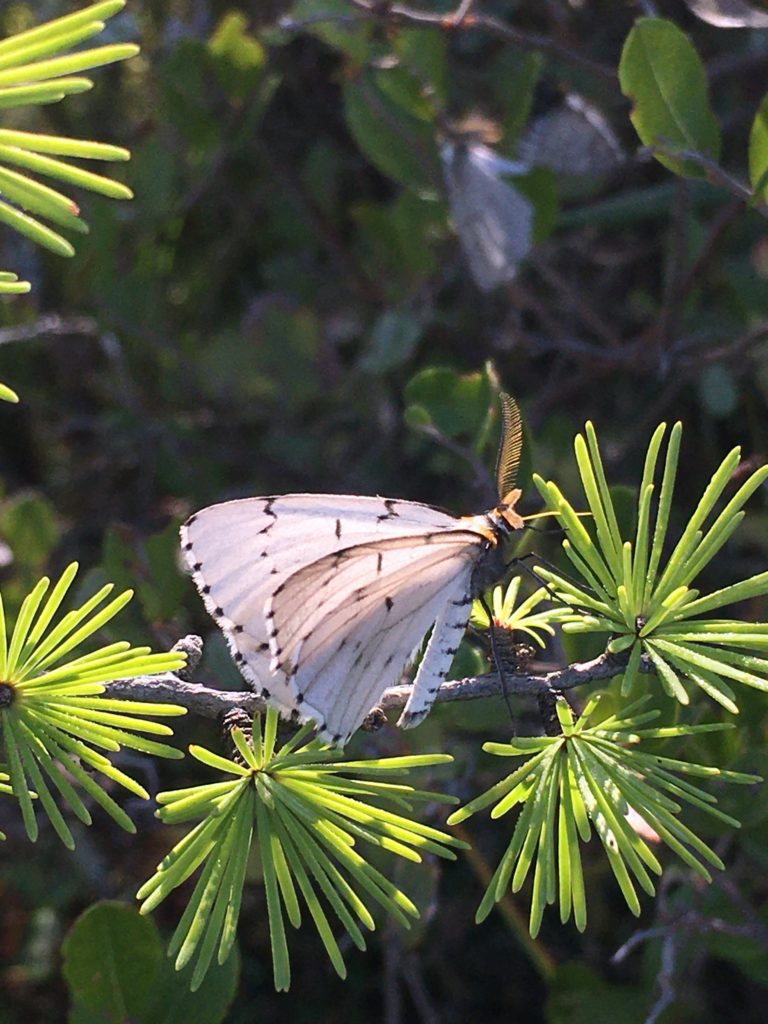
The moth known commonly as the Chain-dotted Geometer on the Boreal Life Trail at the Paul Smith’s College Visitor Information Center.

On a sunny mid-September afternoon, while my wife and I watched for birds and pitcher plants along a bog-crossing boardwalk that is part of the unique 14,000-acre campus of Paul Smith’s College, we were frequently surrounded by white moths with delicate black markings. When one landed close by I took its picture, then immediately submitted it as an iNaturalist observation. “Genus Cingilia,” I saw on the phone screen within 30 seconds. 

Days later, when an email notification informed me that an observation reviewer had refined the identification to “Cingilia catenaria,” or the “Chain-dotted Geometer,” curiosity about the bog moths prompted a visit to BugGuide.net, a reliable site for information about insects and spiders in North America. Here a statement in the “Remarks” section of the species account raised an ecological question: “Locally abundant to the point of being a pest in some years, yet becoming increasingly rare over much of its former range in the Northeast.”

As I wondered whether the numerous bog moths had been a pest-level outbreak, I remembered someone who might be able to answer that question. The observation reviewer had identified herself on iNaturalist. Dr. Janet Mihuc is a professor at Paul Smith’s College who has been conducting a moth biodiversity survey on the college’s lands for the past six years. In an email exchange she was happy to discuss the bog moths and their role in the ecosystem.

I certainly consider C. catenaria common in our area. I am not aware of it being a pest but that may just be because our local bogs have no economic significance to humans so I doubt there is data on the amount of defoliation that the caterpillars can cause. Hopefully the caterpillars are an important food for migrant songbirds before they depart or for resident songbirds. Based on my data, adult moth species diversity peaks in July then drops steadily in August and September. I would expect caterpillar availability to show a similar trend.

Her generous sharing of information was completely inline with my experience as a CMNH educator asking museum scientists for clarification of concepts presented in current exhibits. The fact that the information exchange was brokered by a cell phone app did not diminish the learning that occurred.

Patrick McShea is an Educator at Carnegie Museum of Natural History. Museum employees blog about their unique experiences and knowledge gained from working at the museum.

Related Content

Evidence Counts For Absent Creatures: City Nature Challenge

Go For a Color Walk

Naturally Pittsburgh: Big Rivers and Steep Wooded Slopes

Carnegie Museum of Natural History Blog Citation Information

Blog author: McShea, Patrick
Publication date: April 18, 2022

Share this post!

  • Share on Twitter Share on Twitter
  • Share on Facebook Share on Facebook
  • Share on Pinterest Share on Pinterest
  • Share on LinkedIn Share on LinkedIn
  • Share on Reddit Share on Reddit
  • Share via Email Share via Email

Filed Under: Blog Tagged With: City Nature Challenge, Educator Resources, Pat McShea

  • Page 1
  • Page 2
  • Page 3
  • Interim pages omitted …
  • Page 6
  • Go to Next Page »

sidebar

About

  • Mission & Commitments
  • Directors Team
  • Museum History

Get Involved

  • Volunteer
  • Membership
  • Carnegie Discoverers
  • Donate
  • Employment
  • Events

Bring a Group

  • Groups of 10 or More
  • Birthday Parties at the Museum
  • Field Trips

Powdermill

  • Powdermill Nature Reserve
  • Powdermill Field Trips
  • Powdermill Staff
  • Research at Powdermill

More Information

  • Image Permission Requests
  • Science Stories
  • Accessibility
  • Shopping Cart
  • Contact
  • Visitor Policies
One of the Four Carnegie Museums | © Carnegie Institute | Privacy Policy | Terms of Use | Accessibility
Rad works here logo