• Skip to primary navigation
  • Skip to main content
  • Skip to primary sidebar

Carnegie Museum of Natural History

One of the Four Carnegie Museums of Pittsburgh

  • Visit
    • Buy Tickets
    • Visitor Information
    • Exhibitions
    • Events
    • Dining at the Museum
    • Celebrate at the Museum
    • Powdermill Nature Reserve
    • Event Venue Rental
  • Learn
    • Field Trips
    • Educator Information
    • Programs at the Museum
    • Bring the Museum to You
    • Guided Programs FAQ
    • Programs Online
    • Climate and Rural Systems Partnership
  • Research
    • Scientific Sections
    • Science Stories
    • Science Videos
    • Senior Science & Research Staff
    • Museum Library
    • Science Seminars
    • Scientific Publications
    • Specimen and Artifact Identification
  • About
    • Mission & Commitments
    • Directors Team
    • Museum History
  • Tickets
  • Give
  • Shop

collected on this day

October 15, 2019 by wpengine

Callery Pear from October 11, 1979: 40 years ago

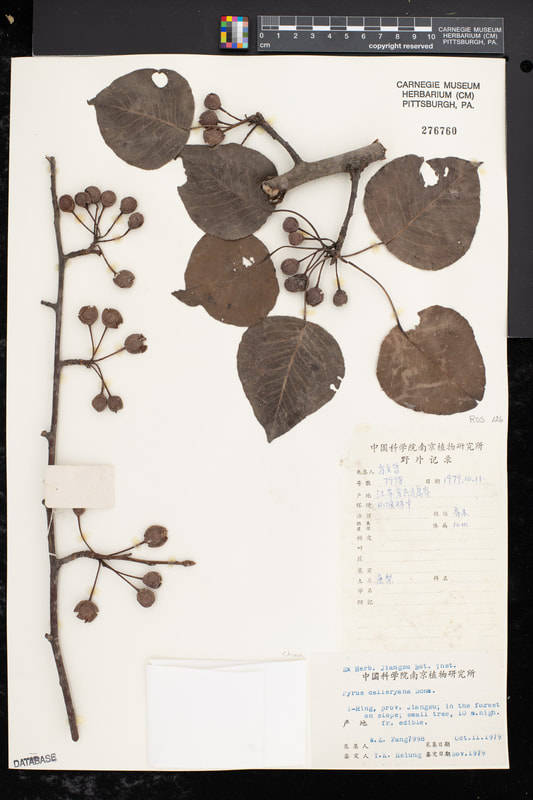
Callery pear herbarium specimen

From wild to cultivated to invasive

This specimen of Callery pear (Pyrus calleryana) was collected on October 11, 1979 by W.Z. Fang in Jiangsu, China. Callery pear is native to East Asia (China, Vietnam).

But…Callery pear can be found in the United States. It was (and is) widely planted as an ornamental landscape tree.  Along streets, in residential yards, in parking lots  – it was a prized plant for well-groomed anthropogenic landscapes. It uniformly grows in low resource conditions, explodes with many beautiful blossoms each spring, provides shade, and has a decent foliage display in the autumn. As many introduced plants go, it went from prized ornamental to an unwanted “invasive species,” spreading across the landscape and affecting the environment. It is now widely recognized invasive species in many states or closely watched as a species likely to become invasive. That said, beyond the legacy of over half a century of mass plantings across the country, it is still commonly planted and old and new cultivars are commercially available. USDA estimated over $23 million in sales in the US in 2009 alone.

How’d Callery pear get to the US? The story behind the introduction of Callery pear is a fascinating one.  Like many of our cultivated plants, seeds were collected on special expeditions in search of plants useful to horticulture, agriculture, or just because. Pyrus calleryana was first introduced to the US in the early 1900s, though not for its attractive blossoms as you might expect. Instead, it was first introduced for its disease resistance. It was successfully used in horticulture as a root stock for European pear fruit production. At the time, European pears in the Pacific northwestern US were being hit hard, grafting to a Callery pear rootstock dramatically decreased crop losses to disease. Callery pear does not produce edible fruit.

​The tree was widely planted starting in the 1960s, when it became commercially available and promoted by the nursery industry as a hardy ornamental tree. Before that, it was planted by the US Department of Agriculture (USDA) for testing at Plant Introduction Stations in Corvallis, Oregon, and Glenn Dale, Maryland. One of these Maryland planted trees was targeted for its special traits and became the source of the hugely popular ‘Bradford’ cultivar (“Bradford pear”). In 1952, one tree was used to graft to rootstock, a plant propagation method making all plants genetically identical.  Other cultivars have since been commercialized, but ‘Bradford’ were/are exceptionally popular. Though intended to be sterile (non-reproducing), it turned out the trees were capable of setting viable seed.  The cultivars themselves are not invasive, but because multiple cultivars exist, together they can cross-pollinate to become invasive.
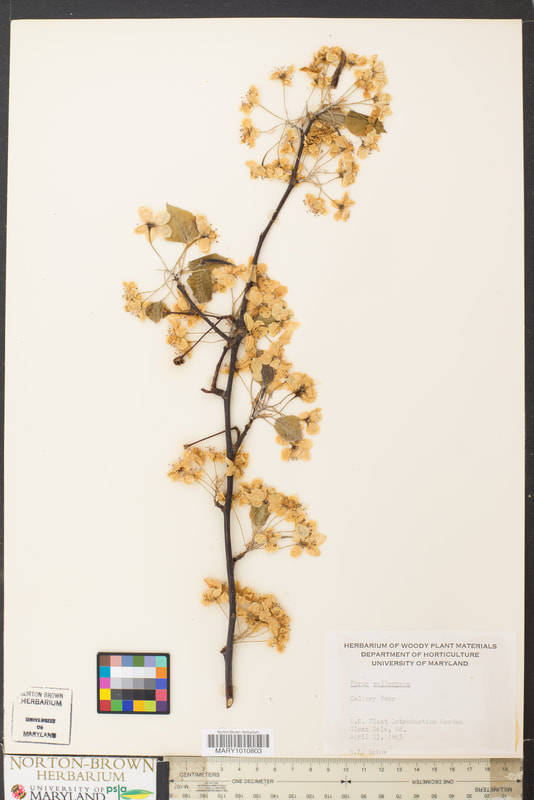
This flowering specimen (above) from University of Maryland Norton-Brown Herbarium (MARY) was collected  in 1963 from the US  Plant Introduction Garden in Glenn Dale, MD  – THE site behind the widespread introduction of this species!

Herbarium specimens have been critical to understanding the spread of this species. In a 2005 study, Dr. Michael Vincent (Miami University in Ohio) found that 50% of all specimens examined over the range of 39 years were collected between 2000-2003.  Though some specimens  were collected in the 1960s in natural areas, it became widely “escaped” from cultivation in many natural  areas in the 1990s.

You may have noticed that most of our specimen images to date are those collected in Pennsylvania and surrounding states.  That’s because these specimens are being digitized as part of a multi-institutional project, the Mid-Atlantic Megalopolis Project, with the overarching goal to mobilize herbarium specimens across the region to understand the effects of urbanization on plant life.  However, this project is a step towards digitizing the entire Carnegie Museum Herbarium. The herbarium is worldwide in scope, and specimens in the Mid-Atlantic region account for only 35% of the 540,000 specimens.

As more specimens become digitized as part of the Mid-Atlantic Megalopolis Project, we’ll have a more complete understanding of the introduction and spread of Callery pear in the region.

Herbarium specimens are collected in the native range too! We’ll be able to compare specimens collected in the invaded range to those in its native China. The use of cultivated specimens and those collected in the native range are underutilized but can provide critical information.
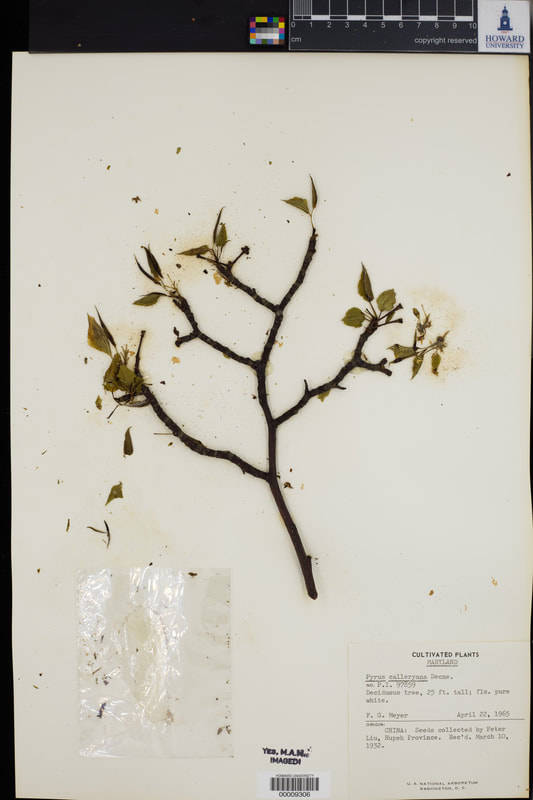
This historically fascinating specimen (above) from Howard University Herbarium (HUDC) below, digitized through the Mid-Atlantic Megalopolis Project, is among the oldest specimens collected in the region. Collected in spring of 1965 in Maryland by Frederick Meyer from a cultivated plant at the US National Arboretum, with the note on the label: “China: Seeds collected by Peter Liu, Hupeh Province. Rec’d.  March 10, 1932.” The US National Arboretum was instrumental in the development and popularity of the ‘Bradford’ and other cultivars.

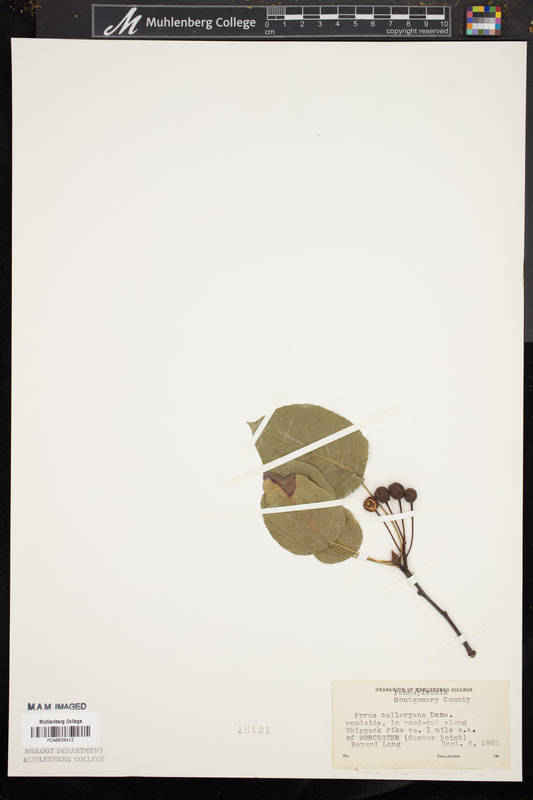
Escaped from cultivation. This specimen (above) from Muhlenberg College Herbarium (MCA) was collected along the roadway in Montgomery county, Pennsylvania by Bayard Long in 1962. This specimen is probably the earliest specimen collected in the wild in Pennsylvania.

Many more specimens like this will be brought to light through the Mid-Atlantic Megalopolis Project.

Read more about this species introduction history in the popular press, published in the Washington Post last year, and in an excellent overview by Dr. Theresa Culley (University of Cinncinati) in Arnoldia and another in BioScience.

See all the Pyrus calleryana specimens being made available online from the Mid-Atlantic Megalopolis project here: http://midatlanticherbaria.org/portal/collections/list.php?db=277%2C328%2C334%2C329%2C333%2C320%2C330%2C40%2C410%2C316%2C335%2C331%2C332%3B11&includecult=1&taxa=Pyrus+calleryana&usethes=1&taxontype=2

Check back for more! Botanists at the Carnegie Museum of Natural History share digital specimens from the herbarium on dates they were collected. They are in the midst of a three-year project to digitize nearly 190,000 plant specimens collected in the region, making images and other data publicly available online. This effort is part of the Mid-Atlantic Megalopolis Project (mamdigitization.org), a network of thirteen herbaria spanning the densely populated urban corridor from Washington, D.C. to New York City to achieve a greater understanding of our urban areas, including the unique industrial and environmental history of the greater Pittsburgh region. This project is made possible by the National Science Foundation under grant no. 1801022.

Mason Heberling is Assistant Curator of Botany at the Carnegie Museum of Natural History. Museum employees are encouraged to blog about their unique experiences and knowledge gained from working at the museum.
Filed Under: Blog Tagged With: Anthropocene, Botany, collected on this day, Mason Heberling, Uprooted

October 4, 2019 by wpengine

October 4, 1940: 79 years ago

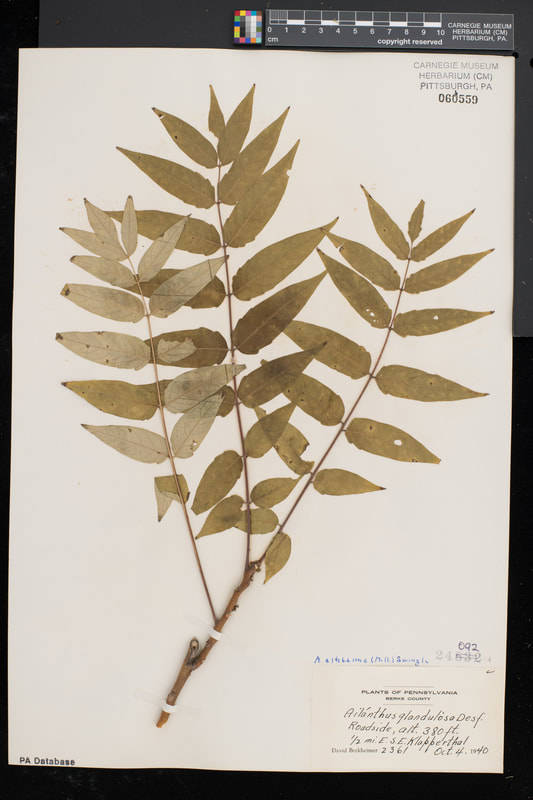
tree of heaven specimen

Loved and hated: An urban plant with history

​”There’s a tree that grows in Brooklyn. Some people call it the Tree of Heaven. No matter where its seed falls, it makes a tree which struggles to reach the sky. It grows in boarded up lots and out of neglected rubbish heaps. It grows up out of cellar gratings. It is the only tree that grows out of cement. It grows lushly…survives without sun, water, and seemingly earth. It would be considered beautiful except that there are too many of it.“

-from Betty Smith’s classic novel, A Tree Grows in Brooklyn (1943)

(Fact check: the species is impressively resilient but does indeed require light and water. But we’ll let it slide with an artistic license here.)

This specimen of tree of heaven (Ailanthus altissima) was collected on October 4, 1940 by D. Berkheimer near Klapperthal in Berks county, Pennsylvania.

Tree of heaven (Ailanthus altissima) is a species with a fascinating and complex cultural history.  It was once glorified as a beautiful urban street tree in the United States. It was tolerant of insects, pollution, and poor growing conditions. The earliest recorded planting in the US (via England) was at William Hamilton’s estate (currently the “Woodlands Cemetery”) in Philadelphia around 1784.  It was also in Bartram’s famous garden nearby. It became popular in the plant nursery industry after 1820. But that feeling didn’t stay long, and within decades it was vilified as an unwanted weed – it had an unpleasant smell, produced prolific seeds, and resprouted from suckers causing it to spread.  Today, it is a common urban “weed” found in urban and non-urban areas across the eastern US.  It is considered invasive in Pennsylvania (and many other states). It is also considered invasive in many parts of Europe.

But where’s it from? Ailanthus altissima is native to East Asia, including China, Taiwan, and Korea. It has a deep ethnobotanical history in China, where it has been used in various ways in traditional Chinese medicine, with written records of its use dating to 732 AD! It also has deep roots in Chinese literature and culture. Among other uses, it has also been used in silk production, as it is a food host to a silkworm.

The oldest herbarium specimen from the Eastern US is undated but inferred to date from 1815-1831 from Philadelphia.  It is in the herbarium of the Academy of Natural Sciences of Drexel University (PH).  The second oldest Pennsylvania specimen is dated 1841, also from Philadelphia.

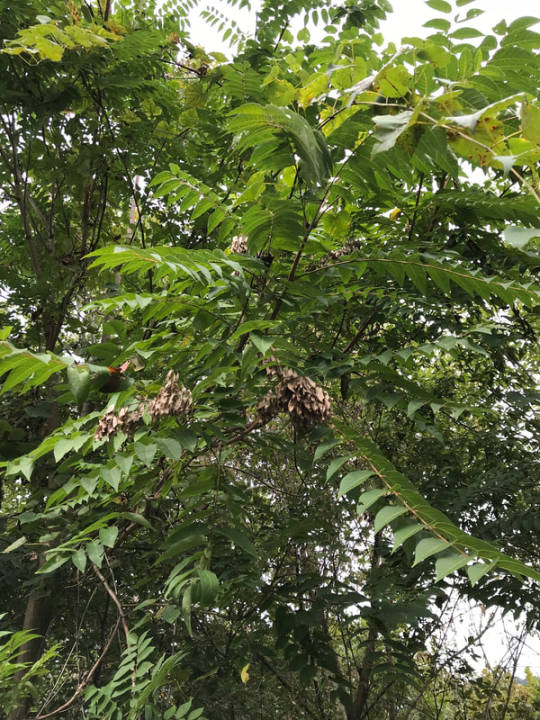
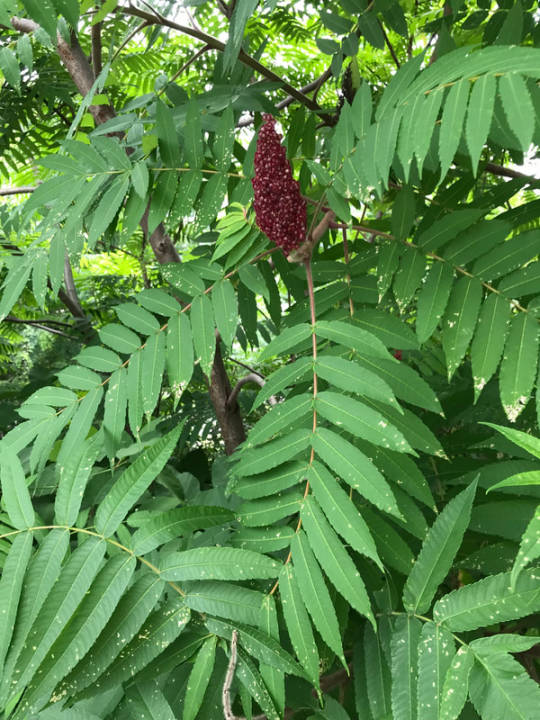
It is around this time of year that the abundance of Tree of Heaven in the Pittsburgh area becomes especially obvious, especially along roadsides. With large, compound leaves and found in disturbed, “weedy” areas, Ailanthus can be easily confused with the similar looking native tree, staghorn sumac (Rhus typhina). Staghorn sumac is in a different plant family (poison ivy family, Anacardiaceae), but this confusion goes way back. Linnaeus even described the species as in the same genus as sumac, so don’t feel too bad if you make the same mistake! (Side note – the taxonomic history of the species is also intense. It has been given many different scientific names over the past three centuries, with three people independently naming it at around mid-1700s!) The leaves are noticeably different upon closer inspection. The fruits are even more  clearly different. Ailanthus has brown clusters of winged seeds (called samaras, like that of maple trees’ “helicopter” seeds). These seeds can be clearly seen now on trees as their leaves drop along most highways around Pittsburgh.

Tree of heaven (Ailanthus altissima) 

Staghorn sumac (Rhus typhina​)

Given its introduction history in the Mid-Atlantic and its intentional planting and affinity for urban areas, the Mid-Atlantic Megalopolis Project will be important and fascinating to understanding more about this plant. The Mid-Atlantic Megalopolis Project is a specimen digitation effort involving more than 12 herbaria (including Carnegie Museum herbarium) funded by a National Science Foundation grant to database (put in computer), image (high res. pictures), and georeference (put on map) all specimens in the region. The region is significant because it is one the oldest densely populated urban corridors in the US, from New York City to Washington, D.C. The Mid-Atlantic Megalopolis Project is producing a critical dataset to look at the introduction history and invasive success (and failure) of species in urban and non-urban areas across this connected region – including Tree of Heaven and many other species.

This specimen image (and many other Tree of Heaven specimens in the region) are available online: http://midatlanticherbaria.org/portal/collections/list.php?db=328&taxa=Ailanthus+altissima&usethes=1&taxontype=2

The earliest specimen in southwestern PA at the museum was collected in 1881 in Beaver county.

For more on the species’ fascinating history and biology in our region, check out this detailed study by Dr. Matt Kasson and colleagues done at Penn State published in 2013 in Northeastern Naturalist.

Check back for more! Botanists at the Carnegie Museum of Natural History share digital specimens from the herbarium on dates they were collected. They are in the midst of a three-year project to digitize nearly 190,000 plant specimens collected in the region, making images and other data publicly available online. This effort is part of the Mid-Atlantic Megalopolis Project (mamdigitization.org), a network of thirteen herbaria spanning the densely populated urban corridor from Washington, D.C. to New York City to achieve a greater understanding of our urban areas, including the unique industrial and environmental history of the greater Pittsburgh region. This project is made possible by the National Science Foundation under grant no. 1801022.

Mason Heberling is Assistant Curator of Botany at the Carnegie Museum of Natural History. Museum employees are encouraged to blog about their unique experiences and knowledge gained from working at the museum.
Filed Under: Blog Tagged With: Anthropocene, Botany, collected on this day, Mason Heberling

September 20, 2019 by wpengine

September 20, 1952: 67 Years Ago

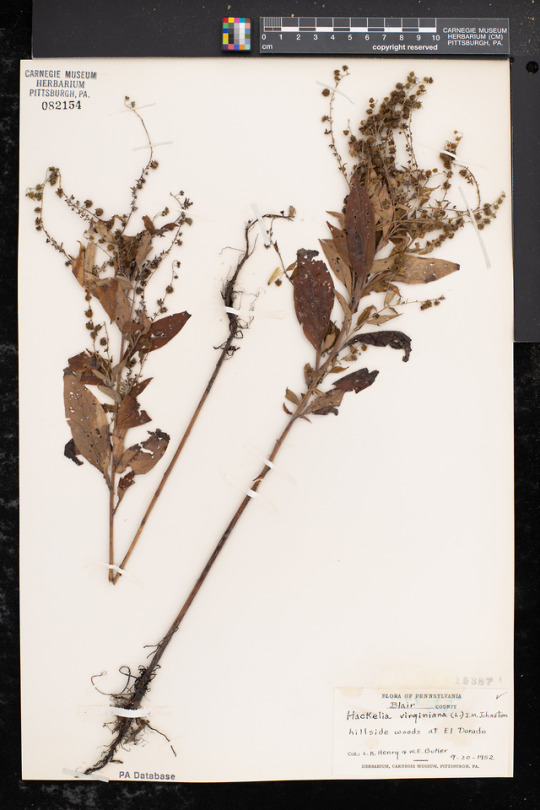
Virginia stickseed specimen

It’s fall seed dispersal time!

This specimen of Virginia stickseed (Hackelia virginiana), also interestingly called beggar’s lice, was collected on September 20, 1952 by Leroy Henry (Carnegie Museum Curator of Botany at the time) in the woods of Blair county, Pennsylvania.

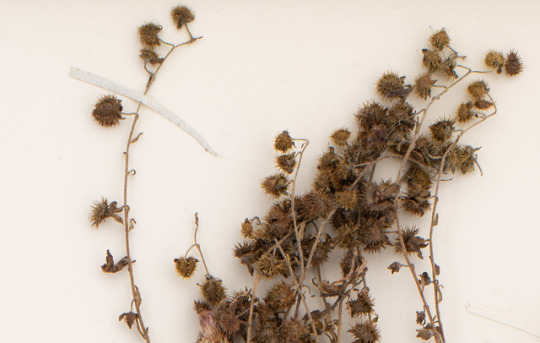
The common name for this plant is quite appropriate.  The small seeds have many burs on them, making them very sticky.  And stick to your clothes with barely a touch, making them easily dispersed (unknowingly) by animals.

If you have a dog, you’ve likely pulled these out their fur in the fall!  My dog was covered in them the other day, which was both amazing and annoying at the same time.

Stickseed is in the borage family, Boraginaceae.  It has very small white flowers that resemble forget-me-not, also in the same plant family.  However, it is the fruit/seeds that are most memorable.

Find high resolution image of this Virginia stickseed specimen (and more) online here:
midatlanticherbaria.org/portal/collections/individual/index.php?occid=12253345&clid=0 


detail of Virginia stickseed specimen

Check back for more! Botanists at the Carnegie Museum of Natural History share digital specimens from the herbarium on dates they were collected. They are in the midst of a three-year project to digitize nearly 190,000 plant specimens collected in the region, making images and other data publicly available online. This effort is part of the Mid-Atlantic Megalopolis Project (mamdigitization.org), a network of thirteen herbaria spanning the densely populated urban corridor from Washington, D.C. to New York City to achieve a greater understanding of our urban areas, including the unique industrial and environmental history of the greater Pittsburgh region. This project is made possible by the National Science Foundation under grant no. 1801022.

Mason Heberling is Assistant Curator of Botany at the Carnegie Museum of Natural History. Museum employees are encouraged to blog about their unique experiences and knowledge gained from working at the museum.
Filed Under: Blog Tagged With: Anthropocene, Botany, collected on this day, Mason Heberling, plants

August 20, 2019 by wpengine

A day late, but thanks for your Impatiens!

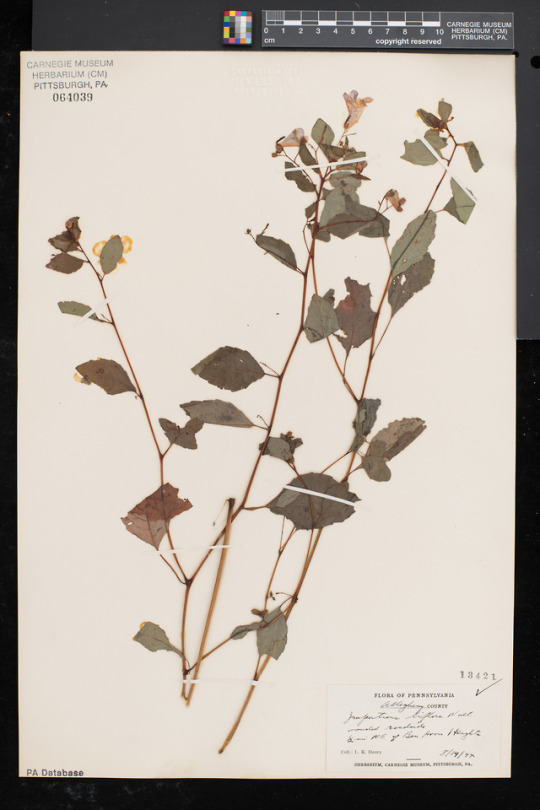
impatiens specimen
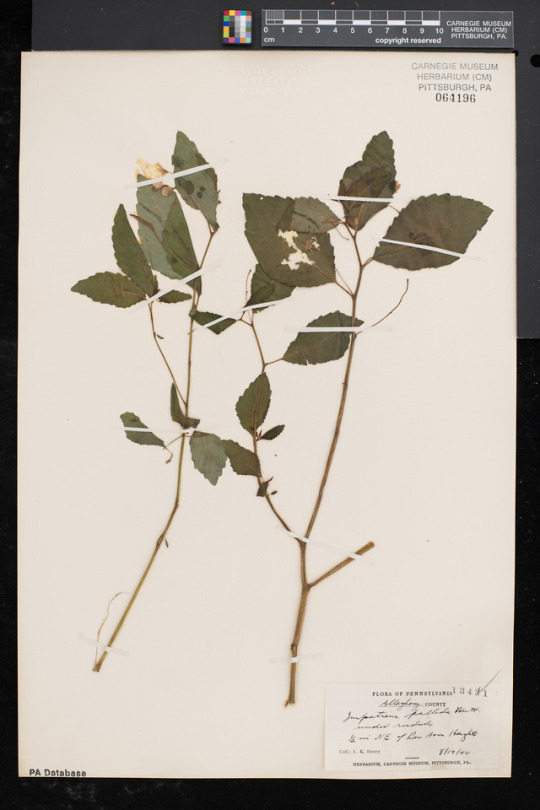
impatiens specimen

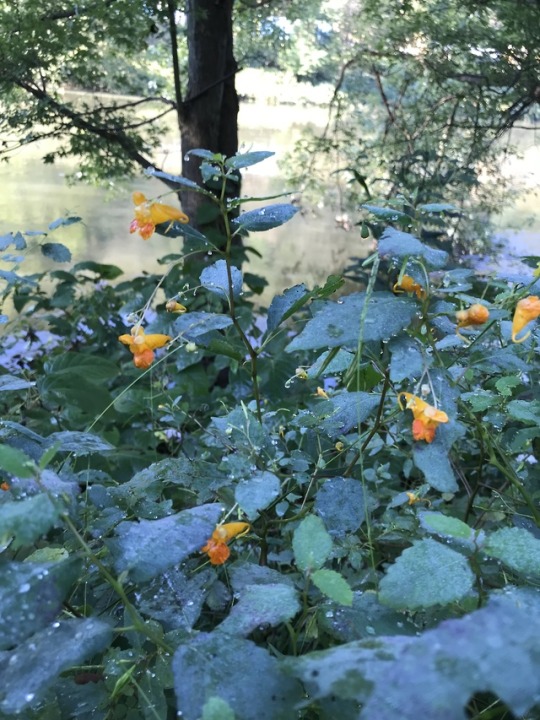
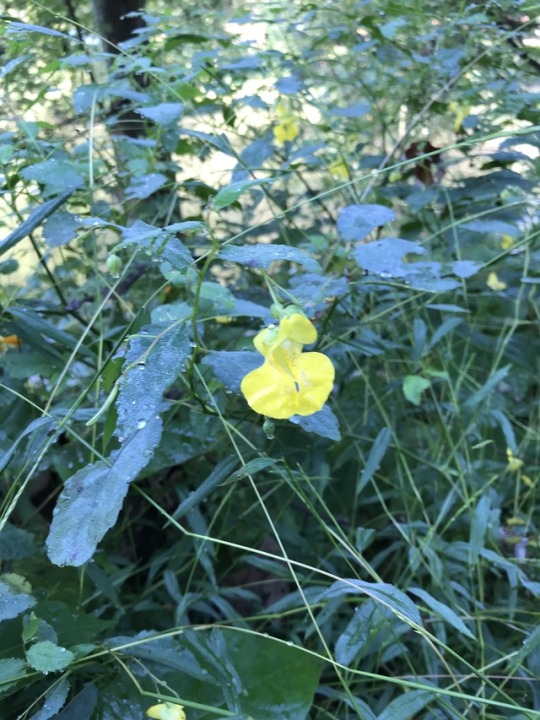
Two specimens of jewelweed, Impatiens, collected on this day (well, yesterday) by Carnegie Museum curator Leroy Henry in 1944 in Ben Avon Heights, near Pittsburgh.

There are two species of jewelweed commonly found in Pennsylvania and in relatively wet, partly shady habitats across eastern North America. They can form dense stands along wet roadside ditches at edge of woods and in floodplain forests. Henry collected both species in the same location, as they commonly grow together.

orange jewelweed

What’s the difference between these two specimens?  Though less obvious in specimen form, the most noticeable difference is flower color. Common jewelweed (Impatiens capensis), also called spotted or orange jewelweed, has orange flowers. In contrast, the flowers of yellow jewelweed (Impatiens pallida), also called pale jewelweed, are…well, yellow.  Flowers of both species have distinctive nectar spurs that jut out of the back of the flower. It is entertaining to watch bumblebees go from flower to flower in a stand of jewelweed.

yellow jewelweed

Jewelweeds are herbaceous, annual plants with juicy stems that can range in size, from short to very tall.  A widespread story is that jewelweed can treat skin irritations, and in particular, helps prevent poison ivy rash by rubbing jewelweed on skin after contact with poison ivy.  I don’t know of this being supported with data.

Jewelweed is also often called “touch-me-not” because the developed seed pods eject seeds out when touched. It can be a fun activity for kids (and adults).

Jewelweed flowers open mid-summer and the plants continue to flower until killed by autumn frost.

Jewelweed produces two types of flowers – the obvious ones with nectar spurs that are visited by bees and also, tiny inconspicuous flowers that do not open.  These small flowers are self-pollinating (cleistogamous).

Deer often eat jewelweed. A recent study found that some populations of the species that have historically received a lot of deer browsing have evolved greater tolerance to herbivory.

I’m always amazed how sensitive jewelweed leaves are to the sun. When exposed to direct sun, their leaves get very droopy. But they seem to quickly bounce back.

Impatiens commonly planted in gardens are related (in the same genus) but are not the same species.

Check out these specimens (and more!) here.

Check back for more! Botanists at the Carnegie Museum of Natural History share digital specimens from the herbarium on dates they were collected. They have embarked on a three-year project to digitize nearly 190,000 plant specimens collected in the region, making images and other data publicly available online. This effort is part of the Mid-Atlantic Megalopolis Project (mamdigitization.org), a network of thirteen herbaria spanning the densely populated urban corridor from Washington, D.C. to New York City to achieve a greater understanding of our urban areas, including the unique industrial and environmental history of the greater Pittsburgh region. This project is made possible by the National Science Foundation under grant no. 1801022.

Mason Heberling is Assistant Curator of Botany at the Carnegie Museum of Natural History. Museum employees are encouraged to blog about their unique experiences and knowledge gained from working at the museum.
Filed Under: Blog Tagged With: Botany, collected on this day, flowers, Leroy Henry, Mason Heberling, plants

July 12, 2019 by wpengine

Who Likes Teaberry? Collected 56 Years Ago

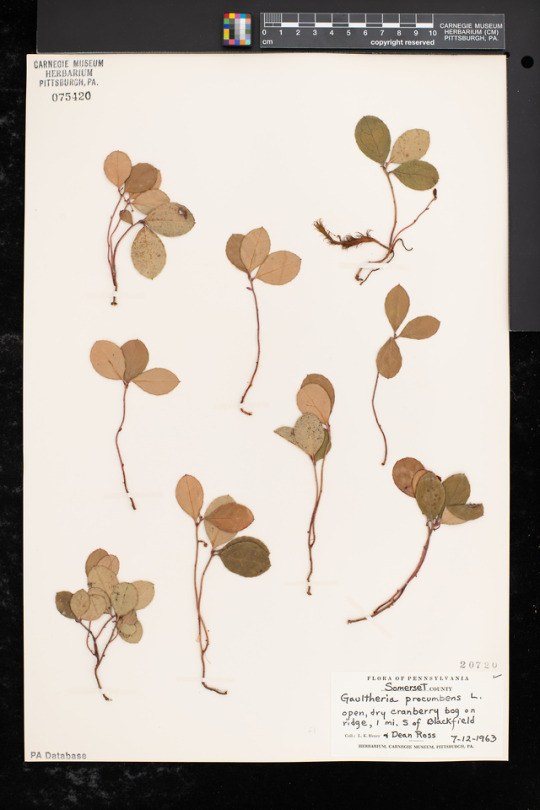
teaberry specimen

This specimen of eastern teaberry (Gaultheria procumbens), also called American wintergreen, was collected on July 12, 1963 by Leroy Henry (Carnegie Museum Curator of Botany at the time) and Dean Ross in a cranberry bog in Somerset county, Pennsylvania.

It is perhaps best known by many as a unique wintergreen flavor of chewing gum and ice cream, especially in Pennsylvania. Atlas Obscura says Teaberry ice cream: “sometimes looks like Pepto-Bismol and smells like Bengay.” Penn State Berkey Creamery calls it  the  “best treat of a bygone era.”

Teaberry is in the heath (blueberry) family, Ericaceae.  It is a small shrub growing along the ground, found across the Eastern US and has distinctive evergreen leaves.

Find a high resolution image of this teaberry specimen (and more) online at midatlanticherbaria.org.

Check back for more! Botanists at the Carnegie Museum of Natural History share digital specimens from the herbarium on dates they were collected. They have embarked on a three-year project to digitize nearly 190,000 plant specimens collected in the region, making images and other data publicly available online. This effort is part of the Mid-Atlantic Megalopolis Project (mamdigitization.org), a network of thirteen herbaria spanning the densely populated urban corridor from Washington, D.C. to New York City to achieve a greater understanding of our urban areas, including the unique industrial and environmental history of the greater Pittsburgh region. This project is made possible by the National Science Foundation under grant no. 1801022.

Mason Heberling is Assistant Curator of Botany at the Carnegie Museum of Natural History. Museum employees are encouraged to blog about their unique experiences and knowledge gained from working at the museum.
Filed Under: Blog Tagged With: Anthropocene, Botany, collected on this day, Leroy Henry, Mason Heberling, plants

July 8, 2019 by wpengine

A Plant Popular During the Revolutionary War



Ceanothus americanus tea plant specimen

Happy Independence Day! What better way to celebrate than with herbarium specimens of New Jersey tea (Ceanothus americanus), named for the fact that it was used as a substitute for tea by colonists and American soldiers during the American Revolutionary War. There was presumably a shortage of black tea, which was imported. Although the leaves contain no caffeine, it fit the bill. The plant also has a much longer history before European settlement.  Tribes of the Missouri River used the leaves for tea as well, and tribes of the Great Lakes used the plant to treat digestive ailments.

New Jersey tea, also called Indian tea, can be found not only in New Jersey, but across the eastern United States.  It is in the buckthorn family (Rhamnaceae), which is unsurprisingly also family to introduced shrub/tree, common buckthorn  (Rhamnus cathartica).

Ceanothus americanus tea plant specimen

These specimens were both collected in Pennsylvania on the 4th of July.  One in Luzerne county by Alfred Twining 1907, who wrote a flora of Northeastern PA ten years later.  Many of his specimens are at the Everhart Museum of Natural History, Science, and Art in Scranton, PA.

The other Independence Day New Jersey Tea specimen was collected by Robert Leberman in Crawford county in 1986.  Leberman established the bird banding program at the Carnegie Musuem of Natural History’s Powdermill Nature Reserve in 1961.  It continues today as the longest running, year-round banding research operation in the country.

New Jersey Tea is a beautiful shrub, important for many pollinators, and food source for other wildlife. The plant is also sold commercially by many native plant nurseries to plant in your yard or garden.

All plants have a cultural history and a scientific one. As you remember the signing of the Declaration of Independence and the American Revolution, think too about New Jersey Tea’s impact on our country. Did John Hancock drink it before signing? (Totally made that up).

Find high resolution images of these specimens (and 290 more!) online: http://midatlanticherbaria.org/portal/collections/list.php?db=328&taxa=Ceanothus+americanus&usethes=1&taxontype=2

Check back for more! Botanists at the Carnegie Museum of Natural History share digital specimens from the herbarium on dates they were collected. They have embarked on a three-year project to digitize nearly 190,000 plant specimens collected in the region, making images and other data publicly available online. This effort is part of the Mid-Atlantic Megalopolis Project (mamdigitization.org), a network of thirteen herbaria spanning the densely populated urban corridor from Washington, D.C. to New York City to achieve a greater understanding of our urban areas, including the unique industrial and environmental history of the greater Pittsburgh region. This project is made possible by the National Science Foundation under grant no. 1801022.  

Mason Heberling is Assistant Curator of Botany at the Carnegie Museum of Natural History. Museum employees are encouraged to blog about their unique experiences and knowledge gained from working at the museum.
Filed Under: Blog Tagged With: Anthropocene, Botany, collected on this day, Mason Heberling, plants

  • « Go to Previous Page
  • Page 1
  • Interim pages omitted …
  • Page 3
  • Page 4
  • Page 5
  • Page 6
  • Page 7
  • Page 8
  • Go to Next Page »

sidebar

About

  • Mission & Commitments
  • Directors Team
  • Museum History

Get Involved

  • Volunteer
  • Membership
  • Carnegie Discoverers
  • Donate
  • Employment
  • Events

Bring a Group

  • Groups of 10 or More
  • Birthday Parties at the Museum
  • Field Trips

Powdermill

  • Powdermill Nature Reserve
  • Powdermill Field Trips
  • Powdermill Staff
  • Research at Powdermill

More Information

  • Image Permission Requests
  • Science Stories
  • Accessibility
  • Shopping Cart
  • Contact
  • Visitor Policies
One of the Four Carnegie Museums | © Carnegie Institute | Privacy Policy | Terms of Use | Accessibility
Rad works here logo