• Skip to primary navigation
  • Skip to main content
  • Skip to primary sidebar

Carnegie Museum of Natural History

One of the Four Carnegie Museums of Pittsburgh

  • Visit
    • Buy Tickets
    • Visitor Information
    • Exhibitions
    • Events
    • Dining at the Museum
    • Celebrate at the Museum
    • Powdermill Nature Reserve
    • Event Venue Rental
    • Gift Cards
  • Learn
    • Field Trips
    • Educator Information
    • Programs at the Museum
    • Bring the Museum to You
    • Guided Programs FAQ
    • Programs Online
    • Climate and Rural Systems Partnership
  • Research
    • Scientific Sections
    • Science Stories
    • Science Videos
    • Senior Science & Research Staff
    • Museum Library
    • Science Seminars
    • Scientific Publications
    • Specimen and Artifact Identification
  • About
    • Mission & Commitments
    • Directors Team
    • Museum History
  • Tickets
  • Give
  • Shop

collected on this day

June 21, 2019 by wpengine

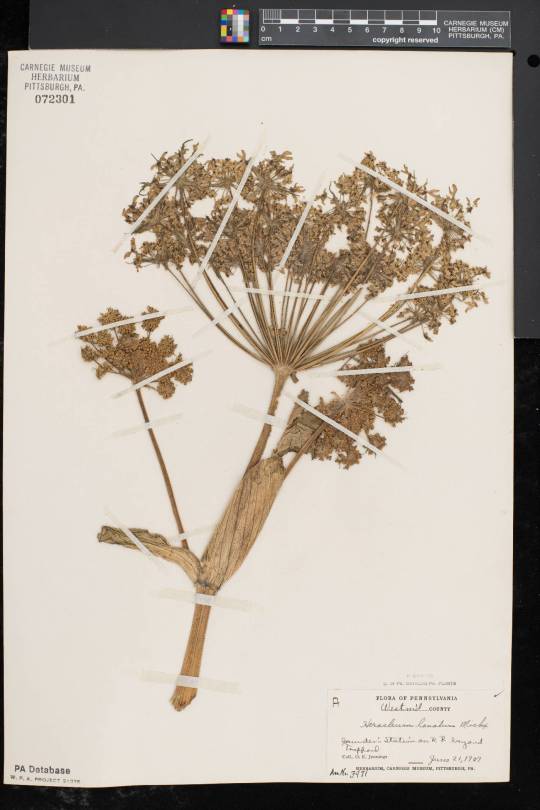
Cow Parsnip: All collected 112, 85, and 59 years ago!

cow parsnip specimen

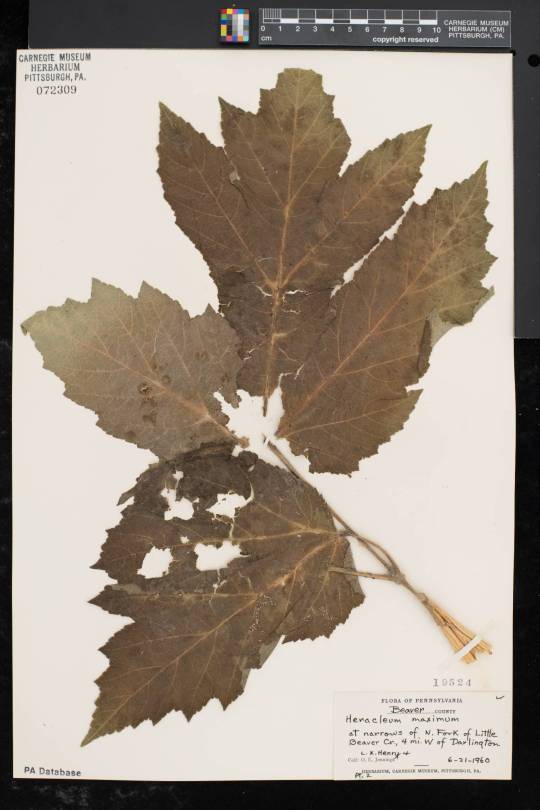
Whoa, this plant will catch your attention!  Although towering in at up to eight feet tall with leaves two feet wide, Cow parsnip (Heracleum maximum, aka Heracleum lanatum) is not a tree, but herbaceous (non-woody). This species is the largest member of the carrot family (Apiaceae) native to North America. It can be found along shaded roadsides, waterways, and the edge of woods. Its flower structure consists of many small white flowers on short stalks connected at a single point – an umbrella of flowers – botanically known as an “umbel.” Umbels are characteristic of the carrot family (think of the perhaps better recognized Queen Anne’s lace, Daucus carota, which is also known as “wild carrot”).

These specimens were all collected on June 21 – but years apart in 1907 (Westmoreland county, PA), 1934 (Pittsburgh), and 1960 (Beaver county, PA).
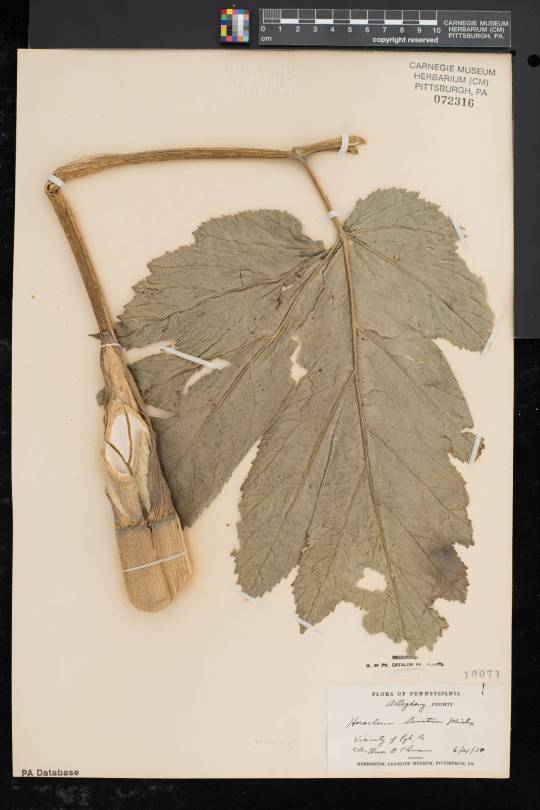
cow parsnip specimen

This species is often confused with giant hogweed. Cow parsnip is often confused for the non-native plant called giant hogweed (Heracleum mantegazzianum). Giant hogweed has hit the news media in the past few years and is on many people’s radar, as it is considered a significant public human health concern. This plant is highly poisonous and designated as a federal noxious weed. The sap of giant hogweed causes “phytophotodermatitis,” meaning serious skin inflammation occurs when contacted skin is exposed to sunlight.  Skin rashes can be very severe.  The sap can cause temporary or permanent blindness. Cow parsnip has a similar set of chemicals in its sap, and although not as poisonous, be careful around these plants.

Giant hogweed can be 8-20 feet tall with leaves up to 5 feet wide!  It is thought to be eradicated in Pennsylvania. Although similar to the Pennsylvania native species cow parsnip, giant hogweed is noticeably larger in height and flower size. (see herbarium specimen here – it took 6 sheets!)

See here for a nice comparison between these similar species.

Given the size of members of the genus, the name Heracleum (derivative of Hercules) is quite fitting.
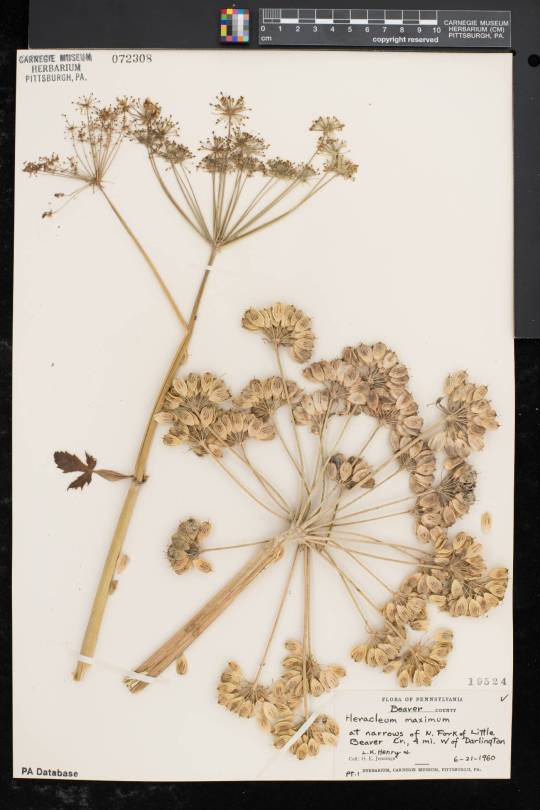
cow parsnip specimen

Specimen records and images for this species in the CM herbarium are now publicly available online.

Check back for more! Botanists at the Carnegie Museum of Natural History share digital specimens from the herbarium on dates they were collected. They have embarked on a three-year project to digitize nearly 190,000 plant specimens collected in the region, making images and other data publicly available online. This effort is part of the Mid-Atlantic Megalopolis Project (mamdigitization.org), a network of thirteen herbaria spanning the densely populated urban corridor from Washington, D.C. to New York City to achieve a greater understanding of our urban areas, including the unique industrial and environmental history of the greater Pittsburgh region. This project is made possible by the National Science Foundation under grant no. 1801022.

Mason Heberling is Assistant Curator of Botany at the Carnegie Museum of Natural History. Museum employees are encouraged to blog about their unique experiences and knowledge gained from working at the museum.

Related Content

Collected On This Day in 2001: Giant Hogweed

Collected On This Day in 1982: One Specimen Isn’t Always Enough

Pressed Flowers Come Alive by Telling Their Pollination Story

Carnegie Museum of Natural History Blog Citation Information

Blog author: Heberling, Mason
Publication date: June 21, 2019

Share this post!

  • Share on Twitter Share on Twitter
  • Share on Facebook Share on Facebook
  • Share on Pinterest Share on Pinterest
  • Share on LinkedIn Share on LinkedIn
  • Share on Reddit Share on Reddit
  • Share via Email Share via Email

Filed Under: Blog Tagged With: Botany, collected on this day, Mason Heberling, plants

December 20, 2018 by wpengine

Collected on this Day in 1990: Poinsettia

by Mason Heberling
poinsettia specimen

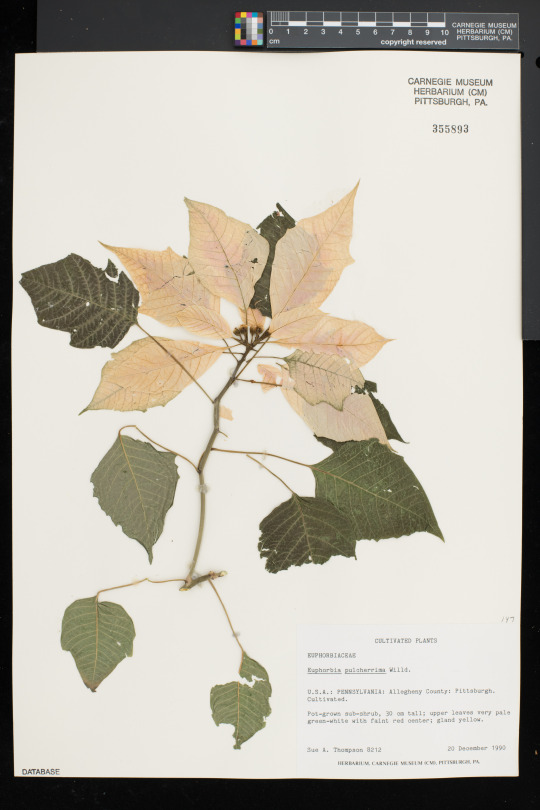
This poinsettia specimen was collected on December 20, 1990 by Sue Thompson from a potted plant in Pittsburgh.  Poinsettia (Euphorbia pulcherrima) are native to Mexico, but now widely cultivated.

Look closely at the colorful “flowers” of poinsettia.  Upon close inspection, you’ll notice that those bright red or white (or otherwise colorful) structures are not flower petals, but specialized leaves called “bracts.”  The actual flowers are yellow and quite tiny.  The brightly colored bracts function to attract pollinators to the flowers.

Poinsettias are an excellent example of a “short-day” plant. (Or, more accurately, a “long-night” plant.)  That means that as the length of darkness at night increases, a complex process begins that signals flowering and the production of pigments in the bracts.

Poinsettias are woody perennials –  meaning you don’t need to throw them away after the holidays!  However, to flower again for next season, it takes some effort. They must experience days with less than 12 hours of daylight for 8-10 weeks straight.  That means you must provide the plant with 13-16 hours of complete darkness (uninterrupted!) in order for it to flower for December.  This may take some commitment to remember to put it in a dark closet each day, but well worth the effort.  Or just enjoy the green foliage year after year as it grows larger.

Check back for more! Botanists at the Carnegie Museum of Natural History share digital specimens from the herbarium on dates they were collected. They have embarked on a three-year project to digitize nearly 190,000 plant specimens collected in the region, making images and other data publicly available online. This effort is part of the Mid-Atlantic Megalopolis Project (mamdigitization.org), a network of thirteen herbaria spanning the densely populated urban corridor from Washington, D.C. to New York City to achieve a greater understanding of our urban areas, including the unique industrial and environmental history of the greater Pittsburgh region. This project is made possible by the National Science Foundation under grant no. 1801022.  

This specimen image is now publicly available online.

Mason Heberling is Assistant Curator of Botany at Carnegie Museum of Natural History. Museum employees are encouraged to blog about their unique experiences and knowledge gained from working at the museum.

Related Content

Collected on This Day in 1934: European larch

Indiana, Pennsylvania: Christmas Tree Capital of the World

Collected on Christmas Eve 1883: Mistletoe

Carnegie Museum of Natural History Blog Citation Information

Blog author: Heberling, Mason
Publication date: December 20, 2018

Share this post!

  • Share on Twitter Share on Twitter
  • Share on Facebook Share on Facebook
  • Share on Pinterest Share on Pinterest
  • Share on LinkedIn Share on LinkedIn
  • Share on Reddit Share on Reddit
  • Share via Email Share via Email

Filed Under: Blog Tagged With: Botany, botany hall, collected on this day, Mason Heberling, plants

December 12, 2018 by wpengine

Fraser Fir

by Mason Heberling
Frasier fir specimen

Collected on some day, probably between 101-122 years ago.

Around 25-30 million cut trees are sold each year in the United States for the holidays. The popularity of certain species for this use has changed through time.  Many different evergreen conifer species are cultivated in the US for decorative use during the holidays.  Needle length, softness, retention, color, and even scent vary by species or variety. Similarly, branching characteristics and branch strength differs by species. Plus, some species grow faster and easier than others, which means some species are cheaper.

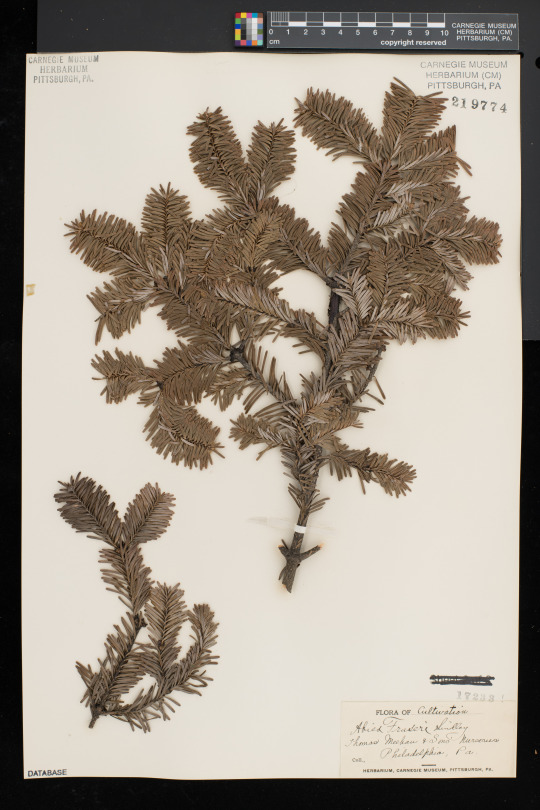
This specimen of Fraser fir (Abies fraseri) was collected in Philadelphia at the Thomas Meehan & Sons Nursery.  The person who collected this specimen and the date of collection are unknown.  Thomas Meehan immigrated to the United States from England in 1848 and started a landscaping business.  With his three sons, he started the Thomas Meehan & Sons Nursuries in 1896.  The nursery was unique in that it specialized in native trees and shrubs, unlike most nurseries that focused on European and Asian varieties (still very common today).  The nursery closed in 1916.

Fraser fir is currently one of the most popular Christmas trees.  It is known for its dark green color, soft needles, stiff branches (great for hanging heavy ornaments), and has good needle retention.  Unfortunately, native to the Southern Appalachians, Fraser fir isn’t the easiest to grow in Pennsylvania.

Before farms began cultivating trees for that purpose in the early 20th century, people just went to the woods to cut down their tree for the holidays.   Some of the earliest Christmas tree farms in the US started in Indiana County, PA as early as 1918.  Many farms in the region turned their fields into Christmas tree farms as it became profitable. By 1960, more than 1 million trees were harvested per year in Indiana County alone.  The harvest in Pennsylvania has declined for several reasons, including increased popularity of artificial trees and consumer interest in Frasier fir trees (grows slower in PA than farms in North Carolina).  However, Pennsylvania is still among the top five states in terms of both number of working Christmas tree farms and trees harvested. According to the National Christmas Tree Association, 31,577 acres in Pennsylvania are used as Christmas tree plantations. Many of the Christmas tree lots in southwestern PA get their trees from farms in Indiana county.

Check back for more! Botanists at the Carnegie Museum of Natural History share digital specimens from the herbarium on dates they were collected. They have embarked on a three-year project to digitize nearly 190,000 plant specimens collected in the region, making images and other data publicly available online. This effort is part of the Mid-Atlantic Megalopolis Project (mamdigitization.org), a network of thirteen herbaria spanning the densely populated urban corridor from Washington, D.C. to New York City to achieve a greater understanding of our urban areas, including the unique industrial and environmental history of the greater Pittsburgh region. This project is made possible by the National Science Foundation under grant no. 1801022.  

This specimen image is now online and publicly available here.

Mason Heberling is Assistant Curator of Botany at Carnegie Museum of Natural History. Museum employees are encouraged to blog about their unique experiences and knowledge gained from working at the museum.

Related Content

A Perfect Mineral for the Christmas Season

Ask a Scientist: What makes poinsettias so special?

Collected on Christmas Eve 1883: Mistletoe

Carnegie Museum of Natural History Blog Citation Information

Blog author: Heberling, Mason
Publication date: December 12, 2018

Share this post!

  • Share on Twitter Share on Twitter
  • Share on Facebook Share on Facebook
  • Share on Pinterest Share on Pinterest
  • Share on LinkedIn Share on LinkedIn
  • Share on Reddit Share on Reddit
  • Share via Email Share via Email

Filed Under: Blog Tagged With: Botany, collected on this day, Mason Heberling, plants

December 10, 2018 by wpengine

Peppermint: A Hybrid Herb for the Holidays

by Mason Heberling
gingerbread man cookie and candy canes

When in candy cane form, it is easy to forget where the flavor came from.  Peppermint (Mentha x piperita) is actually a hybrid between two other mint species, water mint (Mentha aquatica) and spearmint (Mentha spicata).  It is commonly grown for food as well as for use as a medicinal herb.  It is also well known to escape garden settings and spread aggressively.  Like other mints, this species is in the plant family Lamiaceae, which includes many strongly scented kitchen herbs.  Members of the mint family are well recognized by their unique flowers and characteristically square stems.

peppermint specimen

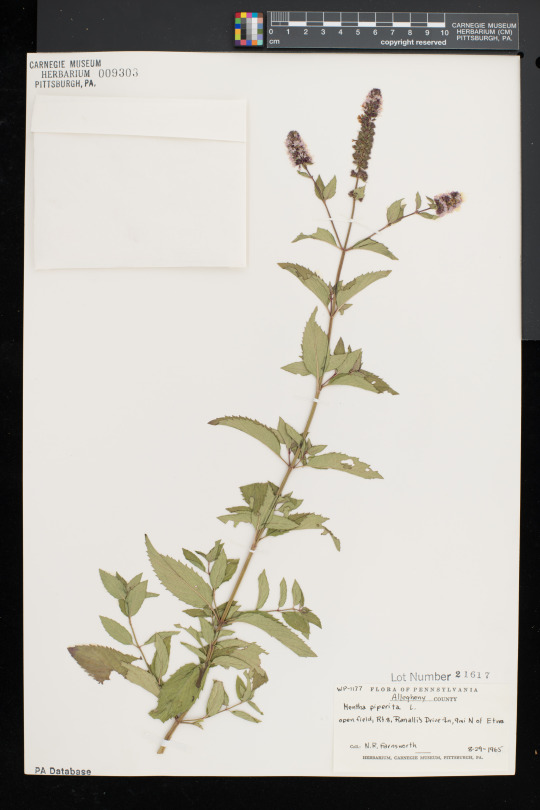
This peppermint specimen was collected on August 29, 1965 by Norman R. Farnsworth in an open field at Ranalli’s Drive-In, eight miles north of Etna off Route 8, outside of Pittsburgh, PA.

Farnsworth (1930-2011) received his PhD from the University of Pittsburgh, where he researched medicinal plants.  He was an influential professor and researcher in the field of pharmacognosy (study of medicinal drugs derived from plants).  He was a founding member of the American Society of Pharmacognosy.

The Carnegie Museum herbarium includes 1,108 specimens collected by Farnsworth.  Each specimen is recognizable, with an envelope attached to each sheet that includes a typed description of the results of chemical screenings he did on the specimen.

Check back for more! Botanists at the Carnegie Museum of Natural History share digital specimens from the herbarium on dates they were collected. They have embarked on a three-year project to digitize nearly 190,000 plant specimens collected in the region, making images and other data publicly available online. This effort is part of the Mid-Atlantic Megalopolis Project (mamdigitization.org), a network of thirteen herbaria spanning the densely populated urban corridor from Washington, D.C. to New York City to achieve a greater understanding of our urban areas, including the unique industrial and environmental history of the greater Pittsburgh region. This project is made possible by the National Science Foundation under grant no. 1801022.  

This specimen image is publicly available.

Mason Heberling is Assistant Curator of Botany at Carnegie Museum of Natural History. Museum employees are encouraged to blog about their unique experiences and knowledge gained from working at the museum.

Related Content

Collected on Christmas Eve 1883: Mistletoe

Indiana, Pennsylvania: Christmas Tree Capital of the World

Collected on This Day in 1934: European larch

Carnegie Museum of Natural History Blog Citation Information

Blog author: Heberling, Mason
Publication date: December 10, 2018

Share this post!

  • Share on Twitter Share on Twitter
  • Share on Facebook Share on Facebook
  • Share on Pinterest Share on Pinterest
  • Share on LinkedIn Share on LinkedIn
  • Share on Reddit Share on Reddit
  • Share via Email Share via Email

Filed Under: Blog Tagged With: Botany, Christmas, collected on this day, Mason Heberling, plants

November 16, 2018 by wpengine

Collected on This Day in 1884: Beech Drops

by Mason Heberling

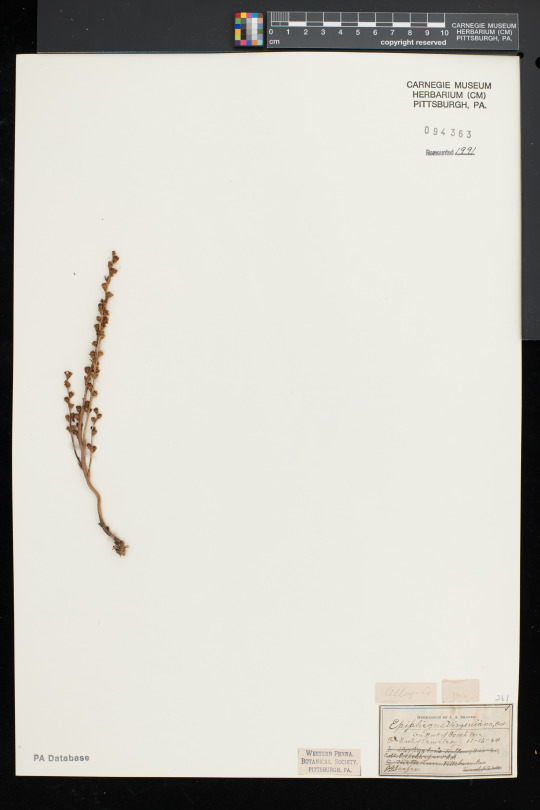
beech drops specimen

Not all plants have leaves.  Beech drops (Epifagus virginiana) is one such example.

This specimen was collected on November 16, 1884 growing on the root of a beech tree (Fagus grandifolia) at the back of a cemetery in Allegheny county. The specimen was collected by John Shafer, who a decade later became the first curator of botany at the Carnegie Museum of Natural History.

Beech drops is a parasitic plant – rather than having leaves to photosynthesize, the species produces root-like structures (called haustorium) that parasitizes roots of beech trees.

The genus “Epifagus” refers to this parasitism on beech (“epi”= upon; “fagus” = beech).

Beech drops are in the  broomrape family (Orobanchaceae), which is comprised mostly of parisitic plants.

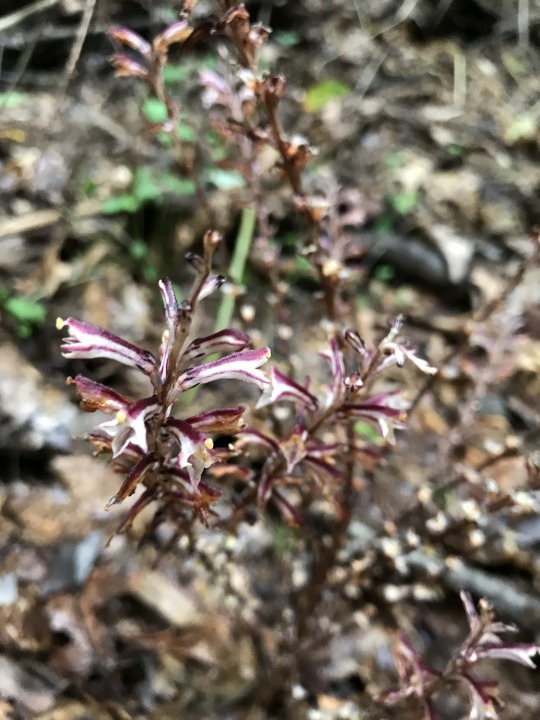
Check out the beautiful, distinctive purple and white flowers in late summer to autumn.

beech drop flowers
Beech drop flowers.  Photo taken on September 12, 2018 at Riddle Run, Springdale, Pennsylvania.

Mason Heberling is Associate Curator of Botany at Carnegie Museum of Natural History.

Botanists at the Carnegie Museum of Natural History share digital specimens from the herbarium on dates they were collected. They have embarked on a three-year project to digitize nearly 190,000 plant specimens collected in the region, making images and other data publicly available online. This effort is part of the Mid-Atlantic Megalopolis Project (mamdigitization.org), a network of thirteen herbaria spanning the densely populated urban corridor from Washington, D.C. to New York City to achieve a greater understanding of our urban areas, including the unique industrial and environmental history of the greater Pittsburgh region. This project is made possible by the National Science Foundation under grant no. 1801022.  

Filed Under: Blog Tagged With: Botany, collected on this day, flowers, Mason Heberling, plants

October 8, 2018 by wpengine

Collected on This Day in 1995

by Mason Heberling

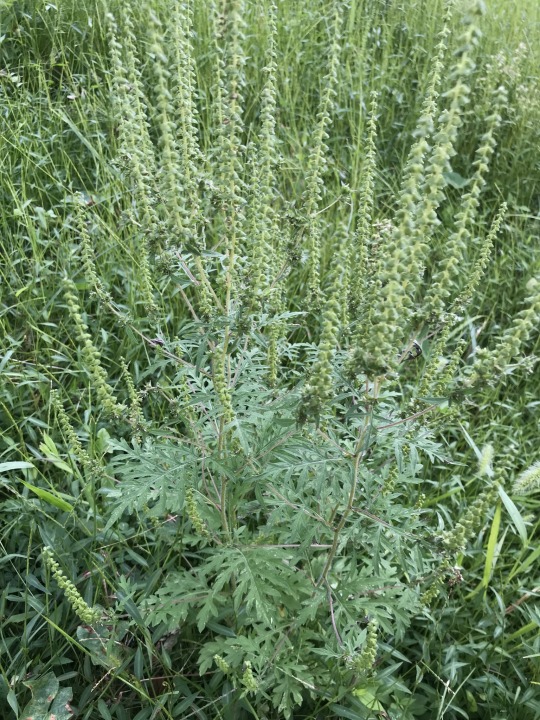
common ragweed

Fall allergies causing you grief?

Ragweed is a plant many people are (all too) familiar with.  Or at least their bodies are.  Common ragweed (Ambrosia artemisiifolia) is actually native to North America, but has been introduced across the world.  In many cases, this plant (or other ragweed species) are to blame for seasonal pollen allergies known as “hay fever.”  In summer and early fall, ragweed plants produce copious numbers of pollen grains, which are dispersed in the wind.  Don’t blame those insect-pollinated plants with showy flowers for your allergy troubles.  Wind pollinated plants like ragweed are your culprit.

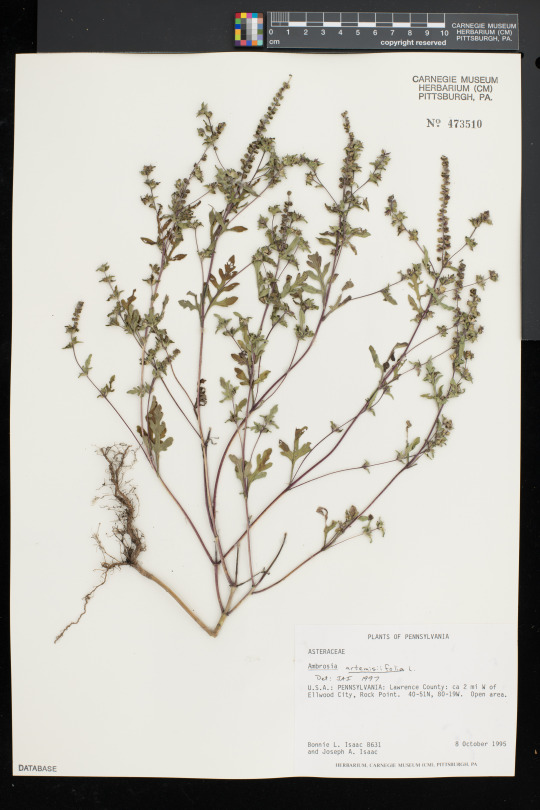
ragweed specimen

This ragweed specimen was collected by Bonnie and Joe Isaac in Lawrence county, Pennsylvania on October 8, 1995.  Bonnie is the collection manager in the Section of Botany at the Carnegie Museum of Natural History, an active plant collector and field botanist, and an expert on the plants of Pennsylvania.

Although ragweed is native to the US, historical records (pollen deposited in sediment cores) suggest that this species was far less common in North America before European colonization.  This is perhaps not too surprising considering the species thrives in disturbed habitats that came with European colonization and urbanization.  A study published in 2014 by Martin and colleagues in the journal Molecular Ecology extracted DNA from nearly 500 historic herbarium specimens dating back to the 1800s to measure the genetic makeup prior to widespread changes to the landscape in the late 19th century. Combined with data from recent collections, they found shifts in the genetic makeup of ragweed populations as the species was expanding in the United States.

Botanists at the Carnegie Museum of Natural History share digital specimens from the herbarium on dates they were collected. They have embarked on a three-year project to digitize nearly 190,000 plant specimens collected in the region, making images and other data publicly available online. This effort is part of the Mid-Atlantic Megalopolis Project (mamdigitization.org), a network of thirteen herbaria spanning the densely populated urban corridor from Washington, D.C. to New York City to achieve a greater understanding of our urban areas, including the unique industrial and environmental history of the greater Pittsburgh region. This project is made possible by the National Science Foundation under grant no. 1801022.  

This specimen is now online: Ambrosia artemisiifolia.

Filed Under: Blog Tagged With: Botany, collected on this day, Mason Heberling, plants

  • « Go to Previous Page
  • Page 1
  • Interim pages omitted …
  • Page 4
  • Page 5
  • Page 6
  • Page 7
  • Page 8
  • Go to Next Page »

sidebar

About

  • Mission & Commitments
  • Directors Team
  • Museum History

Get Involved

  • Volunteer
  • Membership
  • Carnegie Discoverers
  • Donate
  • Employment
  • Events

Bring a Group

  • Groups of 10 or More
  • Birthday Parties at the Museum
  • Field Trips

Powdermill

  • Powdermill Nature Reserve
  • Powdermill Field Trips
  • Powdermill Staff
  • Research at Powdermill

More Information

  • Image Permission Requests
  • Science Stories
  • Accessibility
  • Shopping Cart
  • Contact
  • Visitor Policies
Stay in the loop! Sign up for our newsletter(s).
One of the Four Carnegie Museums | © Carnegie Institute | Privacy Policy | Terms of Use | Accessibility
Rad works here logo