• Skip to primary navigation
  • Skip to main content
  • Skip to primary sidebar

Carnegie Museum of Natural History

One of the Four Carnegie Museums of Pittsburgh

  • Visit
    • Buy Tickets
    • Visitor Information
    • Exhibitions
    • Events
    • Dining at the Museum
    • Celebrate at the Museum
    • Powdermill Nature Reserve
    • Event Venue Rental
  • Learn
    • Field Trips
    • Educator Information
    • Programs at the Museum
    • Bring the Museum to You
    • Guided Programs FAQ
    • Programs Online
    • Climate and Rural Systems Partnership
  • Research
    • Scientific Sections
    • Science Stories
    • Science Videos
    • Senior Science & Research Staff
    • Museum Library
    • Science Seminars
    • Scientific Publications
    • Specimen and Artifact Identification
  • About
    • Mission & Commitments
    • Directors Team
    • Museum History
  • Tickets
  • Give
  • Shop

dinosaurs

July 29, 2021 by wpengine

Real Dinosaurs Versus Reel Dinosaurs: Film’s Fictionalization of the Prehistoric World

by Shelby Wyzykowski

What better way can you spend a quiet evening at home than by having a good old-fashioned movie night? You dim the lights, cozily snuggle up on your sofa with a bowl of hot, buttery popcorn, and pick out a movie that you’ve always wanted to see: the 1948 classic Unknown Island. Mindlessly munching away on your snacks, your eyes are glued to the screen as the story unfolds. You reach a key scene in the movie: a towering, T. rex-sized Ceratosaurus and an equally enormous Megatherium ground sloth are locked in mortal combat. And you think to yourself, “I’m pretty sure something like this never actually happened.” And you know what? Your prehistorically inclined instincts are correct.

From the time that the first dinosaur fossils were identified in the early 1800s, society has been fascinated by these “terrible lizards.” When, where, and how did they live? And why did they (except for their modern descendants, birds) die out so suddenly? We’ve always been hungry to find out more about the mysteries behind the dinosaurs’ existence. The public’s hunger for answers was first satisfied by newspapers, books, and scientific journals. But then a whole new, sensational medium was invented: motion pictures. And with its creation came a new, exciting way to explore the primeval world of these ancient creatures. But cinema is art, not science. And from the very beginning, scientific inaccuracies abounded. You might be surprised to learn that these filmic faux pas not only exist in movies from the early days of cinema. They pervade essentially every dinosaur movie that has ever been made.

One Million Years B.C.

Another film that can easily be identified as more fiction than fact is 1966’s One Million Years B.C. It tells the story of conflicts between members of two tribes of cave people as well as their dangerous dealings with a host of hostile dinosaurs (such as Allosaurus, Triceratops, and Ceratosaurus). However, neither modern-looking humans nor dinosaurs (again, except birds) existed one million years ago. In the case of dinosaurs, the movie was about 65 million years too late. Non-avian dinosaurs disappeared 66 million years ago during a mass extinction known as the K/Pg (which stands for “Cretaceous/Paleogene”) event. An asteroid measuring around six miles in diameter and traveling at an estimated speed of ten miles per second slammed into the Earth at what is now the Yucatán Peninsula in Mexico. The effects of this giant impact were so devastating that over 75% of the world’s species became extinct. But the dinosaurs’ misfortunes were a lucky break for Cretaceous Period mammals. They were able to gain a stronger foothold and flourish in the challenging and inhospitable post-impact environment.

Cut to approximately 65 million, 700 thousand years later, when modern-looking humans finally arrived on the chronological scene. Until recently, the oldest known fossils of our species, Homo sapiens, dated back to just 195,000 years ago (which is, in geological terms, akin to the blink of an eye). And for many years, these fossils have been widely accepted to be the oldest members of our species. But this theory was challenged in June of 2017 when paleoanthropologists from the Max Planck Institute for Evolutionary Anthropology reported that they had discovered what they thought may be the oldest known remains of Homo sapiens on a desert hillside at Jebel Irhoud in Morocco. The 315,000-year-old fossils included skull bones that, when pieced together, indicated that these humans had faces that looked very much like ours, but their brains did differ. Being long and low, their brains did not have the distinctively round shape of those of present-day humans. This noticeable difference in brain shape has led some scientists to wonder: perhaps these people were just close relatives of Homo sapiens. On the other hand, maybe they could be near the root of the Homo sapien lineage, a sort of protomodern Homo sapien as opposed to the modern Homo sapien. One thing is for certain, the discovery at Jebel Irhoud reminds us that the story of human evolution is long and complex with many questions that are yet to be answered.

The Land Before Time

Another movie that misplaces its characters in the prehistoric timeline is 1988’s The Land Before Time. The stars of this animated motion picture are Littlefoot the Apatosaurus, Cera the Triceratops, Ducky the Saurolophus, Petrie the Pteranodon, and Spike the Stegosaurus. As their world is ravaged by constant earthquakes and volcanic eruptions, the hungry and scared young dinosaurs make a perilous journey to the lush and green Great Valley where they’ll reunite with their families and never want for food again. In their on-screen imagined story, these five make a great team. But, assuming that the movie is set at the very end of the Cretaceous (intense volcanic activity was a characteristic of this time), the quintet’s trip would have actually been just a solo trek. Ducky and Petrie’s species had become extinct several million years earlier, and Littlefoot and Spike would have lived way back in the Jurassic Period (201– 145 million years ago). Cera alone would have had to experience several harrowing encounters with the movie’s other latest Cretaceous creature, the ferocious and relentless Sharptooth, a Tyrannosaurus rex.

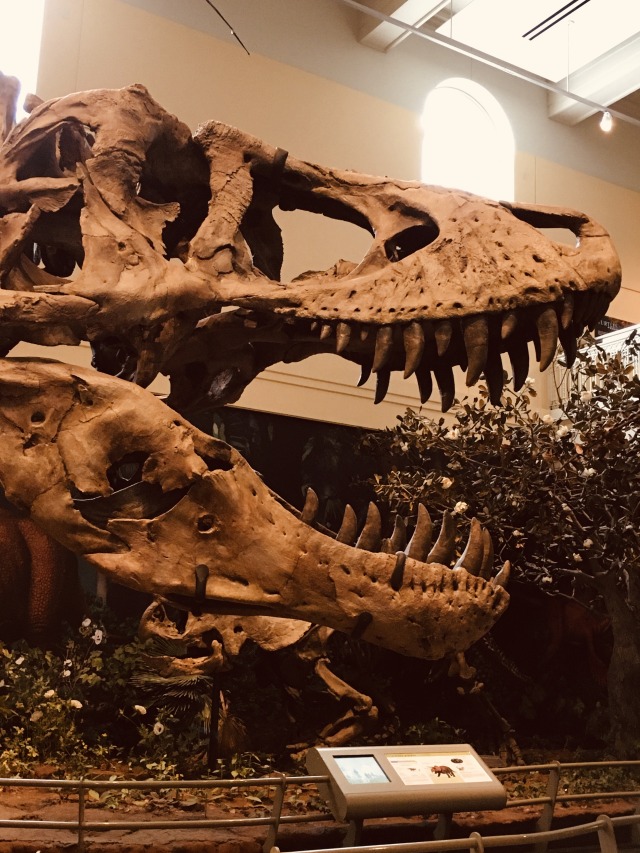
Speaking of Sharptooth, The Land Before Time’s animators made a scientifically accurate choice when they decided to draw him with a two-fingered hand, as opposed to the three fingers traditionally embraced by other movie makers. For 1933’s King Kong, the creators mistakenly modeled their T. rex after a scientifically outdated 1906 museum painting. Many other directors knowingly dismissed the science-backed evidence and used three digits because they thought this type of hand was more aesthetically pleasing. By the 1920s, paleontologists had already hypothesized that these predators were two-fingered because an earlier relative of Tyrannosaurus, Gorgosaurus, was known to have had only two functional digits. Scientists had to make an educated guess because the first T. rex (and many subsequent specimens) to be found had no hands preserved. It wasn’t until 1988 that it was officially confirmed that T. rex was two-fingered when the first specimen with an intact hand was discovered. Then, in 1997, Peck’s Rex, the first T. rex specimen with hands preserving a third metacarpal (hand bone), was unearthed. Paleontologists agree that, in life, the third metacarpal of Peck’s Rex would not have been part of a distinct, externally visible third finger, but instead would have been embedded in the flesh of the rest of the hand. But still, was this third hand segment vestigial, no longer serving any apparent purpose? Or could it have possibly been used as a buttressing structure, helping the two fully formed fingers to withstand forces and stresses on the hand? Peck’s Rex’s bones do display evidence that strongly supports arm use. You can ponder this paleo-puzzle yourself when you visit Carnegie Museum of Natural History’s Dinosaurs in Their Time exhibition, where you can see a life-sized cast of Peck’s Rex facing off with the holotype (= name-bearing) T. rex, which was the first specimen of the species to be recognized (by definition, the world’s first fossil of the world’s most famous dinosaur!).
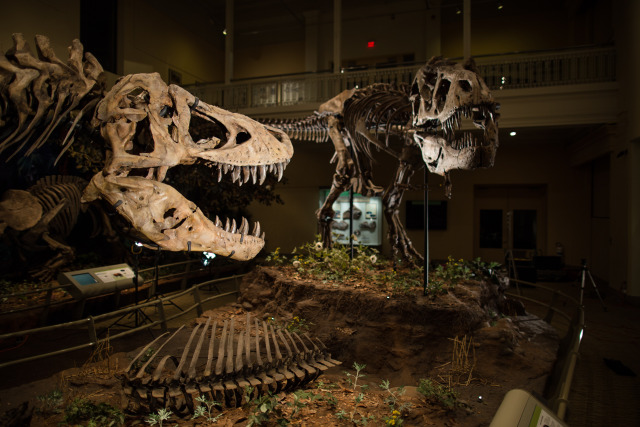
Two T. rex skeletons displayed in a museum exhibit.
T. rex in Dinosaurs in Their Time. Image credit: Joshua Franzos, Treehouse Media

Jurassic Park

One motion picture that did take artistic liberties with T. rex for the sake of suspense was 1993’s Jurassic Park. In one memorable, hair-raising scene, several of the movie’s stars are saved from becoming this dinosaur’s savory snack by standing completely still. According to the film’s paleontological protagonist, Dr. Alan Grant, the theropod can’t see humans if they don’t move. Does this theory have any credence, or was it just a clever plot device that made for a great movie moment? In 2006, the results of ongoing research at the University of Oregon were published in the Journal of Vertebrate Paleontology, providing a surprising answer. The study involved using perimetry (an ophthalmic technique used for measuring and assessing visual fields) and a scale model T. rex head to determine the creature’s binocular range (the area that could be viewed at the same time by both eyes). Generally speaking, the wider an animal’s binocular range, the better its depth perception and overall vision. It was determined that the binocular range of T. rex was 55 degrees, which is greater than that of a modern-day hawk! This theropod may have even had visual clarity up to 13 times greater than a person. That’s extremely impressive, considering an eagle only has up to 3.6 times the clarity of a human! Another study that examined the senses of T. rex determined that the dinosaur had unusually large olfactory bulbs (the areas of the brain dedicated to scent) that would have given it the ability to smell as well as a present-day vulture! So, in Jurassic Park, even if the eyes of T. rex had been blurred by the raindrops in this dark and stormy scene, its nose would have still homed-in on Dr. Grant and the others, providing the predator with some tasty midnight treats.

Now, it may seem that this blog post might be a bit critical of dinosaur movies. But, truly, I appreciate them just as much as the next filmophile. They do a magnificent job of providing all of us with some pretty thrilling, edge-of-your-seat entertainment. But, somewhere along the way, their purpose has serendipitously become twofold. They have also inspired some of us to pursue paleontology as a lifelong career. So, in a way, dinosaur movies have been of immense benefit to both the cinematic and scientific worlds. And for that great service, they all deserve a huge round of applause.

Shelby Wyzykowski is a Gallery Experience Presenter in CMNH’s Life Long Learning Department. Museum staff, volunteers, and interns are encouraged to blog about their unique experiences and knowledge gained from working at the museum.

Related Content

Super Science Saturday: Jurassic Day (July 31, 2021)

What Did Dinosaurs Sound Like?

Diplodocus carnegii (Dippy) – Dinosaur Spotlight (Video)

Carnegie Museum of Natural History Blog Citation Information

Blog author: Wyzykowski, Shelby
Publication date: July 29, 2021

Share this post!

  • Share on Twitter Share on Twitter
  • Share on Facebook Share on Facebook
  • Share on Pinterest Share on Pinterest
  • Share on LinkedIn Share on LinkedIn
  • Share on Reddit Share on Reddit
  • Share via Email Share via Email

Share this post!

  • Share on Twitter Share on Twitter
  • Share on Facebook Share on Facebook
  • Share on Pinterest Share on Pinterest
  • Share on LinkedIn Share on LinkedIn
  • Share on Reddit Share on Reddit
  • Share via Email Share via Email

Filed Under: Blog Tagged With: dinosaurs, sssjurassic, Super Science

June 24, 2021 by wpengine

What Did Dinosaurs Sound Like?

A Brief Foray into Paleoacoustics in Science and Film

by Niko Borish and Caroline Lee

What sound did t. rex make?

Did Dinosaurs Roar?

When you think about dinosaurs as living animals, what do you think of? Many people imagine them as they are depicted in the Jurassic Park films – giant reptiles, clad in scales, generating reverberating roars that shake the screen. Although this image is certainly entertaining, research in recent years points to unexpected findings that are no less interesting. Evidence suggests that dinosaur vocalizations were not likely to have sounded like roars at all! We’ll explore what’s known about the real voices of dinosaurs with a paleontological source and an interview with an expert who has made relevant discoveries. We’ll also discuss how the sounds you hear in the Jurassic Park films were created!

Paleoacoustics and Dinosaur Vocalizations

We had a chance to interview Dr. Julia Clarke, a paleontologist at the University of Texas, to learn more about paleoacoustics (the study of sound associated with fossils) in non-avian dinosaurs and their evolutionary descendants, birds. In Antarctica in the mid-1990s, Vegavis iaai, an ancient bird dating to around 66 to 68 million years ago, was excavated. Dr. Clarke analyzed the fossil, and in 2013 found evidence that Vegavis had a vocal organ specific to birds, known as a syrinx. In extant (meaning alive today) bird species, the syrinx is responsible for all the vocalizations we identify as bird songs or calls. This means that Vegavis most likely honked (not unlike a goose), owing to an asymmetrical third segment in the syrinx. When we asked why it took about two decades to find the syrinx after the fossil’s original discovery, Dr. Clarke answered that “discovery is not just one moment.” She received the fossil for study in 2008. When she was about to return it in 2012, she went over its computed tomographic (CT) scan images again and noticed something new – a tiny structure that looked like a simple bone fragment or toe bone on the surface of the rock. It turned out to be the syrinx! Clarke and her coauthors noted that we still don’t know when the syrinx evolved because non-avian dinosaur fossils lack this structure. Vegavis is related to extant bird species, and despite searching, no earlier dinosaur syrinxes have so far been found.

Carnivorous dinosaurs are often pictured as chasing prey while letting out intimidating roars. Other new discoveries made from studies of extant birds indicate that this image is a misconception. Dr. Clarke explained that instead of open-mouthed roars, scientists theorize that many dinosaurs may have produced closed-mouth vocalizations. Animals produce closed-mouth vocalizations by inflating their esophagus (the tube that connects the throat and stomach) or tracheal pouches (pouches on their windpipe) while keeping their mouth closed, producing something comparable to a low-pitched swooshing, growling, or cooing sound. These closed-mouth vocalizations differ substantially from open-mouth vocalizations like bird calls. Think of closed-mouth vocalizations as being lower and more percussive, as opposed to bird calls, which are more varied in pitch and almost melodic. Modern examples of closed-mouth vocalizations include crocodilian growls and ostrich booms. As a result, scientists reasoned that many dinosaurs did not perform open-mouth vocalizations, but could have generated closed-mouth vocalizations instead. Although birds evolved from theropods (a group of dinosaurs characterized by, among other attributes, hollow bones and a bipedal stance), theropods likely did not have the ability to make complex sounds similar to those of extant songbirds.

Perhaps sadly, the exciting, blood-curdling roars in the Jurassic Park franchise are not scientifically accurate. Current evidence supports that Tyrannosaurus rex made closed-mouth vocalizations, but in the films, the Tyrannosaurus opens its mouth every time it roars. That begs the question: who or what voiced the Tyrannosaurus and other Jurassic Park dinosaurs? The majority of the sounds used to create the Tyrannosaurus sonic palette came from recordings of elephant bellows. Also used were crocodilian growls, roars from lions and tigers (but not bears), the sound of water coming up from a whale’s blowhole, and even growls from the sound producer’s dog. Some other animals’ sounds that were used to make different dinosaurs’ vocalizations include: hawing donkeys, neighing horses, growling tortoises, whistling dolphins, howling howler monkeys, oinking pigs, barking fennec foxes, and chirping birds! Most of these sounds were edited and pitched up or down to fit their roles.

Another popular misconception initiated by the Jurassic Park franchise was the concept of the “Velociraptor resonating chamber.” In Jurassic Park III, the protagonists search for a “Velociraptor resonating chamber” that allows them to communicate with the Velociraptor pack. However, the possibility of this structure was debunked by Dr. Clarke and Dr. Matt Lamanna, a paleontologist at Carnegie Museum of Natural History. The resonating chamber does not actually exist. If such a chamber existed, it would only amplify the sound (auditory vibrations that travel through the air) made by dinosaurs, not modify its timbre (the tone quality of a sound) or pitch (a measure of how high or low a sound is), which would not allow humans to imitate Velociraptor sounds as shown in the movie. In other words, it would not work like a giant duck call. Additionally, the way that scientists perceive closed-mouth vocalizations to function disproves the whole idea of a resonating chamber to begin with. This is because the organs involved in vocalization include either esophageal or tracheal pouches but no dedicated “resonating chamber.”

What non-avian dinosaurs really sounded like is an enigma currently being uncovered by teams of researchers like that led by Dr. Clarke. All in all, while the movies are certainly helpful for getting people interested in dinosaurs and paleontology, a logical next step is to schedule a visit to Carnegie Museum of Natural History to get the real facts!

We would like to extend a gargantuan thank-you to Dr. Julia Clarke and Dr. Matt Lamanna for generously offering expertise for our blog! Their help evolved our blog to the next level, and for that we are extremely grateful.

Niko Borish and Caroline Lee are Teen Volunteers in the Education Department. Museum employees, volunteers, and interns are encouraged to blog about their unique experiences and knowledge gained from working at the museum.

References

Analysis of fossilized Antarctic bird’s ‘voice box’ suggests dinosaurs couldn’t sing. (2016, October 12). National Science Foundation. Retrieved March 7, 2021, from https://www.nsf.gov/news/news_summ.jsp?cntn_id=189996

Clarke, J. (2016, July 16). New Research Debunks The Dinosaur’s Roar (Interview by L. Wertheimer) [Radio broadcast]. In Weekend Edition Saturday. National Public Radio. https://www.npr.org/2016/07/16/486279631/new-research-debunks-the-dinosaurs-roar

Riede, T., Eliason, C. M., Miller, E. H., Goller, F., & Clarke, J. A. (2016). Coos, booms, and hoots: The evolution of closed-mouth vocal behavior in birds. Evolution, 1734-1746. https://doi.org/10.1111/evo.12988

Taylor, D. (Host), & Nelson, A., & Clarke, J. (n.d.). Tyrannosaurus FX (No. 105) [Audio podcast episode]. In L. Battison (Producer), Twenty Thousand Hertz. Twenty Thousand Hertz. https://www.20k.org/episodes/tyrannosaurusfx

Related Content

Diplodocus carnegii (Dippy) – Dinosaur Spotlight

Mesozoic Monthly: Volaticotherium

Fancy Feathers: An Unexplained Complexity in Evolutionary History

Carnegie Museum of Natural History Blog Citation Information

Blog author: Borish, Niko; Lee, Caroline
Publication date: June 24, 2021

Share this post!

  • Share on Twitter Share on Twitter
  • Share on Facebook Share on Facebook
  • Share on Pinterest Share on Pinterest
  • Share on LinkedIn Share on LinkedIn
  • Share on Reddit Share on Reddit
  • Share via Email Share via Email

Filed Under: Blog Tagged With: Caroline Lee, dinosaurs, dinosaurs in their time, Niko Borish, Vertebrate Paleontology

February 24, 2021 by wpengine

Mesozoic Monthly: Nasutoceratops

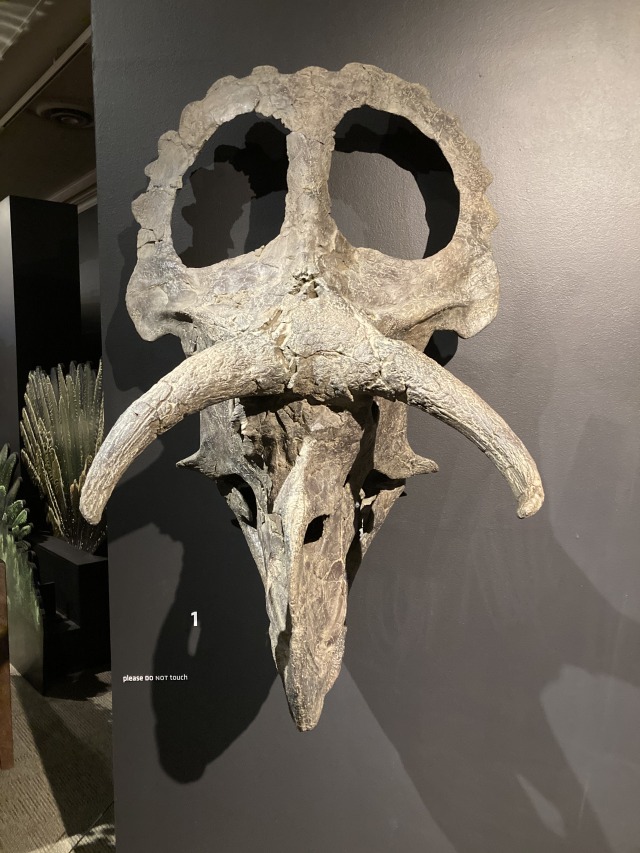
Although much of the Western world recognizes January 1 as the first day of the new year, many other cultures around the globe celebrate Lunar New Year, an alternate calendar system based on the cycles of the moon. Lunar New Year began on February 12 this year, ushering in, according to repeating cycles of the traditional Chinese zodiac, the Year of the Ox. While bovines hadn’t evolved by the Mesozoic Era, there were plenty of dinosaurs that could be compared to an ox. So, in honor of Lunar New Year, this month’s Mesozoic Monthly features Nasutoceratops titusi, a ceratopsian with a rounded nose and curving, bull-like horns!

An anterior (head-on) view of the skull of Nasutoceratops, clearly displaying its most iconic features: the frill and horns. You can view this skull in the temporary exhibition Dinosaur Armor at Carnegie Museum of Natural History until July 5, 2021.

Ceratopsian dinosaurs are famous for their huge, elaborate skulls adorned with ornate frills and large horns. Several different bones make up these unique structures. If you haven’t taken an anatomy class, you may not have realized that your skull is made up of several bones that fuse together as you age (fun fact: baby humans have more bones than adults, and this is why!). The horns above a ceratopsian’s eye arise from the postorbitals, bones that sit right behind the eye hole in the skull. The frill is made of two types of bones: the parietals, which make up the central part of the frill, and the squamosals, which act as the corners. Humans actually have both of these bones: the parietal is the large bone at the crown of your head, and the squamosal is fused into the temporal bones above your ears. The bones that form the nose horn of a ceratopsian are aptly named nasals, and we have them too, supporting the cartilage structure of our noses. Of course, our bones are shaped markedly different from those of Nasutoceratops, but the fact that we (and all other vertebrates, aka animals with backbones) have similar skeletal compositions is a feature we inherited from our most recent common ancestor.

Life restoration of a herd of Nasutoceratops providing a convenient perch for a flock of enantiornithine birds in what’s now southern Utah roughly 75 million years ago. Artwork by Harrison Keller Pyle. You can find more of Keller Pyle’s work on DeviantArt under kepyle2055.

The skulls of ceratopsians are huge: they grow as long as one third of their body length! The skull of Nasutoceratops was almost five feet (1.5 meters) long, and although we don’t have many bones from the rest of its body, paleontologists estimate that the animal was almost 15 feet (4.5 meters) long. But Nasutoceratops wasn’t even the largest ceratopsian! The most famous ceratopsian, Triceratops, has a skull that can reach a whopping 8.2 feet (2.5 meters) long, but even that isn’t the largest. The largest skull of all dinosaurs belongs to Pentaceratops (sometimes called Titanoceratops), a ceratopsian with an absolutely massive 8.7 foot (2.7 meter) skull!

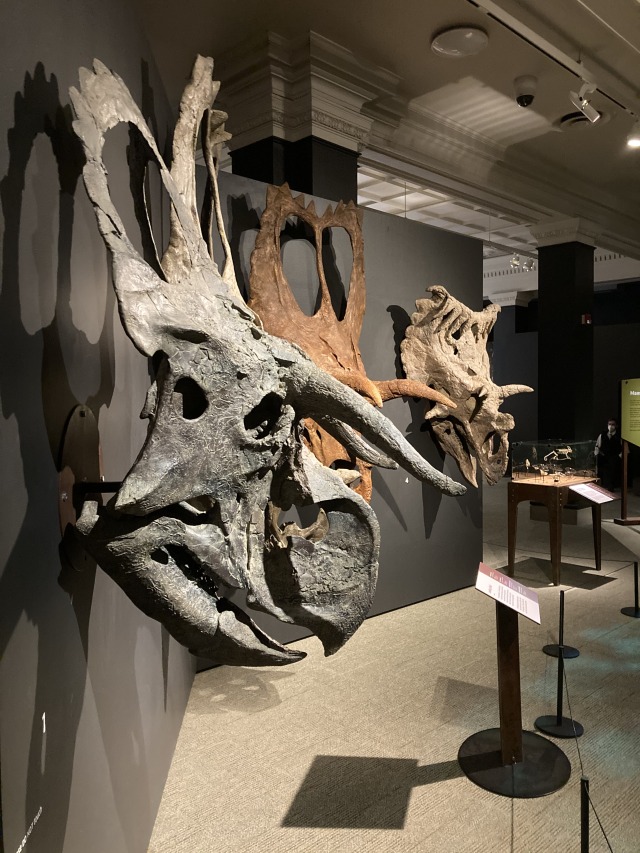
You can view the skull of Nasutoceratops (foreground) alongside those of other ceratopsians (including Utahceratops and Kosmoceratops, mentioned below) in the temporary exhibition Dinosaur Armor at Carnegie Museum of Natural History until July 5, 2021.

Nasutoceratops shared its environment with several other species of ceratopsian, including Kosmoceratops richardsoni and Utahceratops gettyi. Each of these had very different-looking headgear. Nasutoceratops, as previously mentioned, had bull-like horns and a big round nose. Kosmoceratops, in contrast, had weird horns at the top of its frill that curled forward and down, almost like it had bangs, and Utahceratops had short postorbital and nasal horns but a large frill surrounded by spikes. Since all these ceratopsian species lived together, it’s likely that the unique skull ornamentation of different species helped with intra-species recognition (in addition to other functions such as sexual signaling or defense from predators). This meant that each animal could regard shared cranial features as a way to tell who was part of their species. These visual cues might have been especially important for ceratopsians born during the Year of the Ox – according to the Chinese zodiac, “oxen” have poor communication skills, so clear and direct signaling is crucial!

Lindsay Kastroll is a volunteer and paleontology student working in the Section of Vertebrate Paleontology at Carnegie Museum of Natural History. Museum staff, volunteers, and interns are encouraged to blog about their unique experiences and knowledge gained from working at the museum.

Related Content

Ask a Scientist: What kind of dinosaur is a megaraptorid?

Mesozoic Monthly: Dreadnoughtus

A Visit to the Mammoth Site, Hot Springs, SD

Filed Under: Blog Tagged With: dinofest, Dinosaur Armor, dinosaurs, Lindsay Kastroll, Science News, Vertebrate Paleontology

November 30, 2020 by wpengine

Mesozoic Monthly: Scipionyx

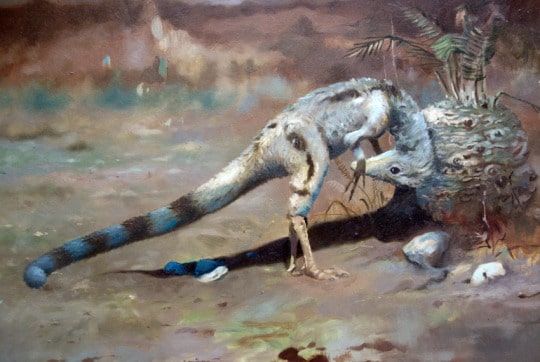
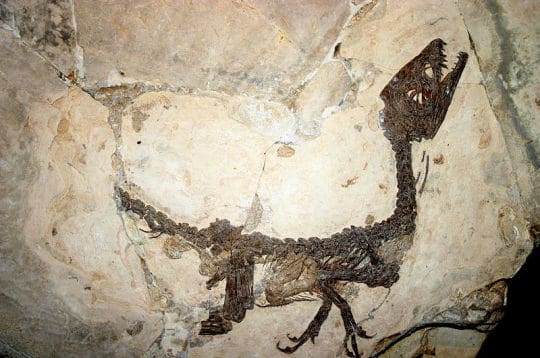
My high school calculus teacher, Mr. Surovchak, once told me about a competition he and his brother had every Thanksgiving. They would weigh themselves before and after dinner to indisputably measure who was able to eat the most. When it comes to dinosaurs, it’s typically much harder to tell what and how much they ate. However, a few fossils give us windows into the guts of dinosaurs – literally! Paleontologists are extremely thankful for spectacular fossils like that of Scipionyx samniticus, a small theropod dinosaur with several internal organs preserved!

Oil painting of Scipionyx samniticus in its Early Cretaceous environment by Emiliano Troco, used with permission. You can find more of their work on their Tumblr and contact them via their WordPress site.

Theropods, like Scipionyx, are dinosaurs that stand on two legs, usually with only three prominent toes on each hind foot. Some of the most famous dinosaurs are theropods, like Tyrannosaurus, Velociraptor, and previous Mesozoic Monthly honoree Citipati (does that make it famous? I like to think so). Most theropods interacted with the world primarily with their heads rather than their hands, hence why several of them look like they have oversized skulls and relatively underdeveloped forelimbs. Many also had hollow bones, and, as we can see in extremely well-preserved fossils, feathers. Is this all starting to sound familiar? That’s because these are also features of birds! If you’ve ever heard someone say that birds are dinosaurs, that’s because modern birds, which are called Aves or Neornithes, are just one evolutionary subset of theropod dinosaurs! Birds have all these features of theropod dinosaurs, plus others like toothless beaks and wings made partly from fused wrist and hand bones. If you are eating turkey for Thanksgiving dinner, remember that you’re eating a dinosaur!

Scipionyx didn’t look much like a turkey, though. It belonged to a group of theropods called compsognathids, which were long-tailed, slender, and relatively small predators. It wasn’t imposing size or an especially fascinating appearance that made Scipionyx special – it was the way the only known specimen was fossilized. It is so well preserved that many of its internal organs are intact in its body cavity! Petrified tissue from the trachea, small intestine, and even rectum can be seen in the fossil, as well as muscle tissue, blood vessels, and traces of other organs. We can tell from the bones and scales in its digestive tract that it ate several meals of lizards and fish before it died. There is such a wealth of biological information preserved in this single specimen, and we can learn even more when we consider its relatives. Although skin didn’t preserve in Scipionyx, at least one fossil of another compsognathid named Sinosauropteryx has such well-preserved skin and filament-like ‘protofeathers’ that we can even see pigments preserved! Based on Sinosauropteryx, we can assume that Scipionyx had some sort of filamentous or fuzzy covering as well, at least over some parts of its body.

The incredible fossil of Scipionyx preserves the dinosaur’s internal organs in 3D! For example, the sinuous shape of the small intestine is visible immediately behind the right elbow. Photo by Giovanni Dall’Orto on Wikimedia Commons. You can read more about this specimen in a paper by Dal Sasso and Maganuco (2011).

The fossil of Scipionyx is very small because the individual in question was just a hatchling when it died. Paleontologists can tell it was a hatchling, and not a small adult animal, because its proportions are similar to those of other juvenile dinosaur fossils and many of its bones had not yet fused together (you can learn more about how bones fuse as organisms get older in the Nemicolopterus edition of Mesozoic Monthly). The baby Scipionyx individual represented by the fossil would have measured around 18 inches (46 cm) long in life, and estimates based on how other compsognathids grew suggest that its species reached about 7 feet (2.1 meters) in length at adulthood. Not much is known about its habitat, but it was likely one of the largest animals around. Scipionyx was found in deposits laid down in a marine environment in what is now Italy. Back in the early part of the Cretaceous Period (the third and final division of the Mesozoic Era, or ‘Age of Dinosaurs’), when Scipionyx was alive, Italy was mostly under a shallow sea dotted with small islands, and the dinosaur would have lived on one of these. Since then, tectonic activity has dramatically changed the region, creating new mountains and lowering sea level to what it is today.

So, this Thanksgiving, if you’re looking for a conversation starter at the dinner table/family video call (or if you urgently need to divert discussion from a more sensitive topic), here’s an idea: ask your dining partners whether they think non-avian theropods like Scipionyx would have tasted more like turkey or chicken! Or, if your loved ones would rather learn than debate, you could perhaps offer to read them any of the 12 Mesozoic Monthly animal spotlights (that’s right, December makes one whole year of Mesozoic Monthly!). I’d certainly feel honored to make an appearance at your Thanksgiving feast.

Lindsay Kastroll is a volunteer and paleontology student working in the Section of Vertebrate Paleontology at Carnegie Museum of Natural History. Museum staff, volunteers, and interns are encouraged to blog about their unique experiences and knowledge gained from working at the museum.

Related Content

Mesozoic Monthly: Champsosaurus

The Two-Headed Dinosaur

Ask a Scientist: What is still unknown about “The Chicken from Hell?”

Filed Under: Blog Tagged With: dinofest, dinosaurs, dinosaurs in their time, Lindsay Kastroll, Mesozoic Monthly, Science News, Vertebrate Paleontology

February 27, 2020 by

Amphibians & Reptiles

  • Second Floor

Check out the reptiles and amphibians of today while looking out over prehistoric reptiles that existed millions of years ago.

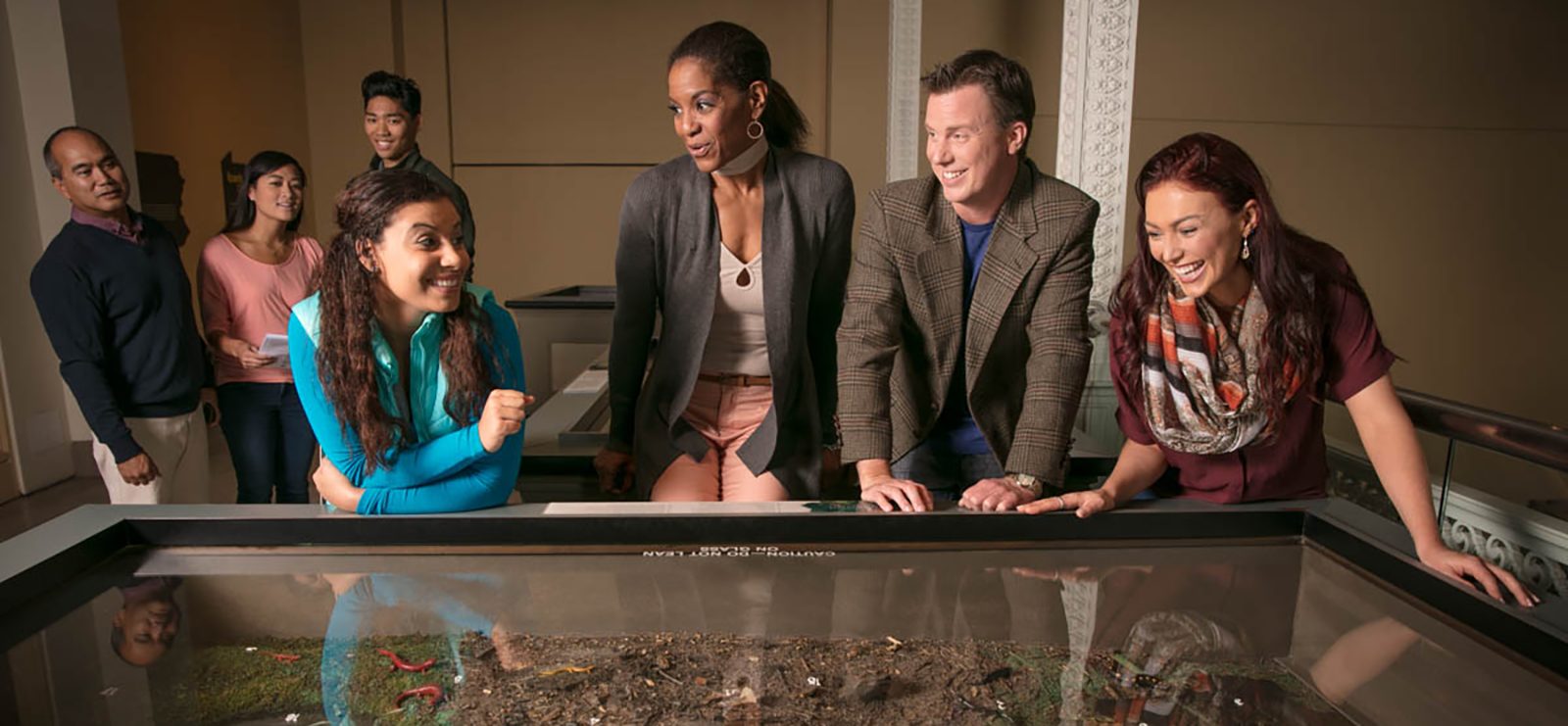
The Daniel G. & Carole L. Kamin T. rex Overlook is home to the museum’s main herpetology displays, which feature toads, frogs, salamanders, snakes, lizards, and turtles of Pennsylvania. Learn about what makes these creatures unique, and enjoy a bird’s-eye view of an exciting scene in Kamin Halal of Dinosaurs, where two T. rexes are frozen in battle while a giant pterosaur flies above.

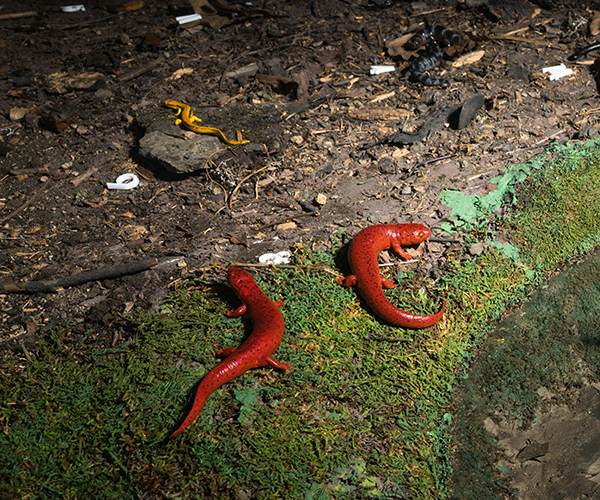
Though Pennsylvania has a temperate climate, it is home to representatives of most reptile and amphibian groups. Four dioramas exhibit examples of animals from our state, including an eastern box turtle, a northern leopard frog, and the venomous copperhead snake.

Red salamanders in a display case

Meet our Herpetologists

Jennifer Sheridan

Jennifer Sheridan, Ph.D.

Assistant Curator of Amphibians and Reptiles

Learn More
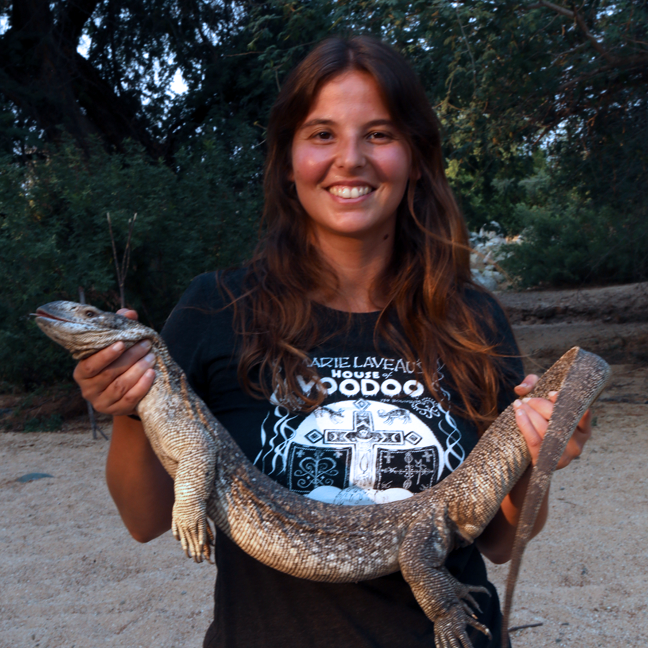
Mariana Marques

Mariana Marques, M.S.

Collection Manager of Amphibians and Reptiles

Learn More

Learn about the Amphibians & Reptiles (Herpetology) Collection at the Museum

The Section of Amphibians and Reptiles maintains a collection of more than 230,000 specimens and ranks at about the ninth largest amphibian and reptile collection in the United States. 

Learn about the Section of Amphibians & Reptiles (Herpetology)

Filed Under: Uncategorized Tagged With: dinos, dinosaurs, dinosaurs in their time

February 27, 2020 by

Cretaceous Seaway

  • First Floor

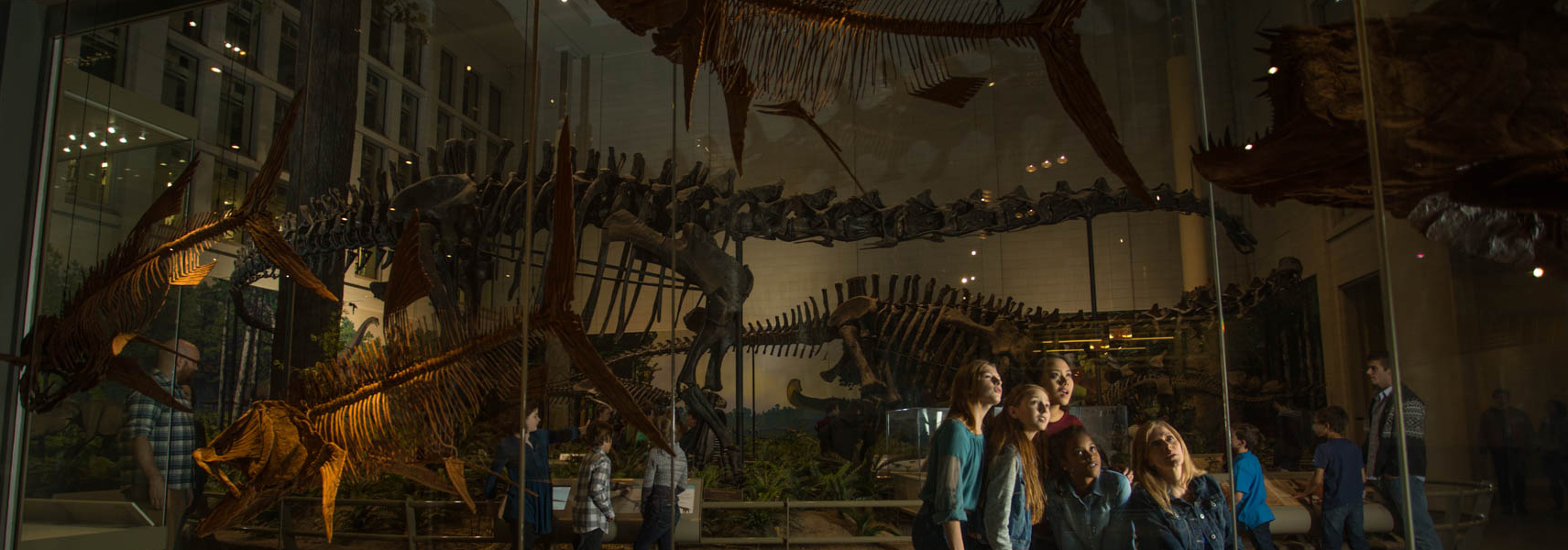
Step into an underwater world in Cretaceous Seaway, a unique exhibition hall that features gentle giants and fierce predators that lived underwater during the Age of Dinosaurs.

The hall brings to life the Western Interior Seaway, a shallow ocean that existed in the Midwestern United States 80 million years ago. Hanging over the entry, a massive Manitoba pliosaur closes in on its potential prey, a juvenile of the plesiosaur Libonectes morgani. The juvenile plesiosaur Libonectes is the only one of its kind, replica or otherwise, on display anywhere in the world.

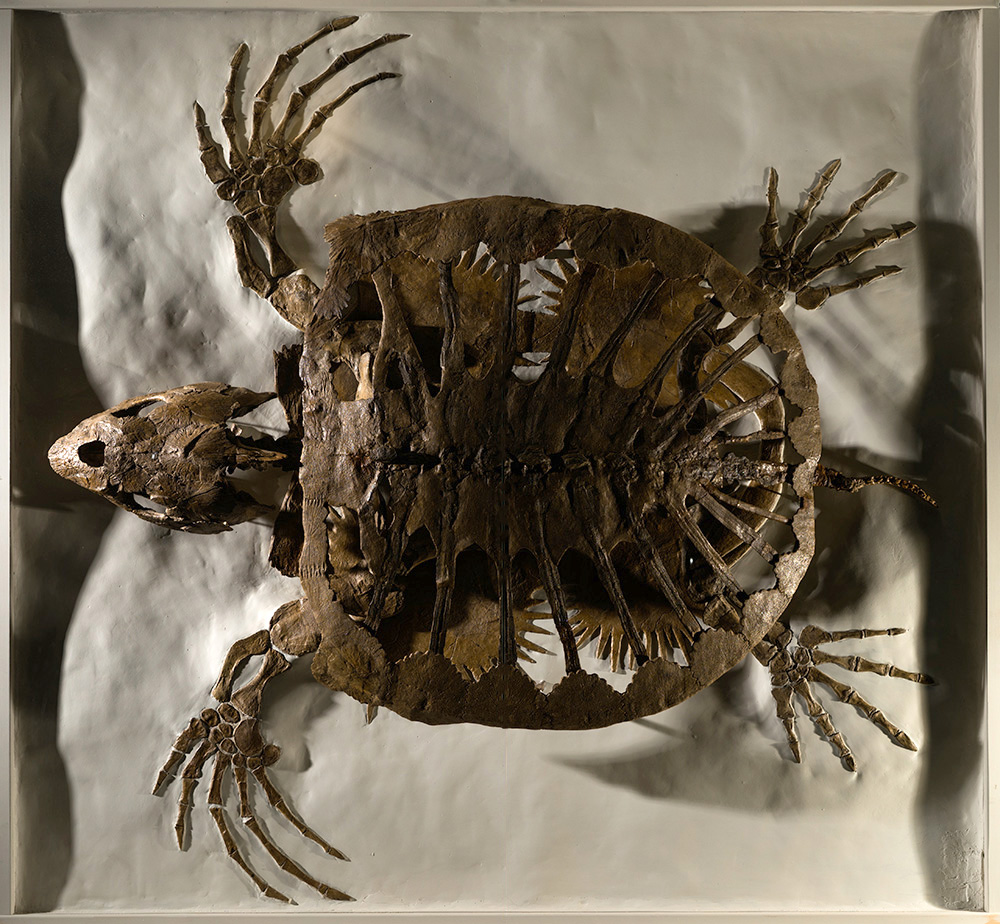
Visitors can also examine the fossils of a giant turtle and a newly restored Tylosaurus mosasaur fossil skull. See a dramatic chase scene where a plesiosaur is in pursuit of a prehistoric diving bird. Look up, and see the king of the seaway—a 40-foot mosasaur swimming above. Two replica fossil fishes hang nearby.

Adjacent to Kamin Hall of Dinosaurs, Cretaceous Seaway is an extension of our blockbuster core exhibition that showcases life during the Cretaceous Period.

fossil of a giant sea turtle

Learn about the Invertebrate Paleontology Collection at the Museum

Invertebrate Paleontology’s collection contains several noteworthy phyla, including Paleozoic trilobites, Mesozoic and Cenozoic crustaceans, lower Carboniferous brachiopods, Paleozoic gastropods, Paleozoic cephalopods, Paleozoic ophiuroids, and Pennsylvanian age eurypterids. The section also has more than 12,000 primary types and figured specimens.

Learn about the Section of Invertebrate Paleontology

Filed Under: Uncategorized Tagged With: dinos, dinosaurs, dinosaurs in their time

  • « Go to Previous Page
  • Page 1
  • Page 2
  • Page 3
  • Page 4
  • Interim pages omitted …
  • Page 9
  • Go to Next Page »

sidebar

About

  • Mission & Commitments
  • Directors Team
  • Museum History

Get Involved

  • Volunteer
  • Membership
  • Carnegie Discoverers
  • Donate
  • Employment
  • Events

Bring a Group

  • Groups of 10 or More
  • Birthday Parties at the Museum
  • Field Trips

Powdermill

  • Powdermill Nature Reserve
  • Powdermill Field Trips
  • Powdermill Staff
  • Research at Powdermill

More Information

  • Image Permission Requests
  • Science Stories
  • Accessibility
  • Shopping Cart
  • Contact
  • Visitor Policies
One of the Four Carnegie Museums | © Carnegie Institute | Privacy Policy | Terms of Use | Accessibility
Rad works here logo