• Skip to primary navigation
  • Skip to main content
  • Skip to primary sidebar

Carnegie Museum of Natural History

One of the Four Carnegie Museums of Pittsburgh

  • Visit
    • Buy Tickets
    • Visitor Information
    • Exhibitions
    • Events
    • Dining at the Museum
    • Celebrate at the Museum
    • Powdermill Nature Reserve
    • Event Venue Rental
  • Learn
    • Field Trips
    • Educator Information
    • Programs at the Museum
    • Bring the Museum to You
    • Guided Programs FAQ
    • Programs Online
    • Climate and Rural Systems Partnership
  • Research
    • Scientific Sections
    • Science Stories
    • Science Videos
    • Senior Science & Research Staff
    • Museum Library
    • Science Seminars
    • Scientific Publications
    • Specimen and Artifact Identification
  • About
    • Mission & Commitments
    • Directors Team
    • Museum History
  • Tickets
  • Give
  • Shop

Education

October 6, 2023 by Erin Southerland

Hispanic Heritage Month Scavenger Hunt: Three Birds and a Butterfly

by Patrick McShea

Hispanic Heritage Month creates an opportunity to consider how we share some forms of winged wildlife with Spanish-speaking regions far to our south. At this time of year, many bird species that are widely considered to be Pennsylvania residents are in the process of a long seasonal migration to warmer climates.

This migratory behavior pattern, established long ago in each species’ evolutionary history, occurs every fall, and reverses with northward movement in the spring. Just as we might consider the wild creatures who spend summers with us to be ours, the people at the Caribbean, Central American, and South American locations where these creatures pass the months of our Pennsylvania winter might consider the winged seasonal visitors to be theirs.

An informal walk to locate three migratory birds and one migratory butterfly among the exhibition halls of Carnegie Museum of Natural History is a good way build background knowledge about wildlife sharing. Recognition of such sharing is a step toward understanding more about other cultures.

Stop #1: Scarlet Tanager (known in Spanish as Piranga Escarlata)
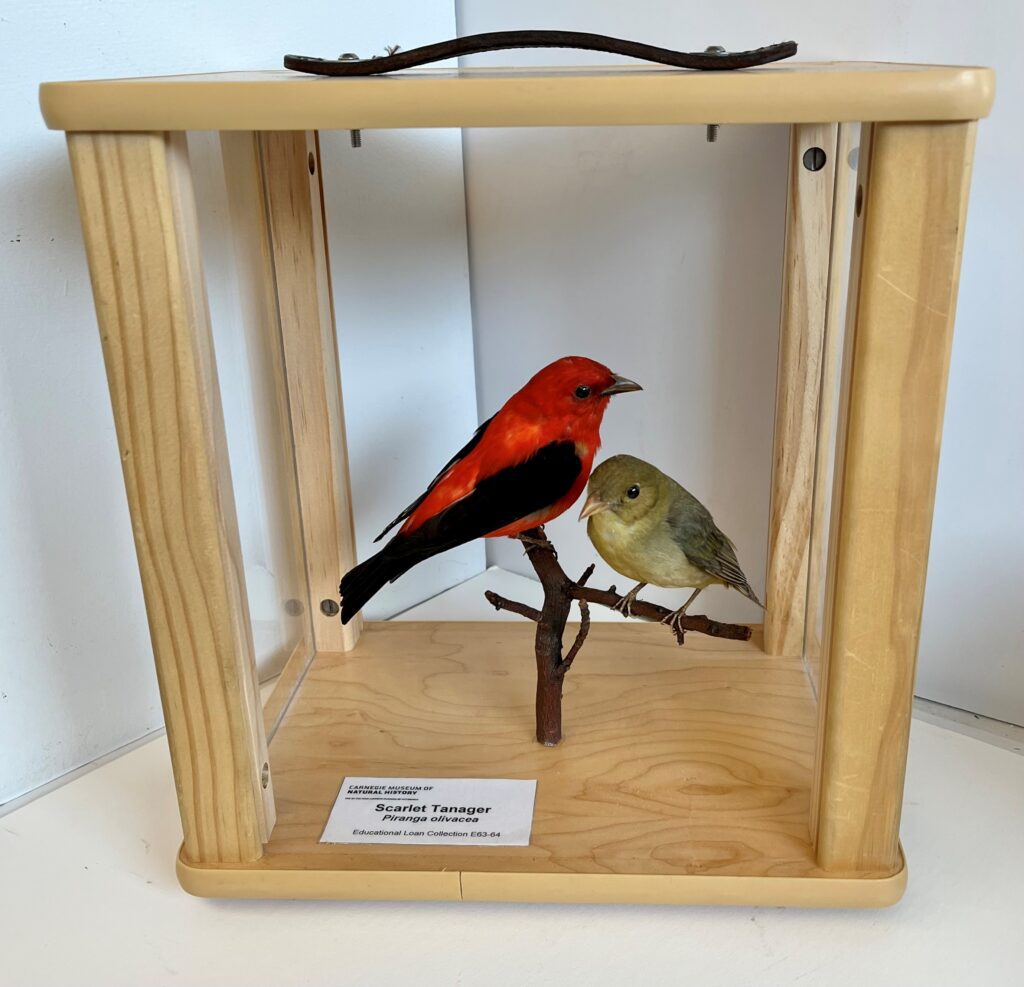
taxidermy mount of two scarlet tanagers

Within the interactive space known as Discovery Basecamp, the Scarlet Tanager’s bright plumage should be easy to locate among other encased bird taxidermy mounts. As the species account in All About Birds states: Male Scarlet Tanagers are among the most blindingly gorgeous birds in an eastern forest in summer, with blood-red bodies set off by jet-black wings and tail.

Recent population studies, which included lots of community science generated data, indicate that Pennsylvania supports more breeding pairs of Scarlet Tanagers than any other state. 

Because this species feeds and nests high in the tree canopy, learning to recognize their distinctive song is a good way to spot one. If this technique enables you to spot a bright red male or yellowish-green female, remember that for some months of the year the bird you’re watching might reside in forests as far away as Bolivia. 

Stop #2: Monarch Butterfly (known in Spanish as Mariposa Monarca)
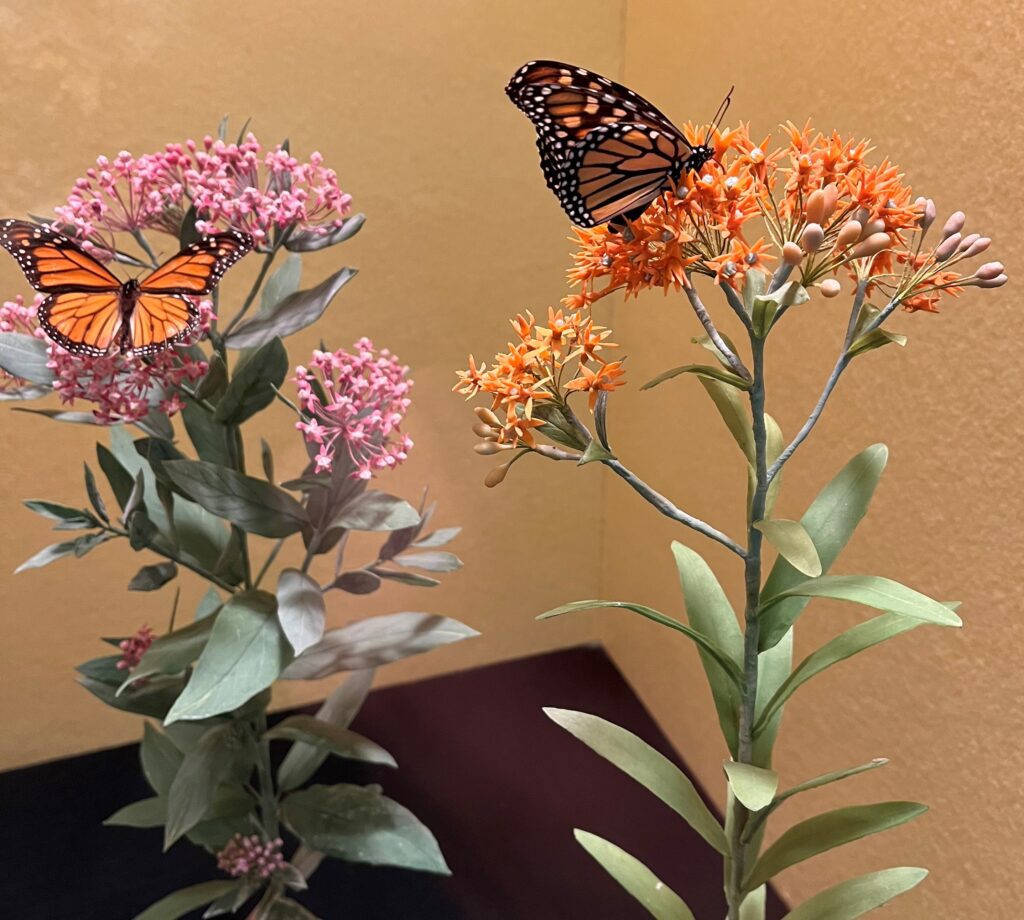
diorama of a monarch butterfly on a milkweed plant

The familiar orange and black monarch butterfly flitting across your neighborhood in the fall might be embarking on an incredible journey from field edges in Pennsylvania to the cool and relatively moist habitat of oyamel fir forests in Mexico’s Sierra Madre Mountains. The seasonal movement of monarchs across the North American continent is one of the longest migrations of any insect. In full cycle, however, it differs from bird migration in reliance upon multiple generations. 

The long southbound fall journey is completed by some of the individual butterflies who embark upon it. These butterflies initiate northward migration in the spring, but no individuals complete the roundtrip journey. Northbound female monarchs lay eggs for a subsequent generation to continue the migration to our region. 

Female monarchs lay eggs on the leaves of milkweed plants, the food source for the caterpillars that hatch within days. The display in the Hall of Botany depicts two of the eleven species of milkweed native to Pennsylvania.

Stop #3: Chimney Swift (known in Spanish as Vencejo de Chimenea)
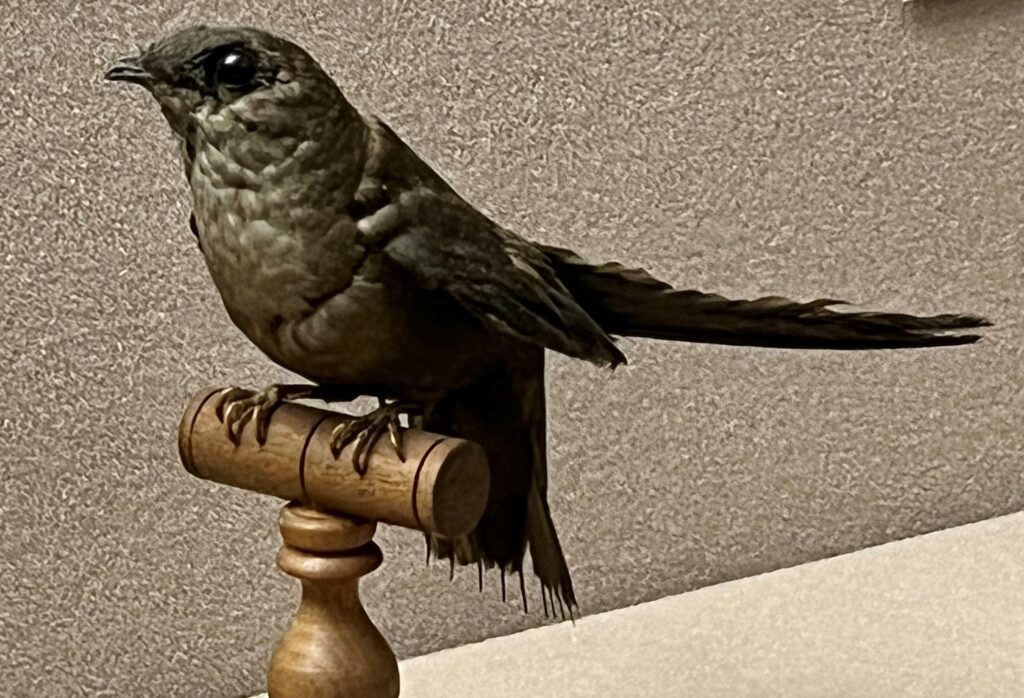
In urban, suburban, and even rural areas of southwestern Pennsylvania, the high-pitched twittering cries of circling Chimney Swifts create a soundtrack for summer days. The birds’ aerial maneuvers are a mix of rapid wing beats and dynamic glides, and much of the action relates to feeding. Chimney Swifts eat on the wing, using their unusually large mouths to capture up to 5,000 flying insects per day.

When the birds disappear from our skies in the fall, they undertake a journey of thousands of miles to the upper reaches of South America’s Amazon Basin, in Peru, Ecuador, and Brazil, where they spend much of the winter. 

In our region, the species roosted and nested in hollow trees before the proliferation of chimneys that accompanied the European colonization of North America. The species is so physically adapted to life on the wing that it is unable to perch upright for long. Note the protruding tail feather shafts on the taxidermy mount. These stiff braces help the bird to hold resting positions against the interior vertical surfaces of chimneys or hollow trees.

Stop #4: Ruby-throated Hummingbird (known in Spanish as Colibri Gorjirrubi)
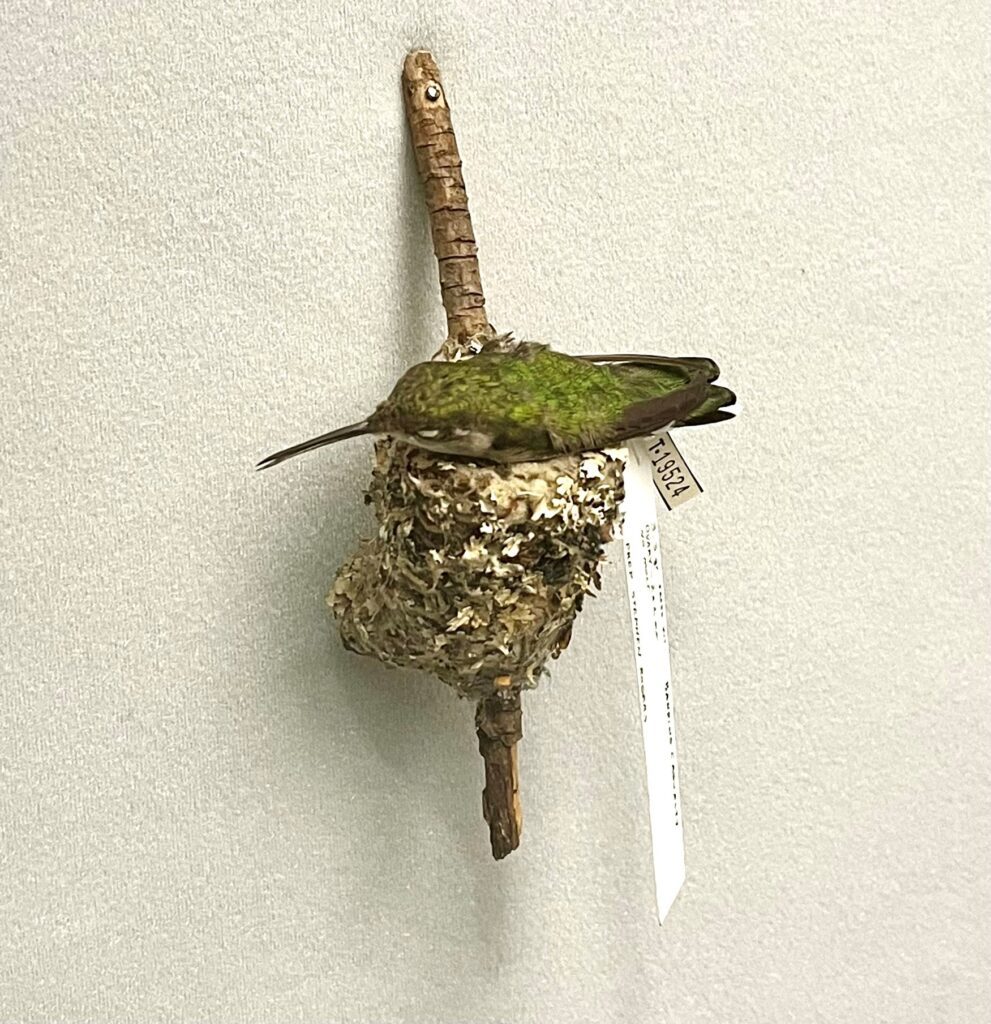
Although there is a Ruby-throated Hummingbird taxidermy mount immediately adjacent to the Chimney Swift mount, the specimen pictured above is located elsewhere in Bird Hall. This female bird, displayed on a nest, is in “study skin” form. Study skins lack the glass eyes and life-like poses of taxidermy mounts, and their uniform flatness facilitates both storage and scientific study. Most of the 190,000 birds in the museum’s scientific collection (including many from Spanish-speaking regions of the world) are in study skin form.

From May through December, Ruby-throated Hummingbirds attract our attention when they visit some of the flowers we tend, or feeders placed specifically to attract the birds. The species’ diet also includes mosquitoes, gnats, fruit flies, small bees, and spiders. On their breeding grounds, six to ten days of construction work by the female bird results in an inch-deep, two-inch diameter, branch-top nest lined with plant down, held together with spider silk, and for concealment purposes, shingled with lichen chips. 

Their annual southward migration includes passage over or around the Gulf of Mexico to reach wintering grounds that stretch southward from Mexico’s Yucatan Peninsula to Costa Rica. 

Maps indicating breeding ranges, wintering grounds, and the migration corridors between those locations are critically important tools for understanding the movements of migratory wildlife within and between continents. Much of the information about the birds profiled in this activity comes from species accounts of All About Birds, an encyclopedic online resource maintained by the Cornell Lab of Ornithology. In each account, a species’ continental-scale migration movements are depicted on color-coded maps. 

Another notable facet of the website maintained by Cornell Lab of Ornithology is the availability of education materials in Spanish. 

Patrick McShea is an Educator at Carnegie Museum of Natural History.

Carnegie Museum of Natural History Blog Citation Information

Blog author: McShea, Patrick
Publication date: October 6, 2023

Share this post!

  • Share on Twitter Share on Twitter
  • Share on Facebook Share on Facebook
  • Share on Pinterest Share on Pinterest
  • Share on LinkedIn Share on LinkedIn
  • Share on Reddit Share on Reddit
  • Share via Email Share via Email

Location key:

Stop #1: Discovery Basecamp

Stop #2: Hall of Botany

Stop #3: Bird Hall

Stop #4: Bird Hall
Filed Under: Blog Tagged With: Education, Hispanic Heritage Month, Pat McShea, scavenger hunt

March 7, 2023 by Erin Southerland

March Mammal Madness 2023: Learn and Win

by Patrick McShea

What chance does a giant water bug have in a battle with a wolverine? During the next few days participants in the online tournament known as March Mammal Madness will attempt to predict the outcome for this theoretical encounter plus 31 others. “Play” in this single elimination series of antagonistic animal matches begins with a wild card qualifying battle on March 13, and concludes, four well-spaced rounds of competition later, with a championship match on April 5. This now decade-old annual activity, which was created and continues to be directed by Professor Katie Hinde, of Arizona State University, has a well-earned reputation as a fun interactive educational event. 

The website for March Mammal Madness (MMM) describes the proceedings as “inspired by (but in no way affiliated with or representing) the NCAA College Basketball March Madness Championship Tournament.” Like the basketball tournament, MMM relies upon a branching four-division bracket listing qualifying competitors and their ranking number to both record predictions and track the tournament’s progress. There are, of course, significant bracket differences. In place of the small print note where some sport tournament brackets announce the chart’s purpose as “For Amusement Only,” the MMM document bears the disclaimer, “MMM includes many non-mammal species.” Also, in the front and center position, where an NCAA, media sponsor, or gaming corporation’s logo would normally appear, is instead the MMM guiding motto: “If you’re learning, you’re winning!”

March Mammal Madness logo

The clearest explanation of how the competition unfolds, and how willingness to learn is a condition of fandom, is on the MMM website: 

The organizers take information about each combatant’s weaponry, armor, fight style, temperament/motivation, and any special skills/consideration and estimate a probability of the outcome and then use a random number generator to determine the outcome. This is why there are upsets in the tournament.

Another thing that can happen is if a species has to battle in an ecology that is really bad for it – for example, if a cold adapted species is battling in a tropical forest, it can dangerously overheat- changing the outcome probabilities. Sometimes an animal gets injured or snaps a canine in a previous round that carries over into the next round- just like an injury of a star player totally changes a basketball team’s outcome. Also hiding or running away counts as a forfeit.

In the early rounds the battle location is in the preferred habitat of the better-ranked combatant in the battle, and ecology can play a huge role in what happens. 

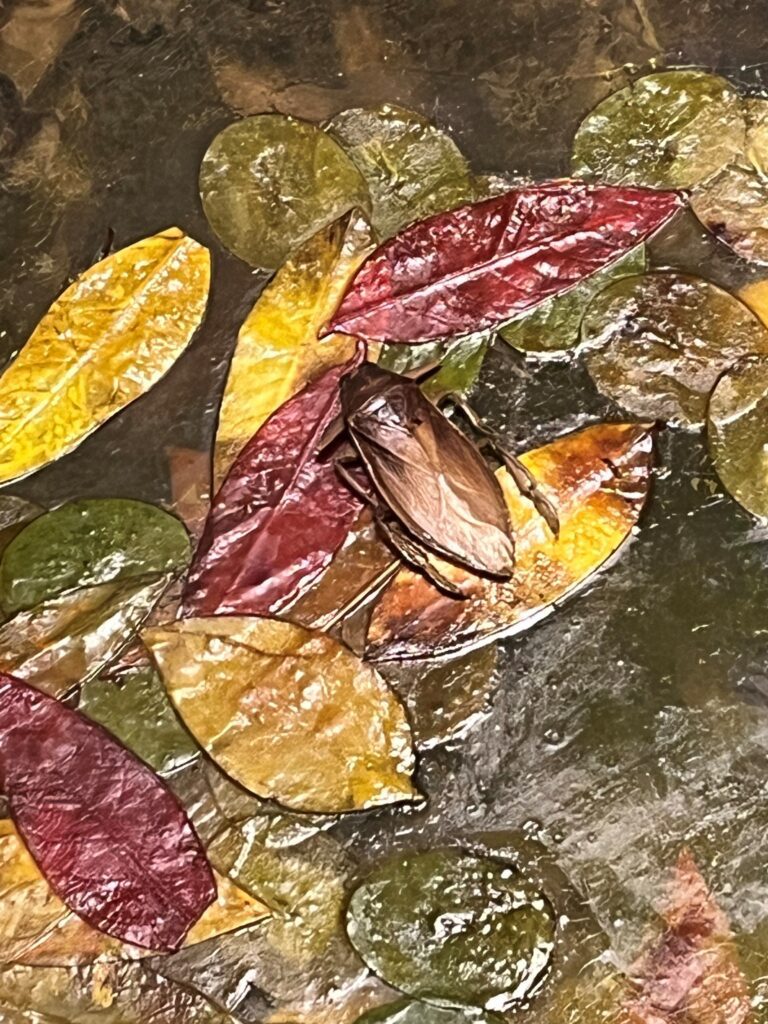
giant water bug museum display

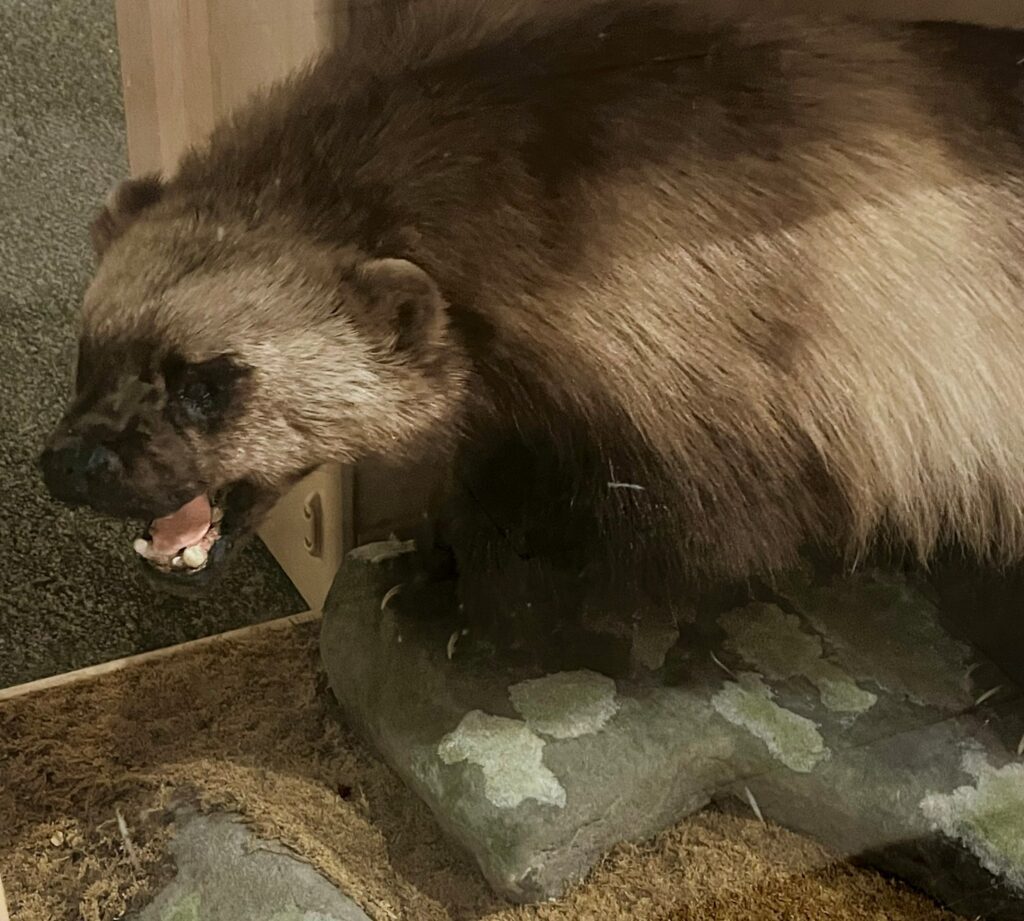
I kept all of this in mind as I considered the first-round water bug versus wolverine battle. On the museum’s second floor, a giant water bug is an invertebrate detail in the Hall of Botany’s bog diorama. On the first floor, an encased wolverine taxidermy mount flanks the interactive space Discovery Basecamp. If both creatures mysteriously came to life and met on a back stairway landing, the insect would certainly be flattened or swallowed whole. Like a sports bettor double-checking a basketball team’s bench depth, foul-shooting percentage, or dependable three-point shooters, I conducted a brief internet search for wolverine vulnerabilities.

wolverine taxidermy mount

Details in a summary of the Western States Wolverine Conservation Project revealed this large member of the weasel family as a species highly sensitive to climate change. The long-clawed and densely furred carnivore, whose common name has been used by various corporations to create brands for action heroes, rugged footwear, and all-terrain vehicles, requires large territories with persistent spring snow cover. In the four U.S. states where resident populations of wolverines are known to occur (Washington, Montana, Idaho, and Montana), locations with heavy spring snow cover provide ample “refrigerated” space for the catching of prey, as well as safe denning sites for pregnant females.

I still picked the wolverine to beat the giant water bug, but I won’t be surprised if it doesn’t happen. Highways were mentioned in some research summaries as barriers to wolverine movements, raising the possibility of a forfeited match. Despite a reputation for ferocity, a no-show wolverine could send a giant water bug to the MMM second round. 

Patrick McShea is an Educator at Carnegie Museum of Natural History.

Related Content

March Mammal Madness and Middle School Science Class

World Pangolin Day 2023 – The Mysterious Brain Bone

Do Any Mammals Lay Eggs?

Carnegie Museum of Natural History Blog Citation Information

Blog author: McShea, Patrick
Publication date: March 7, 2023

Share this post!

  • Share on Twitter Share on Twitter
  • Share on Facebook Share on Facebook
  • Share on Pinterest Share on Pinterest
  • Share on LinkedIn Share on LinkedIn
  • Share on Reddit Share on Reddit
  • Share via Email Share via Email

Filed Under: Blog Tagged With: Education, mammals, Pat McShea, Science News

February 6, 2023 by Erin Southerland

Echoes of Freedom in an Owl’s Call

by Pat McShea
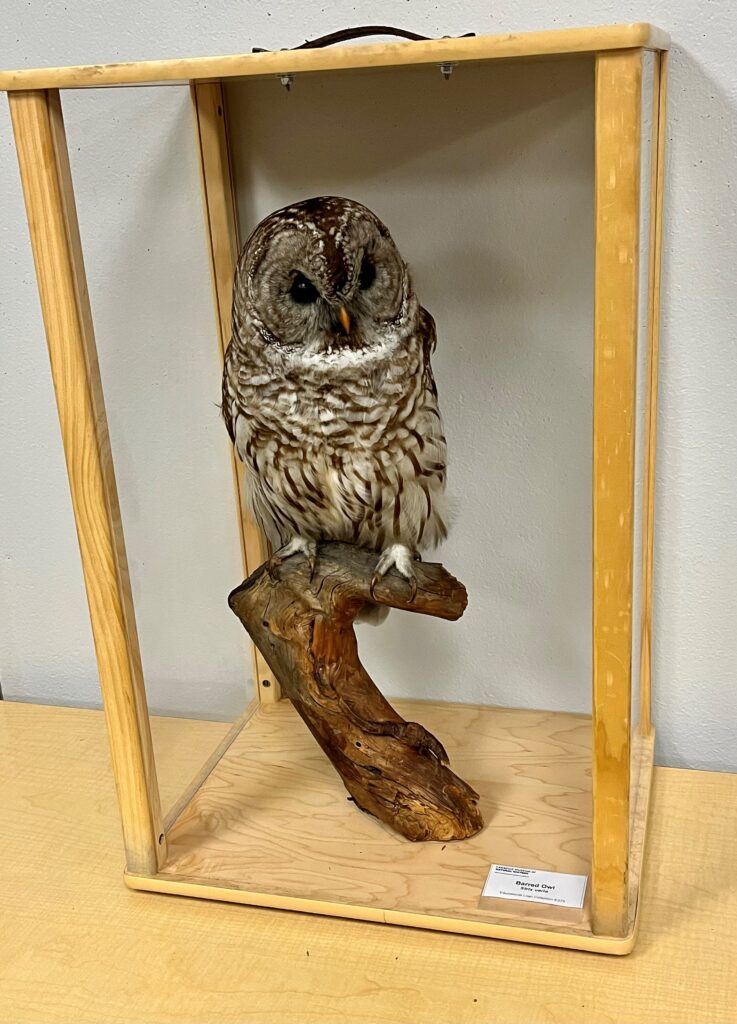
Barred Owl taxidermy mount

“Is that owl real?” Students who approached the museum activity station at a “Dream STEAM” event on Martin Luther King Jr. Day repeated those four words to express curiosity about a 20-inch-high Barred Owl taxidermy mount. The setting was a large meeting room in the Bible Center Church’s Worship, Arts, Recreation, and Ministry Center in Pittsburgh’s Homewood neighborhood. Here, during a busy three-hour morning session, small groups of students ranging from kindergarten to fifth grade rotated with their adult chaperones among activities related to STEAM (Science, Technology, Engineering, Art, and Math) or Black History and Culture.

I was one of three museum representatives who brought the owl and other, less visually striking materials, to enhance an activity we hoped would spark greater interest in science as well as increase knowledge about a heroic Black figure in American History, Harriet Tubman.

Answers of “partially real” to student questions about the owl’s authenticity were provided first, as we shared information about the taxidermy mount’s glass eyes, wire-supported feet, interior foam body, but very real feathers, beak, and talons. Then came an explanation about how in 1849, Harriet Tubman’s expert knowledge of tides, seasons, weather, wildlife, plants, and the stars of the night sky enabled her to escape enslavement on a timber plantation on the Eastern Shore of Maryland, and then safely cross more than 100 miles of forest and wetlands to reach freedom in Philadelphia, Pennsylvania.

Tubman returned to Maryland multiple times during the next ten years to safely lead a total of approximately seventy people in escape from enslavement to freedom, which could sometimes only be guaranteed in places as distant as Canada. When we recounted these courageous actions for the students, the owl assumed a prominent role in our narrative. Tubman used imitations of Barred Owl calls as a code of cautionary signals to the people she physically guided. With the aid of a battery powered bird song player, the students were able to listen to the species’ distinctive barked notes, nine booming syllables that invite translation into the echoing question, “Who Cooks For You? Who Cooks For You All?”

Imitation owl calls from the students followed, spontaneous and solicited, with both types gently critiqued by a reminder that in the dark woods of 1850’s coastal Maryland or Delaware, the skill of the call’s delivery could be a matter of life or death. 

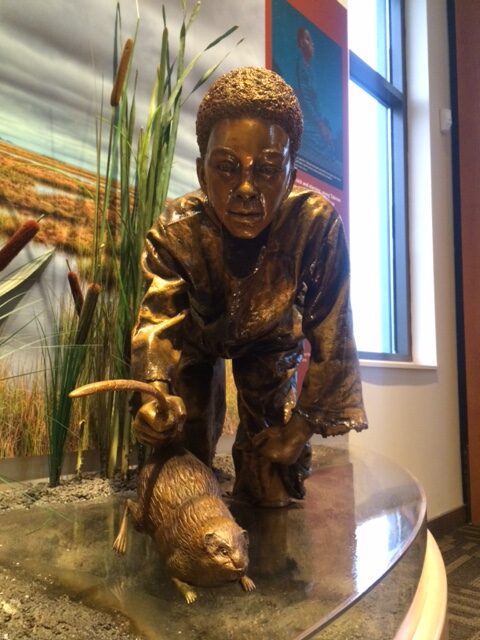
The museum’s activity station also provided opportunities for students to note owl adaptations via pencil drawings, and to examine muskrat pelts as an aid in considering Harriet Tubman’s childhood labor checking traps for the rodents in the marshes of the plantation where she was enslaved. One tabletop display that drew the attention of some students and every adult chaperone credited Ranger Angela Crenshaw, currently Park Manager for Rocks, Susquehanna and Palmer State Parks in Maryland, as the source for much of the activity’s shared information.

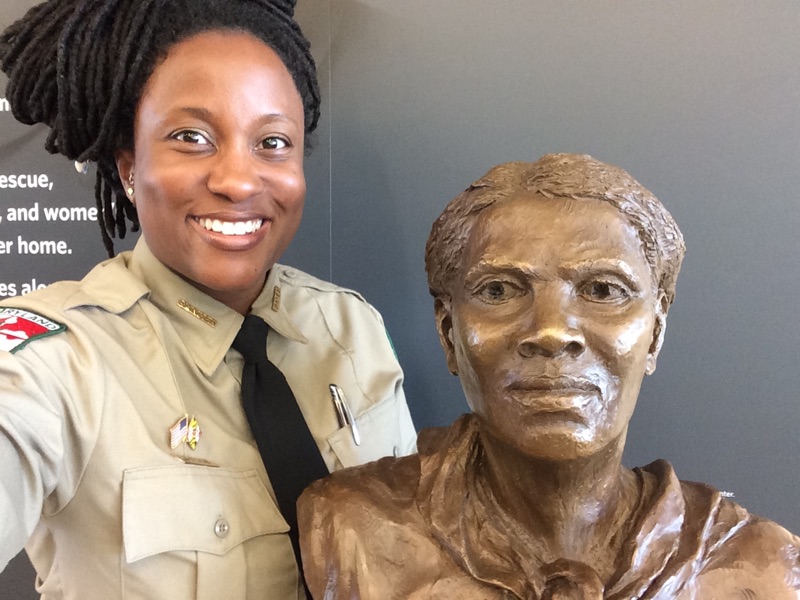
Harriet Tubman UGRR State Park and Visitor Center – Ranger Crenshaw with the Bust of Tubman

 A West Virginia native with strong Baltimore roots, Crenshaw presented interpretive programs for over four years as a ranger at Harriet Tubman Underground Railroad State Park and Visitor Center, a 17-arcre site in Dorchester County, Maryland. Last year, the bicentennial anniversary of Tubman’s birth, articles about the historic icon’s naturalist skills in both Audubon and Smithsonian magazines included quotes from Crenshaw. On May 14, a date Pittsburgh Mayor Ed Gainey proclaimed as “Harriet Tubman Day” in the city, Crenshaw joined seven other presenters for a two-hour panel discussion on Zoom about Tubman’s legacy organized by the Dr. Edna B. McKenzie Branch of the Association for the Study of African American Life and History. 

Harriet Tubman UGRR State Park and Visitor Center – Muskrat Exhibit – MD Department of Natural Resources

When a presenter from another organization asked about how Ranger Crenshaw became a reliable source for information about Harriet Tubman, I recalled a published interview during which she described how her earliest days at the then new park forced a deep immersion into the landscape, and lots of reading about American Slavery, the religion of enslaved people, and the Underground Railroad. Among those documents was an 1868 biography of Tubman titled The Moses Of Her People, by Sarah Bradford, and a letter endorsing the book, by another native of Maryland’s Eastern Shore who escaped enslavement, Frederick Douglass. 

Related Content

King’s Dream and Natural History

Feather and Bone Connections to American History

Educator Loan Collection

Carnegie Museum of Natural History Blog Citation Information

Blog author: McShea, Patrick
Publication date: February 6, 2023

Share this post!

  • Share on Twitter Share on Twitter
  • Share on Facebook Share on Facebook
  • Share on Pinterest Share on Pinterest
  • Share on LinkedIn Share on LinkedIn
  • Share on Reddit Share on Reddit
  • Share via Email Share via Email

Filed Under: Blog Tagged With: Birds, Education, Pat McShea

February 3, 2023 by Erin Southerland

Beyond the Simple Ecosystem Graphic: Teaching About Biodiversity and Pollination

by Pat McShea

You probably remember some version of this graphic: simple line drawings linked by arrows to chart energy flow through an ecosystem featuring the Sun, a patch of grass, a rabbit, and a hawk or fox. During the closing minutes of a recent day-long educator workshop about biodiversity at Carnegie Museum of Natural History, two participating middle school teachers cited the pervasive textbook illustration as an educational prop they now felt comfortable moving beyond. 

Natalie Miles and Christian Shane, science teachers at North Allegheny School District’s Ingomar Middle School, expressed confidence that the seventh graders they work with would benefit from guided firsthand explorations of more complex energy flows involving various plant and invertebrate interactions. “We already teach about pollination,” explained Christian, “and with this information we can guide students on investigations right where they live.” After endorsing Christian’s comments, Natalie added a more personal note. “You’ve kept my nerdy science self fully engaged today. Thank you.”

The core experience that so captivated the pair was a carefully prepared slide presentation by museum scientist Dr. Ainsley Seago. Because the Associate Curator of Invertebrate Zoology likened her session to a sales pitch for insects, she began with what could be termed product information specific to the museum: The CMNH collection consists of approximately 16 million pinned insect specimens, representing locations all over the world, and spanning 150 years of collecting; Moths (Lepidoptera), beetles (Coleoptera), and fleas (Siphonaptera), are collection strengths, but the wide-ranging research resource also includes many groups of non-insect invertebrates. 

The ubiquity of insects and the increasing ease and accuracy of their identification through hand-held technology such as the iNaturalist smartphone app were the next topics on Ainsley’s presentation agenda. Then her core material was setup by a reminder of two different but potentially connected circumstances: 1) Pollinators and bee declines are hot topics right now. 2)Teachers of some grades and subjects need to cover ecosystems according to the PA science standards.

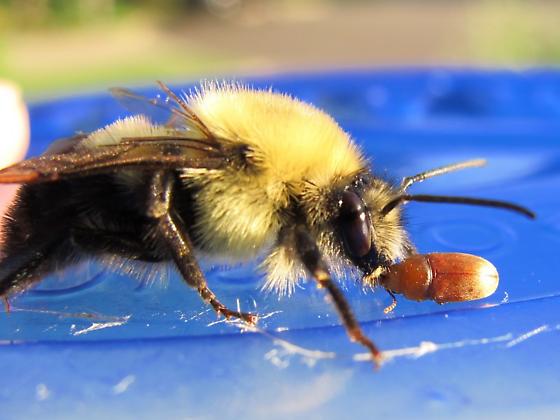
An Antherophagus species of beetle hitches a ride to its next home by attaching to a bumble bee’s tongue. Copyright © 2016 Ilona L.

What followed was refresher session on the biomechanics of pollination that moved seamlessly into enthusiastic introductions for a cast of a dozen insect and other invertebrate characters that might visit, or even inhabit, the blossom of a common wild sunflower on a late summer or early fall day. Some creatures arrived in search of pollen or nectar, others to be in the proper place to ambush and prey upon such visitors, and the most memorable, a tiny fungus beetle whose most supportive micro-habitat is the decaying detritus within bumble bee nests, to temporarily attach itself to that insect’s tongue, and hitch a ride to a new home.

Besides offering her audience alternatives to organisms favored by many textbooks, Ainsley aptly displayed what the late Dr. John Rawlins, Curator Emeritus for the museum’s Section of Invertebrate Zoology termed “bug love.” As I watched the performance from my seat as an observer in the back of the workshop classroom, I recalled something historian David McCullough wrote about Dr. Margaret B. McFarland, the University of Pittsburgh child psychologist who was a strong influencer of Fred Rogers television programs for young audiences. “What she taught, in essence, is that attitudes aren’t taught, they’re caught. If the attitude of the teacher toward the material is positive, enthusiastic, committed, and excited, the students get that.” Such transmission of attitudes also applies to older audiences.

For information about the next scheduled educator workshop, please visit our Events page. 

Related Content

Educator Spotlight: Christian Shane

Learning From Misinterpretations

Two Perspectives on Attending a Course on Moths and Butterflies in the Southwest

Carnegie Museum of Natural History Blog Citation Information

Blog author: McShea, Patrick
Publication date: February 3, 2023

Share this post!

  • Share on Twitter Share on Twitter
  • Share on Facebook Share on Facebook
  • Share on Pinterest Share on Pinterest
  • Share on LinkedIn Share on LinkedIn
  • Share on Reddit Share on Reddit
  • Share via Email Share via Email

Filed Under: Blog Tagged With: Education, Invertebrate Zoology, Pat McShea

September 6, 2022 by Erin Southerland

An Intern’s Point of View

by Jia Tucker

A week before accepting a summer internship with Carnegie Museum of Natural History, I found myself standing on Forbes Avenue in front of Diplodocus carnegii, the statue that is an emblem of the vast institution.

I had never even stepped foot inside of the museum before June 2022. The career path I had formed in my head over the past few years had been wiped clean by a change of heart. To be honest, I only applied to this museum studies internship because of a moderate interest in the field — and it was paying. 

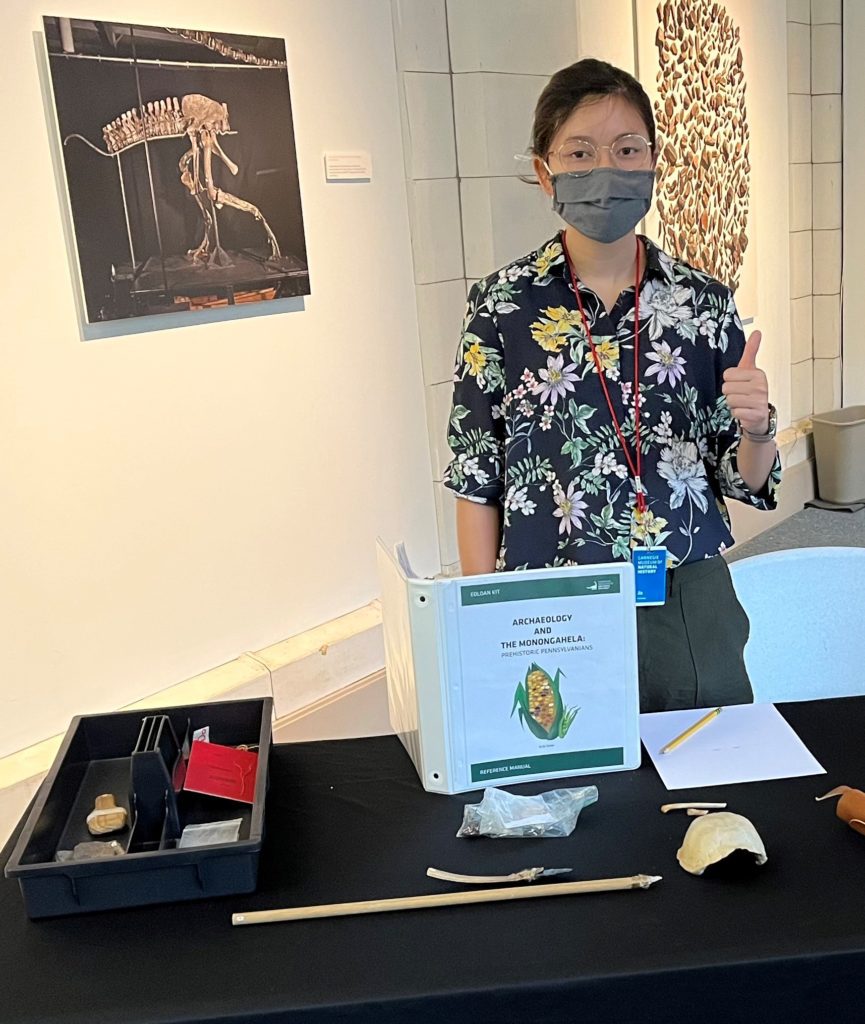
I was placed in the Education and Exhibitions departments. While beginning work in the Education Department, Program Officer Pat McShea tasked me with streamlining and modernizing one of the museum’s “Ed Loan” kits. These kits are borrowed by educators and used to create lesson plans that encompass a variety of subjects from paleontology to anthropology to zoology and beyond. He’d given me a popular, but complicated-to-use kit that focused on what we call the Monongahela, a precontact People whose settlements were concentrated in Western Pennsylvania, eastern Ohio, and northern West Virginia. The kit had a lengthy, approximately seventy-page manual and over thirty objects meant to be used for a lesson plan spanning two to three weeks. I had to pare it down to a dozen objects and two to three days of lessons. 

Preparing to engage museum visitors in discussions about Monongahela artifacts.

Coming from an undergraduate perspective with limited experience in workspaces like the Carnegie, I was new to this kind of responsibility. It wasn’t just an essay that would only go through the eyes of a professor, but a tool for the public. The whole time I worked on the kit and my other project in the Exhibitions department, I questioned my ability to complete my tasks adequately. Although I have an intermediate background in anthropology and am no stranger to doing research, curating an educational resource with such free rein seemed beyond my expertise. It was overwhelming, but in a good way. That’s not to say that my Internship Supervisor, Renee, or Pat left me hanging high and dry. Early in the internship, Renee set me up with a list of the people I should reach out to in the museum, and that was, well, everyone. She had firmly yet kindly suggested that I not let this chance slip away. 

So, I didn’t.

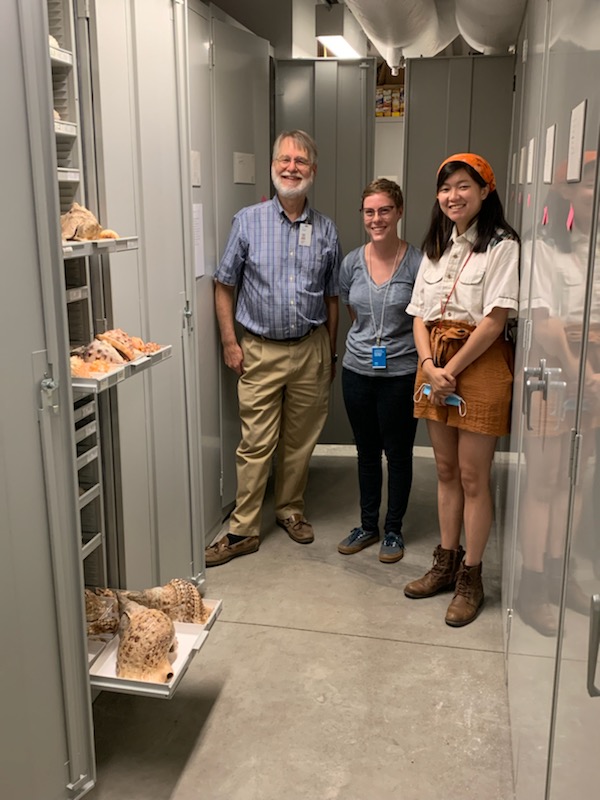
Visiting the Mollusk Collection at CMNH.

With some help, I started contacting program managers from various departments and setting up tours with curators of different collections. I got the chance to hear from people who are passionate about their field of study and eager to learn about what I had to say. It was a reciprocal learning environment that I hadn’t experienced until now. It wasn’t about a LinkedIn connection or a line in a resume. The person who printed all the posters had a name as did the person who developed all the content. What was to me one singular entity fractured into a chorus of different voices all striving to keep the museum alive, and all I wanted to do was contribute a verse. It’s always the people that make the effort worth it. Each person I spoke with would playfully try to convince me to join their field and indulge in their same joys. Although perhaps they were not-so-subtly disguising sincerity. Regardless, for the first time, I felt that flicker of potential. The smorgasbord of an undergraduate degree that I had been haphazardly holding together, hoping that eventually it would be “useful,” could finally stand on its own. The technicalities of it aren’t the important part anyways. Everyone I met came to the museum by both conventional and unconventional means. I’m no exception to the chaos of finding a purpose. 

It’s a shame that as my bones started to settle and my shoulders relaxed into an office chair that was only ever meant to be temporary, I now have to take my leave. Even so, this has been the kind of chance that reminds me that there’s always more to explore up ahead. If you’re seeking a push or some great nugget of enlightenment, here it is. Meet as many perspectives as you can, ask as many questions as you can think of, and be brave. Don’t let it slip away.

Jia Tucker’s summer internship at Carnegie Museum of Natural History was part of the PA Museums Qualifying Diversity Program.

Related Content

How I Became an Archaeologist

Pitt Outreach Efforts Enriched with Museum Materials

A Summer Internship at Powdermill

Carnegie Museum of Natural History Blog Citation Information

Blog author: Tucker, Jia
Publication date: September 6, 2022

Share this post!

  • Share on Twitter Share on Twitter
  • Share on Facebook Share on Facebook
  • Share on Pinterest Share on Pinterest
  • Share on LinkedIn Share on LinkedIn
  • Share on Reddit Share on Reddit
  • Share via Email Share via Email

Filed Under: Blog Tagged With: Education, Educator Loan Program, Jia Tucker

June 3, 2022 by Erin Southerland

Finding Answers: From Museum to Mountains and Back Again

by Patty Dineen

The beautiful wildlife dioramas on the second floor of Carnegie Museum of Natural History have been fascinating visitors for decades. Within the Hall of North American Wildlife, most of these realistic displays feature taxidermy mounts of one or more of the continent’s large charismatic mammals, posed in recreated three-dimensional scenes of appropriate habitat that also feature smaller mammals, birds, insects, and, of course, plants. 

Typically, the dioramas don’t display a generic environment, such as say, the Arctic, the mountains, or the desert, but rather, they depict specific places in North America. The key to the “where” of each diorama is the painted background.  Most of the wildlife dioramas feature gorgeous and detailed renderings of specific locations in North America such as Kodiak Island in Alaska, the Laurel Highlands of Western Pennsylvania, or the beautiful Hayden Valley in Yellowstone National Park.

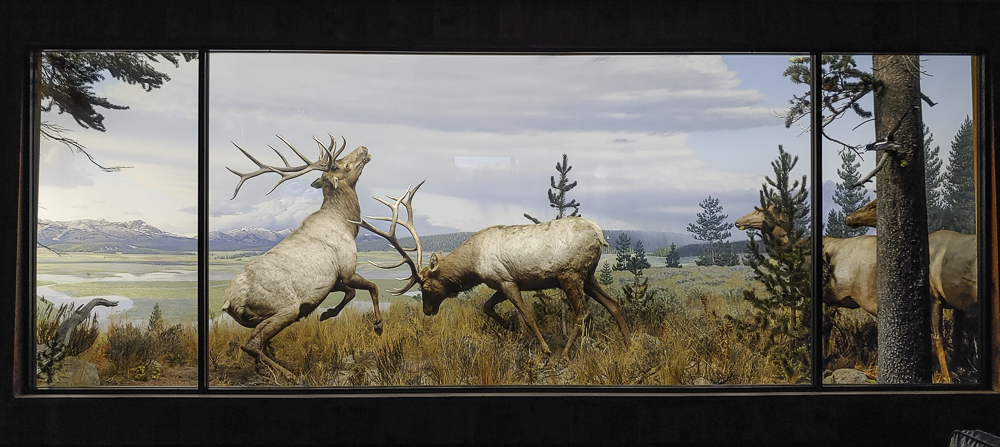
Diorama with taxidermy elk, fake trees other plants, and a mural for the background.
Elk Diorama in the Hall of North American Wildlife.

Finding the Locations That Inspired the Dioramas

Is it still possible to travel to, and view, the locations featured in these wonderful dioramas? Would those places look the same today as when they inspired artistic rendering as wildlife diorama paintings many decades ago? And first things first, how would you even go about finding the exact locations depicted in any of the dioramas? Let me tell you a brief story of a recent travel adventure that included an attempt to find the specific vantage point in Yellowstone National Park where a view of the park’s namesake river valley was long ago recreated as a painting some 1,700 miles east in Pittsburgh. The diorama in question features four American elk: two males fighting as two females watch the action from the side. The scene is a snapshot of the fall elk rut, the mating season when males compete to gather “harems” of females. 

Last fall, as some museum staff made plans for a guided visit to the park, an attempt to locate and stand in the elk diorama vantage point earned a spot on our agenda.

Group of people posing for a photo outdoors.

In early October 2021, our group of 21, consisting of museum staff and their travelling companions, flew from Pittsburgh to Bozeman, Montana, and then traveled south by bus through Paradise Valley to Mammoth Hot Springs in Yellowstone National Park. From this location we began three full days of guided exploration of different parts of the 3,472 square mile park, hoping that at some point we might be able to find the “Elk Diorama” location. We were armed with the Elk Diorama label copy – “…a ritualistic bout between bull elk on the edge of the Hayden Valley, overlooking the Yellowstone River, in Yellowstone National Park,” maps of the park, and photos of the museum’s Elk Diorama. When we shared our information and diorama photos with our two professional guides, one recognized the view and said she was pretty sure she knew the location.

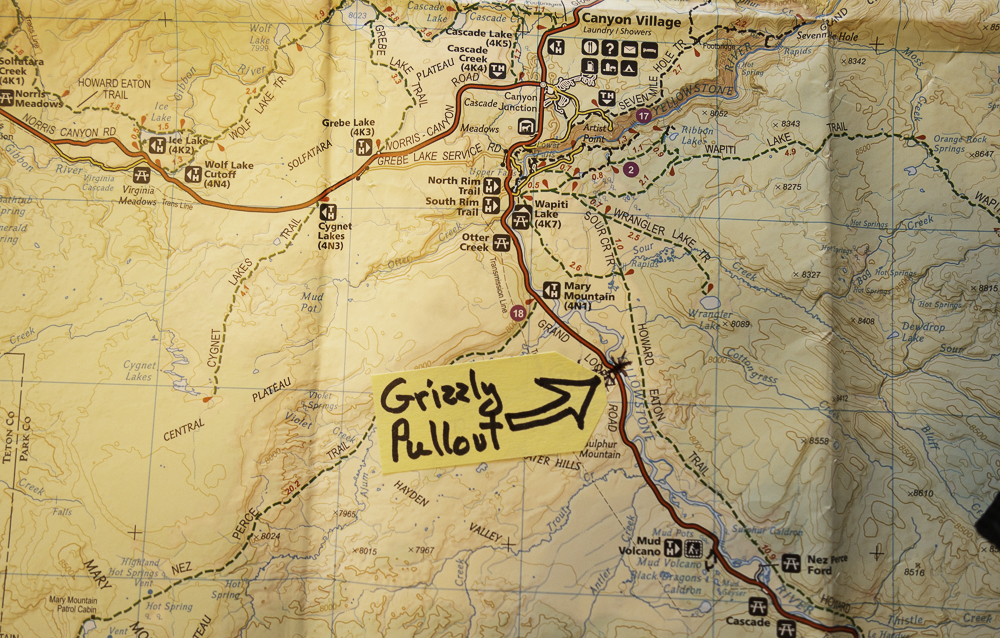
Map of Yellowstone National Park with Grizzly Pullout marked with large handwritten letters and an arrow.

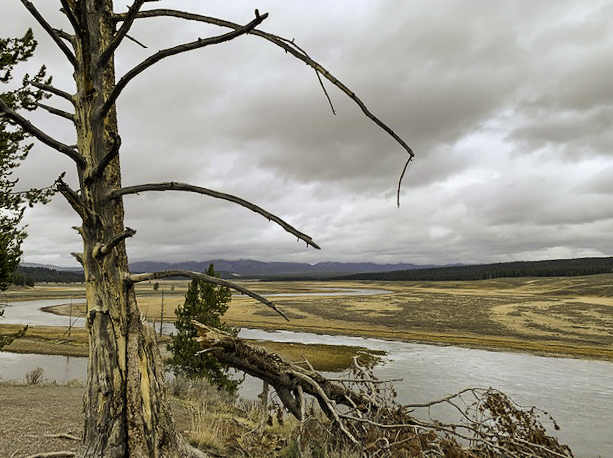
Over our three days of exploring the park we saw geysers and other geothermal features; learned about the Yellowstone National Park wolf project and watched wolves through spotting scopes; and enjoyed wildlife sightings of trumpeter swans, black and grizzly bears, elk, pronghorn, bison, ravens, and young cutthroat trout. On the third and final day, we traveled to The Grand Canyon of the Yellowstone and Yellowstone Lake, and then headed back north from Fishing Bridge and into the Hayden Valley. And there it was — not marked on my large map but referred to by our guides as “Grizzly Pullout” — a wide spot at the side of the road where a couple of cars or a small shuttle bus could pull over for a view of the Yellowstone River as it begins a graceful bend away from the Grand Loop Road. There was the distinctive (even on this heavily clouded day) profile of distant mountains to the left and middle, and a hillside sloping up and to the right in the middle distance. Group members took photos and enjoyed what seemed a familiar landscape (many thanks to Suzanne and Andy McLaren for the photos they took at Grizzly Pullout). We then headed back to Mammoth Hot Springs for one last night in the park before heading back to Pittsburgh, the museum, and our beautiful wildlife dioramas.

View from Grizzly Pullout in Yellowstone National Park: a large tree, a fallen tree, water, sand, hills, and cloudy sky.
View from Grizzly Pullout.

Patty Dineen is a Natural History Interpreter at Carnegie Museum of Natural History.

Related Content

A Deeper Look at Dioramas

Chasing Snails in the Great Smoky Mountains

Doubly Dead: Taxidermy Challenges in Museum Dioramas

Carnegie Museum of Natural History Blog Citation Information

Blog author: Dineen, Patty
Publication date: June 3, 2022

Share this post!

  • Share on Twitter Share on Twitter
  • Share on Facebook Share on Facebook
  • Share on Pinterest Share on Pinterest
  • Share on LinkedIn Share on LinkedIn
  • Share on Reddit Share on Reddit
  • Share via Email Share via Email

Filed Under: Blog Tagged With: Education, Hall of North American Wildlife, Patty Dineen, Science News

  • « Go to Previous Page
  • Page 1
  • Page 2
  • Page 3
  • Page 4
  • Page 5
  • Interim pages omitted …
  • Page 15
  • Go to Next Page »

sidebar

About

  • Mission & Commitments
  • Directors Team
  • Museum History

Get Involved

  • Volunteer
  • Membership
  • Carnegie Discoverers
  • Donate
  • Employment
  • Events

Bring a Group

  • Groups of 10 or More
  • Birthday Parties at the Museum
  • Field Trips

Powdermill

  • Powdermill Nature Reserve
  • Powdermill Field Trips
  • Powdermill Staff
  • Research at Powdermill

More Information

  • Image Permission Requests
  • Science Stories
  • Accessibility
  • Shopping Cart
  • Contact
  • Visitor Policies
One of the Four Carnegie Museums | © Carnegie Institute | Privacy Policy | Terms of Use | Accessibility
Rad works here logo