• Skip to primary navigation
  • Skip to main content
  • Skip to primary sidebar

Carnegie Museum of Natural History

One of the Four Carnegie Museums of Pittsburgh

  • Visit
    • Buy Tickets
    • Visitor Information
    • Exhibitions
    • Events
    • Dining at the Museum
    • Celebrate at the Museum
    • Powdermill Nature Reserve
    • Event Venue Rental
  • Learn
    • Field Trips
    • Educator Information
    • Programs at the Museum
    • Bring the Museum to You
    • Guided Programs FAQ
    • Programs Online
    • Climate and Rural Systems Partnership
  • Research
    • Scientific Sections
    • Science Stories
    • Science Videos
    • Senior Science & Research Staff
    • Museum Library
    • Science Seminars
    • Scientific Publications
    • Specimen and Artifact Identification
  • About
    • Mission & Commitments
    • Directors Team
    • Museum History
  • Tickets
  • Give
  • Shop

Hall of African Wildlife

February 20, 2019 by wpengine

Doubly Dead: Taxidermy Challenges in Museum Dioramas

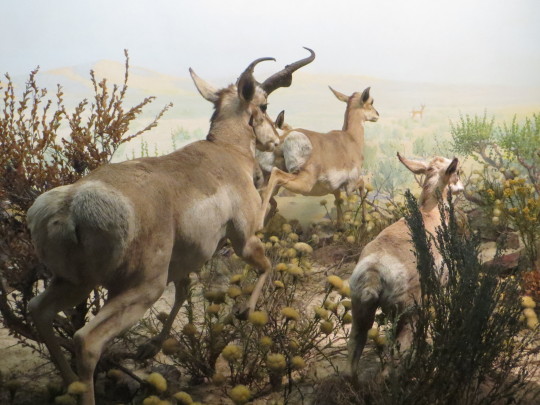
pronghorn antelope diorama

A visit to the wildlife dioramas at Carnegie Museum of Natural History is an opportunity to repeatedly admire the illusions created by teams of skilled taxidermists. None of the featured creatures are alive, but many of them appear to have just paused. Some, such as the pronghorn antelope, pictured above, even seem to be frozen in motion.

In several three-dimensional scenes, where the animal subjects are predators or scavengers, the taxidermists involved in creating the exhibit faced another challenge – presenting the preserved remains of a dead animal as a dead animal. The task, as the somewhat gory details in the pictures below attest, is undoubtedly more difficult than it sounds.
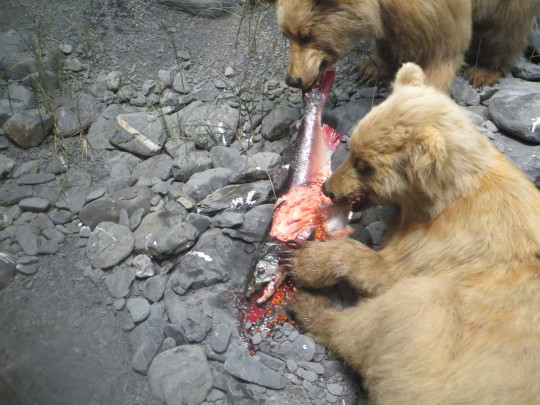
brown bear eating salmon taxidermy diorama

A dead salmon is front and center in the Alaskan Brown Bear diorama, and the pink flesh the cubs are consuming doesn’t look much different than what’s available at supermarket fish counters.
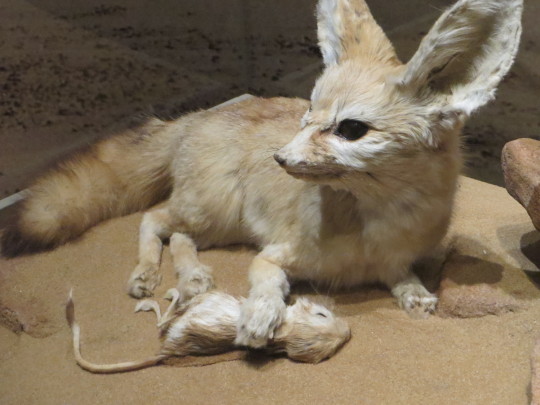
fennec fox and jerboa taxidermy

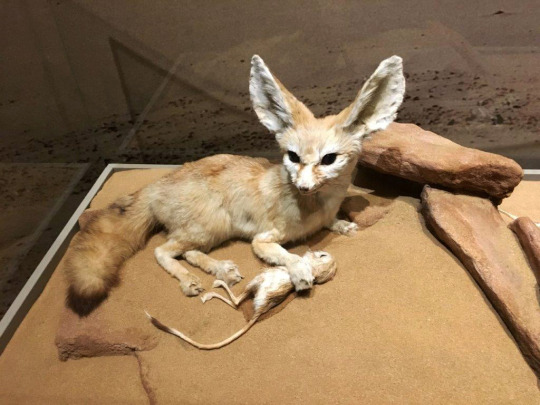
In the Hall of African Wildlife there’s no blood visible on the Lesser Egyptian Jerboa under fennec’s paw. The curled position of the prey’s feet and back legs indicate the struggle with the big-eared fox is over.
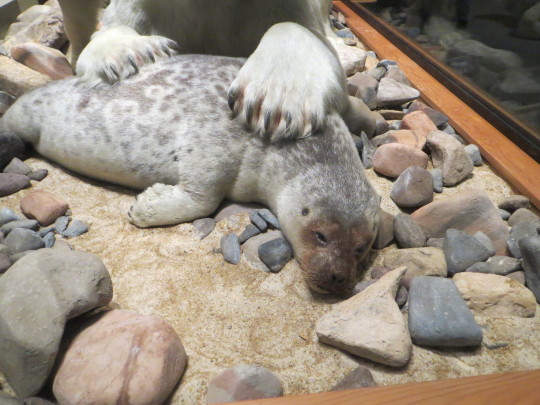
seal taxidermy under paw of polar bear taxidermy

In creating life-like mounts, taxidermists use glass eyes of the proper shape, size, and color.  The glass eyes appear to have lost their luster for the seal that serves as a prey detail in a Polar Bear diorama.
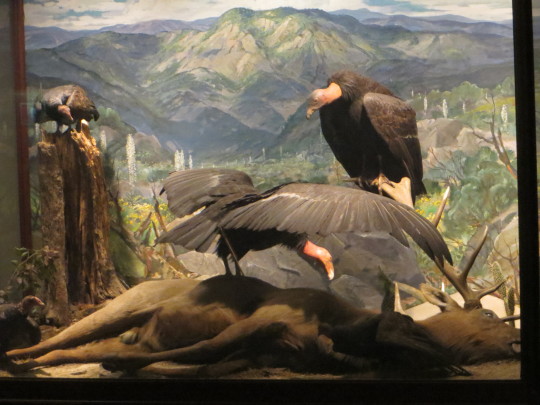
bull elk with large birds in diorama

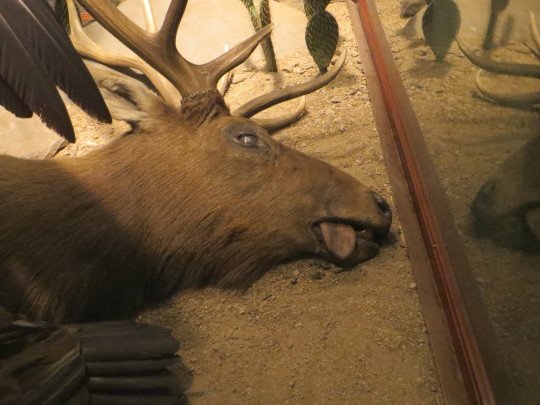
In one of the oldest dioramas within the Hall of North American Wildlife, the centerpiece presence of a dead bull elk indicates the role of both California Condors and Turkey Vultures as scavengers.
detail of bull elk taxidermy

Taxidermy details that indicate the elk’s browsing days are over include dull eyes and a lolling tongue. The tricks of taxidermists are important when they help to explain the role of predators and scavengers, the bedrock biological principle of life from death.

Patrick McShea works in the Education and Visitor Experience department of Carnegie Museum of Natural History. Museum employees are encouraged to blog about their unique experiences and knowledge gained from working at the museum.
Filed Under: Blog Tagged With: diorama, Hall of African Wildlife, Hall of North American Wildlife, mammals, Pat McShea, Patrick McShea, taxidermy

January 28, 2019 by wpengine

F is for Fox

For inhabitants of Western Pennsylvania, the word ‘fox’ as applied to an animal is usually reserved for the red fox (Vulpes vulpes) because if you have seen a fox in an urban area, that is the most likely one you would have seen. Although chiefly nocturnal in its habits, red foxes do venture out during daylight hours. But the red fox is only one of 23 different species of foxes. In fact, 61% of all species in the canid or dog family are foxes; the remainder are dogs, wolves, and jackals.

You might be wondering, what exactly is a fox? A fox is a canid that is distinguished by its pointy snout and bushy tail. In fact, fox comes from an old Germanic word for tail. The collective noun for a group of foxes is a skulk, a leash, or an earth. Males foxes can be referred to as dogs, reynards, or tods, females as vixens, and young as kits, pups, or cubs.

Not all foxes are closely related to each other. There are three main groups. One group is found exclusively in South America and includes eight species; a second group of two species is found in the Americas; and the third and largest group, which includes the red fox, is found all over the world except in South America and Antarctica.

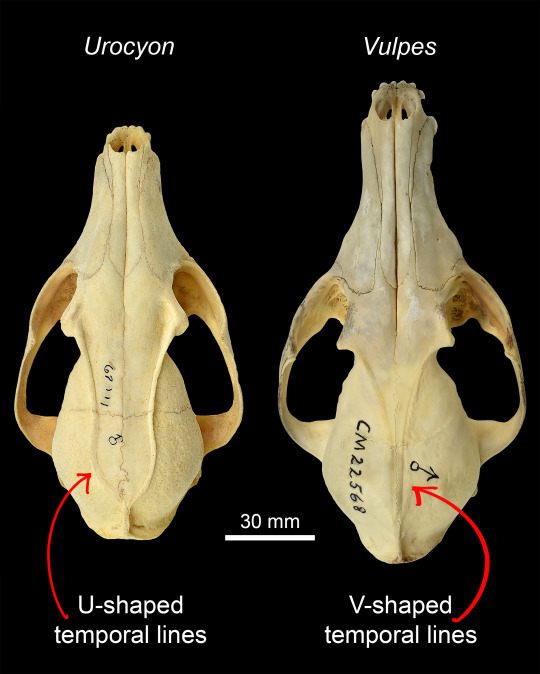
All foxes look like foxes, but they display a remarkable array of behaviors and lifestyles depending on where they live. The two species found in Western Pennsylvania are the red fox (Vulpes vulpes) and gray fox (Urocyon cinereoargentatus). These two are distinguished by their coats, as well as a useful feature on their skulls. Mammals that have strong chewing muscles have prominent ridges on their skulls for muscle attachment. These are called temporal lines. As seen in the photo below, the gray fox has U-shaped temporal lines (i.e., U for Urocyon) and the red fox has V-shaped temporal lines (i.e., V for Vulpes). A convenient coincidence for biologists!

two fox skulls on a black background
Skulls of a gray fox (Urocyon) and red fox (Vulpes) from the Section of Mammals collection, Carnegie Museum of Natural History.

One of our favorite foxes is the Fennec fox (Vulpes zerda). This is the smallest living fox weighing in at less than two kilograms but despite its diminutive size it has the greatest ear size to body size ratio of any fox (see picture below). This little fox is a true survivor, living in one of the harshest environments on the planet: the shifting sand dunes of the Sahara Desert. Their huge ears act as amplifiers providing them with acute hearing for hunting and capturing prey at night. Their ears have an additional purpose – temperature regulation (quite important when you live in one of the hottest environments on Earth). Fennec foxes use the large surface area of their ears to cool their blood. Like dogs, Fennec foxes also have another adaptation for regulating their temperature – they pant. They only start to pant when temperatures reach 95°F, and their breathing rate can increase from 23 breaths per minute to 690 breaths per minute! Get a closer look at a Fennec fox in the Hall of African Wildlife on the second floor of the Carnegie Museum of Natural History.

Photograph of a Fennec fox and a jerboa from the Hall of African Wildlife, Carnegie Museum of Natural History.

Sarah Shelley is a postdoctoral research fellow and John Wible is Curator in the Section of Mammals at the Carnegie Museum of Natural History. Museum employees are encouraged to blog about their unique experiences working at the museum.

Filed Under: Blog Tagged With: Hall of African Wildlife, Hall of North American Wildlife, Sarah Shelley

July 23, 2018 by wpengine

Giant Sable Antelope

By Lisa Miriello

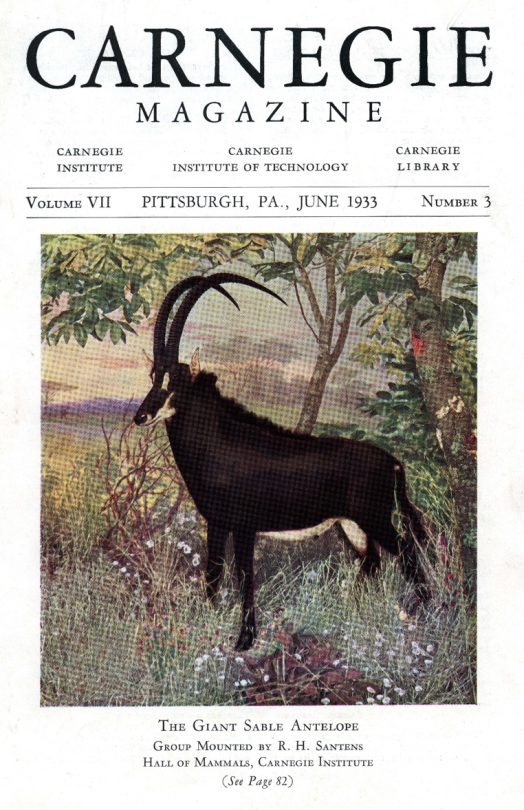
Carnegie magazine cover with giant sable antelope

In 1930, New York publisher Ralph Pulitzer recruited Rudyerd Boulton, the Carnegie Museum of Natural History’s ornithologist, to accompany him to the Portuguese colony of Angola in search of the Giant Sable Antelope. Few American zoologists had explored this region of Africa but Boulton had traveled there in 1925 with the American Museum of Natural History and his knowledge of the territory was invaluable to the Pulitzer party.

Hippotragus niger variani was named as a new subspecies less than fifteen years before the Pulitzer expedition and interest in the scientific community, as well as with big game hunters, grew rapidly. Portuguese authorities soon created new game laws to help protect this rare and impressive animal. Never numerous, today the Giant Sable is critically endangered, threatened by habitat loss, civil war, and poachers. Active conservation efforts continue, but population estimates indicate there are less than a hundred mature individuals, found only in Angola’s Cangandala National Park and the Luando Nature Reserve.

The Carnegie Museum of Natural History is one of only a handful of museums in the country where specimens of the Giant Sable have been preserved. The male collected by Pulitzer was expertly prepared by renowned taxidermy artist R. H. Santens and is exhibited on the museum’s second floor.

Lisa Miriello is the scientific preparator in the Section of Mammals at the Carnegie Museum of Natural History. Museum employees are encouraged to blog about their unique experiences and knowledge gained from working at the museum.
Filed Under: Blog Tagged With: Carnegie Magazine, Hall of African Wildlife, Lisa Miriello, mammals, Section of Mammals

February 7, 2018 by wpengine

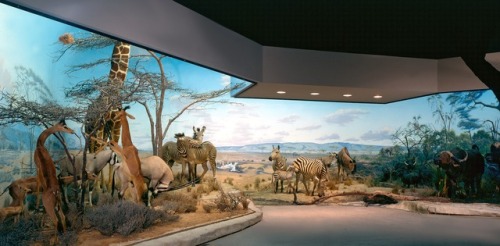
All of the African mammals gathered around the watering hole…

Hall of African Wildlife

All of the African mammals gathered around the watering hole in the Hall of African Wildlife were collected on an early research expedition let by Childs Frick to British East Africa and Abyssinia (now Kenya and Ethiopia).

The official dates of that expedition were 1911–1912, and we can track almost all these specimens to that trip. However, in 1909–1910, Frick took an exploratory trip to part of the area covered in 1911–1912 to scope it out and probably collected the giraffe on that trip at the train stop in Voi.

Filed Under: Blog Tagged With: expedition, Hall of African Wildlife, mammals

August 29, 2017 by wpengine

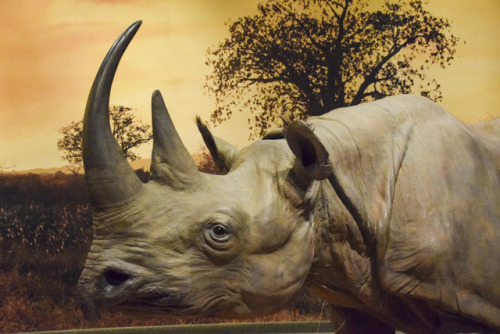
Black rhinoceros

black rhino reproduction
Scattered in small populations throughout the African thornbush, the once-plentiful browsers, the black rhinoceros, may be on the brink of extinction. See a life-sized reproduction of one in the Hall of African Wildlife.

(photo by Hayley Pontia)

Filed Under: Blog Tagged With: Hall of African Wildlife

May 30, 2017 by wpengine

Ostriches

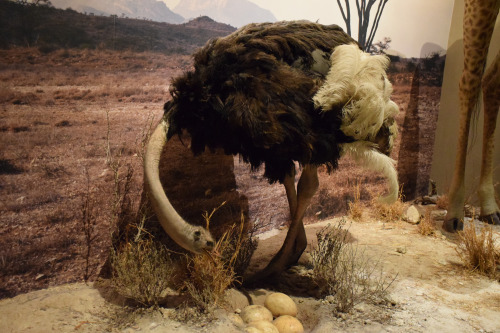
Ostrich taxidermy
Ostriches, like this one on display in the Hall of African Wildlife, are the largest living birds.

Filed Under: Blog Tagged With: Hall of African Wildlife

  • « Go to Previous Page
  • Page 1
  • Page 2
  • Page 3
  • Go to Next Page »

sidebar

About

  • Mission & Commitments
  • Directors Team
  • Museum History

Get Involved

  • Volunteer
  • Membership
  • Carnegie Discoverers
  • Donate
  • Employment
  • Events

Bring a Group

  • Groups of 10 or More
  • Birthday Parties at the Museum
  • Field Trips

Powdermill

  • Powdermill Nature Reserve
  • Powdermill Field Trips
  • Powdermill Staff
  • Research at Powdermill

More Information

  • Image Permission Requests
  • Science Stories
  • Accessibility
  • Shopping Cart
  • Contact
  • Visitor Policies
One of the Four Carnegie Museums | © Carnegie Institute | Privacy Policy | Terms of Use | Accessibility
Rad works here logo