• Skip to primary navigation
  • Skip to main content
  • Skip to primary sidebar

Carnegie Museum of Natural History

One of the Four Carnegie Museums of Pittsburgh

  • Visit
    • Buy Tickets
    • Visitor Information
    • Exhibitions
    • Events
    • Dining at the Museum
    • Celebrate at the Museum
    • Powdermill Nature Reserve
    • Event Venue Rental
    • Gift Cards
  • Learn
    • Field Trips
    • Educator Information
    • Programs at the Museum
    • Bring the Museum to You
    • Guided Programs FAQ
    • Programs Online
    • Climate and Rural Systems Partnership
  • Research
    • Scientific Sections
    • Science Stories
    • Science Videos
    • Senior Science & Research Staff
    • Museum Library
    • Science Seminars
    • Scientific Publications
    • Specimen and Artifact Identification
  • About
    • Mission & Commitments
    • Directors Team
    • Museum History
  • Tickets
  • Give
  • Shop

invertebrate paleontology

September 25, 2020 by wpengine

From Collector to Director

image
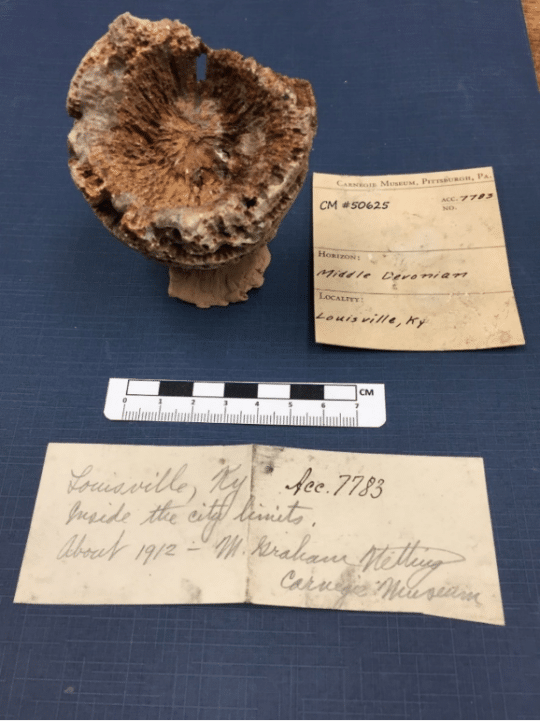
Figure 1: CM 50625 – Rugosa Coral. Collected by M. Graham Netting in 1912.   Coral body shape has a radial symmetry.

In 1912, eight-year-old M. Graham Netting unearthed 13 coral fossils within the city limits of Louisville, Kentucky.  Later, as a 22-year-old Pitt student, he donated them to the Carnegie Museum of Natural History (Figure 1).   When the Great Depression cut short his graduate studies at the University of Michigan in 1929, he returned to the museum as Assistant Curator of Herpetology, and worked his way up to Curator in 1932.   In 1954, six months before turning 50, he was appointed Director of the Carnegie Museum of Natural History.   Along the way, the Wilkinsburg native left an astonishing legacy that includes a steady growth in scientific collections, numerous wildlife dioramas in the Halls of Wildlife, and a mid-Appalachian field research station, Powdermill Nature Reserve.  Upon his retirement in 1975, the Post-Gazette noted, “Long before it was “in,” Netting saw pollution of the air and water ravaging the land.”

Albert Kollar, Collection Manager of the of Section of Invertebrate Paleontology, re-discovered young Graham Netting’s horn corals while working on a multiyear review of the Bayet Collection.  Netting’s label note did not provide any evidence for the stratigraphic unit that he collected from, but more on that later.
image
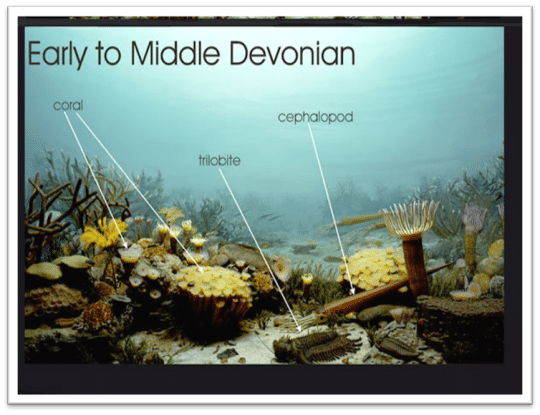
Figure 2: Carnegie Museum of Natural History exhibit reconstruction of an Early to Middle Devonian reef, 375 – 390 MYA.  The reef shows Rugosa and Tabulate corals, a spiny trilobite about 18 inches in length and several straight cephalopods.   Coral tentacles (shown in white) are illustrated in feeding mode.  Both Rugosa and Tabulate corals went extinct at the end of the Permian Period.

Rugose corals are often called horn corals because many species have a horn shape.  Horn corals attach to the sea floor by way of a sticky tentacle that protrudes from the base or curved end of the animal.  Other invertebrate animals, such as brachiopods, attached in this position are described as sessile.  The coral animal or “polyp” built its skeleton from calcium carbonate, a mineral formed from Bicarbonate and Calcium ions in seawater.  The polyp tentacles or feeding polyp extend out from the top of the basic body for feeding (Figure 2).  When the animal died, its soft tissues would have decayed and left behind the external hard mineral skeleton that fossilized.

Netting’s Louisville coral specimens are fossilized in a different way than similar corals from the nearby Falls of the Ohio middle Devonian fossil beds.  His corals are lighter and fragile to the touch, conditions which gave Albert reason to compare Netting’s fossils to similar invertebrate paleontology corals from strata within the Louisville area.  Sometime during or after burial, these horn coral skeletons were replaced by silica or quartz, a process known as silicification. The mineral silica can saturate a column of seawater when the seabed is overwhelmed with a large population of sponges.  Sponge skeletons are composed of silica and when they die silica is added to a column or more of seawater.  Volcanic eruptions eject silica into the atmosphere that eventually settles into the sea.  Again potentially adding higher amounts of silica.  Whatever the cause, Albert believes Netting’s corals were collected from the fossiliferous Middle Devonian age Jeffersonville Limestone, where the “lower foot of a “conglomerate” of reworked silicified Louisville Limestone” of Upper Silurian age is known to occur with silicified coral fossils (Conkin and Conkin, 1972).

Horn and Tabulate corals thrived in shallow seas forming diversified ecological reefs from about the late Silurian Period to the beginning of the Late Devonian epoch. During the Middle Devonian epoch roughly 400 Ma to 390 Ma years ago, reefs formed in central New York, southern Ontario, central Ohio, central Iowa, western Alberta, Canada, western Australia, and in Eifel, Germany.
image
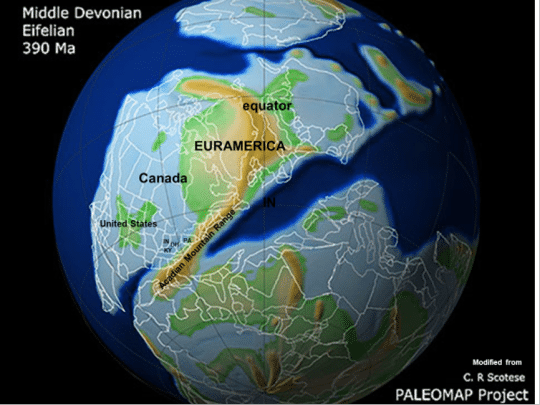
Figure 3:  Paleogeographic Map of the Middle Devonian Period – Kentucky is well south of the equator.

Louisville, during the Devonian Period, was centered in the southern hemisphere about 40 degrees south of the equator. Because of plate tectonics, the coral beds of Louisville would travel 5,500 miles over the next 390 million years to their present-day location of 38 degrees north (Figure 3). Today, fossil outcrops in the city limits of Louisville are difficult to find.
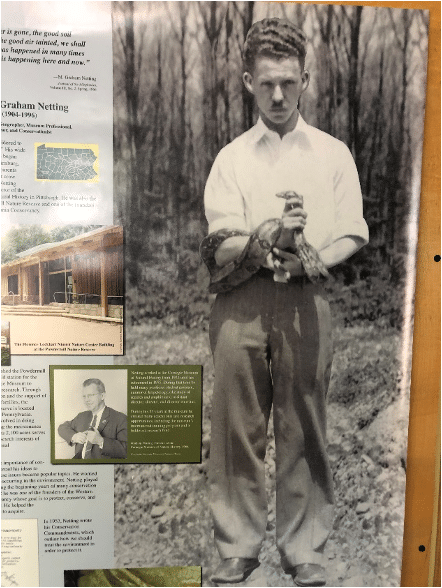
Figure 4: Graham Netting in his twenties.

When Netting retired as Director of Carnegie Museum of Natural History, he moved to a modest house next to Powdermill Nature Reserve.   A seat was saved for him each Sunday at the reserve’s weekly nature talk.  In 1996, he passed away.  Steve Rogers, Collections Manager for the Section of Birds, recalls sipping fresh lemonade on Netting’s back porch in 1981.   According to Rogers, Netting was reflective and humble.   The fossil collector who became a museum director had a habit of rubbing his chin while listening to someone speak.   When asked about his legacy, Rogers replied, “He was more instrumental in forming Powdermill than anyone.  He had an amazing ability to be a part of a team that got things done.”
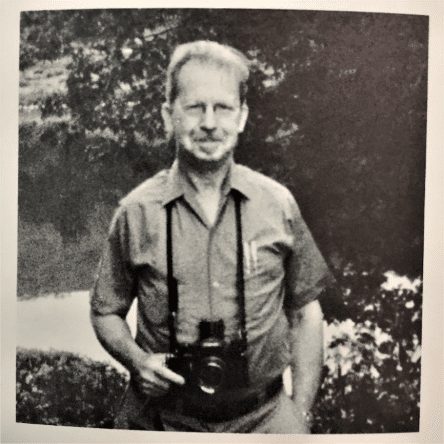
Figure 5: Graham Netting at Retirement in 1975.

As Netting prepared to step down as director in 1975, he said, “These great collections are a natural resource to answer questions about the life of the world.” On a recent day, I saw two children jumping up and down in front of the Glacier Bear diorama in Hall of North American Wildlife on a family visit to the museum.   When one of the children asked, “what’s a diorama?” I thought about Graham Netting, smiled, and encouraged their engagement with the life of the world.

Many thanks to Xianghua Sun, Carnegie Museum Library Manager, Marie Corrado, Carnegie Museum Library Clerk, Stephen Rogers, Collections Manager for the Section of Birds, and John Wenzel, Director of Powdermill Nature Reserve for help researching this post.  

Joann Wilson is an Interpreter in the Education Department at Carnegie Museum of Natural History and Albert Kollar is Collections Manager for the Section of Invertebrate Paleontology. Museum employees are encouraged to blog about their unique experiences and knowledge gained from working at the museum.
Related Content

CMP Travel Program and Section of Invertebrate Paleontology Promote the 125th Anniversary of Carnegie Library of Pittsburgh with an Outdoor Walking Tour

Hidden Treasure of Pittsburgh Found

Harriet Tubman Was a Naturalist

Filed Under: Blog Tagged With: Albert Kollar, Graham Netting, invertebrate paleontology, Joann L. Wilson, Museum from Home, Powdermill Nature Reserve, Science News

September 24, 2020 by wpengine

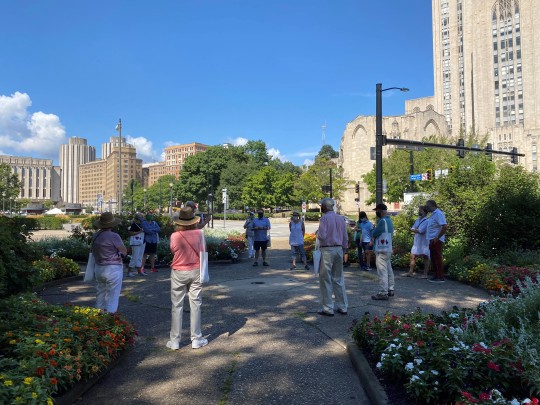
CMP Travel Program and Section of Invertebrate Paleontology Promotes the 125th Anniversary of the Carnegie Library of Pittsburgh with an outdoor walking tour

Before Carnegie Museums of Pittsburgh (CMP) reopened to the public on June 28th, Barbara Tucker, Director of CMP’s Travel Program, talked with me about ways to reengage members and bring them back to the Oakland museums.

With knowledge about my research on the 125th Anniversary of the founding of the Carnegie Library, Barbara suggested a 90-minute outdoor walking tour around the exterior of the massive building.  Starting from where the oldest portion of the building (Portal Entry) meets the newest (Museum of Art) to the front of the historic library entrance, past the Diplodocus carnegii statue, to Forbes Avenue and the entrances of the music hall, natural history museum, and fine arts museum guarded by the statues of the noble quartet.

photo of people standing in a circle in a park
Fig. 1

The tour was advertised on the CMP website under the Travel Program link, https://carnegiemuseums.org/things-to-do/travel-with-us/ and https://carnegiemuseums.org/kollar/, and accurately described as an activity fully compliant with CDC protocols. Within a week, the tour received overwhelming signups, which were organized by date and number of participants by Travel Program assistant Isabel Romanowski. Three tour dates were set in August and several more in September. Special private tours for donors and others in the fall continue to be arranged.

Andrew Carnegie, Founder:

As guide for an exercise that involves close observation of architectural details, I face the challenge of getting participants to imagine this section of Pittsburgh long before any of the structures around in Oakland existed. The library and museums cover five acres of flat bottom land formed by the pre-Ice Age Monongahela River more than 1.2 million years ago. In far more recent times, the land was part of the Mary Schenley Mount Airy tract of 300 acres which was donated to the City of Pittsburgh in 1889 to create Schenley Park in her honor. Andrew Carnegie, (1835 – 1919) industrialist, steel magnate, and philanthropist, in 1895 saw the site as a place to build a complex with a library, fine arts gallery, science museum, and music hall that would represent the noble quartet of literature, art, science, and music.

The Library Tour Themes:

the word Carnegie in gray above the word Carnegie in red
Fig. 2

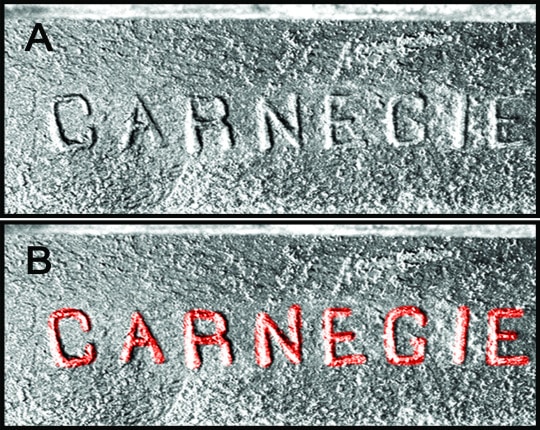
Tour groups assemble on the dark stone steps outside the Carnegie Museum of Art (CMOA) rear entrance for an introduction focusing on the two connected, but architecturally different buildings: the Beaux-Arts style Carnegie Complex, with the original structure dating to1895, and later addition to 1907, which was built by Longfellow, Alden, and Harlow using Carnegie Steel (Fig. 2), and the modern Carnegie Museum of Art, built by architect Edward Larrabee Barnes in 1974.

Two rock types distinguish the building exteriors. The older portions of the building are clad in a light grey, easily carved, 370 million-year-old Berea Sandstone from Amherst, Ohio, while the exterior and much of the interior of Museum of Art is covered in the 295 million-year-old bluish iridescence Larvikite igneous rock from Larvik, Norway. When Barnes was commissioned to build CMOA, he chose the dark rock to blend with the older building’s coal dust veneer, a grime coating that was removed when the exterior stone was cleaned in 1990.

Landscape Art and Geology:

image of the painting "Cathedral of Learning" by John Kane
Fig. 3

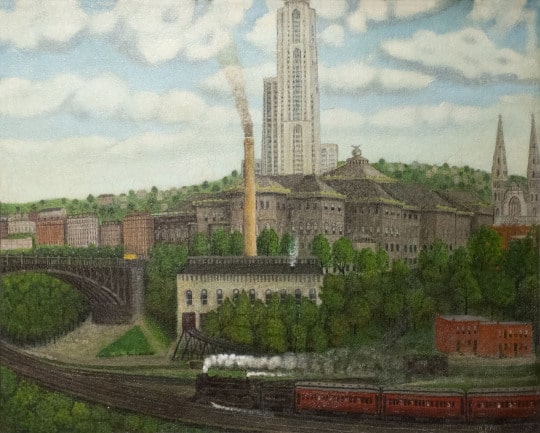
Pittsburgh’s landscape painter, John Kane’s (1860 – 1934), Cathedral of Learning, circa 1930 (Fig. 3), depicts the 150-foot-deep Junction Hollow with its operating railroad. The work also includes many important architectural references, the Schenley Park Bridge (1897), Carnegie Institute’s Bellefield Boiler Plant (designed by Alden and Harlow in 1907 to supply electricity and heat to adjacent buildings), the Carnegie Institute Extension (1907), and a then unfinished Cathedral of Learning. This painting is part of CMOA Fine Arts collections.

image of John Kane painting "Panther Hollow" above a photo of the same spot with geological images on top
Fig. 4

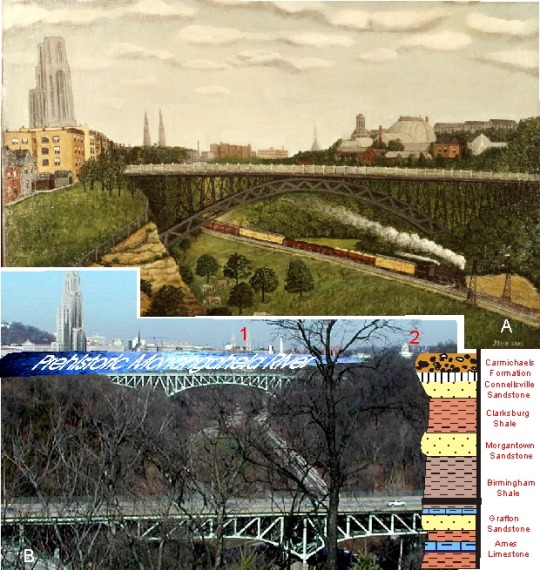
Another John Kane landscape, Panther Hollow, circa 1930 – 1934, (Fig. 4A) in combination with Cathedral of Learning has been used in teaching about the 300 million-year-old geology of Schenley Park (Fig. 4B2) and the pre-Pleistocene Monongahela River that formed the flat bottom landscape of Oakland, and through erosion, Junction Hollow (Fig. 4B1).  Kollar and Brezinski 2010, Geology, Landscape, and John Kane’s Landscape Paintings.

Junction Hollow Landscape:

Kane’s Cathedral of Learning (1930) is an idealized green space of Junction Hollow, the Wilmot Street Bridge in the foreground (1907) now replaced with the Charles Anderson Bridge (1940), and Carnegie Tech’s (now Carnegie Mellon University’s) Hamerschlag Hall or Machinery Hall (1912), built by Henry Hornbostel, a Pittsburgh architect. Hornbostel designed a circular Roman temple wrapped about a tall yellow brick smokestack (Fig. 4A). The design is based on the Roman temple of Vesta in Tivoli, Italy, dating to the early 1st century BC. Hornbostel’s overall campus design focused on connection between art and science, with Junction Hollow representing the geological sciences. The architect Philip Johnston, who built Pittsburgh’s postmodern PPG Place (circa 1984), once contrasted the Bellefield Boiler Plant smokestack as “the ugliest in the world to Machinery Hall’s smokestack as the most beautiful.” In novelist Michael Chabon’s debut novel, The Mysteries of Pittsburgh, (1988) the Bellefield Boiler Plant, termed “the cloud factory” by the narrator, is the setting for a pivotal scene.

Carnegie Library of Pittsburgh (Main):

black and white image of Carnegie Library of Pittsburgh
Fig. 5

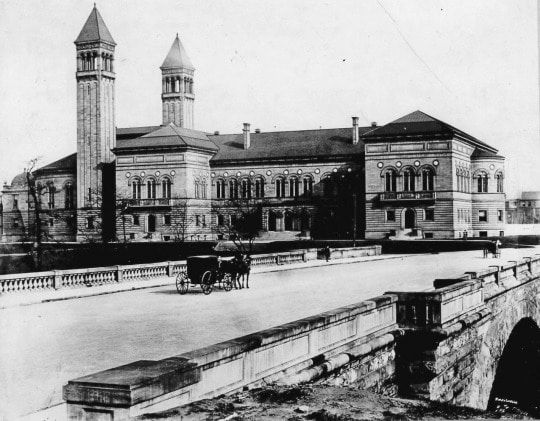
The separate institutions we now know as Carnegie Museum of Natural History and Carnegie Museum of Art can track their origins to exhibits and galleries within space now fully occupied by Carnegie Library of Pittsburgh. An image of the Carnegie Library of Pittsburgh in 1902 from the Bellefield Bridge, a structure now buried under the Mary Schenley Memorial Fountain (1918), reveals eclecticism in architectural features (Fig. 5). The west facing frontage doorways and portico of the library features, CARNEGIE LIBRARY, FREE TO THE PEOPLE, and 24 carved writer names. Missing from the names is Carnegie’s favorite poet, Robert Burns, whose statue was dedicated in 1914 on the grounds of Phipps Conservancy. Three separate entrances are served by granite steps of Permian age from Vermont, one for the science museum, one for the Department of Fine Arts, and the third, with distinctive Romanesque round doorways, brass doors with intricate features, and keystone scrolling, for the Library. This entrance was designed by Harlow, who was the draftsman on the McKim, Mead, and White team responsible for the Beaux-Arts Boston Public Library (1895). When the Carnegie Institute Extension was constructed in 1907, the science museum and fine arts museum collections were moved into the new space. The former spaces in the library became the Children’s Room, Pennsylvania Room, and Music Library.

drawing of Carnegie Library of Pittsburgh
Fig. 6

Carnegie Music Hall
Fig. 7

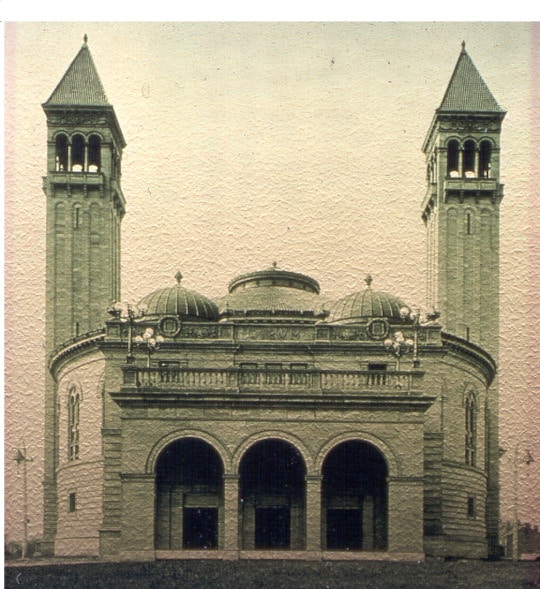
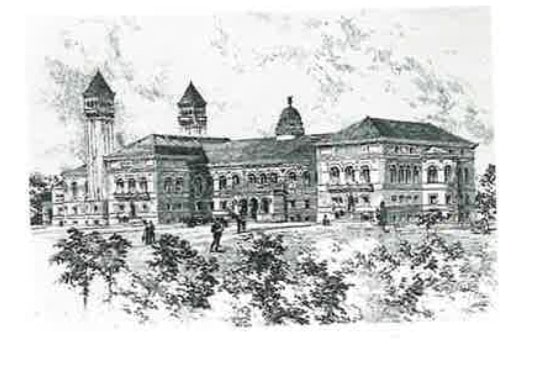
A challenge at this point in the tour involves discussing features that are not visible up close. The Longfellow, Alden, and Harlow’s Italian Renaissance and Beaux-Arts H-shaped parallelogram winning design featured a copula (Fig. 6) on top of the red tile roof that was never built.  Eclecticism features include a double apse, a smaller shaped semi-circular extension of the library’s wall on the southside of the building, and larger apse on the north or Forbes Avenue side of the building, with the semicircular Music Hall auditorium, designed by Longfellow. The music hall exterior was structurally changed by the 1907 construction (Fig. 7).

The exterior Berea Sandstone reveals rustication masonry techniques with the cut blocks on the exterior first floor level distinguished by ashlar pillow horizontal border stone, and smooth masonry from the second floor to the cornice below the roof line.  The second floor late Gothic style windows are divided by a vertical element called a mullion that helps with rigid support of the window arch and divides the window panels. Two symmetrical Campanile towers that Carnegie called “those donkey ears” were modeled after the San Marco Bell Tower in Venice, Italy. The towers served as an architectural offset to the semicircular exterior walls of the music auditorium and were removed in 1902 for the construction of the Carnegie Institute Extension. The installation of the towers can be interpreted as a tribute to Henry Hobson Richardson’s Allegheny County Courthouse twin towers (1888).

Architects choice of light grey sandstone and red tile roof:

The library’s red tile roof incorporated multiple glass roofs over the library, fine arts galleries, and science museum (all shaded from exterior sunlight today) which typified the Beau-Arts style. Keep in mind, the library did not have electric light. Light was provided by gas lighting and natural sunlight.  Longfellow, Alden, and Harlow wrote that “the choice of a red tile roof and grey Ohio (Berea) Sandstone was intentional to contrast with Pittsburgh’s grey skies and the changing seasonal colors of the foliage in Schenley Park.”

The Beaux-Arts Architecture of the Carnegie Institute Extension 1907:

photo of Carnegie Institute extension
Fig. 8

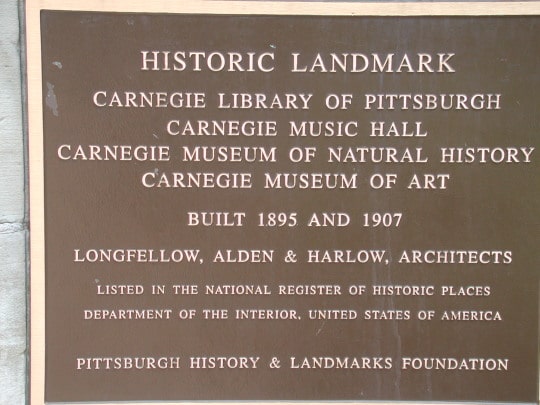
sign that reads Historic Landmark Carnegie Library of Pittsburgh Carnegie Music Hall Carnegie Museum of Natural History Carnegie Museum of Art Built 1895 and 1907 Longellow, Alden & Harlow, Architects Listed in the National Register of Historic Places Department of the Interior, United States of America Pittsburgh History & Landmarks Foundation
Fig. 9

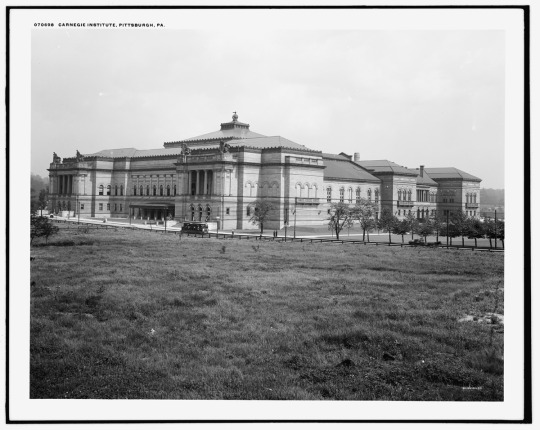
After Longfellow returned to his Boston practice in 1896, Alden and Harlow received the commission to build the Carnegie Institute Extension (1907) (Fig. 8). Their efforts created one of the great Beaux-Arts building in the United States. As Cynthia Field, Smithsonian Architecture Historian, stated in 1985, “the building itself is the greatest object of the entire museum collection.” Formal recognition of the building’s architectural importance exists in two historic landmark plagues placed outside of the Carnegie Library entrance and the Museums’ Carriage Drive entrance (Fig. 9).

New exterior features of the 1907 extension work included the replacement of the red tile roof with copper, the addition of an armillary sphere,  the construction, with a colonnade of solid Corinthian fluted columns of Berea Sandstone, four portico porches over the main entrances to the library, music hall, natural history and art museum, and eastside of building (now removed), and the creation, along Forbes Avenue, of a main Carriage Drive entrance with direct access to the galleries. The carved names of authors, artists, musicians, and scientists in the buildings’ entablature, a Victorian era practice, extends around the building from the library’s southeast corner to the music hall entrance, and natural history and the fine arts entrances.

Also notable along Forbes Avenue are John Massey Rhind’s noble quartet statues that guard the Music Hall and Natural History and Art entrances. The four male figures all seated in classic Greek chairs are Michelangelo (art), Shakespeare (literature), Bach (music), and Galileo (science).  Standing three stories above the quartet on the edge of the roof, four groups of female allegorical figures represent literature, music, art, and science as well. The bronze figures were casted in Naples, Italy in 1907 (Fig 8).

Inside the 1907 Architecture and Building Stones:

The architects created 13 new interior spaces where three grand spaces stand out for specific architecture styles such as, the Beaux-Arts Grand Staircase (voted in 2018 as the 8th best museum staircase in the world), the Neoclassical Hall of Sculpture, and neo-Baroque Music Hall Foyer. The extension used 32 varieties of marbles and fossil limestones, many from antiquity, quarried and imported from Algeria, Croatia, France, Greece, Ireland, Italy, and the United States.

Since 2004, the collaboration between the CMP Travel Program and the Section of Invertebrate Paleontology has been highly successful reaching out to our members and patrons. This summer’s tours generated some particularly appreciative comments:

The Carnegie’s resident scientists are a defining characteristic of this noble institution. Might be an anachronism in an era when museums are focused on providing ‘destination’ entertainment and hosting special events for swells, but while treasures like Dr. Kollar are still on staff, it’s a splendid idea to facilitate interaction between them and museum visitors. Congratulations on a most enjoyable program. -Ron Sommer

Albert was very informative and interesting. I found it most valuable learning the history of the area. -Janet Seifert

I can’t stress enough how unusual and interesting it was to have a geologist give us the tour. It had never occurred to me before that there’s so much one can learn about building materials from a geologist. -Neepa Majumdar

Albert D. Kollar is Collection Manager and Carnegie’s Historian of the Carnegie’s Building Stones. Barbara Tucker is Director of Carnegie Travel Program.

Related Content

The Connemara Marble

Giant Eurypterid Trackway

Smoking Fossils

Filed Under: Blog Tagged With: Albert Kollar, geology, invertebrate paleontology, Science News

July 2, 2020 by wpengine

Behind the Scenes with the Baron de Bayet and L. W. Stilwell Collection, Part 4:  Buying and Selling Fossils in the 19th Century

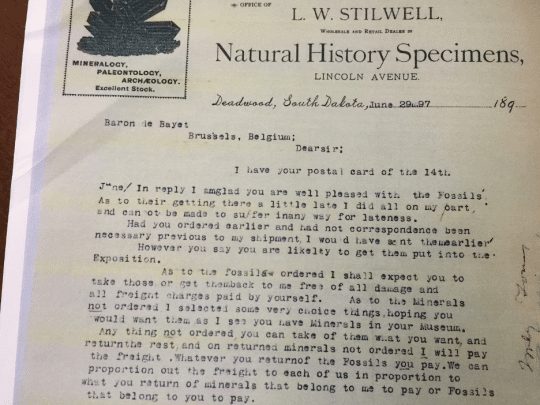
Figure 1:  Letter from Stilwell to Bayet, June 29, 1897 (Carnegie Museum of Natural History, Section of Invertebrate Paleontology)

In this, our fourth and final installment, we will look at the Stilwell-Bayet letters. Because letter writing was the central form of communication in the late 19th century, this correspondence documents past collecting practices.  Although the Carnegie Museum’s Bayet archive retains only Stilwell’s part of the correspondence, the letters provide insight into their business relationship.

Procuring Fossils Was Time Consuming and Expensive

In June of 1897 (Figure 1), Lucien W. Stilwell wrote, “In reply, I am glad you are pleased with the Fossils.  As to their getting there a little late, I did all on my part and cannot be made to suffer in any way for lateness.  Had you ordered earlier and hand [sic] not correspondence been necessary previous to my shipment, I would have sent them earlier.”  Shipping was labor intensive and costly in the late 1800’s.  Additionally, the risk of breakage was high.   The trip from South Dakota to Brussels required multiple carriers and involved wagons, trains and ships.    From start to finish the trip could take months.  One Stilwell receipt dated January 12, 1889, shows the cost of shipping two boxes from New York to Brussels at $5.05, or about $141 today.   Keep in mind, this figure does not include the cost of shipping from the Dakota Territories to New York.

Negotiating Was as Wild as the West

Deal making was a delicate dance.  Stilwell wanted to maximize profit.  Bayet wanted the best price.  In March 1889 Stilwell states “I do not know what new animal you spoke of.  I sent the new ammonite.  As to shipping and getting them away across the ocean, before we agree on price, that is a rather indefinite way and might be an expensive thing.  I can say now, that if people do not want to give what I ask for these heads [Cenozoic mammal heads], I do not care to collect them for when I base my prices on the cost of finding and cleaning them and the cash expense and place them as reasonable as anyone can afford to do the work then I would cease to collect them.”

Let the Buyer Beware

Sometimes, lines were crossed.  In addition to invertebrates, Stilwell sold Bayet Cenozoic mammal fossils from the Badlands.  Stilwell references a mammal skull in the quote above.   In 2004, Spencer Lucas of the New Mexico Museum of Natural History and Science, wrote a paper titled “O.C. Marsh and the Eocene Brontothere Teleodus:  A Paleontological Hoax.  In it he describes negotiations between paleontologist O.C. Marsh and Lucien W. Stilwell.  Lucas concludes that Stilwell, or someone in his employ, added extra teeth to a brontotherium skull in order to induce Marsh into paying a higher price.   At that time, Marsh did not notice that the teeth were doctored.  According to Lucas, Marsh was determined to have the skull at the lowest possible price.  He convinced Stilwell that the skull was not a new species and Stilwell eventually sold him the skull for a reduced figure.  The altered teeth were not discovered until 1982 by Lucas and Schoch.   Lucas concluded in 2004 that, “The Teleodus avus hoax is yet another example of the authenticity problems inherent to the commercial purchase of fossils as well as the great capacity all paleontologists have for seeing what they want to see in a fossil, not what actually is there.”

Albert Kollar notes that to his knowledge there is no indication that any of Bayet’s invertebrate specimens were fabricated or distorted.

The Stilwell-Bayet Correspondence is a fascinating look at collecting and negotiating in the “Wild West” a century ago.   Preparation of fossils for shipping was time consuming and risky.  Rarity and preservation quality often dictated price and it was a “buyer beware” marketplace.   The items in the Carnegie Museum of Natural History collections give a glimpse into the mores, history and values of a past business climate.   Stories, such as this one, also provide an opportunity to think about the future.   One wonders what collecting adventures, conducted by museum scientists today, will resonate with future generations and what conclusions they may draw.

Joann Wilson is an Interpreter for the Department of Education and a volunteer with the Section of Invertebrate Paleontology and Albert Kollar is Collections Manager for the Section of Invertebrate Paleontology. Museum employees are encouraged to blog about their unique experiences and knowledge gained from working at the museum.
Related Content

Ask a Scientist: What is a Trilobite?

The Giant Eurypterid Trackway

Tribute to Otto Epping

Filed Under: Blog Tagged With: Albert Kollar, invertebrate paleontology, Museum from Home, Science News

June 19, 2020 by wpengine

Behind the Scenes with the Baron de Bayet and L. W. Stilwell Collection, Part 2:  The Wild West a Century Ago

black and white photo of Deadwood from a distance
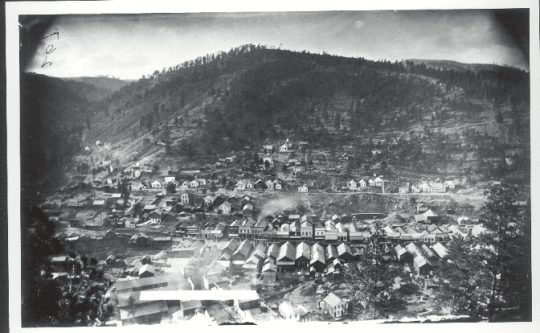
Figure 1:  Deadwood, Dakota Territories 1879.   Image courtesy of the Deadwood Historic Preservation Commission, City of Deadwood Archives.

black and white photo of a Deadwood street
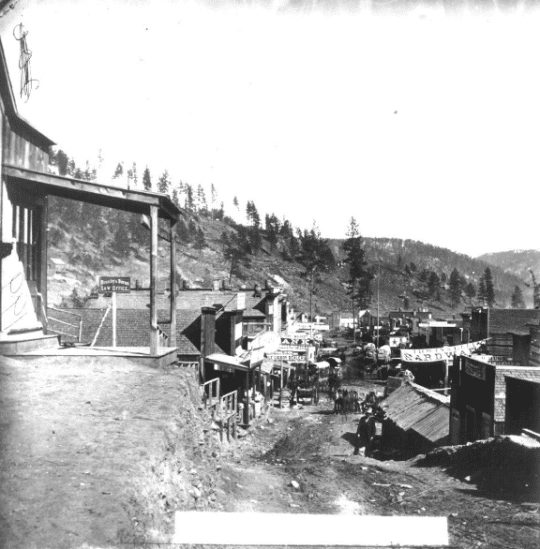
Figure 2:  Deadwood, Dakota Territories 1879.  Image Courtesy of Deadwood Historic Preservation Commission, City of Deadwood Archives.

Fancy yourself on the hottest day in summer in the hottest spot of such a place without water — without an animal and scarce an insect astir — without a single flower to speak pleasant things to you and you will have some idea of the utter loneliness of the Bad Lands.”   Thaddeus Culbertson, 1850

When Lucien Stilwell stepped off the stagecoach on September 25, 1879, he was not your typical visitor to Deadwood.  Photos of Stilwell in later years show a thin scholarly figure with glasses. In 1879, Deadwood, Dakota Territories was known for gold prospecting, gambling and lawlessness.  Just three years prior, Wild Bill Hickock had been shot in the back while playing poker here.  It would be a few more years until Seth Bullock, first sheriff of Deadwood, would begin to bring order to town.

As Stilwell stepped off the stagecoach, he was leaving a fifteen-year career in the grocery and grain business in Cairo, Illinois.  A yellow fever epidemic blanketing parts of the United Sates prompted him to uproot his life.  He arrived just one day before a fire destroyed over 300 buildings and displaced over 2000 people in Deadwood.   According to Michael Runge, City Archivist of Deadwood South Dakota, photos of Deadwood in 1879 (Figures 1 and 2), were taken just before the great fire.  If you look closely at Figure 2, you can see a law office, hardware store, liquor store, and city market.

Despite the great fire and the dangers of Deadwood, Lucien W. Stilwell found a job at a bank, brought his family to town and built a home.  Along the way, he became fascinated by the fossils in the surrounding Black Hills.   He began a careful study of the region and developed relationships with other fossil collectors.   Eventually, he turned his hobby into a side business.

photo of faculties fossil

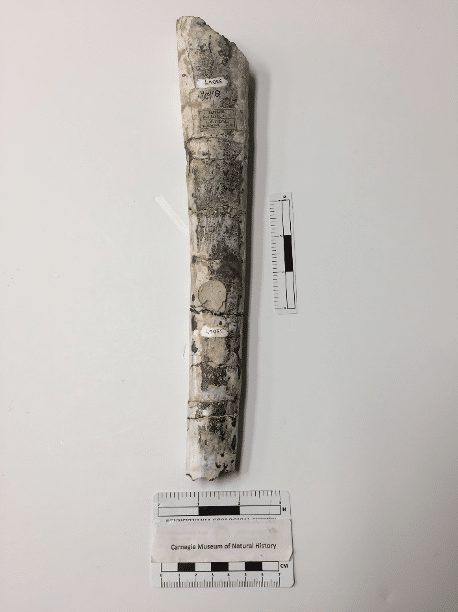
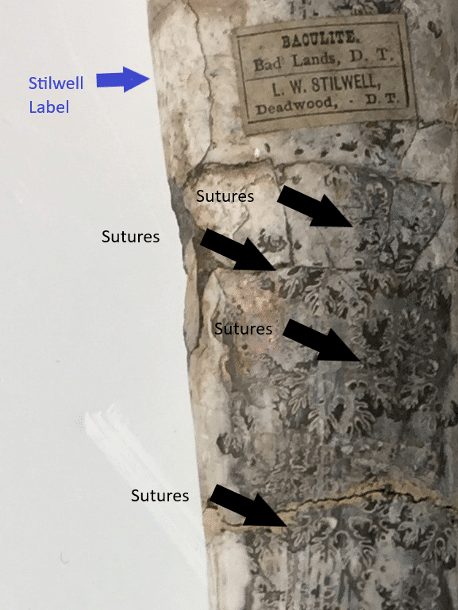
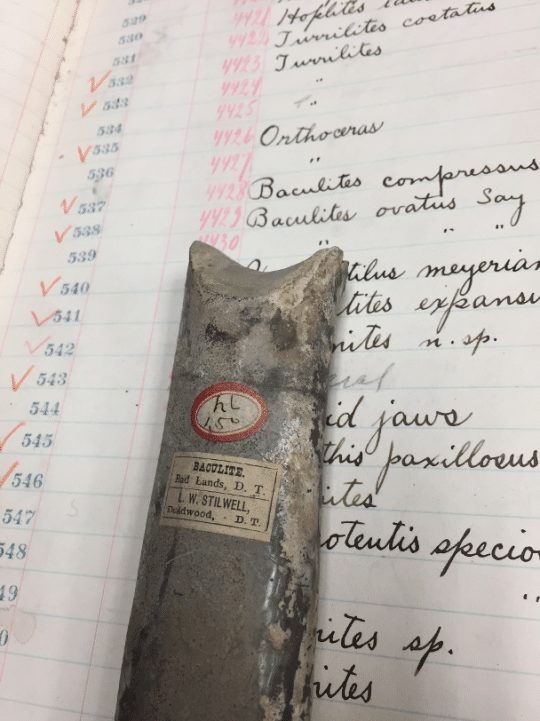
Figures 3 & 4:  CM 33067 – Baculites collected by Stilwell.  Baculites, translated as “walking stick rock”, are an extinct group of straight cephalopods that swam the seas 75 to 80 million years.  “Sutures” or growth lines are formed when the animal adds new shell material as it grows.  Sutures assist paleontologists in the identification of the genus and species.

Prior to leaving the bank in 1890, Stilwell began selling Badland fossils and minerals.  In a correspondence to the Baron de Bayet of Brussels dated January 12, 1889, Stilwell said, “I tried to catch your meaning in your last letter.  As I understand it, you wanted one of every specie and variety of fossils I had, excepting the large and costly specimens of mammals.”    

In one letter to Bayet, Stilwell wrote, “I put in a number of baculites, all of which have some different interest.  One is to show fine sutures another to show iridescence to rare degree, another to show size, another to show form so differing as to be a specie of baculite by another name…”   Albert Kollar of the Section of Invertebrate Paleontology explained that in circumstances when the exact stratigraphic locality is questionable, having the original fossil labels as seen in Fig. 4 are critical to accurate fossil identification.  Stillwell was a capable researcher because of his grasp of the geology and paleontology of the Badlands region.  Figures 3 and 4 show a baculites sold by Stilwell to Bayet.  There are 100 Stilwell fossils in the 130,000 specimen Bayet collection.

The next post in this series will explore why dealers such as Lucien W. Stilwell, found so many fossils in the Badlands.

Many thanks to the generous assistance of Michael Runge, Archivist for the City of Deadwood, South Dakota.

Joann Wilson is an Interpreter for the Department of Education and a volunteer with the Section of Invertebrate Paleontology. Albert Kollar is Collections Manager for the Section of Invertebrate Paleontology. Museum employees are encouraged to blog about their unique experiences and knowledge gained from working at the museum.
Related Content

Behind the Scenes with the Baron de Bayet and L. W. Stilwell Collection, Part 1: Crossing the Atlantic with a Boatload of Fossils

Bayet’s Bounty: The Invertebrates That Time Forgot

A Century Ago, a Donor Walked into the Carnegie Museum

Filed Under: Blog Tagged With: Albert Kollar, Benedum Hall of Geology, invertebrate paleontology, Joann L. Wilson, Museum from Home, Science News

June 11, 2020 by wpengine

Behind the Scenes with the Baron de Bayet and L. W. Stilwell Collection, Part 1:  Crossing the Atlantic with a Boatload of Fossils

Figure 1:  Baculites fossil from the Bayet Collection with L. W. Stilwell label.

Why did a wealthy European baron seek out a Dakota Territories fossil dealer in the winter of 1889?    This post is the first of a four-part series on renowned 19th century fossil collectors Baron de Bayet of Brussels and Lucien W. Stilwell, and their connection to the Carnegie Museum of Natural History.  Bayet assembled one of the great private fossil collections in Europe.  In 1903, Andrew Carnegie bought the 130,000-fossil collection and had it shipped from the Port of Antwerp in Belgium across the Atlantic to the United States.  The purchase garnered headlines in newspapers across Europe and in the United States and launched Carnegie’s fledgling museum onto the world stage.  Thanks to the archival materials purchased by Carnegie as part of the Bayet deal, the relationship between Baron de Bayet and Lucien W. Stilwell provides a glimpse into how the Carnegie Museum of Natural History and other institutions built their collections.   In part one, we consider what forces may have prompted Bayet to assemble a large collection of fossils in the first place.

The Pathway to Fossil Collecting Travelled Through the Principles of Stratigraphy and Geology

From the late 17th century until the early 19th century, collecting fossils was a hobby of gentlemen farmers and naturalists.  Some of these collectors developed fundamental principles of geology and stratigraphy through observations and deductive reasoning, as to how rock layers, or strata, are formed, fully earning credentials as scientists.  For example, in the 17th century physician Nicolaus Steno’s (1638 – 1686) observed simple patterns in strata during his walks through the hills of northern Italy.  The four Laws of Stratigraphy he proposed are the law of superposition, the law of original horizontality, the law of cross-cutting relationships, and the law of lateral continuity.

The principles of stratigraphy were later interpreted by James Hutton (1726-1797), a Scottish geologist, to formulate his Doctrine of Uniformitarianism in 1785.  This line of thinking assumed that the same natural laws and processes that currently operate in the universe had always operated in the universe and applied everywhere in the universe.  Hutton’s Uniformitarianism included the gradualistic concept that “the present is the key to the past”.  

William ‘strata’ Smith (1769 – 1835), considered the Father of Stratigraphy was a geologist and engineer who uncovered fossils from strata as he worked to build a water canal from Oxfordshire, England to the Thames River at London.  In 1815 he made the first color geologic map of England, Wales, and part of Scotland, a document that developed from his identification of strata based on fossil taxa within the rock layers.  His careful tracking suggested that fossil organisms, both faunas and floras, recorded in each geologic formation succeed one another in a definite and recognizable order, a principle summarized as the law of faunal succession.  

Smith’s map led, in 1822, to geologists William Conybeare and William Phillips naming the Carboniferous Period for the younger (coal beds) and older (limestones) boundaries respectively for this ancient unit of geologic time.  Because a single time period could not rest alone in any record of Earth history, the pioneering work of Conybeare and Phillips, Smith, Hutton, and Steno led eventually to the establishment of the Geologic Time Scale, a framework of three unimaginably long Eras, the Paleozoic, Mesozoic, and Cenozoic, for studying the evolution of life as preserved in the fossil and rock record over Earth’s 4.6-billion-year history.  Within the Geologic Time Scale the Carboniferous Period is one of seven periods of the 290 million years that represent the Paleozoic Era.

As these principles of geology grew in acceptances, Charles Lyell (1769 -1875) an English field geologist who traveled extensively throughout Europe and North America, wrote a three-volume Principles of Geology (1830 – 1833), a work that Charles Darwin read during his Voyage of the Beagle (1831 – 1836).  Darwin’s Theory of Evolution as written in his The Origin of Species by Means of Natural Selection – or the Preservation of Favored Races in the Struggle for Life circa 1859, was influenced by the geology and stratigraphy ideas put forth in the Principles of Geology.

Museums Emerged

Amateur fossil collectors such as Stilwell and Bayet perhaps recognized opportunities to supply and acquire fossils to satisfy demand for fossils by museums and universities across Europe and the United States.  The first museum to become established in Europe was the Muséum national d’histoire naturelle in Paris, France in 1793, followed by the Museum für Naturkunde Berlin in 1810.   Museums in Belgium, London and Austria followed.

In the United States, the Lewis and Clark Expedition (1804 – 1806), mandated by President Thomas Jefferson, was the first U.S. government expedition to explore the unknown territory of the Louisiana Purchase in search of minerals, fossils, and indigenous artifacts.  Co-led by Merriweather Lewis (1774 – 1809) and William Clark (1770 – 1838), the expedition collections were deposited at the Academy of Natural Sciences of Philadelphia, now known as the Academy of Natural Sciences of Drexel University.  Soon, other university museums came into existence such as “The Louis Agassiz Museum of Comparative Zoology”, of Harvard University in 1859, and the Peabody Museum of Natural History at Yale University in 1866.   The United States government established the Smithsonian Museum of Natural History in 1866.  Before long, private institutions such as the American Natural History Museum in New York City, the Field Museum of Chicago, and Carnegie Museum appeared on the scene.

As museums hired scientific staff, rivalries between experts at different institutions developed.  By the 1870’s, paleontologists Edward Drinker Cope, of the Academy of Natural Sciences in Philadelphia, and O.C. March, of the Peabody Museum at Yale University, began a two-decade competition to outdo each other in a battle to collect and name as many vertebrate fossils as possible.  Their exploits are often referred to as “the Bone Wars” (Rea 2001).    In 1874, O. C. Marsh arrived in the Dakota Territories.   Word of the exotic sea creatures from the Western Interior Seaway and mammals from the Oligocene Period reached Europe, leading the Baron de Bayet to contact Lucien W. Stilwell for his assistance in acquiring “one of every species and variety.”

Next:  Lucien W. Stilwell arrives in Deadwood Dakota Territories, a town known for gold, gambling and lawlessness.  

Joann Wilson is volunteer with the Section of Invertebrate Paleontology and Albert Kollar is Collections Manager for the Section of Invertebrate Paleontology.  Museum staff, volunteers, and interns are encouraged to blog about their unique experiences and knowledge gained from working at the museum.
Filed Under: Blog Tagged With: Albert Kollar, invertebrate paleontology, Joann L. Wilson, Museum from Home, Science News

May 1, 2020 by wpengine

The Giant Eurypterid Trackway: A Great Fossil Discovery on Display in the Carnegie Museum of Natural History

Figure 1.

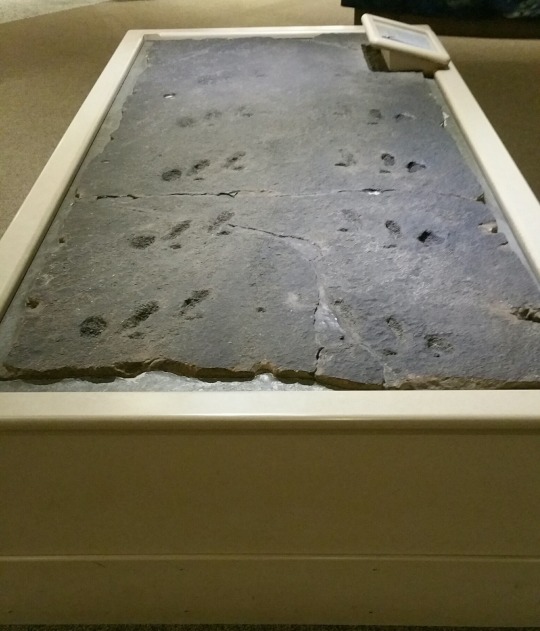
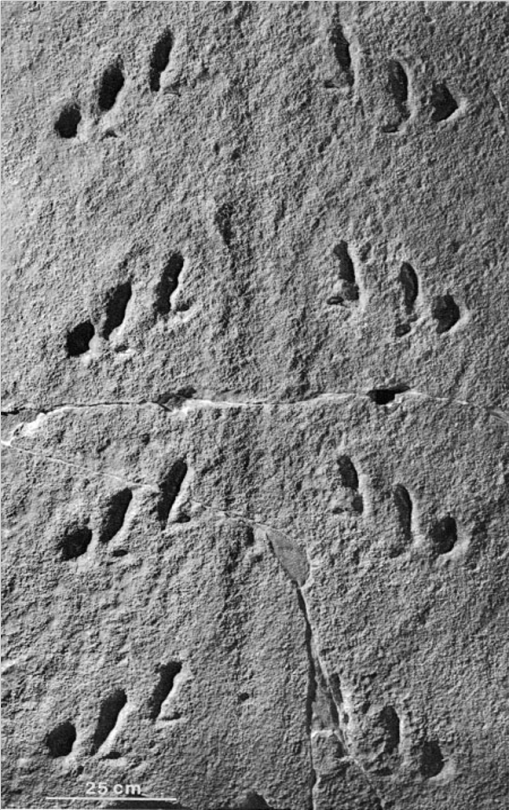
When museum patrons enter Carnegie Museum of Natural History’s Benedum Hall of Geology, they encounter a one-ton block of coarse sandstone with a series of bilateral footprints encased on the rock’s surface. Most visitors don’t know what type of creature made these footprints (Fig. 1) or realize that this fossil trackway represents one of the great fossil discoveries in the history of western Pennsylvania paleontology.

Figure 2. Illustration by Kay Hughes.

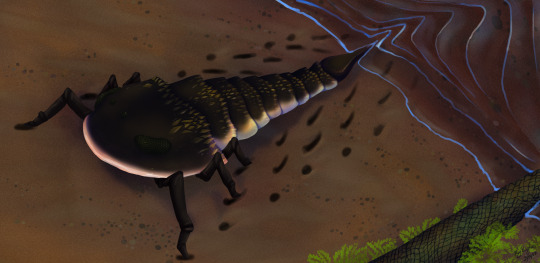
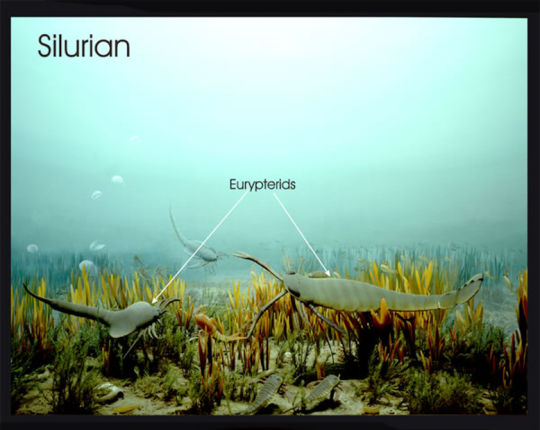
Last month, the cover of Pennsylvania Geology (Fig. 2) helped address both deficiencies. The magazine bears a colorful illustration by Kay Hughes of a 315 million-year-old scene: a large six-legged arthropod emerging from the water and dragging its tail onto a sand bar among fallen Lepidodendron logs. The intruder is a Giant Eurypterid, a creature known to science as Palmichnium kosinskiorum, and a member of an extinct family of arthropods informally called “sea scorpions” that are distant biological cousins.

Within the journal is a fuller explanation for the artistic interpretation of the creature behind the Benedum Hall trackway, an article I co-wrote with Kay Hughes and John Harper titled, Reflections on Palmichnium kosinskiorum-The Footprints of Pennsylvania’s Elusive Elk County Monster.

Fortuitous Discovery

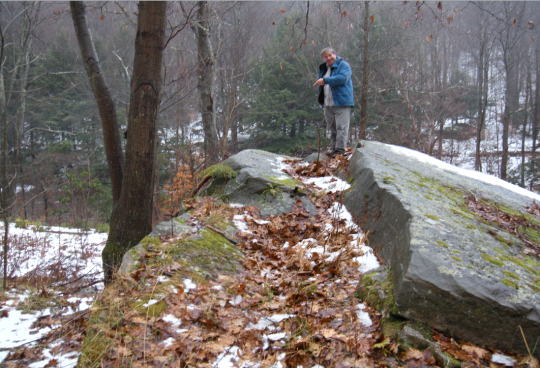
Figure 3. Photograph of Elk County in situ trackway looking southward (Brezinski and Kollar 2016).

Figure 4. Trackway closeup showing tail drag on display in Benedum Hall of Geology (Brezinski and Kollar 2016)

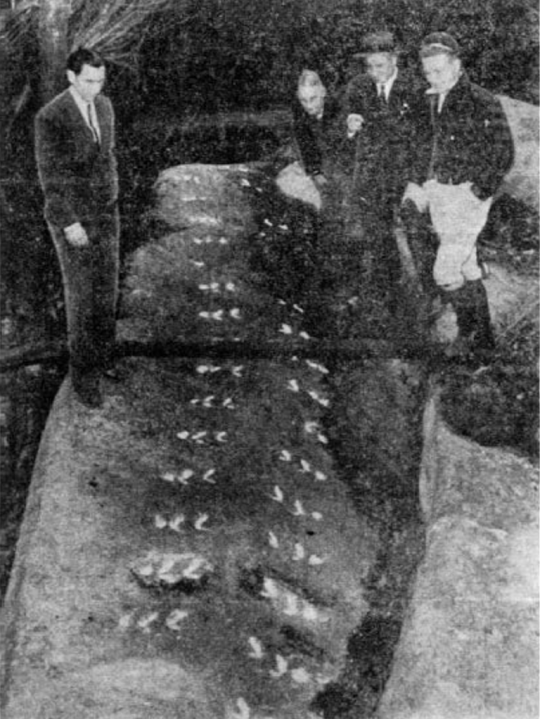
Seventy-two years ago, in an Elk County section of the Allegheny National Forest, James Kosinski, a preparator in the Education Department of Carnegie Museum of Natural History, and his brother Michael were hunting deer in heavily wooded terrain. When Michael stumbled upon a large sandstone boulder bearing a pattern of unusual impressions, he informed James, who (Fig. 3) immediately recognized the impressions as the fossil tracks of an unknown animal (Fig. 4).

Later, when James described the discovery to Carnegie Museum’s Dr. E. Rudy Eller, Curator of the Section of Invertebrate Paleontology, and Dr. J. Leroy Kay, Curator of Vertebrate Paleontology, plans were made to remove a section of the boulder containing the best-preserved section of the trackway and transport the heavy block to the museum.

Exhibit History

Figure 5. Former Paleozoic Hall Silurian Period Marine Diorama with Eurypterids.

Upon arrival at the museum in 1948, the sandstone block was prepared for exhibition and placed near the museum’s Coal Forest exhibit in 1949. In 1965, the trackway was incorporated as a floor centerpiece in the newly open Paleozoic Hall which featured dioramas of characteristic life forms of that Era’s time periods (Cambrian, Ordovician, Silurian, Devonian, Pennsylvanian, and Permian) along with representative fossils from the museum collection. (Fig. 5) In 1998, when Paleozoic Hall was dismantled, the trackway was placed temporarily in the Invertebrate Paleontology lab. The trackway returned to public view in 2007 as part of Bizarre Beasts, a temporary exhibition in the R. P. Simmons Family Gallery about unusual life forms. When Bizarre Beasts closed, I worked with James Senior, Chair of the museum’s Exhibit Department, to place the trackway in the Benedum Hall of Geology entrance as an introduction to great fossil discoveries from western Pennsylvania.

The Research – Locality Data Supports Recent Theory

The fossil trackway was initially identified by Dr. Kay as a hopping reptile inhabiting a Pennsylvanian coal forest 300 million years ago. Although Dr. Eller, citing his own research, suggested the track was formed by a crawling eurypterid, it would take 35 more years for the fossil trackway to be studied by expert arthropod paleontologists from Europe.

The eventual designation of Palmichnium kosinskiorum as a holotype specimen (CM 34388), a category of first order scientific importance, dates to the fossil’s description as a eurypterid trackway in a 1983 research paper by Dr. Derek E. G., Briggs and Dr. W. D. J. Rolfe, titled, A giant arthropod trackway from the Lower Mississippian of Pennsylvania (Journal of Paleontology, 57, 377 – 390). In paleontology, when a non-scientist such as Michael Kosinski discovers a fossil of importance, paleontologists, in this case Derek Briggs and Ian Rolfe, name the new fossil species after the founder, hence P. kosinskiorum.

For years, paleontologists in the Section of Invertebrate Paleontology assumed the scientific conclusions of Briggs and Rolfe (1983) about the eurypterid trackway were beyond dispute. This situation changed in 2009, when Yale University Professor Adolph Seilacher, a world-renowned expert on fossil trackways visited the museum. While Briggs and Rolfe concluded the trackway formed in a marine sandstone, Seilacher explained to me that the trackway was likely formed in an eolian or wind-blown sand environment. He also recommended that someone investigate the rocks at the fossil location in Elk County to substantiate his hypothesis.

Figure 6. D.K. Brezinski at trackway. 

Later that year, when I accompanied David K. Brezinski, Associate Curator Adjunct, Section of Invertebrate Paleontology, to re-locate and re-examine the sandstone boulder with the remaining tracks, we discovered the original geologic and deposition conclusion by Briggs and Rolfe (1983) was incorrect (Fig. 6). In 2011, we reported these new findings at the Northeastern Sectional Meeting of the Geological Society of America in Pittsburgh.  After the meeting, we continued our research and eventually published our conclusion that the geologic age of the trackway was Early Pennsylvanian age and the embedded footprints represented a fluvial sand bar environment of deposition.(Reevaluation of the Age and Provenance of the Giant Palmichnium Kosinskiorum Eurypterid Trackway, from Elk County, Pennsylvania, Brezinski and Kollar (2016),  Annals of Carnegie Museum 84, 39 – 45,)

School Groups and Museum Interpreters

Based upon repeated anecdotal reports from the Interpreters who guide tour groups through the museum’s exhibit halls, the eurypterid trackway is one of the most celebrated education stops for elementary school students. According to Interpreter Patty Dineen, the appealing factors of the trackway include the size and possible scariness of the creature who made the tracks, the fact the track-maker lived long before the dinosaurs, the fossil’s local origin, and the sheer amount for information that can be gathered from the ancient preserved tracks.

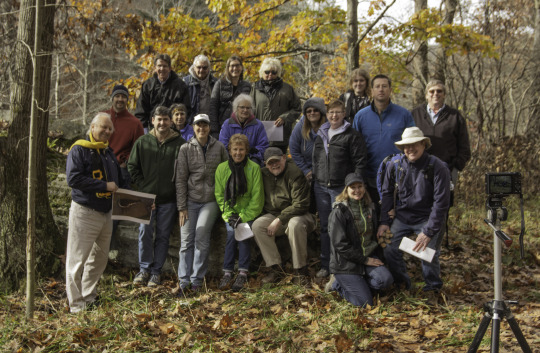
Figure 7. Interpreter field trip.

As part of an effort to better inform school groups about the eurypterid trackway, in 2017 Patty Dineen and Joann Wilson, co-coordinators and instructors for the museum’s Natural History Interpreters, arranged for six Interpreters to participate in a PAlS geology fall field trip to the fossil site in Elk County. (Fig. 7) An important by-product of field excursion was the creation of an instructional video that explains how museum scientists conduct research.

“Treasures of the Carnegie” Planning for a better Trackway Experience

Now that an illustration exists (Fig. 1) of the eurypterid that shaped the trackway walking out of the 315 million-year-old Olean River onto a sand bar, it might be time to consider how to best devise an improved visual and virtual tour experience for the Carnegie patrons and school groups.

Albert D. Kollar is Collections Manager for the Section of Invertebrate Paleontology at Carnegie Museum of Natural History. Museum staff, volunteers, and interns are encouraged to blog about their unique experiences and knowledge gained from working at the museum.
Filed Under: Blog Tagged With: Albert Kollar, Benedum Hall of Geology, invertebrate paleontology, Museum from Home, Science News

  • « Go to Previous Page
  • Page 1
  • Page 2
  • Page 3
  • Page 4
  • Page 5
  • Interim pages omitted …
  • Page 7
  • Go to Next Page »

sidebar

About

  • Mission & Commitments
  • Directors Team
  • Museum History

Get Involved

  • Volunteer
  • Membership
  • Carnegie Discoverers
  • Donate
  • Employment
  • Events

Bring a Group

  • Groups of 10 or More
  • Birthday Parties at the Museum
  • Field Trips

Powdermill

  • Powdermill Nature Reserve
  • Powdermill Field Trips
  • Powdermill Staff
  • Research at Powdermill

More Information

  • Image Permission Requests
  • Science Stories
  • Accessibility
  • Shopping Cart
  • Contact
  • Visitor Policies
One of the Four Carnegie Museums | © Carnegie Institute | Privacy Policy | Terms of Use | Accessibility
Rad works here logo