• Skip to primary navigation
  • Skip to main content
  • Skip to primary sidebar

Carnegie Museum of Natural History

One of the Four Carnegie Museums of Pittsburgh

  • Visit
    • Buy Tickets
    • Visitor Information
    • Exhibitions
    • Events
    • Dining at the Museum
    • Celebrate at the Museum
    • Powdermill Nature Reserve
    • Event Venue Rental
    • Gift Cards
  • Learn
    • Field Trips
    • Educator Information
    • Programs at the Museum
    • Bring the Museum to You
    • Guided Programs FAQ
    • Programs Online
    • Climate and Rural Systems Partnership
  • Research
    • Scientific Sections
    • Science Stories
    • Science Videos
    • Senior Science & Research Staff
    • Museum Library
    • Science Seminars
    • Scientific Publications
    • Specimen and Artifact Identification
  • About
    • Mission & Commitments
    • Directors Team
    • Museum History
  • Tickets
  • Give
  • Shop

invertebrate paleontology

April 29, 2020 by wpengine

A Century Ago, a Donor Walked into the Carnegie Museum

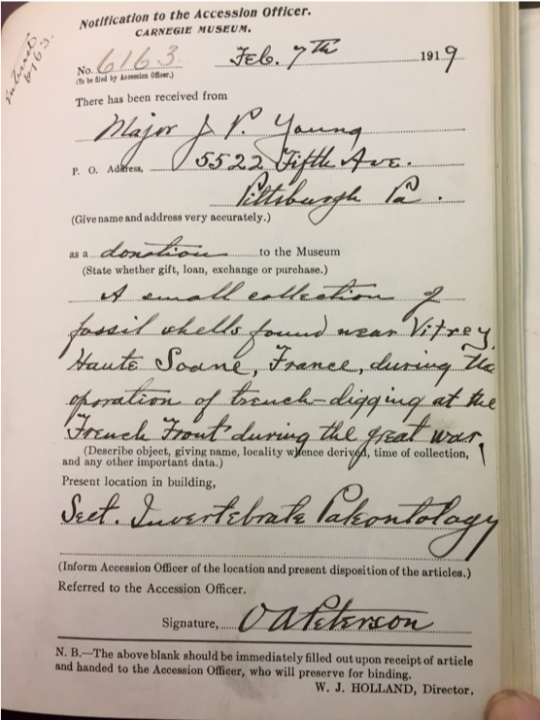
Figure 1:  Accession #6163, Donated By Major J.P. Young

What could have inspired someone to arrive at the Carnegie Institute, on a cold winter day to donate a small collection of fossils found while serving in World War I, less than a month after returning to the United States?

Albert D. Kollar, Collections Manager for the Section of Invertebrate Paleontology at the Carnegie Museum of Natural History, discovered this mystery while undertaking a multi-year project to take a fresh look at the Baron de Bayet Collection, a collection of 130,000 fossils purchased by Andrew Carnegie in 1903.   While looking at the trilobites, an extinct group of arthropods, Albert noticed a few specimens missing the characteristic “BH” letters and/or labels that typically identify the Bayet collection. After some detective work, Albert uncovered evidence of a previously unknown collection, “a small collection of fossil shells,” from France, that had been donated by a “Major J.P. Young” in 1919. (Figure 1).

Major Young, born in 1873 in Middletown, Ohio, developed a love of collecting early in life, spotting artifacts from indigenous cultures of North America, while working as a surveyor, for the Pennsylvania Railroad. His connection to Pittsburgh was further strengthened by his marriage to Margaret Young Oliver, daughter of George T. Oliver, industrialist and United States Senator from Pennsylvania. After World War I, John and Margaret settled in Ithaca, New York, where John was affiliated with his alma mater, Cornell University, for the remainder of his life.  From 1925-1935, he painstakingly illustrated eight volumes of diatoms, single celled algae with sharp exterior coatings made of silica. Many of these illustrations were published by Dr. Mathew Hohn in 1951. During World War II, John Young volunteered as a “dollar a year man;” so that a Cornell staff member could serve in the war effort. After the war, he returned to his fascination with indigenous artifacts when he reorganized the Seneca and Cayuga collections of the DeWitt Museum in Ithaca, New York. But his longest tenure of service involved the Cornell Paleontological Research Institution (PRI), which he joined in 1934. He served as president from 1941-43 and remained active until his death in 1957. Fellow members of the PRI described him as “scholarly and pleasant” in a memorandum published after his passing.

Which brings us back to those fossils. In 1917, at age 44, John Paul Young joined the United States Army, and was tapped to lead the 5th Trench Mortar Battalion, a unit of 600 soldiers. Sometime between September and November of 1918, while managing his soldiers’ cold, thirst, hunger, and conditions such as “trench foot,” a complication from extreme wetness and cold that could turn a soldier’s foot into a gangrenous mass, Major Young  uncovered the trilobite fossils during the excavation of trenches under his command. The construction of a World War I trench is shown in real time in the first 17 minutes of the movie, 1917.   After this blog’s original release, Albert watched 1917 on the big screen in January 2020 to gain an appreciation of the difficulty in trench construction shoring the walls with wood, tin, and wire while a battle takes place.  To Albert’s amazement the process of digging a 7-foot-deep trench to the top of the parapet out of brown mud and brown colored rock, closely matches the Major’s accession description (Fig. 1) and fossil colors (Fig. 4). The Major noticed fossiliferous rocks at the bottom of a trench along the Western Front in Vitrey-sur-Mance, France (Figure 2). Intrigued to find fossils in a trench, the Major collected and then later donated them to the Carnegie Institute in 1919.
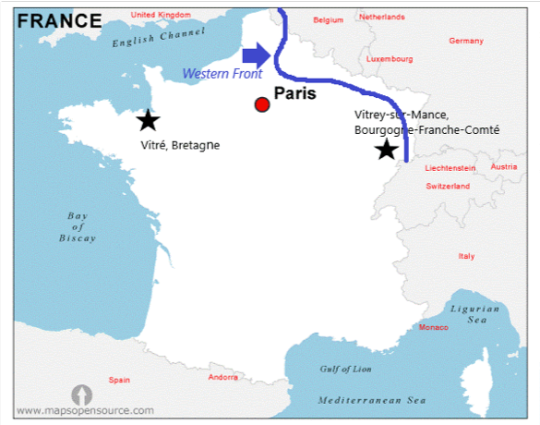
Figure 2: French Locations of Carnegie Trilobites

This fall, Albert travelled to Paris to visit the Muséum national d’Histoire naturelle in Paris seeking to uncover this 100-year-old French trilobite mystery. Albert met with Dr. Sylvain Charbonnier, Collections Manager of Invertebrate Paleontology at the Muséum to discuss this puzzle. Albert’s query is to verify the genus, species, age, and stratigraphic locality of these trilobites. At this point, his preliminary research indicates that the Bayet trilobites are distorted and preserved in a black siltstone rock, that Albert recently coated with a white salt to enhance the fossil detail (Figure 3). In contrast, the three trilobites without labels possibly attributed to Major Young (see Figure 4) are also distorted; but preserved in a brown iron color siltstone. The iron oxide coating gives them a reddish appearance. They too are coated with a whitish salt to enhance detail.
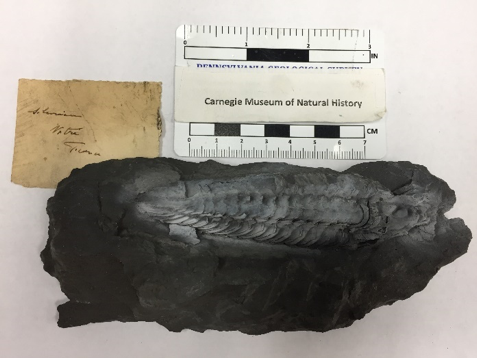
Figure 3: Sample of a Bayet Trilobite from Vitré
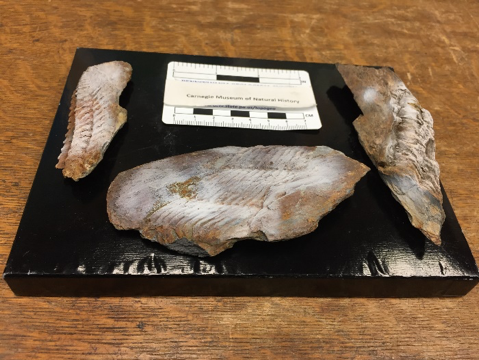
Figure 4: Trilobites From Major Young Donation

An established paleontological collecting method, crucial to the identification of specimens, is to know the exact placement of the fossil to the stratigraphic locality (rock layer) which can support a known geologic age verified in the Geologic Time Scale. If someone makes a collection, such as the Baron de Bayet, and a paper label is preserved (Figure 3) then, Albert must confirm through paleontology literature and the geologic map of France, all known stratigraphic localities in the region for evidence of similar trilobites. For example, the Vitré label in Figure 3, establishes the location for this trilobite as Bretagne in the northwest of France. To ascertain the proper locality of the Major’s donation (Figure 4), we assume at this point, that it is from Vitrey-sur-Mance in the northeast of France; but further research is planned to resolve the exact location of the of the trenches that the Major occupied in World War I.

Following the advice of Dr. Charbonnier, Albert will proceed to digitize all 50 plus trilobites and send these images and other documentation to the Paris Muséum for further review. While we await the results, the fact that the fossils are sparking a new vein of research is probably exactly what the Major had hoped for all along.

Joann Wilson is the Interpreter for the Department of Education and Volunteer for the Section of Invertebrate Paleontology at CMNH and Albert Kollar is the Collections Manager for the Section of Invertebrate Paleontology. Museum staff, volunteers, and interns are encouraged to blog about their unique experiences and knowledge gained from working at the museum.

Many thanks to the fabulous Carnegie Library of Pittsburgh staff, with special acknowledgment to Carnegie Museum Library Managers, Xianghua Sun and Marilyn Cocchiola Holt, and Carnegie Reference Librarians Joanne Dunmyre and Leigh Anne Focareta. Special thank you to Peter Corina at the Kroch Library, Division of Rare and Manuscript Collections at Cornell University.    
Filed Under: Blog Tagged With: invertebrate paleontology, Museum from Home, Science News

April 13, 2020 by wpengine

Smoking Fossils

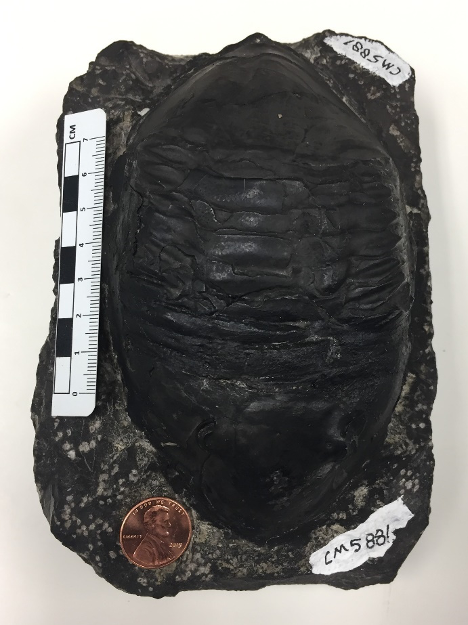
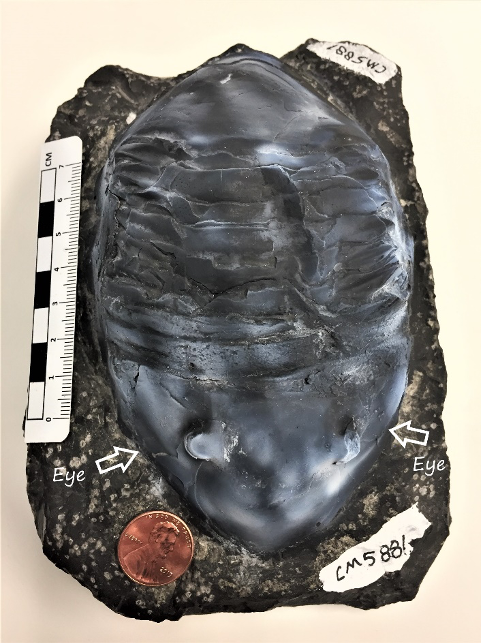
Figure 1: CM 5881 Trilobite (Isotelus maximus) with “smoke”                    

Figure 2: Same Trilobite without “smoke”

Ever wonder how scientists make fossils jump off the printed page?  Enter a centuries-old technique known as “smoking fossils.”   While there are many ways to “smoke” a fossil, one of the more commonly used methods was refined by paleontologist-geologist, Dr. Curtis Teichert.   In 1948, he developed a process to heat aluminum chloride powder in a test tube with the result creating a white vapor that could be applied with a pump to a fossil.    Although the Teichert process involves vapor rather than smoke; you will hear it informally referred to as “smoking fossils.”  Today, Dr. Teichert’s method is still practiced behind a set of metal doors in the basement of the Carnegie Museum of Natural History with one modification: a ventilator hood runs at a low hum in order to remove vapors circulating in the air during the “smoking” process.  

A few weeks ago, Albert Kollar, Collections Manager for the Section of Invertebrate Paleontology, “smoked” a few fossils for an upcoming blog post on state fossils.  As Teichert noted in 1948, “…  the application of a white coating to fossils is essential for photographic reproduction in order to eliminate spottiness and to bring about fine structural details otherwise lost on a black background.”   One of the fossils selected by Albert was a 480-million-year-old trilobite (Figures 1 and 2).  Trilobites are an extinct group of marine animals with an exoskeleton.   In Figure 1, all three segments of the body are easy to see.   The cephalon (head), thorax (mid-section), and pygidium (end) are well defined and the calcite crystal eyes stand out.   By contrast, the same fossil without “smoke” (Figure 2) is difficult to study because it appears to merge with the rock.  

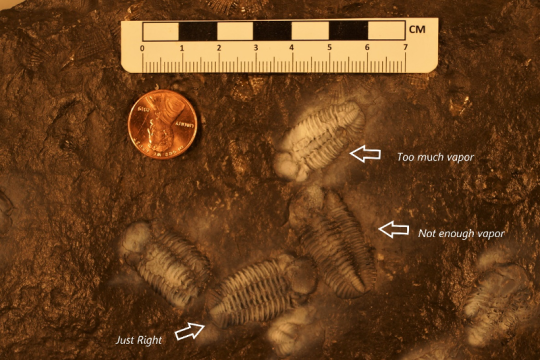
It takes years of practice to add the aluminum chloride vapor with precision.   Too much vapor gives the fossil a hazy appearance and it makes it difficult to see the fine details, while too little vapor imparts a splotchy appearance with some details visible and others disappearing into the stone.   Albert selected a “death assemblage,” or group of fossils that died on the sea floor, to illustrate the art of getting the vapor just right (Figure 3).    And how long does the vapor last?    Albert explained that the effect can last up to a week if left in a closed cabinet, but it can also be removed with a damp cloth anytime.    

Figure 3: PA State Fossil (CM 53898) – Trilobite (Phacops rana) with too much, not enough and just enough “smoke”

So, the next time you are enjoying a photo of a fossil on exhibit or in a magazine, look for evidence of “smoke.”   It is just one more way that scientists help to bring ancient creatures to life.    

Joann Wilson is a volunteer with the Section of Invertebrate Paleontology and Albert Kollar is Collections Manager for the Section of Invertebrate Paleontology at Carnegie Museum of Natural History. Museum staff, volunteers, and interns are encouraged to blog about their unique experiences and knowledge gained from working at the museum.

Filed Under: Blog Tagged With: invertebrate paleontology, Museum from Home, Science News

March 9, 2020 by wpengine

The Connemara Marble: A Cross-Atlantic Connection Between Ireland and Pittsburgh

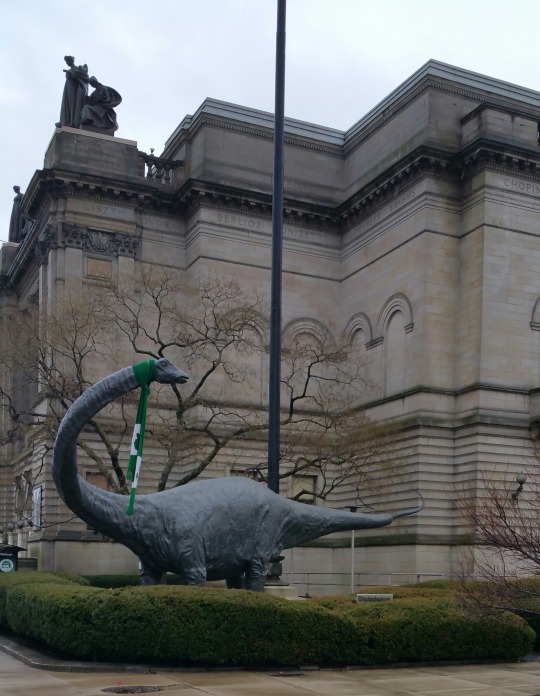
Irish Dippy the dinosaur statue

Fig. 1: Irish Dippy

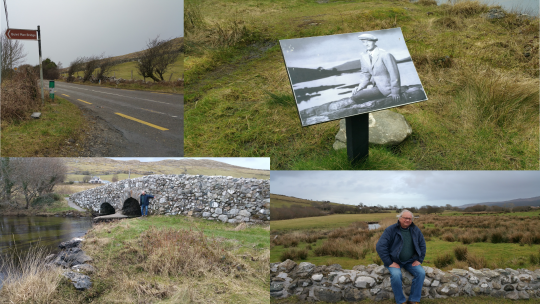
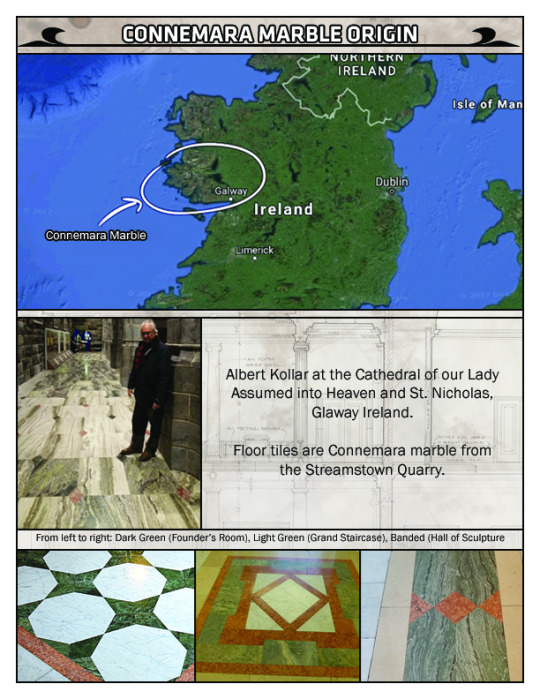
Each March in celebration of St. Patrick’s Day, the full-size dinosaur replica of Dippy (Diplodocus carnegii) that stands guard outside the Carnegie Complex along Forbes Avenue in Oakland, is draped in an iconic Irish scarf (Fig. 1). Inside the classic halls of the Carnegie Complex is a green marble from County Galway, western Ireland. It is called Connemara Marble and is ubiquitous in the museum’s architectural floor designs. Before visiting Ireland for the first time in 2015, my only reference to the green Isle was watching a classic John Wayne and Maureen O’Hara movie, titled, The Quiet Man circa 1952. Much of the movie was filmed amongst the Connemara landscapes and many of the films iconic locations survive to this very day, such as the famous Quiet Man Bridge (Fig. 2).  Moreover, researchers from the Carnegie Museum, National University of Ireland Galway, Connemara Marble Industries Ltd., Moycullen and Mount Holyoke College in Massachusetts, are investigating the significance of this Irish green marble in the architectural design of the Carnegie Institute Extension built by Alden & Harlow in 1907 (Fig. 3), Kollar et al., 2017; Feely et al., 2019, and Kollar et al., in review.

Fig. 2: Quiet Man bridge

Fig. 3: Connemara Map

The Streamstown Quarry in Western Ireland

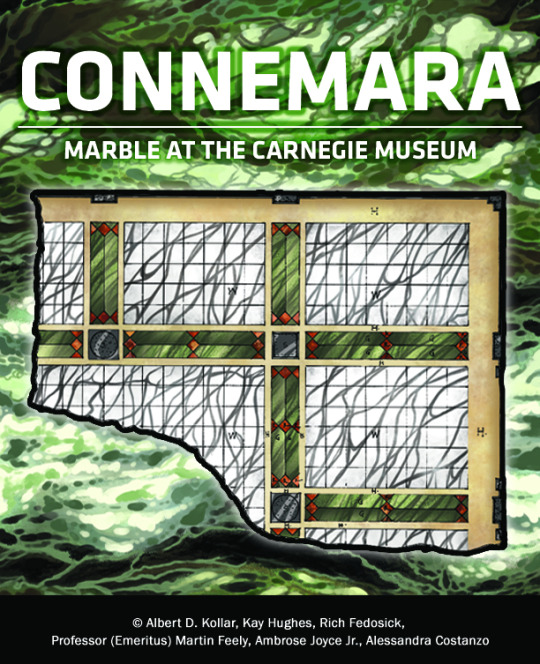
A cross-Atlantic research connection between Ireland and Pittsburgh was initiated in the winter of 2015, when I visited Martin Feely at the National University of Ireland, Galway, an expert on the geology of the Connemara Marble, and Ambrose Joyce, owner of the Streamstown quarry. The objective was to determine the provenance and geology of the Carnegie’s Connemara Marble quarry and to compare the varieties of colored marbles used in the Carnegie’s floor tiles against other buildings with Connemara Marble from the Streamstown quarry (Fig. 4).  The Connemara Marble can be found in the twelve public spaces, corridors, and private rooms, including the Hall of Sculptures, Grand Staircase, Green Room, President’s Office, and entrance corridors to the Carnegie Library of Pittsburgh. A unique use of Connemara Marble is as inlays in the design of the Thistle, the Scottish National flower in the Music Hall Foyer walls.

Fig. 4: Connemara Marble at the Carnegie Museum 

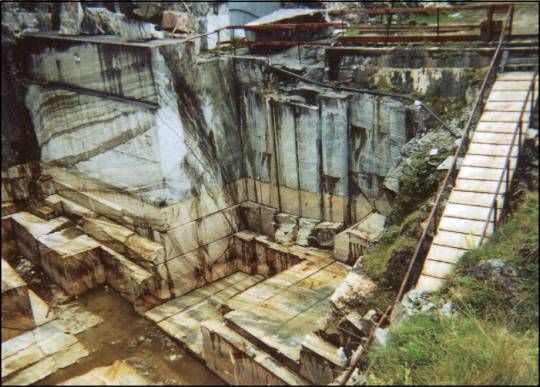
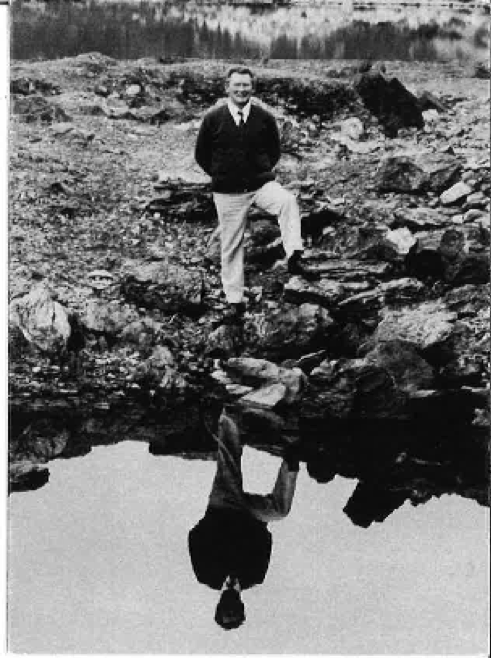
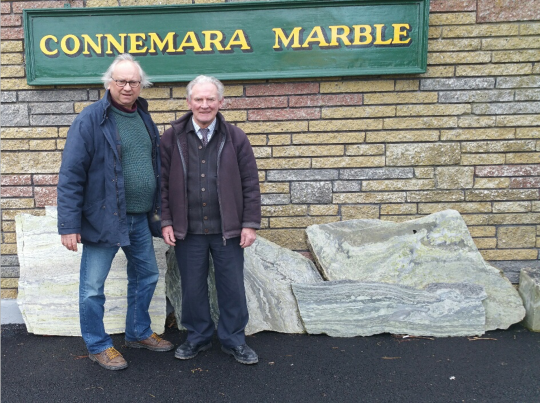
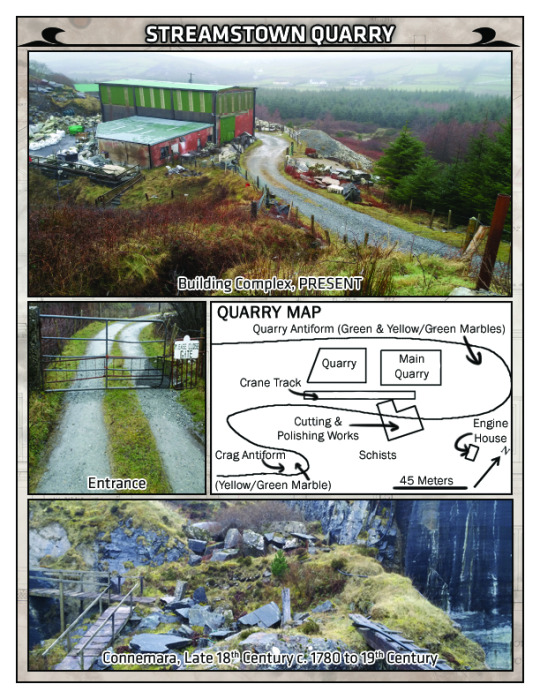
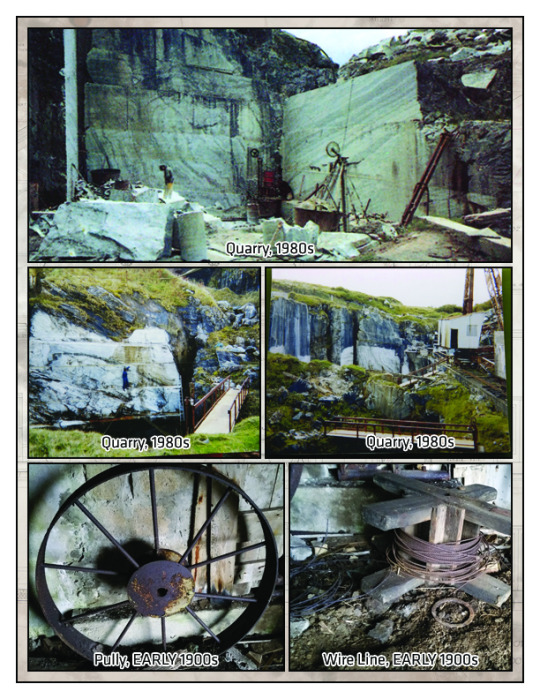
The best way to get to the Streamstown Quarry is by car. The 50-mile drive, along the N59 from Galway to Clifden takes about an hour and 15 minutes through quaint villages and along scenic winding roadways. Understandably, it rained that day as it commonly does in County Galway, circa 45 inches per year. In comparison, Pittsburgh receives about 36 inches of rain per year. Like Pittsburgh, Galway has lush green landscapes because of the annual rainfall.  Visible from the road are mountainous outcrops and lakes e.g. the Twelve Bens quartzite mountains formed over millions of years ago. Their present topography resulted from ice-sculpting during the last glacial maximum. The peat bogs in the low-lying regions formed 5,000 years ago. The history of the Streamstown quarry (Fig. 5) was always best recounted by the patriarch of the family Ambrose Joyce Sr., who sadly passed away in 2015 (Fig. 6 a, b). The entrance to the quarry is hidden from the main road and access is through a gate and then along a minor road shared by other land owners – access to the quarry is strictly by permission only, from Ambrose Joyce. The quarry and its buildings are surrounded by stockpiles of large marble blocks (Fig. 7). I walked around the quarry with Ambrose Joyce Jr. to see the old equipment and hear about the marble quarrying operations dating back to its late 19th century active period (Fig. 8). Then we viewed the modern quarry (Fig. 9) as Martin Feely explained the geology of the 650 Ma. pre-Cambrian limestone that would become green marble during the Ordovician Period some 470 million years ago.

Fig. 5: Streamstown Quarry

Fig. 6 a: Ambrose Joyce, Sr. 

Fig. 6 b: Ambrose Joyce, Sr. and Albert Kollar

Fig. 7: Streamstown Quarry setting

Fig. 8: Streamstown Quarry history

Fig. 9: Albert Kollar, Martin Feely, Ambrose Joyce Jr.

We returned to Galway via the Connemara Marble Industries Ltd., Moycullen, County Galway to meet with the Joyce family (Fig. 10). At the Connemara Marble Industries Ltd., Moycullen marble souvenirs and jewelry are produced for the tourist trade using the marble extracted from Streamstown quarry (Fig. 11, 12, 13).  Today, the ongoing global demand for Connemara Marble, for use in interior decoration projects, is supplied by the Italian company Antonlini. They source the marble from another Connemara marble quarry located several miles to the east of the Streamstown quarry.

Fig. 11: Christmas ornaments

Fig. 12: Coaster and Cube Shamrock

Fig. 13: Kennedy, Joyce, and rosary shamrock

Global Heritage Stone Resource

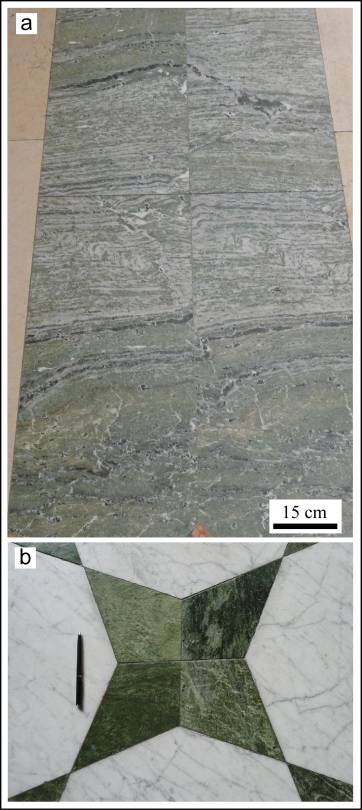
In 2019, the Connemara Marble was proposed as a Global Heritage Stone Resource with a citation to the Connemara Marble used in the Carnegie Museum (Wyle Jackson et al. 2020)  This Irish Heritage Stone was a much sought-after green marble for use in architecture, buildings and sculptures in Ireland, England, and the United States from the mid-19th century to the early 20th century including the Carnegie’s Hall of Sculpture (Fig. 14 a) and the Founder’s Room (Fig. 14 b) floor designs.

Figs. 14 a and b: Floor tiles

Have a Happy St. Patrick’s Day.

Albert D. Kollar is the Collection Manager in the Section of Invertebrate Paleontology at Carnegie Museum of Natural History. Museum employees are encouraged to blog about their unique experiences and knowledge gained from working at the museum.

Filed Under: Blog Tagged With: Albert Kollar, invertebrate paleontology, Science News

October 15, 2019 by wpengine

Carnegie Geologists Win National Award

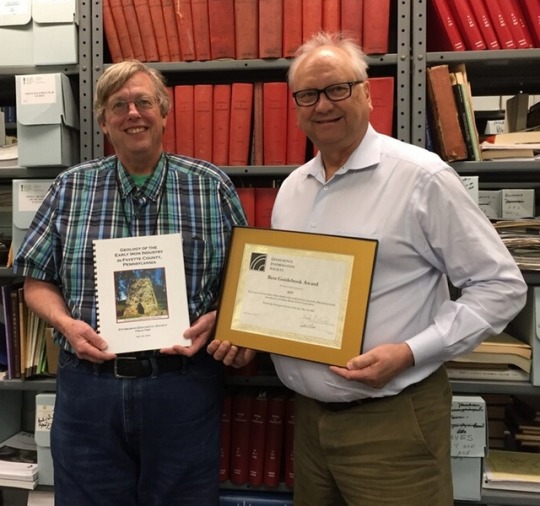
John Harper and Albert D. Kollar.

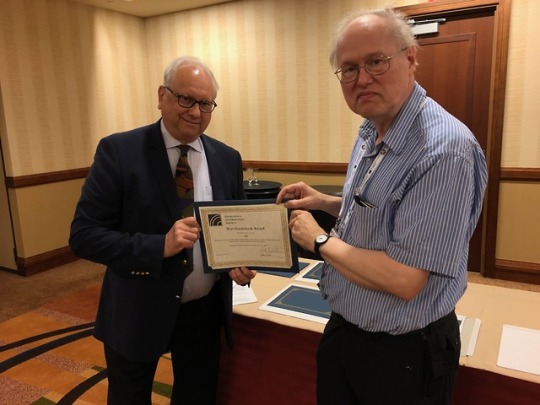
In the fall of 2018, Albert D. Kollar and John A. Harper (volunteer and research associate) of the Section of Invertebrate Paleontology in collaboration with the Pittsburgh Geological Society conducted a geology field trip titled: Geology of the Early Iron Industry in Fayette County, Pennsylvania. Back then, we had no idea this field guide would be recognized by the Geoscience Information Society with their GSIS Award 2019 for Best Guidebook (professional) at the Annual Meeting of the Geological Society of America (GSA). On September 23, 2019, Albert attended the Awards Luncheon in Phoenix, Arizona, to receive the GSIS Award.

Albert D. Kollar and Michael Noga representing Geoscience Information Society.

As stated by the GSIS committee chair, “The Geology of the Early Iron Industry in Fayette County, Pennsylvania is well-written and well-illustrated, with both professional and popular sections. I can see local geology teachers taking students on these trips to show a chapter in the development of an important early ore industry in the United States. With the aid of detailed road logs guidebook users can see and learn about the geology, industrial development, history, and fossils in Fayette County. Field Trip leaders can use the guidebook to expand on several topics, depending on the interests of their trip attendees. An additional benefit of the guidebook is its free availability online, so any traveler with an interest in the area can explore on their own. The Pittsburgh Geological Society has performed a great model for other local societies that are interested in spreading the benefits of their field trips to wider audiences.”

In receiving the award, Kollar opined that the guidebook has been recognized for the diverse geology of the region and the many historical sites that can be seen and visited respectively throughout southwestern Pennsylvania. These include, the geology of Chestnut Ridge, a Mississippian-age limestone quarry with abundant fossils and Laurel Caverns, the history of oil and gas exploration, the historic Wharton Charcoal Blast Furnace, the geology of natural gas storage, the country’s First Puddling Iron Furnace, and the birth place of both coke magnate Henry Clay Frick and Old Overholt Straight Rye Whiskey, West Overton, Westmoreland County, Pennsylvania.

Another feature of the guidebook is its dedication to Dr. Norman L. Samways, retired metallurgist, geology enthusiast, and good friend who spent many years as a volunteer with the Invertebrate Paleontology Section of the Carnegie Museum of Natural History.  Sam, as we called him, passed away in February 2018.  His contribution came about when he was instrumental in the research and writing of the Geology and History of Ironmaking in Western Pennsylvania, with his co-authors John A. Harper, Albert D. Kollar, and David J. Vater, published as PAlS Publication 16, 2014. Moreover, Sam was solely responsible for a new historical marker, AMERICA’S FIRST PUDDLING FURANCE along PA 51, dedicated on September 10, 2017 by the Pennsylvania Historical & Museum Commission and the Fayette County Historical Society. David Vater contributed to the guidebook’s content by drawing a schematic diagram of a typical puddling iron furnace, which is greatly appreciated. Key fossils and iron ores of the section’s collection are referenced as well. The cataloged fossils cited in peer review journals authored by section staff and research associates includes those on the trilobites by Brezinski (1984, 2008, and 2009), Bensen (1934) and Carter, Kollar and Brezinski (2008) for brachiopods, and Rollins and Brezinski (1988) for crinoid-platyceratid (snail) co-evolution.

In recent years, the section has run highly successful regional field trips about various geology and paleontology topics based on the museum collections, collaborations with the Pittsburgh Geology Society, the Geological Society of America, Osher Institute of the University of Pittsburgh, Nine-Mile Run Watershed, Allegheny County Parks, Pittsburgh Parks Conservancy, Montour Trail, Carnegie Discovers, and the section’s own PAlS geology and fossil program. A future field trip is being planned to assess the dimension stones that built the Carnegie Museum and noted architectural building stones of Oakland.

Albert D. Kollar is the Collection Manager in the Section of Invertebrate Paleontology at Carnegie Museum of Natural History. Museum employees are encouraged to blog about their unique experiences and knowledge gained from working at the museum.

Filed Under: Blog Tagged With: Albert Kollar, Anthropocene, fossils, geology, invertebrate paleontology, western pennsylvania

July 10, 2019 by wpengine

Citizen Science, The Last Ice Age in Western Pennsylvania and Carnegie Museum of Natural History Exhibits

Recent education initiatives in the Section of Invertebrate Paleontology encourage citizen science collaborations among professional geological societies to elevate the value of fossil collections, research and museum exhibits of the Carnegie Museum of Natural History. For example, this April, 20 members of the North Alleghenies Geological Society were introduced to exceptional Pennsylvanian age fossils on display in Benedum Hall of Geology, i.e., the giant Eurypterid trackway (discovered in Elk County, PA) and the amphibian fossil skull Fedexia (discovered in Moon Twp., near the Pittsburgh International Airport), and the Jurassic age Lyme Regis of England, Holzmaden and Solnhofen fossils of Germany in Dinosaurs in Their Time. And yes, we did view the Carnegie dinosaurs from the Morrison Formation of Sheep Creek, Wyoming and Dinosaur National Monument, Jensen, Utah. The group was amazed with the behind-the-scenes in fossil invertebrates. This month, another citizen science field trip event took place to Slippery Rock Gorge and Moraine State Park in Butler and Lawrence Counties for 40 members of the Pennsylvania Council of Professional Geologists (PCPG). The title of the field trip: The Last Ice Age in Western Pennsylvania: A Changing Climate as Seen in the Glacial Landscape co-led by Albert D. Kollar of the Carnegie Museum of Natural History and Dan A. Billman (Billman Geologic Consultants, Inc). Dan and his wife Pam (both geologists) are longtime supporters of the section and museum. They are members of the section’s PAlS (Patrons and lauradanae Supporters). Dan co-authored the 2011 PAlS Publication 11, Geology of the Marcellus Shale and has provided drill cuttings of the 390 million-year-old Marcellus Shale for the section’s Geology and Energy workshops. Dan served as president of PCPG in 2017 and 2018 and asked if I would be interested to co-lead a glacial geology field trip for PCPG in June of 2019.

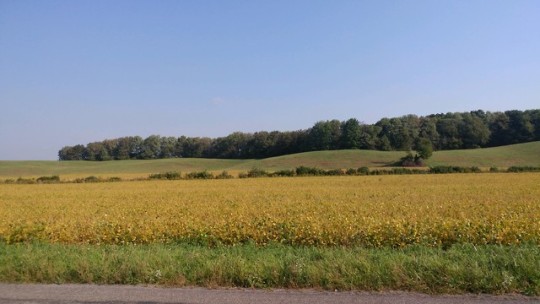
The 23,000 year old Jacksville Esker in Butler County, PA. The esker is the ridge between the shrubs and base of the tree line.

So why propose a field trip to the region known with the best-preserved landscapes of the Last Ice Age in western Pennsylvania? In Dan’s opinion, many of the PCPG members are certainly aware of the current discussion on human induced climate change but may be less familiar with the climate change and landscapes that occurred and formed respectively just 23,000 years ago. For instance, a summary of the professional affiliations of the 40 participants on the field trip confirms a division of sorts in disciplines. The dominant groups in attendance are made up of sixteen environmental geologists, followed by nine oil and gas geologists, four with PA DEP, four earth resource scientists, four geologic consultants, two academic professors, and one part-time school teacher – who asked to volunteer in the section – a new citizen scientist for the section.

To plan the field trip, we reviewed past geologic field trip guides and publications on the subject and visited the sites several times over the last six months. We also looked at key exhibits in the Carnegie Museum that mimic many of the glacial and climate change features that we would see on the field trip. These include the bedrock geology of western Pennsylvania i.e., coal, sandstone, limestone and shale that represent depositional cycles associated with the Milankovitch cyclothems and Earth’s precession. These are related to some 120 glaciation events in the rock record that occurred over Permo-Carboniferous time (Pennsylvanian Period) 319 MA to Early Permian 270 MA. In the museum dioramas: A replica coal forest and coeval marine seaway can be seen in Benedum Hall of Geology. In Botany Hall, the Northern Pennsylvania Bog is an example of a glacial tundra bog like the West Liberty Bog – a paleoclimate indicator. And the Muskox exhibit of the Arctic tundra biome is representative of the Alpine permafrost periglacial environment in the Appalachian ridges, which formed “rock city”. The Last Glacial Maximum, a +/-23,000-year-old Kent glacial terminal moraine, Jacksville Esker, and the scenic gorge at Cleland Rock were the highlights of the trip.

Blog post by Albert D. Kollar, collection manager in the Section of Invertebrate Paleontology at Carnegie Museum of Natural History, and Dan A. Billman of Billman Geologic Consultants, Inc.

Filed Under: Blog Tagged With: Albert Kollar, Benedum Hall of Geology, geology, invertebrate paleontology, western pennsylvania

April 26, 2019 by wpengine

One of the Best Kept Secrets:  The Collaboration of the Carnegie Museum and Shady Side Academy Middle School 2014 – 2019

Each spring, when the Robin first appear on the landscape, 70 students from Shady Side Academy Middle School in Fox Chapel, descend upon the Carnegie Museum for their yearly four-hour tour. Led by National Earth Science Teacher of the Year Award Winner, Matt Brunner, the seventy students are divided into four groups that partake in arranged educational activities that last 45 minutes each. One of the most important activities is lunch, without which, the entire school visit would collapse – seriously!  Each group is toured by museum educators and staff i.e., interpreters for the natural history exhibits and CMOA art staff for that class. A unique, behind the scenes fossil and geology workshop in invertebrate paleontology is the highlight of the visit. After Mr. Brunner started teaching at Shady Side Academy in 2004, we developed a behind the scenes Earth Science learning/activities class. Years later, the class has become very popular with the students, chaperones and school administrators. Continuing with this collaboration, Matt developed an energy debate class for his sixth graders, which focuses on fossil fuels and other sources of energy in the student’s daily lives. To help address the student’s questions on energy, Matt invited Ray Follador and me, and other scientists to come to Shady Side Academy to talk about the use of fossil fuels, nuclear, and renewables in energy production. Each January, 70 bleary eyed sixth graders wait in anticipation for our 8 AM to 8:45 class in the school auditorium. The class is divided into two ten-minute PowerPoint presentations, a Question and Answer session, and the use of a 200-foot long rope, that fully engage the entire class to help visualize the depth of the Marcellus Shale Gas Deposit below the school parking lot.

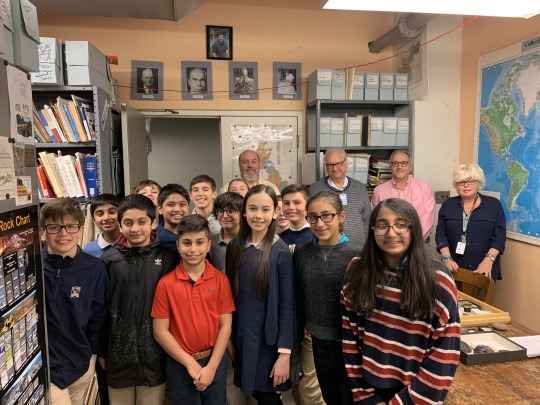
Shady Side Academy Middle School visit to the Section of Invertebrate Paleontology, April 03, 2019. Back row. left to right, Matt Brunner, Albert Kollar, Ray Follador, Tara Pallas-Sheetz

Behind the Scenes in Invertebrate Paleontology:  As each class of 18 students enter the Invertebrate Paleontology office, they are asked to sit down on the carpeted floor for a brief introduction to the section’s staff, and to sign their names to a gallon-size zip-lock plastic bag and a copy of the section’s Geology and Fossils Coloring Book.  The class is then divided into three equal groups that rotate among the three scheduled activities that last approximately ten – twelve minutes each.  The fossil activities include, 1. Breaking fossil rocks on the one-hundred-year-old rock breaker coordinated by Tara Pallas-Sheetz. 2. Building a fossil and rock kit from duplicate (non-accessioned) fossils with geologist Ray Follador. 3.  Learning about the evolution of trilobites, the state fossil of Pennsylvania, Phacops rana (a trilobite) and fossil arthropods such as, eurypterid, horseshoe crab, and cockroach with Albert Kollar. In activity 3, some of the fossils shown on the table are naturally preserved in various colors of yellow, red, gray and black. Keeping in mind the fossil colors, each student is asked to use colored pencils to color in the black and white illustrations of arthropods on page 35 in the coloring book. For many students, this activity showcases their artistic talents. All students are encouraged to handle fossils and ask questions. Each group keeps their fossil kits and each student keeps the fossils collected from the rock trimmer activity (the reason for the plastic bag). The invertebrate paleontology learning activity class is later reviewed by Mr. Brunner in his Earth Science classes at Shady Side Academy.

Albert D. Kollar and Tara Pallas-Sheetz, Section of Invertebrate Paleontology

Ray Follador, Pittsburgh Geological Society

Matt Brunner, Shady Side Academy Middle School

Filed Under: Blog Tagged With: Albert Kollar, invertebrate paleontology, Ray Follador

  • « Go to Previous Page
  • Page 1
  • Page 2
  • Page 3
  • Page 4
  • Page 5
  • Page 6
  • Page 7
  • Go to Next Page »

sidebar

About

  • Mission & Commitments
  • Directors Team
  • Museum History

Get Involved

  • Volunteer
  • Membership
  • Carnegie Discoverers
  • Donate
  • Employment
  • Events

Bring a Group

  • Groups of 10 or More
  • Birthday Parties at the Museum
  • Field Trips

Powdermill

  • Powdermill Nature Reserve
  • Powdermill Field Trips
  • Powdermill Staff
  • Research at Powdermill

More Information

  • Image Permission Requests
  • Science Stories
  • Accessibility
  • Shopping Cart
  • Contact
  • Visitor Policies
One of the Four Carnegie Museums | © Carnegie Institute | Privacy Policy | Terms of Use | Accessibility
Rad works here logo