• Skip to primary navigation
  • Skip to main content
  • Skip to primary sidebar

Carnegie Museum of Natural History

One of the Four Carnegie Museums of Pittsburgh

  • Visit
    • Buy Tickets
    • Visitor Information
    • Exhibitions
    • Events
    • Dining at the Museum
    • Celebrate at the Museum
    • Powdermill Nature Reserve
    • Event Venue Rental
  • Learn
    • Field Trips
    • Educator Information
    • Programs at the Museum
    • Bring the Museum to You
    • Guided Programs FAQ
    • Programs Online
    • Climate and Rural Systems Partnership
  • Research
    • Scientific Sections
    • Science Stories
    • Science Videos
    • Senior Science & Research Staff
    • Museum Library
    • Science Seminars
    • Scientific Publications
    • Specimen and Artifact Identification
  • About
    • Mission & Commitments
    • Directors Team
    • Museum History
  • Tickets
  • Give
  • Shop

Luke DeGroote

December 7, 2022 by Kathleen

A New Building at Powdermill

by Luke DeGroote

On a crisp fall morning, 30 minutes before the sun rises, the bird banding crew at Powdermill Avian Research Center (PARC) are hard at work setting up the mist nets for a typical day. As the dewdrops fall from the nets and the birds call, everything seems as normal as it has since 1961, but something is different. For the first time, the birds will be processed in a new location. PARC has finally established a new home.

On September 30, 2022, we celebrated the Grand Opening of the Richard P. Mellon Avian Research Center. This new facility is a great leap ahead for PARC that will allow us to continue conducting our avian research as we have since 1961, while also providing new opportunities for outreach, additional research projects, and more efficient data collection. A 60-second video tour provides visual orientation to the facility.

View this post on Instagram

A post shared by Powdermill Nature Reserve (@powdermillnaturereserve1956)

So, what’s inside? The new building consists of a bird holding room, research lab, seminar space, kitchen/lounge, offices, a multi-use lab space, and an observation deck.

Bird Holding Room: This space is used by the bird banding techs. It allows easy access to the bird bags, radios, and carabiners, and has spaces for the birds to await their turn to be processed in the lab. The addition of this room frees up lab space and prevents the processor, recorder, and bird banders from being interrupted while collecting data.
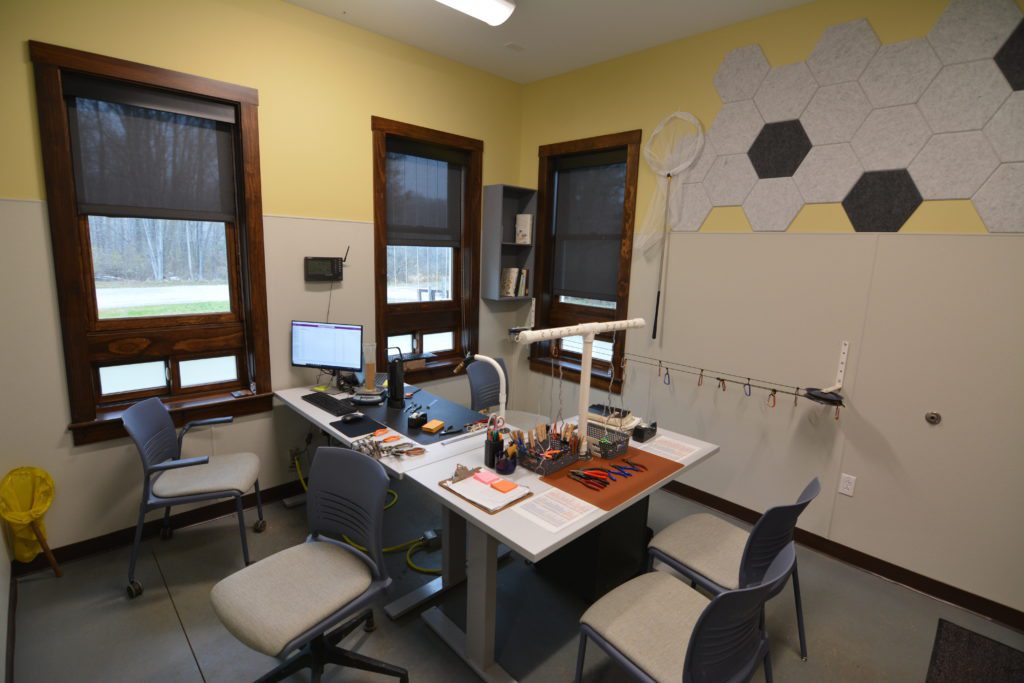
room with an l-shaped desk with bird banding equipment on it

Research Lab: This room mirrors the original setup in the old building. Birds are banded and processed here on a day-to-day basis. PARC’s bird banders have captured and processed over 800,000 birds with many more to come in the lab’s future.
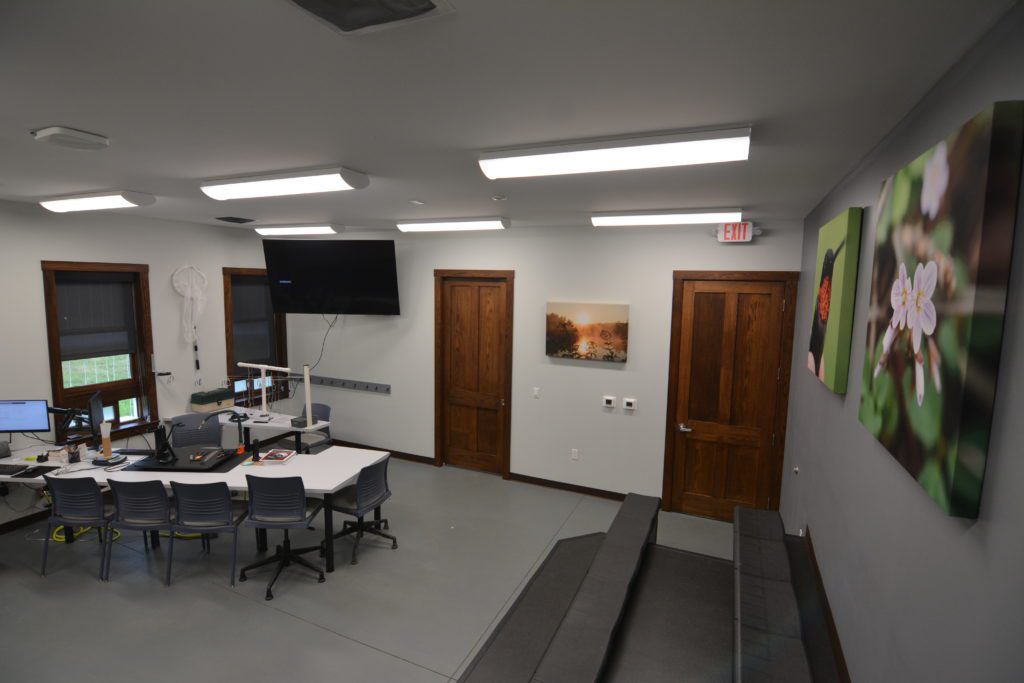
Seminar Space: This classroom space will now allow large groups to visit us for field trips, open houses, and guided tours. This space has a similar setup to the research lab with the addition of lecture-style seating and a video screen that allow groups to see bird banding up close and learn about PARC’s many avian research projects.
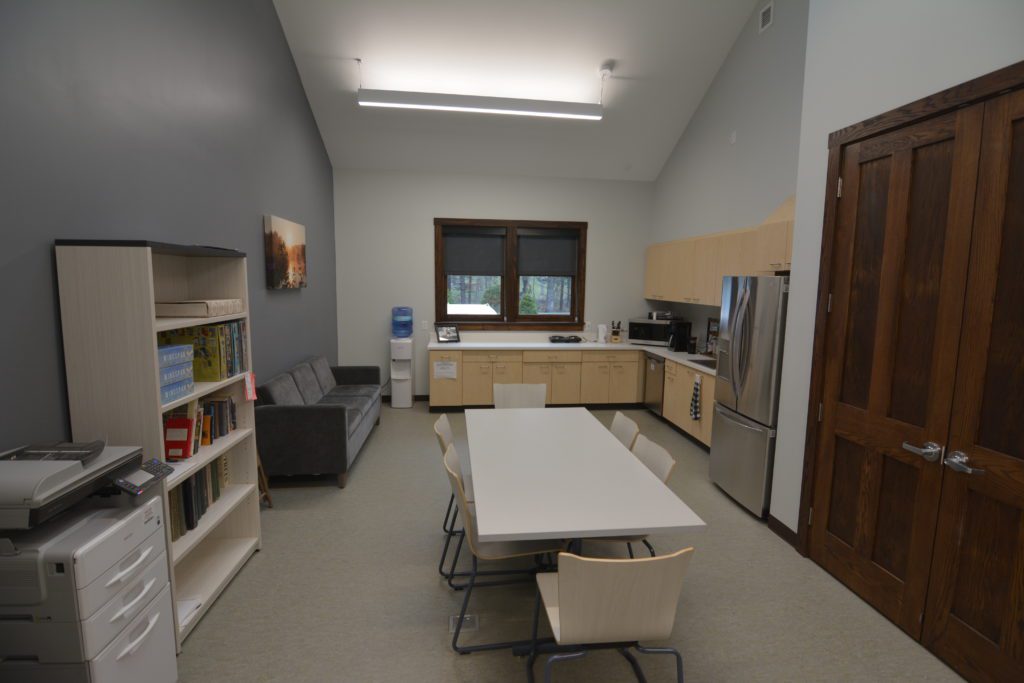
Kitchen/Lounge: This is a much-needed space where we can fuel up on coffee for our early mornings or late nights, or where workshop participants can take a snack break. It’s also a fantastic place to play our favorite board game (Wingspan, of course).
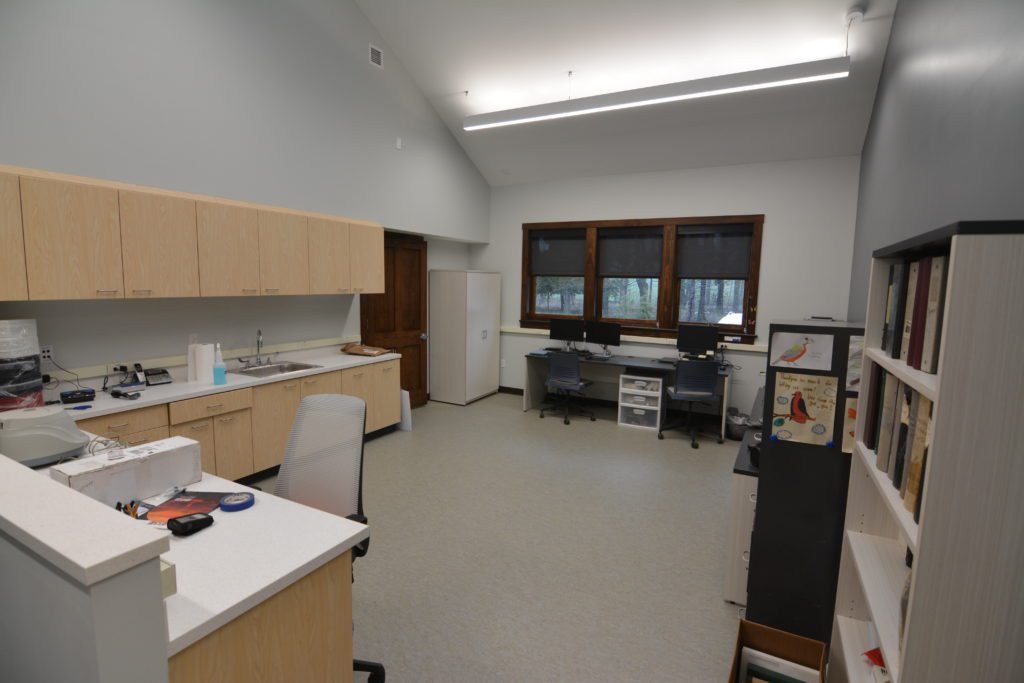
Lab: This multi-use space has proved to be a great addition for PARC staff and collaborators. There are desks and computers for the Avian Outreach Tech, Flight Tunnel Tech, and visiting researchers. The space is also utilized for data proofing and ongoing research projects.

Although the move from the original building was bittersweet, we are so thrilled to continue conducting avian research from this new space. Thank you so much to everyone who helped this new building come to life. The opportunities with this new building are endless.

Luke DeGroote is Avian Research Coordinator at Powdermill Nature Reserve, the museum’s environmental research center.

Related Content

An Intern’s Experience Studying the Ecosystem at Powdermill

Chimney Swift Conservation

Encounter With an Orb Weaver Spider: Is It Predator or Prey?

Carnegie Museum of Natural History Blog Citation Information

Blog author: DeGroote, Luke
Publication date: December 1, 2022
Share this post!

  • Share on Twitter Share on Twitter
  • Share on Facebook Share on Facebook
  • Share on Pinterest Share on Pinterest
  • Share on LinkedIn Share on LinkedIn
  • Share on Reddit Share on Reddit
  • Share via Email Share via Email

Filed Under: Blog Tagged With: Luke DeGroote, Powdermill Nature Reserve, Science News

March 9, 2022 by Erin Southerland

Pittsburgh Launches Spring 2022 Lights Out Program to Protect Migratory Birds

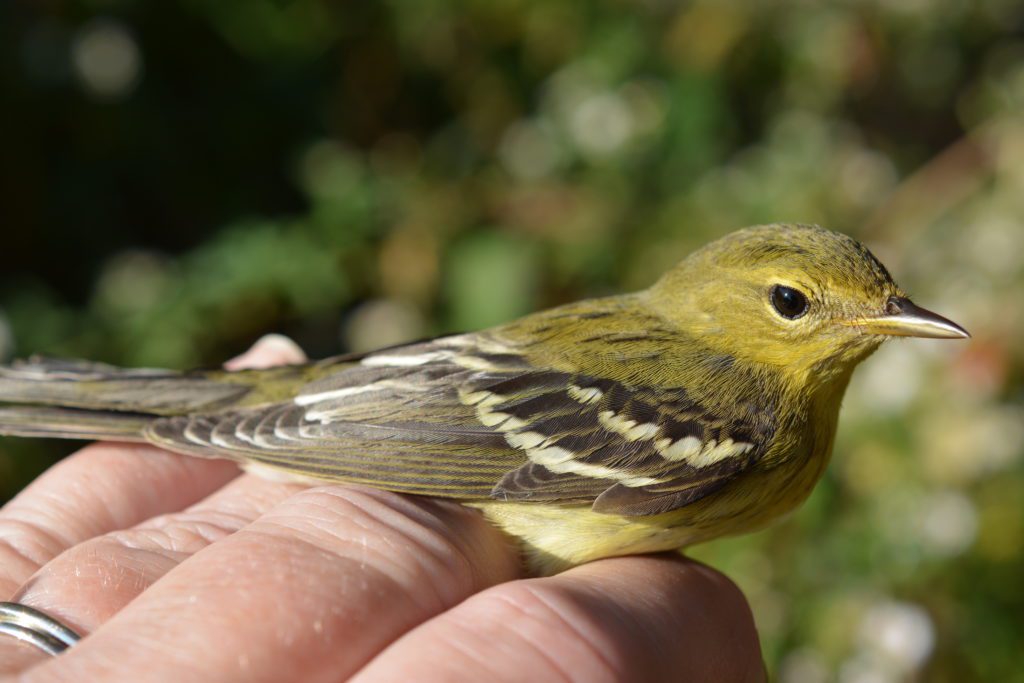
Yellow, gray, and white bird on a hand outdoors.
Blackpoll Warbler

Carnegie Museum of Natural History’s BirdSafe Pittsburgh program announces the Spring 2022 Lights Out Pittsburgh campaign. Lights Out Pittsburgh, an endeavor launched in September 2021 by BNY Mellon, the Building Owners and Managers Association of Pittsburgh, Carnegie Museum of Natural History, the National Aviary, and Pittsburgh Downtown Partnership, encourages owners of businesses and homes to turn off lights during peak migration hours, reducing bird window collisions and disorientation caused by artificial light in the night sky. Lights Out Pittsburgh seeks to build on the momentum of its successful fall campaign that recruited 75 buildings to join the movement. 
 
More than 100,000 birds pass over the Pittsburgh region each year during fall and spring migrations, and research indicates that window collisions and disorientation brought about by bright lights are leading causes of bird fatalities. Lights Out Pittsburgh invites partners to join a growing national community of businesses and residences by turning off as much internal and external building light as possible—particularly in upper floors and lobbies—during the hours between midnight and 6 a.m. from March 15 to May 31. 

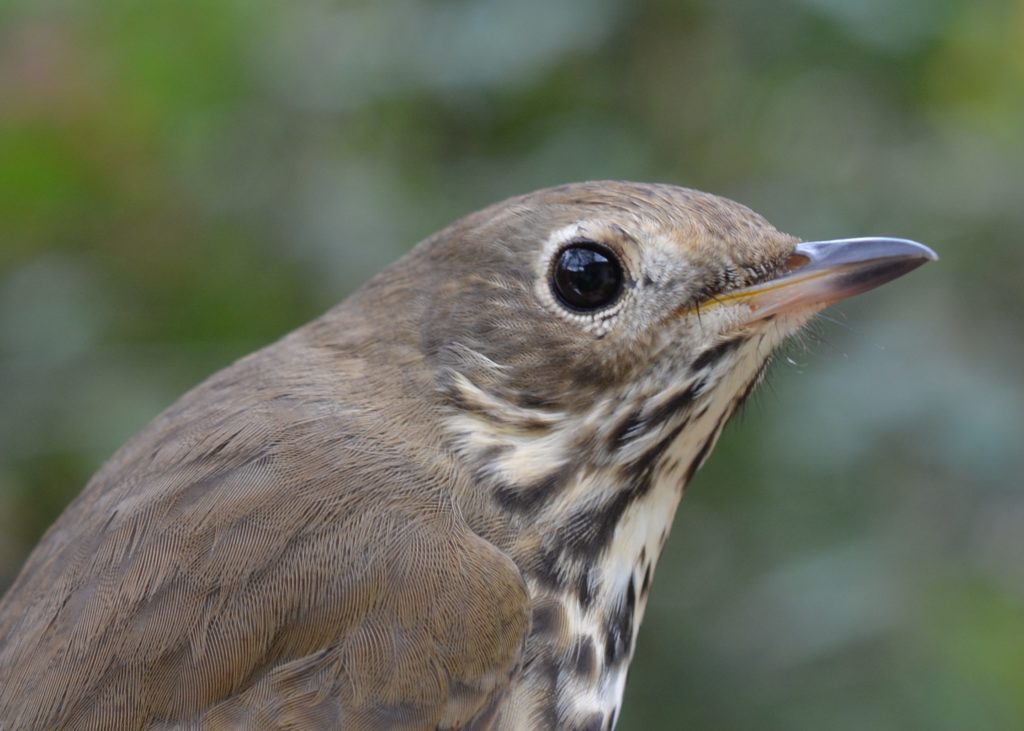
Close up of a pale brown bird with a black and white striped throat.
Hermit Thrush

“Bringing a Lights Out program to Pittsburgh last fall culminated a long-time professional goal,” said Jonathan Rice, Urban Bird Conservation Coordinator at Carnegie Museum of Natural History and manager of BirdSafe Pittsburgh. “Now it’s time to build on that. Eight years of research has shown us where birds collide in our city. This Lights Out program is the first step in making Pittsburgh a safer place for birds stopping over during migration, or who live here year-round.”
 
Lights Out Pittsburgh‘s Spring 2022 campaign will mitigate avian fatalities as migratory birds head to their summer destinations. BNY Mellon, Carnegie Mellon University, Carnegie Science Center, Eleven Stanwix, House Building, Law & Finance Building, Point Park University, Union Trust Building, United Steelworkers’ Building, 100 Ross, 20 Stanwix, 600 Waterfront, and other buildings have pledged to turn off unnecessary lighting from midnight to 6 a.m. Others can join by visiting birdsafepgh.org. 
 
“I am proud that BNY Mellon initiated this movement in the city of Pittsburgh,” said Christina Bencho of BNY Mellon. “Each year it becomes increasingly important that we use our reach, market influence, and resources to support environmental, social, and governance (ESG) issues. As one of the largest building owners in the city, this is a topic we felt passionate about moving forward.”
 
Since 2014, BirdSafe Pittsburgh has coordinated volunteers to monitor key neighborhoods during migration periods, collecting data documenting bird fatalities and providing care to birds with injuries caused by window collisions. BirdSafe Pittsburgh will document the Lights Out initiative’s progress on reducing bird mortalities.
 
The collaborative effort to save birds on their migratory journeys continues to grow as businesses and residents join the pledge to turn off unnecessary lights from midnight to 6 a.m. during peak seasonal migration periods. All are welcome and encouraged to participate. For more information about the Pittsburgh area Lights Out initiative or volunteering for BirdSafe Pittsburgh, visit birdsafepgh.org.

###

BNY Mellon is a global investments company dedicated to helping its clients manage and service their financial assets throughout the investment lifecycle. Whether providing financial services for institutions, corporations or individual investors, BNY Mellon delivers informed investment and wealth management and investment services in 35 countries. As of June 30, 2021, BNY Mellon had $45.0 trillion in assets under custody and/or administration, and $2.3 trillion in assets under management. BNY Mellon can act as a single point of contact for clients looking to create, trade, hold, manage, service, distribute or restructure investments. BNY Mellon is the corporate brand of The Bank of New York Mellon Corporation (NYSE: BK). Additional information is available on www.bnymellon.com. Follow us on Twitter @BNYMellon or visit our newsroom at www.bnymellon.com/newsroom for the latest company news.

About BOMA Pittsburgh – Since 1919, the Building Owners & Managers Association of Pittsburgh has been helping owners and managers of commercial real estate maintain safe, efficient properties in Western PA. We do this through state and local advocacy, fostering professional connections through networking events, organizing members to serve in the local community, and training the next generation of commercial real estate leaders. BOMA Pittsburgh is proudly Federated with BOMA International, and our members operate over 31 million square feet of commercial real estate. 

Carnegie Museum of Natural History, one of the four Carnegie Museums of Pittsburgh, is among the top natural history museums in the country. It maintains, preserves, and interprets an extraordinary collection of millions of objects and scientific specimens used to broaden understanding of evolution, conservation, and biodiversity. Carnegie Museum of Natural History generates new scientific knowledge, advances science literacy, and inspires visitors of all ages to become passionate about science, nature, and world cultures. More information is available by calling 412.622.3131 or by visiting the website, https://carnegiemnh.org.

About the National Aviary – The one and only National Aviary celebrates 70 years of saving birds and protecting habitats in 2022. Located on Pittsburgh’s historic Northside since its founding in 1952, the National Aviary is home to 500 birds representing more than 150 diverse species from around the world, many of them threatened or endangered in the wild. The National Aviary’s large walk-through habitats create an intimate, up-close interaction between visitors and free-flying birds, including opportunities to hand-feed and to meet many species rarely found in zoos. Hours of operation are 10:00 a.m. – 5:00 p.m. daily except for Tuesdays. For tickets and more information visit aviary.org.

About the Pittsburgh Downtown Partnership The Pittsburgh Downtown Partnership (PDP) is a dynamic, nonprofit organization comprised of business and community leaders, property owners, civic organizations, foundations, and residents who provide energy, vision, and advocacy for Downtown Pittsburgh. Working collaboratively with its partners, the PDP strives to create a positive Downtown experience for residents, workers and visitors alike. The PDP’s strategic initiatives include clean and safe services, transportation, and economic development and advocacy. For more information, visit www.DowntownPittsburgh.com, follow us on Twitter at http://twitter.com/downtownpitt and “like” us on Facebook. 

Filed Under: Press Release Tagged With: Birds, birdsafe pittsburgh, Luke DeGroote, Science News

February 9, 2021 by Erin Southerland

Surprising Study Reveals that Common Potoo Bird Is Migratory

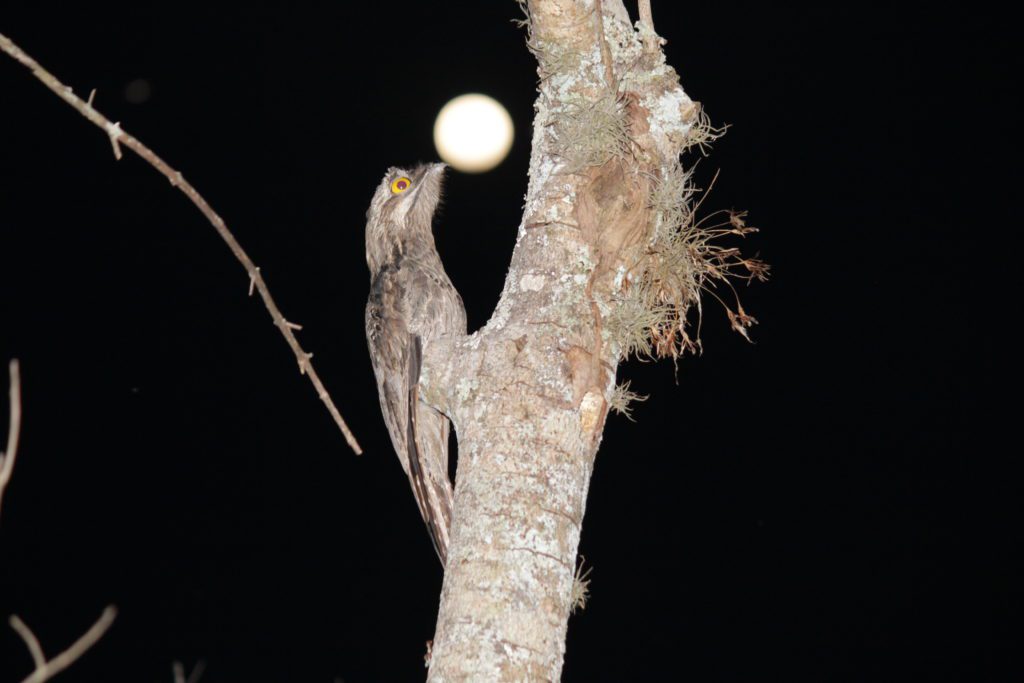
Common Potoo, Nyctibius griseus 
© Fernando Cipriani
A team of scientists from Carnegie Museum of Natural History’s Powdermill Nature Reserve and Museu de Microbiologia do Instituto Butantan in Brazil recently documented migratory movements by a large and charismatic bird species long thought to be sedentary across its extensive South American range. The species under study, the Common Potoo, known scientifically as Nyctibius griseus, is an abundant, cryptically colored, nocturnal bird found in open woodland and savannah habitat from Nicaragua south to Uruguay and northern Argentina. The research findings, which were published in Ibis, the International Journal of Avian Studies, represent the first time any species of Potoos have been shown to migrate.
 
According to Luke DeGroote, research coordinator at the Powdermill Avian Research Center, and the publication’s lead author, the lack of previous knowledge about the species’ seasonal movements is both surprising and understandable—surprising because the charismatic bird is popular among the public and understandable because the species is effectively camouflaged when at rest.
 
As DeGroote explained in a blog post summarizing the study’s findings: “Their plumage, structure and posture allow them to masquerade as broken branches or stumps; a feat they sometimes attempt in the open, bold as brass on fenceposts and bottles. Notches in their eyelids allow them to watch intruders with eyes closed or nearly so.”
 
The role of citizen science in the study is of particular significance. The research largely charted movement of Common Potoos southward on the continent to a temperate zone in the austral (Southern Hemisphere) summer to breed, and then their return to a more equatorial area (such as the Amazon) in the austral winter. Much of the data documenting the movements of Common Potoos came from eBird, an online reporting system coordinated by the Cornell Lab of Ornithology and the National Audubon Society, and WikiAves, a similar Brazilian public domain resource.
 
As DeGroote explains, “Data from citizen scientists is becoming more robust and could allow scientists to uncover more hidden migrations, habitat requirements, status and trends to conserve birds within South America.”
About Powdermill Nature Reserve
Powdermill Nature Reserve, the environmental research center of Carnegie Museum of Natural History, has been dedicated to its mission of research, education, and conservation for more than 50 years. It is a place for scientists, for students, and for families who are interested in the natural world. The Powdermill bird migration research program is home to the one of the longest continually running bird banding stations in the United States. A wide variety of public education programs serve children and adults. Researchers from around the world conduct diverse long- and short-term scientific studies in herpetology, botany, invertebrate zoology, and ornithology. The Powdermill Avian Research Center (PARC) is part of Powdermill Nature Reserve.

Filed Under: Press Release Tagged With: Birds, Luke DeGroote, Powdermill Nature Reserve

April 29, 2020 by wpengine

Wind and Migration

Spring is just around the corner, even if it doesn’t feel like it the last few days.  In the Laurel Highlands, the trout lilies and trillium are blooming, the closed umbrella forms of May apples are poking through the leaf litter, and the migrating birds are on their way.  Some are already here.  For many birders, spring is the most exciting time of year.  We’ve waited months to see something different, all dressed up fancy and bright after growing new feathers over the winter.  We also get a chance to see some birds as they lay over, northward bound to the boreal forest or arctic tundra.   So, when will they be here?  That depends on two things: time and wind.

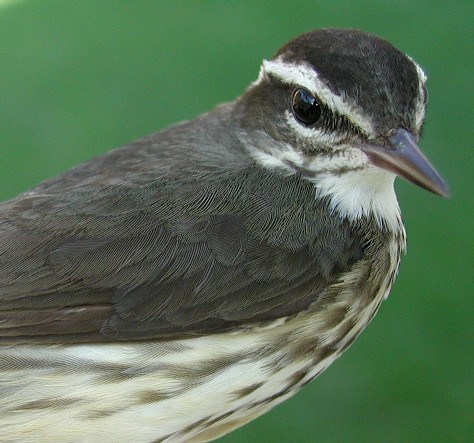
Birds want to arrive as soon as there’s food to eat so they can stake their claim on a nice plot of land to raise a family.  Since the tundra is still frozen, birds that breed there, like the Grey-cheeked Thrush, won’t be coming until around the second week of May.  Louisiana Waterthrushes on the other hand, arrived the beginning of April, as soon as insects were flying along the mountain streams they call home.  Both species know when to depart their wintering grounds based on daylength, honed over thousands of years through natural selection.

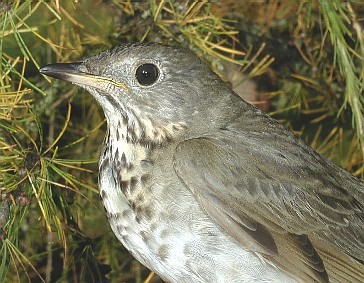
Gray-cheeked Thrush

Louisiana Waterthrush

The other thing birds base their decision to leave upon is weather, specifically wind.  And it effects how many migrants might be arriving on a particular day at a particular place.  Put another way, birds’ instincts effect the range of dates they arrive, weather influences the specific dates.

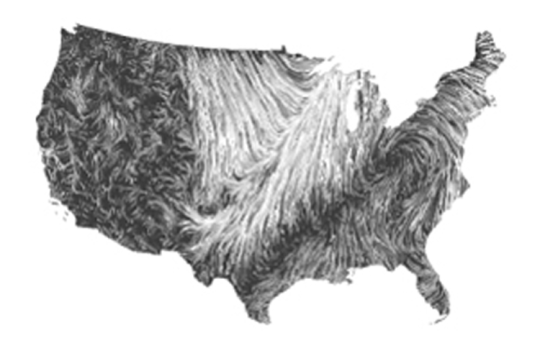
How is wind important? Hawks soar using thermals (warm air rising from heated land masses) or ridges (wind pushed up by ridges). Songbirds on the other hand, migrate at night and fly when the winds are light or are in the direction they are heading (when they literally have a tail wind). Because low pressure systems spin counter-clockwise fall migrants will move after a low front passes in the fall or before a low front arrives in the spring. We like to use Hint.fm wind maps to help predict when and where migrants can move. Besides being informative, these maps show the beautiful complexity of wind patterns.

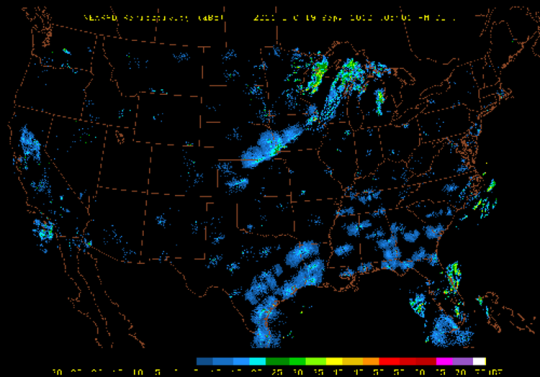
You might now be wondering how we use these maps. Let’s use Sept 19th, 2012 as an example. At 1pm EST there are light, southerly winds along the eastern seaboard and throughout the Southeast. There are also strong southerly winds in the western part of the Midwest. If you imagine that these patterns will slowly move eastward (say half an inch by sunset) you might predict strong migration for the eastern seaboard, the southeast, and the Midwest.

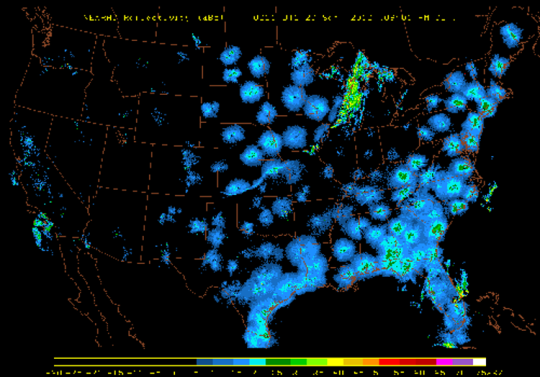
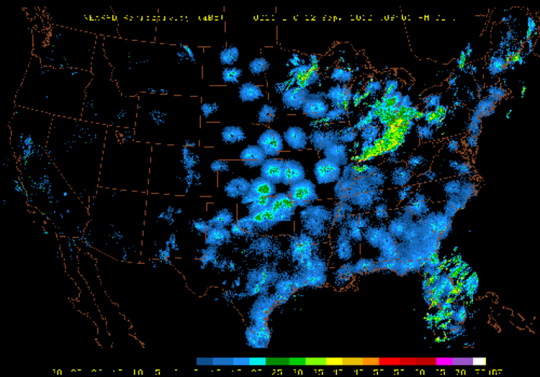
If you made such a prediction you would be right, but you don’t have to take our word for it. It turns out that birds taking off and migrating at night are picked up on radar. Here’s a radar loop from 5pm EST Sept 19th to 1:40am EST Sept 20th. At the very beginning you can see storm systems across Wisconsin and Iowa. As the frames progress you can see intense circular “clouds” appearing across the east, Southeast, and Midwest. These “clouds” are millions of birds taking off after sunset and continuing to migrate throughout the night. They’re circular because they are centered around each radar. We call these appearances “blooms” because they blossom around the radar sites.

Notice that where the storm system is and several hundred miles to the east (about an inch) there aren’t any blooms. That’s because this is the area which is experiencing strong northerly winds. Rather than fighting the headwind, birds in this area are staying put until more favorable winds come through. The winds along the gulf appear to be favorable for a trans-gulf crossing and you can see the clouds of birds take off and begin to move off the gulf coast shoreline (especially Texas). Looking at the longer loop from 3pm EST the 19th to 2pm EST the 20th you can also see birds taking off in Illinois and Iowa after the front has passed through.

What about the spring you ask?  Remember, since the low-pressure systems spin counter clockwise birds migrate ahead of a front.  A few days ago, the night of April 11th, there were southerly winds resulting in good movement northward across the southeastern U.S.  Looking ahead, the next significant warm-up with nightly, light, southerly winds won’t occur until next week, mid-week (around Tuesday April 21st). If piecing together wind patterns and radar isn’t your thing, Cornell Lab of Ornithology has you covered.  They’ve put together something they call BirdCast which puts combines weather, radar, and bird data (ebird) to forecast bird migration for the U.S.

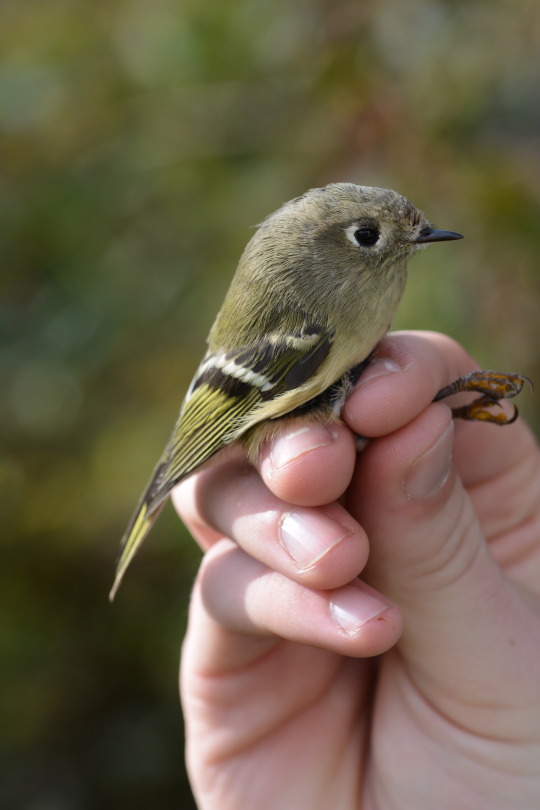
Ruby-crowned Kinglet

We may be quarantined but that doesn’t mean we have to miss the magic of migration.  As I write, there’s a ruby-crowned kinglet singing in a maple across the street.  We can bird, or learn birds, in our backyard or neighborhood.  We can bird a new local patch and contribute what we see to science by logging our sightings into ebird.com.  Over the last few years people in Pennsylvania have found some amazing birds in their own backyard.  A Black-backed Oriole from Mexico, a Painted Bunting which overshot the Carolinas by more than a few states, and even a Bahama Woodstar.  With migration, we never know exactly what we’re going to get.  To me that’s part of the magic.  That, and knowing that it’s time for them to come, carried hundreds or even thousands of miles by their wings and the wind.

Luke DeGroote is the avian research coordinator at Powdermill Nature Reserve, Carnegie Museum of Natural History’s environmental research center. Museum staff, volunteers, and interns are encouraged to blog about their unique experiences and knowledge gained from working at the museum.

Filed Under: Blog Tagged With: Birds, Luke DeGroote, Museum from Home, parc, Science News

February 19, 2019 by Kathleen

58 years, 750,000 birds: Building Powdermill’s Avian Research Center One Bird at a Time

Speaker: Luke DeGroote, Avian Research Coordinator, Powdermill Nature Preserve, Carnegie Museum of Natural History

Studies of natural history are increasingly rare, yet they underpin the questions that are asked, the validity of tests performed, and the efforts to conserve biodiversity in a rapidly changing world. How these time-honored techniques are mixed with new technology to build research and education programs for the 21st Century at Powdermill’s Avian Research Center will be presented.

Tagged With: Luke DeGroote, Powdermill

May 7, 2018 by wpengine

Luke DeGroote in AFO Afield

We’re thrilled to share that Avian Research Coordinator Luke DeGroote’s bird banding workshop has been featured in AFO Afield!

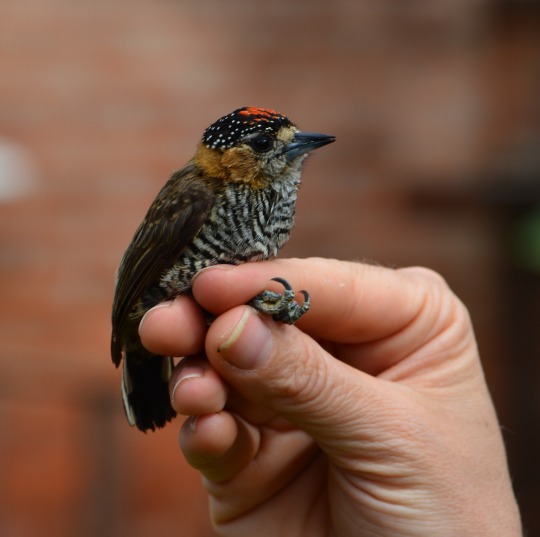
Ochre-Collared Piculet

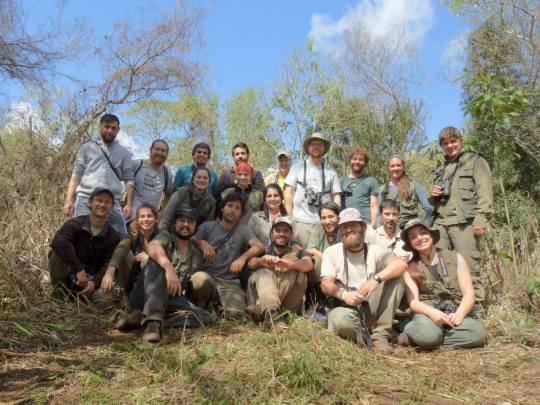
Luke was one of five instructors teaching 15 participants advanced bird banding skills and ethics, and molt interpretation in Iguazú National Park in Argentina last year.

Instructors and students in Iguazú National Park

But what is bird banding and why does it matter?

It’s the practice of catching and releasing birds after marking them with a small band around the leg to identify them. The bands let researchers study all kinds of things about birds including migration patterns, social structure and behavior of different species, population changes, and diseases.

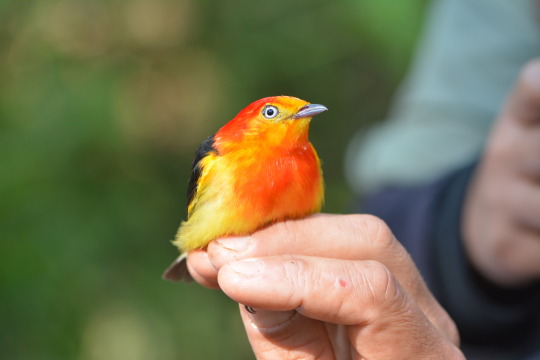
Band-Tailed Manakin

The group was thrilled to catch and band a band-tailed manakin—a small bird that looks a bit like it was tie-dyed because of the way the bright red, orange, and yellow feathers cover its head and chest.

Read more about Luke DeGroote’s participation in this collaboration between the North American Banding Council (NABC) and AFO in AFO Afield.

Filed Under: Blog Tagged With: bird banding, Luke DeGroote, parc

  • Page 1
  • Page 2
  • Go to Next Page »

sidebar

About

  • Mission & Commitments
  • Directors Team
  • Museum History

Get Involved

  • Volunteer
  • Membership
  • Carnegie Discoverers
  • Donate
  • Employment
  • Events

Bring a Group

  • Groups of 10 or More
  • Birthday Parties at the Museum
  • Field Trips

Powdermill

  • Powdermill Nature Reserve
  • Powdermill Field Trips
  • Powdermill Staff
  • Research at Powdermill

More Information

  • Image Permission Requests
  • Science Stories
  • Accessibility
  • Shopping Cart
  • Contact
  • Visitor Policies
One of the Four Carnegie Museums | © Carnegie Institute | Privacy Policy | Terms of Use | Accessibility
Rad works here logo