• Skip to primary navigation
  • Skip to main content
  • Skip to primary sidebar

Carnegie Museum of Natural History

One of the Four Carnegie Museums of Pittsburgh

  • Visit
    • Buy Tickets
    • Visitor Information
    • Exhibitions
    • Events
    • Dining at the Museum
    • Celebrate at the Museum
    • Powdermill Nature Reserve
    • Event Venue Rental
  • Learn
    • Field Trips
    • Educator Information
    • Programs at the Museum
    • Bring the Museum to You
    • Guided Programs FAQ
    • Programs Online
    • Climate and Rural Systems Partnership
  • Research
    • Scientific Sections
    • Science Stories
    • Science Videos
    • Senior Science & Research Staff
    • Museum Library
    • Science Seminars
    • Scientific Publications
    • Specimen and Artifact Identification
  • About
    • Mission & Commitments
    • Directors Team
    • Museum History
  • Tickets
  • Give
  • Shop

Blogs by Mason Heberling

Mason Heberling is the assistant curator in the Section of Botany and co-chair of collections at Carnegie Museum of Natural History. Heberling is a plant ecologist and botanist whose research explores plant functional strategies in deciduous forest understories, especially in the context
of environmental change. Much of his current research focuses on the ecology
and evolution of non-native, invasive plants in the eastern United States, the ecophysiological strategies of the herbaceous layer in deciduous forests, and the impacts of climate change on the timing of leafing out and flowering in temperate deciduous forests.

February 15, 2018 by wpengine

Collected on Valentine’s Day, 1996

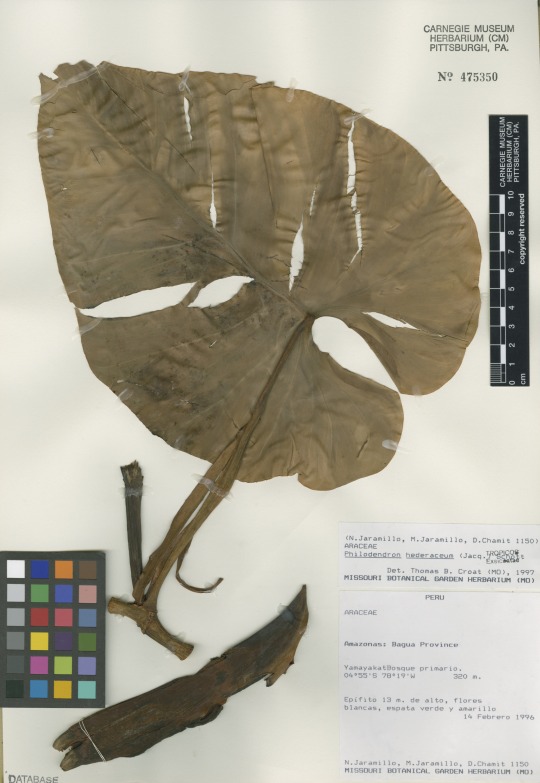
heartleaf philodendron (Philodendron hederaceum) collected on Valentine’s Day in Peru

Does this heart-shaped leaf look familiar?  22 years ago, this specimen of heartleaf philodendron (Philodendron hederaceum) was collected on Valentine’s Day in Peru. Almost certainly you have seen this species, but probably not in the wild.  Heart leaf philodendron is a very popular houseplant. This huge leaf on this specimen may look a bit different than those in your home, as the species rarely reaches maturity as a
houseplant.  Philodendrons have both juvenile and adult forms of their leaves, changing their form and size as they climb up a tree.

There are also many different species and varieties of philodendrons.
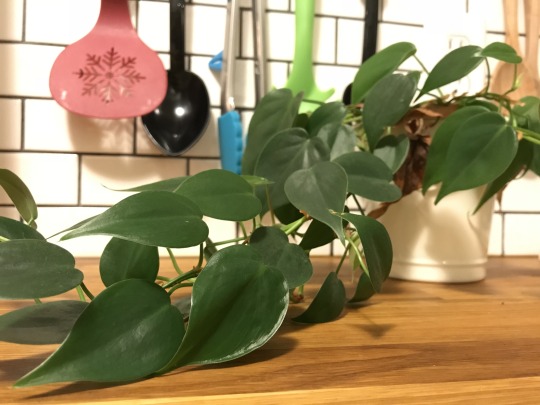
healthy green philodendron growing on a kitchen counter

Philodendron growing on a bookshelf
Philodendron in its newly found habitat in the Anthropocene. Philodendrons are incredibly popular as indoor plants, being easy to take care of and incredibly tolerant of low light conditions in your house. Philodendrons are toxic to pets. However, the NASA Clean Air Study has found philodendrons to filter out harmful chemicals and improve indoor air quality.

The name Philodendron comes from the Greek philo meaning “love” and dendron meaning “tree.”  The name doesn’t refer to the heart shaped leaves, but rather to its growth habit as a vine that climbs trees.  It is native to tropical Mexico, the Caribbean, and regions in South America.
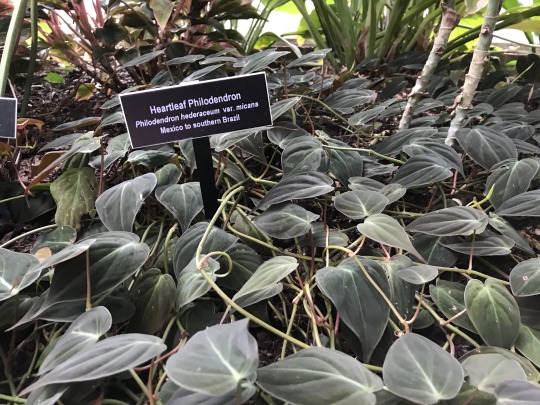
Philodendron growing outside

Happy Valentine’s Day from this loving plant!
Filed Under: Blog Tagged With: Anthropocene, Botany, Mason Heberling

February 12, 2018 by wpengine

Collected February 11 in 1903

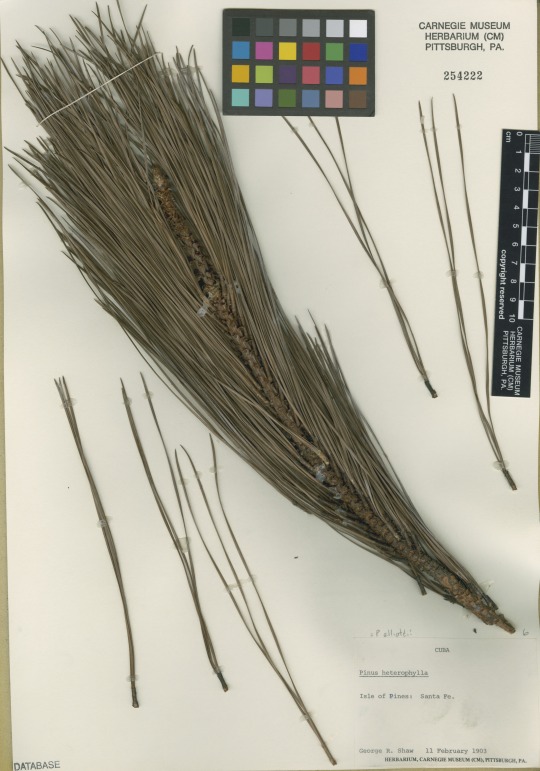
herbarium specimen of Pinus elliottii

In honor of the cool, new Tropical Forest Cuba opening up this past weekend at Phipps Conservatory and Botanical Gardens, here’s a specimen collected in Cuba 115 years ago today.  This pine specimen of Pinus elliottii, known as slash pine or Cuban pine, was collected by George Russell Shaw in the Isles of Pines, Cuba
(now known as Isla de la Juventud).  Shaw was an influential botanist working at the Arnold Arboretum (Harvard) who specialized in pines.

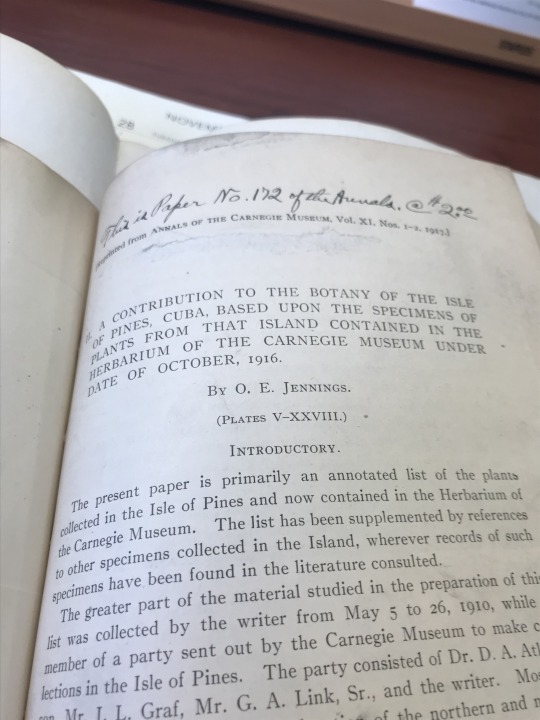
The Carnegie Museum of Natural History has many specimens from Cuba.  Curator of Botany Otto Jennings and others went on expeditions to Cuba in the early 1900s, and many specimens are now preserved at the Carnegie Museum.

page of an open book
One publication resulting from expeditions to the Isles of Pines, written by one the first curators of botany Otto Jennings, who researched the plants of Cuba.

The herbarium includes 4,068 specimens from Cuba, of which 54 are type specimens (meaning they are associated with the description of a species new to science).

Learn more about the plants and culture of Cuba at Tropical Forest Cuba at Phipps Conservatory and Botanical Gardens!

Botanists at Carnegie Museum of Natural History share pieces of the herbarium’s historical hidden collection on the dates they were discovered or collected. Check back for more!

Filed Under: Blog Tagged With: Mason Heberling

December 28, 2017 by wpengine

Collected on Christmas Eve 1883: Mistletoe

herbarium specimen of mistletoe

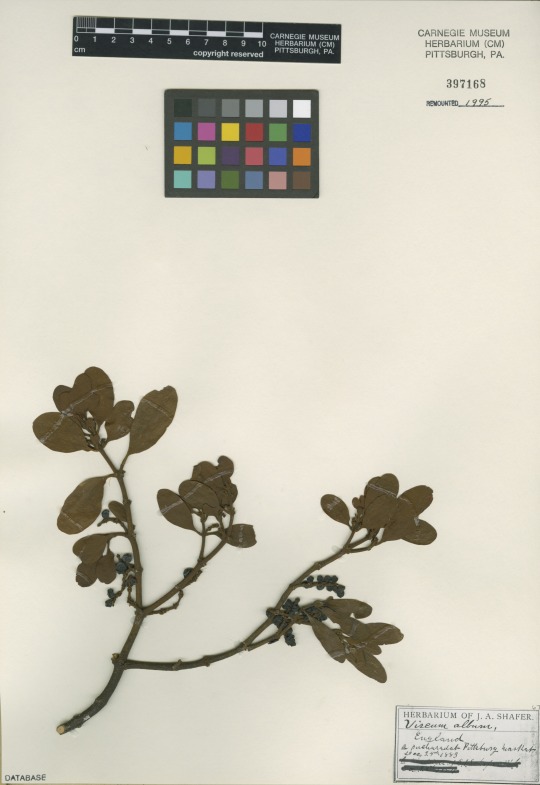
John A. Shafer bought this mistletoe at a market in Pittsburgh, Pennsylvania on Christmas Eve 1883. Sixteen years later, Shafer became the museum’s first botany curator. This mistletoe’s scientific name is Viscum album.

Mistletoes refer to many species within the genus Viscum. Usually, mistletoes refer to a species native to Europe, Viscum album. (“Album” is Latin for white.) European mistletoe has a deep cultural history, dating back to ancient Greece. It remains a well-known holiday decoration today.

Mistletoes are Hemi-Parasitic

Did you know that mistletoes are hemi-parasitic plants? They grow on the branches of trees like oaks, with special roots (called “haustorium”). These roots penetrate host trees to obtain water and nutrients. However, mistletoes don’t get all of their nutrients from their host plants. Hemi-parasitic plants like mistletoes make some of their own nutrients. They do this like other plants, through photosynthesis.

Mistletoe Germination

How do mistletoes germinate high up on the branches of trees? They have evolved to produce berries which birds like to eat. Birds then fly around, land on another branch, and poop viable mistletoe seeds. Without the help of birds, the seeds would likely just fall to the ground.

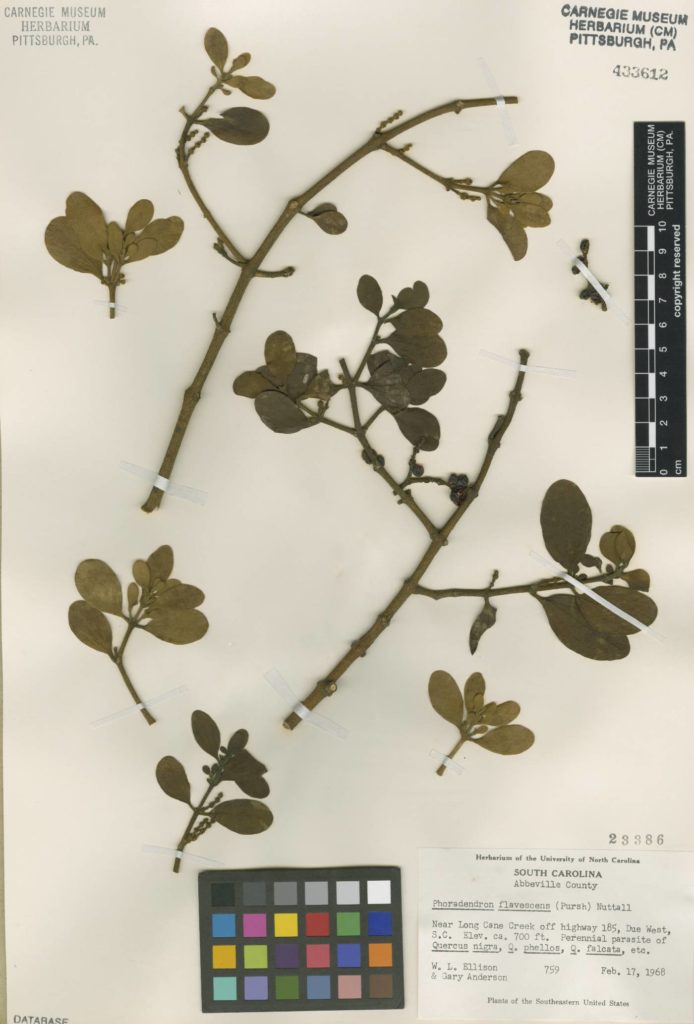
Mistletoes are native to the United States, too. American mistletoe (Phoradendron leucarpum) is native to southeastern states. People harvest and and sell this species in the United States in Christmas traditions, just like European mistletoe. The plant below is part of the museum’s herbarium and is from South Carolina in 1968. This specific American mistletoe had more than one host plant, all oak trees.

American Mistletoe
American mistletoe (Phoradendron leucarpum) used to be known as Phoradendron flavescens. You can see the old name on the Herbarium sheet from 1968.
an old label
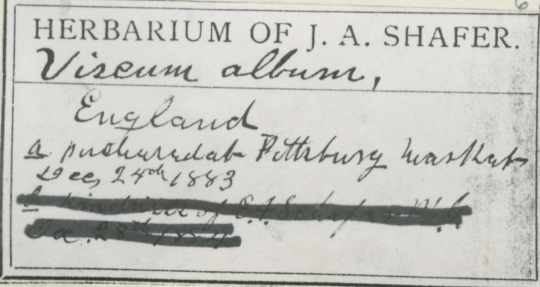
Close up image of label that reads: “a. purchased at Pittsburg market.” It took me a while to decipher this handwriting. Note that Pittsburgh’s official spelling was “Pittsburg” until 1911. The mistletoe was for sale for the holidays. It was imported from its native range in England.

Botanists at Carnegie Museum of Natural History share pieces of the herbarium’s historical hidden collection on the dates they were discovered or collected. Check back for more!

Filed Under: Blog Tagged With: Botany, herbarium, Mason Heberling

December 22, 2017 by wpengine

Collected in December 1928

herbarium specimen of holly

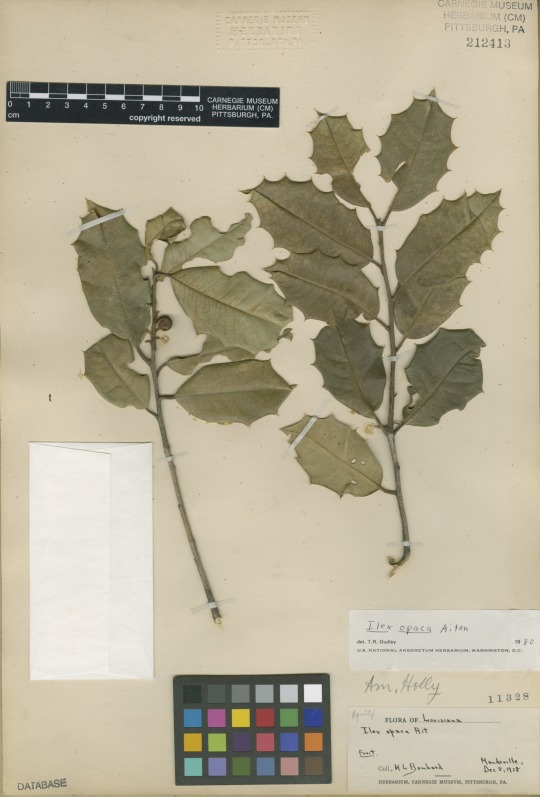
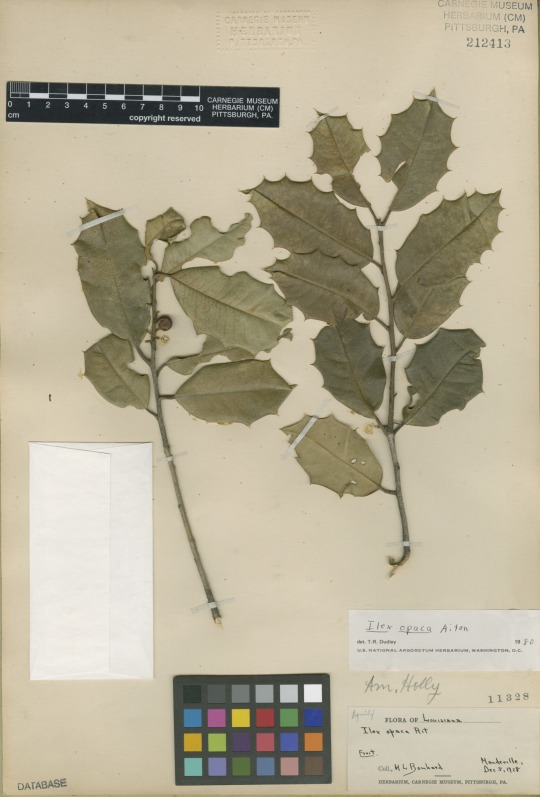
Are you decking your halls with boughs of holly? This specimen of American holly (Ilex opaca) was collected by M.L. Bomhard in Mandeville, Louisiana by on December 8, 1928. The holly revered for its holiday cheer usually refers to a related European species, Ilex aquifolium. But there are native holly species in North America that are equally (if not more) cheerful. Like most other hollies, American holly is dioecious, meaning it has male and female flowers on separate plants. Only the female plants have the characteristic bright red berries we all know and love. American holly stands out as one of the few broadleaved evergreen trees native to the Eastern United States (i.e., has green leaves during winter that are not needles). This species is near the northern edge of its range in Pennsylvania and is more common in southern states.  It is listed in PA as a species of “special concern” due to its relative rarity.


Botanists at Carnegie Museum of Natural History share pieces of the herbarium’s historical hidden collection on the dates they were discovered or collected. Check back for more!

Filed Under: Blog Tagged With: Botany, herbarium, Mason Heberling

December 15, 2017 by wpengine

Afraid you missed our most recent Scientists Live?

Afraid you missed our most recent Scientists Live with Mason Heberling in the Herbarium? You can tune in anytime here or on Carnegie Museum of Natural History’s Youtube channel. Binge watch the whole Scientists Live series in our Scientists Live playlist.

Filed Under: Blog Tagged With: Botany, herbarium, Mason Heberling, Scientists Live

December 8, 2017 by wpengine

Collected on this Day in 1928

herbarium specimen of holly

Are you decking your halls with boughs of holly?  This specimen of American holly (Ilex opaca) was collected by M.L. Bomhard in Mandeville, Louisiana on December 8, 1928. The holly revered for its holiday cheer usually refers to a related European species, Ilex aquifolium, but there are native holly species in North America that are equally, if not more, cheerful.

Like most other hollies, American holly is dioecious, meaning it has male and female flowers on separate plants. Only the female plants have the characteristic bright red berries we all know and love.  American holly stands out as one of the few broadleaved evergreen trees native to the Eastern US (i.e., has green leaves during winter that are not needles). This species is near the northern edge of its range in Pennsylvania and is more common in southern states. It is listed in Pennsylvania as a species of “special concern” due to its relative rarity.

Botanists at Carnegie Museum of Natural History share pieces of the herbarium’s historical hidden collection on the dates they were discovered or collected. Check back for more!

Filed Under: Blog Tagged With: Bonnie Isaac, Botany, herbarium, Mason Heberling

  • « Go to Previous Page
  • Page 1
  • Interim pages omitted …
  • Page 12
  • Page 13
  • Page 14
  • Page 15
  • Page 16
  • Interim pages omitted …
  • Page 21
  • Go to Next Page »

sidebar

About

  • Mission & Commitments
  • Directors Team
  • Museum History

Get Involved

  • Volunteer
  • Membership
  • Carnegie Discoverers
  • Donate
  • Employment
  • Events

Bring a Group

  • Groups of 10 or More
  • Birthday Parties at the Museum
  • Field Trips

Powdermill

  • Powdermill Nature Reserve
  • Powdermill Field Trips
  • Powdermill Staff
  • Research at Powdermill

More Information

  • Image Permission Requests
  • Science Stories
  • Accessibility
  • Shopping Cart
  • Contact
  • Visitor Policies
One of the Four Carnegie Museums | © Carnegie Institute | Privacy Policy | Terms of Use | Accessibility
Rad works here logo