• Skip to primary navigation
  • Skip to main content
  • Skip to primary sidebar

Carnegie Museum of Natural History

One of the Four Carnegie Museums of Pittsburgh

  • Visit
    • Buy Tickets
    • Visitor Information
    • Exhibitions
    • Events
    • Dining at the Museum
    • Celebrate at the Museum
    • Powdermill Nature Reserve
    • Event Venue Rental
    • Gift Cards
  • Learn
    • Field Trips
    • Educator Information
    • Programs at the Museum
    • Bring the Museum to You
    • Guided Programs FAQ
    • Programs Online
    • Climate and Rural Systems Partnership
  • Research
    • Scientific Sections
    • Science Stories
    • Science Videos
    • Senior Science & Research Staff
    • Museum Library
    • Science Seminars
    • Scientific Publications
    • Specimen and Artifact Identification
  • About
    • Mission & Commitments
    • Directors Team
    • Museum History
  • Tickets
  • Give
  • Shop

Blogs by Mason Heberling

Mason Heberling is the assistant curator in the Section of Botany and co-chair of collections at Carnegie Museum of Natural History. Heberling is a plant ecologist and botanist whose research explores plant functional strategies in deciduous forest understories, especially in the context
of environmental change. Much of his current research focuses on the ecology
and evolution of non-native, invasive plants in the eastern United States, the ecophysiological strategies of the herbaceous layer in deciduous forests, and the impacts of climate change on the timing of leafing out and flowering in temperate deciduous forests.

October 5, 2017 by wpengine

Collected on this Day in 2007

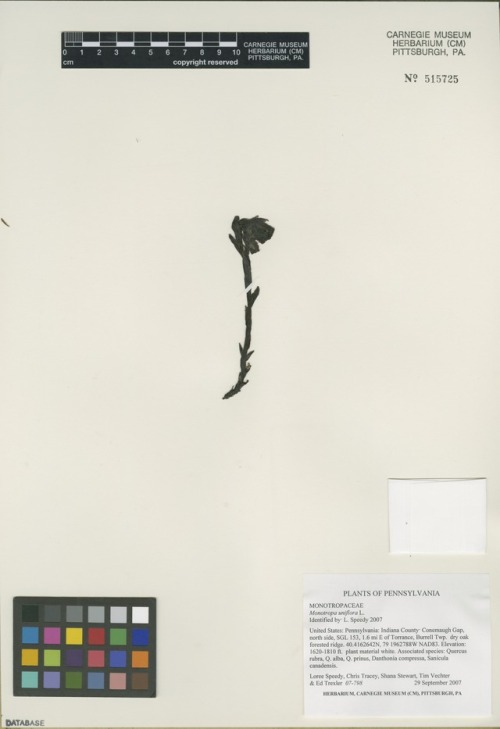
herbarium specimen of Monotropa uniflora, ghost plant

Not all plants in our area photosynthesize!  Collected on September 29, 2007, this specimen was collected by Loree Speedy in dry woods in Burrell Township, Indiana County, PA (near Blairsville).  Often mistaken for a fungus, Monotropa uniflora, commonly known as the ghost plant, is indeed a flowering plant in the blueberry family.

When alive, the plant is white (hence the name ghost plant), but turns black when dried. It lacks the green chlorophyll pigments of most plants, and therefore does not make its own sugars through photosynthesis. Instead, Monotropa uniflora is a heterotroph.

Like humans, heterotrophs ingest or absorb carbon necessary for life from organic sources, rather than fixing carbon from atmospheric carbon dioxide through photosynthesis). More specifically, this plant is a myco-heterotroph.

The way this plant gets its food is incredible. It parasitizes mycorrhizal fungi in the soil. And where does the mycorrhizal fungi get its food? These fungi form a close relationship (symbiosis) with many forest trees, shrubs and herbs, where the fungi aid the host plant in water and nutrient uptake and the fungi receive sugars from the plant in return. This complex relationship was shown using radioactive carbon dioxide, tracking tagged carbon molecules from a host tree to Monotropa uniflora.

So…ultimately, the food for this non-photosynthetic plant comes from other plants in the forest!


Botanists at Carnegie Museum of Natural History share pieces of the herbarium’s historical hidden collection on the dates they were discovered or collected. Check back for more!
Filed Under: Blog Tagged With: Botany, herbarium, Mason Heberling

September 25, 2017 by wpengine

Collected on this Day in 1946

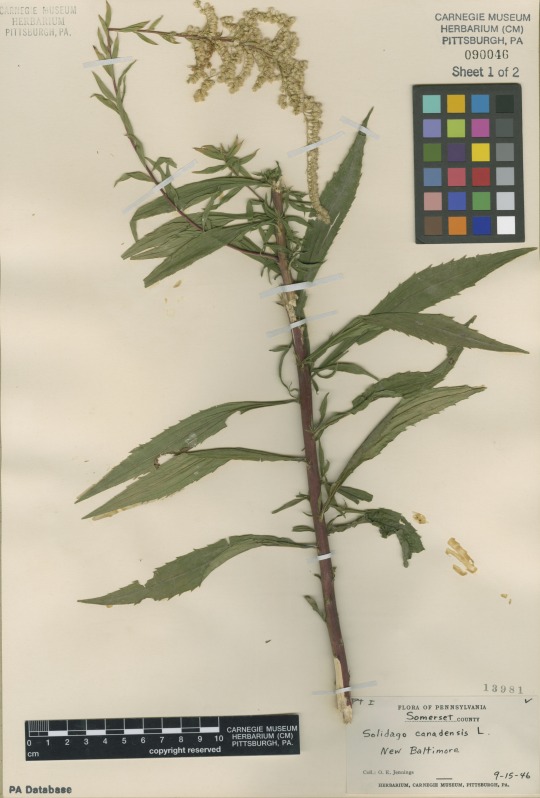
Canada goldenrod (Solidago canadensis) in bloom

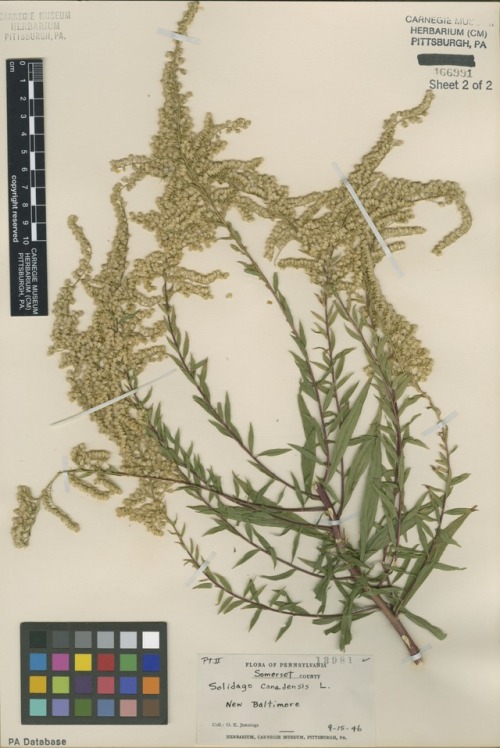
Canada goldenrod (Solidago canadensis) sheet 2

It is that time of year when old fields across western Pennsylvania are painted yellow.

Collected on September 15, 1946, this specimen was found in New Baltimore, Somerset County by an influential curator of botany at the museum, Otto Jennings. There are many species of goldenrod (in the genus Solidago) in our region. They are often associated with runny noses and sneezing from fall allergies (hay fever), but don’t blame the goldenrods!

Their relatively heavy pollen rarely becomes air-borne, but rather these plants are insect-pollinated. Wind-pollinated species, like ragweed, are more likely your culprit. This specimen pictured here (split between two herbarium sheets) is Canada goldenrod (Solidago canadensis).

Canada goldenrod is a fall-blooming, native species common throughout western Pennsylvania. However, it was introduced to Europe and Asia for use in floral arrangements and gardens and has since become an invasive weed in other parts of the world.


Botanists at Carnegie Museum of Natural History share pieces of the herbarium’s historical hidden
collection on the dates they were discovered or collected. Check back for more!
Filed Under: Blog Tagged With: Bonnie Isaac, Botany, Mason Heberling

September 11, 2017 by wpengine

Collected on this Day in 1991

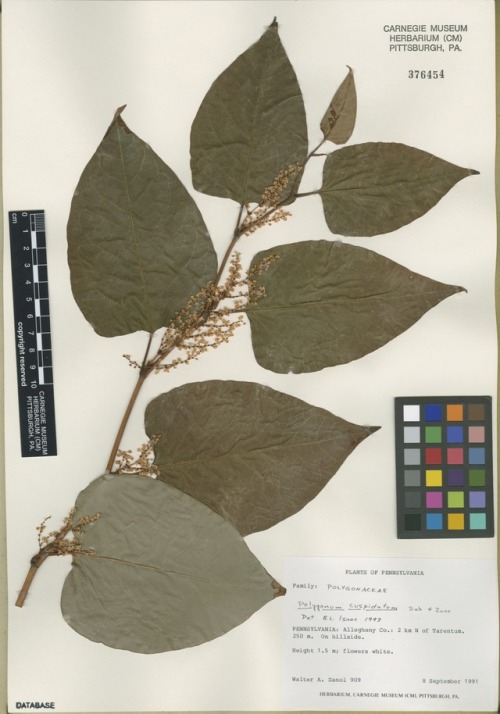
herbarium specimen of Bohemian knotweed (Fallopia xbohemica)

Collected on September 8, 1991, this specimen was found near Tarentum, Pennsylvania by Walt Zanol.

If you had to pick the most aggressive, invasive plant in the Pittsburgh area, knotweed would be among the top choices. This particular specimen is Bohemian knotweed (Fallopia xbohemica), a hybrid between giant knotweed (Fallopia sachalinensis) and Japanese knotweed (Fallopia japonica).  Japanese knotweed was introduced from East Asia, and giant knotweed came from Sakhalin (Russia). The hybrid likely originated when these two species met after they were introduced in Europe.

Both species and their hybrid can be found around Pittsburgh, often in enormous dense clusters along highways and waterways. Take note on your drive to work or walk in the neighborhood—knotweeds
are all around!

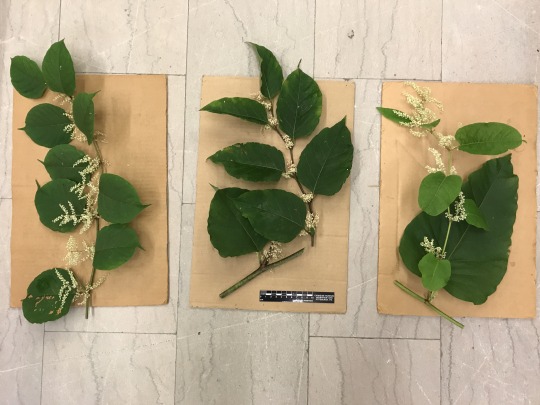
Giant knotweed is distinguished by its large (usually much larger than your hand), heart-shaped
leaves.  Japanese knotweed and the hybrid Bohemian knotweed are much more difficult to distinguish, with much variation in leaf shape. In fact, the hybrid was only recognized in the early 1980s and
was largely overlooked in the United States until even more recently.  Some suggest it invades more aggressively than its parents.

Most specimens in Carnegie Museum of Natural History’s herbarium were originally identified as Japanese knotweed. Last year, Allison Cusick, a research associate at the museum, went through all 212 knotweed specimens and re-identified many as the hybrid. In fact, only three of the specimens from
Allegheny County were identified as Japanese knotweed!

three varieties of knotweed
Left to right: Japanese knotweed (Fallopia japonica), Bohemian knotweed (Fallopia xbohemica), giant knotweed (Fallopia sachalinensis).

All three knotweeds collected at the same site near the Allegheny River and Barking Slopes Conservation Area, New Kensington/Plum, Pennsylvania.  


Botanists at Carnegie Museum of Natural History share pieces of the herbarium’s historical hidden collection on the dates they were discovered or collected. Check back for more!
Filed Under: Blog Tagged With: Botany, herbarium, Mason Heberling

September 11, 2017 by wpengine

Collected on this Day in 2005

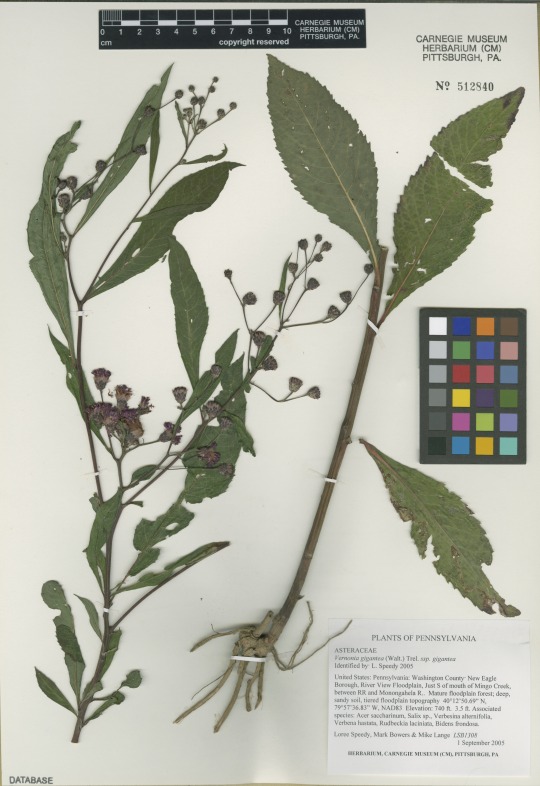
herbarium specimen of tall ironweed, Vernonia gigantea

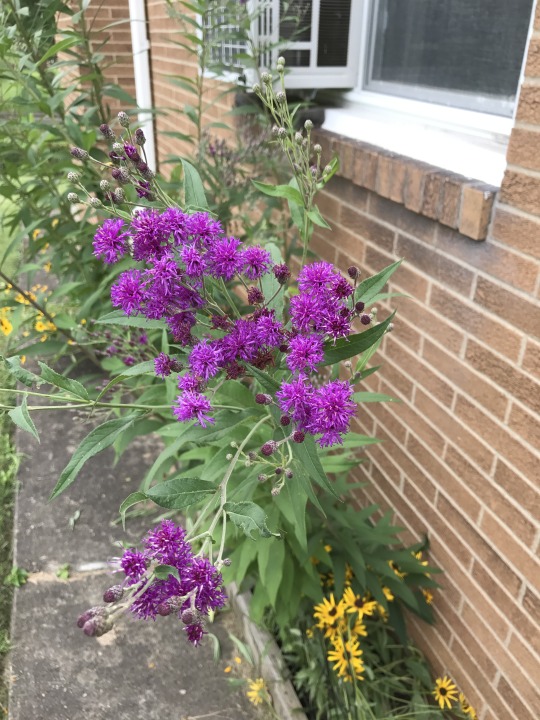
Collected on September 1, 2005, this specimen was found in a floodplain forest near the Monongahela River in New Eagle, PA (Washington County).  Ironweed (which includes many species in the genus Vernonia) is a great plant for native pollinators.  Consider adding it to your garden!  This species of ironweed, known as “tall ironweed” (Vernonia gigantea), can be 2–7 feet tall (or sometimes more than 10 feet) with beautiful purple flower heads from mid-late summer. Learn more about ironweed (and see it all year long) in Botany Hall at Carnegie Museum of Natural History.

ironweed blooming with bright pink-purple flowers

Botanists at Carnegie Museum of Natural History share pieces of the herbarium’s historical hidden collection on the dates they were discovered or collected. Check back for more!
Filed Under: Blog Tagged With: Botany, herbarium, Mason Heberling

August 21, 2017 by wpengine

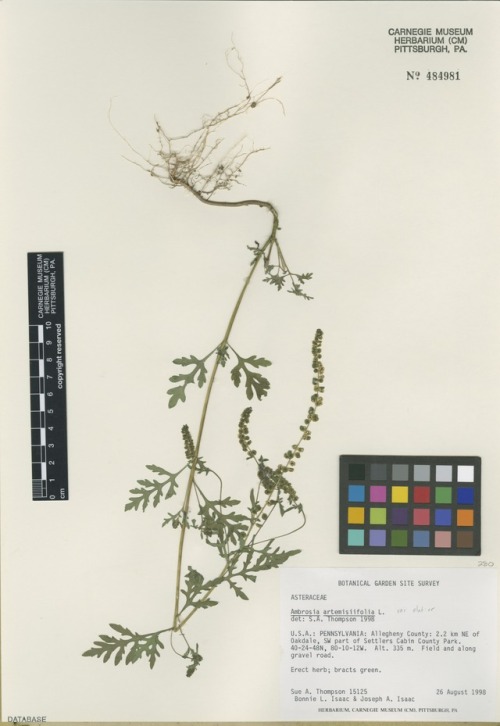
Collected on this Day in 1998

Herbarium specimen of common ragweed (Ambrosia artemisiifolia)

Collected on August 26, 1998, this specimen was found along a gravel road not far from Settlers Cabin County Park. Ragweed is a plant that is (all too) familiar to many people.

Common ragweed (Ambrosia artemisiifolia) is native to North America, but it has been introduced across the world. In many cases, this plant (or other ragweed species) are to blame for seasonal pollen allergies known as hay fever. In summer and early fall, ragweed plants produce copious numbers of pollen grains, which are dispersed in the wind. Although ragweed is native in the United States, historical records (pollen deposited in sediment cores) suggest that this species was far less common in North America before European colonization. This is perhaps not too surprising considering the species thrives in disturbed habitats that came with European colonization and urbanization.

A study published in 2014 in the journal Molecular Ecology extracted DNA from nearly 500 historic herbarium specimens dating back to the 1800s to measure the genetic makeup prior to widespread changes to the landscape in the late 19th century. Combined with data from recent collections, they found shifts in the genetic makeup of ragweed populations as the species was expanding in the United States.


Botanists at Carnegie Museum of Natural History share pieces of the herbarium’s historical hidden collection on the dates they were discovered or collected. Check back for more!
Filed Under: Blog Tagged With: Botany, Mason Heberling

August 18, 2017 by wpengine

Collected on this Day in 1901

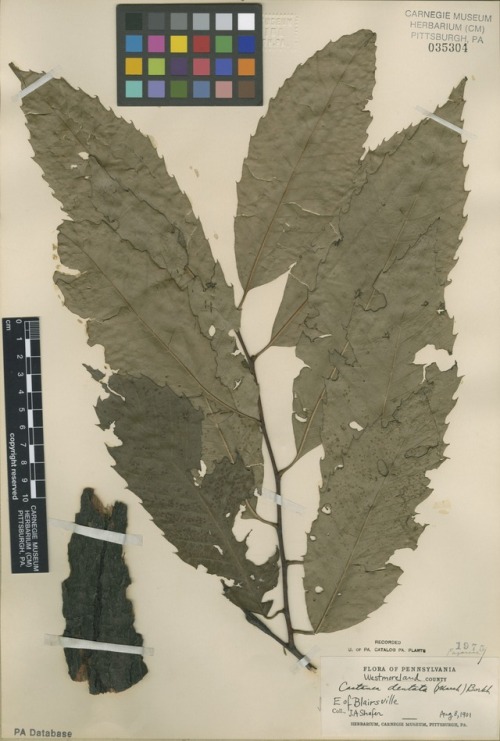
American chestnut herbarium specimen

Collected on August 8, 1901, this American chestnut (Castanea dentata) specimen was found near Blairsville, Pennsylvania by John Shafer.

The American chestnut was once a major player in eastern United States forests, especially Pennsylvania and the Appalachian Mountains. American chestnut provided many ecological functions, including an important food source for wildlife, and was prized by humans for its wood. Some estimated that one in four trees in some forests were American chestnut. Due to chestnut blight, a disease caused by a pathogenic fungus (Cryphonectria parasitica) introduced in the early 1900s from Japan, this is no longer true. The species went from an important component of many forests to being functionally extinct.

The species can still be found in some places as resprouted shoots from existing stumps, but they do not reach reproductive maturity. Breeding efforts are underway to restore the American chestnut through creating blight-resistant chestnuts by crossbreeding with Chinese chestnuts, which are resistant to blight.

There are 264 American chestnut specimens in Carnegie Museum’s herbarium, which document the distribution and biology of this important species before and after the blight. This specimen picture here was collected before chestnut blight was known in the United States.


Botanists at Carnegie Museum of Natural History share pieces of the herbarium’s historical hidden collection on the dates they were discovered or collected. Check back for more!
Filed Under: Blog Tagged With: Botany, Mason Heberling

  • « Go to Previous Page
  • Page 1
  • Interim pages omitted …
  • Page 14
  • Page 15
  • Page 16
  • Page 17
  • Page 18
  • Interim pages omitted …
  • Page 21
  • Go to Next Page »

sidebar

About

  • Mission & Commitments
  • Directors Team
  • Museum History

Get Involved

  • Volunteer
  • Membership
  • Carnegie Discoverers
  • Donate
  • Employment
  • Events

Bring a Group

  • Groups of 10 or More
  • Birthday Parties at the Museum
  • Field Trips

Powdermill

  • Powdermill Nature Reserve
  • Powdermill Field Trips
  • Powdermill Staff
  • Research at Powdermill

More Information

  • Image Permission Requests
  • Science Stories
  • Accessibility
  • Shopping Cart
  • Contact
  • Visitor Policies
One of the Four Carnegie Museums | © Carnegie Institute | Privacy Policy | Terms of Use | Accessibility
Rad works here logo