• Skip to primary navigation
  • Skip to main content
  • Skip to primary sidebar

Carnegie Museum of Natural History

One of the Four Carnegie Museums of Pittsburgh

  • Visit
    • Buy Tickets
    • Visitor Information
    • Exhibitions
    • Events
    • Dining at the Museum
    • Celebrate at the Museum
    • Powdermill Nature Reserve
    • Event Venue Rental
    • Gift Cards
  • Learn
    • Field Trips
    • Educator Information
    • Programs at the Museum
    • Bring the Museum to You
    • Guided Programs FAQ
    • Programs Online
    • Climate and Rural Systems Partnership
  • Research
    • Scientific Sections
    • Science Stories
    • Science Videos
    • Senior Science & Research Staff
    • Museum Library
    • Science Seminars
    • Scientific Publications
    • Specimen and Artifact Identification
  • About
    • Mission & Commitments
    • Directors Team
    • Museum History
  • Tickets
  • Give
  • Shop

Blogs by Mason Heberling

Mason Heberling is the assistant curator in the Section of Botany and co-chair of collections at Carnegie Museum of Natural History. Heberling is a plant ecologist and botanist whose research explores plant functional strategies in deciduous forest understories, especially in the context
of environmental change. Much of his current research focuses on the ecology
and evolution of non-native, invasive plants in the eastern United States, the ecophysiological strategies of the herbaceous layer in deciduous forests, and the impacts of climate change on the timing of leafing out and flowering in temperate deciduous forests.

March 17, 2017 by wpengine

Collected on this Day in 1945

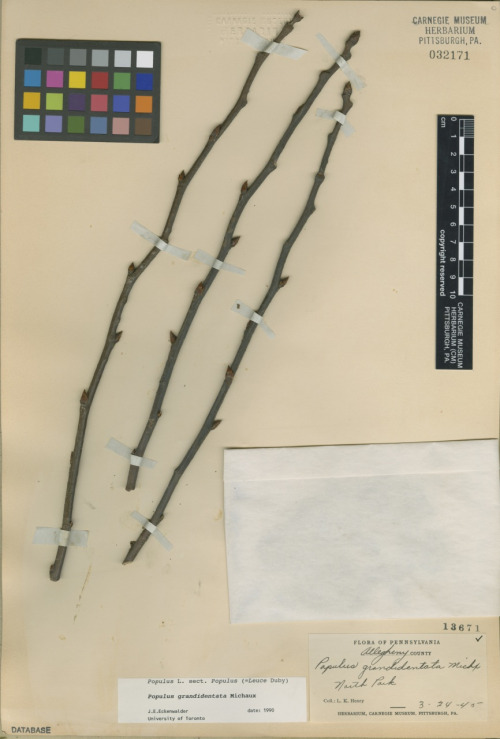
Big-tooth aspen (Populus grandidentata) specimin pressed and dried on paper
Collected on March 24, 1945, this specimen was found by Leroy K. Henry in North Park, just outside of Pittsburgh. Leroy Henry was an influential curator of botany at the museum from 1937-1973 and specialized in taxonomy and ecology of fungi in the region. Big-tooth aspen (Populus grandidentata) is a tree native to northeastern North America. Aspen produces small flowers on hanging clusters known as catkins.

Why collect and preserve a specimen that has no leaves? Since this species flowers in the early spring before it
leafs out, one reason is to be able to collect flowers for further scientific study. Flowers for this specimen are stored in the rectangular envelope in the lower right of the sheet. Along with hundreds of other specimens, this information can be used to understand how flowering dates change through time as a result of climate change. Scientists are using these specimens in ways the original collector never imagined.


Botanists at Carnegie Museum of Natural History share pieces of the herbarium’s historical hidden collection on the dates they were discovered or collected. Check back for more!
Filed Under: Blog Tagged With: Mason Heberling

March 13, 2017 by wpengine

Collected on this Day in 1830

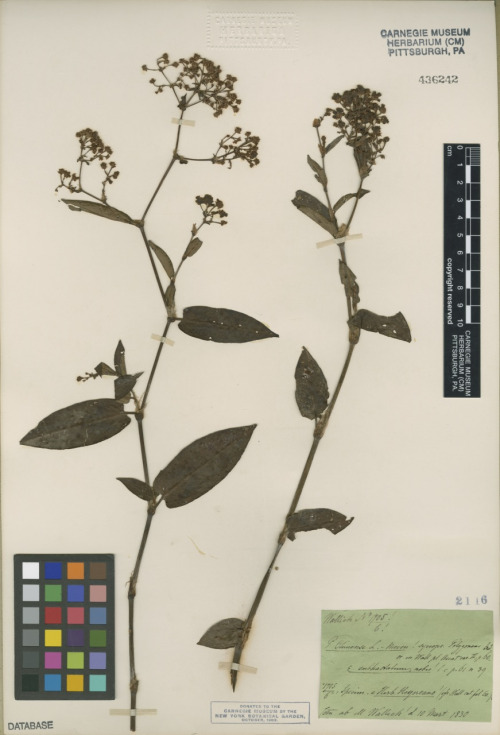
A specimine of olygonum chinense, Chinese knotweed, dried and pressed to paper
Collected on March 10, 1830, this specimen was found by Nathaniel Wallich, probably in India.  Polygonum chinense is also known as Chinese knotweed, although there are several species with that common name. This species is in the same family as many familiar plants, including Japanese knotweed, which is a widespread invasive plant in our area. Nathaniel Wallich (1786-1854) was an influential botanist from Denmark who worked much of his
life in India. Carnegie Museum of Natural History’s Herbarium includes 36 specimens from his collections, each over 180 years old.  If you thought your handwriting was hard to read, check out the label in the lower right!


Botanists at Carnegie Museum of Natural History share pieces of the herbarium’s historical hidden collection on the dates they were discovered or collected. Check back for more!
Filed Under: Blog Tagged With: Botany, herbarium, Mason Heberling

March 3, 2017 by wpengine

Collected on this Day in 1992

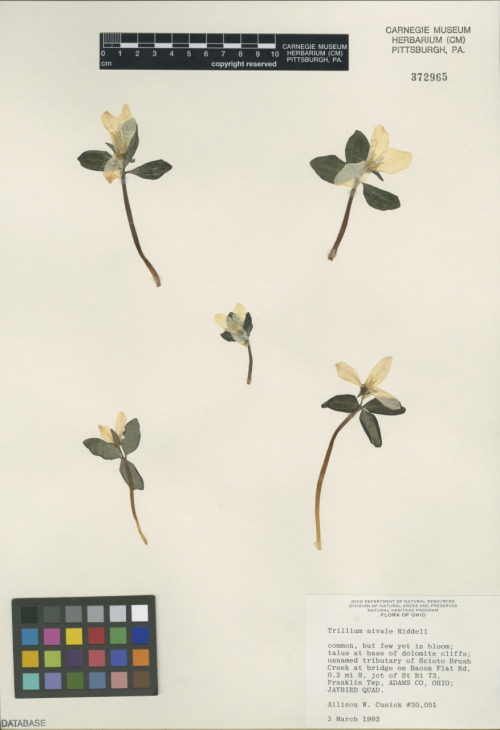
Trillium nivale (snow trillium), delicate white flowers with green stems and leaves pressed on paper

Collected on March 3, 1992, this specimen was found in Franklin Township, Ohio (Adams County) by Allison Cusick. Allison is an active research associate at the museum and has collected more than 4,600 specimens (and counting) for Carnegie Museum of Natural History’s herbarium.

A rare species of conservation concern, Trillium nivale (snow trillium) grows less than 4 inches tall and is found in rich forest understories. It is one of the earliest spring flowers to bloom in our region, sometimes even while snow is still on the ground. When you see these flowers, know that spring will arrive soon!


Botanists at Carnegie Museum of Natural History share pieces of the herbarium’s historical hidden collection on the dates they were discovered or collected.
Check back for more!
Filed Under: Blog Tagged With: Mason Heberling

February 27, 2017 by wpengine

Collected on this Day in 1976

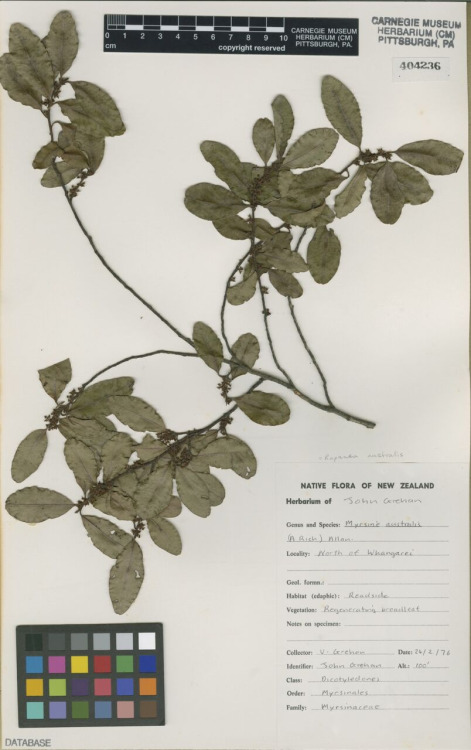
shrub species (Myrsine australis) specimen

Collected on February 24, 1976, this specimen was found by John Grehan near Whangarei, North Island, New Zealand. This shrub species (Myrsine australis) is endemic to New Zealand, meaning it is found only in New Zealand. New Zealand represents one of the most isolated regions of the world, with roughly 80% of its flowering plant species being endemic.


Botanists at Carnegie Museum of Natural History share pieces of the herbarium’s historical hidden collection on the dates they were discovered or collected. Check back for more!
Filed Under: Blog Tagged With: Botany, Mason Heberling

February 22, 2017 by wpengine

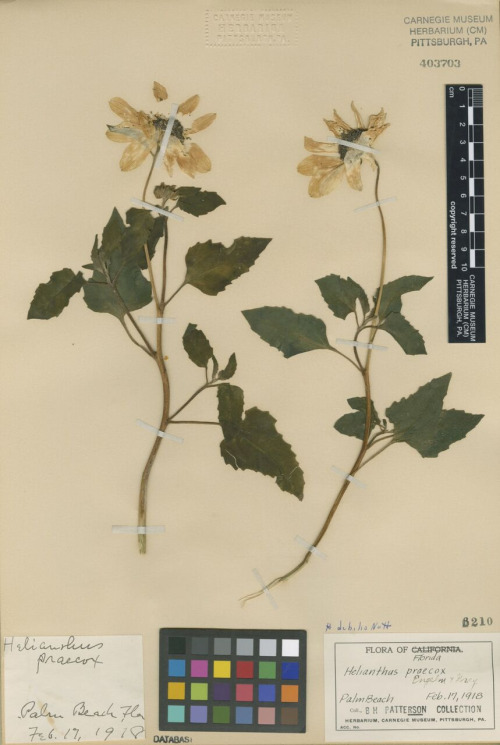
Collected on this Day in 1918

preserved specimen of the flower Helianthus debilis, also known as beach sunflower

Collected on February 17, 1918, this specimen was found in Palm Beach, Florida. Helianthus debilis (also known as beach sunflower) is native to the coastal United States. Most Helianthus species are native to North
America, including the well-known common sunflower (Helianthus annuus), which was domesticated in the southeastern United States by Native Americans over 4,000 years ago.


Botanists at Carnegie Museum of Natural History share pieces of the herbarium’s historical hidden collection on the dates they were discovered or collected. Check back for more!

Filed Under: Blog Tagged With: Botany, Mason Heberling

February 13, 2017 by wpengine

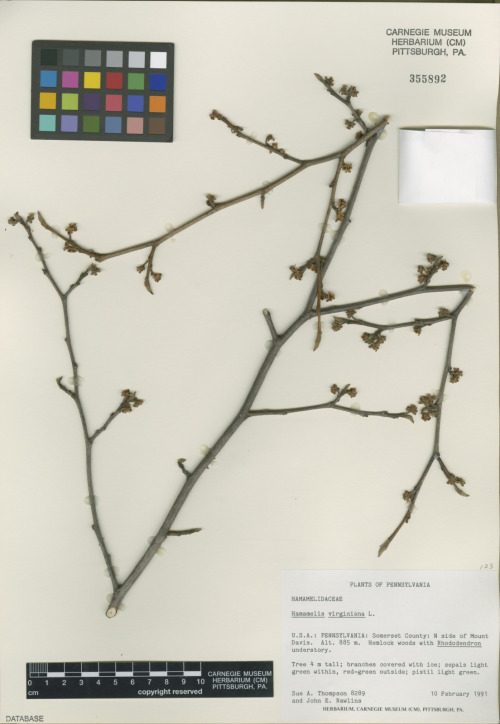
Collected on this Day in 1991

Witch hazel (Hamamelis virginiana) specimen
Collected on February 10, 1991, this specimen was found in Somerset County at Mount Davis (the highest point in Pennsylvania) by former Assistant Curator of Botany Sue Thompson and the current Curator of Invertebrate Zoology John Rawlins. Witch hazel (Hamamelis virginiana) is a shrub native to eastern North America, which flowers in late autumn after leaves have fallen. It is also known for its medicinal uses as an astringent.


Botanists at Carnegie Museum of Natural History share pieces of the herbarium’s historical hidden collection on the dates they were discovered or collected. Check back for more!

Filed Under: Blog Tagged With: Invertebrate Zoology, Mason Heberling

  • « Go to Previous Page
  • Page 1
  • Interim pages omitted …
  • Page 18
  • Page 19
  • Page 20
  • Page 21
  • Go to Next Page »

sidebar

About

  • Mission & Commitments
  • Directors Team
  • Museum History

Get Involved

  • Volunteer
  • Membership
  • Carnegie Discoverers
  • Donate
  • Employment
  • Events

Bring a Group

  • Groups of 10 or More
  • Birthday Parties at the Museum
  • Field Trips

Powdermill

  • Powdermill Nature Reserve
  • Powdermill Field Trips
  • Powdermill Staff
  • Research at Powdermill

More Information

  • Image Permission Requests
  • Science Stories
  • Accessibility
  • Shopping Cart
  • Contact
  • Visitor Policies
One of the Four Carnegie Museums | © Carnegie Institute | Privacy Policy | Terms of Use | Accessibility
Rad works here logo