• Skip to primary navigation
  • Skip to main content
  • Skip to primary sidebar

Carnegie Museum of Natural History

One of the Four Carnegie Museums of Pittsburgh

  • Visit
    • Buy Tickets
    • Visitor Information
    • Exhibitions
    • Events
    • Dining at the Museum
    • Celebrate at the Museum
    • Powdermill Nature Reserve
    • Event Venue Rental
    • Gift Cards
  • Learn
    • Field Trips
    • Educator Information
    • Programs at the Museum
    • Bring the Museum to You
    • Guided Programs FAQ
    • Programs Online
    • Climate and Rural Systems Partnership
  • Research
    • Scientific Sections
    • Science Stories
    • Science Videos
    • Senior Science & Research Staff
    • Museum Library
    • Science Seminars
    • Scientific Publications
    • Specimen and Artifact Identification
  • About
    • Mission & Commitments
    • Directors Team
    • Museum History
  • Tickets
  • Give
  • Shop

Blogs by Mason Heberling

Mason Heberling is the assistant curator in the Section of Botany and co-chair of collections at Carnegie Museum of Natural History. Heberling is a plant ecologist and botanist whose research explores plant functional strategies in deciduous forest understories, especially in the context
of environmental change. Much of his current research focuses on the ecology
and evolution of non-native, invasive plants in the eastern United States, the ecophysiological strategies of the herbaceous layer in deciduous forests, and the impacts of climate change on the timing of leafing out and flowering in temperate deciduous forests.

June 26, 2017 by wpengine

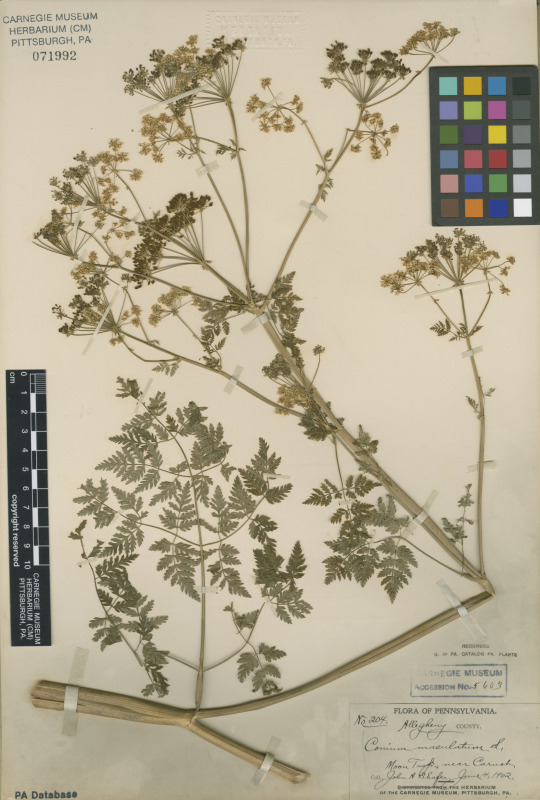
Poisons of the Carnegie: Hemlock

herbarium specimen of poison hemlock

by Mason Heberling

Poison hemlock (Conium maculatum) was used to kill the Greek philosopher Socrates in 399 BC. All parts of the plant are
highly toxic, containing an alkaloid poison, coniine, which disrupts the central nervous system and can cause paralysis of respiratory muscles and death.

Although native to Europe, poison hemlock has been introduced to the United States and can be found in the Pittsburgh region.
Despite the name, it is not related to hemlock trees, but instead a member of the carrot family (Apiaceae). Carrot family members are often recognizable by their flowers, which are on stalks that spread from a common point to form umbrella-like
clusters (botanically called an “umbel”).

Keep an eye out for this species. It is blooming now in our region along roadsides and ditches. Towering at heights of over 9 feet, this plant is hard to miss if you look for it. Aside from its height, it can also be distinguished from similar species by the purple blotches on the stems. It is best to avoid contact with this species. It can be fatal if ingested and can
also cause skin irritations if touched.

purple and green stems and leaves of a hemlock plant

This summer is all about poison at Carnegie Museum of Natural History. Staff will be sharing fascinating pieces of our collection that are toxic, poisonous, or venomous to celebrate our summer blockbuster exhibition The Power of Poison. For more information about this highly interactive, family-friendly exhibition, visit pop.carnegiemnh.org.
Filed Under: Blog Tagged With: Botany, Mason Heberling

June 16, 2017 by wpengine

Collected on this Day in 1925

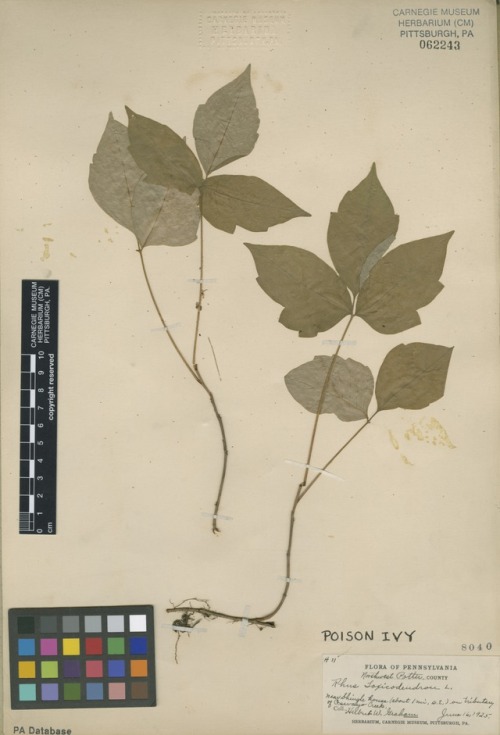
Poison ivy (Toxicodendron radicans)

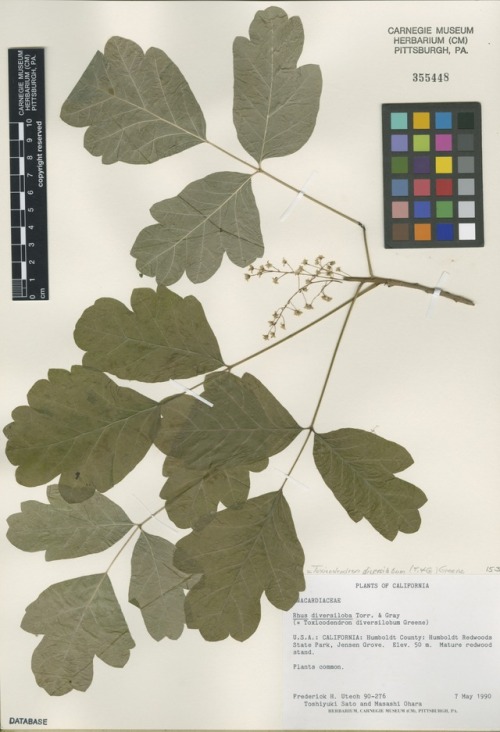
 poison oak (Toxicodendron diversilobum)
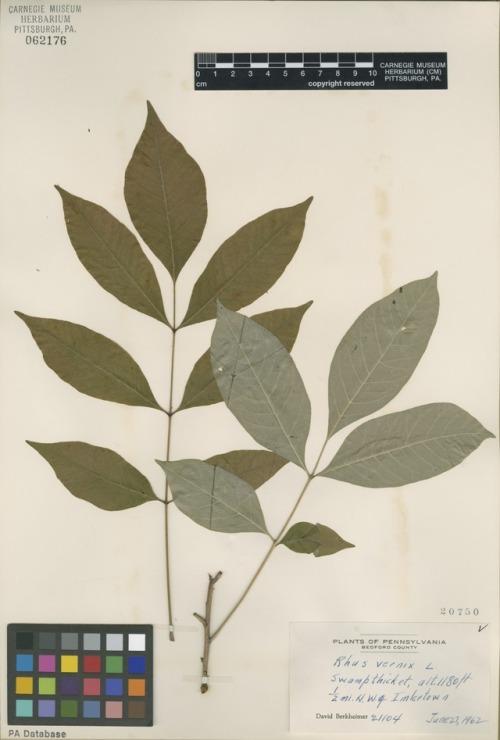
Poison sumac (Toxicodendron vernix)

Collected on June 16, 1925, this specimen was found near Potter County, Pennsylvania by H.W. Graham.

Poison ivy (Toxicodendron radicans) is a species with which you might be very familiar!  Poison ivy is a native woody vine found in wooded areas across the eastern United States. The species can take various forms and habits, growing as a vine along the ground, up a tree, or as a small shrub.

Poison ivy is famous for a chemical it produces, urushiol, which upon contact can cause a severe skin rash in humans. The rash, which can last up to several weeks, can also lead to an infection due to intense scratching that breaks the skin. Serious health effects can stem from ingesting urushiol or can cause other allergic reactions in eyes and throat when inhaling smoke from burned plants.  If you come into contact with poison ivy, the best way to prevent an allergic reaction is washing with water and soap (or other detergent to wash off oils) as soon as possible. Some people are more sensitive to poison ivy than others or become more sensitive after repeated exposure.

Poison ivy is in the cashew plant family (Anacardiaceae), which includes several other species that produce skin irritants. In addition to poison ivy, poison oak, and poison sumac, the family also includes mangos and cashews.  Interestingly, the shell of the cashew nut contains chemicals that can cause similar allergic skin reactions as poison ivy.

You might have heard “Leaves of three, let it be,” but what does that mean exactly? How do you know if it is poison ivy, poison oak, or poison sumac?  Many plants might at first glance resemble poison ivy, but they can be easily distinguished.  Poison ivy is common in woods, forest edges, roadsides, and weedy areas throughout Pennsylvania and has aerial, hairy-looking rootlets on stems of vines. Poison sumac (Toxicodendron vernix) is also native to Pennsylvania, but it is less common and only found in swamps and other persistently wet habitats. Poison sumac (Toxicodendron vernix) has leaves made up of many more leaflets than poison ivy. Lastly, poison oak (Toxicodendron diversilobum) is sometimes confused with poison ivy, but it is unlikely you encountered this species in Pennsylvania—it is only native to the western United States.


Botanists at Carnegie Museum of Natural History share pieces of the herbarium’s historical hidden collection on the dates they were discovered or collected. Check back for more!

Filed Under: Blog Tagged With: Mason Heberling

May 31, 2017 by wpengine

Collected on this Day in 1923

three specimens of dried plants

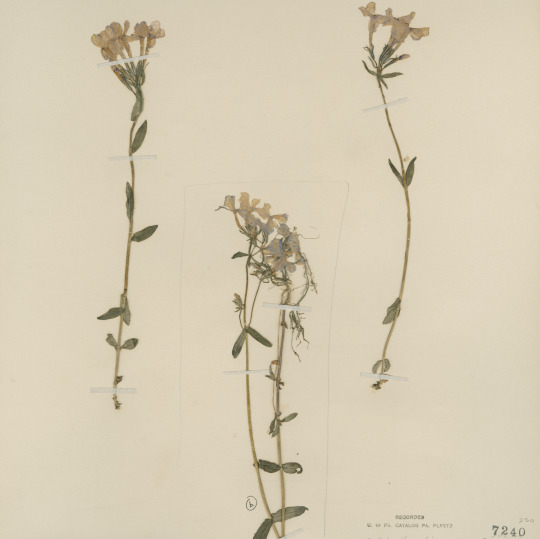
Collected in late May, 1923, this specimen was found by E.H. McClelland at Idlewild Park, near Ligonier, Pennsylvania. This herbarium sheet actually contains two different phlox species—Phlox stolonifera (creeping phlox) and Phlox divaricata (wild blue phlox). There are at least seven species of phlox native to Pennsylvania. Phlox is a popular choice among wildflower gardeners.

Phlox can be easily confused with Dame’s rocket (Hesperis matronalis), a non-native plant
in the mustard family that is common along many wooded streams and roadsides. An easy way to tell the difference is by the flowers—wild phlox has five petals while Dame’s rocket has four petals. Dame’s rocket is in the mustard family, whose flower petals characteristically form a cross (hence its former family name Cruciferae).


Botanists at Carnegie
Museum of Natural History share pieces of the herbarium’s historical hidden
collection on the dates they were discovered or collected. Check back for more!

Filed Under: Blog Tagged With: Botany, Mason Heberling

May 30, 2017 by wpengine

Collected today in 1952 & 2002

Herbarium specimen branch of a maple tree
Herbarium specimen collected in 2002

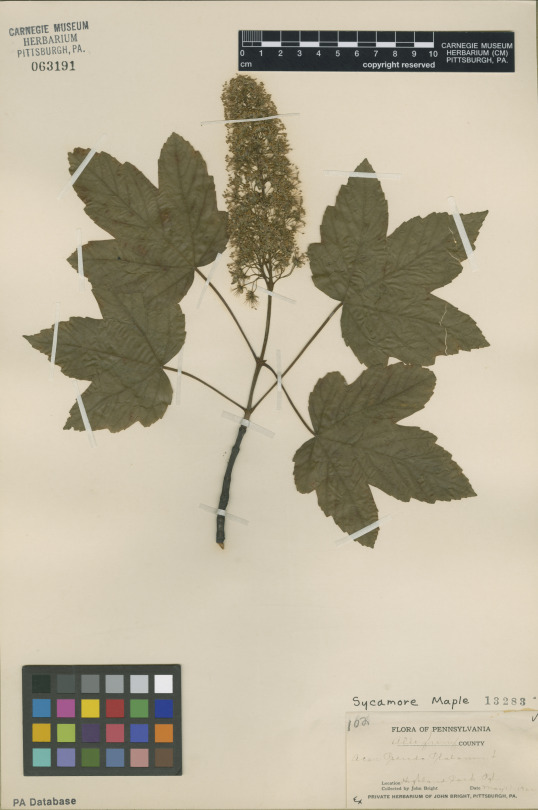
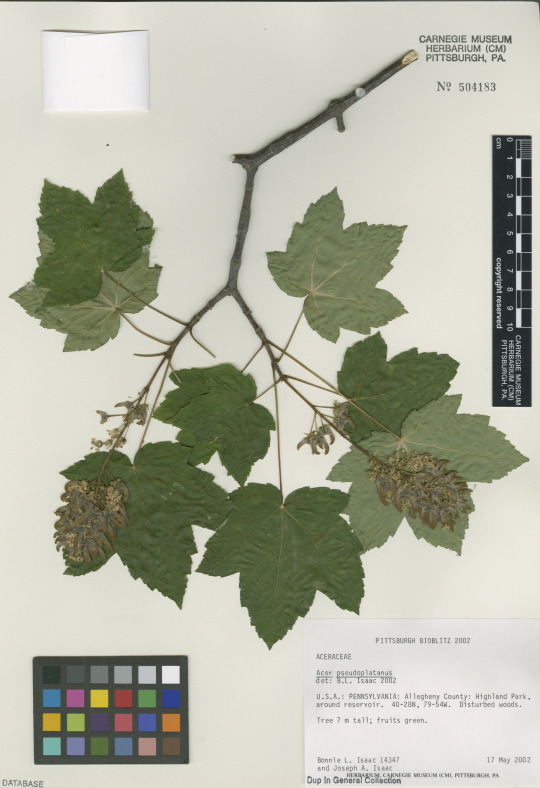
Both of these specimens were collected on May 17 in Pittsburgh’s Highland Park—but 50 years apart. John Bright collected the specimen on top in 1952. Fifty years later to the day, collection manager Bonnie Isaac unknowingly recollected the same species in the same location! If you look closely, you will notice the 1952 specimen did not yet produce seed by mid-May, while the 2002 specimen has already started developing the characteristic maple-like seeds. Due to increasing spring temperatures in recent decades, many plants tend to flower earlier, as shown through herbarium specimens.

Botanists at the museum are studying the impacts of human-caused environmental changes over the past century by following in the footsteps of past collectors. They are revisiting field sites on the same day to compare modern day plants to specimens collected over 100 years ago.

Sycamore maple (Acer pseudoplatanus) has been intentionally introduced across temperate regions, including the United States and New Zealand. It has since become invasive, meaning it actively spreads across the landscape and can cause ecological damage. It is less common than other invasive maples (such as Norway maple) in this region, but it is invasive in several sites in the Pittsburgh area.


Botanists at Carnegie Museum of Natural History share pieces of the herbarium’s historical hidden collection on the dates they were discovered or collected. Check back for more!

Filed Under: Blog Tagged With: Bonnie Isaac, Botany, Mason Heberling

May 24, 2017 by wpengine

Collected at Kennywood Park

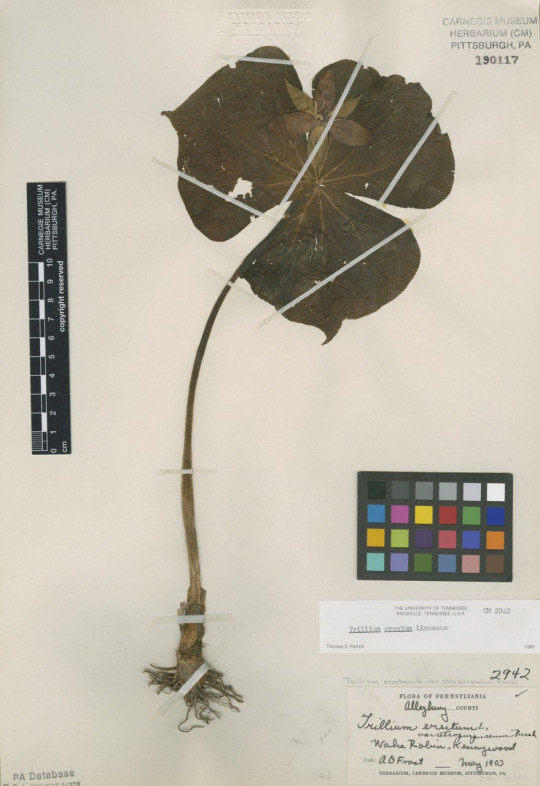
Trillium erectum herbarium specimen

This Trillium erectum specimen was collected at Kennywood in May 1903.  Found in forest understories in our region, Trillium erectum has several common names—red trillium (one form has deep maroon flower), wake robin (it is a sign of spring), and stinking benjamin/wet dog trillium (its flower smells of wet dog).


Botanists at Carnegie Museum of Natural History share pieces of the herbarium’s historical hidden collection on the dates they were discovered or collected. Check back for more!

Filed Under: Blog Tagged With: Botany, Mason Heberling

May 22, 2017 by wpengine

Collected on this Day in 2006

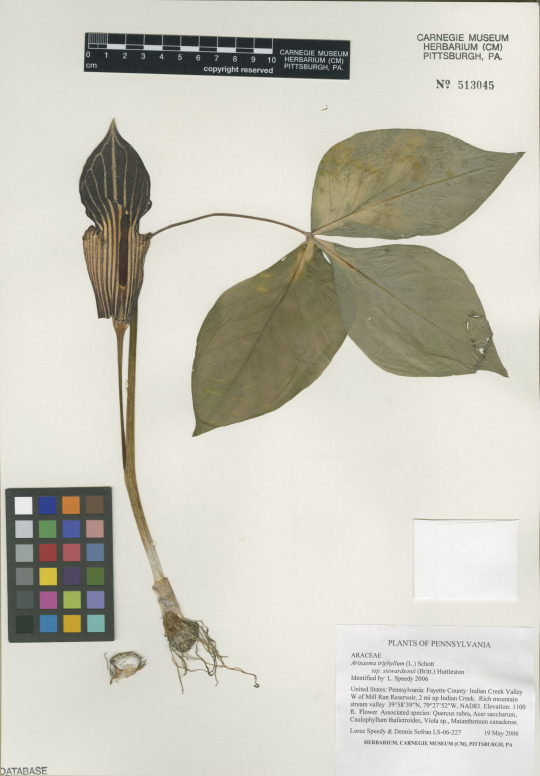
Herbarium specimen of jack-in-the-pulpit

Collected on May 19, 2006, this specimen was found by Loree Speedy in a stream valley near the Mill Run Reservoir in Fayette County, Pennsylvania. This charismatic species (Arisaema triphyllum) is known as jack-in-the-pulpit and is native to forests of the eastern United States.

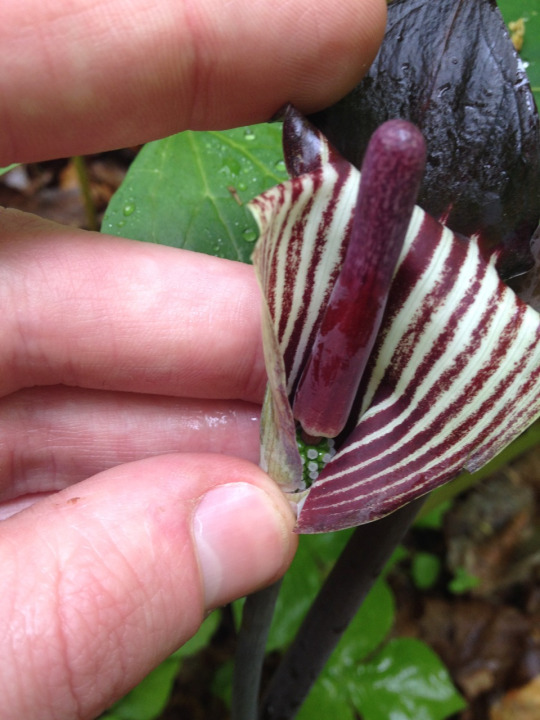
Its common name comes from its flowering structure—a distinctive hooded structure (spathe) that looks like a pulpit and the flowers (spadix) that resemble “Jack,” the minister standing within. This flower structure is shared among members of the arum family (Araceae; members often called aroids), which includes the popular houseplants known as peace lilies.

The natural history of jack-in-the-pulpits is fascinating. For starters, individual plants can be male or female, and the gender can switch from year to year! This species has intrigued botanists for decades and has been used as a study system to understand the ecology and evolution of plant sex expression. Larger plants tend to have female flowers, but the exact size is dependent on environmental conditions and genetics of a given population. Jack-in-the-pulpit has calcium oxalate in its leaves that can irritate skin and is poisonous to ingest.

It is generally avoided by deer. However, recent research from the lab of Susan Kalisz—a research associate at the museum—has shown that deer overabundance negatively affects the growth of this species. While it is rarely eaten by deer, they affect other environmental conditions, such as light levels and soil conditions.

jack-in-the-pulpit in bloom
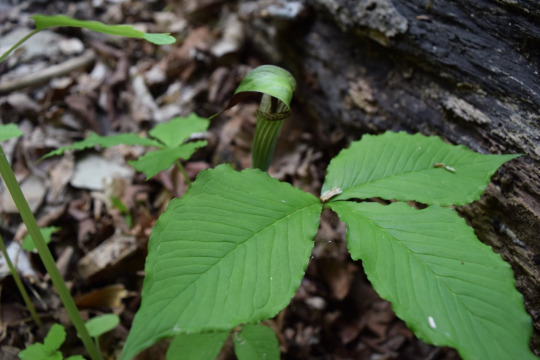
leaves from jack-in-the-pulpit plant

Botanists at Carnegie Museum of Natural History share pieces of the herbarium’s historical hidden collection on the dates they were discovered or collected. Check back for more!

Filed Under: Blog Tagged With: Botany, Mason Heberling

  • « Go to Previous Page
  • Page 1
  • Interim pages omitted …
  • Page 16
  • Page 17
  • Page 18
  • Page 19
  • Page 20
  • Page 21
  • Go to Next Page »

sidebar

About

  • Mission & Commitments
  • Directors Team
  • Museum History

Get Involved

  • Volunteer
  • Membership
  • Carnegie Discoverers
  • Donate
  • Employment
  • Events

Bring a Group

  • Groups of 10 or More
  • Birthday Parties at the Museum
  • Field Trips

Powdermill

  • Powdermill Nature Reserve
  • Powdermill Field Trips
  • Powdermill Staff
  • Research at Powdermill

More Information

  • Image Permission Requests
  • Science Stories
  • Accessibility
  • Shopping Cart
  • Contact
  • Visitor Policies
One of the Four Carnegie Museums | © Carnegie Institute | Privacy Policy | Terms of Use | Accessibility
Rad works here logo