• Skip to primary navigation
  • Skip to main content
  • Skip to primary sidebar

Carnegie Museum of Natural History

One of the Four Carnegie Museums of Pittsburgh

  • Visit
    • Buy Tickets
    • Visitor Information
    • Exhibitions
    • Events
    • Dining at the Museum
    • Celebrate at the Museum
    • Powdermill Nature Reserve
    • Event Venue Rental
    • Gift Cards
  • Learn
    • Field Trips
    • Educator Information
    • Programs at the Museum
    • Bring the Museum to You
    • Guided Programs FAQ
    • Programs Online
    • Climate and Rural Systems Partnership
  • Research
    • Scientific Sections
    • Science Stories
    • Science Videos
    • Senior Science & Research Staff
    • Museum Library
    • Science Seminars
    • Scientific Publications
    • Specimen and Artifact Identification
  • About
    • Mission & Commitments
    • Directors Team
    • Museum History
  • Tickets
  • Give
  • Shop

Blogs by Mason Heberling

Mason Heberling is the assistant curator in the Section of Botany and co-chair of collections at Carnegie Museum of Natural History. Heberling is a plant ecologist and botanist whose research explores plant functional strategies in deciduous forest understories, especially in the context
of environmental change. Much of his current research focuses on the ecology
and evolution of non-native, invasive plants in the eastern United States, the ecophysiological strategies of the herbaceous layer in deciduous forests, and the impacts of climate change on the timing of leafing out and flowering in temperate deciduous forests.

September 10, 2019 by Erin Southerland

Carnegie Museum of Natural History Researchers Detail Innovative Uses of Museum Collections for Understanding Global Change

herbarium specimen with large green leaves

Researchers from Carnegie Museum of Natural History and Michigan State University report plant specimens are being used in novel new ways that could influence future environmental policy, species conservation, and collections-based science. Specimen digitization and new data analysis technologies increase the relevance of herbaria for scientific research, education, and societal issues like climate change and invasive species. The study, titled “The Changing Uses of Herbarium Data in an Era of Global Change,” was published September 4, 2019 and is featured on the cover of the October issue of BioScience.

Nearly 390 million plant specimens are kept in over 3000 herbaria around the world, with more specimens collected each day. Plant collection is a centuries-old practice, and herbaria have long been critical resources for discovering and formally describing new species, a core function that continues today. However, collections use is expanding to provide clues about how global changes impact certain species.

The new uses of herbarium specimens documented by Mason Heberling, Assistant Curator of Botany at Carnegie Museum of Natural History, Stephen Tonsor, Director of Science at Carnegie Museum of Natural History, and Alan Prather, Associate Professor of Plant Biology at Michigan State University, illustrate the increased value of specimens and herbaria in the Anthropocene, our current era. Changing use of specimens is part of a larger trend of change in the roles of natural history museums from repositories of knowledge to active leaders in scientific research that has a direct impact on life today.

“Museum specimens are being leveraged in innovative and powerful ways that most collectors and curators couldn’t even dream of a century, or even decades, ago,” says Heberling, “Natural history collections are perhaps more relevant than ever. These specimens have important stories to tell to understand the past, present, and future of life.”

The entire study is available online.

The Changing Uses of Herbarium Data in an Era of Global Change

Abstract: Widespread specimen digitization has greatly enhanced the use of herbarium data in scientific research. Publications using herbarium data have increased exponentially over the last century. Here, we review changing uses of herbaria through time with a computational text analysis of 13,702 articles from 1923 to 2017 that quantitatively complements traditional review approaches. Although maintaining its core contribution to taxonomic knowledge, herbarium use has diversified from a few dominant research topics a century ago (e.g., taxonomic notes, botanical history, local observations), with many topics only recently emerging (e.g., biodiversity informatics, global change biology, DNA analyses). Specimens are now appreciated as temporally and spatially extensive sources of genotypic, phenotypic, and biogeographic data. Specimens are increasingly used in ways that influence our ability to steward future biodiversity. As we enter the Anthropocene, herbaria have likewise entered a new era with enhanced scientific, educational, and societal relevance.
Filed Under: Uncategorized Tagged With: Botany, herbarium, Mason Heberling, Stephen Tonsor

August 22, 2019 by wpengine

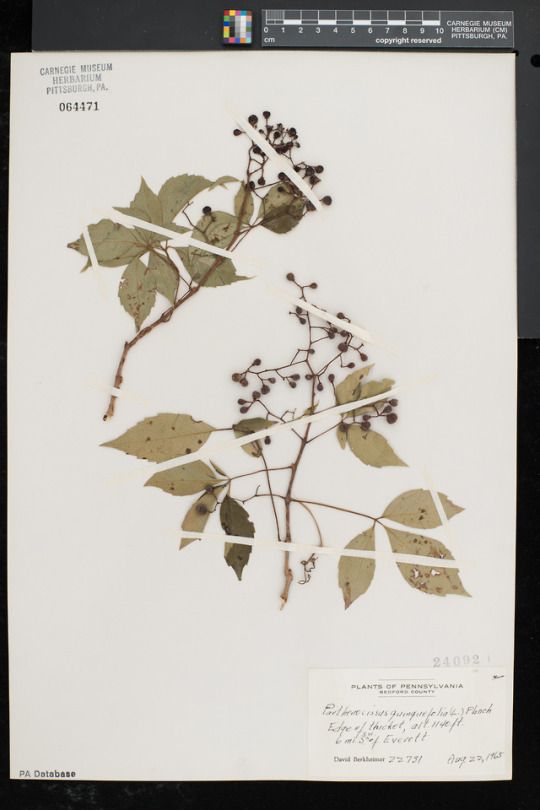
A couple of creepers: plant doppelgängers

Did you know that many plant species have doppelgängers?

thicket creeper specimen
Virginia creeper specimen

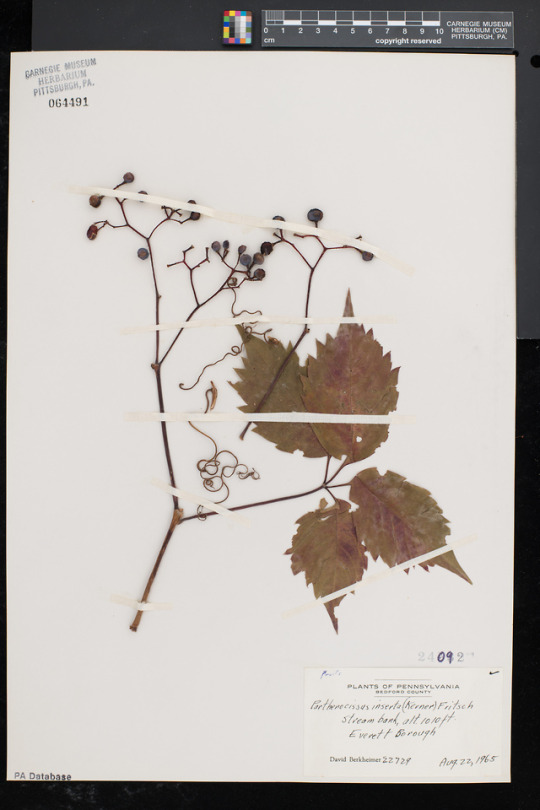
Check out these two species, both collected at the same site on August 22, 1965 by David Berkheimer in Everett Borough (Bedford county), Pennsylvania.

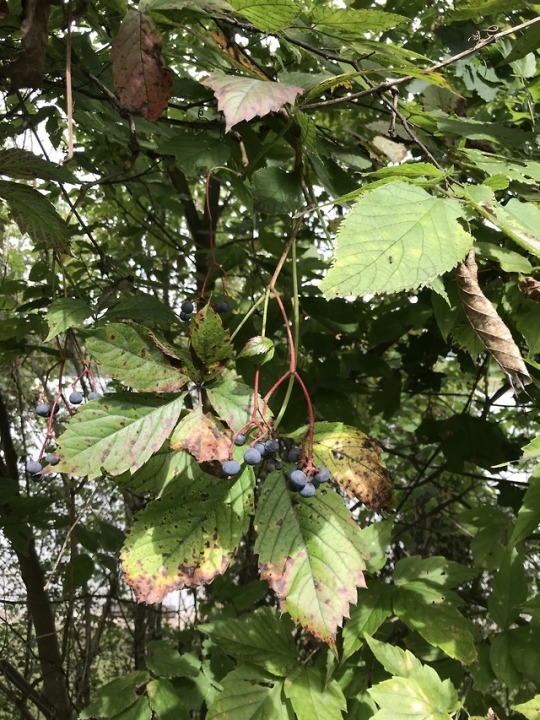
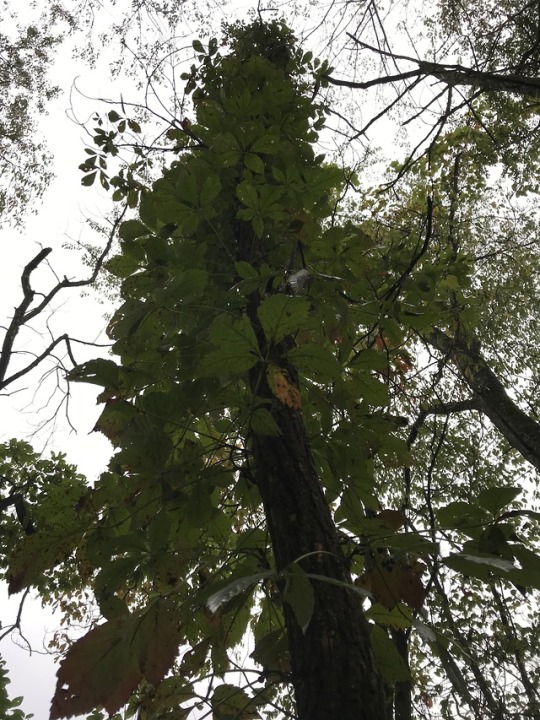
With its distinctive hand-like leaves, Virginia creeper (Parthenocissus quinquefolia) is fairly well known, or at least familiar by look to many.  It is a woody vine in the grape plant family (Vitaceae), common to forests, forest edges, and urban areas across eastern North America.  It is one of those ubiquitous but overlooked plants. The species is just about everywhere, climbing high up trees. But upon closer look, there are two similar looking species in Pennsylvania. Although less commonly recognized (though not all that uncommon to find!), thicket creeper (Parthenocissus inserta) looks very similar.  (Note: there is some confusion, with some botanists calling this species P. vitacea, but either way, there are definitely two species here).

Virginia creeper
thicket creeper

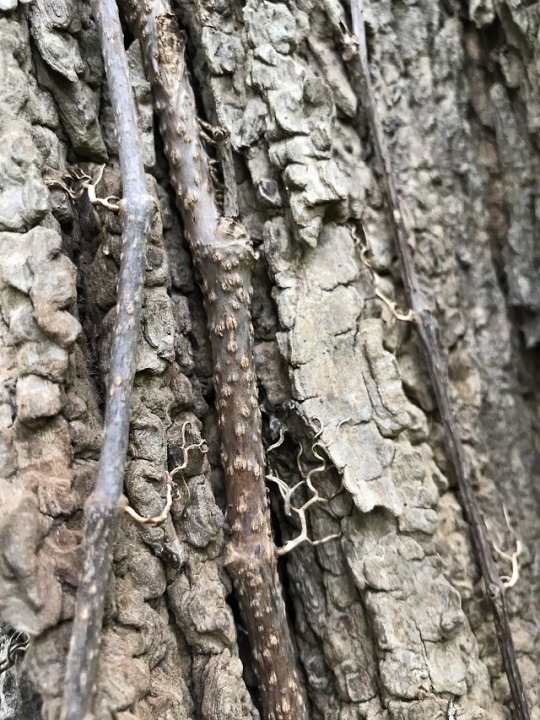
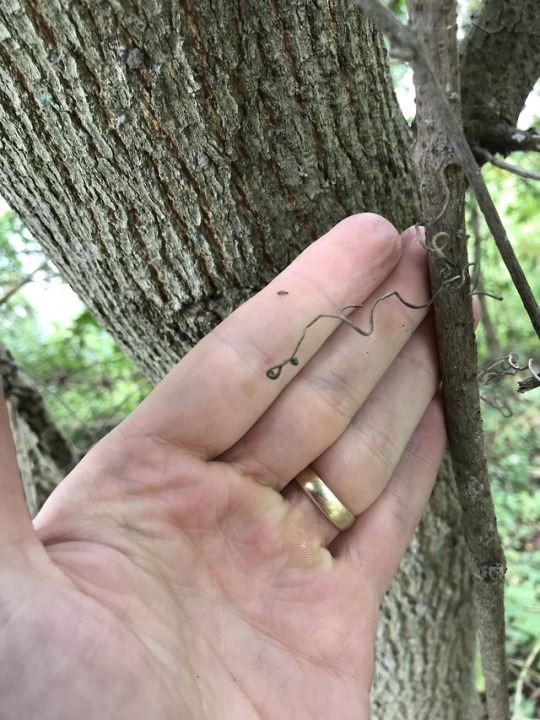
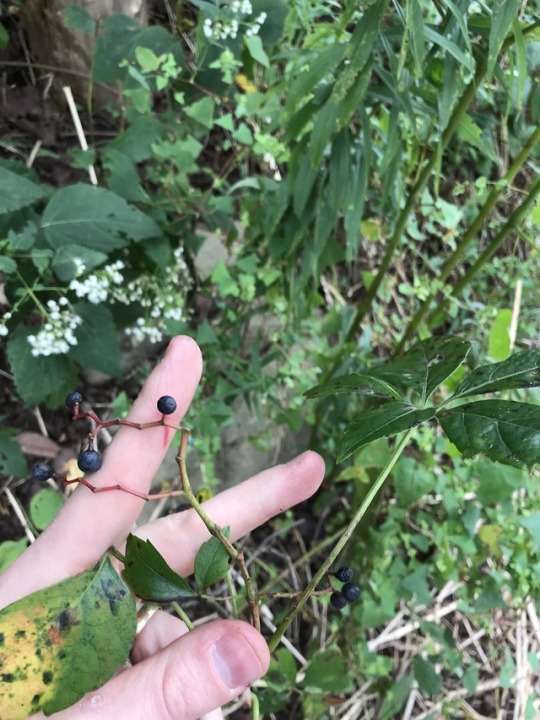
So what’s the difference? There are two easy ways to tell the difference.  First, the species have differences in their tendrils (the structures that wrap around branches, attaching the vine to the tree it is climbing).  Virginia creeper has clear adhesive, swollen disks where the tendrils attach to the tree.  In contrast, thicket creeper does not have these. (But to confuse you, they rarely do).  Second, the flowering/fruiting structures are different. Thicket creeper has branching inflorescences (stem structure with flowers/fruits), often in two main axes, with noticeably larger berries than Virginia creeper. Virginia creeper has an inflorescence that branches, often in zig-zag, random looking pattern, but most importantly – with a clear central axis.

Virginia creeper with adhesive disks
thicket creeper no adhesive disks

A couple years ago, I was confident I could pick Virginia creeper out of a line up.  But I must admit, I didn’t even know until last year there was another species that looked like Virginia creeper. It was a mind-blowing moment, and pretty much dropped everything to go exploring for the two species. I’m always curious every time I see these vines to figure out which species it is.  It turns out, thicket creeper is more common than I thought around Pittsburgh, especially along the rivers.

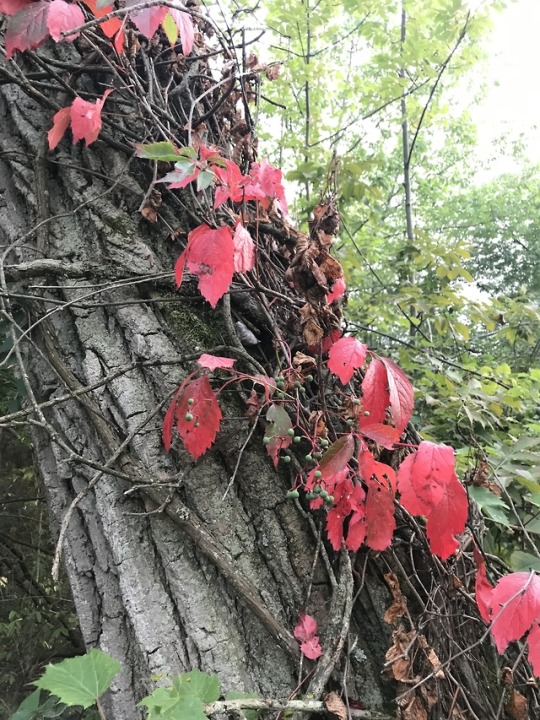
And keep an eye out for these species this fall, when they have developed fruits to easily tell them apart.  And on top of that, they have some of the most bright red, beautiful foliage of any plant in our area!

thicket creeper in autumn
Virginia creeper climbing up

Check out these specimens (and more!) here.

Check back for more! Botanists at the Carnegie Museum of Natural History share digital specimens from the herbarium on dates they were collected. They are in the midst of a three-year project to digitize nearly 190,000 plant specimens collected in the region, making images and other data publicly available online. This effort is part of the Mid-Atlantic Megalopolis Project (mamdigitization.org), a network of thirteen herbaria spanning the densely populated urban corridor from Washington, D.C. to New York City to achieve a greater understanding of our urban areas, including the unique industrial and environmental history of the greater Pittsburgh region. This project is made possible by the National Science Foundation under grant no. 1801022.

Mason Heberling is Assistant Curator of Botany at the Carnegie Museum of Natural History. Museum employees are encouraged to blog about their unique experiences and knowledge gained from working at the museum.

Filed Under: Blog Tagged With: Botany, Mason Heberling, plants

August 22, 2019 by Kathleen

Rethinking the museum specimen in the digital age

Mason HeberlingSpeaker: Mason Heberling, Carnegie Museum of Natural History

Natural history collections are receiving unprecedented attention due to recently developed tools, new perspectives, and perhaps most notably, their increased accessibility through widespread digitization. With nearly 390 million plant specimens collected by thousands of botanists over nearly five centuries in museums worldwide, herbaria (collections of preserved dead plants) comprise an enormous resource for understanding the world around us. These collections were historically established and maintained primarily for taxonomic study (the classification and naming of life) and related uses. Though their longstanding functions remain relevant, museum specimens are increasingly being used in novel and unanticipated ways by a diverse array of disciplines. Mason Heberling will discuss the past, present, and future of herbarium specimen use, highlighting examples from his latest research on invasive species and climate change. In addition to maximizing our use of existing collections, an open re-evaluation of the very collection event itself is needed to ensure we are effectively documenting our rapidly changing world. The use of digital observations and community science platforms, such as iNaturalist, provide a powerful approach to enhance the research value of specimens. As we enter the Anthropocene, a new geological epoch marked by global environmental changes, herbaria have likewise entered a new era with enhanced scientific, educational, and societal relevance.
Tagged With: Mason Heberling

August 20, 2019 by wpengine

A day late, but thanks for your Impatiens!

impatiens specimen
impatiens specimen

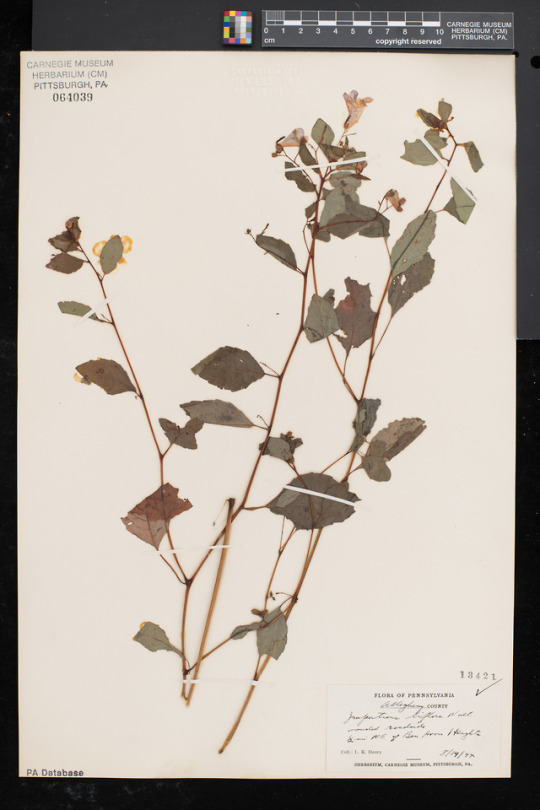
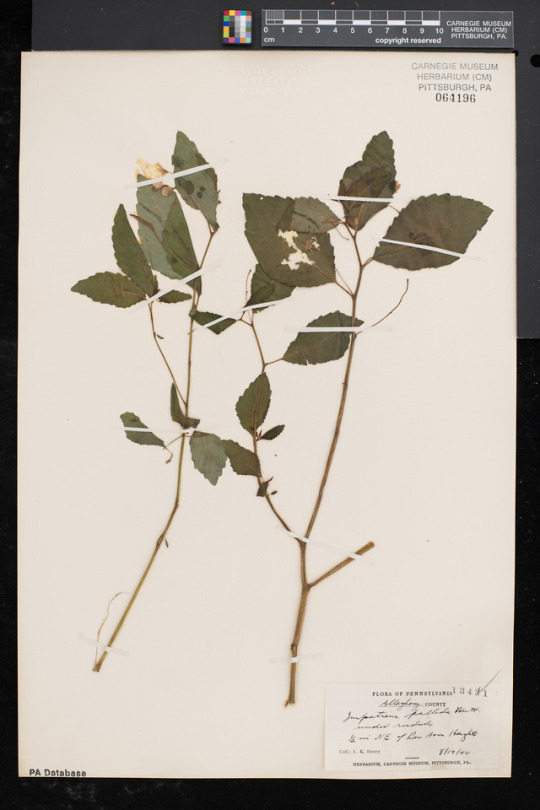

Two specimens of jewelweed, Impatiens, collected on this day (well, yesterday) by Carnegie Museum curator Leroy Henry in 1944 in Ben Avon Heights, near Pittsburgh.

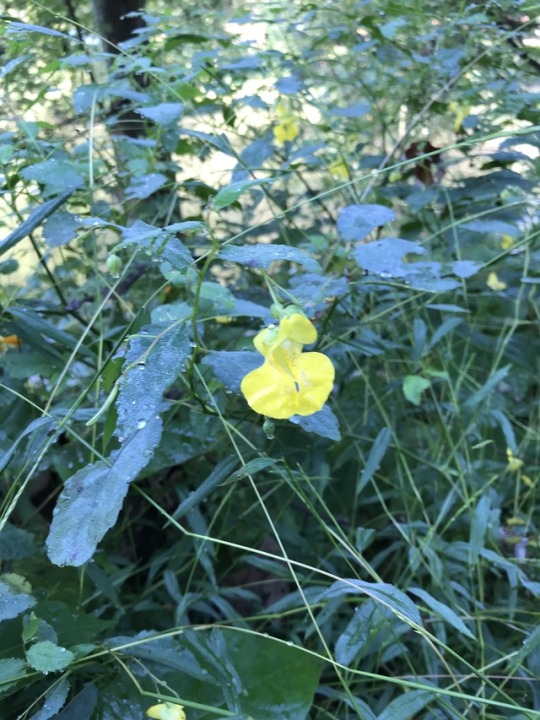
There are two species of jewelweed commonly found in Pennsylvania and in relatively wet, partly shady habitats across eastern North America. They can form dense stands along wet roadside ditches at edge of woods and in floodplain forests. Henry collected both species in the same location, as they commonly grow together.

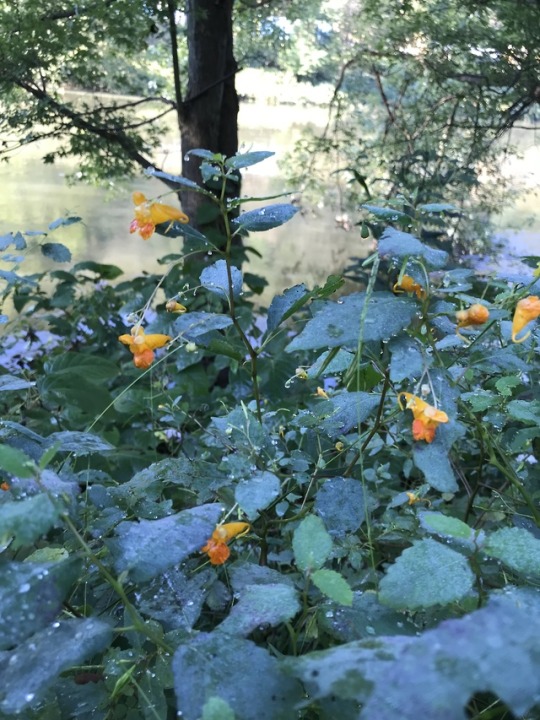
orange jewelweed

What’s the difference between these two specimens?  Though less obvious in specimen form, the most noticeable difference is flower color. Common jewelweed (Impatiens capensis), also called spotted or orange jewelweed, has orange flowers. In contrast, the flowers of yellow jewelweed (Impatiens pallida), also called pale jewelweed, are…well, yellow.  Flowers of both species have distinctive nectar spurs that jut out of the back of the flower. It is entertaining to watch bumblebees go from flower to flower in a stand of jewelweed.

yellow jewelweed

Jewelweeds are herbaceous, annual plants with juicy stems that can range in size, from short to very tall.  A widespread story is that jewelweed can treat skin irritations, and in particular, helps prevent poison ivy rash by rubbing jewelweed on skin after contact with poison ivy.  I don’t know of this being supported with data.

Jewelweed is also often called “touch-me-not” because the developed seed pods eject seeds out when touched. It can be a fun activity for kids (and adults).

Jewelweed flowers open mid-summer and the plants continue to flower until killed by autumn frost.

Jewelweed produces two types of flowers – the obvious ones with nectar spurs that are visited by bees and also, tiny inconspicuous flowers that do not open.  These small flowers are self-pollinating (cleistogamous).

Deer often eat jewelweed. A recent study found that some populations of the species that have historically received a lot of deer browsing have evolved greater tolerance to herbivory.

I’m always amazed how sensitive jewelweed leaves are to the sun. When exposed to direct sun, their leaves get very droopy. But they seem to quickly bounce back.

Impatiens commonly planted in gardens are related (in the same genus) but are not the same species.

Check out these specimens (and more!) here.

Check back for more! Botanists at the Carnegie Museum of Natural History share digital specimens from the herbarium on dates they were collected. They have embarked on a three-year project to digitize nearly 190,000 plant specimens collected in the region, making images and other data publicly available online. This effort is part of the Mid-Atlantic Megalopolis Project (mamdigitization.org), a network of thirteen herbaria spanning the densely populated urban corridor from Washington, D.C. to New York City to achieve a greater understanding of our urban areas, including the unique industrial and environmental history of the greater Pittsburgh region. This project is made possible by the National Science Foundation under grant no. 1801022.
Mason Heberling is Assistant Curator of Botany at the Carnegie Museum of Natural History. Museum employees are encouraged to blog about their unique experiences and knowledge gained from working at the museum.

Filed Under: Blog Tagged With: Botany, collected on this day, flowers, Leroy Henry, Mason Heberling, plants

July 12, 2019 by wpengine

Who Likes Teaberry? Collected 56 Years Ago

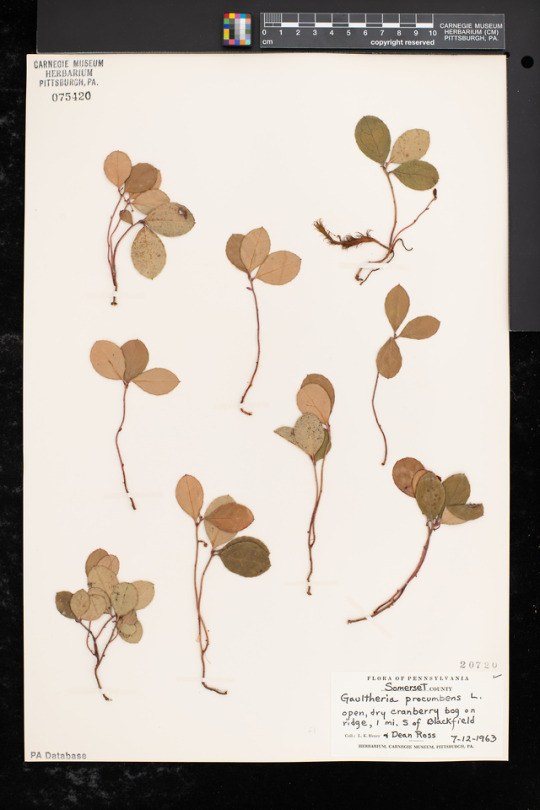
teaberry specimen

This specimen of eastern teaberry (Gaultheria procumbens), also called American wintergreen, was collected on July 12, 1963 by Leroy Henry (Carnegie Museum Curator of Botany at the time) and Dean Ross in a cranberry bog in Somerset county, Pennsylvania.

It is perhaps best known by many as a unique wintergreen flavor of chewing gum and ice cream, especially in Pennsylvania. Atlas Obscura says Teaberry ice cream: “sometimes looks like Pepto-Bismol and smells like Bengay.” Penn State Berkey Creamery calls it  the  “best treat of a bygone era.”

Teaberry is in the heath (blueberry) family, Ericaceae.  It is a small shrub growing along the ground, found across the Eastern US and has distinctive evergreen leaves.

Find a high resolution image of this teaberry specimen (and more) online at midatlanticherbaria.org.

Check back for more! Botanists at the Carnegie Museum of Natural History share digital specimens from the herbarium on dates they were collected. They have embarked on a three-year project to digitize nearly 190,000 plant specimens collected in the region, making images and other data publicly available online. This effort is part of the Mid-Atlantic Megalopolis Project (mamdigitization.org), a network of thirteen herbaria spanning the densely populated urban corridor from Washington, D.C. to New York City to achieve a greater understanding of our urban areas, including the unique industrial and environmental history of the greater Pittsburgh region. This project is made possible by the National Science Foundation under grant no. 1801022.
Mason Heberling is Assistant Curator of Botany at the Carnegie Museum of Natural History. Museum employees are encouraged to blog about their unique experiences and knowledge gained from working at the museum.

Filed Under: Blog Tagged With: Anthropocene, Botany, collected on this day, Leroy Henry, Mason Heberling, plants

July 8, 2019 by wpengine

A Plant Popular During the Revolutionary War


Ceanothus americanus tea plant specimen

Happy Independence Day! What better way to celebrate than with herbarium specimens of New Jersey tea (Ceanothus americanus), named for the fact that it was used as a substitute for tea by colonists and American soldiers during the American Revolutionary War. There was presumably a shortage of black tea, which was imported. Although the leaves contain no caffeine, it fit the bill. The plant also has a much longer history before European settlement.  Tribes of the Missouri River used the leaves for tea as well, and tribes of the Great Lakes used the plant to treat digestive ailments.

New Jersey tea, also called Indian tea, can be found not only in New Jersey, but across the eastern United States.  It is in the buckthorn family (Rhamnaceae), which is unsurprisingly also family to introduced shrub/tree, common buckthorn  (Rhamnus cathartica).


Ceanothus americanus tea plant specimen

These specimens were both collected in Pennsylvania on the 4th of July.  One in Luzerne county by Alfred Twining 1907, who wrote a flora of Northeastern PA ten years later.  Many of his specimens are at the Everhart Museum of Natural History, Science, and Art in Scranton, PA.

The other Independence Day New Jersey Tea specimen was collected by Robert Leberman in Crawford county in 1986.  Leberman established the bird banding program at the Carnegie Musuem of Natural History’s Powdermill Nature Reserve in 1961.  It continues today as the longest running, year-round banding research operation in the country.

New Jersey Tea is a beautiful shrub, important for many pollinators, and food source for other wildlife. The plant is also sold commercially by many native plant nurseries to plant in your yard or garden.

All plants have a cultural history and a scientific one. As you remember the signing of the Declaration of Independence and the American Revolution, think too about New Jersey Tea’s impact on our country. Did John Hancock drink it before signing? (Totally made that up).

Find high resolution images of these specimens (and 290 more!) online: http://midatlanticherbaria.org/portal/collections/list.php?db=328&taxa=Ceanothus+americanus&usethes=1&taxontype=2

Check back for more! Botanists at the Carnegie Museum of Natural History share digital specimens from the herbarium on dates they were collected. They have embarked on a three-year project to digitize nearly 190,000 plant specimens collected in the region, making images and other data publicly available online. This effort is part of the Mid-Atlantic Megalopolis Project (mamdigitization.org), a network of thirteen herbaria spanning the densely populated urban corridor from Washington, D.C. to New York City to achieve a greater understanding of our urban areas, including the unique industrial and environmental history of the greater Pittsburgh region. This project is made possible by the National Science Foundation under grant no. 1801022.  

Mason Heberling is Assistant Curator of Botany at the Carnegie Museum of Natural History. Museum employees are encouraged to blog about their unique experiences and knowledge gained from working at the museum.

Filed Under: Blog Tagged With: Anthropocene, Botany, collected on this day, Mason Heberling, plants

  • « Go to Previous Page
  • Page 1
  • Interim pages omitted …
  • Page 5
  • Page 6
  • Page 7
  • Page 8
  • Page 9
  • Interim pages omitted …
  • Page 21
  • Go to Next Page »

sidebar

About

  • Mission & Commitments
  • Directors Team
  • Museum History

Get Involved

  • Volunteer
  • Membership
  • Carnegie Discoverers
  • Donate
  • Employment
  • Events

Bring a Group

  • Groups of 10 or More
  • Birthday Parties at the Museum
  • Field Trips

Powdermill

  • Powdermill Nature Reserve
  • Powdermill Field Trips
  • Powdermill Staff
  • Research at Powdermill

More Information

  • Image Permission Requests
  • Science Stories
  • Accessibility
  • Shopping Cart
  • Contact
  • Visitor Policies
One of the Four Carnegie Museums | © Carnegie Institute | Privacy Policy | Terms of Use | Accessibility
Rad works here logo