• Skip to primary navigation
  • Skip to main content
  • Skip to primary sidebar

Carnegie Museum of Natural History

One of the Four Carnegie Museums of Pittsburgh

  • Visit
    • Buy Tickets
    • Visitor Information
    • Exhibitions
    • Events
    • Dining at the Museum
    • Celebrate at the Museum
    • Powdermill Nature Reserve
    • Event Venue Rental
    • Gift Cards
  • Learn
    • Field Trips
    • Educator Information
    • Programs at the Museum
    • Bring the Museum to You
    • Guided Programs FAQ
    • Programs Online
    • Climate and Rural Systems Partnership
  • Research
    • Scientific Sections
    • Science Stories
    • Science Videos
    • Senior Science & Research Staff
    • Museum Library
    • Science Seminars
    • Scientific Publications
    • Specimen and Artifact Identification
  • About
    • Mission & Commitments
    • Directors Team
    • Museum History
  • Tickets
  • Give
  • Shop

Blogs by Mason Heberling

Mason Heberling is the assistant curator in the Section of Botany and co-chair of collections at Carnegie Museum of Natural History. Heberling is a plant ecologist and botanist whose research explores plant functional strategies in deciduous forest understories, especially in the context
of environmental change. Much of his current research focuses on the ecology
and evolution of non-native, invasive plants in the eastern United States, the ecophysiological strategies of the herbaceous layer in deciduous forests, and the impacts of climate change on the timing of leafing out and flowering in temperate deciduous forests.

April 29, 2020 by wpengine

Collected on this Day in 1998: Spontaneous mints in your backyard

by Mason Heberling

mint specimens on herbarium sheet

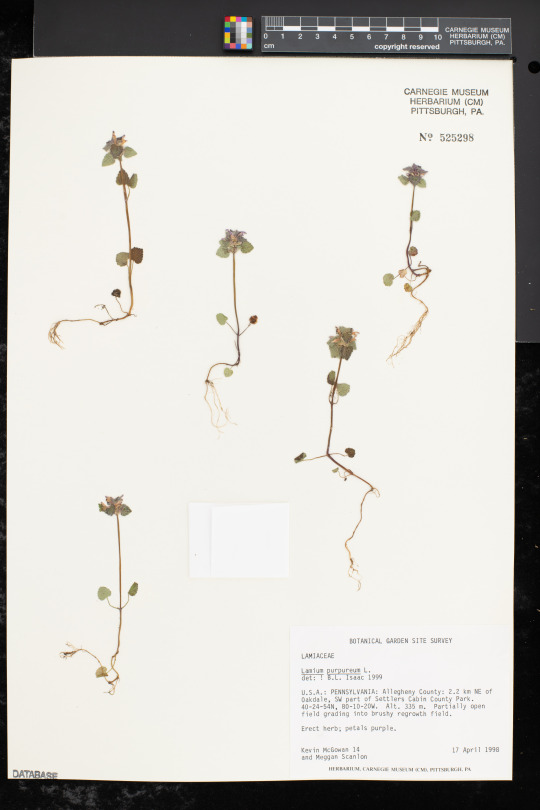
This specimen of purple dead-nettle  (Lamium purpureum) was collected on April 17, 1998 by Kevin McGowan and Meggan Scanlon near Settler’s Cabin County Park in Oakdale, PA on property that is now the Pittsburgh Botanic Garden.  As seen in the title of the specimen label, it was collected as part of a biological survey for the planning of the site, a large ongoing restoration of the formerly mined property.

Purple dead-nettle is probably in your backyard. Or if not, you likely don’t have to go far to find it in a lawn or sidewalk crack.   Some call it a “weed.” Or, in the case of in your lawn, “spontaneous vegetation” is a lighter hearted term. It is native to Europe and Asia but now widespread across the world, including North America.

Purple dead-nettle is not related to stinging nettle, despite the name.   It was named “dead-nettle” because is reminiscent to nettles (well, at least to whoever came up with the common name) but does not have stinging hairs.

Purple dead-nettle is in the mint family (Lamiaceae) with square stems often characteristic of mints.  Try rolling the stem between your fingers and you’ll notice the square stems.

The City Nature Challenge is just around the corner (April 30 – May 3, 2021)!
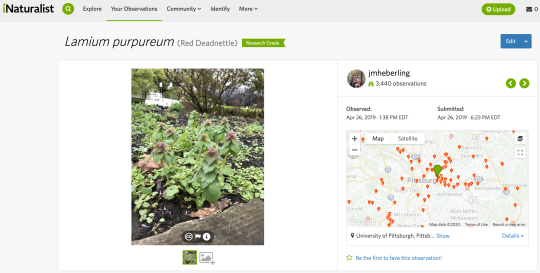
Lamium purpureum was the 9th most observed species in the Pittsburgh region for City Nature Challenge 2019.  Here’s an observation of purple dead-nettle from the 2019 challenge from the flower bed near the Dippy statue at the Carnegie Museum of Natural History.

The City Nature Challenge is a global event where cities come together to share the biodiversity seen in their urban areas. Your nature sightings are shared through the free community science platform, iNaturalist. If you have never used iNaturalist, the City Nature Challenge is a great way to introduce yourself to iNaturalist.  You’ll be hooked.

Past years have been (friendly) competitions among cities, competing for the most observations or species. But given the current pandemic, this year is different.  It is not about the number of observations you make. It is a celebration of nature, wherever you can safely be this year…which for most, is your backyard!  Or the sidewalk near your house. Or the parking lot. Or a local park. Or maybe even inside your house.

Keep a look out for purple dead-nettle.  You won’t have to go far! In City Nature Challenge Pittsburgh 2019, this species was the 9th most observed species!

Or if you can’t safely be outside, you can view other observations on iNaturalist.org at any time!  You can help identify photos or just click around and go for a virtual botanical hike around Pittsburgh!

Or look online at Carnegie Museum’s 185 herbarium specimens of purple dead nettle, going back to 1826 in England! Or this one growing 138 years ago collected in Beaver county.

However you can, there are plenty of ways to participate and connect with nature while staying safe!

Find this specimen of purple dead-nettle here.

Check back for more! Botanists at the Carnegie Museum of Natural History share digital specimens from the herbarium on dates they were collected. They are in the midst of a three-year project to digitize nearly 190,000 plant specimens collected in the region, making images and other data publicly available online. This effort is part of the Mid-Atlantic Megalopolis Project (mamdigitization.org), a network of thirteen herbaria spanning the densely populated urban corridor from Washington, D.C. to New York City to achieve a greater understanding of our urban areas, including the unique industrial and environmental history of the greater Pittsburgh region. This project is made possible by the National Science Foundation under grant no. 1801022.

Mason Heberling is Assistant Curator of Botany at the Carnegie Museum of Natural History. Museum employees are encouraged to blog about their unique experiences and knowledge gained from working at the museum.

Related Content

Collected on This Day in 1998: Common Chickweed

Spring Birds in Your Backyard

Botany Near Home

Carnegie Museum of Natural History Blog Citation Information

Blog author: Heberling, Mason
Publication date: April 17, 2020
Share this post!

  • Share on Twitter Share on Twitter
  • Share on Facebook Share on Facebook
  • Share on Pinterest Share on Pinterest
  • Share on LinkedIn Share on LinkedIn
  • Share on Reddit Share on Reddit
  • Share via Email Share via Email

Share this post!

  • Share on Twitter Share on Twitter
  • Share on Facebook Share on Facebook
  • Share on Pinterest Share on Pinterest
  • Share on LinkedIn Share on LinkedIn
  • Share on Reddit Share on Reddit
  • Share via Email Share via Email

Filed Under: Blog Tagged With: City Nature Challenge ID, collected on this day, Mason Heberling, Museum from Home

April 29, 2020 by wpengine

Collected on this Day in 1906

(Not quite yet) flowering dogwood

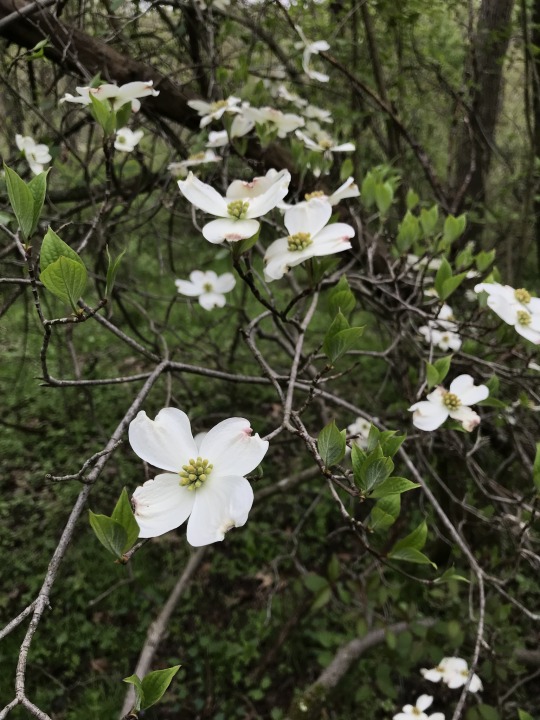
This specimen of flowering dogwood (Cornus florida) was collected on January 21, 1906 in Fern Hollow, Frick Park, Pittsburgh by Otto Jennings. The specimen was collected 13 years before Frick Park became a city park, bequeathed by the well-known industrialist Henry Clay Frick after his death. Otto Jennings was an influential botanist in western Pennsylvania, serving as curator at the museum for many years.

I’ve said it before, but I’ll say it again –  specimens without leaves are cool!  Why did Jennings collect this specimen?

Flowering dogwood has distinctively big flower buds through the winter.  The flower is in there, remaining dormant, waiting to blossom in the spring.  Like many other woody species in our area, the leaf and flower buds are pre-formed  by the previous fall. They remain dormant until they reach their chilling requirement (number of cold days), the air temperature warms, and/or the days get longer (in plants, this is called “photoperiod”).  Different species have different requirements, with some species being more conservative than others to prevent premature leaf out in the middle of winter.

Only about two and half more months until flowering dogwood awakes in western Pennsylvania. In the meantime, you can admire the species in the spring diorama in Botany Hall, or look for their buds outside.

Find this specimen and more here.

Check back for more! Botanists at the Carnegie Museum of Natural History share digital specimens from the herbarium on dates they were collected. They are in the midst of a three-year project to digitize nearly 190,000 plant specimens collected in the region, making images and other data publicly available online. This effort is part of the Mid-Atlantic Megalopolis Project (mamdigitization.org), a network of thirteen herbaria spanning the densely populated urban corridor from Washington, D.C. to New York City to achieve a greater understanding of our urban areas, including the unique industrial and environmental history of the greater Pittsburgh region. This project is made possible by the National Science Foundation under grant no. 1801022.

Mason Heberling is Assistant Curator of Botany at the Carnegie Museum of Natural History. Museum employees are encouraged to blog about their unique experiences and knowledge gained from working at the museum.

Filed Under: Blog Tagged With: collected on this day, Mason Heberling, Museum from Home

April 29, 2020 by wpengine

From cultivation to invasion: a common route

Collected on this Day in 1937

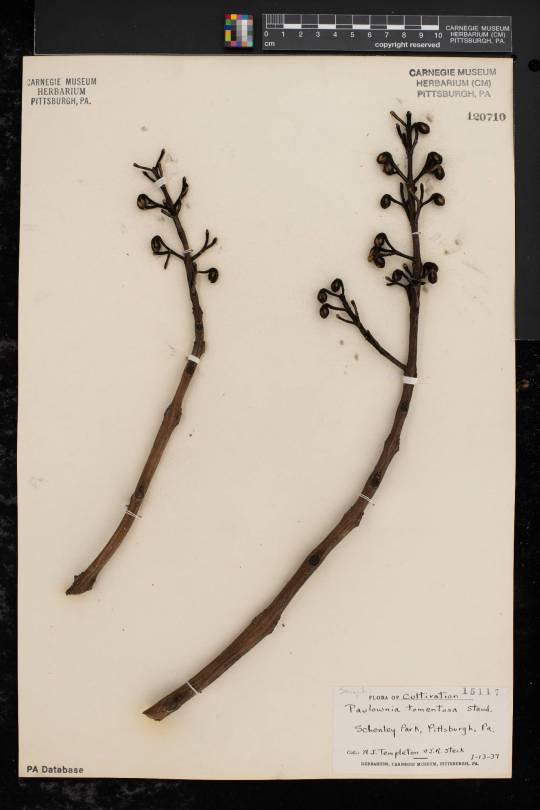
This specimen of princess tree (Paulownia tomentosa) was collected on January 13, 1937 in Schenley Park, Pittsburgh by R.J. Templeton and J.R. Steck.  Though subtle, note the heading on the label “Flora of Cultivation.”  This header suggests that this tree was planted in the park, rather than naturally occurring on its own.

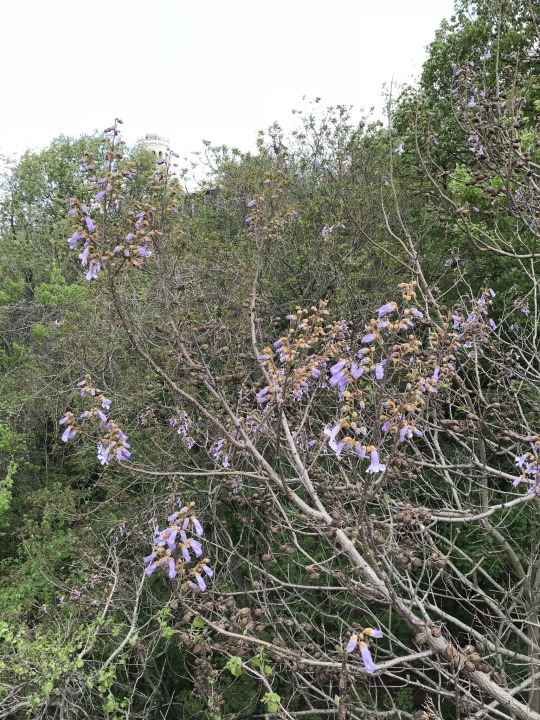
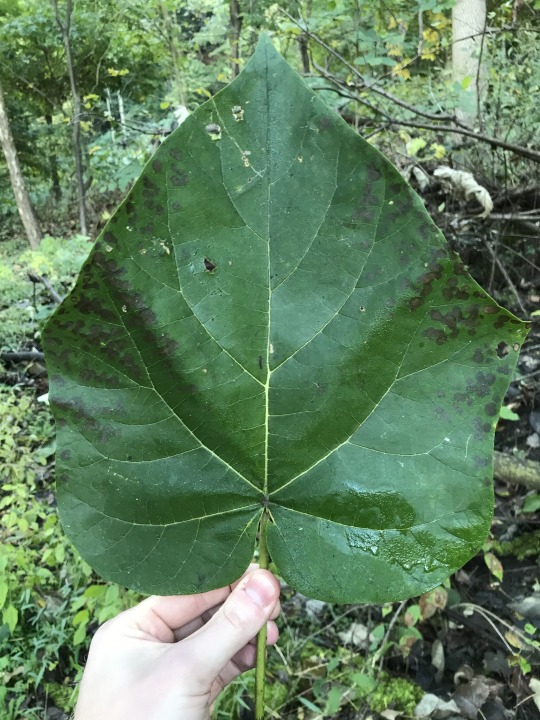
Princess tree has a remarkable presence – large wide leaves larger than your face (though you can’t see that in this winter collected specimen) and very showy, fragrant flowers that burst from large buds in the spring.  Signs of the flowers/fruits remain obvious on the branches year round.

Princess tree is a common urban weedy tree that is not native to Pennsylvania or the United States. Rather, it is native to Central and Western China.  It was brought to Europe in the 1830s (and then to the US) by the Dutch East India Company, with many historical medicinal and ornamental uses, as well as its wood. The tree was named after a Romanov princess, the Grand Duchess Anna Pavlovna.

Princess tree can still be found in Schenley Park.  It is especially noticeable, with its flowers at eye level, as you walk or drive across the bridge from the museum to Phipps Conservatory (Schenley bridge).

Listed as invasive by the state, Princess tree should not be planted in Pennsylvania.  It grows quickly and actively spreads beyond its planting, into roadsides, streams, and disturbed forests with potential to displace native plants.

Find this specimen and more here: http://midatlanticherbaria.org/portal/collections/list.php?db=all&catnum=CM120710&othercatnum=1

Check back for more! Botanists at the Carnegie Museum of Natural History share digital specimens from the herbarium on dates they were collected. They are in the midst of a three-year project to digitize nearly 190,000 plant specimens collected in the region, making images and other data publicly available online. This effort is part of the Mid-Atlantic Megalopolis Project (mamdigitization.org), a network of thirteen herbaria spanning the densely populated urban corridor from Washington, D.C. to New York City to achieve a greater understanding of our urban areas, including the unique industrial and environmental history of the greater Pittsburgh region. This project is made possible by the National Science Foundation under grant no. 1801022.

Mason Heberling is Assistant Curator of Botany at the Carnegie Museum of Natural History. Museum employees are encouraged to blog about their unique experiences and knowledge gained from working at the museum.

Filed Under: Blog Tagged With: Anthropocene, Botany, botany hall, collected on this day, Hall of Botany, Mason Heberling, Museum from Home, Uprooted

April 23, 2020 by Kathleen

CARNEGIE MUSEUM BOTANIST WINS ECOLOGICAL SOCIETY OF AMERICA GEORGE MERCER AWARD FOR YOUNG SCIENTISTS

Mason Heberling of Carnegie Museum of Natural History and Caitlin McDonough MacKenzie at University of Maine awarded for climate change research 

George Mercer Award recognizes outstanding, recently published, ecological research by young scientists

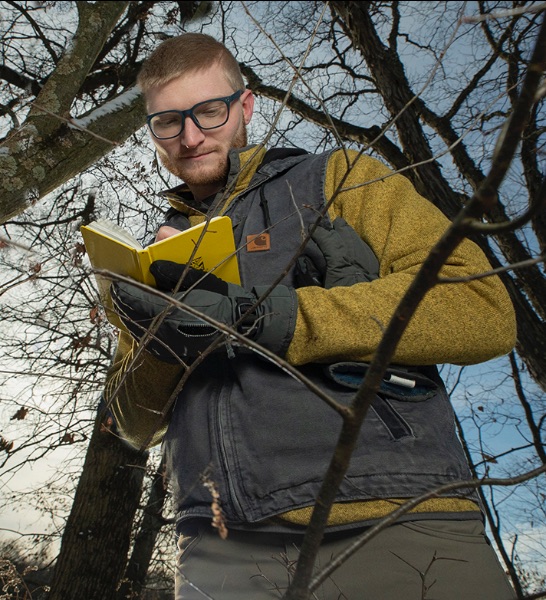
Mason Heberling, Assistant Curator of Botany at Carnegie Museum of Natural History. Photo credit: Joshua Franzos, Treehouse Media

[Pittsburgh, Pennsylvania, April 16, 2020] — The Ecological Society of America (ESA) named co-authors Mason Heberling, Assistant Curator of Botany at Carnegie Museum of Natural History, and Caitlin McDonough MacKenzie, postdoctoral fellow at University of Maine, recipients of the George Mercer Award that recognizes excellence in recent ecological research by scientists aged 40 years or younger at time of publication. Heberling and McDonough MacKenzie, who share the award with the more senior co-authors Richard Primack of Boston University, Susan Kalisz of the University of Tennessee, Knoxville, and Jason Fridley of Syracuse University, compared historical observations collected by Henry David Thoreau with new observations to show effects of climate change on spring wildflowers and trees.  The study, entitled “Phenological mismatch with trees reduces wildflower carbon budgets,” appeared in the scientific journal Ecology Letters in February 2019. The study demonstrated that trees are responding more rapidly to climate change than wildflowers, and this is having a negative effect on wildflower energy budgets.

ESA describes the research as “creative and powerful integration of historical records and contemporary experiments covering many species.” ESA goes on to note that Heberling and his colleagues “tell a convincing and important scientific story with notably clear writing and compelling visuals.”

“It is an immense honor to share this prestigious award with Caitlin and co-authors,” said Heberling. “We didn’t even know each other when we were collecting our separate datasets, but with serendipity and word-of-mouth, our projects came together to reveal findings that were exciting, surprising, and alarming at the same time. I am humbled to receive this award that celebrates a rich legacy of previous winners who have greatly influenced and inspired the field of ecology. I still can’t quite believe it.”

The research team compared Thoreau’s observations in Concord, Massachusetts to photosynthetic data collected by Heberling in a forest in Fox Chapel, Pennsylvania, near Pittsburgh, as part of a multi-year field experiment. Heberling adapted these measurements to calculate how temperature-driven shifts in trees leafing out has impacted wildflowers from Thoreau’s time until now.

The combined analysis shows that small differences in the responses of wildflowers versus trees to a warming climate could be harming wildflower abundance and growth already, with greater effects in coming years. The innovative study shows how phenological mismatches between trees and wildflowers can impact plant physiology and energy budgets and suggests future experiments and observations that can be carried out.

“The research of Mason and his colleagues presents an innovative approach to understanding the shifts in plant response, and therefore changes in the plant community, with changing climate,” said Rose-Marie Muzika, Director of Science and Research at Carnegie Museum of Natural History.  “It exemplifies the creative scientific direction of Carnegie Museum of Natural History by reaching into the past and studying the present to provide a potential glimpse into the future.”

The Ecological Society of America (ESA) is a nonpartisan, nonprofit organization of scientists founded in 1915 to promote ecological science by improving communication among ecologists; raise the public’s level of awareness of the importance of ecological science; increase the resources available for the conduct of ecological science; and ensure the appropriate use of ecological science in environmental decision making by enhancing communication between the ecological community and policy-makers.

Filed Under: Press Release Tagged With: Mason Heberling

March 19, 2020 by wpengine

Collected on this Day in 1898

Spring goes on! Spring seems to happen fast, which makes it all the more special and worth our attention. Comfort can be found in the new life of spring, a time of change.

Happy official first day of spring! For many people, spring conjures images of sunshine (and rain), birds tweeting about, and plants emerging from winter. Trees flower and leaf out high up in the canopy. Wildflowers emerge below, many playing a delicate balance between getting injured by cold or frost but taking advantage of the longer sunny days before being shaded out by tree leaves.

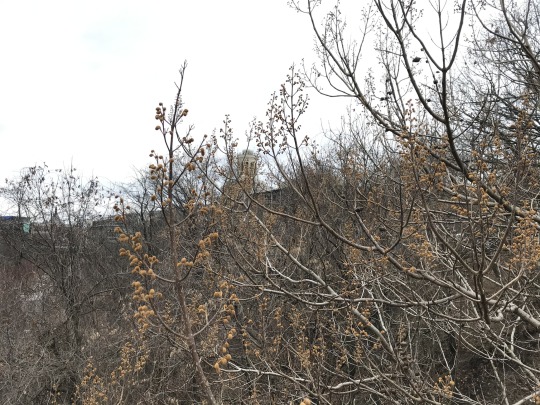
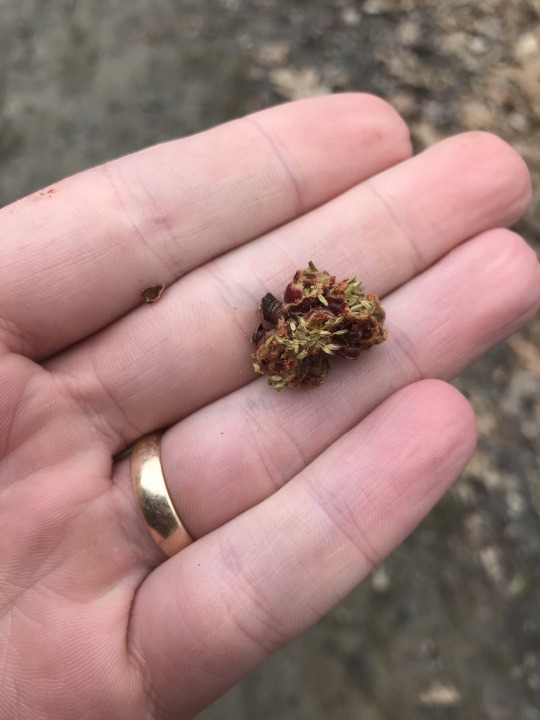
Many deciduous trees flower before, during, or just after they produce a new spring flush of leaves. That’s right – trees flower too! Keep a careful look out for them now and over the coming month. Many trees flower early in the spring, with small clusters of flowers. These easy to overlook flowers 40 feet or more up in the canopy are easy to overlook.  They are often quite small and are wind pollinated. That means that rather than relying on insects, the wind blows their pollen, transferring it to female flowers. (And also…as many with allergies know, we breathe in pollen too.)  Upon fertilization, seeds begin to develop. Flowering early, before leaves are out, is adaptive because the flowers are not blocked by vegetation.

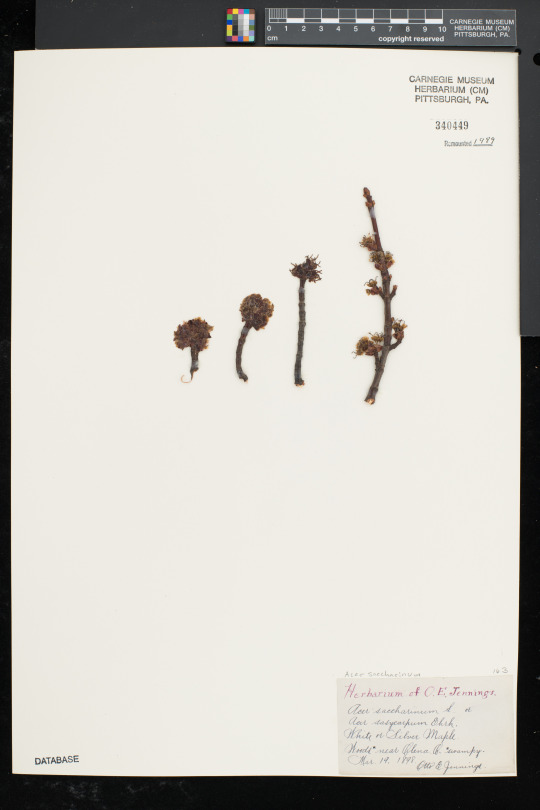
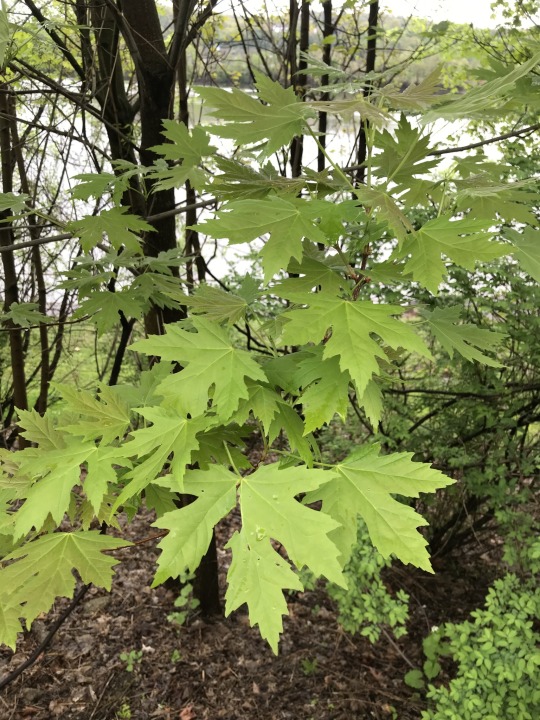
This specimen of silver maple (Acer saccharinum) is in flower, but leaves are not yet emerged. Silver maple is native to swampy, wet areas such as around lakes across eastern North America.  It is also planted, so it is now found in many habitats. It has beautiful bark that forms distinctive strips and with “maple-looking” leaves that are deeply loped.

Beyond the science, this specimen also tells an important cultural story about the history behind the Carnegie Museum. This specimen was collected by Otto Jennings in Olena, Ohio in 1898.  Otto Jennings was one of the first curators of botany at the museum. This specimen was collected when he was only 20 years old, six years before he moved to the museum. He was born in 1877 on a farm in Olena, Ohio. He collected this specimen not far from his childhood home.  Jennings started his 60-year tenure at the Carnegie Museum six years later, in 1904. He made many contributions throughout his career, serving as the Curator of Botany, Director of Education, and eventually Director of the Carnegie Museum of Natural History.  He also was Head of the Department of Biological Sciences at the University of Pittsburgh, having advised many students.  His legacy remains to this day for his influence on the museum, botany, conservation, and environmental education.

So many stories behind these specimens.

Find this specimen and the 304 other specimens Jennings collected near his childhood home here.

Check back for more! Botanists at the Carnegie Museum of Natural History share digital specimens from the herbarium on dates they were collected. They are in the midst of a three-year project to digitize nearly 190,000 plant specimens collected in the region, making images and other data publicly available online. This effort is part of the Mid-Atlantic Megalopolis Project (mamdigitization.org), a network of thirteen herbaria spanning the densely populated urban corridor from Washington, D.C. to New York City to achieve a greater understanding of our urban areas, including the unique industrial and environmental history of the greater Pittsburgh region. This project is made possible by the National Science Foundation under grant no. 1801022.

Mason Heberling is Assistant Curator of Botany at the Carnegie Museum of Natural History. Museum employees are encouraged to blog about their unique experiences and knowledge gained from working at the museum.

Filed Under: Blog Tagged With: Botany, collected on this day, Mason Heberling

March 18, 2020 by wpengine

Collected on this Day in 1951: Bedstraw

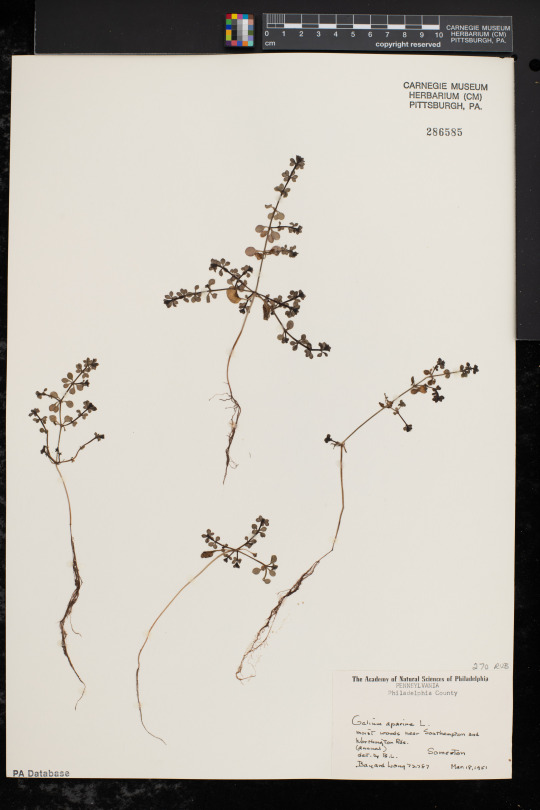
This bedstraw specimen was collected on March 18, 1951 by Bayard Long in Philadelphia county, Pennsylvania.

Bayard Long (1885-1969) was a Philadelphia-area botanist and an active member of the Philadelphia Botanical Club (founded in 1891 and still exists today).  He was a prolific collector and served as Curator of the Club’s Local Herbarium for 56 years (housed at the Academy of Natural Sciences).

Fogg writes of his collections in 1970 in the journal Rhodora: “It is doubtful that anyone ever possessed a higher standard for the quality of an herbarium specimen than Bayard Long.  Every leaf had to be laid out flat, every inflorescence properly displayed, every flower part clearly shown. Extra flowers and loose fruits and seeds were placed in pockets affixed to the sheet. Root systems (collected in their entirety whenever possible) were scrupulously clean, habitats were accurately described, and localities were identified to the nearest tenth of a mile and closest compass point. All of this seems the more remarkable when it is realized that Long collected close to 80,000 numbers, not including collections made as a member of Fernald’s expeditions.”

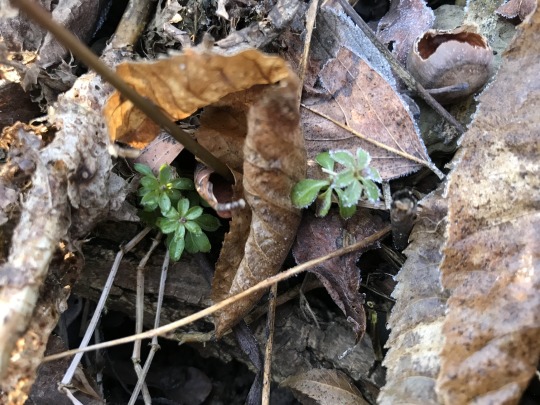
Bedstraws (species in the genus Galium, in the coffee family Rubiaceae) are common and memorable in our woods. They have many historical and traditional uses. In particular, they were used to stuff mattresses, hence the funny name. Also called cleavers or catchweed, the stems are sticky (due to fine hook hairs) and can be fun to stick on your clothes. They have likely stuck to you or your pet. This specimen is Galium aparine. An annual plant, seeds germinate in spring and produce tiny white flowers. They are emerging now, poking through the leaf litter.

Find this specimen and more here.

There are >64,000 specimens collected by Bayard Long currently digitized and online.

Check back for more! Botanists at the Carnegie Museum of Natural History share digital specimens from the herbarium on dates they were collected. They are in the midst of a three-year project to digitize nearly 190,000 plant specimens collected in the region, making images and other data publicly available online. This effort is part of the Mid-Atlantic Megalopolis Project (mamdigitization.org), a network of thirteen herbaria spanning the densely populated urban corridor from Washington, D.C. to New York City to achieve a greater understanding of our urban areas, including the unique industrial and environmental history of the greater Pittsburgh region. This project is made possible by the National Science Foundation under grant no. 1801022.

Mason Heberling is Assistant Curator of Botany at the Carnegie Museum of Natural History. Museum employees are encouraged to blog about their unique experiences and knowledge gained from working at the museum.

Filed Under: Blog Tagged With: Botany, collected on this day, Mason Heberling, Museum from Home, Science News

  • « Go to Previous Page
  • Page 1
  • Interim pages omitted …
  • Page 3
  • Page 4
  • Page 5
  • Page 6
  • Page 7
  • Interim pages omitted …
  • Page 21
  • Go to Next Page »

sidebar

About

  • Mission & Commitments
  • Directors Team
  • Museum History

Get Involved

  • Volunteer
  • Membership
  • Carnegie Discoverers
  • Donate
  • Employment
  • Events

Bring a Group

  • Groups of 10 or More
  • Birthday Parties at the Museum
  • Field Trips

Powdermill

  • Powdermill Nature Reserve
  • Powdermill Field Trips
  • Powdermill Staff
  • Research at Powdermill

More Information

  • Image Permission Requests
  • Science Stories
  • Accessibility
  • Shopping Cart
  • Contact
  • Visitor Policies
One of the Four Carnegie Museums | © Carnegie Institute | Privacy Policy | Terms of Use | Accessibility
Rad works here logo