• Skip to primary navigation
  • Skip to main content
  • Skip to primary sidebar

Carnegie Museum of Natural History

One of the Four Carnegie Museums of Pittsburgh

  • Visit
    • Buy Tickets
    • Visitor Information
    • Exhibitions
    • Events
    • Dining at the Museum
    • Celebrate at the Museum
    • Powdermill Nature Reserve
    • Event Venue Rental
    • Gift Cards
  • Learn
    • Field Trips
    • Educator Information
    • Programs at the Museum
    • Bring the Museum to You
    • Guided Programs FAQ
    • Programs Online
    • Climate and Rural Systems Partnership
  • Research
    • Scientific Sections
    • Science Stories
    • Science Videos
    • Senior Science & Research Staff
    • Museum Library
    • Science Seminars
    • Scientific Publications
    • Specimen and Artifact Identification
  • About
    • Mission & Commitments
    • Directors Team
    • Museum History
  • Tickets
  • Give
  • Shop

Blogs by Mason Heberling

Mason Heberling is the assistant curator in the Section of Botany and co-chair of collections at Carnegie Museum of Natural History. Heberling is a plant ecologist and botanist whose research explores plant functional strategies in deciduous forest understories, especially in the context
of environmental change. Much of his current research focuses on the ecology
and evolution of non-native, invasive plants in the eastern United States, the ecophysiological strategies of the herbaceous layer in deciduous forests, and the impacts of climate change on the timing of leafing out and flowering in temperate deciduous forests.

June 21, 2019 by wpengine

Cow Parsnip: All collected 112, 85, and 59 years ago!

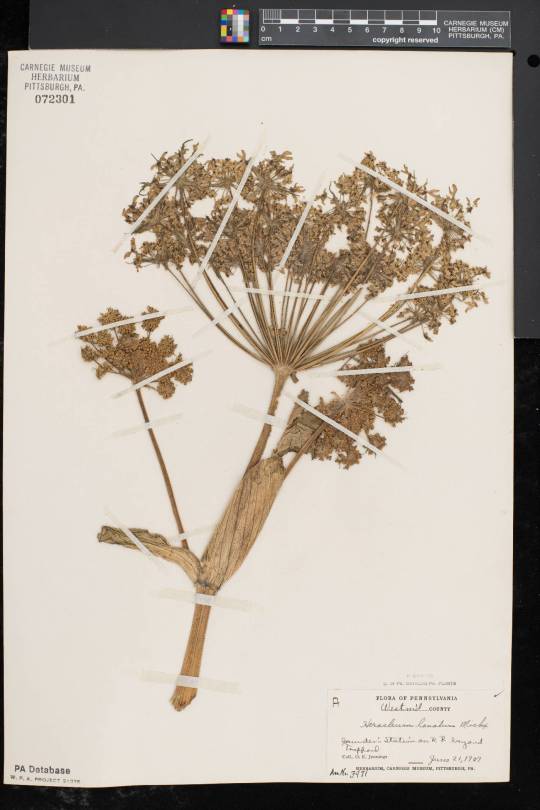
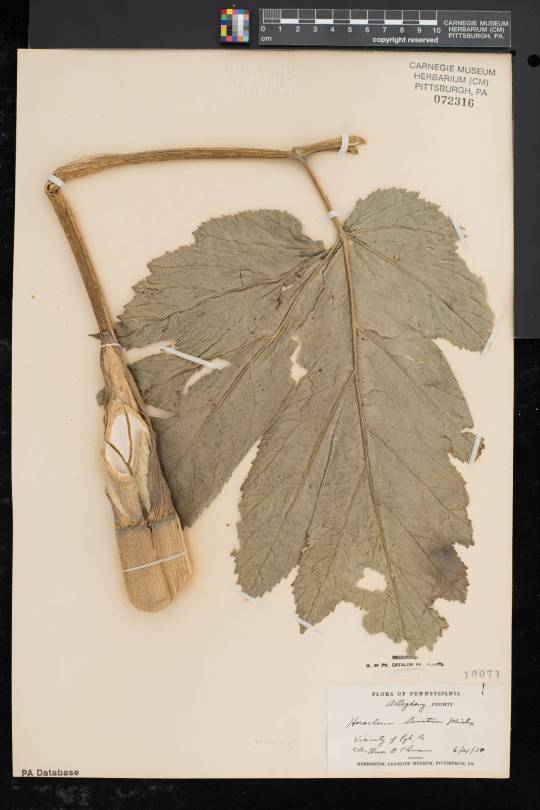
cow parsnip specimen

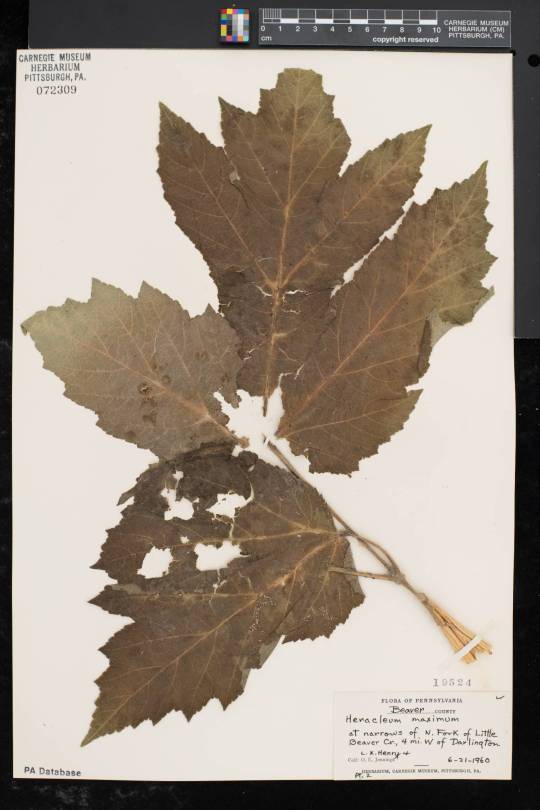
Whoa, this plant will catch your attention!  Although towering in at up to eight feet tall with leaves two feet wide, Cow parsnip (Heracleum maximum, aka Heracleum lanatum) is not a tree, but herbaceous (non-woody). This species is the largest member of the carrot family (Apiaceae) native to North America. It can be found along shaded roadsides, waterways, and the edge of woods. Its flower structure consists of many small white flowers on short stalks connected at a single point – an umbrella of flowers – botanically known as an “umbel.” Umbels are characteristic of the carrot family (think of the perhaps better recognized Queen Anne’s lace, Daucus carota, which is also known as “wild carrot”).

These specimens were all collected on June 21 – but years apart in 1907 (Westmoreland county, PA), 1934 (Pittsburgh), and 1960 (Beaver county, PA).
cow parsnip specimen

This species is often confused with giant hogweed. Cow parsnip is often confused for the non-native plant called giant hogweed (Heracleum mantegazzianum). Giant hogweed has hit the news media in the past few years and is on many people’s radar, as it is considered a significant public human health concern. This plant is highly poisonous and designated as a federal noxious weed. The sap of giant hogweed causes “phytophotodermatitis,” meaning serious skin inflammation occurs when contacted skin is exposed to sunlight.  Skin rashes can be very severe.  The sap can cause temporary or permanent blindness. Cow parsnip has a similar set of chemicals in its sap, and although not as poisonous, be careful around these plants.

Giant hogweed can be 8-20 feet tall with leaves up to 5 feet wide!  It is thought to be eradicated in Pennsylvania. Although similar to the Pennsylvania native species cow parsnip, giant hogweed is noticeably larger in height and flower size. (see herbarium specimen here – it took 6 sheets!)

See here for a nice comparison between these similar species.

Given the size of members of the genus, the name Heracleum (derivative of Hercules) is quite fitting.
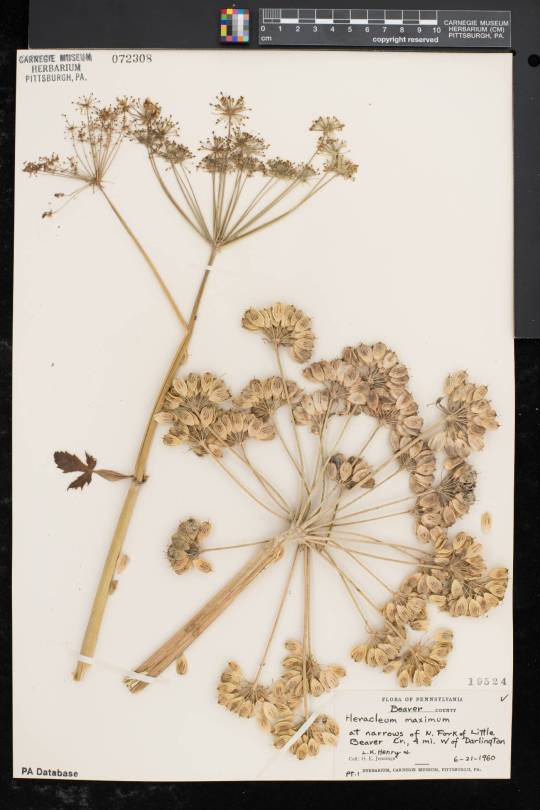
cow parsnip specimen

Specimen records and images for this species in the CM herbarium are now publicly available online.

Check back for more! Botanists at the Carnegie Museum of Natural History share digital specimens from the herbarium on dates they were collected. They have embarked on a three-year project to digitize nearly 190,000 plant specimens collected in the region, making images and other data publicly available online. This effort is part of the Mid-Atlantic Megalopolis Project (mamdigitization.org), a network of thirteen herbaria spanning the densely populated urban corridor from Washington, D.C. to New York City to achieve a greater understanding of our urban areas, including the unique industrial and environmental history of the greater Pittsburgh region. This project is made possible by the National Science Foundation under grant no. 1801022.

Mason Heberling is Assistant Curator of Botany at the Carnegie Museum of Natural History. Museum employees are encouraged to blog about their unique experiences and knowledge gained from working at the museum.

Related Content

Collected On This Day in 2001: Giant Hogweed

Collected On This Day in 1982: One Specimen Isn’t Always Enough

Pressed Flowers Come Alive by Telling Their Pollination Story

Carnegie Museum of Natural History Blog Citation Information

Blog author: Heberling, Mason
Publication date: June 21, 2019
Share this post!

  • Share on Twitter Share on Twitter
  • Share on Facebook Share on Facebook
  • Share on Pinterest Share on Pinterest
  • Share on LinkedIn Share on LinkedIn
  • Share on Reddit Share on Reddit
  • Share via Email Share via Email

Filed Under: Blog Tagged With: Botany, collected on this day, Mason Heberling, plants

June 7, 2019 by wpengine

Collected 189 Years Ago: Strawberry Bush

strawberry bush specimen

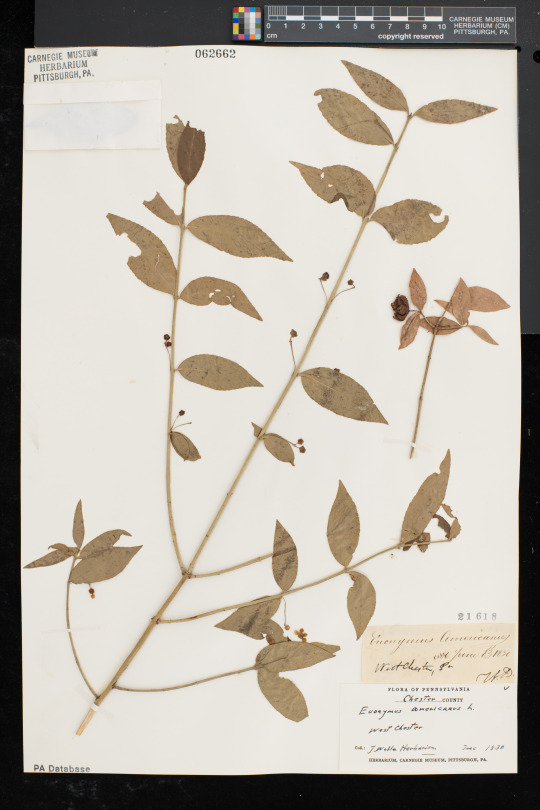
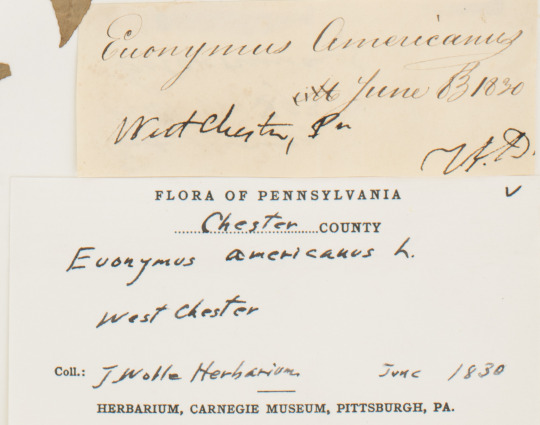
This is a special specimen. The Carnegie Museum of Natural History herbarium is full of specimens of scientific and historical importance. And this is a notable one, collected in June 1830 by William Darlington in West Chester, Pennsylvania. William Darlington (1782-1863) was an important figure in the history of Pennsylvania botany. Darlington was a physician, politician (US House of Representatives 1815-1823), and as you might guess – a botanist! At the University of Pennsylvania, Darlington studied botany under Benjamin Smith Barton, a well-known botanist who also trained Meriwether Lewis (of the Lewis & Clark Expedition). He spent most of his life in West Chester, PA. He wrote some of the earliest botanical works, including a flora of Chester County in 1826 and others on agriculture. Many of his specimens are among the earliest documentation of Pennsylvania’s flora and are preserved in the William Darlington herbarium at West Chester University.

This particular specimen is of the native shrub Euonymus americanus, commonly called “strawberry  bush.” Despite the name, it is not related to strawberries, but is in the bittersweet/spindle family, Celastraceae. You may recognize some similarities with the related species from East Asia, burning bush (Euonymus alatus), which is commonly planted due to its bright red fall color (around Cathedral of Learning in Pittsburgh, and many other places).  However, burning bush should not be planted, as it is invasive, spreading into natural areas.

label from strawberry bush specimen

In the Carnegie Museum herbarium, there are 62 specimens collected by Darlington between 1828 and 1840, mostly from Chester County, PA.

How’d some of Darlington’s specimens end up at the Carnegie Museum? This specimen is part of Jacob Wolle’s personal collection, who was the grandfather of William Holland, the first director of the museum.

This specimen image is now publicly available online.

Read more about Darlington and  other influential figures in the history of botany in Pennsylvania at Herbarium World.

Check back for more! Botanists at the Carnegie Museum of Natural History share digital specimens from the herbarium on dates they were collected. They have embarked on a three-year project to digitize nearly 190,000 plant specimens collected in the region, making images and other data publicly available online. This effort is part of the Mid-Atlantic Megalopolis Project (mamdigitization.org), a network of thirteen herbaria spanning the densely populated urban corridor from Washington, D.C. to New York City to achieve a greater understanding of our urban areas, including the unique industrial and environmental history of the greater Pittsburgh region. This project is made possible by the National Science Foundation under grant no. 1801022.  

Mason Heberling is Assistant Curator of Botany at the Carnegie Museum of Natural History. Museum employees are encouraged to blog about their unique experiences and knowledge gained from working at the museum.

Filed Under: Blog Tagged With: Botany, Mason Heberling, plants, William Darlington

May 31, 2019 by wpengine

Poison Ivy – Collected on This Day

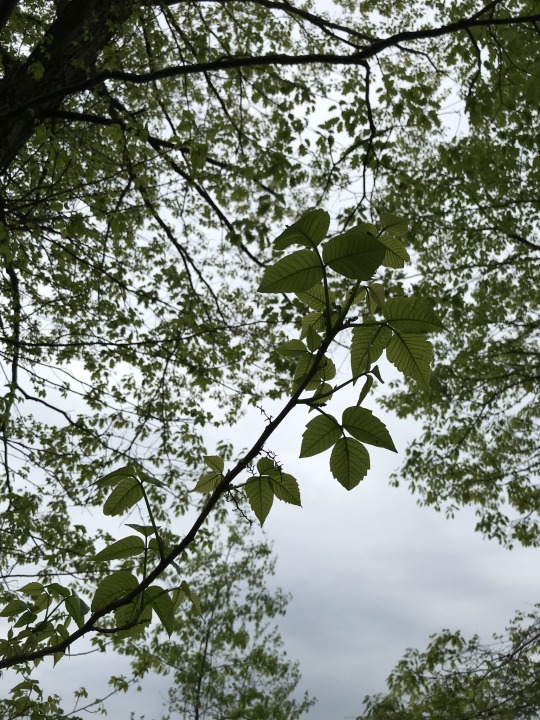
poison ivy growing as a shrub

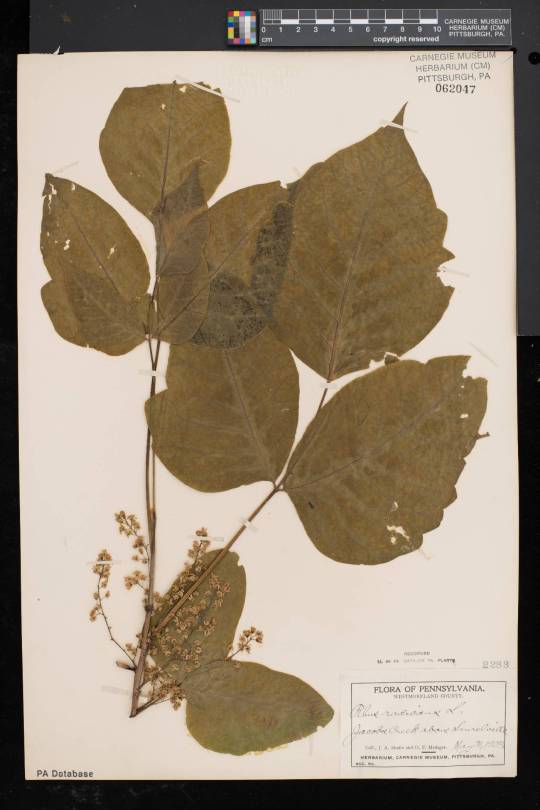
Watch out for poison ivy!  It is a fascinatingly cool plant but can also be dangerous.  This flowering specimen of poison ivy was collected on May 31, 1903 by John Shafer (the first curator of botany at Carnegie Museum) and O.P. Medsger in the Laurel Highlands of southwestern PA.

poison ivy herbarium sheet

What is Poison Ivy?

Poison ivy (Toxicodendron radicans) is a woody vine found in forest understories, but does especially well on forest edges. It is very common in urban and suburban areas. It takes many forms, climbing high up a tree, along the ground, or even a short shrubby thing. The leaves take a range of shapes, but as the adage goes (“leaves of 3, let it be”), it has three leaflets.

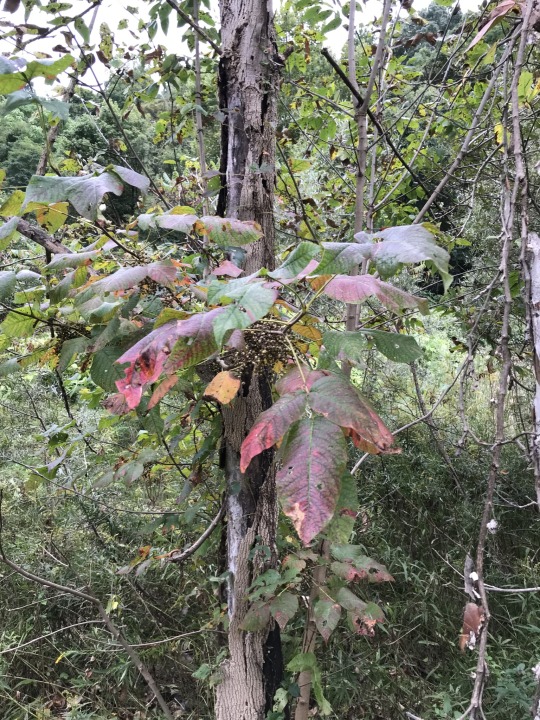
poison ivy in a tree

Poison Ivy Chemistry – What Causes the Rash?

Poison ivy is known for its chemistry, producing a class of organic compounds call urushiol. These are found in the plant’s sap and on leaves/stems/roots. Urushiol causes a nasty rash to those who touch it. Not all people have a reaction (but most are sensitive). Don’t be too confident if you haven’t had a rash before – it can develop with repeated exposure.  Incredibly itchy, the rash can become a serious health issue if infected, especially if its oils get in contact with your eyes, face, or throat.  The rash can appear days after exposure and can last for weeks.

poison ivy rash

Research indicates poison ivy will get more poisonous with climate change, both in terms of growth and producing higher quantities of forms of urushiol particularly toxic to humans.

Is Poison Ivy a Weed?

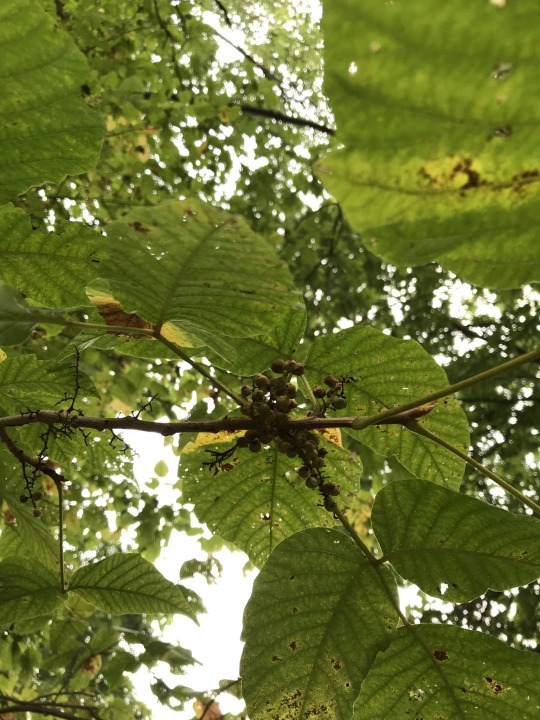
Some people call Poison ivy because of its fear-causing rash, but it is native to eastern North America.  The species has a wide distribution across our region, and across the world (native subspecies in China). Although native, the species seems to be getting more common as we create more forest edge habitat.   The colorful foliage can be quite beautiful in the fall, and the berries are a food source for birds and other animals. Humans seem to be the only ones allergic to it.

poison ivy colored foliage in autumn
poison ivy berries

Plants Similar to Poison Ivy

Poison ivy is often confused with other non-poisonous and poisonous plants.

Some common confusions:

  1. Virginia creeper (Parthenocissus quinquefolia), a vine in the grape but different leaves, and not with leaves of three
  2. Box elder maple (Acer negundo), a tree that has compound leaves unlike most stereotypical maples,  but with samaras (aka “helicopter” seeds)

Poison ivy and some other rash-causing plants are in the cashew family (Anacardiaceae) – which also includes poison oak (not found in Pennsylvania, but in western USA), staghorn sumac (not rash causing), poison sumac (rash causing, but you likely won’t come across it unless in very wet habitats)….and even a few familiar species like  pistachio,  cashew, and mango (some people are allergic).

What an amazing plant.

This specimen image is now publicly available online: http://midatlanticherbaria.org/portal/collections/individual/index.php?occid=12232529&clid=0

Check back for more! Botanists at the Carnegie Museum of Natural History share digital specimens from the herbarium on their collection dates. They have embarked on a three-year project to digitize nearly 190,000 plant specimens collected in the region (like Poison ivy!) making images and other data publicly available online. This effort is part of the Mid-Atlantic Megalopolis Project (mamdigitization.org), a network of thirteen herbaria spanning the densely populated urban corridor from Washington, D.C. to New York City to achieve a greater understanding of our urban areas, including the unique industrial and environmental history of the greater Pittsburgh region. This project is made possible by the National Science Foundation under grant no. 1801022.  

Mason Heberling is Assistant Curator of Botany at the Carnegie Museum of Natural History. Museum employees are encouraged to blog about their unique experiences and knowledge gained from working at the museum.

Filed Under: Blog Tagged With: Botany, conservation, herbarium, Mason Heberling, pennsylvania, plants

May 16, 2019 by wpengine

A Lot to be Fascinated By in the Herbarium

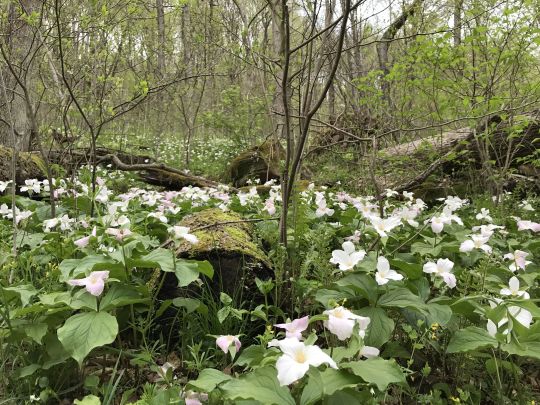
wildflowers in the woods

Are you fascinated by plants? Fascination of Plants Day is upon us (don’t worry, we didn’t know it was a thing either, but agree celebration is in order!). As you might guess, we in the Section of Botany at the Carnegie Museum of Natural History are definitely into any and all things plants. Plants are inextricable from our daily lives and play critical roles in our environment.  Plus, they are just pretty cool, too. Amid chirping birds or a lion chasing a gazelle, they might be easy to overlook, but they are well worth your attention. From the sidewalk cracks in front of the museum to a remote tropical rainforest, there is a lot to celebrate.

With over half a million plant specimens in the Carnegie Museum herbarium, we have a lot to be fascinated by. Botanists here at the museum and across the world are making new discoveries about plants through these collections. On this 5th annual Fascination of Plants Day, I’d like to share some exciting new work in our collection – extracting fungal DNA from herbarium specimen roots collected over a hundred years ago.

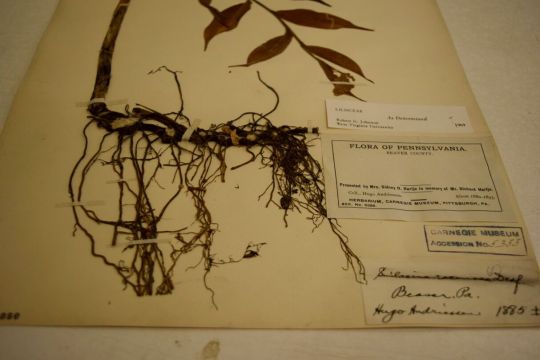
plant specimen with long roots on herbarium sheet

Unexpected inspiration often comes from looking at old specimens in new ways. Museum specimens were collected for many different reasons. The uses of specimens are many, and recently, being used in new ways.  Museum specimens have a lot to tell us. If we look.

Recently, I became fascinated by something often ignored – roots on herbarium specimens. Why do herbarium specimens have roots?

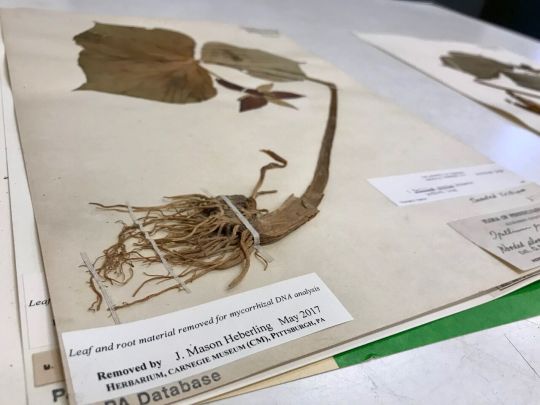
dried plant specimen on herbarium sheet

It is standard practice for botanists to collect the entire plant when possible.  Of course, that isn’t possible for a huge tree, but many plants can fit nicely on an herbarium sheet, roots and all. And  not only do many specimens have roots, but they have soil too.

For some plants, roots can be very helpful for identification. But for the most part, roots on herbarium specimens have not been generally used. But what can 100-year-old roots tell us?

With this new fascination with herbarium specimen roots, I contacted  Dr. David Burke, a microbial ecologist and expert in belowground forest ecology at the Holden Arboretum in Kirkland, Ohio. David studies belowground microbial soil communities and their interactions with plant roots. Nearly 75% of all flowering plant species form close relationships with mycorrhizal fungi. Many plant species in our forests across the eastern United States rely upon these mycorrhizal fungi to obtain water and nutrients necessary for growth. In return, the fungi get food (sugars) from the plant.

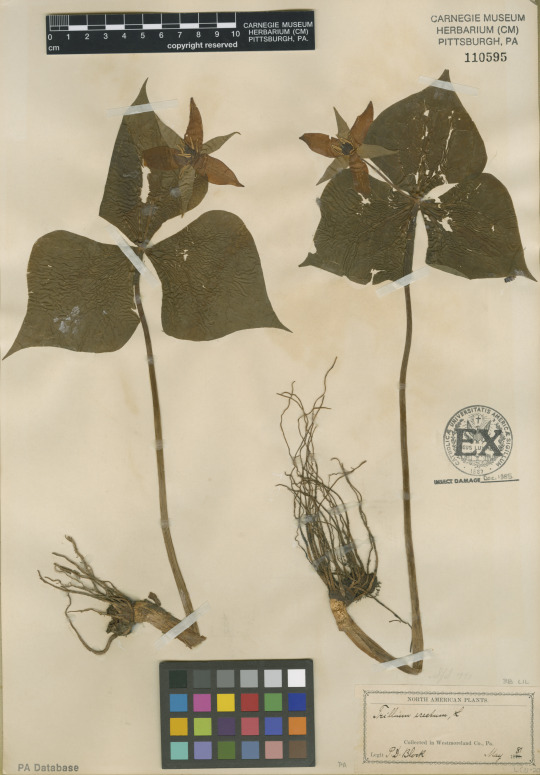
herbarium sheet of dried flower with roots

Can herbarium specimen roots tell us about relationships between mycorrhizal fungi and plants?  And perhaps more importantly: Have human activities affected these plant-fungal relationships over the past century?

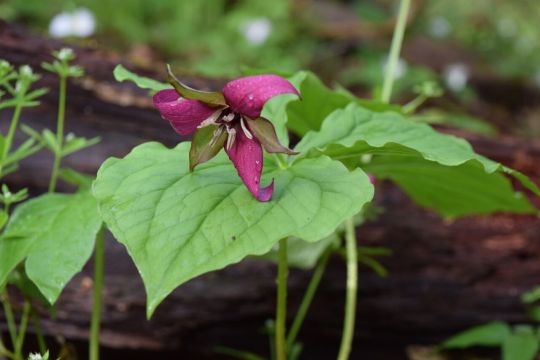
David Burke had not extracted fungal DNA from herbarium specimen roots, but he was eager to try. (In fact, to our knowledge, no one had done this with herbarium specimen roots before.)  We sampled roots from herbarium specimens of four common forest wildflowers collected in western Pennsylvania between 1881 to 2008. These species included some favorites familiar in our area: red trillium, large-flowered trillium, false Solomon’s seal, and jack-in-the-pulpit.

red-purple flower in the woods

David was able to extract and sequence fungal DNA from plant roots as old as 137 years old! We published our results in a special issue on belowground botany in Applications in Plant Sciences. You can read the full study here.  While there is still much to be done, we showed that museum collections across the world hold enormous potential to provide new insights in the basic belowground biology of plants. They can also help us understand how human activities may affect the web of life in overlooked ways.

Herbarium specimen roots have a lot to tell us about the past, present, and future of our forests in the Anthropocene. And that is fascinating!

woods with many spring wildflowers in bloom

Mason Heberling is Assistant Curator of Botany at the Carnegie Museum of Natural History. Museum employees are encouraged to blog about their unique experiences and knowledge gained from working at the museum.

Filed Under: Blog Tagged With: Botany, Hall of Botany, herbarium, Mason Heberling, plants, Section of Botany

March 18, 2019 by wpengine

What’s a Shamrock?

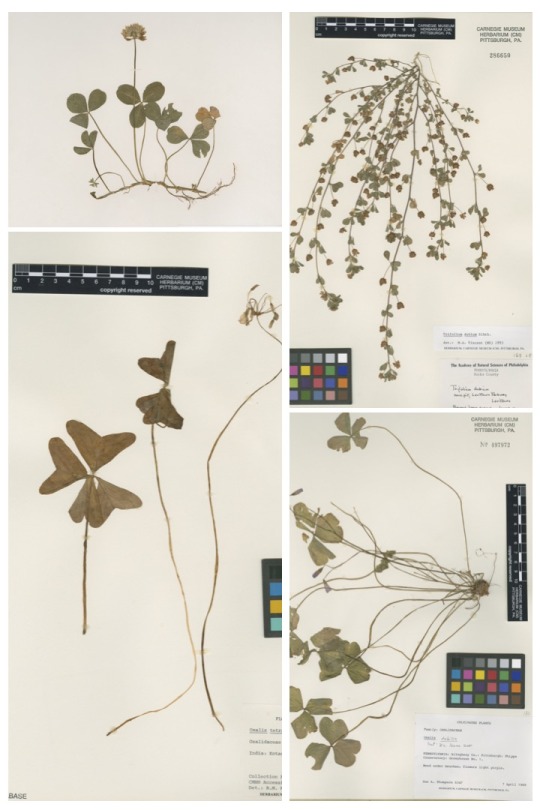
There is no overwhelming scientific consensus on which species is the well-known Irish national emblem.  There was survey of Irish botanists in the early 1890s asking which species was the “true” shamrock.  A similar survey was repeated in 1988.  The results suggest the shamrock is either Trifolium dubium(aka “lesser trefoil”) or Trifolium repens (aka “white clover”).  The plants commonly sold around St. Patrick’s Day as “shamrocks” or “4-leaf clovers” are in the plant genus Oxalis(“wood sorrel”), which belong to different plant family than true clovers.

four shamrock specimens

Top left: Trifolium repens (collected 1974 in Louisiana), aka “white clover”

Top right: Trifolium dubium (collected 1961 in Pennsylvania), aka “lesser trefoil”

Bottom left: Oxalis tetraphylla (collected 1981 in India), aka “lucky clover,” although not a true clover

Bottom right: Oxalis debilis (collected 1989 in cultivation), aka “pink woodsorrel”

These specimens were recently imaged (along with many others in the legume family, Fabaceae) and are publicly available online.


Check back for more! Botanists at the Carnegie Museum of Natural History share digital specimens from the herbarium on dates they were collected. They have embarked on a three-year project to digitize nearly 190,000 plant specimens collected in the region, making images and other data publicly available online. This effort is part of the Mid-Atlantic Megalopolis Project (mamdigitization.org), a network of thirteen herbaria spanning the densely populated urban corridor from Washington, D.C. to New York City to achieve a greater understanding of our urban areas, including the unique industrial and environmental history of the greater Pittsburgh region. This project is made possible by the National Science Foundation under grant no. 1801022.

Mason Heberling is Assistant Curator of Botany at the Carnegie Museum of Natural History. Museum employees are encouraged to blog about their unique experiences and knowledge gained from working at the museum.

Filed Under: Blog Tagged With: Botany, Mason Heberling, plants

February 4, 2019 by wpengine

Happy Groundhog Day!

By Mason Heberling

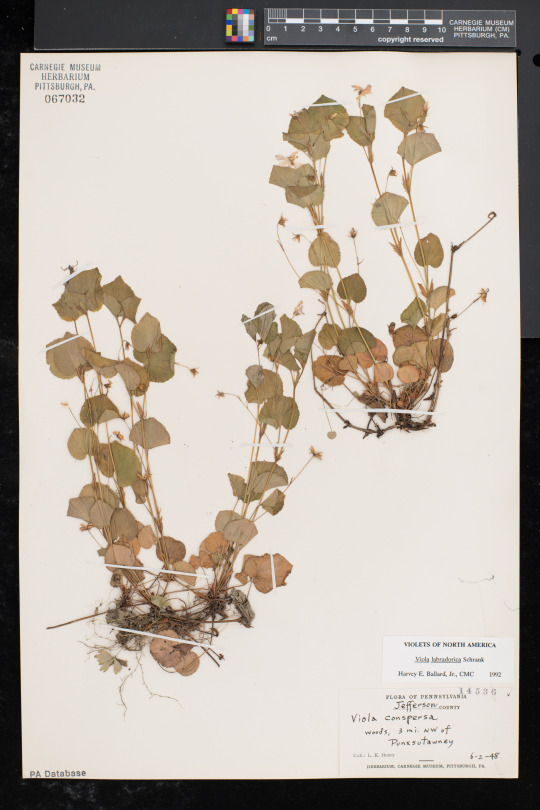
labrador violet specimen

Do you think Punxsutawney Phil was ever overcome by the beauty of this very violet 71 years ago? Or perhaps he nibbled off a leaf or two? After all, legend has it that Phil is over 100 years old! This specimen of Labrador violet (Viola labradorica) was collected near Phil’s home in Punxsutawney, Pennsylvania on June 2, 1948 by Carnegie Museum botany curator Leroy Henry.

In case you wondered, on Groundhog Day 1948, Punxsutawney Phil saw his shadow and predicted six more weeks of winter.

This specimen was imaged recently (along with many others in the violet family) and is publicly available online.

Check back for more! Botanists at the Carnegie Museum of Natural History share digital specimens from the herbarium on dates they were collected. They have embarked on a three-year project to digitize nearly 190,000 plant specimens collected in the region, making images and other data publicly available online. This effort is part of the Mid-Atlantic Megalopolis Project (mamdigitization.org), a network of thirteen herbaria spanning the densely populated urban corridor from Washington, D.C. to New York City to achieve a greater understanding of our urban areas, including the unique industrial and environmental history of the greater Pittsburgh region. This project is made possible by the National Science Foundation under grant no. 1801022.  

Filed Under: Blog Tagged With: Botany, flowers, Mason Heberling, plants

  • « Go to Previous Page
  • Page 1
  • Interim pages omitted …
  • Page 6
  • Page 7
  • Page 8
  • Page 9
  • Page 10
  • Interim pages omitted …
  • Page 21
  • Go to Next Page »

sidebar

About

  • Mission & Commitments
  • Directors Team
  • Museum History

Get Involved

  • Volunteer
  • Membership
  • Carnegie Discoverers
  • Donate
  • Employment
  • Events

Bring a Group

  • Groups of 10 or More
  • Birthday Parties at the Museum
  • Field Trips

Powdermill

  • Powdermill Nature Reserve
  • Powdermill Field Trips
  • Powdermill Staff
  • Research at Powdermill

More Information

  • Image Permission Requests
  • Science Stories
  • Accessibility
  • Shopping Cart
  • Contact
  • Visitor Policies
Stay in the loop! Sign up for our newsletter(s).
One of the Four Carnegie Museums | © Carnegie Institute | Privacy Policy | Terms of Use | Accessibility
Rad works here logo