• Skip to primary navigation
  • Skip to main content
  • Skip to primary sidebar

Carnegie Museum of Natural History

One of the Four Carnegie Museums of Pittsburgh

  • Visit
    • Buy Tickets
    • Visitor Information
    • Exhibitions
    • Events
    • Dining at the Museum
    • Celebrate at the Museum
    • Powdermill Nature Reserve
    • Event Venue Rental
  • Learn
    • Field Trips
    • Educator Information
    • Programs at the Museum
    • Bring the Museum to You
    • Guided Programs FAQ
    • Programs Online
    • Climate and Rural Systems Partnership
  • Research
    • Scientific Sections
    • Science Stories
    • Science Videos
    • Senior Science & Research Staff
    • Museum Library
    • Science Seminars
    • Scientific Publications
    • Specimen and Artifact Identification
  • About
    • Mission & Commitments
    • Directors Team
    • Museum History
  • Tickets
  • Give
  • Shop

Matt Lamanna

October 5, 2017 by wpengine

Who is Dr. Matt Lamanna?

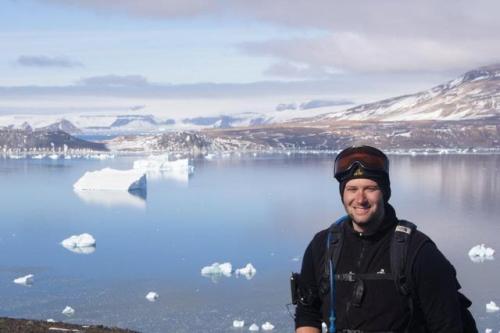
Matt Lamanna on expedition in Antarctica

Did you know that Section of Vertebrate Paleontology curator Matt Lamanna has discovered dinosaur fossils on all seven
continents, including Antarctica?

Dr. Lamanna leads the Antarctic Peninsula Paleontology Project, an international team of scientists investigating the end
of the Mesozoic Era (”Age of Dinosaurs”) in Antarctica, and also leads or co-leads research projects studying dinosaurs in Patagonia (Argentina), the Sahara (Egypt), and the Australian Outback.

Lamanna has named or co-named 15 new species of dinosaurs and fossil birds, including Anzu wyliei and three of the largest land animals known to science—the titanosaurian sauropods Dreadnoughtus schrani, Notocolossus gonzalezparejasi, and Paralititan stromeri. Each of these massive sauropods is estimated to have weighed more
than 40 tons, roughly equivalent to eight adult elephants.

Lamanna has co-authored two papers in the preeminent journal Science and appeared on television programs for PBS (NOVA), the Discovery Channel, the History Channel, A&E, the Science Channel, and more. Recently, he assisted the US Department of Homeland Security in their investigation of a dinosaur fossil that had been illegally smuggled out of China.
Filed Under: Blog Tagged With: Antarctic Peninsula Paleontology Project, dinosaurs, Matt Lamanna, Vertebrate Paleontology

August 3, 2017 by wpengine

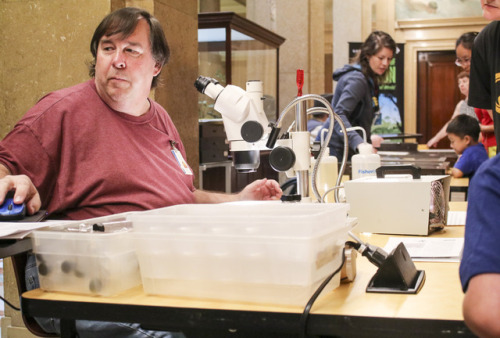
Researchers and scientists at work

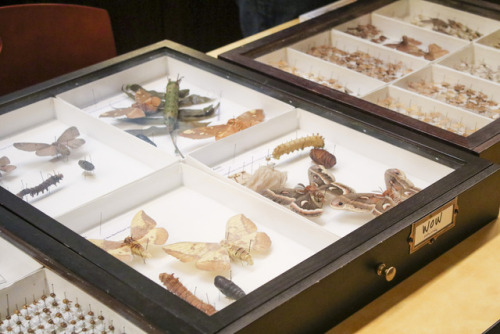
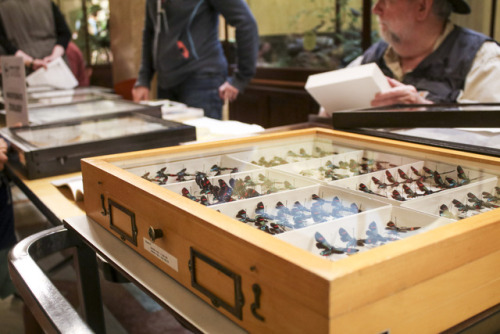
specimens from the section of Invertebrate Zoology

researchers at work

moth and caterpillar specimens

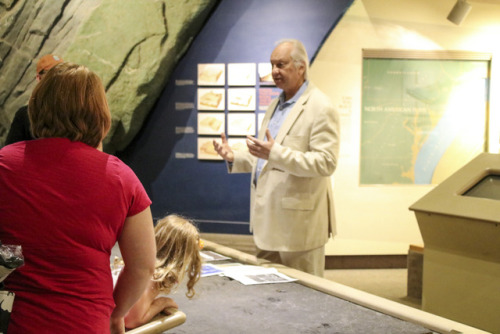
Albert talking to visitors in Benedum Hall of Geology

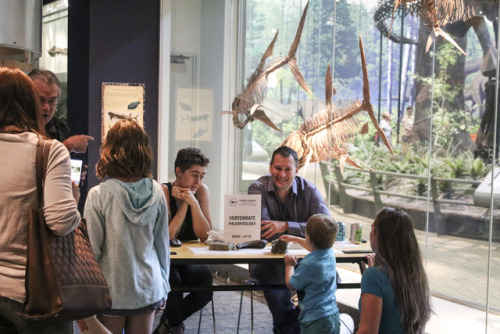
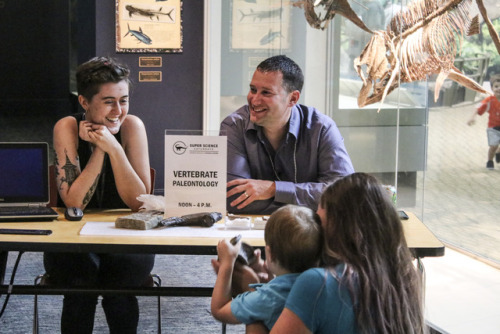
visitors meeting our dinosaur experts

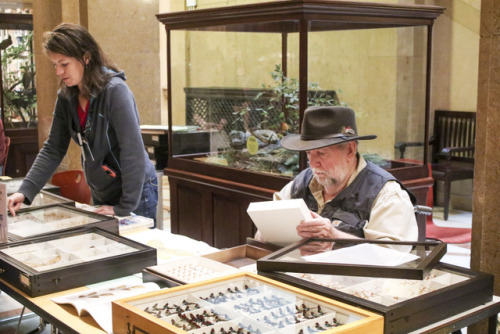
researchers in the section of Invertebrate Zoology

researchers in the section of Vertebrate Palentology

Did you know researchers and scientists are at work in the museum every day?

Visitors got an inside look at the behind-the-scenes science of our museum by interacting with Carnegie scientists at a special Super Science Saturday—Scientist Takeover!

Entomologists, paleontologists, anthropologists, and other scientists spent Saturday, July 22 in the galleries showing off their cool collections, answering questions, and discussing their work with curious museum-goers. Visitors also enjoyed tours and hands-on activities like sifting through soil to find Pennsylvania land snails.

Super Science Saturdays is a program at Carnegie Museum of Natural History that invites visitors of all ages to explore a special theme through hands-on activities, experiments, demonstrations, discussions with museum experts, and more. Events are free with museum admission.

Don’t miss our next event, Whiskers and Woofs, on August 19.

Filed Under: Blog Tagged With: Albert Kollar, invertebrate paleontology, Invertebrate Zoology, John Rawlins, Matt Lamanna, mollusks, Super Science Saturday, Vertebrate Paleontology

January 24, 2017 by wpengine

Paleontologist Matt Lamanna

Paleontologist Matt Lamanna was live from the Big Bone Room at Carnegie Museum of Natural History in January! Matt discusses the famous Diplodocus carnegii, becoming a paleontologist, and more!

Filed Under: Blog Tagged With: Matt Lamanna, paleontology, Scientists Live

September 10, 2016 by wpengine

From Antarctica to Pittsburgh

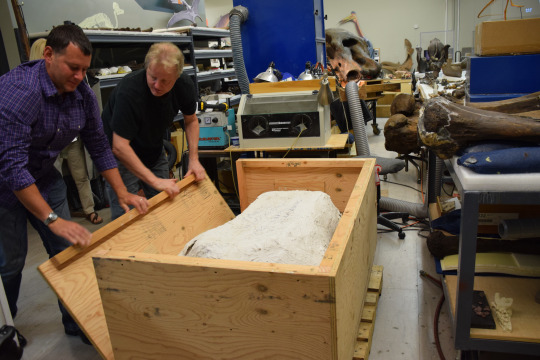
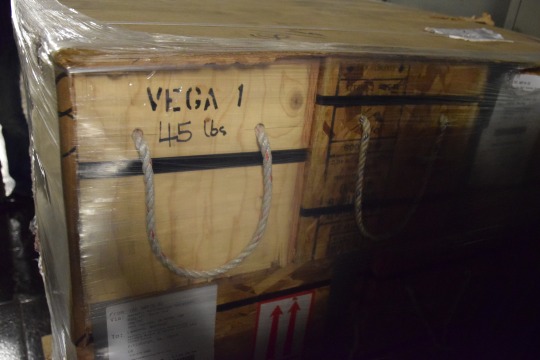
Last week, several tons of fossils arrived at Carnegie Museum of Natural History from Antarctica, where our paleontologist and principal dinosaur research Matt Lamanna led the AP3 Expedition this spring. The fossils traveled by boat from Antarctica to Chile to the United States, where they were then trucked across the country to our museum.

In the coming weeks, our staff will begin carefully unpacking these specimens and studying them.

To read more about the expedition, visit our expedition blog.


Lamanna and Dan Pickering, a scientific preparator, open one package containing the largest fossil in the shipment.
A box with fossils collected from Vega Island in Antarctica.

Filed Under: Blog Tagged With: antarctica, behind the scenes, expedition, fossils, Matt Lamanna, museums, paleontology

July 14, 2016 by wpengine

Crafting Lost Dinosaur Bones

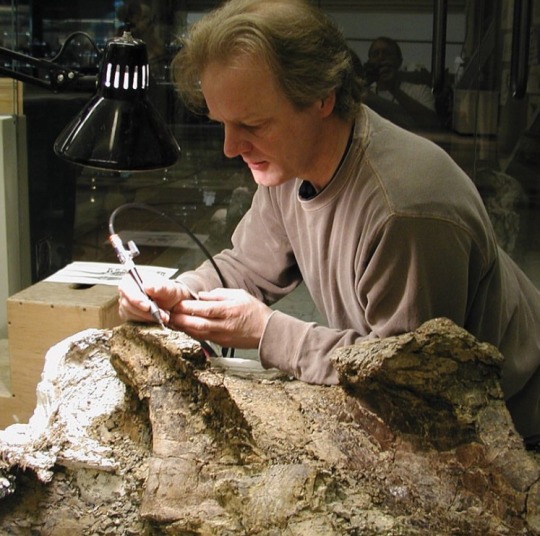
Dan Pickering working on fossil

The most amazing thing about the skeletons in our Dinosaurs in Their Time exhibit is that the majority of their bones are the real deal.

The second most amazing thing about those skeletons is that whenever a bone was missing, someone had to create a cast of that bone from scratch.

Dan Pickering is one of those craftsman. Dan, whose been part of the museum’s PaleoLab team since 2005, is an artist, a sculptor by training.

He first used his skills in the exhibit department, but when the overhaul of Dinosaur Hall and its inhabitants became a reality, as Dan puts it, “I wanted a piece of the dinosaur action.”

Pictured above: Dan preparing a giant neck vertebrae of Dreadnoughtus, a super-massive dinosaur from Patagonia excavated and studied by museum dinosaur hunter Matt Lamanna and colleagues.

Filed Under: Blog Tagged With: dinosaurs in their time, Matt Lamanna, Paleolab, Pittsburgh

April 27, 2016 by wpengine

New Discovery Lets Researchers Get Inside a Dinosaur’s Head

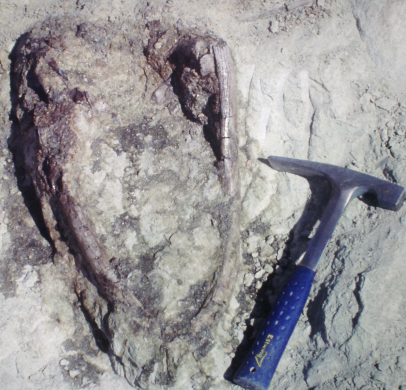
Sarmientosaurus musacchioi fossil
The skull of Sarmientosaurus musacchioi at the discovery site in Argentina. (photo by Rubén Martínez)

In some areas of the world, the fossils of sauropod dinosaurs are so common that paleontologists literally trip over the bones of these huge, long-necked, long-tailed plant-eaters that many people think of when they hear the word “dinosaur.”

While some kinds of sauropod bones are common, others such as skulls are more elusive – which makes a new discovery that was coauthored by a Carnegie Museum of Natural History paleontologist very exciting.

A skull discovered in a rural area of southern Chubut Province, Argentina, will give a face and name to a ten-ton sauropod that plodded around the southern hemisphere about 95 million years ago – Sarmientosaurus musacchioi.

Assistant Curator of Vertebrate Paleontology Matt Lamanna worked on a team that named the new species of dinosaur, which he said will yield a wealth of insights into the biology and behavior of titanosaurs, a group of sauropods that includes the most massive land animals that have ever existed. The fossil was originally discovered by the team leader Rubén Martínez of the Universidad Nacional de la Patagonia San Juan Bosco in Chubut.

The skull  Martínez and his team discovered is arguably the most complete and well-preserved titanosaur skull ever found. It provides scientists with their first good look at the head of an
anatomically primitive titanosaur.

Scientists from Ohio University Heritage College of Osteopathic Medicine were able to reconstruct a model of what the dinosaur’s brain would have looked like. Despite the colossal size of the animal, its brain was probably only the size of an orange!

Lamanna said that Sarmientosaurus is one of the most exciting discoveries he’s worked on in his career and will provide researchers with information on the origins and evolutionary relationships of titanosaurs.

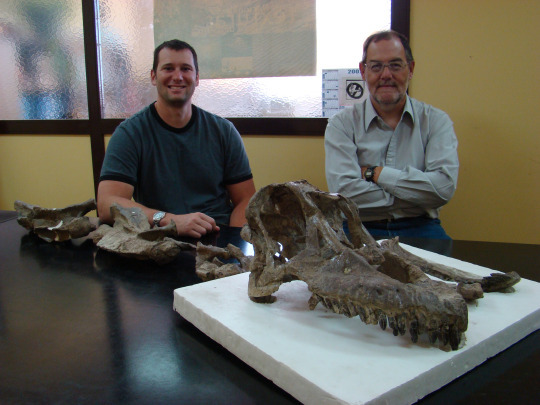
Matt and paleontologist with sarmientosaurus skull

Above: Research team members Dr. Rubén Martínez (Universidad Nacional de la Patagonia San Juan Bosco, Comodoro Rivadavia, Argentina, right), and Dr. Matt Lamanna (Carnegie Museum of Natural History, Pittsburgh, USA, left) with the skull and neck skeleton of the new titanosaurian dinosaur species Sarmientosaurus musacchioi.

Further information and resources:

http://dx.plos.org/10.1371/journal.pone.0151661
Still images, animations, and interactive 3D digital model for download (with captions and credits): https://www.dropbox.com/sh/in3tupno91h0haw/AACJmvc05hB7fk5tkeNcwgCBa?dl=0
YouTube animation of the Sarmientosaurus skull and brain endocast: https://www.youtube.com/watch?v=Zb8e5ffEC74
Interactive Sketchfab animation of the Sarmientosaurus skull: https://skfb.ly/MKOP
Interactive Sketchfab animation of the transparent Sarmientosaurus skull showing the brain endocast inside: https://skfb.ly/MKLO
Interactive Sketchfab animation of the Sarmientosaurus brain endocast: https://skfb.ly/MKKH

Filed Under: Blog Tagged With: dinosaurs, discovery, Matt Lamanna, paleontology

  • « Go to Previous Page
  • Page 1
  • Page 2
  • Page 3
  • Page 4
  • Page 5
  • Page 6
  • Go to Next Page »

sidebar

About

  • Mission & Commitments
  • Directors Team
  • Museum History

Get Involved

  • Volunteer
  • Membership
  • Carnegie Discoverers
  • Donate
  • Employment
  • Events

Bring a Group

  • Groups of 10 or More
  • Birthday Parties at the Museum
  • Field Trips

Powdermill

  • Powdermill Nature Reserve
  • Powdermill Field Trips
  • Powdermill Staff
  • Research at Powdermill

More Information

  • Image Permission Requests
  • Science Stories
  • Accessibility
  • Shopping Cart
  • Contact
  • Visitor Policies
One of the Four Carnegie Museums | © Carnegie Institute | Privacy Policy | Terms of Use | Accessibility
Rad works here logo