• Skip to primary navigation
  • Skip to main content
  • Skip to primary sidebar

Carnegie Museum of Natural History

One of the Four Carnegie Museums of Pittsburgh

  • Visit
    • Buy Tickets
    • Visitor Information
    • Exhibitions
    • Events
    • Dining at the Museum
    • Celebrate at the Museum
    • Powdermill Nature Reserve
    • Event Venue Rental
  • Learn
    • Field Trips
    • Educator Information
    • Programs at the Museum
    • Bring the Museum to You
    • Guided Programs FAQ
    • Programs Online
    • Climate and Rural Systems Partnership
  • Research
    • Scientific Sections
    • Science Stories
    • Science Videos
    • Senior Science & Research Staff
    • Museum Library
    • Science Seminars
    • Scientific Publications
    • Specimen and Artifact Identification
  • About
    • Mission & Commitments
    • Directors Team
    • Museum History
  • Tickets
  • Give
  • Shop

museums

January 2, 2019 by wpengine

Earth History in Your Hand

By Gil Oliveira

© Chart: The Conversation, CC-BY-ND

In my previous blog, I wrote about the last Jurassic World movie, which ends with the rise of a new fictional Jurassic Age, where humans and dinosaurs must learn to coexist. The Jurassic is one of the most famous geological time-periods. But when exactly was the Jurassic? The Jurassic Period ran from 200 to 145 million years ago. A long time ago… To put it into perspective, the origin of our species, Homo sapiens, dates back approximately 300 thousand years ago, which also seems a long time ago, but represents only 0.007% of the entire history of the planet (4.5 billion years)! What happened on Earth the 99.993% of the time when we did not yet even exist?

To understand earth history, natural history museums travel back through time. To do this they use a communication tool called the Geological Time Scale. In the same way we measure time with segments (such as years, months, weeks, and days), geologists subdivide deep time into useable, agreed upon units (eons, eras, periods, epochs, and ages).
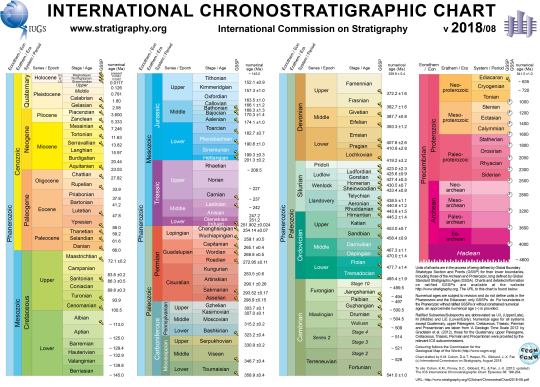
chronostratigraphic chart
© ICS: http://www.stratigraphy.org, CC BY-NC-ND

But the Geological Time Scale is not exactly a calendar, because these time intervals are not equal in length like the hours in a day. Instead, divisions are based on significant events in the history of the Earth, that are detectable in rock, fossil and ice records, such as the extinction of the dinosaurs 66 million years ago, which defines the beginning of the Cenozoic era.

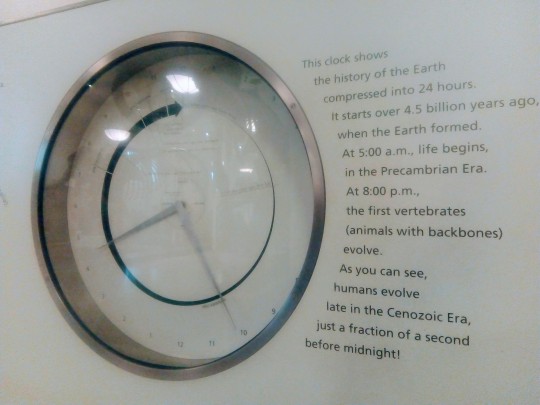
Museums don’t seek to teach the official chart of geologic time. But they seek to teach about deep time and the planet’s history, helping to put current times into a longer historical context. Museums use different techniques to make the geological time scale comprehensible. One approach is linear and usually consists of a strip of paint that represents the geological time scale rolled out on a surface. It was used for instance in the Objective Earth: Living in the Anthropocene exhibition at the Valais Nature Museum (Switzerland), which rolled out a linear poster around 30 feet long on the ground (and the wall). A second approach I have seen is more focused on aesthetics and takes the form of a spiral of time. Another technique is to take the age of the Earth and compress it into one year or one day. The American Museum of Natural History in New York used this approach with a 24-hour clock. The label indicates that life began at 5 am and the first vertebrates evolved at 8 am. As for the humans, they appeared just a fraction of a second before midnight.
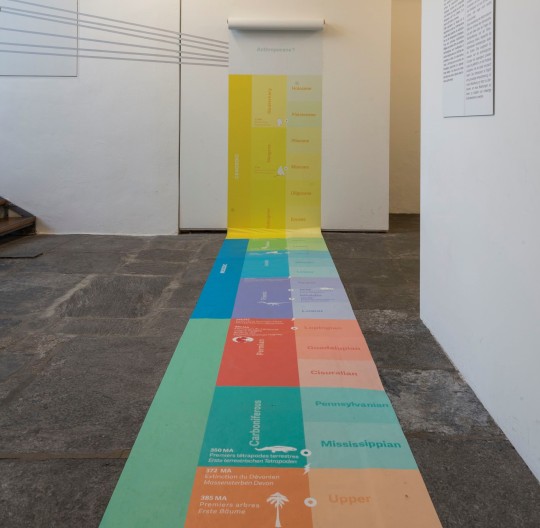
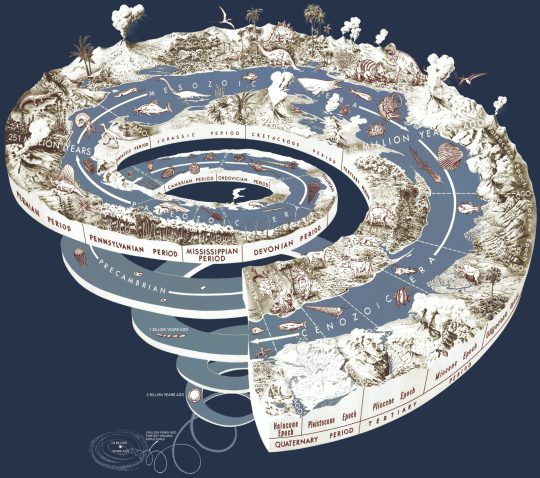
Objective Earth. Living the Anthropocene © Robert Hofer


illustration of deep time
© USGS https://pubs.usgs.gov/gip/2008/58/


clock illustrating deep time
© Gil Oliveira

Each approach has benefits and disadvantages. The Geologic Time Spiral for instance can be visually striking, but the perspective of the spiral’s depth runs the risk to lose any perception of the proportion of geological time, which is the main information. It may also give a false impression of accelerating events (geological, biological, climatic, human) as we move closer to the present.

In 2007, the Cuvier Museum in Montbeliard (France) came up with a new way to represent the geological time scale. Thierry Malvesy, now curator of Geology Collections at the museum of natural history of Neuchatel (Switzerland), did it using cubes of different volumes. The advantage is to respect the proportions of time while allowing the public to see everything at a glance. It was used to explain the principle of biological evolution, emphasizing the importance of time in the evolution of life.
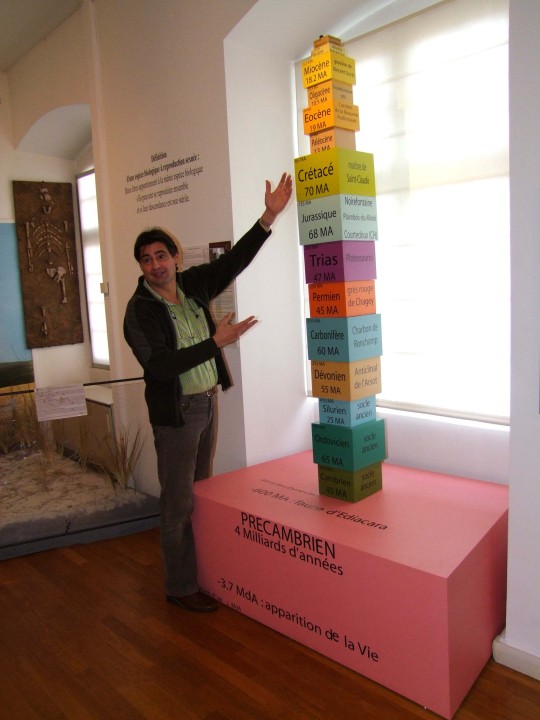
Cuvier Museum, 2007 © Thierry Malvesy

What is the best way to make the geological time scale understandable? There’s no easy answer. Each approach is a compromise in a way. The dinosaurs exhibit at the Smithsonian’s National Museum of Natural History uses both the spiral and the linear approach. This choice may only be temporary, as the new hall called The David H. Koch Hall of Fossils—Deep Time will open in less than a year. I wonder which approach they will use to help visitors connect to Earth’s distant past?
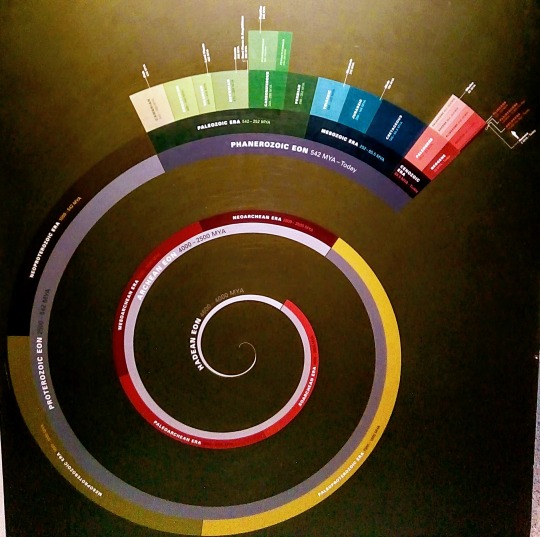
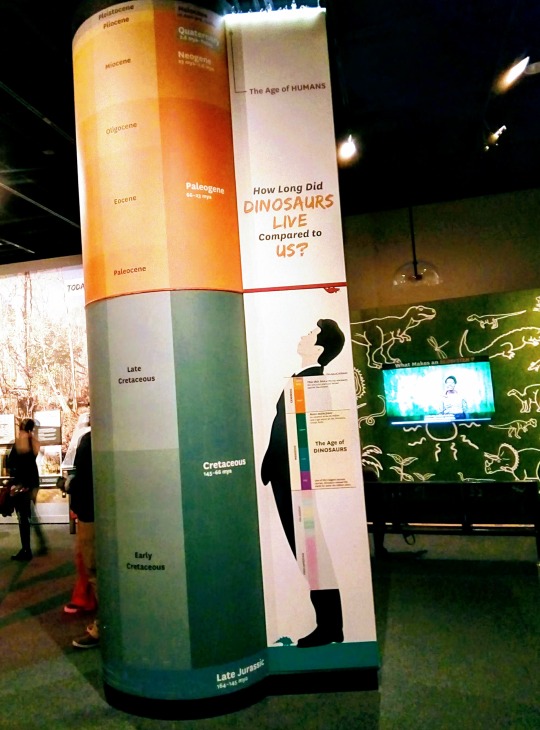
illustration of deep time
© Gil Oliveira

how long did dinosaurs live compared to us?
© Gil Oliveira


As the Carnegie Museum of Natural History is embracing the Anthropocene as a major theme for the future, it is important to place this newly proposed epoch in deep time. It is equally important for museums to find the best way to do it.

Gil Oliveira is postgraduate student working as an intern in the Section of the Anthropocene at the Carnegie Museum of Natural History. Museum employees are encouraged to blog about their unique experiences working at the museum.
Filed Under: Blog Tagged With: Anthropocene, Anthropocene Living Room, Gil Oliviera, museums

August 10, 2018 by wpengine

Mastodon Restoration

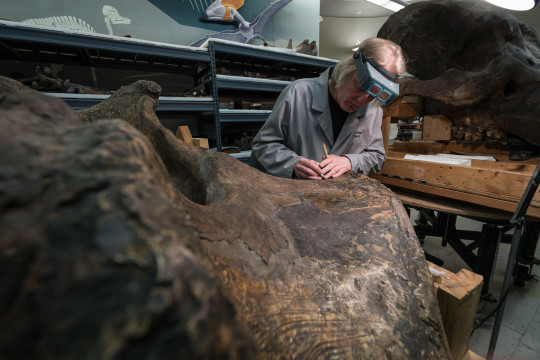
Dan Pickering working on mastodon restoration

What does a Scientific Preparator do? Part of Dan Pickering’s really cool job is carefully restoring museum specimens. In this photo he’s working on our mastodon specimen, one of Andrew Carnegie’s first acquisitions for the museum.

After having 120 years of “stuff” put on it to “preserve” it while it was on display, it needed significant restoration work.

All of this “stuff” was applied to the mastodon specimen over time:

·     Shellac

·     Varnish

·     Paint

Plus, cracks, cavities, and broken and missing areas were kept up with:

·     Plaster

·     Putty

·     Bondo

·     Glue

·     Epoxy

·     Wood

·     Chicken wire

·     Metal pins

On top of all that, soot built up on the mastodon when the museum was free and the doors were kept wide open.

Everything from shellac to soot must be removed or corrected to modern standards to restore this historically valuable specimen.

However, not all of these materials can be removed because most fossils are found as partial skeletons. When work is complete, you shouldn’t be able to see which parts are real bones and which parts were added – the skeleton should look cohesive. But if you look closely (from within five feet or so), different tones, colors, and textures will reveal real bones vs. elements added during restoration.

You can watch Dan and other Scientific Preparators at work on the mastodon in PaleoLab.

Filed Under: Blog Tagged With: Andrew Carnegie, Dan Pickering, museums, Paleolab, restoration

August 8, 2018 by wpengine

Hei-tiki Figurines

By Deborah Harding

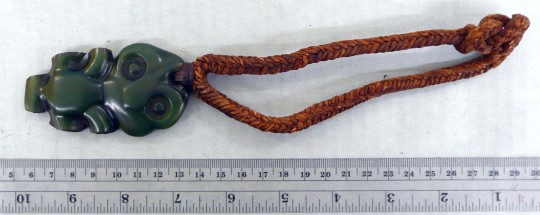
Hei-tiki figurines made by the Maori people of New Zealand have had several origins and meanings attributed to them over the years. It may refer to the First Man, Tiki; some have speculated that the curious proportions are those of an unborn child.

Tikis are carved in stone and wood, in various sizes. The hei-tikis are designed to be worn around the neck. Originally carved very laboriously from hard greenstone, modern versions are also made in plastic and other materials for the tourist trade. The eye rings were often filled with red sealing wax.

Hei-tiki figurine

Our hei-tiki came to us from the collection of Charles Spang, a manufacturer from Etna. He collected it probably in the mid-19thcentury, and his collection was later donated by his children in 1906. Unfortunately, the arms and legs are broken off.

About ten years ago, a Maori visitor to the collections remarked with surprise on the presence of the braided neck cord. Evidently it is rare to find the cord still intact. He couldn’t tell us what the fiber was, but it’s done in a 16-strand round braid.

Deborah Harding is the collection manager of the Section of Anthropology at Carnegie Museum of Natural History. Museum employees are encouraged to blog about their unique experiences and knowledge gained from working at the museum.

Filed Under: Blog Tagged With: anthropology, museums

July 10, 2018 by wpengine

Collected on This Day: Apocynum cannabinum

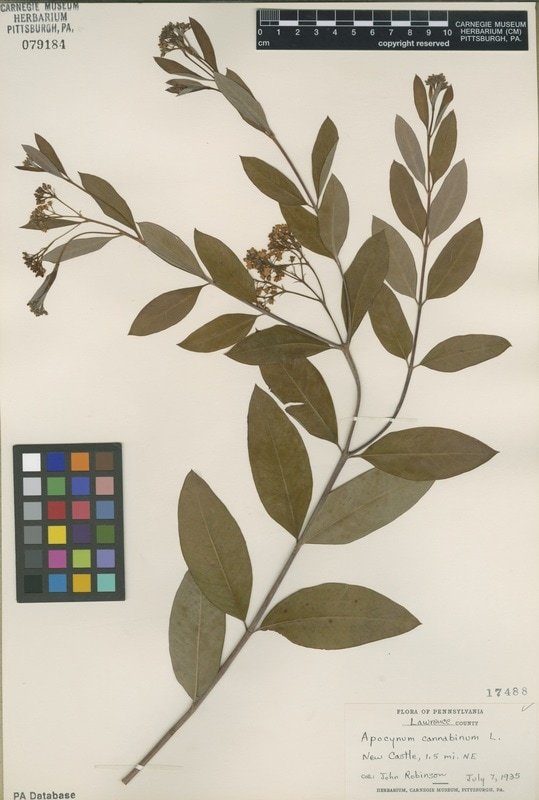
Hemp dogbane (Apocynum cannabinum) specimen

Collected on July 7, 1935, this specimen was found by John Robinson near New Castle, PA.  Hemp dogbane (Apocynum cannabinum) are important food plants for moth and butterfly larvae, and like other plants in the milkweed family, this plant is poisonous.  Its milk-like, sticky, latex sap contains cardiac glycosides that causes heart problems, rapid pulse, vomiting, and possible death.  This is especially of concern to pets and livestock, although dogbane is generally avoided. Hemp dogbane has a rich ethnobotanical history by Native Americans – its bark having been used for fiber (hence the “hemp” part of name), and roots, seeds, or leaves used for medicines to treat a wide variety of ailments. Hemp dogbane can be found in sparely wooded areas, ditches, and field edges across United States.

Botanists at Carnegie Museum of Natural History share pieces of the herbarium’s historical hidden collection on the dates they were discovered or collected. Check back for more!

Mason Heberling is Associate Curator of Botany at Carnegie Museum of Natural History.

Carnegie Museum of Natural History Blog Citation Information

Blog author: Heberling, Mason
Publication date: July 6, 2017

Share this post!

  • Share on Twitter Share on Twitter
  • Share on Facebook Share on Facebook
  • Share on Pinterest Share on Pinterest
  • Share on LinkedIn Share on LinkedIn
  • Share on Reddit Share on Reddit
  • Share via Email Share via Email

Filed Under: Blog Tagged With: Botany, collected on this day, herbarium, Mason Heberling, museums, plants

May 14, 2018 by wpengine

From Nebraska or Bust, a Truck load of Mollusks

By Tim Pearce, Curator of Collections, Section of Mollusks

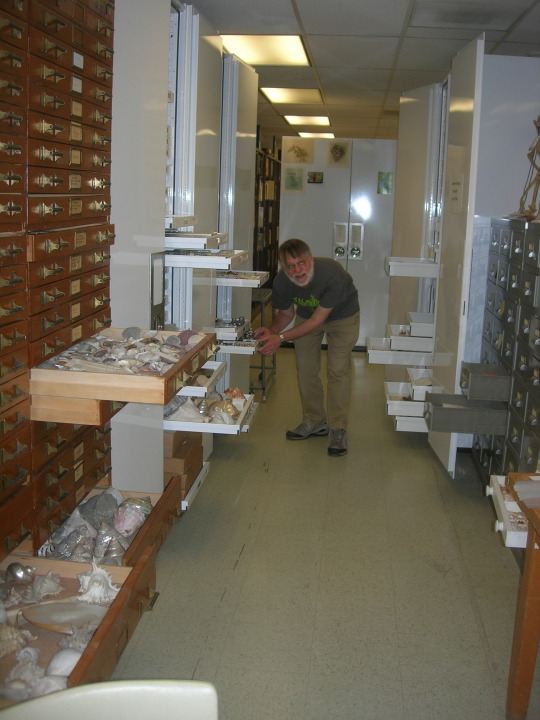
A rare opportunity for Carnegie Museum of Natural History occurred in early May when we adopted an extensive mollusk collection.  Although the mollusk specimens had been well cared for, their existence at the Nebraska State Museum, University of Nebraska, was little known to mollusk researchers over the past 100 years, so they were seldom used. The curator recognized that for the foreseeable future, the museum will have priorities other than mollusks, so would not have resources to properly work up the collection. I was very excited when he contacted me about the possibility of transferring the collection to Carnegie Museum. At Carnegie Museum, we have the expertise to identify, update names, catalog, and make the information available on the internet, so it will be available to researchers around the world.

The collection has an excellent collection of freshwater mussels. Carnegie Museum had four lots of freshwater mussels from Nebraska, now we have more than 158 lots. Also included are many marine and terrestrial mollusks from pre-Castro Cuba, and most of the collection is pre-1929.

Carefully packing the collection into 60 boxes took two of us seven days. We are very grateful to the kindness and generosity of the museum director and curator for lodging us and providing access to the collection, even over the weekend.

We drove the collection to Pittsburgh in a rental truck. Given that I consider each shell to be as valuable as a Picasso, every time we hit a bump, I thought, “Oh, my poor Picassos.”

As we drove, we recalled the odd black leather case about 2 by 3.5 inches in size that we came across tucked away at the back of a drawer in the mollusk collection. Inside the case, we found a shell, a cone shell to be exact, and a small carefully folded paper wedged beside the shell. The unfolded paper was a letter dated July 23, 1938, which read, “Sirs, 30 years ago I stole this shell. Have had pecks of bad luck. Am returning the shell and hope the bad luck will end.” The letter was signed with the man’s first and last name, and his address.

What was going on in his life in 1908 that prompted him to steal the shell? When did he make the connection between the theft of the shell and bad luck (that comes in pecks)? Did his luck improve after the return of the shell? We can only wonder.

The shell and the intriguing letter in their case continue to reside with the museum in Nebraska as part of the historical record; I consider it to be a priceless artifact.

Timothy A. Pearce, PhD, is the head of the mollusks section at Carnegie Museum of Natural History. Museum employees are encouraged to blog about their unique experiences and knowledge gained from working at the museum.

Filed Under: Blog Tagged With: mollusks, museums, Tim Pearce

November 16, 2016 by wpengine

Where to Look for Fossils

Amy Henrici
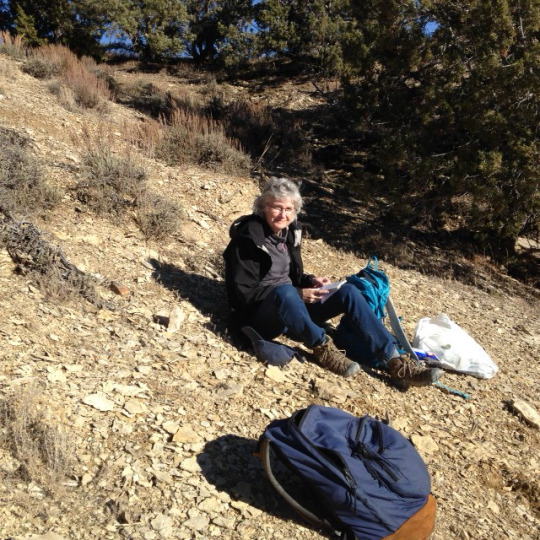
Vertebrate Paleontology Collections Manager Amy Henrici in the field.

As I travelled west from Pittsburgh to meet Carnegie Museum of Natural Hisotry Vertebrate Fossil Collection Manager Amy Henrici for a frog fossil hunting expedition in eastern Nevada, the same question was asked by each of my airplane seat mates.

“How do you know where to look for fossils?“

For the sites we planned to visit the answer was simple. Earlier written reports by geologists mapping rock formations and mineral deposits noted the occasion occurrence of fossils in certain rock layers.

Fossil searches involved locating and visiting sites where such rock layers are exposed on the surface, and then examining fragments that have eroded from these outcrops.The full process, which might stretch over decades, is an example of how published findings allow one branch of science to serve another.

As a geologist friend takes great pleasure in explaining, “Geologists let paleontologists know where fossils are in the multitude rock layers of Earth’s history, in time and in place.”


Patrick McShea is a museum educator who is traveling through Nevada with Vertebrate Paleontology Collections Manager Amy Henrici to search for frog fossils. He frequently blogs about his experiences.

Filed Under: Blog Tagged With: Amy Henrici, expedition, fossils, frogs, geology, museums, paleontology

  • Page 1
  • Page 2
  • Page 3
  • Interim pages omitted …
  • Page 7
  • Go to Next Page »

sidebar

About

  • Mission & Commitments
  • Directors Team
  • Museum History

Get Involved

  • Volunteer
  • Membership
  • Carnegie Discoverers
  • Donate
  • Employment
  • Events

Bring a Group

  • Groups of 10 or More
  • Birthday Parties at the Museum
  • Field Trips

Powdermill

  • Powdermill Nature Reserve
  • Powdermill Field Trips
  • Powdermill Staff
  • Research at Powdermill

More Information

  • Image Permission Requests
  • Science Stories
  • Accessibility
  • Shopping Cart
  • Contact
  • Visitor Policies
One of the Four Carnegie Museums | © Carnegie Institute | Privacy Policy | Terms of Use | Accessibility
Rad works here logo