• Skip to primary navigation
  • Skip to main content
  • Skip to primary sidebar

Carnegie Museum of Natural History

One of the Four Carnegie Museums of Pittsburgh

  • Visit
    • Buy Tickets
    • Visitor Information
    • Exhibitions
    • Events
    • Dining at the Museum
    • Celebrate at the Museum
    • Powdermill Nature Reserve
    • Event Venue Rental
  • Learn
    • Field Trips
    • Educator Information
    • Programs at the Museum
    • Bring the Museum to You
    • Guided Programs FAQ
    • Programs Online
    • Climate and Rural Systems Partnership
  • Research
    • Scientific Sections
    • Science Stories
    • Science Videos
    • Senior Science & Research Staff
    • Museum Library
    • Science Seminars
    • Scientific Publications
    • Specimen and Artifact Identification
  • About
    • Mission & Commitments
    • Directors Team
    • Museum History
  • Tickets
  • Give
  • Shop

parc

October 5, 2017 by wpengine

Hummingbird Bands

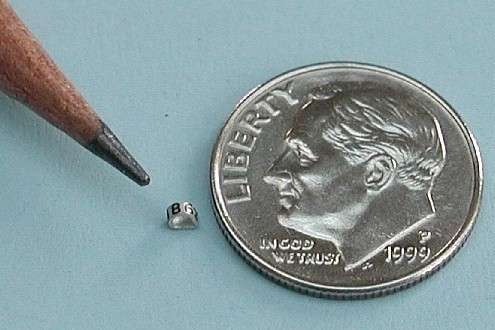
tiny hummingbird band similar in size to the point of a pencil

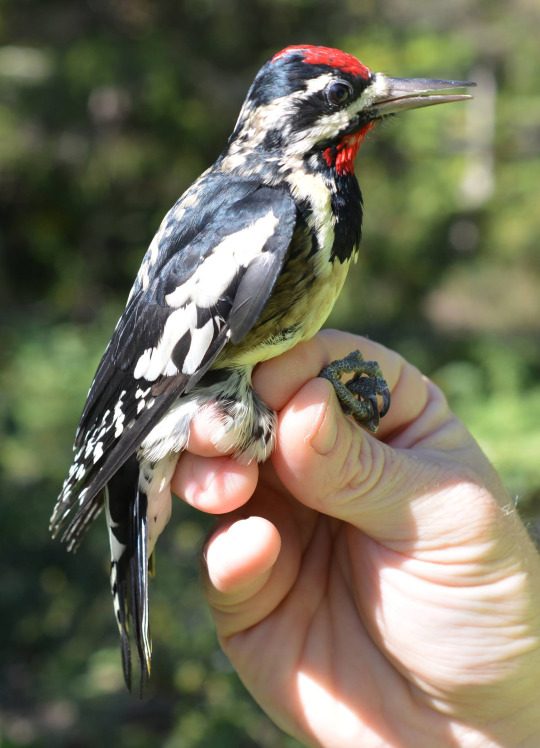
At Powdermilll Nature Reserve, researchers use different sized bands for different sized birds, which helps them track the movement and lifespan of populations.

The band pictured above is a hummingbird band. It is so small that the customary nine-digit band number is reduced to five digits with a letter prefix.


Powdermill Nature Reserve’s avian research center is part of Carnegie Museum of Natural History’s biological research station in Rector, Pennsylvania.  The research center operates a bird banding station, conducts bioacoustical research, and performs flight tunnel analysis with the goal of reducing window collisions.
Filed Under: Blog Tagged With: bird banding, Birds, parc, Powdermill Nature Reserve

October 5, 2017 by wpengine

1,400 Miles in Three Weeks

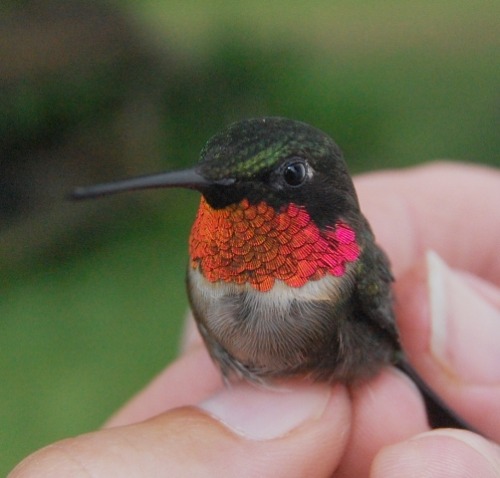
hummingbird with a bright red throat and black head

We received word this spring from the National Banding Lab that a young male ruby-throated hummingbird banded at Powdermill Nature Reserve on September 18, 2014 was recaptured three weeks later (October 10) in Lake Jackson, Texas.

A journey of 1,425 miles in three weeks is pretty astounding when one considers that this male weighed in at just 3.5 grams, not much more than a penny. His wings measured 42 mm (a little over 1.5″).

The hummingbird’s wing beat has been measured at 50 times per second. Now we’re not sure exactly when he left our banding area or if he was caught the day he arrived in Texas, but if he used every day in the interval to fly south, he would have averaged 65 miles per day. Pretty impressive!

Once the data was collected in Texas, the bird was released and probably spent a few days fattening up for the next leg of its migration—a nonstop crossing of the Gulf of Mexico!


Powdermill Nature Reserve’s avian research center is part of Carnegie Museum of Natural History’s biological research station in Rector, Pennsylvania.  The research center operates a bird banding station, conducts bioacoustical research, and performs flight tunnel analysis with the goal of reducing window collisions.
Filed Under: Blog Tagged With: bird, parc, Powdermill

August 18, 2017 by wpengine

Some Breeding Birds Adjust to Local Climate Warming

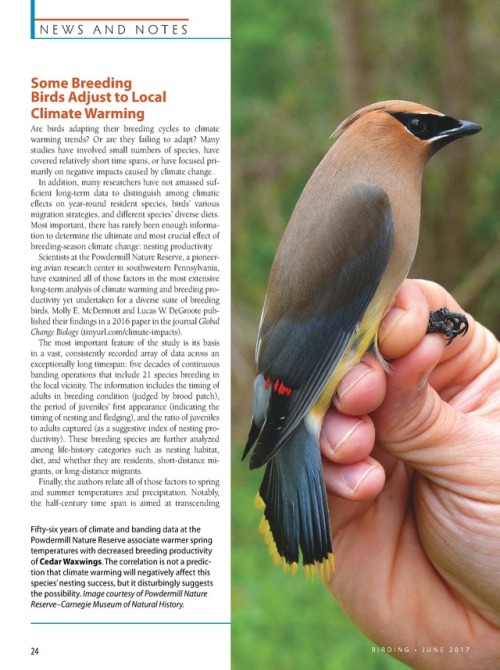
First page of the article in Birding Magazine

Birding magazine recently featured the research of Luke DeGroote, the avian research coordinator at Carnegie Museum of Natural History’s environmental research center Powdermill Nature Reserve. Check out the June 2017 issue for the full article.

Filed Under: Blog Tagged With: Birds, Luke DeGroote, parc, Powdermill Nature Reserve

July 10, 2017 by wpengine

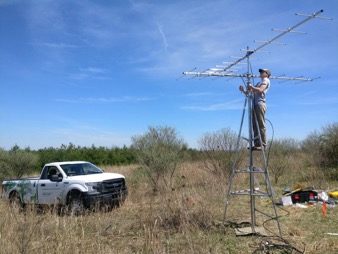
Powdermill Antennae Helps Track Migration

Antenna being put up in a field


by Scott Pruden

Ever wonder where birds and butterflies go on those long, seasonal migratory journeys? So do scientists, and the installation of several new antennae at Powdermill Nature Reserve will help them find out.

The three arrays are part of the Motus Wildlife Tracking System. Motus (which is Latin for “movement”) is an international collaborative research network that tracks small flying organisms, like birds, butterflies, and bats, that have been fitted with digitally encoded radio transmitters.

These “nano-tags” broadcast intermittent radio signals, which the antennae scan for and detect. Scientists use the data collected to track the migration patterns of tagged animals. The network includes more than 350 receiving stations throughout Canada, the United States, Mexico, Central America, South America, and the Caribbean.

Data from 2016 shows that about 40 percent of nano-tagged tagged birds are tracked using Motus, compared with about one in a thousand birds tagged with leg bands.

Powdermill Avian Research Center is located near Rector, Pennsylvania, at Powdermill Nature Reserve, the environmental research center of the Carnegie Museum of Natural History, and is one of the longest continuously operating bird banding stations in the United States.

Powdermill Reserve, which encompasses 2,200 acres of ponds, streams, woodlands, open fields, and thickets, allows scientists to monitor and study changes in the local ecology and wildlife populations. The reserve is home to a wide variety of plants and animals facing habitat destruction in the region.

Installation of the Motus antennae is supported by a grant from the Richard King Mellon Foundation, which helps support conservation efforts in southwestern Pennsylvania and throughout the United States.

Filed Under: Blog Tagged With: parc

October 24, 2016 by wpengine

Fall Bird Banding at Powdermill

bird banding at Powdermill Nature Reserve

Fall is an exciting and busy time for our avian researchers at Powdermill Nature Reserve, Carnegie Museum of Natural History’s environmental research center in Rector Pennsylvania.

As birds migrate south, thousands fly through Powdermill, where they are identified, banded, and studied before they continue their long journey to their winter nesting grounds.

Researchers band anything from worm-eating Warblers to brightly colored purple finches in their nets each year.

This fall alone, more than 4,000 birds representing 150+ species have been studied and banded since September. Researchers catch the birds in specially designed mist nets that are cast each morning before dawn. Caught birds are carefully transported to a banding station, where they are identified, measured, and given a small band issued through the US Geological Survey.  Bands provide information for other researchers and don’t affect the birds flight, nesting, or eating habits.

Above all else, the well being of every bird is Powdermill’s top priority at all times. The entire banding process takes less than a minute, and the vast majority of birds are actually quite calm during their short visit at the banding station.

But why band birds at all?

The fundamental goal of bird banding has always been to record the age, sex, wing length, fat deposits, and body mass of captured species as a way of monitoring, year to year, how avian populations are faring in the wild.

Banding gives us insight into many things like the life cycles and longevity of birds, habitat use, and how disease and environmental toxins are affecting wild bird populations.

Want to learn more? You can see monthly and annual banding summaries online or follow Powdermill Nature Reserve on Facebook for weekly updates and stunning pictures.

Filed Under: Blog Tagged With: avian research, bird banding, Birds, nature, parc, Powdermill, research

  • « Go to Previous Page
  • Page 1
  • Page 2
  • Page 3
  • Page 4

sidebar

About

  • Mission & Commitments
  • Directors Team
  • Museum History

Get Involved

  • Volunteer
  • Membership
  • Carnegie Discoverers
  • Donate
  • Employment
  • Events

Bring a Group

  • Groups of 10 or More
  • Birthday Parties at the Museum
  • Field Trips

Powdermill

  • Powdermill Nature Reserve
  • Powdermill Field Trips
  • Powdermill Staff
  • Research at Powdermill

More Information

  • Image Permission Requests
  • Science Stories
  • Accessibility
  • Shopping Cart
  • Contact
  • Visitor Policies
One of the Four Carnegie Museums | © Carnegie Institute | Privacy Policy | Terms of Use | Accessibility
Rad works here logo