• Skip to primary navigation
  • Skip to main content
  • Skip to primary sidebar

Carnegie Museum of Natural History

One of the Four Carnegie Museums of Pittsburgh

  • Visit
    • Buy Tickets
    • Visitor Information
    • Exhibitions
    • Events
    • Dining at the Museum
    • Celebrate at the Museum
    • Powdermill Nature Reserve
    • Event Venue Rental
  • Learn
    • Field Trips
    • Educator Information
    • Programs at the Museum
    • Bring the Museum to You
    • Guided Programs FAQ
    • Programs Online
    • Climate and Rural Systems Partnership
  • Research
    • Scientific Sections
    • Science Stories
    • Science Videos
    • Senior Science & Research Staff
    • Museum Library
    • Science Seminars
    • Scientific Publications
    • Specimen and Artifact Identification
  • About
    • Mission & Commitments
    • Directors Team
    • Museum History
  • Tickets
  • Give
  • Shop

Patrick McShea

July 2, 2020 by wpengine

Mystery Spit

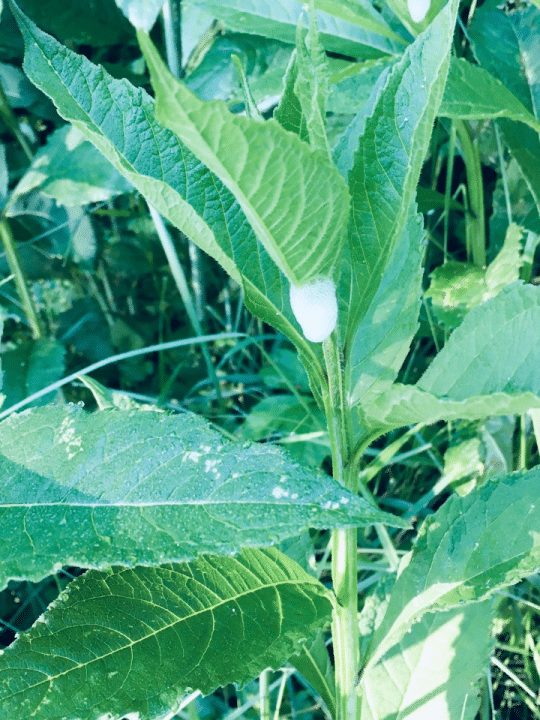
spittlebug froth on a leaf
Spittlebug froth on the stalk and leaf stem of a sneezeweed plant.

You’ve likely noticed the stuff at this time of year even if you didn’t have a ready name for it – grape-sized globs of frothy white foam on all kinds of plant stems.

The bubbles are made by the nymph stage of a large group of insects known commonly as frog hoppers, and scientifically as members of the widespread insect superfamily Cercopoidea.

Because the activity of the nymphs is so noticeable, they’ve earned their own common name – spittlebugs.
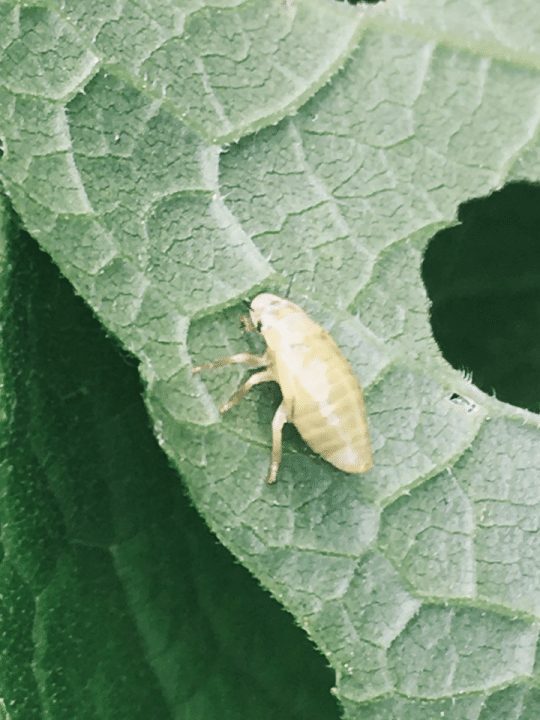
spittlebug on a leaf
A spittlebug temporarily removed from its frothy shelter.

The nymphs, which hatch in the spring from eggs laid the previous summer, are sap drinkers. They pierce plant stems to access the juices produced by the growing plant, drink deeply, and after processing vital nutrients, turn their waste stream into a protective shelter. Although spittlebug froth visually resembles spit, it contains no saliva. The bubbles are mixture of the tiny creature’s urine and a sticky fluid produced in an abdominal gland.

The frothy layer keeps the soft-bodied insects from drying out and it also serves as a predator barrier. Because spittlebugs produce urine in amounts more than 150 times their own body weight, their bubbly shelters generally offer ample protection.

Research about spittlebugs has been conducted at University of British Columbia. Information about this research, including a short video narrated by New York Times Science Writer James Gorman can be found at:  https://www.nytimes.com/2019/02/19/science/spittlebugs-bubble-home.html

Patrick McShea works in the Education and Visitor Experience department of Carnegie Museum of Natural History. Museum employees are encouraged to blog about their unique experiences and knowledge gained from working at the museum.
Related Content

Is That Snow…in June?

Fourth of July and the Firefly

Educator Spotlight: Christian Shane

Filed Under: Blog Tagged With: Education, Museum from Home, Pat McShea, Patrick McShea

June 18, 2020 by wpengine

Eastern Garter Snake Encounter

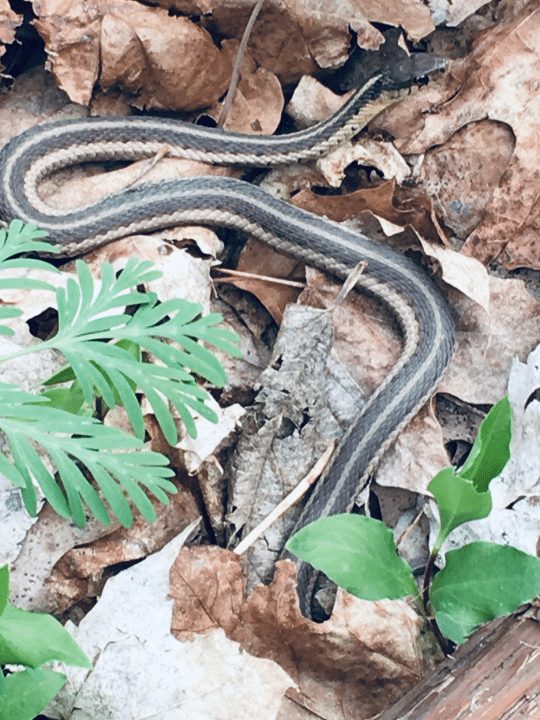
photo of garter snake in leaves

The eastern garter snake never moved. I only noticed the harmless reptile because my hands were within inches of its sleek body as I crouched to photograph a large-flowered trillium. The image above is a result of an abrupt subject change, but rushing wasn’t necessary. I was later able to photograph the intended wildflower without disturbing its striped neighbor.

After perhaps 90 seconds of sharing space with the snake, I backed carefully away from the blooming patch of forest understory within the Allegheny Land Trust’s Barking Slopes Natural Area. Later that day, in the pages of a trusted reference book, I found an explanation for what seemed an unusually passive predator.

Amphibians and Reptiles of Pennsylvania and the Northeast, is a Cornell University Press publication from 2001 by three authors with deep ties to CMNH, Arthur C. Hulse, long a Research Associate for the Museum’s Section of Herpetology, the late C. J. McCoy, a curator within the Section between 1964 and 1993, and Ellen J. Censky, a curator within the Section between 1994 and 1998.

The 5 pages of the 400-page volume devoted to garter snakes includes a description of the snake’s wide range of reactions to close encounters with our species.

“At one extreme, some remain fairly quiescent and allow themselves to be picked up and will not attempt any defensive behavior. At the other extreme, individuals flatten the head and body, flare the lips to expose teeth, and strike violently.”

The authors cite research indicating that young garter snakes are more aggressive after eating a large meal, a behavior that might occur because recently ingested food reduces their mobility, and therefore their chances for successful escape.

By this line of reasoning, the docile creature I encountered might simply have been hungry.

Patrick McShea works in the Education and Visitor Experience department of Carnegie Museum of Natural History. Museum employees are encouraged to blog about their unique experiences and knowledge gained from working at the museum.
Related Content

Northern Ribbon Snake

Lost and Found

Flying Snakes? Unique Reptile Adaptations

Filed Under: Blog Tagged With: Education, Educators, herpetology, Museum from Home, Pat McShea, Patrick McShea

May 29, 2020 by wpengine

Educator Spotlight: Christian Shane

In mid-March, like every teacher who suddenly found work and home life disrupted by Covid-19 related school closings, Christian Shane was concerned about his students. During the earliest days of sheltering restrictions, however, the science teacher from North Allegheny School District’s Ingomar Middle School was also worried about fish.

Christian and his seventh-grade students participate in Trout in the Classroom, an inter-disciplinary program made possible by a unique partnership between the Pennsylvania Council of Trout Unlimited and the Pennsylvania Fish and Boat Commission. A 55-gallon tank in Christian’s classroom held some 200 fingerling rainbow trout, fish raised from eggs since November, and destined for eventual release in designated stocked trout waters.

The release occurred far earlier than planned, and without any student participation. “When the school closed, teachers were instructed not to enter the building,” Christian explained, “but a custodian called that very first Saturday and said I’d better come get the fish.”

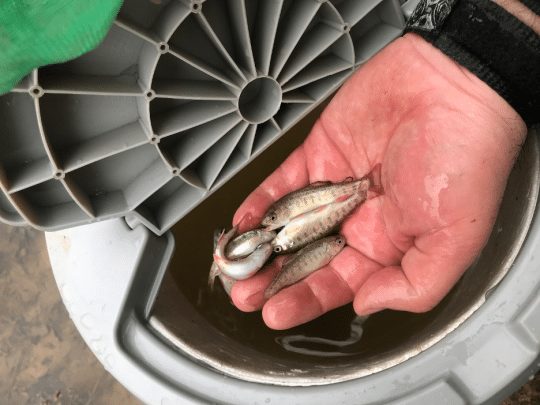
Fingerling trout on the early release date. A video of the release was shared with students.

I learned of the rescue and release weeks afterward when I called Christian to ask if his home-based lessons involved any of the mammal skulls he borrowed from the Museum’s loan program in early March. The skulls were secure in his classroom, Christian reported, but the first-hand learning experiences the specimens provided for students before the school closure proved to be vitally important during later home bound instruction. “I’ve been trying to get the students outside. Whatever the size of their yard, I want them to notice things where they live that relate to what we’re covering in our remote lessons.”

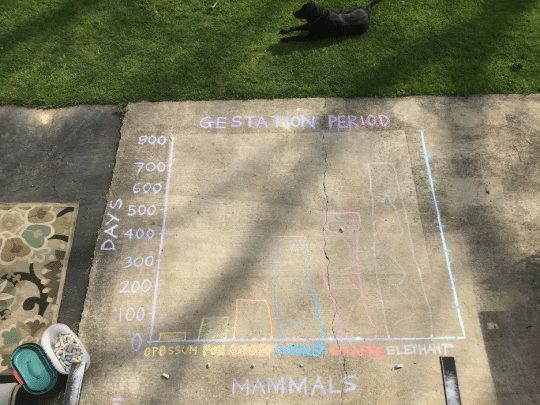
A teach-from-home innovation: Christian Shane created a driveway graph of mammal gestation periods.

According Christian, in a semester where teaching goals progressed from understanding the structures and processes of organisms to fuller comprehension of the roles of organisms in ecosystems, being able to make detailed observations of something as common as fern or a blooming violet was vitally important. “Students took two weeks to acclimate to the new conditions, but I’m confident they’ve learned a lot this spring.”

No doubt an innovative teacher had something to do with that progress.

Patrick McShea works in the Education and Visitor Experience department of Carnegie Museum of Natural History. Museum employees are encouraged to blog about their unique experiences and knowledge gained from working at the museum.
Filed Under: Blog Tagged With: Education, Educator Loan Program, Pat McShea, Patrick McShea

May 26, 2020 by wpengine

South American Hippo Habitat

two South American hippo toys

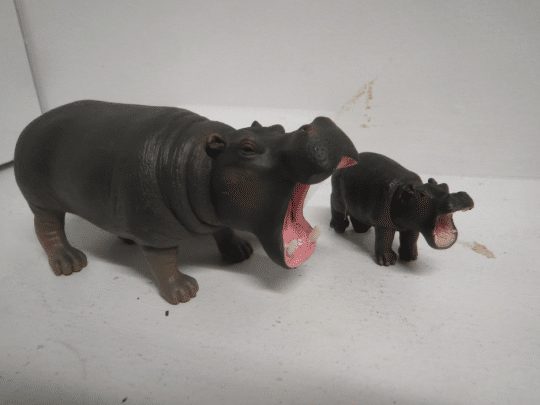
In the wake the groundbreaking exhibition, We Are Nature, museum educators increasingly recognize opportunities for existing exhibits to foster discussions of profound human impacts. Because of a recent research study published in Proceedings of the National Academy of Science, even these sturdy plastic components of the African Wildlife Play Table (above) can spark wide ranging discussions about the impacts of large animal relocations.

The research paper Introduced herbivores restore Late Pleistocene ecological functions, by ecologist Erick Lundgren (University of Technology, Sydney, Australia) and ten co-authors, documents the establishment and growth of a hippo population along a section of Columbia’s Magdalena River over the past three decades. The founding members of a population now estimated to include as many as 80 individuals were four hippos, three females and one male, acquired during the 1980s by notorious drug lord Pablo Escobar for a private zoo on his estate.

According to researchers, the population of Magdalena River hippos could grow to between 800 and 5,000 animals by the year 2050.

For a summary of the research and its implications by The New York Times science writer Asher Elbein, please visit “Pablo Escobar’s Hippos Fill a Hole Left Since Ice Age Extinctions.”

Patrick McShea works in the Education and Visitor Experience department of Carnegie Museum of Natural History. Museum employees are encouraged to blog about their unique experiences and knowledge gained from working at the museum.
Filed Under: Blog Tagged With: Anthropocene Living Room, Anthropocene Studies, Education, Educators, mammals, Museum from Home, Pat McShea, Patrick McShea

April 29, 2020 by wpengine

Lost and Found

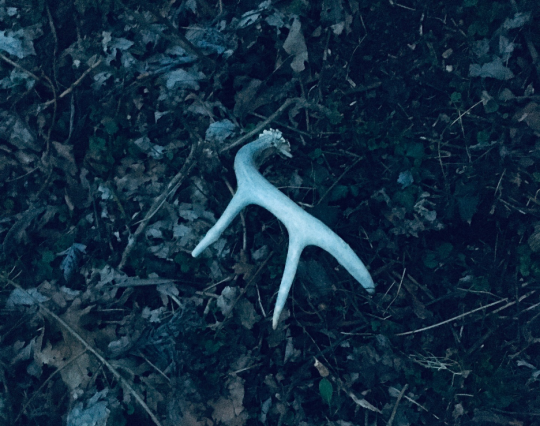
In the darkening woods of an early spring evening, the deer antler practically glowed. After retrieving and examining the bone-like left-side appendage, I walked a wide circle within my neighbor’s wooded property hoping to spot a matching right-side antler.

Male deer grow and shed antlers annually, a process driven by changes in daylight, and controlled, like so many biological operations, by the chemical signals of hormones. Antler to skull connections are solid during the breeding season but dropping testosterone levels eventually weaken the link. Because white-tailed deer bucks in our region frequently shed antlers by mid-January, my multi-point find might well have spent ten weeks on the ground.

As a museum educator I appreciate the potential of antlers as teaching tools. Science teachers often borrow sets of them to illustrate lessons about sexual selection in evolution, and in Discovery Basecamp, the museum’s object-centered learning center, visitors frequently pose for pictures holding white-tailed deer antlers just above their own ears.

The specimen pictured above has been put to a different use. It currently rests on the ground amidst a tangle of wild grapevine near where I originally found it. The location is a place where I can occasionally check the rate at which various rodents gnaw on the antler, and thereby recycle much of its calcium into the same system it was briefly pulled from.

Patrick McShea works in the Education and Visitor Experience department of Carnegie Museum of Natural History. Museum employees are encouraged to blog about their unique experiences and knowledge gained from working at the museum.
Filed Under: Blog Tagged With: Education, Museum from Home, Patrick McShea

April 2, 2020 by wpengine

Rabbit Bone Reward

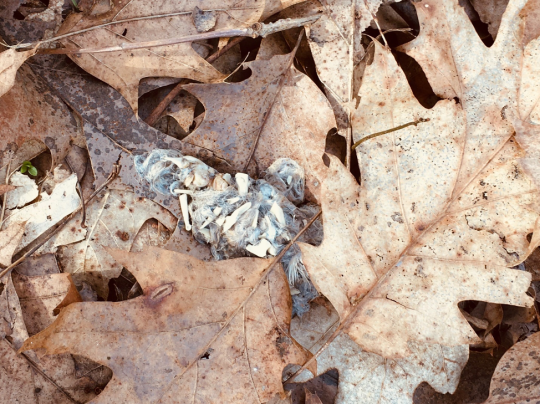
During a mid-March search for a great horned owl nest in an Allegheny County park, a loose jumble of rabbit bones and fur served as a consolation prize. On a mile-long hike that lacked a definitive owl sighting, the rabbit remains were at least evidence of the big winged predator’s recent presence.

Owls swallow their prey whole or in large chunks. After chemical processing within an owl’s stomach separates digestible tissue from bones, teeth, fur, and feathers, these indigestible elements are compressed into a pellet and coughed-up.

The rain-dissected pellet rested on an oak-leaf cushion directly below a 12-foot high trail-crossing branch that might well have been the owl’s cough-up perch.  As I imagined a well-fed owl occupying the perch, I recalled a challenge distilled through the wide-ranging conversations of the museum’s recent 21st Century Naturalist Project: How can all who utilize natural history collections routinely summon the imagination necessary to link individual specimens with the environments that once sustained them?

The energy flow represented just by the tiny bundle of white bone and blue-gray fur, for example, ran back in time to the rabbit and all the plant growth that nourished it, and infinitely forward to an owl then incubating eggs of another generation on a hidden nest.

For more information about owl pellets please visit:

https://www.allaboutbirds.org/news/what-are-owl-pellets

Patrick McShea works in the Education and Visitor Experience department of Carnegie Museum of Natural History. Museum employees are encouraged to blog about their unique experiences and knowledge gained from working at the museum.

Filed Under: Blog Tagged With: Education, Museum from Home, Patrick McShea

  • « Go to Previous Page
  • Page 1
  • Page 2
  • Page 3
  • Page 4
  • Interim pages omitted …
  • Page 9
  • Go to Next Page »

sidebar

About

  • Mission & Commitments
  • Directors Team
  • Museum History

Get Involved

  • Volunteer
  • Membership
  • Carnegie Discoverers
  • Donate
  • Employment
  • Events

Bring a Group

  • Groups of 10 or More
  • Birthday Parties at the Museum
  • Field Trips

Powdermill

  • Powdermill Nature Reserve
  • Powdermill Field Trips
  • Powdermill Staff
  • Research at Powdermill

More Information

  • Image Permission Requests
  • Science Stories
  • Accessibility
  • Shopping Cart
  • Contact
  • Visitor Policies
One of the Four Carnegie Museums | © Carnegie Institute | Privacy Policy | Terms of Use | Accessibility
Rad works here logo