• Skip to primary navigation
  • Skip to main content
  • Skip to primary sidebar

Carnegie Museum of Natural History

One of the Four Carnegie Museums of Pittsburgh

  • Visit
    • Buy Tickets
    • Visitor Information
    • Exhibitions
    • Events
    • Dining at the Museum
    • Celebrate at the Museum
    • Powdermill Nature Reserve
    • Event Venue Rental
  • Learn
    • Field Trips
    • Educator Information
    • Programs at the Museum
    • Bring the Museum to You
    • Guided Programs FAQ
    • Programs Online
    • Climate and Rural Systems Partnership
  • Research
    • Scientific Sections
    • Science Stories
    • Science Videos
    • Senior Science & Research Staff
    • Museum Library
    • Science Seminars
    • Scientific Publications
    • Specimen and Artifact Identification
  • About
    • Mission & Commitments
    • Directors Team
    • Museum History
  • Tickets
  • Give
  • Shop

Patrick McShea

June 19, 2019 by wpengine

Harriet Tubman Was a Naturalist

statue of Harriet Tubman
Photo Credit: Maryland Department of Natural Resources

Last fall, when Akiima Price spoke to museum staff and visitors as part of the R.W. Moriarty Science Seminar series, the renowned environmental educator discussed the potential and the challenges of using nature-based experiences to help heal economically stressed families and communities.

The one-time National Park Service Ranger advised anyone who hoped to model her efforts to look for connections between seemingly disparate groups, topics, and situations. When Akiima invoked Harriet Tubman as a mentor, she helped identify a connection between the 19th Century historic figure and existing museum educational materials.
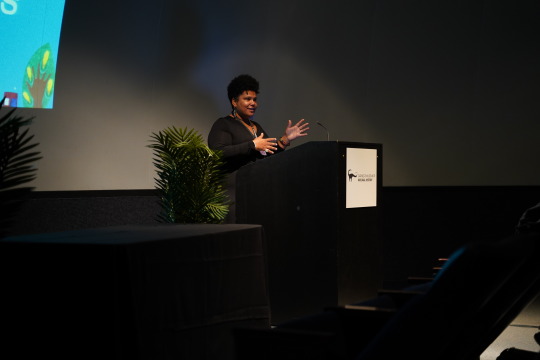
Akiima Price speaking at Carnegie Museum of Natural History.

“Harriet Tubman was a naturalist!” Akiima stated. “She had to be!” A summary of Tubman’s most celebrated accomplishments followed – her escape from slavery in 1849, and her work over the next decade planning and guiding the successful escapes of dozens of other slaves. As Akiima explained, those multi-day journeys, across marshes and through forests, implied a deep working knowledge of tides, seasons, weather, wildlife, and plants.

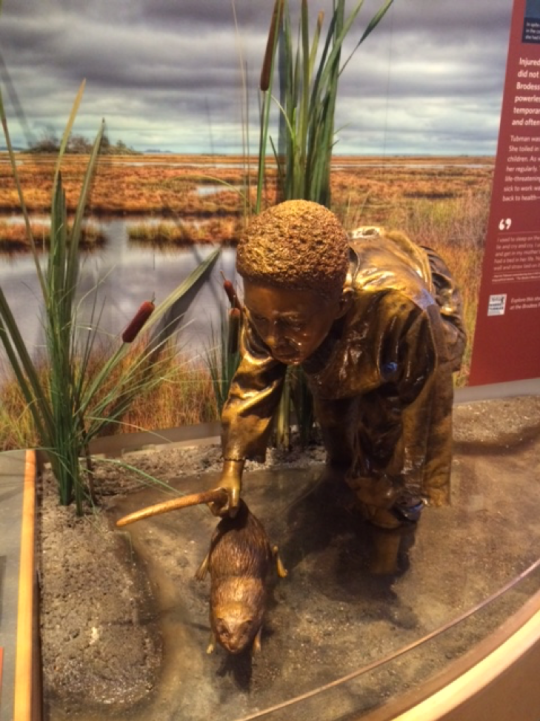
The testimony led me to read more about Harriet Tubman and her success as a “conductor” on the Underground Railroad. Her understanding of the landscape apparently began at an early age. Several accounts mentioned how Tubman’s slave labor as a child on a tidewater Maryland farm included trapping muskrats in adjacent marshes, work performed barefoot, even in freezing weather.
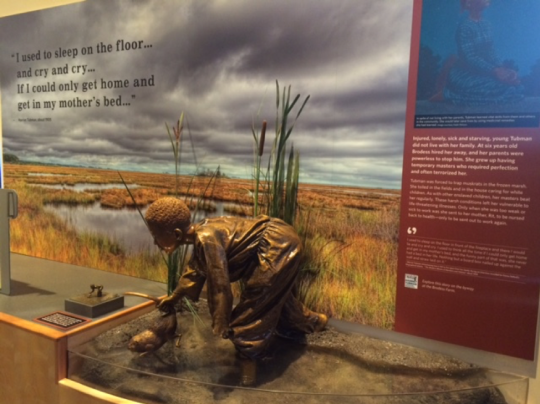
museum exhibit featuring Harriet Tubman
Photo Credit: Maryland Department of Natural Resources

For the past two years, this forced work has been memorialized in a life-sized bronze sculpture within the Visitor Center of the Harriet Tubman Underground Railroad National Historic Park in Church Creek, Maryland.

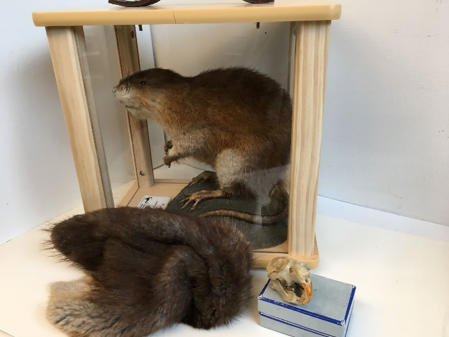
At Carnegie Museum of Natural History, a picture of the sculpture, along with information about Tubman and the park that commemorates her heroic accomplishments, now reside within the Muskrat Box of Educator Loan Collection. The additions do not diminish the unit’s traditional use. The muskrat taxidermy mount, skull, and pelt continue to help teachers present more effective lessons about mammal adaptations and wetland ecology. The new materials simply add an American history facet, a connection to a fearless woman’s struggle against the slavery system she was born into.
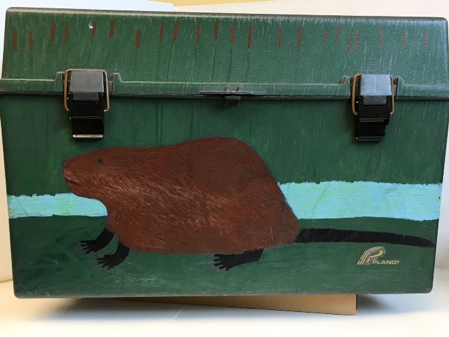
toolbox with muskrat painted on it
Muskrat taxidermy, skull, and pelt
Muskrat box and contents

Patrick McShea works in the Education and Visitor Experience department of Carnegie Museum of Natural History. Museum employees are encouraged to blog about their unique experiences and knowledge gained from working at the museum.
Filed Under: Blog Tagged With: Educator Loan Program, Pat McShea, Patrick McShea

June 12, 2019 by wpengine

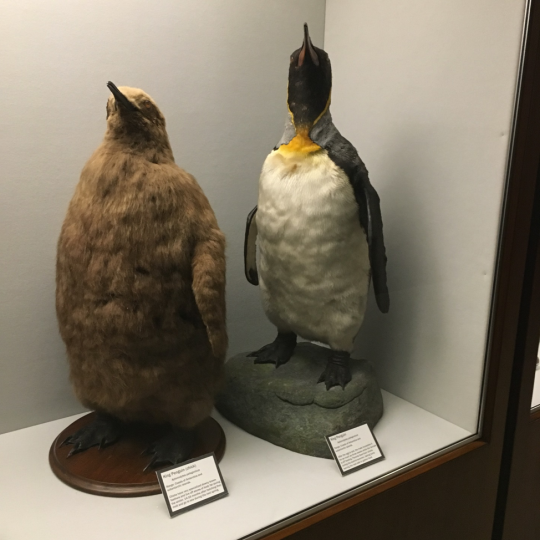
Why Do the King Penguins in Bird Hall Look so Different from Each Other?

king penguin chick and adult in Bird Hall

Visitor comments often offer insight into the effectiveness of museum displays. The most candid comments are overheard snatches of conversation, some as touching as they are humorous.

The setting: Bird Hall at Carnegie Museum of Natural History, 2:00 p.m. on a summer afternoon.

Three siblings, the oldest about nine, were studying a pair of king penguin taxidermy mounts while their mother, a few display cases away, looked at a different group of birds.

The mother walked toward her children as the nine-year-old explained the birds to his younger brother and sister, “This one is the girl penguin, and this one is the boy penguin. They really look different. The girls are brown and fuzzy, and the boys are black and white.”

The mother quickly surmised the misinterpretation and offered a gentle correction without any trace of ridicule: “The brown one’s a young bird. The label says ‘chick,’ but that doesn’t mean it’s a girl.”

Patrick McShea works in the Education and Visitor Experience department of Carnegie Museum of Natural History. Museum employees are encouraged to blog about their unique experiences and knowledge gained from working at the museum.
Filed Under: Blog Tagged With: bird hall, Birds, Education, Pat McShea, Patrick McShea

May 16, 2019 by wpengine

Learning to See, Seeing to Learn, Freshwater Insects

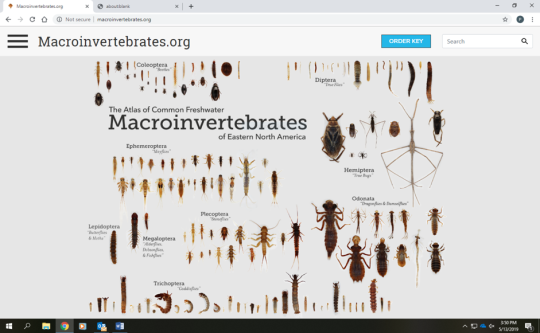
screenshot of macroinvertebrates.org

The Atlas of Common Freshwater Macroinvertebrates of Eastern North America is an online guide and accompanying set of teaching and learning resources designed to support water quality monitoring in citizen science projects and fresh water ecology education.

A suite of visual resources developed to help learners to identify fresh water insects.

For the team of entomologists, learning scientists, software engineers and designers who collaborated in the National Science Foundation-supported effort to plan, develop, test, and revise the site, six words guided the key design goals for this educational resource—Learning to See, Seeing to Learn. Team members aimed both to support the development of observational skills and provide the rich visual resources needed for observation and identification.

In freshwater environments the term macroinvertebrates refers to animals without backbones that can be seen with the naked eye. Because these insects, crustaceans, worms, and mollusks fill vital roles in aquatic food webs, their presence, absence, abundance, and diversity is key to assessing water quality in streams and freshwater bodies over time.

In early April, I spent several hours demonstrating www.macroinvertebrates.org at a table display during the Creek Connections Student Research Symposium held at the Campus Center of Allegheny College. The Meadville college has been providing opportunities for students to become stream researchers for more than 20 years, so I was confident the website would be well received by these budding young freshwater scientists.

The table displayed two iPads for visitors to explore the Macroinvertebrates.org site, a set of stream insects embedded in Lucite cubes, a traditional Riker mount of pond macros, a field microscope, and a stack of promotional postcards.

During the event I spoke with and handed-out information to approximately 100 people, a mix of middle school and high school students presenting their stream study projects, their teachers, Allegheny College students and faculty, and representatives from other organizations participating in the symposium.

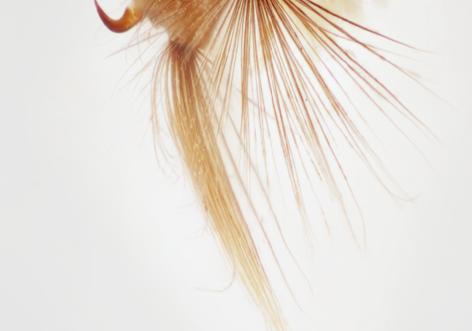
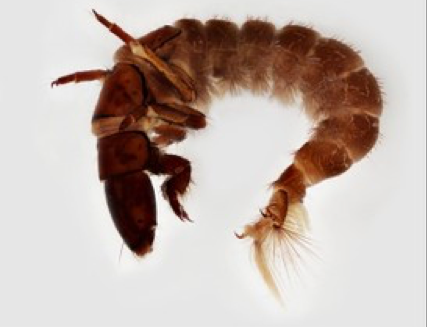
close up of caddisfly

Images showing dynamic zoomed and full-scale views of a caddisfly.

Table visitors were particularly impressed by set-ups on the paired iPads – one screen fully zoomed-in on the abstract art-like image on the “setal fan on a proleg” of a net-spinning caddisfly, the other featuring a whole-body image of the tiny beast. The companion images addressed the linked challenge of learning to see and seeing to learn.

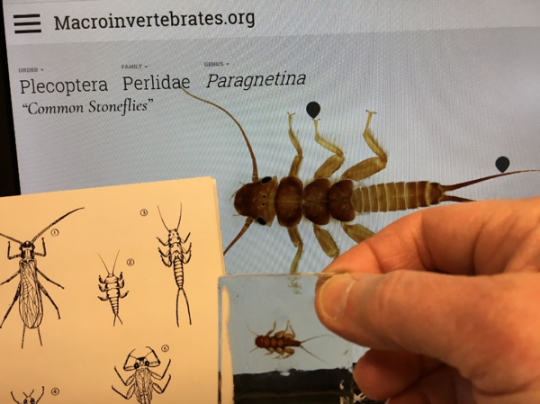
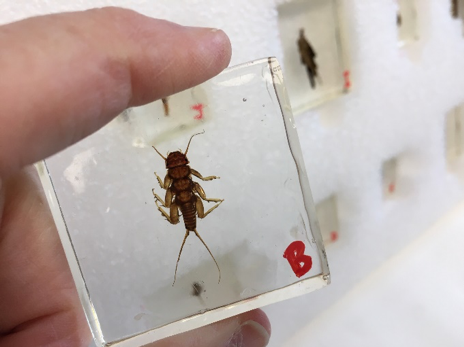
stonefly preserved in clear resin
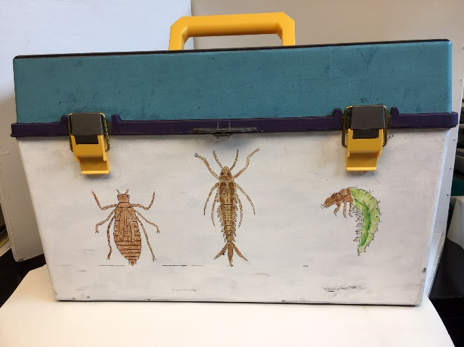
toolbox with macroinvertebrates painted on it

As teachers continue to experiment with ways for their students to use the online guide, the museum has added a set of preserved macroinvertebrates to the Educator Loan Collection. Pictured above is a stonefly embedded in a block of clear resin, and the colorfully-illustrated toolbox that contains a set of ten different specimens prepared in the same manner.

Partners involved in the development of www.macroinvertebrates.org include Carnegie Mellon University’s Human Computer Interaction Institute, University of Pittsburgh’s Learning Research & Development Center, Stroud Water Research Center, Clemson University, and Carnegie Museum of Natural History.

Patrick McShea works in the Education and Visitor Experience department of Carnegie Museum of Natural History. Museum employees are encouraged to blog about their unique experiences and knowledge gained from working at the museum.
Filed Under: Blog Tagged With: Education, Educator Loan Program, Educator Loans, Educator Resources, Invertebrate Zoology, Macroinvertebrates, Pat McShea, Patrick McShea

April 23, 2019 by wpengine

Broken Egg Evidence

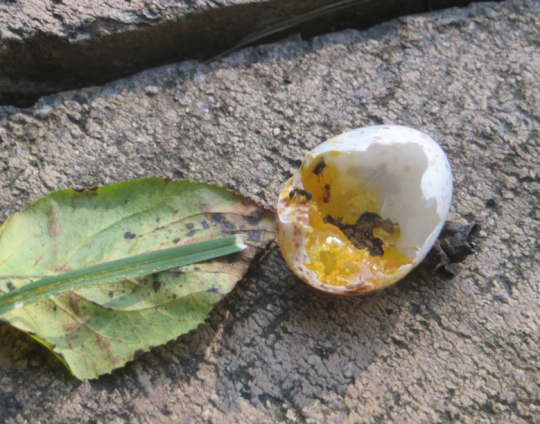
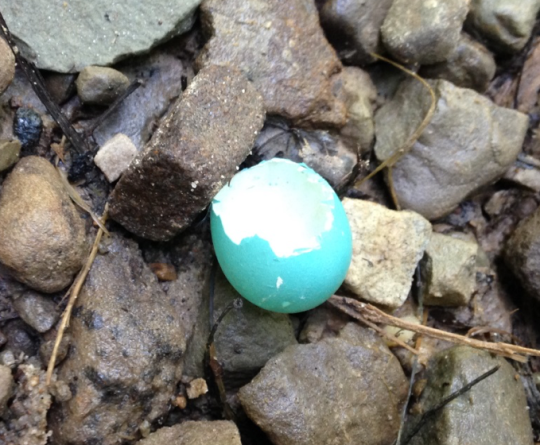
Challenges involving eggs aren’t limited to the Easter season. The pictures below are of songbird egg shells I came across in early July of 2018. Each fragment hints at a different outcome for the developing bird that once occupied the structure. My speculation about those outcomes is mainly informed by details about the places where the shells were found, critical information not captured in the photographs.

broken egg on the ground

This northern cardinal egg shell fragment rested on a brick sidewalk near a forsythia bush where a pair of the birds had been observed nesting. Blue jays frequented the area, as did eastern chipmunks. Either could have removed an egg from the nest, broken the shell, eaten much of the contents, and left drying yolk for ants to scavenge.

broken blue egg among rocks

It’s likely this wood thrush egg fragment was deliberately dropped by a parent bird as part of routine post-hatch nest-keeping duties. The blue shell rested on a gravel State Game Lands road inMercer County, a place that echoed with flute-like Wood Thrush song. The fragment’s spotless interior was evidence that this egg had almost certainly been opened by its occupant rather than a nest visitor.

Patrick McShea works in the Education and Visitor Experience department of Carnegie Museum of Natural History. Museum employees are encouraged to blog about their unique experiences and knowledge gained from working at the museum.
Filed Under: Blog Tagged With: Birds, Education, eggs, Pat McShea, Patrick McShea

February 20, 2019 by wpengine

Doubly Dead: Taxidermy Challenges in Museum Dioramas

pronghorn antelope diorama

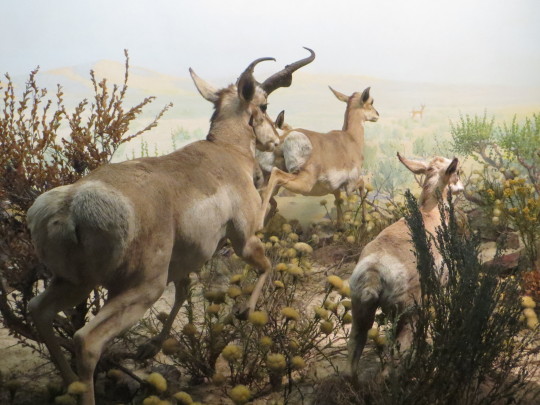
A visit to the wildlife dioramas at Carnegie Museum of Natural History is an opportunity to repeatedly admire the illusions created by teams of skilled taxidermists. None of the featured creatures are alive, but many of them appear to have just paused. Some, such as the pronghorn antelope, pictured above, even seem to be frozen in motion.

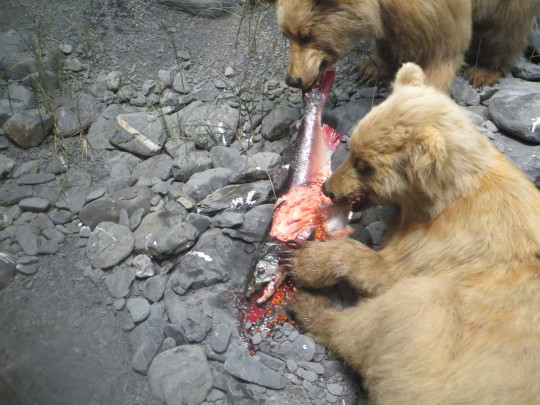
In several three-dimensional scenes, where the animal subjects are predators or scavengers, the taxidermists involved in creating the exhibit faced another challenge – presenting the preserved remains of a dead animal as a dead animal. The task, as the somewhat gory details in the pictures below attest, is undoubtedly more difficult than it sounds.

brown bear eating salmon taxidermy diorama

A dead salmon is front and center in the Alaskan Brown Bear diorama, and the pink flesh the cubs are consuming doesn’t look much different than what’s available at supermarket fish counters.

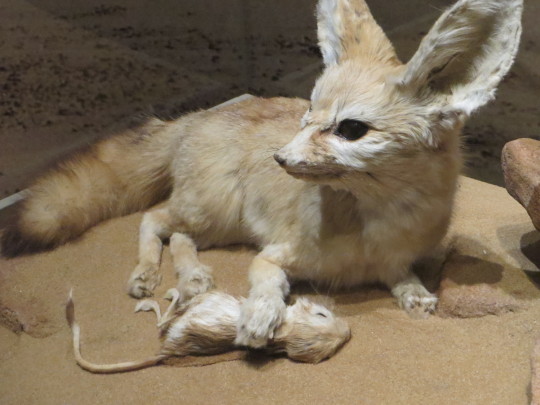
fennec fox and jerboa taxidermy

In the Hall of African Wildlife there’s no blood visible on the Lesser Egyptian Jerboa under fennec’s paw. The curled position of the prey’s feet and back legs indicate the struggle with the big-eared fox is over.

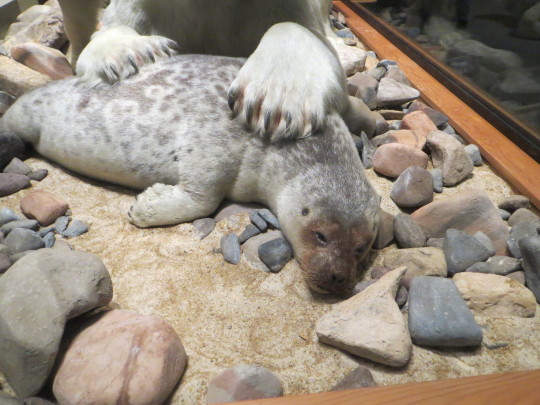
seal taxidermy under paw of polar bear taxidermy

In creating life-like mounts, taxidermists use glass eyes of the proper shape, size, and color.  The glass eyes appear to have lost their luster for the seal that serves as a prey detail in a Polar Bear diorama.

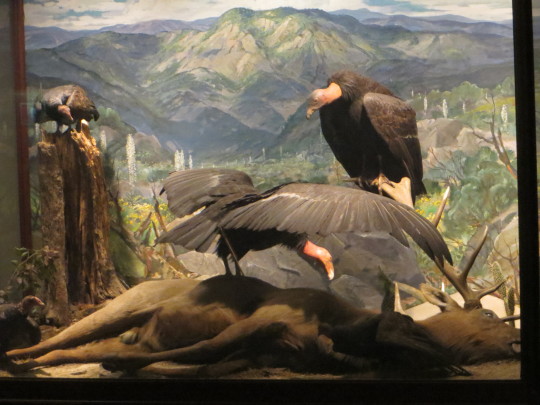
bull elk with large birds in diorama

In one of the oldest dioramas within the Hall of North American Wildlife, the centerpiece presence of a dead bull elk indicates the role of both California Condors and Turkey Vultures as scavengers.

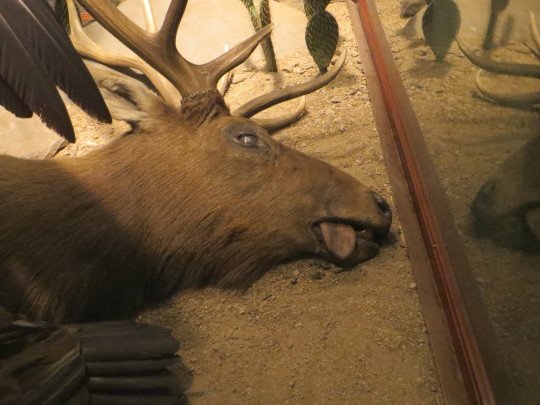
detail of bull elk taxidermy

Taxidermy details that indicate the elk’s browsing days are over include dull eyes and a lolling tongue. The tricks of taxidermists are important when they help to explain the role of predators and scavengers, the bedrock biological principle of life from death.

Patrick McShea works in the Education and Visitor Experience department of Carnegie Museum of Natural History. Museum employees are encouraged to blog about their unique experiences and knowledge gained from working at the museum.
Filed Under: Blog Tagged With: diorama, Hall of African Wildlife, Hall of North American Wildlife, mammals, Pat McShea, Patrick McShea, taxidermy

February 6, 2019 by wpengine

Red Bird

By Patrick McShea

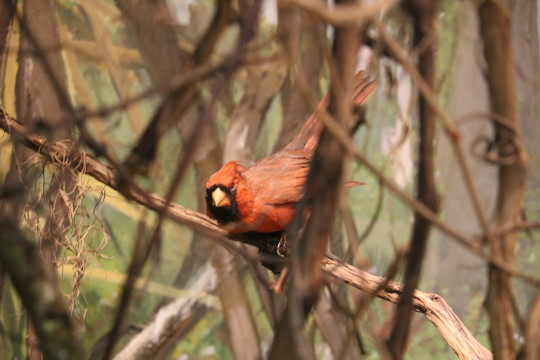
cardinal diorama

A detail in a Hall of Botany diorama can add much to our understanding of a popular songbird. Pictured above is a male Northern Cardinal, a species widely portrayed on cards and calendars amid snowy scenery.

Cardinals are certainly noticeable under winter conditions. The bright red of the male’s feathers and the reddish-brown plumage of the female stand out in snow covered landscapes. The range for this non-migratory species is enormous, however, and includes tropical regions.

The Hall of Botany bird, for example, adds color to a three-dimensional recreation of a tiny patch of Florida Everglades. Northern Cardinals have also long occupied suitable habitat much further south in Mexico and Guatemala.

The species, which has been deemed the official avian representative for seven U.S. states, was rarely seen anywhere in Pennsylvania until the 1890s. In Birds of Western Pennsylvania, the encyclopedic volume published in 1940 by the museum’s then Curator of Ornithology, W.E. Clyde Todd, growth of the local cardinal population is noted:

In recent years it has invaded the parks and residential sections of Pittsburgh in gradually increasing numbers, and it is seemingly as much at home there as it is in the wooded ravines in the vicinity of the city.”

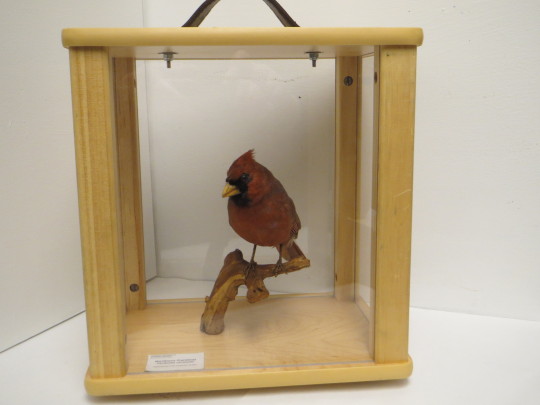
cardinal diorama
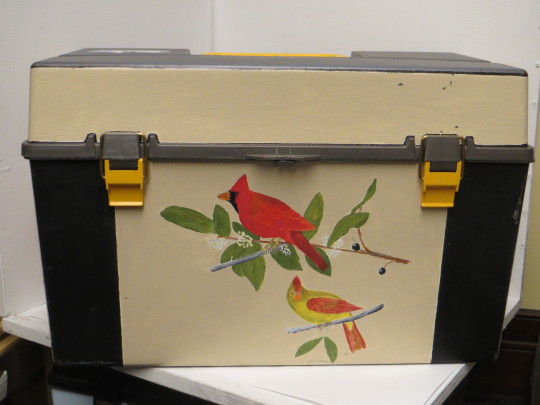
tool box with painted cardinals

One measure of the Northern Cardinal’s continued popularity is requests by elementary teachers to borrow taxidermy mounts of the species from the museum’s Educator Loan Collection. Pictured above are a taxidermy mount and the “toolbox” it travels in. The illustration on the box is a recreation of John James Audubon’s cardinal portrait by Museum Educator Assistant John Franc.

Patrick McShea works in the Education and Visitor Experience department of Carnegie Museum of Natural History. Museum employees are encouraged to blog about their unique experiences and knowledge gained from working at the museum.
Filed Under: Blog Tagged With: bird hall, Birds, botany hall, Education, Educator Loans, Hall of Botany, Patrick McShea, pennsylvania, western pennsylvania

  • « Go to Previous Page
  • Page 1
  • Page 2
  • Page 3
  • Page 4
  • Page 5
  • Page 6
  • Interim pages omitted …
  • Page 9
  • Go to Next Page »

sidebar

About

  • Mission & Commitments
  • Directors Team
  • Museum History

Get Involved

  • Volunteer
  • Membership
  • Carnegie Discoverers
  • Donate
  • Employment
  • Events

Bring a Group

  • Groups of 10 or More
  • Birthday Parties at the Museum
  • Field Trips

Powdermill

  • Powdermill Nature Reserve
  • Powdermill Field Trips
  • Powdermill Staff
  • Research at Powdermill

More Information

  • Image Permission Requests
  • Science Stories
  • Accessibility
  • Shopping Cart
  • Contact
  • Visitor Policies
One of the Four Carnegie Museums | © Carnegie Institute | Privacy Policy | Terms of Use | Accessibility
Rad works here logo