• Skip to primary navigation
  • Skip to main content
  • Skip to primary sidebar

Carnegie Museum of Natural History

One of the Four Carnegie Museums of Pittsburgh

  • Visit
    • Buy Tickets
    • Visitor Information
    • Exhibitions
    • Events
    • Dining at the Museum
    • Celebrate at the Museum
    • Powdermill Nature Reserve
    • Event Venue Rental
  • Learn
    • Field Trips
    • Educator Information
    • Programs at the Museum
    • Bring the Museum to You
    • Guided Programs FAQ
    • Programs Online
    • Climate and Rural Systems Partnership
  • Research
    • Scientific Sections
    • Science Stories
    • Science Videos
    • Senior Science & Research Staff
    • Museum Library
    • Science Seminars
    • Scientific Publications
    • Specimen and Artifact Identification
  • About
    • Mission & Commitments
    • Directors Team
    • Museum History
  • Tickets
  • Give
  • Shop

pennsylvania

August 25, 2016 by wpengine

Salamander Forests in Pa.

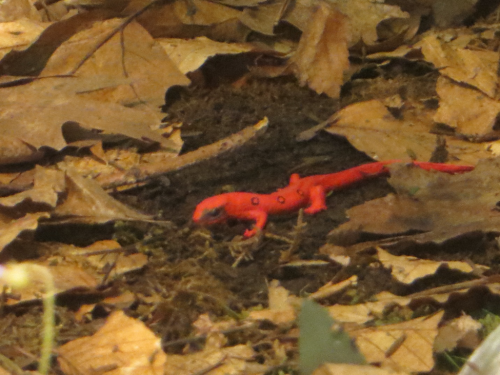
red eft salamander

by Patrick McShea

Within a Hall of Botany diorama depicting old growth Pennsylvania forest, a ferocious predator lurks amid dried oak, maple, and beech leaves. No snail, worm, or ground-dwelling insect is safe in the damp realm where this bright amphibian prowls.

The three-inch-long salamander is a red eft, the name given the land-dwelling middle life stage of the otherwise aquatic red-spotted newt. The creature’s solitary presence in the exhibit accurately reflects what you might hope
to see during a visit to a real old growth glen. At such a place, however, plenty of the eft’s near and distant salamander kin would almost certainly be lurking just out of sight.
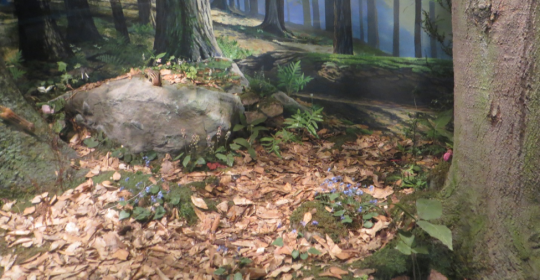
salamander forest display

Pennsylvania supports 22 species of salamanders, the majority of which spend at least part of their lives foraging in habitat where trees, deep shade, damp leaf litter, loose soil, rotting logs, and mossy rocks occur. If the results of a 2014 University of Missouri study of salamander abundance in Ozark forests can be extrapolated to our region, the total biomass of salamanders inhabiting many wooded tracts rivals that of white-tailed deer.

Because these salamanders eat invertebrates that eat leaf litter, the abundance of the tiny predators helps forests to be places where a portion of the carbon pulled from the atmosphere by trees is stored in leaf litter.


Patrick McShea works in the Education and Visitor Experience department of Carnegie Museum of Natural History. Museum employees are encouraged to blog about their unique experiences of working at the museum.

Filed Under: Blog Tagged With: botany hall, forests, Patrick McShea, pennsylvania

August 18, 2016 by wpengine

A stratigraphic model showing different layers of rock strata

stratigraphic model showing different layers of rock strata

A stratigraphic model showing different layers of rock strata in Benedum Hall of Geology at Carnegie Museum of Natural History.

(photo by Hayley Pontia) 

Filed Under: Blog Tagged With: Benedum Hall of Geology, geology, pennsylvania, Pittsburgh

August 12, 2016 by wpengine

An Appalachian Research Hub

Powdermill Nature Reserve Visitor's Center

Researchers at Powdermill Nature Reserve, the environmental research center of Carnegie Museum of Natural History, are documenting the health of Western Pennsylvania’s flora and fauna with bird banding, long-term studies, and other key environmental research out of Rector Pa.

Those efforts will be bolstered thanks to a recent $700,000 grant from the Richard King Mellon Foundation, which will further position Powdermill as an ecological research powerhouse of the Appalachian region. The grant will fund new technology like drone imagining and radio frequency “nanotags” to study and protect birds. The focal species groups that will be studied are birds, pollinators, salamanders, and forest trees.

Powdermill scientists are eager to use nanotag radio telemetry to improve their tracking of migratory birds, attaching tiny radio beacons to birds that will track their migration as they fly by special towers equipped with sensors.

The sensors will log the tagged birds in a central database, allowing scientists to track birds from South America to Canada without recapturing them. Since only about one in 1,000 birds banded at Powdermill are ever recaptured, the new technology is sure to improve the reserve’s data collection efforts.

“As this grant strengthens our scientific activities, Powdermill will accordingly improve its educational outreach regarding pressing environmental issues of interest to concerned citizens,” said Powdermill Director John Wenzel.

Check out Powdermill Nature Reserve’s Facebook page for beautiful images and snapshots of some of the important working happening there that will benefit the entire Western Pennsylvania region.

Filed Under: Blog Tagged With: Birds, conservation, nature, pennsylvania, Powdermill

August 5, 2016 by wpengine

Other Milkweed-Loving Insects

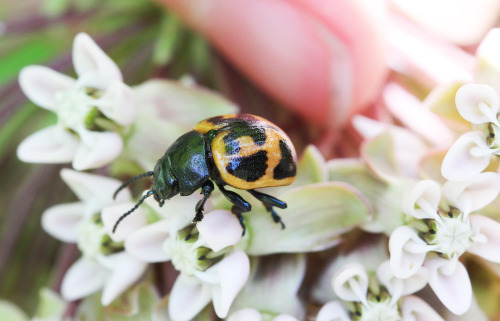
Milkweed Leaf Beetle (Labidomera clivicollis)

 by Andrea Kautz

Milkweed is in bloom and it’s not only the monarchs that love it!

We are all familiar with the striped caterpillars that rely on milkweed as a food source and the beautiful orange butterflies they become, but lots of other insects utilize milkweed in a similar way.

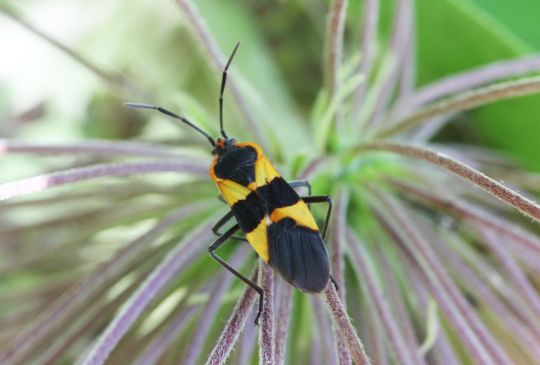
A quick inspection of the Common Milkweed (Asclepias syriaca) blooming near Powdermill Nature Reserve’s nature center parking lot reveals three different milkweed specialists pictured: the Milkweed Leaf Beetle (Labidomera clivicollis), the Large Milkweed Bug (Oncopeltus fasciatus), and the Milkweed Longhorn Beetle (Tetraopes tetrophthalmus).

The next time you come across a milkweed plant, see if you can find any of these guys hanging out; they are all quite attractive!

bug
The Large Milkweed Bug (Oncopeltus fasciatus)

Andrea Kautz is a research entomologist at Carnegie Museum of Natural History’s Powdermill Nature Reserve. Museum employees are encouraged to blog about their unique experiences and knowledge gained from working for the museum.

Filed Under: Blog Tagged With: bugs, insects, pennsylvania

July 9, 2016 by wpengine

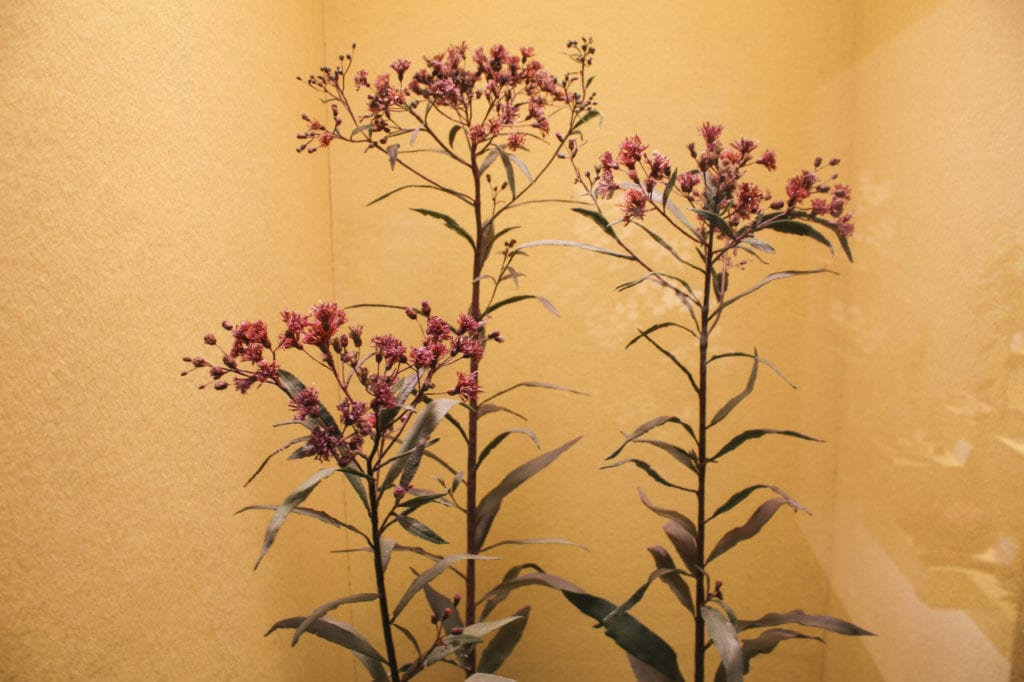
Vernonia altissima

Vernonia altissima flower in bloom

Vernonia altissima’s bright flowers provide an important food source for native pollinators found in Pennsylvania and many other surrounding states.

(Photo by Hayley Pontia)


Filed Under: Blog Tagged With: Botany, flowers, gardening, pennsylvania

  • « Go to Previous Page
  • Page 1
  • Page 2
  • Page 3
  • Page 4

sidebar

About

  • Mission & Commitments
  • Directors Team
  • Museum History

Get Involved

  • Volunteer
  • Membership
  • Carnegie Discoverers
  • Donate
  • Employment
  • Events

Bring a Group

  • Groups of 10 or More
  • Birthday Parties at the Museum
  • Field Trips

Powdermill

  • Powdermill Nature Reserve
  • Powdermill Field Trips
  • Powdermill Staff
  • Research at Powdermill

More Information

  • Image Permission Requests
  • Science Stories
  • Accessibility
  • Shopping Cart
  • Contact
  • Visitor Policies
One of the Four Carnegie Museums | © Carnegie Institute | Privacy Policy | Terms of Use | Accessibility
Rad works here logo