• Skip to primary navigation
  • Skip to main content
  • Skip to primary sidebar

Carnegie Museum of Natural History

One of the Four Carnegie Museums of Pittsburgh

  • Visit
    • Buy Tickets
    • Visitor Information
    • Exhibitions
    • Events
    • Dining at the Museum
    • Celebrate at the Museum
    • Powdermill Nature Reserve
    • Event Venue Rental
  • Learn
    • Field Trips
    • Educator Information
    • Programs at the Museum
    • Bring the Museum to You
    • Guided Programs FAQ
    • Programs Online
    • Climate and Rural Systems Partnership
  • Research
    • Scientific Sections
    • Science Stories
    • Science Videos
    • Senior Science & Research Staff
    • Museum Library
    • Science Seminars
    • Scientific Publications
    • Specimen and Artifact Identification
  • About
    • Mission & Commitments
    • Directors Team
    • Museum History
  • Tickets
  • Give
  • Shop

Blogs from Powdermill Nature Reserve

Powdermill Nature Reserve is Carnegie Museum of Natural History’s environmental research center. Located 55 miles southeast of Pittsburgh in Rector, Pennsylvania, Powdermill is a field station and laboratory where researchers do long-term studies of natural populations in western Pennsylvania. In addition to being positioned for Appalachian-specific studies in ornithology, ecology, invertebrate zoology, and botany, Powdermill is a great place to spend a fun-filled day outdoors with the family.

November 9, 2018 by wpengine

Keeping Birds Safe with GIS and Citizen Science

By Jon Rice and James Whitacre

Almost 600 million birds die every year in North America after colliding with buildings. BirdSafe Pittsburgh, which has been a museum program for over four years, has collected over 1,500 birds that collided with windows. These birds have been collected in Downtown and surrounding areas, and through our efforts, we have learned what increases the likelihood of birds colliding with windows.
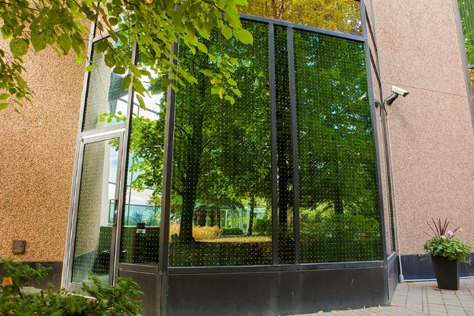
windows modified with a pattern birds can see

Locating and Researching Bird Strikes

Using the power of Geographic Information Systems (GIS), we have been tracking and collecting where birds have collided with windows. This will help us to find collision hotspots and assess the types of buildings that cause the most problems for birds. Our efforts so far have concentrated on downtown Pittsburgh with a crew of dedicated volunteers.

However, we are now inviting you – the public – to help us find bird strikes in your neighborhood. We have developed a form on our website for you to add bird strikes to our database. If you find a bird dead or stunned, you can help us add to our database of bird strikes using the form. It will guide you through how to add pictures of the bird, add the location to the map, and fill out the required data. Any bird added will help us expand our research.

We already know that skyscrapers, low-rise buildings, and residential houses alike threaten birds, albeit unequally. According to a study published in 2014, low-rises account for the majority of building related mortalities at 56%, with residential houses accounting for nearly all the rest at 44%, and high-rises only accounting for less than 1%. But, how do the buildings in downtown Pittsburgh and the surrounding neighborhoods fit into this picture?

By analyzing the precise locations of bird strikes in Pittsburgh using GIS, we hope to assess the types of buildings impacting bird deaths. By collecting fine scale data where birds strike windows, we could identify specific problem windows that birds strike more often than others. This would allow us to focus mitigation efforts to specific areas of concern rather than along an entire building façade. For instance, treating 10 windows on a building side instead of all 100 windows would result in considerable cost-savings while maintaining the same effect on decreasing bird strikes.

How You Can Help Save Birds
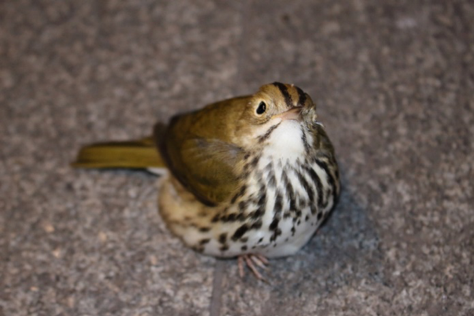
bird sitting on the sidewalk

Birds hit windows because of the reflections caused by sunlight hitting the glass and looking like open sky, trees or habitat. By breaking up the reflections with anything following a “2-inch-by-4-inch rule,” birds are less likely to strike the window. The 2-by-4 rule refers to the space between horizontal elements at no more than 2 inches apart, and the space between vertical elements at no more than 4 inches apart. These simple and cost-effective measures will reduce window collisions while maintaining the aesthetic qualities.

By helping us collect bird strike data and modifying the windows of your home or business, we can decrease the number of bird-window collisions and maintain stronger bird populations.

More information about BirdSafe Pittsburgh can be found at birdsafepgh.org.

Jon Rice is Citizen Science Assistant and James Whitacre is a GIS Research Scientist at Carnegie Museum of Natural History’s Powdermill Nature Reserve. Museum employees are encouraged to blog about their unique experiences and knowledge gained from working at the museum.
Filed Under: Blog Tagged With: Birds, birdsafe pittsburgh, James Whitacre, Jon Rice, Pittsburgh, Powdermill Nature Reserve

October 24, 2018 by wpengine

A Striking Success in Protecting Birds

by John Wenzel

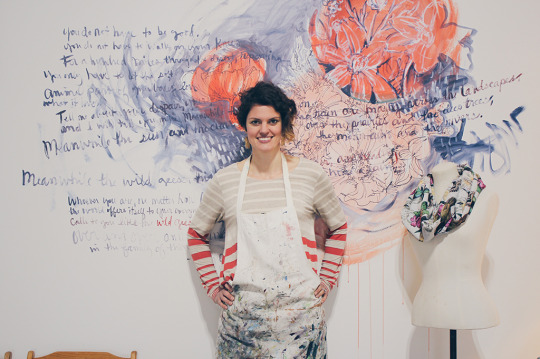
A particular point of pride of our bird research is the BirdSafe Pittsburgh program. A consortium of environmental groups and concerned citizens is working to create a more bird-friendly city, from restoring urban habitat to advising builders and architects on designing structures that will be less dangerous to birds. One of our prime collaborators has been Ashley Cecil, who was Artist in Residence at Carnegie Museum of Natural History. Ashley’s art is bird-themed, including one work that was reproduced on adhesive film that reflects UV light and is highly visible to birds. This film can be applied to windows so that birds will see Ashley’s pattern and avoid collision rather than see a reflection of a distant tree they would approach, striking the window. The film is available in color, making the window look like a stained glass, and in transparent form, resembling lace.

Ashley Cecil in front of her art work

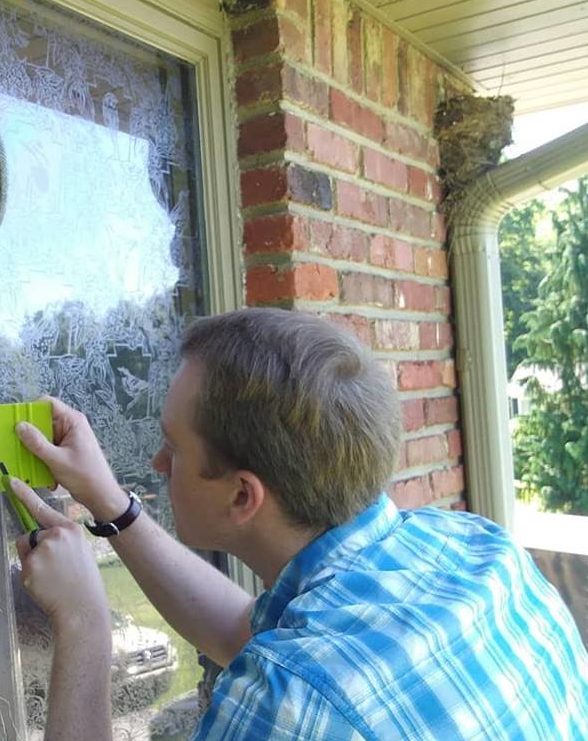
But does the film work? If you put the film on the window, does it reduce bird strikes? As the Director of Powdermill Nature Reserve, I thought I should lead by example and test the film on my own house. I have been monitoring bird strikes at my home since August of 2015. From about 6:00 am to 8:00 am, three or four days a week (at total of six to eight hours a week), I listened for strikes and recorded them. They are not random, nor evenly distributed. Certain windows seem to be a repeated problem, while others never seem to get hit. My house has 15 windows of various dimensions, plus a cathedral window that is 11 feet high and 21 feet wide. No bird has ever hit that window as far as I know. Most strikes occur when migrating birds are coming through, usually April and May, or September and October. When there is a flush of migration, it shows: I had seven strikes from August 27 to 31 in 2015, in only 10 hours of observation. Ignoring seasonal variation, and averaging across the entire data set, a rough estimate is that I observed about one strike for every 20 hours of observation. On June 14, 2018, our Urban Bird Conservation Coordinator, Jon Rice, installed the transparent film on the five most dangerous windows, leaving the others bare.

Jon rice applying birdsafe window

We have had zero bird strikes since the film was installed. To assess the effect of the film, consider that in the same period in 2017 we had seven strikes, in 2016 we had four, and in 2015 we had nine. Years have some random variation, but clearly, there is a reduction from these earlier three years’ average of 6.7 down to 0. More than that, my wife Donna and I became more vigilant since the installation of the film, and we logged about 10 or 12 hours of observation per week rather than six or eight we did for the baseline. If we use the baseline expected frequency of one bird per 20 hours of observation, then with the more thorough observations we would have expected a little more than one bird every two weeks, or about 10 birds in the 18 elapsed weeks, rather than 6.7. Using a simple “chi-square” statistic to estimate the difference between an expectation of 10 birds and an observation of zero, the probability is one in a thousand that we would get zero birds by random variation from an expectation of 10 birds. In other words, if our recent sample differs from our baseline probability purely by chance, we would have to measure 1,000 years to get one year as far from expectation as we got in 2018 following application of Ashley’s film. According to our scientific standards, we reject proposals that have a probability of less than one in 20. Our analysis is less than one in 1,000. We conclude that the film works very well to prevent birds from hitting windows.

You can contact Urban Bird Conservation Coordinator Jon Rice at RiceJ@CarnegieMNH.org.

John Wenzel is the Director at Powdermill Nature Reserve, Carnegie Museum of Natural History’s environmental research center. Museum employees are encouraged to blog about their unique experiences and knowledge gained from working at the museum.
Filed Under: Blog Tagged With: Anthropocene, Ashley Cecil, birdsafe pittsburgh, conservation, John Wenzel, Powdermill Nature Reserve

September 26, 2018 by wpengine

Boogie Woogie Aphids

by John Wenzel

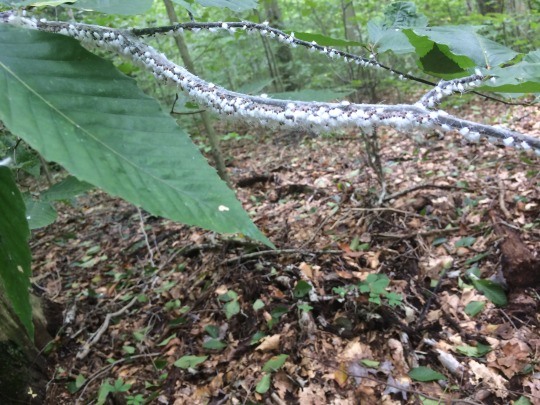
aphids on a branch

Aphids are usually small wingless insects that suck sap from plants, usually specializing on one kind of plant. Many species can reproduce rapidly by parthenogenesis, where females give live birth to daughters without mating. They can build up great numbers quickly, which is why aphids are often pests of crop plants. In late summer or early autumn, populations are about as large as they are going to get, and soon a generation of both male and females that has wings is produced. These will disperse and mate before winter comes. The winged females will lay eggs that last over winter to start the cycle again in the spring. In our area, one amusing species is the beech blight aphid (Grylloprociphilus imbricator) that feeds on beech trees. The aphid produces from its abdomen profuse wax fibers that give it a woolly appearance. In the photo shown here, the aphid itself is just a small brown dot at one end of the white fluffy wax mass. The wax is essentially a shield, and a predator that bites into the woolly floss will come away with nothing but wax. These aphids have a defensive behavior of waving their abdomens and the wax shield when they are disturbed, as you can see in this video of dancing aphids.

Because sap has far more sugar than nutrients, aphids need to get rid of the sugar by excreting it in the form of honeydew. Under a mass of aphids like that shown here, the honeydew will accumulate on the branches or the ground below the aphid colony and will attract flies, bees, wasps, and other insects seeking the sweet liquid. There is a black sooty mold (Scorius spongiosa) that grows only on the honeydew of beech aphids, and can build up a large mass. Neither the aphids nor the mold are detrimental to beech trees, so there is no need to try to exterminate either of them. If they are considered a nuisance by a homeowner, it is easy to wash the aphids off the branches with a hose.

John Wenzel is the Director at Powdermill Nature Reserve, Carnegie Museum of Natural History’s environmental research center. He has published research on the evolution of web building behavior. Museum employees are encouraged to blog about their unique experiences and knowledge gained from working at the museum.
Filed Under: Blog Tagged With: insects, John Wenzel, Powdermill Nature Reserve

September 13, 2018 by wpengine

Wet Weekend!

by Joylette Portlock

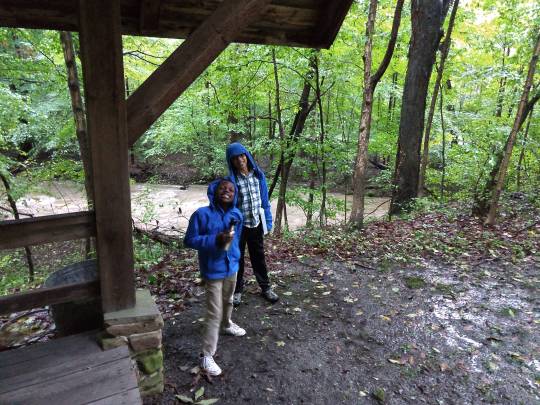
I had the chance to visit Powdermill Nature Reserve over the weekend. Yes, this past weekend, the one where it rained for three days almost continuously across a multi-state area. I took my kids with me, and we had a blast; after all, “rain is a grown-up problem.”* I have to say, the woods always feel so alive to me during/right after a hard rain. The world feels full of promise and power. As we watched Powdermill Run, swollen and wild, churning, cutting a new path through the woods after floods this summer, I thought of the power of water, to nourish, to sweep clean, and to cause damage.

kids in the rain

And, because being a grownup requires other grownup thoughts, I thought of the water in my basement, and considered, again, the costly prospect of installing a French drain around the house.

If you’re feeling like there seems to be more water than ever before, you’re not wrong. Climate change, one of the most significant challenges of the Anthropocene, is shifting the way water moves around the planet. It is resulting in more precipitation in places and at times where we don’t need it; a global phenomenon that is felt locally.

KDKA reported that this past Sunday in Pittsburgh was the second wettest day ever recorded in the area and we’ve already passed the yearly average rainfall. In other words, every drop from this point out in 2018 puts us closer to an annual “wettest ever” status, too.

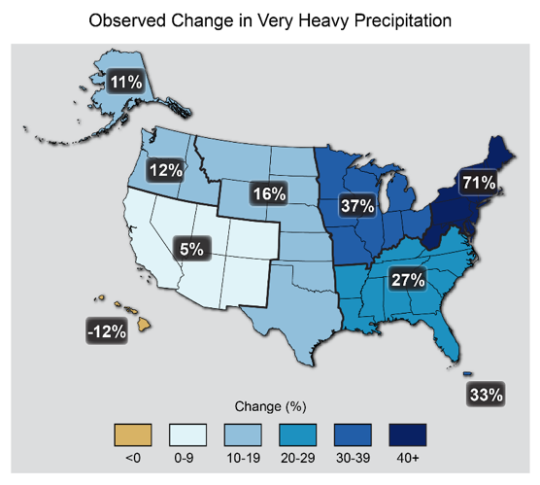
Our downpour this weekend is part of a trend. Since the 1950s, the amount of water falling during heavy downpours in this part of the U.S. has increased by 71%, per the 2014 National Climate Assessment, and that’s an increase that is definitely more than the natural variation:

The map shows percent increases in the amount of precipitation falling in very heavy events (defined as the heaviest 1% of all daily events) from 1958 to 2012 for each region of the continental United States; Adapted from: Global Climate Change Impacts in the United States.

This may come as a surprise – we usually talk about global warming in terms of heat waves and hurricanes – but climate scientists have known about these precipitation effects, which have a big impact even in non-coastal areas, for some time. It’s a big deal for flooding risk (and in areas like Pittsburgh, with a combined sewer-stormwater system, for water quality).

wow gif with LeVar Burton

In other words, it’s not just my basement at risk.

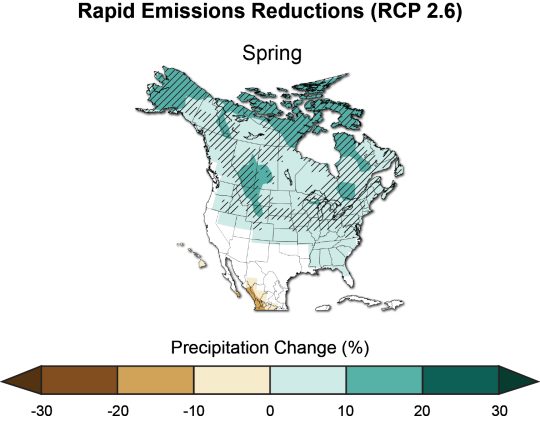
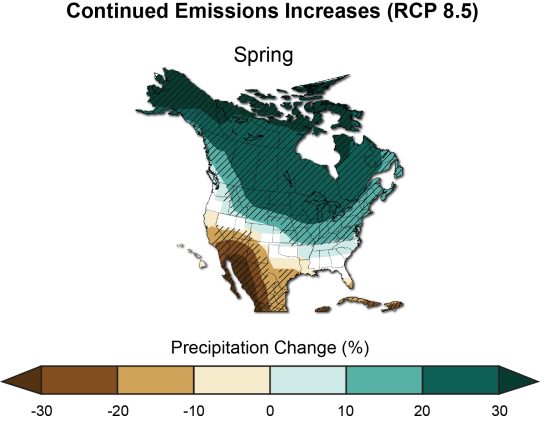
However, the forecast doesn’t have to be gloomy. Also from the National Climate Assessment: our actions right now make a difference, globally and locally. These maps show the projected difference in annual springtime precipitation, by 2090, if we take steps to dramatically reduce our impact on our climate now vs. if we don’t:

Springtime in 2090, Business as usual
Kenneth E. Kunkel, Cooperative Institute for Climate and Satellites – NC


Springtime in 2090, with changes
Kenneth E. Kunkel, Cooperative Institute for Climate and Satellites – NC

Grown-up problems, indeed. Playing in the rain can be very fun. And the world is full of promise and power. But perhaps Powdermill Run isn’t the only thing that requires a new path forward.

*Said to me by a summer camp counselor at the Pittsburgh Zoo and Aquarium in 2017 when I dropped my son off for camp on a rainy day.

Joylette Portlock, Ph.D., is associate director of science and research at Carnegie Museum of Natural History. She is also executive director of Communitopia, a nonprofit focused on climate change communication, and holds many other roles in the community. Museum employees are encouraged to blog about their unique experiences and knowledge gained from working at the museum.
From the National Climate Assessment website:

The National Climate Assessment summarizes the impacts of climate change on the United States, now and in the future.

A team of more than 300 experts guided by a 60-member Federal Advisory Committee produced the report, which was extensively reviewed by the public and experts, including federal agencies and a panel of the National Academy of Sciences.

Filed Under: Blog Tagged With: Anthropocene, climate change, Powdermill, Powdermill Nature Reserve, water

September 10, 2018 by wpengine

This Land is Your Land, This Land is Mine Land

by Max Winn and Andrea Kautz

Since the passing of Act 54 in 1994, Pennsylvania requires a review of all subsidence impacts related to underground coal mining every five years. Subsidence occurs when land at the surface collapses down into a cavity created by removing a layer of coal. This can affect structures, roads, water wells/springs, streams, ponds, and wetlands. It can also induce landslides.

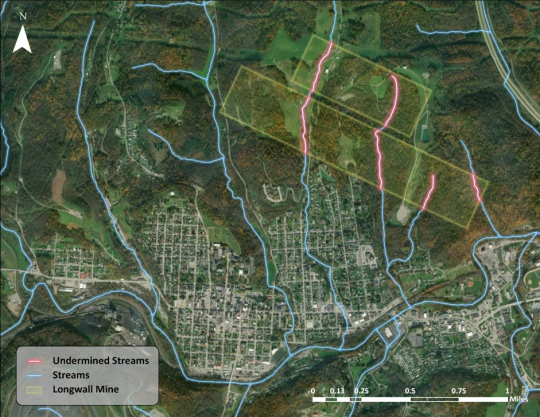
Powdermill scientists are currently part of the oversight team for the 2013-2018 review, and are using GIS technology to calculate and assess the impacts that mines have specifically on streams and wetlands.  Most subsidence impacts occur over “long wall” mines, where enormous panels of coal are removed. “Room and pillar” mines leave pillars of coal to support the roof of the mine, which generally prevents subsidence, but impacts may still occur.

Take a look at this aerial imagery of a portion of a longwall mine, that shows just how much area the panels cover and the streams that are undermined. The larger panel is over a mile long! Using GIS, we can calculate how much of the undermined streams are impacted by either flow loss or pooling. Flow loss is experienced when the earth fractures and the water is lost below the surface.  Pooling occurs when water collects in a depression caused by subsidence and can no longer flow downstream.

map of streams and mines

When stream impacts occur in Pennsylvania, the coal companies are required to mitigate the damage to return the stream to its previous state. Because you can generally predict where subsidence impacts are going to occur before mining, pre-mining surveys are done to determine the health of the streams initially. The survey determines normal flow rates throughout the year, and also describes the community of aquatic macroinvertebrates that live in the stream. Based on what types of insects and other invertebrates are found during the survey, the stream is given a score based on how healthy it is. These data are used to compare to post-mining surveys that occur after attempts to mitigate have been completed. If the scores are comparable, the stream is considered repaired, but if not, the company is required to take further mitigative action.

Experts from the Carnegie Museum of Natural History and Powdermill Nature Reserve are working with regulatory agencies and mining companies to ensure that our natural environment is passed on to the next generation in a healthy condition.

Max Winn is a GIS Technician and Andrea Kautz is a Research Entomologist at Carnegie Museum of Natural History’s Powdermill Nature Reserve. Museum employees are encouraged to blog about their unique experiences and knowledge gained from working at the museum.

Filed Under: Blog Tagged With: coal, pennsylvania, Powdermill Nature Reserve, We Are Nature 2

August 27, 2018 by wpengine

Sweet ‘n sassy, Sassafras

by John Wenzel

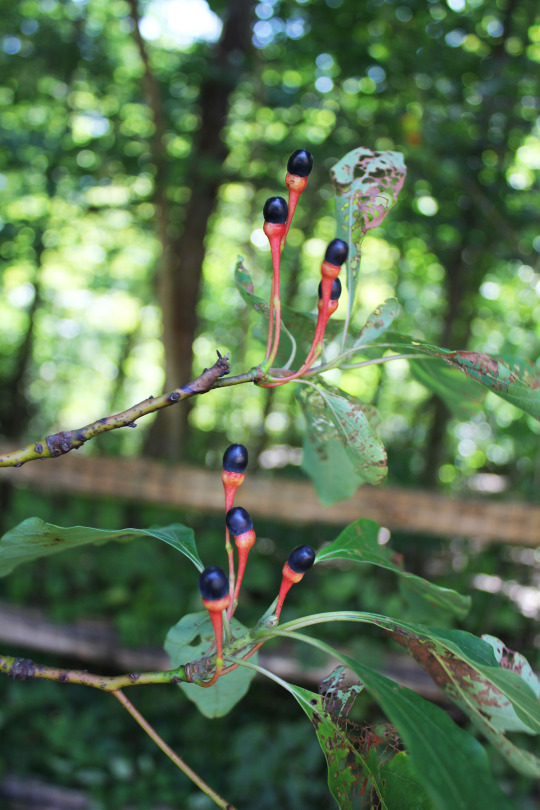
The flavoring of our popular root beer comes from the roots of sassafras, a common tree in open areas or at forest edges. Trees are either male or female, with the females producing interesting and attractive fruits in late August at our location.

sassafras fruit
Photo credit: Andrea Kautz

As is typical of members of the Laurel family, the leaves and twigs have a pleasant odor when crushed. The spice we call bay laurel is a relative of sassafras, and other relatives include our local spicebush and in the tropics avocados and cinnamon.

The leaves may be used in some Louisiana Creole cooking such as gumbo. The leaves are unusual in that the same tree may have simple leaves, or leaves with two lobes that resemble a mitten, or leaves with three lobes.

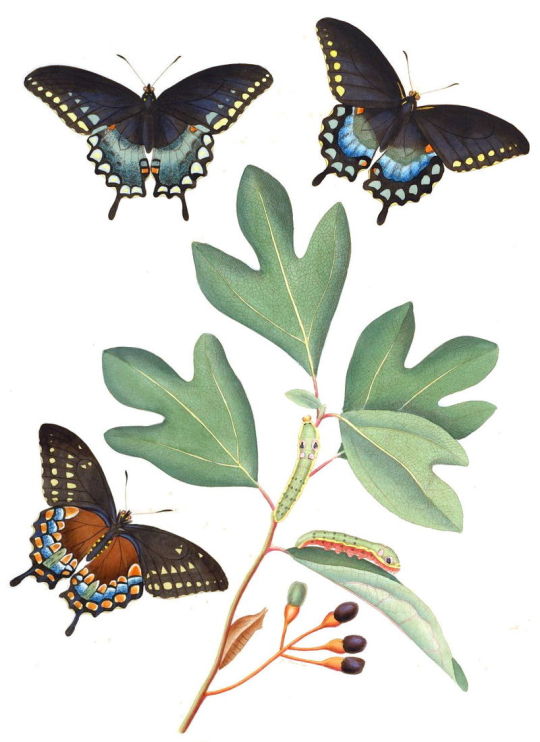
butterflies and sassafras

Sassafras is a traditional medicinal plant, and its oils were used in dentistry as both an anesthetic and disinfectant, although they are now banned in the USA due to carcinogenic properties. The tree is one of the main hosts of the attractive spicebush swallowtail butterfly, which was one of the first insects described from the New World by Linnaeus in 1758.

John Wenzel is the Director at Powdermill Nature Reserve, Carnegie Museum of Natural History’s environmental research center. Museum employees are encouraged to blog about their unique experiences and knowledge gained from working at the museum.
Filed Under: Blog Tagged With: Mason Heberling, Powdermill, Powdermill Nature Reserve

  • « Go to Previous Page
  • Page 1
  • Interim pages omitted …
  • Page 8
  • Page 9
  • Page 10
  • Page 11
  • Page 12
  • Interim pages omitted …
  • Page 17
  • Go to Next Page »

sidebar

About

  • Mission & Commitments
  • Directors Team
  • Museum History

Get Involved

  • Volunteer
  • Membership
  • Carnegie Discoverers
  • Donate
  • Employment
  • Events

Bring a Group

  • Groups of 10 or More
  • Birthday Parties at the Museum
  • Field Trips

Powdermill

  • Powdermill Nature Reserve
  • Powdermill Field Trips
  • Powdermill Staff
  • Research at Powdermill

More Information

  • Image Permission Requests
  • Science Stories
  • Accessibility
  • Shopping Cart
  • Contact
  • Visitor Policies
One of the Four Carnegie Museums | © Carnegie Institute | Privacy Policy | Terms of Use | Accessibility
Rad works here logo