Bear’s New Friend
Bear heads outside to find his friend Mouse and have some fun in the sun, but he hears a sound in the tree! Bear’s friends join him as he goes searching for the source of the noise, and together they find a shy new friend! After this fun rhyming story, we will head outside to look for some new friends of our own on a short nature hike.
Blogs from Powdermill Nature Reserve
Powdermill Nature Reserve is Carnegie Museum of Natural History’s environmental research center. Located 55 miles southeast of Pittsburgh in Rector, Pennsylvania, Powdermill is a field station and laboratory where researchers do long-term studies of natural populations in western Pennsylvania. In addition to being positioned for Appalachian-specific studies in ornithology, ecology, invertebrate zoology, and botany, Powdermill is a great place to spend a fun-filled day outdoors with the family.
Pittsburgh Participates in International City Nature Challenge
We are thrilled to share that Pittsburgh has come in 26th of nearly 70 cities that participated in the City Nature Challenge! It’s a friendly competition between cities around the world. Anyone can join by logging their outdoor observations on iNaturalist.org or with the iNaturalist app.
Matt Webb, Urban Bird Conservation Coordinator at Powdermill Nature Reserve, led Pittsburgh’s involvement in the challenge. It lasted four days, from April 27-30, and 165 Pittsburghers contributed observations.
Pittsburgh participants logged 4,393 observations of 847 species with iNaturalist.
The winning city, San Francisco, had 1,532 participants who logged 41,737 observations of 3,211 species.
Even though the competition is over, anyone may still log observations using iNaturalist. Download the free app to your phone, create an account, and photograph what you see outside. The GPS on your phone automatically logs in the date, time, and location of your photo. You may add information you already know about the plant, animal, or insect you photographed, then community members may contribute more information and confirm species identification. It’s all about having fun learning in nature.
To read more about Pittsburgh’s participation in the City Nature Challenge and Matt Webb, check out this feature in Allegheny Front.
Powdermill Spring
By John Wenzel
Winter was long and hard this year, and we were all eager to see Spring come at last. At Powdermill Nature Reserve, we write on a little calendar when we see the first spring blooms, the emergence of certain insects, or the chorus of frogs. People know that global warming means warmer temperatures, but seasons represent a pendulum (summer-winter-summer-winter,) and adding energy to a pendulum (warming) increases the swing, with more violent variation.
I see from our calendar that in 2016 our spring beauties (one of the earliest of the beautiful spring “ephemeral” flowers) appeared on March 17. They were a little later in 2017. This year, with such a late spring, they showed up on April 6, three weeks behind 2016. All the early flowers were much delayed. Bloodroot appeared on March 29 in 2016, but not until April 20 in 2018.
But the late arrival of Spring only affects the early species, and the later spring flowers arrive close to when we expect them. The beautiful nodding trout lilies bloomed on April 14 in 2016 and April 15 in 2017. This means that the composition of the forest in 2018 was rather different from 2016, combining species that rarely appear together.
Rather than gradual change, we have new compositions. What does that mean? I would like to be optimistic, but the fact is that we just don’t know what it means. For now, seeing the early spring flowers along with the ones that usually follow makes for a beautiful, and very welcome spring woodland. And we write what we see on our little calendar.
John Wenzel is the Director at Powdermill Nature Reserve, Carnegie Museum of Natural History’s environmental research center. Museum employees are encouraged to blog about their unique experiences and knowledge gained from working at the museum.
White-throated Sparrow
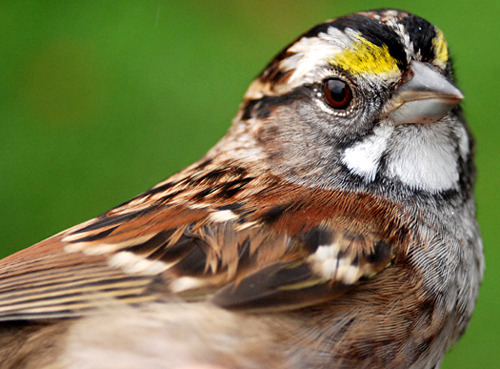
This forest sparrow breeds in Canada, but can be found in eastern and southern America during the winter months.
Powdermill Nature Reserve’s avian research center is part of Carnegie Museum of Natural History’s biological research station in Rector, Pennsylvania. The research center operates a bird banding station, conducts bioacoustical research, and performs flight tunnel analysis with the goal of reducing window collisions.
Yellow-bellied Flycatcher
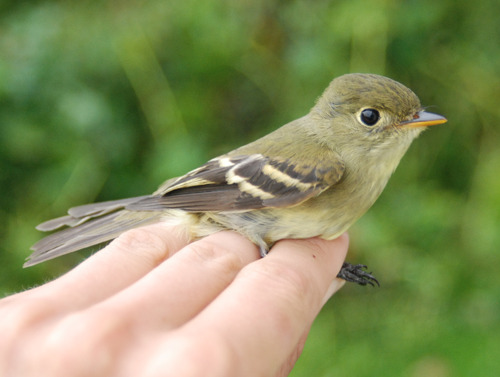
This hatching-year bird can be identified by it overall yellow appearance (through the throat), small bill, steeply sloped forehead, and slight emargination on primary 6 (usually).
Powdermill Nature Reserve’s avian research center is part of Carnegie Museum of Natural History’s biological research station in Rector, Pennsylvania. The research center operates a bird banding station, conducts bioacoustical research, and performs flight tunnel analysis with the goal of reducing window collisions.
Flycatcher
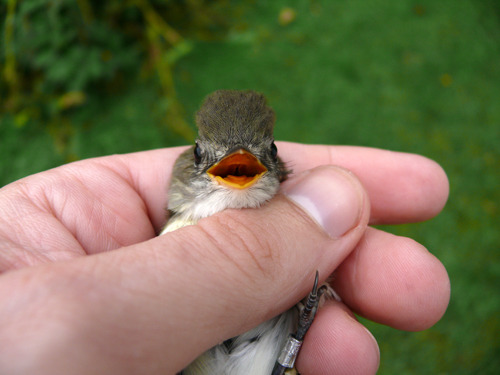
Check out the yellow-orange mouth lining of this Flycatcher.
Powdermill Nature Reserve’s avian research center is part of Carnegie Museum of Natural History’s biological research station in Rector, Pennsylvania. The research center operates a bird banding station, conducts bioacoustical research, and performs flight tunnel analysis with the goal of reducing window collisions.
