• Skip to primary navigation
  • Skip to main content
  • Skip to primary sidebar

Carnegie Museum of Natural History

One of the Four Carnegie Museums of Pittsburgh

  • Visit
    • Buy Tickets
    • Visitor Information
    • Exhibitions
    • Events
    • Dining at the Museum
    • Celebrate at the Museum
    • Powdermill Nature Reserve
    • Event Venue Rental
  • Learn
    • Field Trips
    • Educator Information
    • Programs at the Museum
    • Bring the Museum to You
    • Guided Programs FAQ
    • Programs Online
    • Climate and Rural Systems Partnership
  • Research
    • Scientific Sections
    • Science Stories
    • Science Videos
    • Senior Science & Research Staff
    • Museum Library
    • Science Seminars
    • Scientific Publications
    • Specimen and Artifact Identification
  • About
    • Mission & Commitments
    • Directors Team
    • Museum History
  • Tickets
  • Give
  • Shop

iNaturalist

May 19, 2020 by wpengine

Joining the iNaturalist Team!

Carnegie Museum of Natural History has promoted participation in the Pittsburgh City Nature Challenge for the past three years. Because I live outside the six-county “Challenge” region, I decided to help the best way I know how, by participating, as time permits, in the identification phase of the iNaturalist-based project.

Although publicity about the City Nature Challenge tends to focus on the value of participants documenting the diversity of life around them by taking pictures and submitting them via the iNaturalist app, the proper identification of submitted images is critically important.

My normal carpool commute time to the museum is usually a little over an hour. So, I decided that what would normally be my commute time to work would become my iNaturalist identification time. This process proved to be enlightening in several ways.  First was the digital proof that a lot of people in the Pittsburgh region are interested in the outdoors. That is a good thing! Second, was the ample evidence that people of all ages got involved in a project that can potentially help me and other scientists track what is going on in the outdoors. Also, a good thing. Submitted images can help us track phenology, the timing of recurring events such as plant blooming or fruiting.
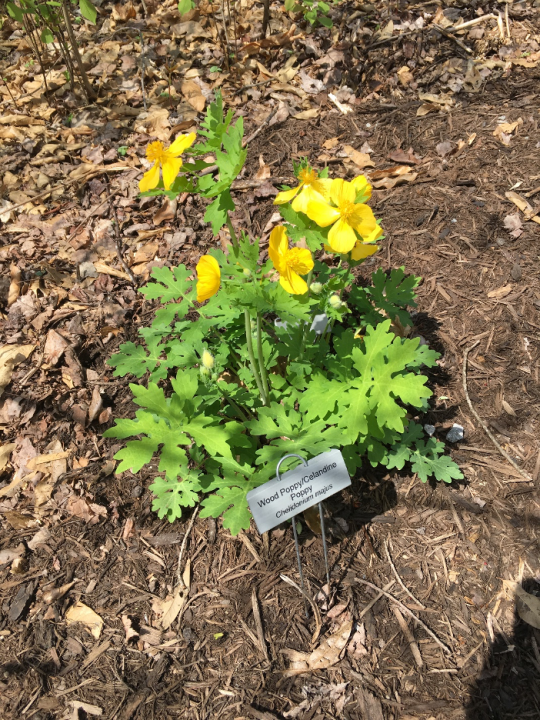
Photo of Stylophorum diphyllum mislabeled as Chelidonium majus in a native plant garden. Credit: BL Isaac

We can also use iNaturalist records for distribution studies. For instance, there is a “native” plant known as the woods-poppy (Stylophorum diphyllum) that we don’t have any records of from natural populations in the Commonwealth of Pennsylvania. There are nine documented Pennsylvania specimens in herbaria that I am aware of. Only one of those is older than I am.  The locality data on it is very vague and suspect as to whether it is really from Pennsylvania. (“Probably near Zelienople” is a far from precise location.) The other eight specimens are all known to be from cultivated populations. These specimens are from only three counties. State botanists have been discussing and debating this plant for several decades. It is native in Ohio and west, but is it native in Pennsylvania? There are now nearly 300 observations of woods-poppy (Stylophorum diphyllum) from across Pennsylvania on iNaturalist.

What is going on here? Have botanists just been overlooking this thing for decades?  Is it escaping from cultivated populations?  I know that it is being sold in native plant nurseries, so are folks just buying it and planting it out and about?  I do know that we need to get out and get some of these populations documented. Maybe by visiting some of the sites we can postulate why this plant that wasn’t seen in Pennsylvania for centuries is now popping up everywhere.

I have also learned that there is plenty of room for educating people on the importance of knowing how to identify plants.  It is almost scary the number of people (it doesn’t take many) who have trouble identifying poison ivy. There are also plenty of problems with identifying common backyard plants.  I have been active the last few years with plant identification workshops, and there is certainly a need for more of these. I’ll continue to learn as I continue to help identifying plants for the City Nature Challenge while I “commute” to work. I’m eager to see what other mysteries may pop up that pique my curiosity about the world around us.

Bonnie Isaac is the Collection Manager in the Section of Botany. Museum staff, volunteers, and interns are encouraged to blog about their unique experiences and knowledge gained from working at the museum.

Related Content

City Nature Challenge

City Nature Challenge Recap

The City Nature Challenge Family Experience

Carnegie Museum of Natural History Blog Citation Information

Blog author: Isaac, Bonnie
Publication date: May 19, 2020

Share this post!

  • Share on Twitter Share on Twitter
  • Share on Facebook Share on Facebook
  • Share on Pinterest Share on Pinterest
  • Share on LinkedIn Share on LinkedIn
  • Share on Reddit Share on Reddit
  • Share via Email Share via Email

Share this post!

  • Share on Twitter Share on Twitter
  • Share on Facebook Share on Facebook
  • Share on Pinterest Share on Pinterest
  • Share on LinkedIn Share on LinkedIn
  • Share on Reddit Share on Reddit
  • Share via Email Share via Email

Filed Under: Blog Tagged With: Bonnie Isaac, botany hall, City Nature Challenge, iNaturalist, Section of Botany

April 19, 2019 by wpengine

More Info: Steel City Nature Challenge on the Blog: Here We Go Pittsburgh!

City Nature Challenge 2019 logo

Ever wondered what wildlife is thriving in your city?  One way to learn about what is in your backyard is to team up with other people to explore nature through the City Nature Challenge!  The competition has been running since 2016, beginning in California, and growing into an international event. This year people will be participating from Antarctica to India!

We Need Your Help!

Your challenge is to look around and take pictures of as many types of plants, animals, and fungi as you can in four days!  Cities around the world are competing with each other to see who can log the most observations on iNaturalist (a free online and mobile application) – and we want Pittsburgh to have its best year yet!  This year, the City Nature Challenge takes place in two stages: the first part is April 26 – April 29 and the second part is April 30 – May 5. We’re calling for anyone in the Allegheny, Butler, Washington, Armstrong, Beaver, and Westmoreland counties to put their exploring hats on and help us identify the wildlife in our area!

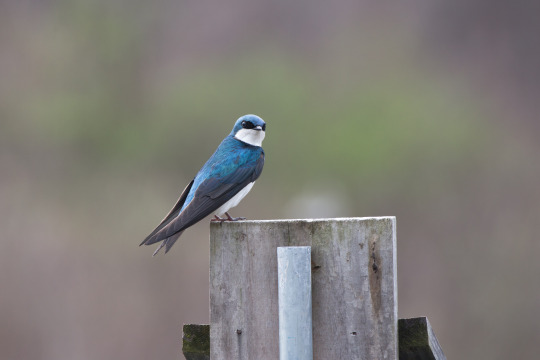
bird on a post
Spring is a great time to go outside and look for wildlife!

Three Simple Steps

All you need to remember to participate are these steps:

1.    Find Wildlife!

2.    Take Pictures!

3.    Share your Findings on iNaturalist!

Stage One: April 26 – April 29

Take a picture of every wild plant or animal you find, even if it’s something you see every day!  Only photos taken during this period of time will count for the Challenge. Last year the City Nature Challenge had over 420,000 observations – can we get even more this year?

Places to look for wildlife: your backyard, local parks, hiking trails, gardens.

Stage Two: April 30 – May 5

Identify what you’ve found and explore others’ observations!  You can confirm other people’s identifications or suggest a different identification.  If you receive two confirmations for a picture you’ve shared, you’ve got yourself a research grade identification!  Cool!

How Do I Use iNaturalist?

Below are two videos to help you navigate iNaturalist.  The first will explain how you can upload observations onto iNaturalist for stage one.  The second will show you how you can identify others’ observations during stage two.

Stage One: Uploading Observations

Stage Two: Identify and Confirm Observations

image has text at the top that says City Nature Challenge is Organized By, underneath the text are logos for California Academy of Sciences and Natural History Museum of Los Angeles County

Explore nature together.  Visit Nature 360 for activities and information.

Blog post by Melissa Cagan.

Filed Under: Blog Tagged With: Anthropocene, City Nature Challenge, iNaturalist, Melissa Cagan, Nature 360, Pittsburgh

December 31, 2018 by wpengine

Expanding the value of herbarium specimens with citizen science app, iNaturalist

By Mason Heberling

Biological collections are at the heart of the natural history museum. Biological collections are large and diverse, with specimens of shells, bugs, birds, fossils, bones, plants, and more. They were collected anywhere from the sidewalk in front of the museum this past spring to a remote jungle on the other side of the world a century ago.

Each of the roughly 22 million objects at the Carnegie Museum of Natural History have valuable scientific stories to tell. Knowledge derived from museum specimens motivate or inform nearly every aspect of museum practice. Specimens are used directly in museum exhibitions and programming. Specimens are sources of scientific data, used by researchers both at the museum and across the world to understand the past, present, and future of life. And these specimens continue to be used in new and innovative ways to inform us about the world and the impact of humans in the Anthropocene.

Collecting from nature for admiration and study is an ancient practice, with plant collecting among the oldest. The oldest known collection of plants, known as an herbarium (plural: herbaria), dates to 16thcentury Italy!

But specimen collecting is not a dated practice; it is not just something botanists used to do. Plant collecting remains to this day an active and necessary part of botanical science. With over half a million plant specimens, the Carnegie Museum herbarium is not stagnant.  Our collection continues to grow. New specimens are collected and added to the herbarium each year, expanding the scope of the collection and therefore its scientific and societal relevance. In fact, in the recent era of rapid environmental change, new collections are all the more important.

Despite the continued importance of this practice, the standard process for collecting new specimens has change remarkably little through time. Major changes in collection practices include the use of GPS coordinates and to a lesser extent, specific sampling methods for genetic analyses.

In the Section of Botany, Bonnie Isaac (Collections Manager) and I are developing innovative ways to maximize the future use of our collections. One way we are doing this is by linking our collections to the popular citizen science platform, iNaturalist (inaturalist.org). iNaturalist is a free resource available online or as a mobile app that allows users to record biodiversity observations. We are using iNaturalist in the field and in the herbarium to facilitate new collections and expand the research value of specimens.

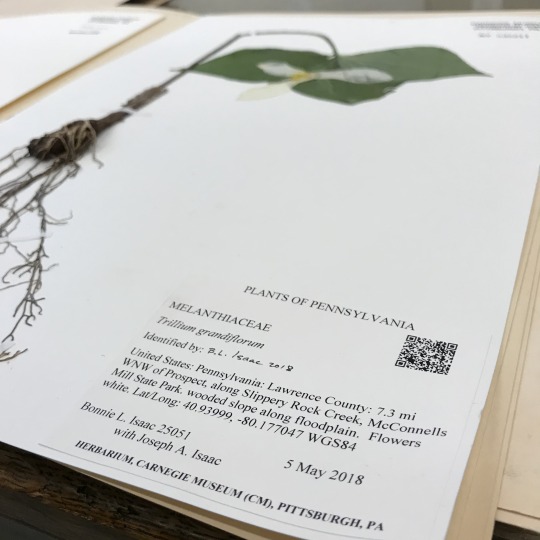
Herbarium specimen of large flowered trillium (Trillium grandiflorum) with QR code on label
Herbarium specimen of large flowered trillium (Trillium grandiflorum) with QR code on label that directs researchers to the associated iNaturalist observation, including images of the plant in the wild.

Before collecting a specimen, we take images in the field of the specimen in real life. These images are uploaded to iNaturalist, including other data such as date, time, location, and species identification. Other iNaturalist users can also contribute directly through verifying the identity of the specimen or making other comments.

Back in the herbarium, we export this information from iNaturalist to create unique herbarium labels for each specimen. We are using QR codes to link the specimens to the online iNaturalist observation. These QR codes can be read by most mobile devices. Among other information, the iNaturalist observation account online permanently links images from the field to the physical specimens in the herbarium.

What color were the flower petals? What was the size of the plant? Did it have a unique pattern on the bark?  What was the branching pattern? These questions and more can be asked to place herbarium specimens in a more complete context.

We envision a future where researchers can go through the herbarium with a mobile device such as a tablet or smart phone, scan QR codes on specimens, and be immediately directed to images of the specimen in the field.

Our article outlining this approach is available for free online:

Heberling, J. M., and B. L. Isaac. 2018. iNaturalist as a tool to expand the research value of museum specimens. Applications in Plant Sciences 6(11): e1193.  https://bsapubs.onlinelibrary.wiley.com/doi/epdf/10.1002/aps3.1193

Mason Heberling is Assistant Curator of Botany at the Carnegie Museum of Natural History.


Check back for more! Botanists at the Carnegie Museum of Natural History have embarked on a three-year project to digitize nearly 190,000 plant specimens collected in the region, making images and other data publicly available online. This effort is part of the Mid-Atlantic Megalopolis Project (mamdigitization.org), a network of thirteen herbaria spanning the densely populated urban corridor from Washington, D.C. to New York City to achieve a greater understanding of our urban areas, including the unique industrial and environmental history of the greater Pittsburgh region. This project is made possible by the National Science Foundation under grant no. 1801022. Any opinions, findings, and conclusions or recommendations expressed in this material are those of the author(s) and do not necessarily reflect the views of the National Science Foundation.

Filed Under: Blog Tagged With: Bonnie Isaac, Botany, Hall of Botany, herbarium, iNaturalist, Mason Heberling, plants

May 14, 2018 by wpengine

Pittsburgh Participates in International City Nature Challenge

We are thrilled to share that Pittsburgh has come in 26th of nearly 70 cities that participated in the City Nature Challenge! It’s a friendly competition between cities around the world. Anyone can join by logging their outdoor observations on iNaturalist.org or with the iNaturalist app.

Matt Webb, Urban Bird Conservation Coordinator at Powdermill Nature Reserve, led Pittsburgh’s involvement in the challenge. It lasted four days, from April 27-30, and 165 Pittsburghers contributed observations.

Pittsburgh participants logged 4,393 observations of 847 species with iNaturalist.

The winning city, San Francisco, had 1,532 participants who logged 41,737 observations of 3,211 species.

Even though the competition is over, anyone may still log observations using iNaturalist. Download the free app to your phone, create an account, and photograph what you see outside. The GPS on your phone automatically logs in the date, time, and location of your photo. You may add information you already know about the plant, animal, or insect you photographed, then community members may contribute more information and confirm species identification. It’s all about having fun learning in nature.

To read more about Pittsburgh’s participation in the City Nature Challenge and Matt Webb, check out this feature in Allegheny Front.

Filed Under: Blog Tagged With: City Nature Challenge, iNaturalist, Pittsburgh, Powdermill, Powdermill Nature Reserve

sidebar

About

  • Mission & Commitments
  • Directors Team
  • Museum History

Get Involved

  • Volunteer
  • Membership
  • Carnegie Discoverers
  • Donate
  • Employment
  • Events

Bring a Group

  • Groups of 10 or More
  • Birthday Parties at the Museum
  • Field Trips

Powdermill

  • Powdermill Nature Reserve
  • Powdermill Field Trips
  • Powdermill Staff
  • Research at Powdermill

More Information

  • Image Permission Requests
  • Science Stories
  • Accessibility
  • Shopping Cart
  • Contact
  • Visitor Policies
One of the Four Carnegie Museums | © Carnegie Institute | Privacy Policy | Terms of Use | Accessibility
Rad works here logo