• Skip to primary navigation
  • Skip to main content
  • Skip to primary sidebar

Carnegie Museum of Natural History

One of the Four Carnegie Museums of Pittsburgh

  • Visit
    • Buy Tickets
    • Visitor Information
    • Exhibitions
    • Events
    • Dining at the Museum
    • Celebrate at the Museum
    • Powdermill Nature Reserve
    • Event Venue Rental
  • Learn
    • Field Trips
    • Educator Information
    • Programs at the Museum
    • Bring the Museum to You
    • Guided Programs FAQ
    • Programs Online
    • Climate and Rural Systems Partnership
  • Research
    • Scientific Sections
    • Science Stories
    • Science Videos
    • Senior Science & Research Staff
    • Museum Library
    • Science Seminars
    • Scientific Publications
    • Specimen and Artifact Identification
  • About
    • Mission & Commitments
    • Directors Team
    • Museum History
  • Tickets
  • Give
  • Shop

Blogs from Powdermill Nature Reserve

Powdermill Nature Reserve is Carnegie Museum of Natural History’s environmental research center. Located 55 miles southeast of Pittsburgh in Rector, Pennsylvania, Powdermill is a field station and laboratory where researchers do long-term studies of natural populations in western Pennsylvania. In addition to being positioned for Appalachian-specific studies in ornithology, ecology, invertebrate zoology, and botany, Powdermill is a great place to spend a fun-filled day outdoors with the family.

February 25, 2019 by wpengine

Bugs on Bugs on Bugs…on Birds

Big fleas have little fleas

Upon their backs to bite ‘em;

And little fleas have lesser fleas

And so, ad infinitum.

-Ogden Nash

Flat flies, louse flies, keds. The distinctive members of the fly family Hippoboscidae go by many names. All are obligate blood feeders found on mammals or birds and have a flattened body shape suitable for sliding in between the feathers and fur of their hosts. Their life history is as strange as their appearance, I assure you. While the vast majority of flies and other insects lay numerous eggs to reproduce, female hippoboscids prefer a more mammalian strategy. A single fertilized egg hatches within the female, and the developing larva is nourished within the mother through specialized “milk” glands until it is fully grown. The hugely swollen female then gives birth to a mature larva which immediately pupates, and later emerges as a winged adult hungry for a blood meal.

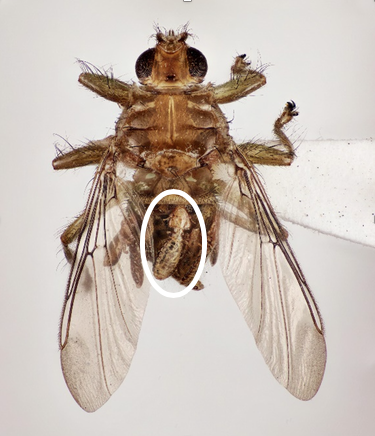
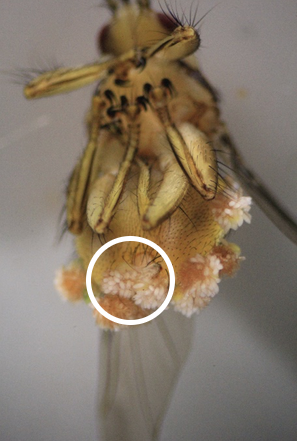
Hippoboscids are frequently encountered at the banding station at Powdermill Nature Reserve. Last year, most of the birds that were processed here were checked for these parasites, which were collected. Not much is known about these flies on songbirds as most of the research conducted deals with raptors. While identifying the flies under a microscope, we discovered these flies were often carrying some smaller bugs with them on their abdomens. These hitchhikers were bird lice and avian skin mites (see photos).
fly with white circle drawn around bird lice on abdomen
Dorsal view of a hippoboscid fly with several bird lice hitching a ride on its abdomen.


fly with white circle drawn around mites
Ventral view of a hippoboscid fly carrying several female avian skin mites (Epidermoptidae), each surrounded by a cluster of white eggs.

Both of these small parasites are wingless and poor dispersers, but can conveniently get from bird to bird by riding on the hippoboscid flies, a strategy called phoresy. In the case of the skin mites, the females actually require a hippoboscid to reproduce. They attach themselves to the body of the fly and lay their eggs all around them in a clump. To add to the craziness, sometimes the mites attach to the lice which attach to the fly, which you find on birds. So there you have it. Bugs on bugs on bugs… on birds!

Andrea Kautz is a Research Entomologist at Carnegie Museum of Natural History’s Powdermill Nature Reserve. Museum employees are encouraged to blog about their unique experiences and knowledge gained from working at the museum.
Filed Under: Blog Tagged With: Andrea Kautz, avian research, Birds, bugs, Powdermill Nature Reserve

January 22, 2019 by wpengine

Woodlands in White

By John Wenzel

As we enter 2019, I start my ninth year here, and Powdermill Nature Reserve grows cold and quiet. The summer woodland is easy to appreciate, full of sounds of birds in the day, and frogs and insects at night, but for me the forest is most elegant in winter.

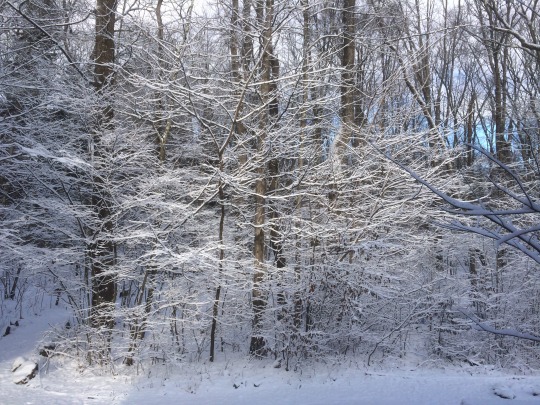
Powdermill woods covered in snow

I moved to Powdermill in January, and at first I lived alone at the reserve. My first season was one of snow and solitude, of beauty and discovery.  The woods are never as striking as when every dark twig is lined in white, creating a world of infinite fragile lace. The naked branches let the explorer see much farther than when the woods are heavy with leaves.  We see deep into the forest, and through it entirely across a hilltop or when we are above the wooded valley.  Animal tracks in the snow allow us to feel the presence of the unseen wildlife more than we do in summer. Wet seeps from mountain springs melt away spots of snow and provide the occasional soothing view of bright green moss, which is very welcome and more readily admired in the starkness of winter.

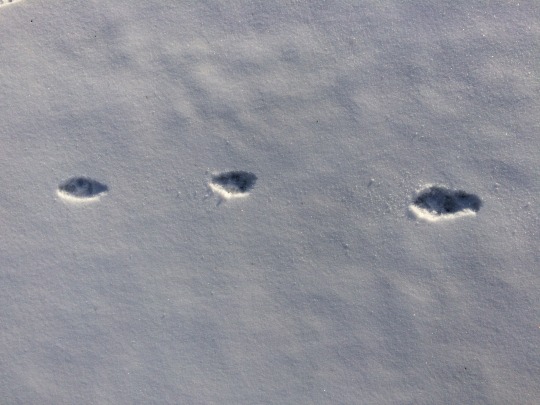
coyote tracks in snow
Coyote tracks at Powdermill Nature Reserve.

Noise of the outside world is nearly absent when a blanket of snow covers the landscape.  This makes the bubbling flow of Powdermill Run all more distinct, and more focal in the outdoor experience. In daylight, we see the million crystal reflections beneath a bright blue sky. At night, far from town, we marvel at the inestimable number of brilliant stars in the onyx above.  Perhaps because visitors to the Nature Center are few in winter, I feel that the reserve is more “mine” than at other times. My Powdermill is the quiet, winter Powdermill, dressed in white and hushed by the cold.

John Wenzel is the Director at Powdermill Nature Reserve, Carnegie Museum of Natural History’s environmental research center. Museum employees are encouraged to blog about their unique experiences and knowledge gained from working at the museum.
Filed Under: Blog Tagged With: John Wenzel, nature, Powdermill, Powdermill Nature Reserve, Winter

December 31, 2018 by wpengine

From Metes and Bounds to GPS: Part 2

By James Whitacre

In my last post I talked about how surveyors and cartographers used chains and compasses to survey the land. They also used the system of metes and bounds to describe the data they collected, typically for land ownership purposes. At the GIS Lab at Powdermill Nature Reserve, we no longer use these techniques of old when mapping research data in the field. But with today’s advances in technology, we use much different methods and tools to collect research data.

The primary tool used today for collecting data in the field is a GPS receiver, as you might have guessed. At Powdermill, we use these devices to quickly and efficiently record latitude, longitude, and altitude. We can also couple GPS receivers with mobile apps to help us collect other non-spatial data.

To learn more about projects that use mobile apps and GPS, I recommend checking out the BirdSafe Pittsburgh program and our effort to map plastic waste.

However, you may be wondering, what exactly is GPS…and what does it actually stand for? The Global Positioning System (GPS) is operated by the US Air Force and has been around since 1978. It is a world-wide constellation of over 30 satellites that are constantly in orbit around the earth. With just four satellites in view, the location of the GPS device can be determined by using a process called trilateration, which measures the distances between multiple satellites and the device on the ground (I’m not going to get into the technical math…). GPS is also just one of a few other global navigation satellite systems (GNSS), as Russia, China, and the European Union all have operational systems as well. Many GPS devices utilize all GNSS systems.

There are many different types of GPS devices and they are generally categorized into three accuracy levels: recreational grade (accurate from 3 to within 10 meters), mapping grade (0.5 to 3 meters), or survey grade (1 millimeter to 0.5 meters). If your smartphone has GPS on it, as most do, that is considered a recreational grade GPS device. Other recreational GPS devices, such as Garmin devices, are fairly affordable and can be found at sporting goods stores. More sophisticated GPS devices for mapping and surveying are not typically found in stores and must be ordered from specialty vendors.

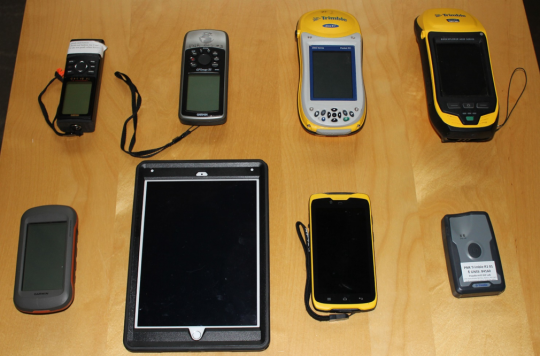
GIS lab mapping tools including GPS

The above image shows the different devices the GIS Lab has used over the years. At Powdermill, we use mapping grade GPS devices most often, as represented by the four devices on the right in the image above, but we also use recreational GPS devices and GPS-enabled mobile devices, which are the four devices on the left. We no longer use the top row of devices as the devices on the bottom row are newer technology that vastly outperform the older devices. The need for survey grade GPS devices is not typically needed for research at Powdermill, as one to three meters of accuracy is usually good enough for most ecological and field biology research.

By collecting research data with geographic information collected from GPS, we can analyze ecological phenomena in space, which allows us to discover much more about plant and animal communities. For example, we have used GPS to collect where trees are in addition to the species and size of the trunk. When we analyzed the distribution of our trees, we learned that red maples tend to grow on south facing slopes, while sugar maples tend to grow on north facing slopes. This information could impact future decisions for our forest management. Therefore, it is essential that we think spatially about our research!

James Whitacre is the GIS Research Scientist for Carnegie Museum of Natural History, where he primarily manages the GIS Lab at Powdermill Nature Reserve, the Museum’s environmental research center. Museum employees are encouraged to blog about their unique experiences and knowledge gained from working at the museum.
Filed Under: Blog Tagged With: GIS lab, GIS Research, James Whitacre, Powdermill Nature Reserve, research

November 14, 2018 by wpengine

Snowflakes and Snow Fleas

by John Wenzel

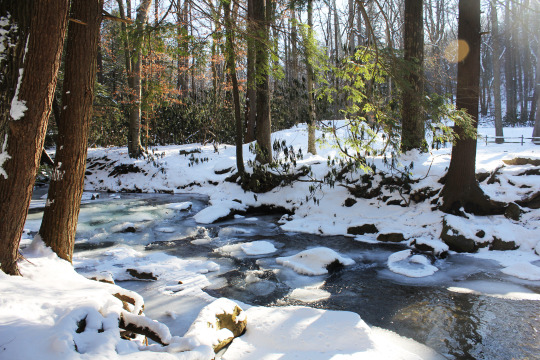
river and trees in the snow

When Shakespeare wrote “Now is the winter of our discontent,” he certainly was not referring to entomologists.  Botanists, mammalogists, ornithologists, and herpetologists spend most of the winter in the office waiting for spring. But many entomologists remain busy because insects that live under water go into high gear and treat the winter as their growing season. Hatching from eggs in spring or summer, these aquatic “macroinvertebrates” get their Thanksgiving dinner as the leaves fall into the stream. The insects are grazing and hunting underwater, growing to adulthood, preparing to fly away next spring when the air is warm again.

I was lucky to grow up with a 10 acre woodlot on one side of our house and a 12 acre pond on the other. As a kid, I loved to be out in my row boat or exploring the woods, hunting wildlife, catch and release. My parents encouraged my interests in nature, providing books and equipment that allowed me to increase my knowledge and experience as I grew.

I raised caterpillars through metamorphosis, marked turtles that I would find again years later, and nursed orphaned baby animals. Initially, I had no special preferences other than those that seem to come naturally to all humans. Mammals capture our affection, we all wish we could fly like birds, predators are particularly interesting, as is anything colorful or rare. By the time I was in college, I decided to study insects as a career for many reasons, and chief among them was a very pragmatic element for a striving academic: if you know about insects, you can find fascinating species in your backyard, wherever you live, anywhere in the world.

Since college, I have learned a great deal about many other groups, but when winter is approaching, I enjoy very much being an entomologist.  Even on the coldest day in January, I can go out to a stream and find abundant insects doing their thing, below the ice in the cold water. Some specifically emerge in winter when there are no predators around. At Powdermill Nature Reserve, we have plenty of wonderful winter insects, and it is great fun to hunt for these gems.

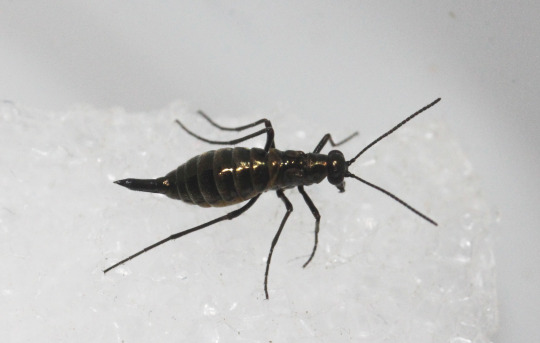
scorpionfly

Here you see a female Boreus scorpionfly who came up from a patch of moss to walk across the snow looking for a male in late December. Also called a snow flea, Boreus is so rare that few entomologists ever see them alive. There is a deep reward in learning to appreciate small things, and I have never regretted becoming an entomologist, especially as winter approaches.

Want to know more about winter bugs? Read about the first Powdermill Christmas Bug Count.

John Wenzel is the Director at Powdermill Nature Reserve, Carnegie Museum of Natural History’s environmental research center. Museum employees are encouraged to blog about their unique experiences and knowledge gained from working at the museum.
Filed Under: Blog Tagged With: entomology, insects, John Wenzel, Powdermill Nature Reserve, Winter

November 12, 2018 by wpengine

From Metes and Bounds to GPS: Part 1

By James Whitacre

Did you know that George Washington was a cartographer? Well, technically his training was in surveying, but back in his time, surveyors would typically create beautiful maps to show off their surveys. Other famous Americans, such as Thomas Jefferson, Abraham Lincoln, and both Meriwether Lewis and William Clark, were also surveyors.

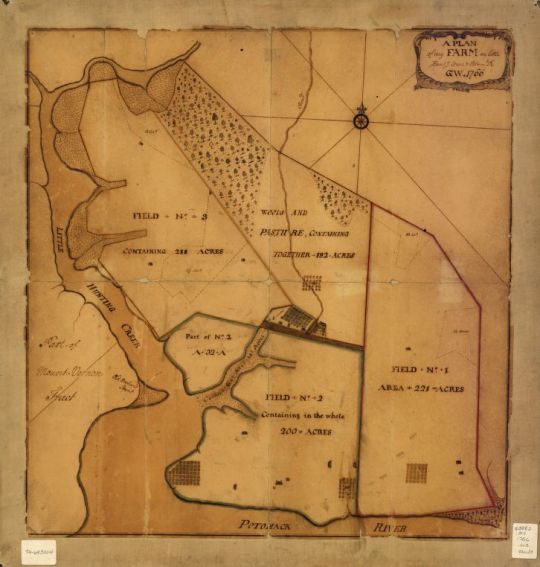
The map below is of one of Washington’s many farms near Mount Vernon, VA, which shows off his stellar map-making skills. Around the time when Washington was surveying land, the profession was gaining more ground as the industrial revolution was taking shape and the US was expanding.

map of George Washington's farm

A plan of my farm on Little Huntg. Creek & Potomk. R., George Washington, 1766; Source: Library of Congress

As I look in awe at Washington’s map, I can’t help but wonder how surveyors and cartographers collected and visualized their geospatial data before computers and GPS were around. It truly is a great mix of science and art. However, Washington and his fellow surveyors of antiquity used much different techniques than we use today.

Surveyors would use chains, rods (which were literally poles of a fixed length), and a surveyor’s compass or a Theodolite to quickly measure distances and angles. The Gunter’s Chain measured 66 feet long and contained 100 links. This chain could be used to measure many other lengths, for instance a rod (aka a pole or perch) equaled 25 chain links (16.5 feet), 10 chains equaled a furlong (660 feet or 1/8 mile), and 80 chains equaled one mile (5,280 feet). Further, an acre is defined as a one chain by one furlong (66 by 660 feet), which is 43,560 square feet (Are you able to follow all that math?).

The Theodolite contains an optical telescope with cross-hairs that is used to sight direction and then the angle or bearing can be read off a scale. Surveyors would also use sophisticated instruments such as zenith telescopes, sextants, or octants to determine the positions of the sun or stars which could also help with determining latitude and longitude.

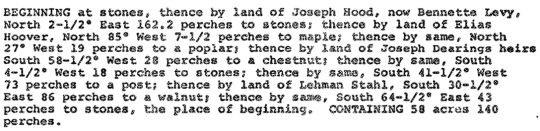
By recording the measurements and angles or bearings from these instruments, surveyors would describe the land using a system called metes and bounds. This system also incorporates physical features, such as trees, stones, and streams, to describe the boundaries. Metes and bounds were originally used in England, and it is still used today, even in Pennsylvania. The image below is an example from one of Powdermill’s metes and bounds descriptions. Surveyors and cartographers can decipher these descriptions and use geometry (which comes from the Greek “earth measurement”) to find property boundaries in the field, or draw and chart the measurements on to paper, thus creating maps.

example of metes and bounds description

Example of Metes and Bounds description from Powdermill Nature Reserve; Source: Westmoreland County, PA, Recorder of Deeds

At the Geographic Information Systems (GIS) Lab at Powdermill Nature Reserve, we spend a lot of our time collecting scientific data for research in the field so that it can be mapped and analyzed. Today, however, we use sophisticated GPS units, mobile devices, and high-end GIS software to help us efficiently collect, analyze, and visualize our field data. Stay tuned for my next blog post where I will discuss how GPS works and how we use it in our everyday research at Powdermill Nature Reserve.

James Whitacre is the GIS Research Scientist for Carnegie Museum of Natural History, where he primarily manages the GIS Lab at Powdermill Nature Reserve, the Museum’s environmental research center. Museum employees are encouraged to blog about their unique experiences and knowledge gained from working at the museum.
Filed Under: Blog Tagged With: GIS Research, James Whitacre, Powdermill Nature Reserve

November 12, 2018 by wpengine

Pennsylvania Botany 2018

by Bonnie Isaac

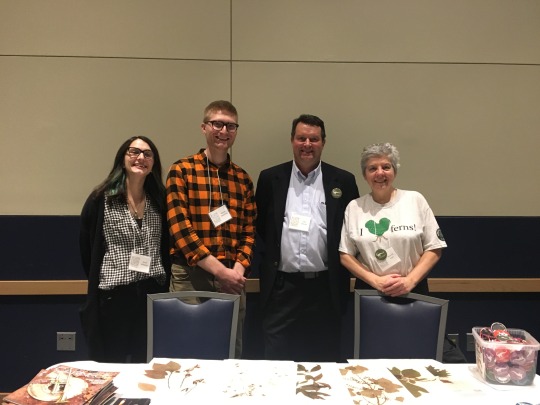
Carnegie Museum of Natural History (CMNH) was well represented at PA Botany 2018. The 4th Biennial Pennsylvania Botany Symposium took place on November 2nd and 3rd at the Penn Stater Hotel and Conference Center. CMNH staff were there in full force.  PNR Director John Wenzel, Post-Doctoral Fellow Mason Heberling, Botany Collection Manager Bonnie Isaac, and Botany Curatorial Assistant Sarah Williams attended in addition to over 200 other people. This event features a day of workshops followed by a day of presentations. CMNH Botany folks were involved in both the workshops and the symposium talks. Williams & Isaac assisted workshop leaders, Heberling was a student in one of the workshops, and Wenzel was a symposium speaker.  CMNH Botany volunteer Joe Isaac was the instructor for the workshop for Botanical Consultants.

Curatorial Assistant Sarah Williams, Post-Doctoral Fellow Mason Heberling, PNR Director John Wenzel and Botany Collection Manager Bonnie Isaac at CMNH Table in the Exhibitor hall at PA Botany 2018.

John Wenzel’s presentation highlighted some of the exciting things going on at Powdermill Nature Reserve and CMNH integrating botany and technology. John showed the crowd some of the cool techniques developed at PNR for forest study using drones and computer simulation of trees as well as introducing them to the new AR Perpetual Garden App available for free in app stores. This app helps people learn about the effects of the deer population on an environment. It shows how the forest should look compared to how the forest looks when deer are over abundant. The app features Woodland In Balance vs. Woodland Out of Balance Scenarios along with dialogue to explain the differences and why they differ.

CMNH Botany has been active in this event since its inception in 2012. We hope to see more people attend this conference on plants and how important they are.  You can find more information for this conference and other plant related items at PABotany.org.

Bonnie Isaac is the Collection Manager in the Section of Botany. Museum employees are encouraged to blog about their unique experiences and knowledge gained from working at the museum.
Filed Under: Blog Tagged With: Bonnie Isaac, Botany, John Wenzel, Mason Heberling, plants, Powdermill Nature Reserve, Sarah Williams

  • « Go to Previous Page
  • Page 1
  • Interim pages omitted …
  • Page 7
  • Page 8
  • Page 9
  • Page 10
  • Page 11
  • Interim pages omitted …
  • Page 17
  • Go to Next Page »

sidebar

About

  • Mission & Commitments
  • Directors Team
  • Museum History

Get Involved

  • Volunteer
  • Membership
  • Carnegie Discoverers
  • Donate
  • Employment
  • Events

Bring a Group

  • Groups of 10 or More
  • Birthday Parties at the Museum
  • Field Trips

Powdermill

  • Powdermill Nature Reserve
  • Powdermill Field Trips
  • Powdermill Staff
  • Research at Powdermill

More Information

  • Image Permission Requests
  • Science Stories
  • Accessibility
  • Shopping Cart
  • Contact
  • Visitor Policies
One of the Four Carnegie Museums | © Carnegie Institute | Privacy Policy | Terms of Use | Accessibility
Rad works here logo