• Skip to primary navigation
  • Skip to main content
  • Skip to primary sidebar

Carnegie Museum of Natural History

One of the Four Carnegie Museums of Pittsburgh

  • Visit
    • Buy Tickets
    • Visitor Information
    • Exhibitions
    • Events
    • Dining at the Museum
    • Celebrate at the Museum
    • Powdermill Nature Reserve
    • Event Venue Rental
  • Learn
    • Field Trips
    • Educator Information
    • Programs at the Museum
    • Bring the Museum to You
    • Guided Programs FAQ
    • Programs Online
    • Climate and Rural Systems Partnership
  • Research
    • Scientific Sections
    • Science Stories
    • Science Videos
    • Senior Science & Research Staff
    • Museum Library
    • Science Seminars
    • Scientific Publications
    • Specimen and Artifact Identification
  • About
    • Mission & Commitments
    • Directors Team
    • Museum History
  • Tickets
  • Give
  • Shop

Blogs from our Scientific Researchers

Carnegie Museum of Natural History is home to active research and vast scientific collections. Our scientific researchers regularly contribute to the blog at the museum.

March 27, 2020 by wpengine

Lantern Slides

As someone who was born in 1998, I grew up in a world full of LED screens. With the click of a button, screens come to life and display anything and everything. The black mirror suddenly stops reflecting your anticipating face and a myriad of icons and a colorful image burn themselves into your retinas. I couldn’t imagine another way of consuming images. I’ve perused old photo albums with glossy, physical photos as a fun trip down memory lane with my parents, but digital images displayed on our computer desktop or our television screen was my first remembered experience of imagery. Holding a camera, clicking a button, and having the image still and lit up on the camera screen. How else could it be?

I’ve worked in the Carnegie Museum of Natural History for 3 years now in the Herpetology department, and it never ceases to amaze me. I’ve been fascinated by the beautiful specimens from all corners of the world, some of which can’t be found in nature anymore. Our Alcohol House is home to many preserved frogs, salamanders, snakes, and turtles that I have worked closely with and appreciated for their features and patterns. Seeing these creatures that I would have to travel across the world to see in real life is a treat every time I go to the museum.
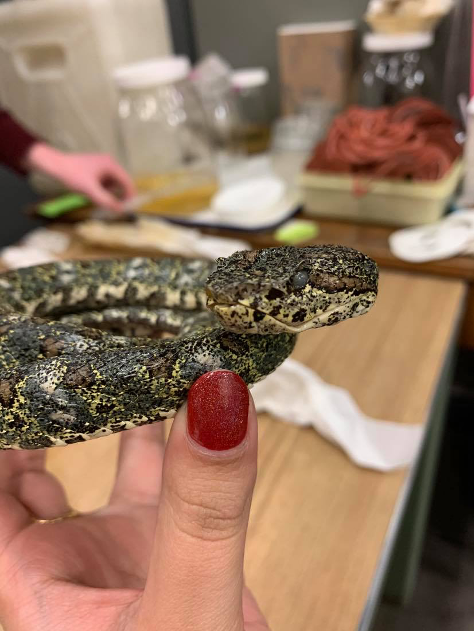
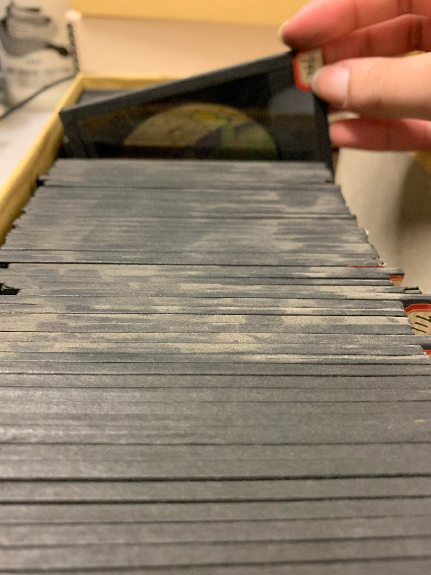
I recently moved from working on our physical preserved specimens to start a project of cataloging lantern slides that were used for presentations in the 1920s. We pulled out the boxes labeled Lantern Slides with numbers from 1- 1000. I opened it up, imagining vintage, unedited photographs with bright colors on glass. And instead it was filled with hundreds of dusty, sooty (Pittsburgh’s classic problem) rectangle slides stacked up in an unassuming row. I gingerly picked one up to see if I could see the image, and I could see a dull outline of a frog, nothing special, and less colorful and detailed than the preserved frogs I had seen from all corners of the world in the Alcohol House or the beautiful National Geographic photos I have seen online. Just a piece of dark glass with an outline of a frog. This…was going to be boring.
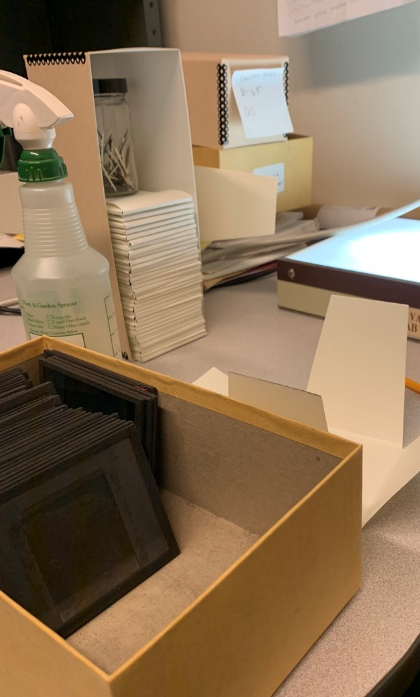
I sat down for my first day of going through the slides and set up my station for cleaning and recording the information on the slides. I saw that a new gadget had been added to my repertoire of conservation tools, a light box. I plugged it in and pressed the button–nothing. Sighing, I did the archaic press-and-hold, and the light slowly flickered on, creating a large rectangle of plain, white light. Buttons were meant to immediately turn something on and show me images, and this silly box not only required a press-and-hold but just showed me light! Dejectedly, I picked up the first lantern slide, number one, and looked at the dark image with the outline of a frog. I wiped off the black soot, and began to record the information, slide 1, photograph, frog… I wrapped it up to make sure that the glass and image wouldn’t get damaged and placed it into a new box. 999 more to go.
I went to pick up the next slide, when my eyes fell on the light box, which was currently acting as a glorified lamp. Should I make this task even more grueling by adding the extra step of placing the boring image on the boring light or should I just work through all of them as fast as possible and go back to handling our amazing specimens? I decided to take the extra step of placing the slide on the light box.

And suddenly, the image came to life.
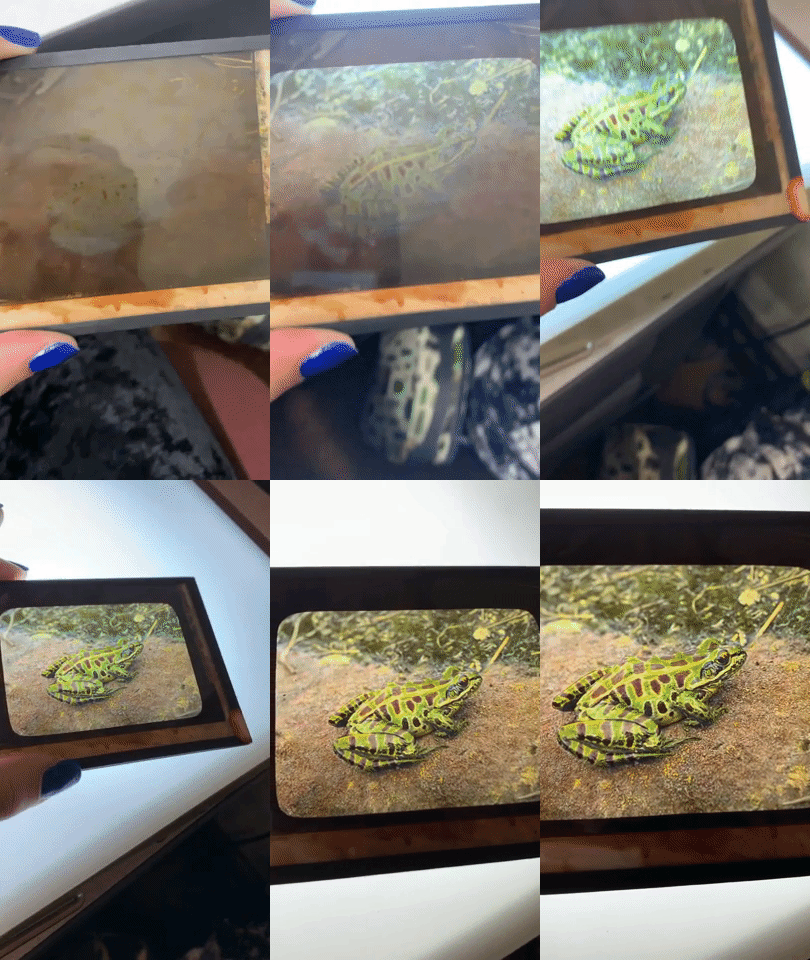
The vague green with some dark splotches that was dull on the slide became the vibrant color I had imagined, and the details of the frog’s pattern were crisp and clear. The image had an almost 3D, life-like quality that the screen does not have the depth to convey. I was shocked that these dust covered glass rectangles were holding such secrets within them, and that all it took was placing them on a light box to unveil their beauty. Without immediate gratification, I had made up my mind that these images weren’t beautiful, when all I had to do was take a few extra steps to discover images unlike those that I had seen on screens. I proceeded to take the image off and watch it revert back to dull and lifeless, and place it back on to the light box and watch it come to life, and marvel at how these little glass slides went from boring to fascinating in a second.

Lantern slides felt like they were of the past, a time where image projecting and quality must have been worse—right? By working with these old, dusty slides, I was able to see images of reptiles and amphibians the likes of which I hadn’t seen before. I now relish every opportunity I have to go into the museum and look at salamanders, snakes, alligators, and a whole host of other creatures (and researchers) on the light box. The Carnegie Museum of Natural History is rich with resources from the past and working with the Herpetology Department has given me the opportunity to get an inside look into how the museum might have operated far before even my grandparents were born. Getting involved in helping out at the museum is a wonderful way to get involved in outreach, science communication, and is an overall enriching experience!

Swapna Subramanian is an Anthropology and Ecology & Evolution double major at the University of Pittsburgh, and a volunteer in the Section of Herpetology at the Carnegie Museum of Natural History. Museum employees are encouraged to blog about their unique experiences and knowledge gained from working at the museum.
Filed Under: Blog Tagged With: amphibians and reptiles, herpetology, Science News

March 18, 2020 by wpengine

Collected on this Day in 1951: Bedstraw

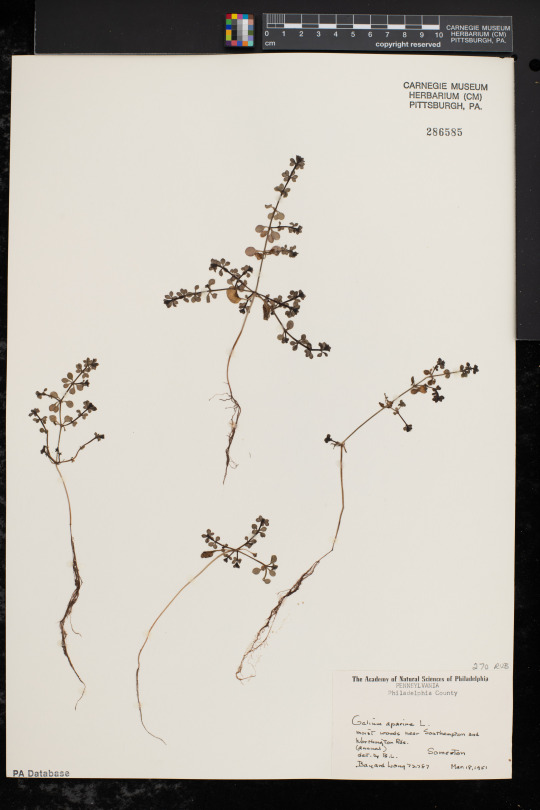
This bedstraw specimen was collected on March 18, 1951 by Bayard Long in Philadelphia county, Pennsylvania.

Bayard Long (1885-1969) was a Philadelphia-area botanist and an active member of the Philadelphia Botanical Club (founded in 1891 and still exists today).  He was a prolific collector and served as Curator of the Club’s Local Herbarium for 56 years (housed at the Academy of Natural Sciences).

Fogg writes of his collections in 1970 in the journal Rhodora: “It is doubtful that anyone ever possessed a higher standard for the quality of an herbarium specimen than Bayard Long.  Every leaf had to be laid out flat, every inflorescence properly displayed, every flower part clearly shown. Extra flowers and loose fruits and seeds were placed in pockets affixed to the sheet. Root systems (collected in their entirety whenever possible) were scrupulously clean, habitats were accurately described, and localities were identified to the nearest tenth of a mile and closest compass point. All of this seems the more remarkable when it is realized that Long collected close to 80,000 numbers, not including collections made as a member of Fernald’s expeditions.”

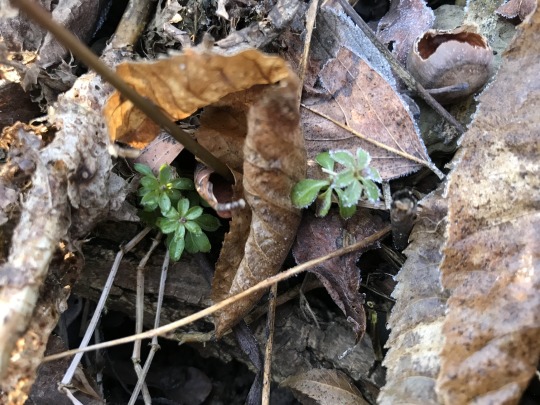
Bedstraws (species in the genus Galium, in the coffee family Rubiaceae) are common and memorable in our woods. They have many historical and traditional uses. In particular, they were used to stuff mattresses, hence the funny name. Also called cleavers or catchweed, the stems are sticky (due to fine hook hairs) and can be fun to stick on your clothes. They have likely stuck to you or your pet. This specimen is Galium aparine. An annual plant, seeds germinate in spring and produce tiny white flowers. They are emerging now, poking through the leaf litter.

Find this specimen and more here.

There are >64,000 specimens collected by Bayard Long currently digitized and online.

Check back for more! Botanists at the Carnegie Museum of Natural History share digital specimens from the herbarium on dates they were collected. They are in the midst of a three-year project to digitize nearly 190,000 plant specimens collected in the region, making images and other data publicly available online. This effort is part of the Mid-Atlantic Megalopolis Project (mamdigitization.org), a network of thirteen herbaria spanning the densely populated urban corridor from Washington, D.C. to New York City to achieve a greater understanding of our urban areas, including the unique industrial and environmental history of the greater Pittsburgh region. This project is made possible by the National Science Foundation under grant no. 1801022.

Mason Heberling is Assistant Curator of Botany at the Carnegie Museum of Natural History. Museum employees are encouraged to blog about their unique experiences and knowledge gained from working at the museum.
Filed Under: Blog Tagged With: Botany, collected on this day, Mason Heberling, Museum from Home, Science News

March 13, 2020 by wpengine

An Introduction to BirdSafe Pittsburgh

It is estimated that 599 million birds die every year in North America after colliding with buildings. BirdSafe Pittsburgh was created in 2014 to research why birds collide with windows and how best to resolve this immense problem. Since then, every Spring and Fall the Downtown area of Pittsburgh, and some surrounding areas, have been monitored for migrating birds that have collided with windows.

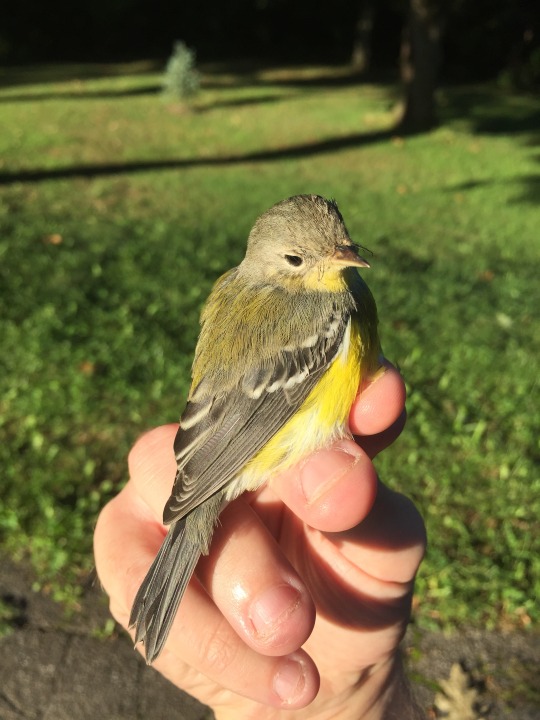
Fall first year female magnolia warbler. It was caught after colliding with a window downtown and later released in Schenley Park.

The unfortunate birds found dead are brought back to the museum where they become part of our collection. The birds found alive after a collision are taken to a local rehabilitation center and are eventually released if they survive their injuries. These efforts help us understand what about a building makes it dangerous to a bird and using this information we can mitigate deadly areas with the help of building owners and managers.

Every person’s effort makes a difference, volunteering to walk a predetermined route downtown or monitoring your own home helps us continue to learn and spread the word of this problem. For more information about the project and how you can get involved visit our website: birdsafepgh.org, our facebook page: facebook.com/birdsafepgh/, or contact Jonathan Rice at ricej@carnegiemnh.org.

Jon Rice Urban Bird Conservation Coordinator is at Carnegie Museum of Natural History’s Powdermill Nature Reserve. Museum employees are encouraged to blog about their unique experiences and knowledge gained from working at the museum.
Filed Under: Blog Tagged With: Birds, birdsafe pittsburgh, Science News

March 11, 2020 by wpengine

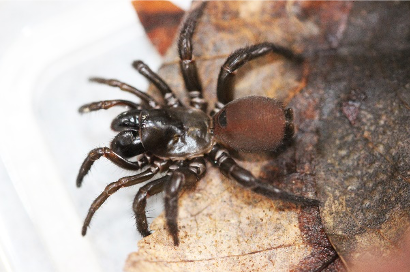
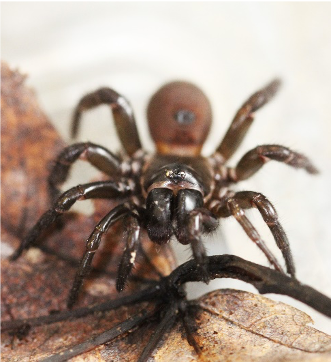
Tarantula relative found at Powdermill

On March 6th, CMNH herpetologist Dr. Danny Hughes came across a very cool spider at Powdermill while digging holes for a salamander survey, and graciously captured it for us. We were excited to find out that it was a folding-door spider in the family Antrodiaetidae and genus Antrodiaetus!  It is related to tarantulas and belongs to the same group of primitive spiders called mygalomorphs. They are uncommonly encountered, partly because they spend most of their lives in underground, silk-lined burrows. The entrance to the burrow is camouflaged with debris so that when unsuspecting prey walk by, the spider can just reach up and out of the opening, grab its meal, and retreat (see this YouTube video for an example: https://www.youtube.com/watch?v=k5owIY63g3E).

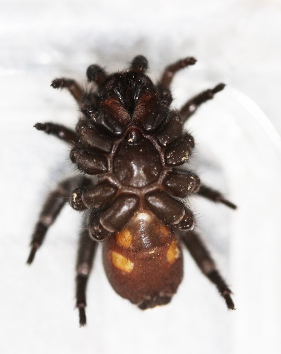
While the large fangs of these spiders may seem intimidating, they are not aggressive and are not of medical concern to humans because their venom is not very potent. In the ventral image, note the two pairs of yellow patches on the underside of the abdomen. These are respiratory structures known as book lungs. Nearly all spiders have a pair of book lungs, but only the primitive groups have two pairs.

Most folks are familiar with tarantulas which are found more in warmer climates, but these lesser-known mygalomorphs can be found right here in western PA. In fact, Powdermill is home to another family of mygalomorphs, the purseweb spiders (in the family Atypidae) which look similar, but they build silken tubes that run up along the base of a tree or rock above ground. We will be keeping our eyes peeled for this other cool family of spiders so we can photograph and show them off in another post. Stay tuned!

Andrea Kautz is a Research Entomologist at Carnegie Museum of Natural History’s Powdermill Nature Reserve. Museum employees are encouraged to blog about their unique experiences and knowledge gained from working at the museum.
Filed Under: Blog Tagged With: Invertebrate Zoology, Powdermill, Science News

March 9, 2020 by wpengine

How to Wear Your Shell: Snail vs. Monoplacophoran

Do you wear your baseball cap with the brim in front or in the back? For some headgear, the orientation matters, for example, a football helmet worn in non-standard orientation might hinder your ability to see.

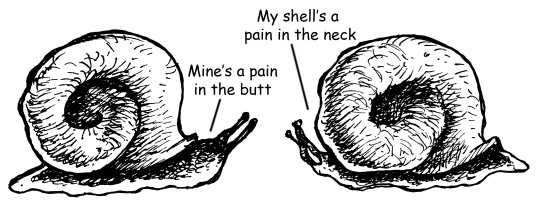
In most snails (gastropods), the shell coils over the tail. In some other mollusks, the shell coils over the head.

Torsion is a feature of all snails. Torsion is a 180° twisting of the head-foot with respect to the shell and internal organs, early in development. Torsion results in the anus being over the head (snails are real poop heads!). Why snails are torted remains a biological mystery, but a common hypothesis is that torsion also brings the gills and sensory organs to the front, and the anus just came along for the ride.

Snails have muscles that attach their bodies to the inside of their shells. Snails tighten these muscles to pull the body into the shell. A consequence of torsion is that the muscle scars (where muscles attach to the shell) are asymmetrical.

Monoplacophorans are a class of mollusks like snails except they do not undergo torsion. The lack of torsion means the shell coils over the head (in those having coiled shells). Furthermore, the muscle scars on their shells are symmetrical. Few monoplacophorans survive today, but they were more plentiful millions of years ago.

When I see snails in the funny pages in the newspaper, I notice that the cartoonists drew the shells in the standard orientation about half the time (50%, or random chance). When you see a cartoon snail with its shell in a non-standard orientation, you might wonder if it is really a monoplacophoran?

Next time you put on your baseball cap, think about how snails wear their shells, and remember the famous baseball snail: Slicky Mantle – he was quite a slugger – you should see him slide into home plate!

Cartoon mollusks with shell oriented as gastropod (left) and monoplacophoran (right). Illustration by Geoff Weber.

Timothy A. Pearce, PhD, is the head of the mollusks section at Carnegie Museum of Natural History. Museum employees are encouraged to blog about their unique experiences and knowledge gained from working at the museum.
Filed Under: Blog Tagged With: mollusks, Science News, Tim Pearce

March 9, 2020 by wpengine

I love this interspecies friendship!

I confess I am not big on social media, but occasionally I see something that I can’t stop watching. This short clip caught on a wildlife camera in San Jose, California shows a coyote leading a badger though a culvert under a highway. And I am not alone in appreciation as this post has gone viral with millions of views! Simply put, this duo is absurdly cute. I can’t stop watching. While it is well established scientifically that coyotes and badgers hunt together, this video conveys so much more. The way the coyote leaps playfully, tail wagging, beckoning his short-legged little friend to follow conveys friendship. It conveys two buddies out for an adventure. 

View this post on Instagram

🐾 Our wildlife cameras spotted this coyote and badger traveling together through a culvert (tunnel) under a highway in the South Bay. We believe this is the first observation of its kind documenting these two together. Studies have shown that a badger and coyote hunting together can be beneficial for both species, as they pursue favorite prey such as ground squirrels. Maybe that’s where they’re headed? See what else our wildlife cameras have spotted with the link in our profile or at openspacetrust.org/blog/wildlife. Video: @peninsulaopenspacetrust / @pathways_for_wildlife . . . #Coyote #Badger #Wildlife #BayAreaWildlife #WildlifeCameras #WidlifeMovement #CuteAnimals #Animals #CoyoteAndBadger

A post shared by POST – Open Space For All (@peninsulaopenspacetrust) on Feb 4, 2020 at 10:25am PST

There are so many examples of non-human animals, individuals of the same species and of different species, interacting in complex ways that reveal their unique personalities, friendships, kindness, and dare I say, love. Traits or expressions we tend to confer only to humans for fear of anthropomorphizing, a big no-no in science. (For example, see this national geographic blog about this coyote-badger video). And yet I would argue that the most apt description of these behaviors is to describe them with the same words we would use to describe them in humans. Our brains are similar. These arguments are well developed by ecologist Carl Safina, in his best-selling book Beyond Words, and summarized here in this powerful TEDX talk.

A recent study about African grey parrots also captured the surprise of scientists. African grey parrots were very helpful in sharing tokens to other parrots so that parrot could exchange the token for food. The helping parrots did this without any direct reward for themselves. This type of helping behavior, most simply described as generosity or kindness, is surprising to scientists and many expressed doubt that it is real. Why? Other creatures are our close kin. We share the same nervous systems. It makes sense that we also share feelings and thoughts, emotional and social lives too. I think this is obvious to anyone who has a pet. For this badger and coyote pair, why shouldn’t we all, scientists alike, call it a friendship? Which raises another question: if we start calling these behaviors friendship, without fear of anthropomorphizing, might this help us to better empathize with our fellow animal kin and take better care of them and the Earth?  

I wonder.

Nicole Heller is Curator of the Anthropocene for Carnegie Museum of Natural History. Museum employees are encouraged to blog about their unique experiences working at the museum.

This video was captured by Peninsula Open Space Trust (POST), a land trust nonprofit where Heller worked as the Director of Conservation Science prior to joining the museum. POST is doing terrific conservation work to make the busy San Francisco Bay Area safe for wildlife to move around, find habitat, and successfully reproduce in the face of daily human traffic and long-term urban growth and climate change.

Filed Under: Blog Tagged With: Anthropocene, Nicole Heller, Science News, We Are Nature 2

  • « Go to Previous Page
  • Page 1
  • Interim pages omitted …
  • Page 39
  • Page 40
  • Page 41
  • Page 42
  • Page 43
  • Go to Next Page »

sidebar

About

  • Mission & Commitments
  • Directors Team
  • Museum History

Get Involved

  • Volunteer
  • Membership
  • Carnegie Discoverers
  • Donate
  • Employment
  • Events

Bring a Group

  • Groups of 10 or More
  • Birthday Parties at the Museum
  • Field Trips

Powdermill

  • Powdermill Nature Reserve
  • Powdermill Field Trips
  • Powdermill Staff
  • Research at Powdermill

More Information

  • Image Permission Requests
  • Science Stories
  • Accessibility
  • Shopping Cart
  • Contact
  • Visitor Policies
One of the Four Carnegie Museums | © Carnegie Institute | Privacy Policy | Terms of Use | Accessibility
Rad works here logo