• Skip to primary navigation
  • Skip to main content
  • Skip to primary sidebar

Carnegie Museum of Natural History

One of the Four Carnegie Museums of Pittsburgh

  • Visit
    • Buy Tickets
    • Visitor Information
    • Exhibitions
    • Events
    • Dining at the Museum
    • Celebrate at the Museum
    • Powdermill Nature Reserve
    • Event Venue Rental
  • Learn
    • Field Trips
    • Educator Information
    • Programs at the Museum
    • Bring the Museum to You
    • Guided Programs FAQ
    • Programs Online
    • Climate and Rural Systems Partnership
  • Research
    • Scientific Sections
    • Science Stories
    • Science Videos
    • Senior Science & Research Staff
    • Museum Library
    • Science Seminars
    • Scientific Publications
    • Specimen and Artifact Identification
  • About
    • Mission & Commitments
    • Directors Team
    • Museum History
  • Tickets
  • Give
  • Shop

Stephen Rogers

October 20, 2021 by Erin Southerland

It Isn’t Easy Being Different

by Stephen P. Rogers
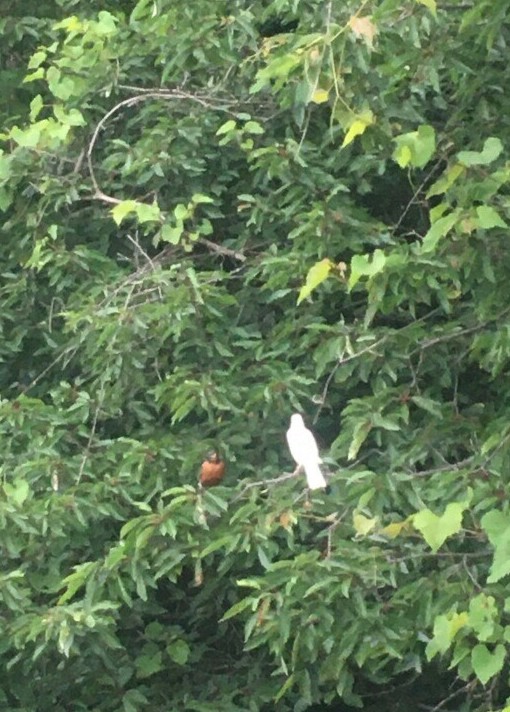
White bird and a robin in a tree

In nature there is always variation among individuals. In fact, the ability of an organism’s genes to pass along variation to a subsequent generation accounts for how species evolve. When enough variation develops among a group of individuals that are in some way isolated from other similar individuals, a new species might evolve. Often, however, a variation leads to such a unique set of features that the individual does not survive long enough to reproduce.

In June, I received a call from a person named Joseph who enjoys watching birds near his home in Plum Borough. He and a neighbor had been watching an albino American Robin in the field behind their apartment complex for a few days. One afternoon three standard colored Robins began harassing this albino and chased it rapidly towards the field’s wooded edge. When Joseph heard a ‘thunk’ as the bird hit a poplar tree, he put on his boots to search for it.  After some effort he found the bird, unfortunately dead. He called the National Aviary to report his find, and a representative he spoke with forwarded his number to me. I visited Joseph to retrieve the rare specimen, and he later sent me pictures of the living bird as well as an immediate post-mortem image showing pink eyes, a feature which designates the creature as a true albino.
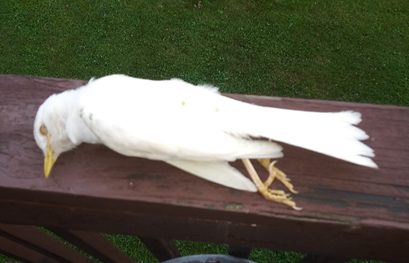
albino American Robin laying on its side outdoors

Adding the Albino Robin to the Museum Collection

I contacted Annie Lindsay, Powdermill Nature Reserve’s Banding Program Manager, to ask if she had ever seen an albino at the museum’s field research station. She had not, but reported some encounters with birds bearing leucistic feathers. The term refers to feathers without pigment. Sometimes birds who lose individual feathers when they are not molting replace a lost colored feather with one that is white. I have seen this phenomenon in some birds I have prepared. I have also occasionally prepared birds with leucism, a condition caused by a genetic mutation that results in a partial reduction of color in a bird’s plumage, resulting certain areas white and other areas the typical colors of the species.

Among the American Robins in the CMNH collection we have an example of both a full albino and a leucistic individual. Both are pictured below alongside a male and female robin in normal coloration. The leucistic bird had been watched for three years before it was found dead. This lifespan can be interpreted as evidence that other robins must have accepted its’ coloration.
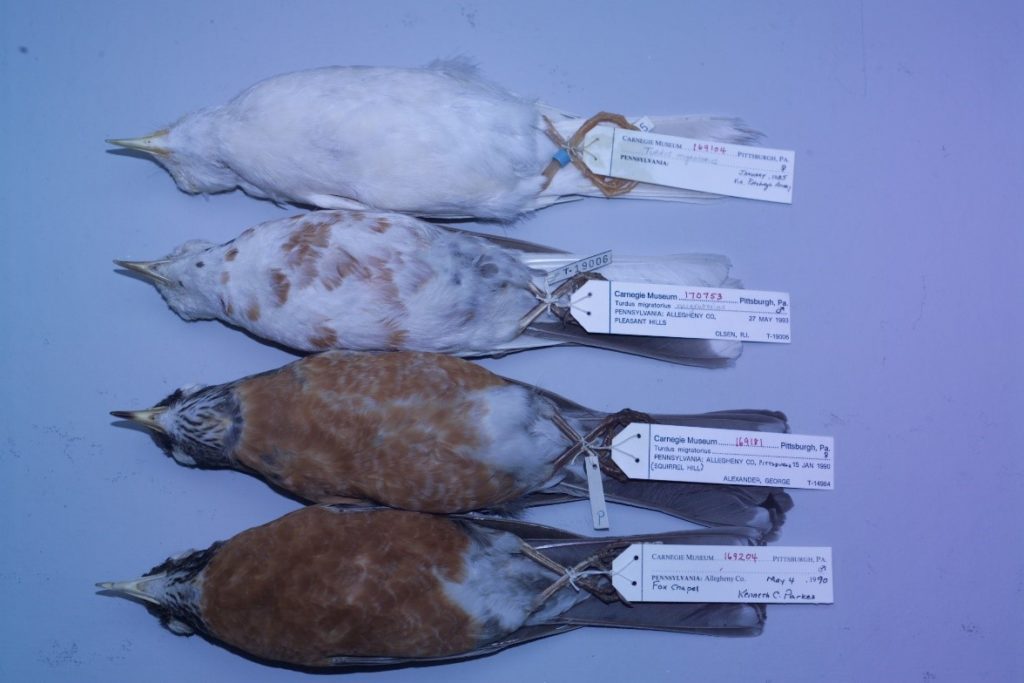
Four study skins of American Robins

All of these birds are from the Pittsburgh area, a region which has been the primary source of birds added to the collection for many years. Typical collection addition situations involved vigilant bird watchers who found a bird that had been hit by a car (one of these individuals) or had been found dead near a window. Over the past 40 years I’ve transformed thousands of such feathered accident victims into museum specimens for current and future scientific studies. During this time, I’ve noticed a trend. If a person finds a dead bird, they may or may not contact the museum to see if we want the specimen. However, if it appears to be extra colorful, or rare by distribution, or in the case of the Plum Borough robin, albino, they may make a special effort to reach out to Carnegie Museum of Natural History. The albino American Robin is still in a museum freezer awaiting preparation. Perhaps it may become a taxidermy specimen rather than a study skin.

Stephen P. Rogers is Collection Manager in the Section of Birds at Carnegie Museum of Natural History. Museum employees are encouraged to blog about their unique experiences and knowledge gained from working at the museum.

Related Content

Halloween and Birds

Lights Out for Birds

Turkeys

Carnegie Museum of Natural History Blog Citation Information

Blog author: Rogers, Stephen P.
Publication date: October 21, 2021
Share this post!

  • Share on Twitter Share on Twitter
  • Share on Facebook Share on Facebook
  • Share on Pinterest Share on Pinterest
  • Share on LinkedIn Share on LinkedIn
  • Share on Reddit Share on Reddit
  • Share via Email Share via Email

Filed Under: Blog Tagged With: Birds, Science News, Stephen Rogers

November 3, 2020 by wpengine

Turkeys

by Stephen Rogers

November is the month best known for the holiday celebrated on the fourth Thursday of the month, Thanksgiving, which revolves around one of the classiest of birds in Pennsylvania, the Wild Turkey. Most people are familiar with the local, reasonably tame, birds that roam around Pittsburgh, but few know the history of this noble bird. By the early 1900s habitat loss and over-hunting had left the species in dire shape. Wild turkeys disappeared at one point from Ohio, New York, as well as 16 other states of its original range. The Pennsylvania Game Commission (PGC) can be credited with bringing back the species in the state. The birds became more common field and forest scenery beginning in the mid-1980’s as the agency abandoned a turkey farm that produced captive-bred birds for stocking, and focused restorations efforts on trapping wild turkeys from the areas with sustainable populations, notably northcentral PA and the mountainous areas of Somerset and Westmoreland counties, and re-locating them to areas with suitable habitat. The PGC continues to set the hunting seasons within the state, expanding or restricting both the time periods and locations for hunting to maintain a healthy wild turkey population.

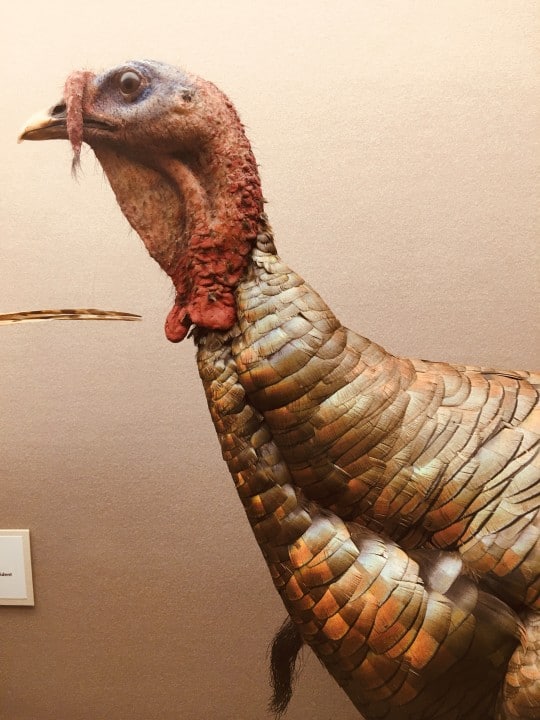
close up of turkey taxidermy mount

Carnegie Museum of Natural History has wild turkey egg sets, skeletons, study skins, taxidermy mounts, and some fluid-preserved specimens from eight states as well as a couple from the failed PGC turkey farm. I was raised in northcentral PA and have contributed two turkey specimens to the collection over my years of working for the museum. One of these, a preserved fluid head, had the distinction of being dissected to study its brain by an ornithologist at the Smithsonian Institution who worked with a CMNH curator, Brad Livezey. They studied higher-level phylogeny and their publication can be seen here.

In recent years the PGC has brought back turkey hunting for two days around Thanksgiving throughout that state as an addition to regional seasons that vary depending on population levels. Because we are encouraged to blog, I thought I would relate a Thanksgiving Turkey tale here.

Among my most memorable Thanksgivings was the holiday 49 years ago, in 1971, when our family had the family of my mother’s twin sister over for dinner. Hunting was what occupied most of my waking thoughts in those days, but my hunting partner, my dad, had to work that morning and it became my task to take my Uncle John and cousin Ronnie out in four inches of new snow that had fallen the day before. My aunt, who was undergoing breast cancer treatment, wanted to spend time with her twin to celebrate perhaps their last holiday together. For these sisters and their daughters, getting the “menfolk” out of the way seemed to be the best way to create the proper atmosphere.

I had never hunted with Uncle John or Ronnie before, but I knew where to find a turkey flock.  After a mile-long hike we busted up a flock and John promptly missed one of the scattering big birds. At this point we split up, hoping to run into lone turkeys as they tried to regroup. I headed in the direction of some of the fleeing birds to use a turkey call, while John and Ronnie sat amid the large laurel thicket we had rousted the flock from.

After a period of time, Uncle John had to do what bears are notoriously known for doing in the woods. An experienced hunter would always keep his shotgun handy anywhere while hunting, but John leaned his gun against a tree and went a few feet away to do his business. Of course, out came a few turkeys into a clearing just yards away from him, looking at him with apparent wonder at what he was doing with his pants down.

We never got a turkey that day, but among the many Thanksgivings I have experienced it was the most memorable. As we all ate turkey around the ping-pong table in the basement that evening, Uncle John took his ribbing with great humility, and the banter took my aunt’s thoughts away from the cancer which was late stage at that time.

As we commemorated Breast Cancer Awareness last month, it should be on everyone’s mind that mammograms should still be done in this era of COVID.

I hope to take my gun out for a walk this Thanksgiving, but I imagine the turkeys will socially distance from me. Shooting a bird isn’t the end all of a hunt, it’s the memories we make afield.

For more history on the wild turkey see:

History of the Wild Turkey in North America

A Look Back at Wild Turkeys

Stephen Rogers is Collection Manager in the Section of Birds at Carnegie Museum of Natural History. Museum employees are encouraged to blog about their unique experiences and knowledge gained from working at the museum.

Related Content

Ravens and Crows, What’s the Difference? 

Powerlifting Poultry and Mallards That Marathon

Bard Birds

Carnegie Museum of Natural History Blog Citation Information

Blog author: Rogers, Stephen
Publication date: November 3, 2020

Share this post!

  • Share on Twitter Share on Twitter
  • Share on Facebook Share on Facebook
  • Share on Pinterest Share on Pinterest
  • Share on LinkedIn Share on LinkedIn
  • Share on Reddit Share on Reddit
  • Share via Email Share via Email

Filed Under: Blog Tagged With: bird hall, Birds, Hall of Birds, Section of Birds, Stephen Rogers

October 7, 2020 by wpengine

Halloween and Birds

Birds, being the happy creatures they are, don’t seem to me to connect with Halloween. Sure, death scenes in old movies, or exaggerated depictions of nighttime itself, are often populated with vultures, owls and corvids (crows and ravens), but Halloween itself, not so much. About the only “scary” term I can think of relating to birds is the group popularly referred to as “GOATSUCKERS.”

Early stories about goatsuckers can be credited to Aristotle and Pliny over 2000 years ago. Rumors about a group of birds now classified Caprimulgids, indicated they would suck the milk out of goats, and afterwards the goats would go blind. Of course, the stories are false, but the persistence the common group name might very well continue to frighten young children.

The 70 species of Caprimulgids remain saddled with a Family name, and in some cases a Genus name, that translates from Latin, “capra” for nanny goat, and “mulgēre” to milk, as “milker of goats,” or considering how a bird might attempt such a feat, “goatsucker.”

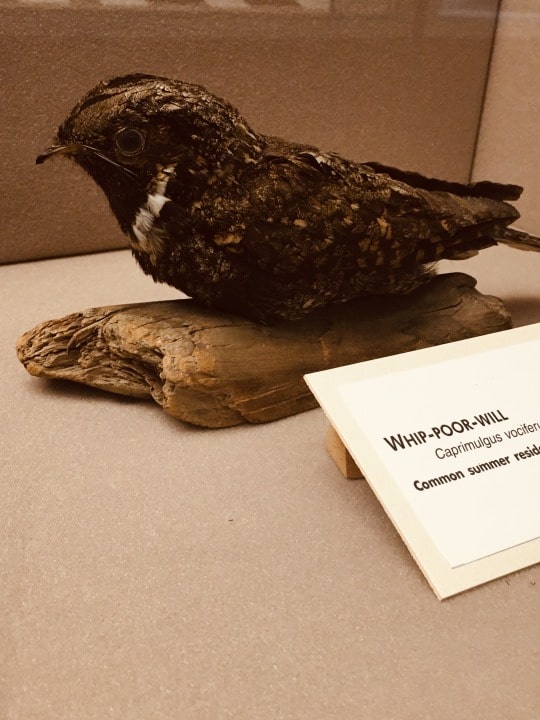
taxidermy mount of whip-poor-will
Image credit: Pat McShea

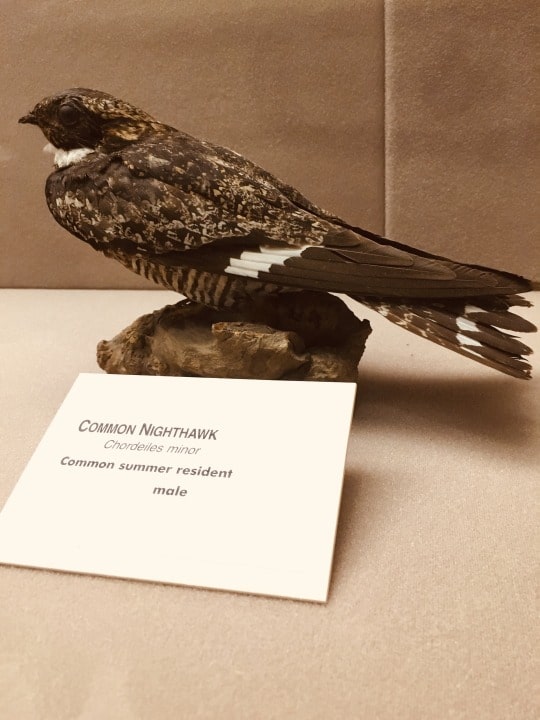
The family Caprimulgidae is a nocturnal group of birds referred to as nightjars or nighthawks that live worldwide except in New Zealand and on some islands in Oceania. In Pennsylvania the only birds of this group seen routinely are the Common Nighthawk and the Whip-poor-will, and both species are declining in numbers. Both are insectivorous birds with what appears to be small mouths that can actually open extremely wide to swallow insects in flight. The sounds of Whip-poor-wills can be haunting to those unfamiliar with them. For an image of the bird and a recording of their distinctive sound click this YouTube link.

taxidermy mount of common nighthawk
Image credit: Pat McShea

The CMNH Section of Birds collection, with nearly 207,000 records, includes only three “goatsuckers” collected on Halloween. Two are Pauraques (Nyctidromus albicollis yucatanensis) from Veracruz, Mexico collected in 1963, and a single Common Nighthawk (Chordeiles minor minor) found dead by former Amphibian and Reptiles Curator Jack McCoy in Schenley Park on Halloween night 1989. Migration should have happened long before that date – in fact this fall Pittsburgh’s estimated peak occurred September 14, when an estimated flight of 50,000 birds of various species passed overhead overnight.

Stephen Rogers is Collection Manager in the Section of Birds at Carnegie Museum of Natural History. Museum employees are encouraged to blog about their unique experiences and knowledge gained from working at the museum.

Related Content

Sympathy For the Devil

Collected on This Day in 1967: Fall Blooms Rival Those of Spring

Ask a Scientist: How do you tell the difference between a raven and a crow?

Filed Under: Blog Tagged With: Birds, Hall of Birds, halloween, Science News, Section of Birds, Stephen Rogers

September 9, 2020 by wpengine

Canada Goose

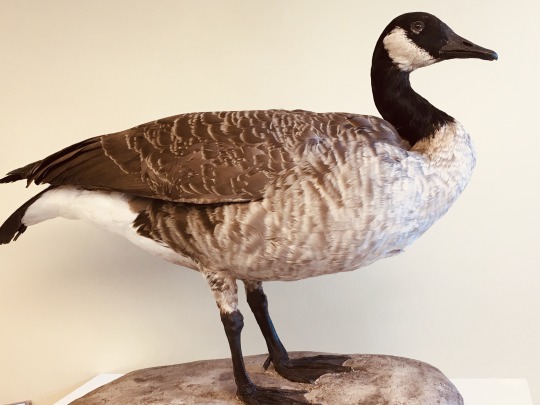
taxidermy mount of Canada Goose

When I think of September and waterfowl, my first thoughts go to the Canada Goose (notice I did not say Canadian Goose which is actually an incorrect name of the bird – there are of course “Canadian Canada Geese”). Nevertheless, my thoughts go to the “American Canada Goose” which seems to be everywhere near water come early fall, and the sounds of them honking puts a little flutter in those Pennsylvanians who hunt. September 1 was the first day of the resident Goose season which runs through September 25th.

Eighty years ago, Canada Geese almost never spent the summer in Pennsylvania. W.E. Clyde Todd, the first curator in the Section of Birds at the Carnegie Museum, kept meticulous records of the comings and goings of many birds in Western Pennsylvania. He has the distinction of the longest tenure of any employee at the museum, having started as a field collector in 1898 and retired and became emeritus curator in 1944. Even after retiring, he continued to come to the museum almost daily until his death in 1969. Mr. Todd, who lived most of his life in Beaver, published the landmark book Birds of Western Pennsylvania in 1940. Several paragraphs in the chapter on the Canada Goose mention early arrivals of the species from the north where they spent the summer as well as late migration to the north where they bred after having spent the winter roaming Pennsylvania fields and waterways. He mentions in the account that the first breeding of American Canada Goose did not occur until 1937 when a few pinioned geese released a few years earlier were successful in breeding in the state.

Today the Canada Goose is almost TOO prevalent for many residents. County and state parks, farm ponds, golf courses, and lawns adjacent to the three rivers seem to be very littered with “fertilizer” which prevents people from running barefoot on the lawns. There are actually professional Geese Police who use Border Collies to chase the geese away from unwanted areas, especially those where lethal means cannot be used. Loud noises have also been used, but as soon as the noises cease or the Border Collies leave, the geese return to foul the lawns and make the water “foul” also. Goose droppings contribute to over fertilization of ponds and lakes causing algal blooms which can be harmful to native fish, invertebrates, and the natural ecosystems of our waterways

Hunting is the only guaranteed method of keeping the resident Canada Goose population in check, of course only in areas where hunting is safe and legal. Hunting can reduce the negative impacts of a species that was not historically a year-round resident. In areas where the practice is safe, legal, and well-regulated, hunting can help to restore ecosystems, reduce local nuisances, provide nutritious food, and get people outdoors! Although the nuisance goose season has liberal bag limits, populations of the birds continue to increase.

Goose recipes can be found on the web using a simple Google Search. There are those who love the taste of a well-prepared bird, and those who think the meat is unfit for human consumption. Make a friend with a goose hunter and you can decide yourself.

Biography of Mr. Todd: https://sora.unm.edu/sites/default/files/journals/auk/v087n04/p0635-p0649.pdf

Book review: https://sora.unm.edu/sites/default/files/journals/auk/v057n04/p0579-p0595.pdf

Canada Goose sounds: https://www.allaboutbirds.org/guide/Canada_Goose/sounds

Stephen Rogers is Collection Manager in the Section of Birds at Carnegie Museum of Natural History. Museum employees are encouraged to blog about their unique experiences and knowledge gained from working at the museum.

Related Content

Lazarus Bird

Bird Watching Bonus

Ask a Scientist: Ravens and Crows, What’s the Difference?

Filed Under: Blog Tagged With: Birds, Hall of Birds, Science News, Section of Birds, Stephen Rogers

December 4, 2017 by wpengine

Skeleton Preservation

spread wing and tail of a bird

by Stephen Rogers

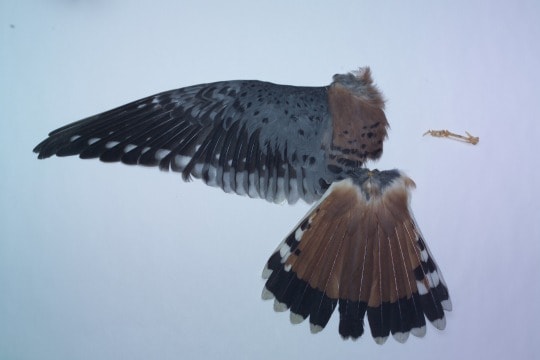
For many years beginning in the early 1980s, collection managers in Carnegie Museum of Natural History’s Section of Birds began keeping a spread wing and sometimes a tail for many of the skeletons we produced. The rational was that there were two sets of wing bones, and sacrificing one side to produce a spread wing and sometimes also a tail (not sacrificing the pygostyle), would produce a reference item that could be used to examine molt, verify identity, and as reference for morphology and artists who use the collection.

Above is an example of a spread wing and tail and the other corresponding wing parts from the other side of the wing. This photo was sent to a person wishing to have measurements of the pollex bone and the length of the alula—in this case we could provide measurements from the same individual. The pieces of tissue on the wing can also be used to supply dried tissue for DNA.

We did not and, even now, do not preserve tissue in ethanol or liquid nitrogen. Usually dried toe-pad material is used to get DNA when tissue is not available, but if we did not save skins of the specimens collected, a piece of tissue from the wing can be used. Another use of these specimens has been the extraction of wax like material that birds apply from the uropygial gland to keep the bird feather waterproof. One researcher extracted these chemicals from spread wings which was easier than doing so from study skins—dipping the feathers into a solution to dissolve off the material and running it through a gas chromatograph.


Stephen Rogers is a collections manager at Carnegie Museum of Natural History. Museum employees are encouraged to blog about their unique experiences and knowledge gained from working at the museum.

Filed Under: Blog Tagged With: Birds, Section of Birds, Stephen Rogers

July 7, 2017 by wpengine

Poisons of the Carnegie: Timber Rattlesnake

rattlesnake specimen on display

by Patrick McShea

Where timber rattlesnakes are concerned, the scientific collections at Carnegie Museum of Natural History have more specimens than any other museum in the world. Of the more than 207,000 preserved amphibian and reptile specimens in the Section of Herpetology, 595 are Crotalus horridus, the scientific name for the timber rattlesnake. (In second place, with 507 specimens, is the North Carolina Museum of Natural Sciences. The Smithsonian and all other museums have far fewer specimens.)

For anyone wondering about the importance such unusual sets, collection manager Steve Rogers cites visiting researcher John Allsteadt, lead author of a 2006 scientific paper titled, Geographic variation in the morphology of Crotalus horridus.

“He examined and measured every one of our timber rattlesnakes. It was a whole lot of work,” Rogers said.

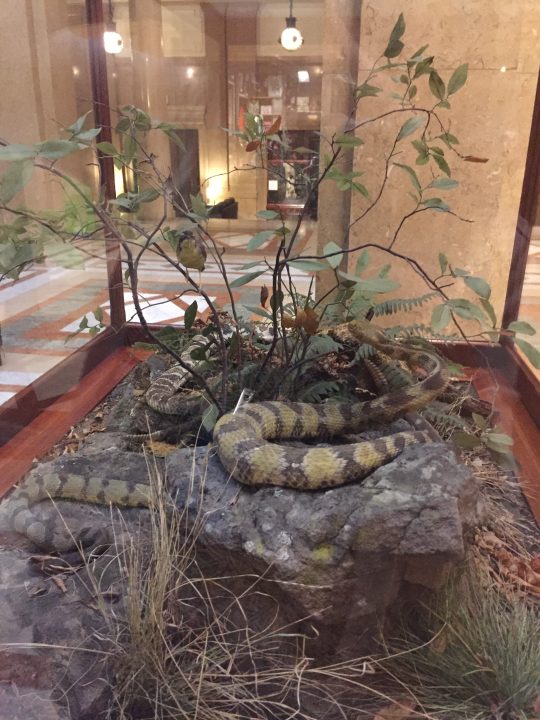
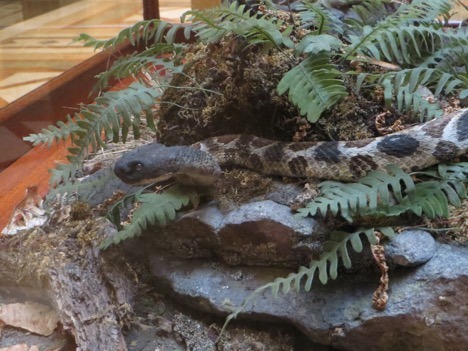
On the exhibit front, a newly restored historic diorama features three timber rattlesnakes collected more than a century ago near Ohiopyle, Pennsylvania. Alive, the venomous reptiles must have sometimes basked on sandstone ledges above the roar of Youghiogheny River rapids.  In their current location, on the first floor near the Grand Staircase, polished marble is the predominant rock. Ambient sounds here range from the full-voiced chatter of visiting school groups to the electronic “ding” of adjacent elevator doors.

rattle snake display case

The contrast in backgrounds mirrors a longstanding gap between timber rattlesnake myth and reality. For the European immigrants who settled eastern North America, fear of timber rattlesnakes trumped any possible understanding of the species’ predictable behaviors, ecological role, and generally non-aggressive nature.

In the 1782 publication, Letters from an American Farmer, a work widely recognized as a foundation of American literature, author J. Hector St. John Crevecoeur summarizes the reptile’s predicament in the growing new nation:

“In the thick settlements, they are now become very scarce; for wherever they are met with, open war is declared against them; so that in a few years there will be none left but on our mountains.”

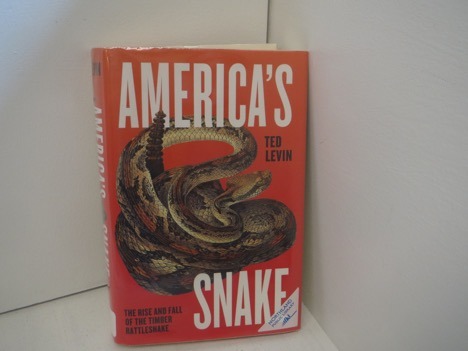
Readers interested in how this prediction played out over the intervening 23 decades should seek out America’s Snake: The Rise and Fall of the Timber Rattlesnake, a book by naturalist Ted Levin published in 2016 by The University of Chicago Press. The “open war” mentioned by Crevecoeur is an on-going theme in the work’s 481 pages, as is a threat unimaginable in colonial times, illegal international trade in venomous snakes. Levin also offers profiles of people working to safeguard the species and clearly relates what is currently known about timber rattlesnake evolution and anatomy, with attention paid to the physical adaptations that enable the creatures to make, store, and deliver a powerful venom composed of multiple toxins.

The bibliography of America’s Snake includes a reference to the publication of the researcher who measured all 595 Carnegie timber rattlesnakes. The note is an important if indirect link between this museum and a masterful modern work of natural history literature.

red book cover for a book title "America's Snake" by Ted Levin

Patrick McShea works in the Education and Visitor Experience department of Carnegie Museum of Natural History. Museum employees are encouraged to blog about their unique experiences of working at the museum.

Filed Under: Blog Tagged With: Stephen Rogers

  • Page 1
  • Page 2
  • Go to Next Page »

sidebar

About

  • Mission & Commitments
  • Directors Team
  • Museum History

Get Involved

  • Volunteer
  • Membership
  • Carnegie Discoverers
  • Donate
  • Employment
  • Events

Bring a Group

  • Groups of 10 or More
  • Birthday Parties at the Museum
  • Field Trips

Powdermill

  • Powdermill Nature Reserve
  • Powdermill Field Trips
  • Powdermill Staff
  • Research at Powdermill

More Information

  • Image Permission Requests
  • Science Stories
  • Accessibility
  • Shopping Cart
  • Contact
  • Visitor Policies
One of the Four Carnegie Museums | © Carnegie Institute | Privacy Policy | Terms of Use | Accessibility
Rad works here logo