• Skip to primary navigation
  • Skip to main content
  • Skip to primary sidebar

Carnegie Museum of Natural History

One of the Four Carnegie Museums of Pittsburgh

  • Visit
    • Buy Tickets
    • Visitor Information
    • Exhibitions
    • Events
    • Dining at the Museum
    • Celebrate at the Museum
    • Powdermill Nature Reserve
    • Event Venue Rental
  • Learn
    • Field Trips
    • Educator Information
    • Programs at the Museum
    • Bring the Museum to You
    • Guided Programs FAQ
    • Programs Online
    • Climate and Rural Systems Partnership
  • Research
    • Scientific Sections
    • Science Stories
    • Science Videos
    • Senior Science & Research Staff
    • Museum Library
    • Science Seminars
    • Scientific Publications
    • Specimen and Artifact Identification
  • About
    • Mission & Commitments
    • Directors Team
    • Museum History
  • Tickets
  • Give
  • Shop

SWK2

August 16, 2024 by Erin Southerland

Natural History Collection Managers: The Stewards of Time Travel 

by Serina Brady and Mariana Marques

For centuries, naturalists have collected the living world with the primary goal of understanding the diversity and complexity of our planet. In vast shelves and cabinets located in natural history museums, we find a diversity of specimens used daily by researchers, students, naturalists, and conservationists from around the world. These collections are not just archives of the past, but they also play a crucial role in addressing present-day challenges. By documenting the diversity of life, natural history collections provide a wealth of information that can be used to tackle issues such as climate change, pandemics, pathogen dispersals, deforestation, habitat fragmentation, and biodiversity loss. They can be considered the world’s most comprehensive and complex library, serving as a valuable resource for understanding and addressing the health of our planet. 

Each specimen can be seen as a unique document or book recording an aspect of life on Earth at a particular time and place. They testify to the existence of a given species in a given locality and at a particular time, and they have a fundamental role as a guarantee of the scientific method: they allow objective observation that can be replicable. Natural history collections are an unparalleled source of information. For instance, a single bird or reptile specimen can provide data on its species, its habitat, its diet, and even its health. This wealth of information continues to allow researchers to understand better the past, the present, and the future of biodiversity, as well as the health of our planet – from local communities to the entire Earth.  
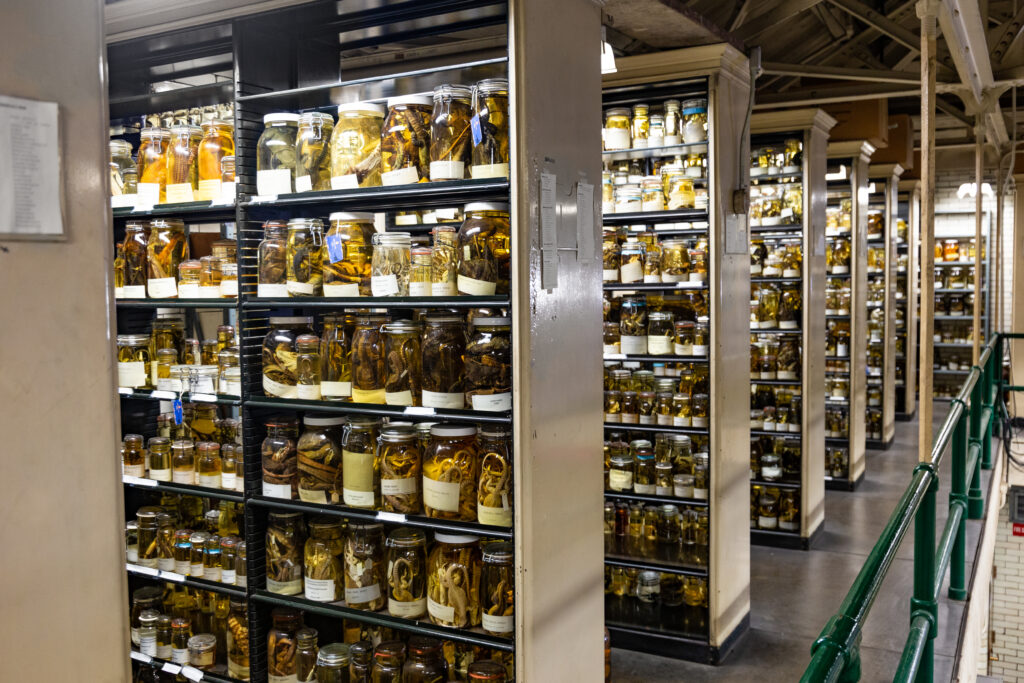
Carnegie Museum of Natural History Alcohol House, Collection of Amphibians and Reptiles. ©Photo by: Luis Ceríaco. 
Carnegie Museum of Natural History, Collection of Birds. ©Photo by: Luis Ceríaco. 

These collections are usually housed in natural history museums. These museums are research, conservation, education, and public outreach hubs. Their collections are not limited to public exhibitions; in fact, the majority are housed in storage locations, generally out of sight and knowledge of the public. The process of collecting and storing these specimens is methodical. Each specimen is carefully collected, identified, and cataloged, then stored in a controlled environment to ensure long-term preservation. This process ensures that these specimens, often fragile and irreplaceable, are protected and can continue to be used for research and education for future generations.  

Natural History Collections: a Tool to Face Global Changes 

How can a specimen collected more than 100 years ago still be relevant today? Historical collections, like the one housed at Carnegie Museum of Natural History, provide baseline data points. These initial measurements or observations serve as a starting point for future comparisons. By providing a snapshot of life on Earth at a particular time and place, these specimens allow us to study change over time. The first and most crucial step is to gather those baseline data points!  

From their early days, natural history collections’ primary goal was to inventory all life on Earth. However, with new cutting-edge technology, researchers can recover different data from historical specimens, data that the original collector didn’t even imagine. For example, when birds were collected from the U.S. Rust Belt, collectors didn’t realize that the specimens would be used to infer information about the history of pollution. Similarly, in the early twentieth century, the collectors of salamanders in the Appalachian woods didn’t even realize that some of those specimens were already infected with a pathogen that is devastating some of the world amphibian populations today.  

However, because specimens were collected, we can now map the expansion of this pathogen through time or trace the amount of black carbon in the air over time through birds’ feathers to help fight and understand climate change. Part of the job of Collection Managers like us is not just to preserve and maintain the existing collections, but also to anticipate and predict the questions future researchers will be asking. This proactive approach ensures we gather today’s data to answer tomorrow’s questions. Specimens collected over a century ago are actively used today to answer questions about current and future environmental changes.  

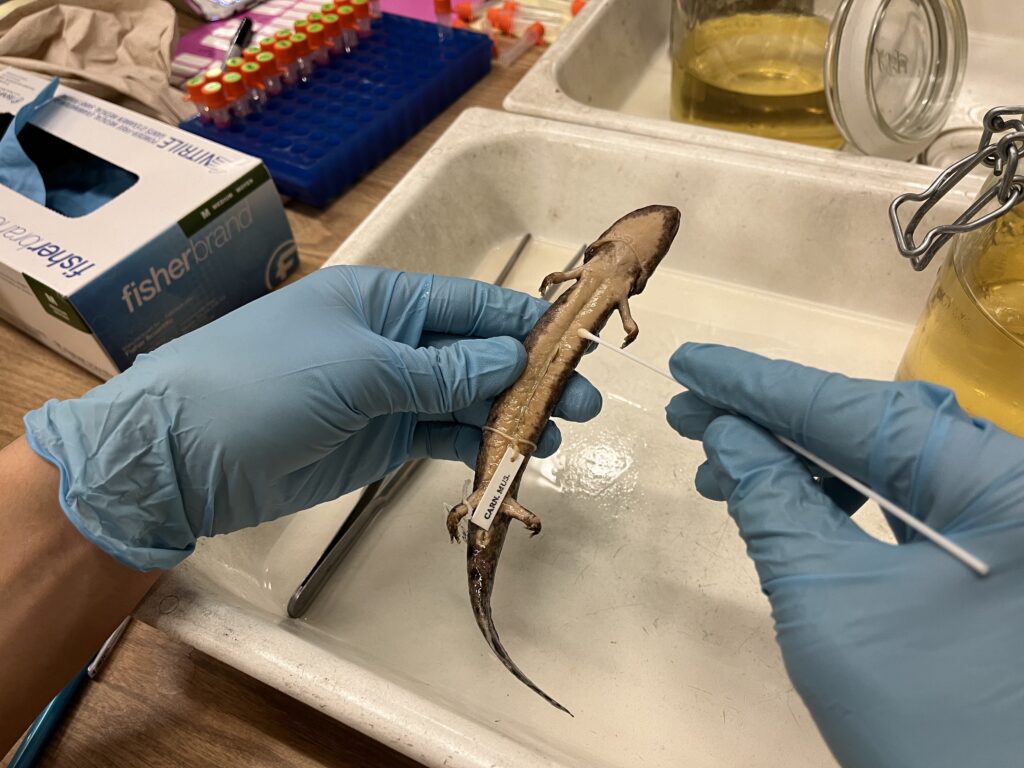
Specimens at the Carnegie Museum of Natural History collected during the early 1900s continued to have a significant role in research questions. These specimens give researchers insight into environmental changes through time, such as soot deposited on bird feathers or the presence of pathogens such as the chytrid fungus on amphibian populations across a specific time and place. Top: Two Eastern Towhee (Pipilo erythrophthalmus) specimens, one from 1895 (bottom) and the other from 1993 (top), showing the change in air quality over time (DuBay and Fuldner 2017). © Photo by Luis Ceríaco. Below: Amphibian specimen of Common Mudpuppy (Necturus maculosus) being swabbed by a student from the University of Pittsburgh (Richards-Zawacki Lab) to detect the presence of the amphibian chytrid fungus – Batrachochytrium dendrobatidis. ©Photo by: Rachel Verdi. 

New applications of technologies, such as computed tomography (CT) scans, provide novel insights and usages for specimens. CT scans allow a complete 3D model of a specimen, including access to its internal morphology without damaging it. Using next-generation sequencing, scientists can use fragmented and degraded DNA for advanced analyses such as phylogenetic and phylogeographic analysis. These specialized methods allow us to study species’ evolutionary relationships and geographic distribution. These advanced techniques are just some of the ways natural history collections are being used to push the boundaries of scientific knowledge.  
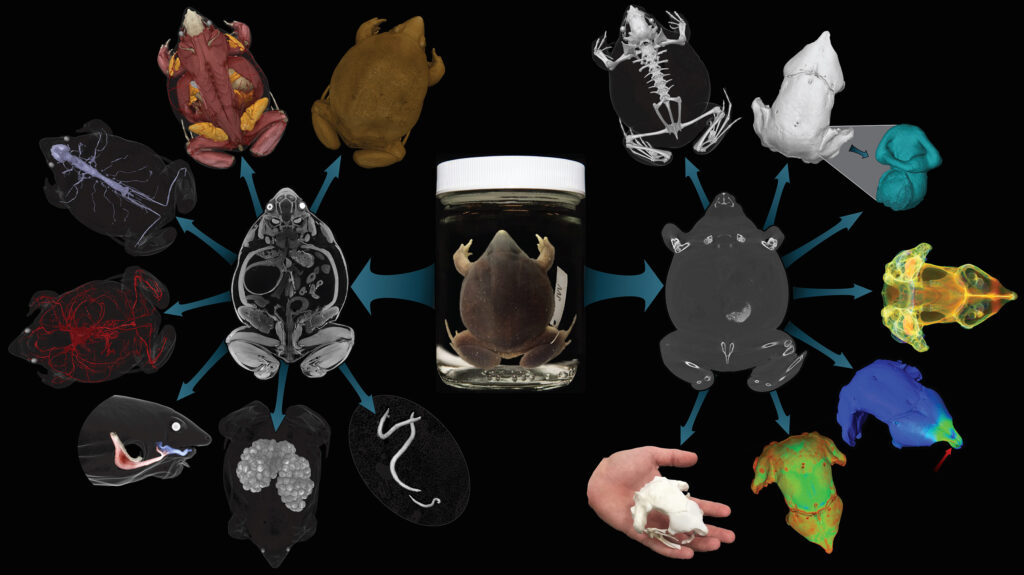
CT scans provide details of internal anatomy, presence of parasites, reproduction, etc., without damaging the specimen. CT scans are a significant technological advance for fields such as taxonomy, developmental and evolutionary biology, and studying functional morphology for natural history specimens. © Edward Stanley, Florida Museum of Natural History, University of Florida (oVert – OpenVertebrate project). 

A Biodiversity Backup 

Continuing to grow our collections is not only scientifically essential but undeniably needed. Currently, 1.8 million species have been formally described to science, although worldwide experts predict that around 8.75 million species still await to be discovered, described, and named. Given current extinction rates, we are racing against time to describe the remaining 86% of the world’s species, many of which may become extinct before we know they even existed! 

New species of birds, amphibians, reptiles, mammals, and insects continue to be discovered worldwide, sometimes based on specimens tucked away in a museum for decades! These collections are not just archives of the past but also living libraries that continue to grow and evolve as new species are discovered. Each new discovery adds to our understanding of the natural world and underscores the importance of these collections in documenting and preserving Earth’s biodiversity. These new specimens contribute to our most significant and longest dataset of the natural world. But just as a library that stops acquiring new books, a natural history collection that doesn’t add new specimens will eventually lose its scientific value and relevancy. If we don’t continue to add physical proof of today’s biodiversity, we create unfillable gaps in one of our most powerful natural history data sets. Today is tomorrow’s past, and natural history collections act as a biodiversity backup of our planet!  

Serina Brady is Collection Manager of Birds and Mariana Marques is Collection Manager of Amphibians and Reptiles at Carnegie Museum of Natural History.

Related Content

Risk Assessment, or How to Keep Your Collection Intact

Type Specimens: What Are They and Why Are They Important?

Staff Favorites: Dolls in the Museum’s Care

Carnegie Museum of Natural History Blog Citation Information

Blog author: Brady, Serina; Marques, Mariana
Publication date: August 16, 2024
Share this post!

  • Share on Twitter Share on Twitter
  • Share on Facebook Share on Facebook
  • Share on Pinterest Share on Pinterest
  • Share on LinkedIn Share on LinkedIn
  • Share on Reddit Share on Reddit
  • Share via Email Share via Email

Filed Under: Blog Tagged With: amphibians and reptiles, Birds, Mariana Marques, Science News, Serina Brady, SWK2

August 4, 2023 by Erin Southerland

Staff Favorites: Dolls in the Museum’s Care

by the Section of Anthropology and Archaeology Staff and Volunteers

With the pink wave that is Barbie sweeping the theaters, we thought it would be a good opportunity to spotlight our doll collection. The Anthropology collection at CMNH holds more than three thousand dolls and it is our pleasure to take care of them. Historically and anthropologically speaking, dolls have always served cultural, spiritual, and societal purposes. Whether for entertainment, religion, or education, they can be found all over the world and have been around for thousands of years.

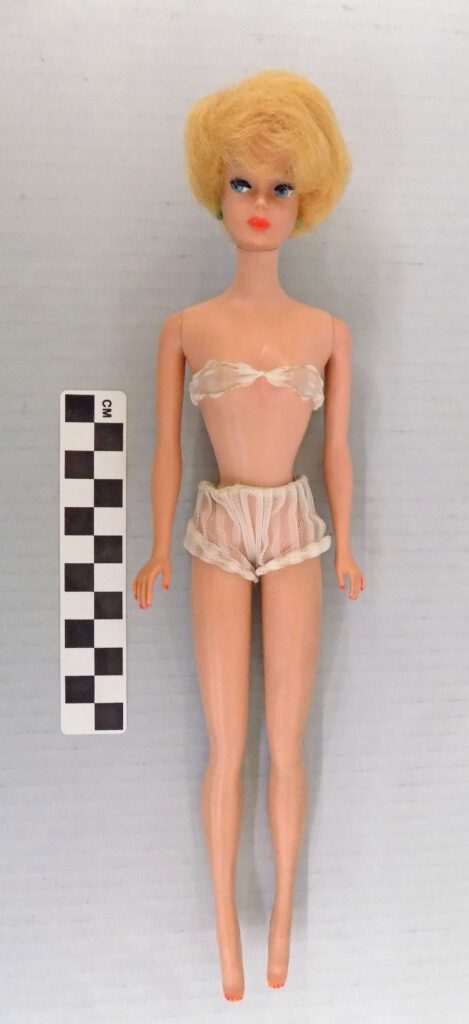
Barbie

Barbie doll
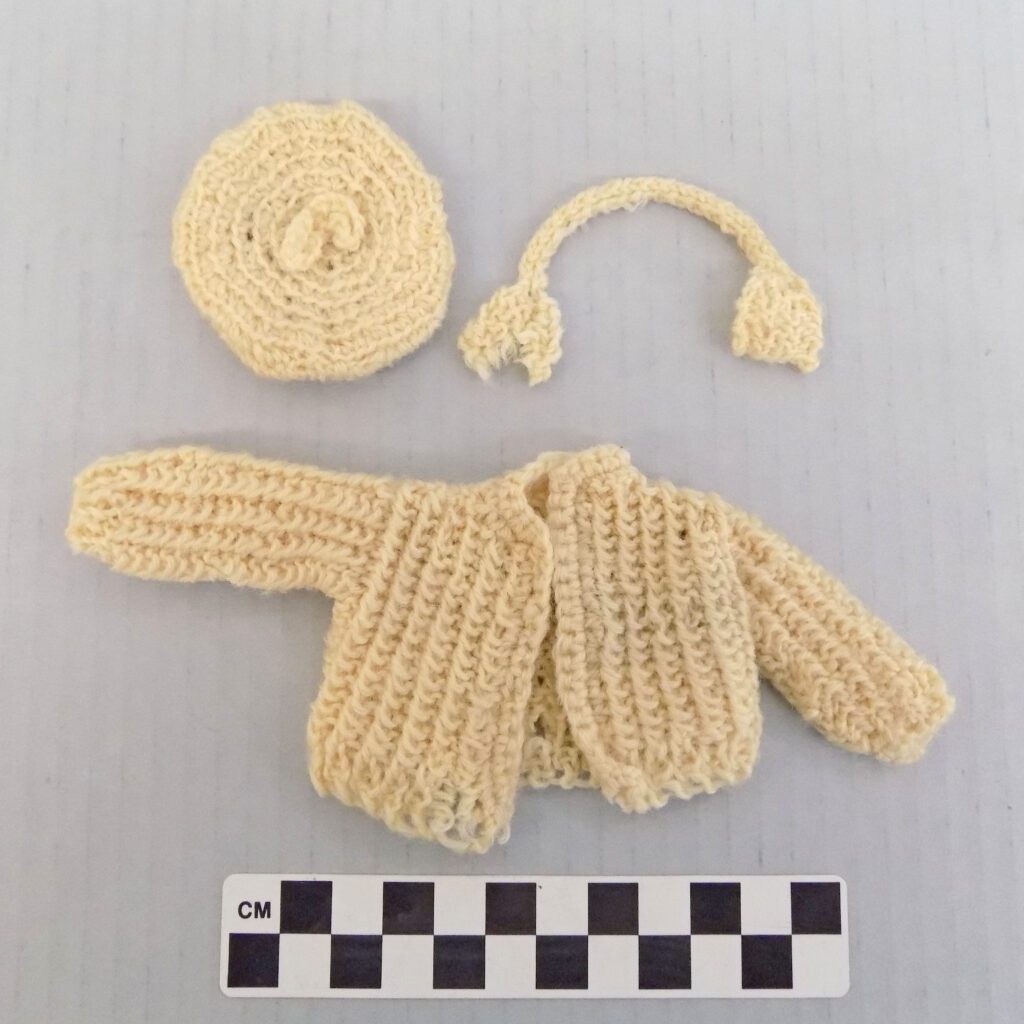
White hat, earmuffs, and sweater for a Barbie doll
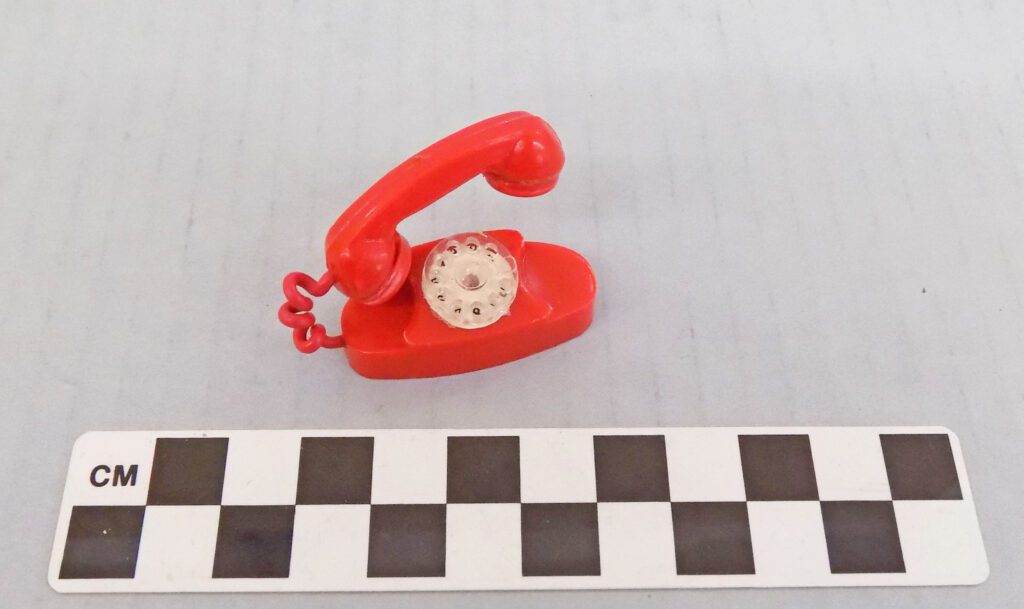
Barbie-sized red rotary telephone

“Hi Barbie! Until recently, our doll collection lacked any traces of Barbie. Then a close friend of the Section of Anthropology was kind enough to not only donate their beloved original doll but also the clothing that they had sewn for her. Barbie and Ken, as an astronaut, a rock star, a pregnant Midge, beach, or any other iteration, have impacted the lives of millions. Sadly, there has not been an archaeologist Barbie but the best part about playing with dolls is that I can easily pretend that the paleontologist version is diligently studying human culture instead of dinosaurs (Sorry, Dr. Lamanna). 

Individuality has always been important to me, so I have always been the biggest fan of Weird Barbie, upon whom I did my fair share of hair cutting and marker tattooing. And while we have only one Barbie at CMNH, we have plenty of other dolls in the collection that our staff and volunteers have chosen to write about. Please enjoy some of our favorites.” –Amy Covell-Murthy, Archaeology Collection Manager and Head of the Section of Anthropology

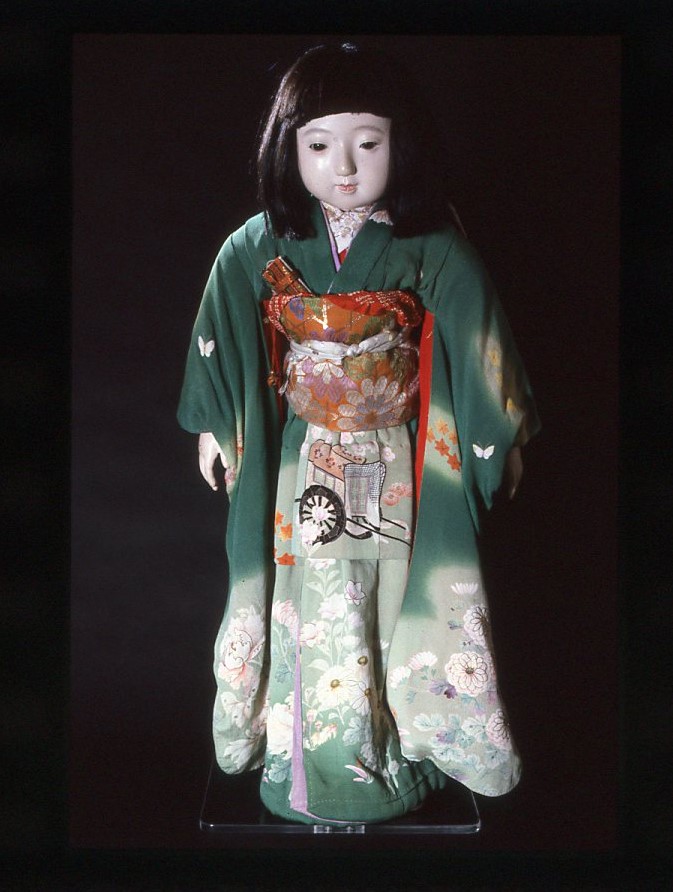
Miss Kochi the Friendship Doll

On January 14, 1929, complete with passport, steamer ticket, and a trunk full of accessories, Miss Kochi the friendship doll arrived in Pittsburgh to her new home at the museum. Representing the children of Kochi, the southernmost prefecture on the island of Shikoku in Japan, Miss Kochi crossed the Pacific  with 57 other friendship dolls who went to various cities within the United States. 

Created as part of a doll exchange program between the children of Japan and the U.S., Miss Kochi and her sister dolls were lovingly made with the hope of promoting peace between the two countries in the years leading up to World War II. Crafted by some of the most respected doll makers in Japan, the ambassador dolls, as they were also known, are all 85cm high. They have moveable arms and legs and real human hair. Each is dressed in a colorful kimono made of pure silk and accompanied by lacquered tea sets, furniture, and other accessories used in the celebration of Hinamatsuri, or Doll’s Day. Miss Kochi is dressed in a beautiful, embroidered, emerald green kimono with a red sash. 

“Miss Kochi is one of my favorite dolls in the collection because I love all the care and detail that was put into her outfit and tiny accessories. Additionally, the message of friendship and kindness that motivated her creation and eventual journey to Pittsburgh is charming and inspiring.” –Kristina Gaugler, Anthropology Collection Manager

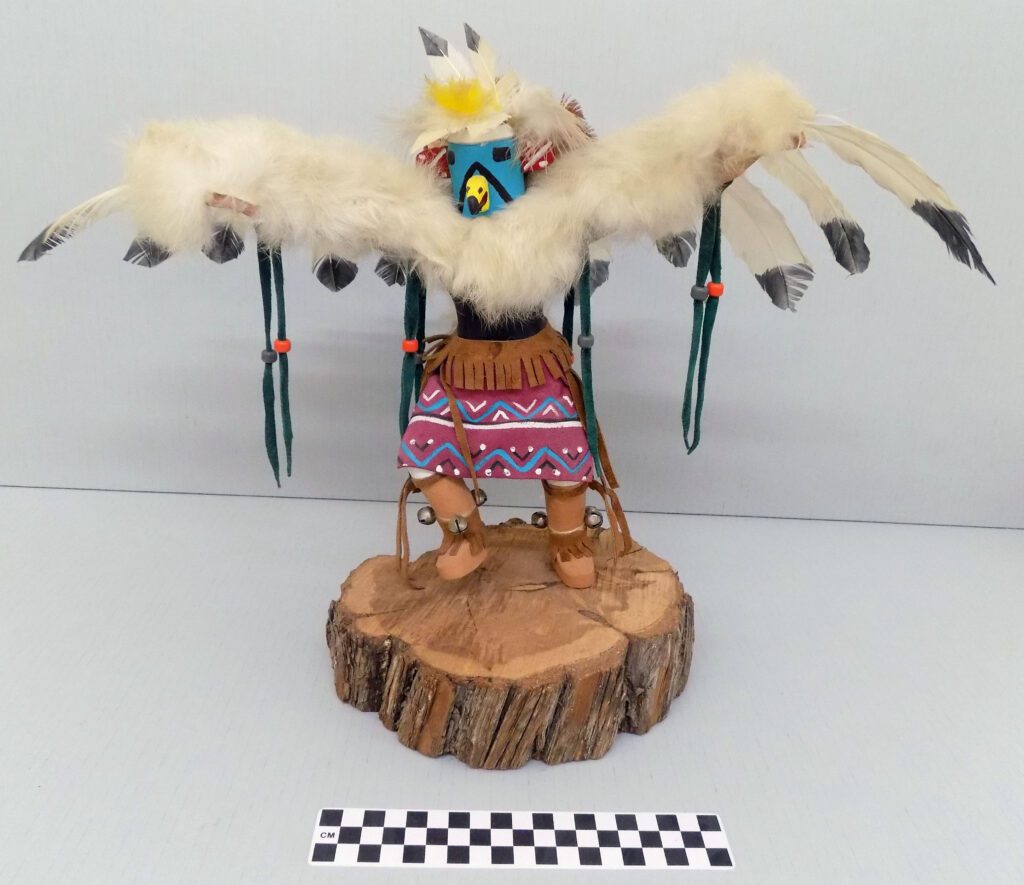
Eagle Kachina

eagle katsina

The Eagle Kachina holds special significance to both the Hopi and Zuni people, representing important spiritual and cultural aspects in their respective traditions.

To the Hopi people, the Eagle Kachina is considered a powerful and sacred being. It is associated with spiritual strength, protection, and a close connection to the divine. The eagle is revered for its ability to soar high in the sky, reaching great heights, and is seen as a messenger between the earthly world and the spiritual realms. During Hopi Kachina ceremonies, the Eagle Kachina is often portrayed by a dancer wearing an elaborate costume and a mask representing the eagle’s features. The dancer embodies the spirit of the Eagle Kachina and plays a significant role in ceremonial dances. 

For the Zuni people, the Eagle Kachina, also known as “Ko’kko,” holds similar importance. The Zuni Eagle Kachina represents the embodiment of the eagle spirit and is venerated for its connection to the heavens and its role as a messenger to the gods. The Zuni people view the Eagle Kachina as a symbol of power, courage, and wisdom, and it plays a crucial role in their rituals and religious practices. Like the Hopi, the Zuni also create intricate Kachina dolls, including the Eagle Kachina, as sacred objects representing the spirits and their significance in Zuni culture.

“I like the Eagle Kachina doll as it signifies all that is important to me as it is to the Hopi and Zuni, the spiritual connection to the natural world.”—Jim Barno, Archaeology Volunteer

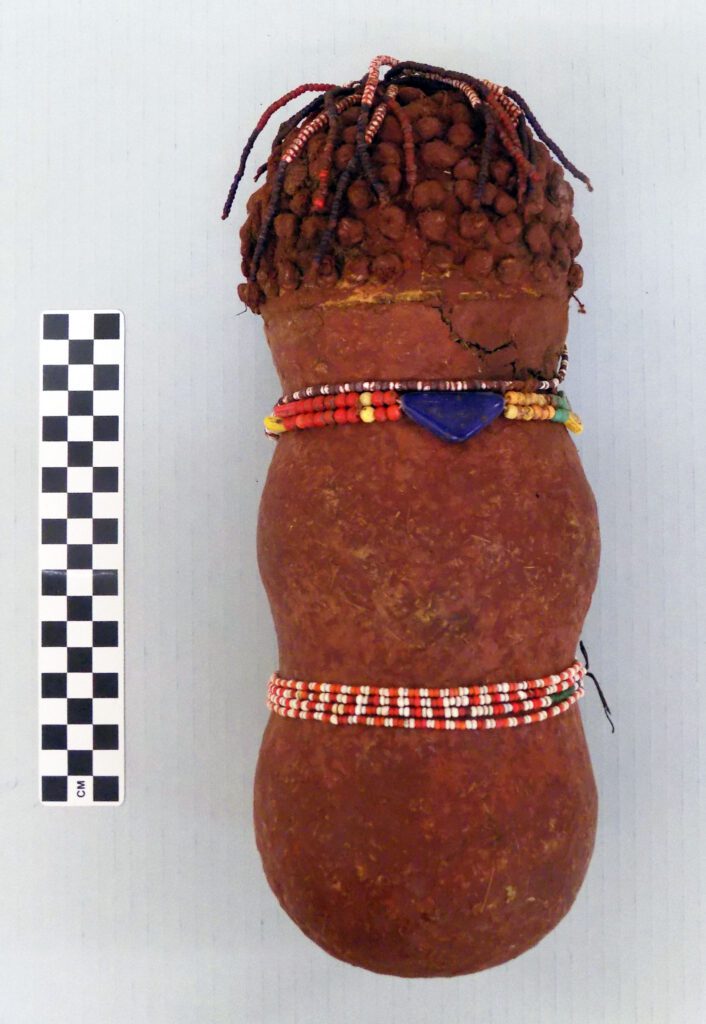
Calabash Gourd Doll

calabash gourd doll

To make this doll, a Tonga woman or girl from a village near Lake Kariba in Zimbabwe, would have filled calabash gourds with sand, seeds, or stone, and covered the gourds with mud, dung, and leaves, before decorating them with strands of beads. Dolls like this one were made by or given to Tonga girls around the ages of 10 to 13, as they approached puberty. The doll came into CMNH’s collection in 1967 as one of many objects from the Tonga people obtained through trade by Terence Coffin-Grey, a taxidermist who worked in natural history museums in Zimbabwe and the U.S., including at CMNH. This doll’s “hairstyle,” with tight balls made of mud and strands of beads, resembles that of some Tonga women of the time, based on photographs shared with CMNH by Coffin-Grey. CMNH has several other similar dolls of different sizes, shapes, and decorations, including some with fabric skirts.

“I chose this doll based on the recommendation of Amy Covell-Murthy and was immediately charmed and intrigued when I saw it. When I held it, I was struck by the weight of it, and I loved learning about this practice of doll-making shared between women and girls in a matrilineal society.” –Deirdre M. Smith, Assistant Curator

Talash Doll

Talash and corn cob dolls

We are all a part of nature. Our ancestors created dolls for children using the natural materials around themselves. The tradition of making dolls from talash, the leaves wrapped around a corn cob, dates back many generations.

Talash is a very interesting material that is easy to work with, and the products made from it are very warm and beautiful. The husks of the corn would be removed in the fall after harvesting the corn. They would then be dried and stored in a dry place. The leaves come in different colors and shades, from white to brown. If necessary, the leaves could also be painted, sometimes with dyes made of onion peel or food coloring. To begin weaving, the middle leaves of cobs are often preferred for their strength and flexibility so as not to tear. The husks are also moistened with water to help give them more elasticity. The length of the strip up to 1 cm is in the middle. Strips that are uneven or ripped would be discarded.

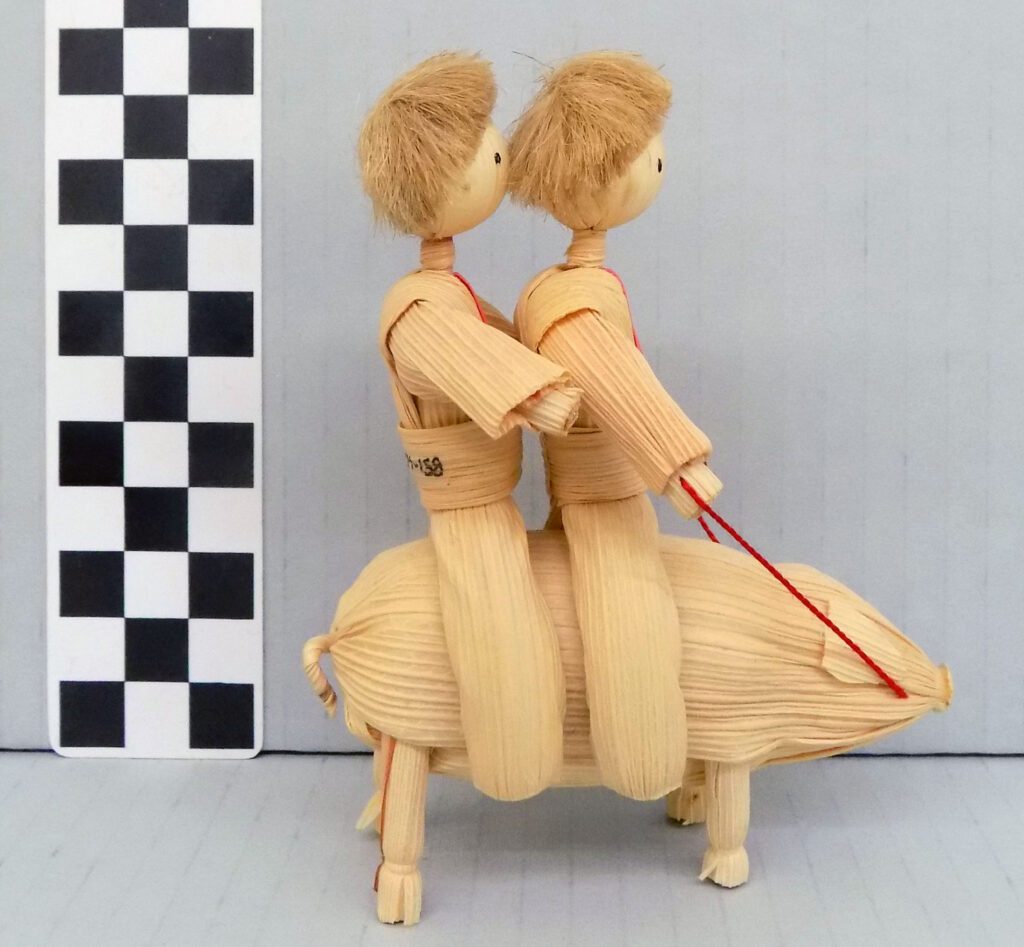
This doll is of boys riding a pig, which highlights ordinary country life in a European village. Eastern Europe has a lot of rivers such as the Danube, Vistula, Dnipro, and others. The territory near the rivers is very large, and kids would help relatives graze pigs on these meadows, while also occasionally playing with them. 

“This doll showed me how people create interesting toys with simple natural things. This is part of our deep roots and traditions in Eastern Europe. I also like the fairy tale by Hans Christian Andersen called Swineherdand (The Swineherd), and for me this doll is reminiscent of that story.”—Lidiia Zadorozhna Ruban, Anthropology Library Volunteer

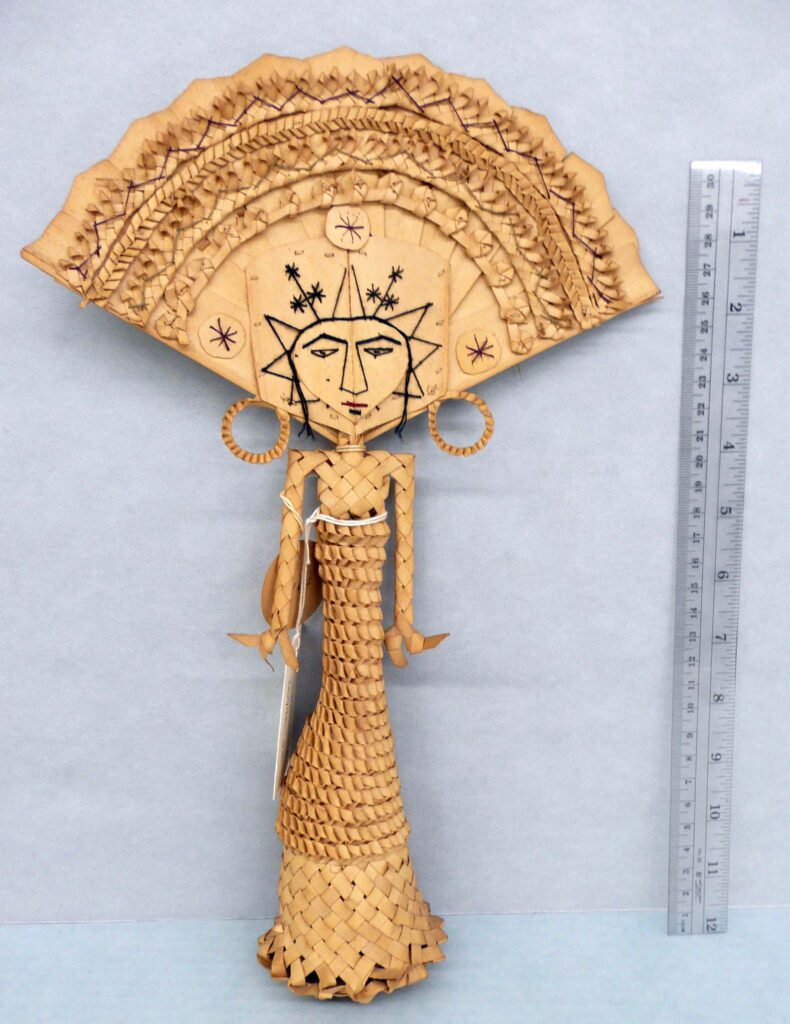
Balinese Tjili Doll

Balinese Tjili doll

This Balinese Tjili doll came to be a part of the Carnegie collection in 1980 through the donation of Dr. Betty J. Meggers, an international doll collector. Made in the image of Dewi Sri, Indonesia’s goddess of rice and fertility, figures like this doll symbolize fruitfulness and good harvests. 

“This doll caught my attention because of her intricate woven design and large, fan-like headdress that radiates like a setting sun. I believe her story shows how dolls can serve so many purposes and are beloved by different cultures all around the world.”—Lily Heistand, Anthropology Volunteer

Folklórico Dancer

folklorico dancer doll
Young Matí wearing same dress style

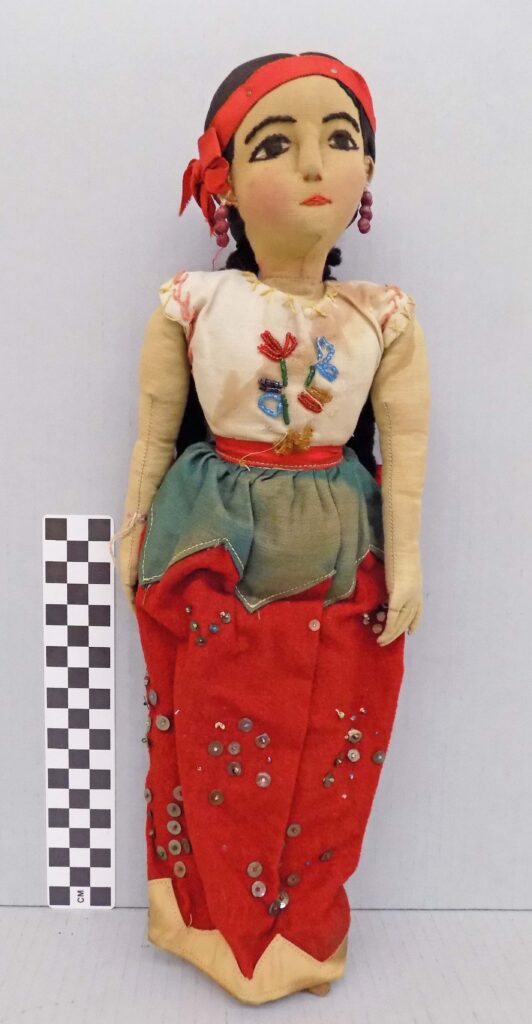
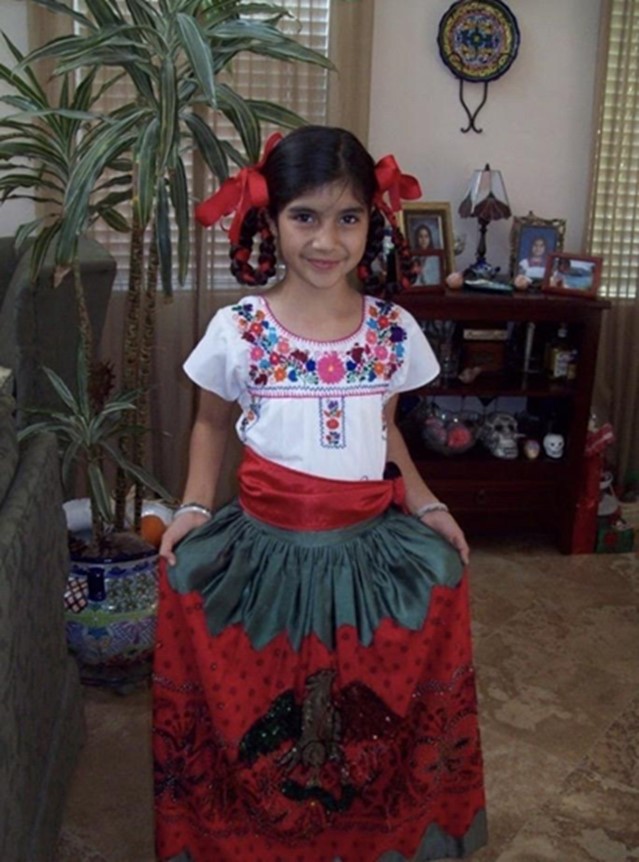
This doll is a folklórico dancer! Made in Cuernavaca, Morelos, México, this doll joined the museum’s collection as a donation in March of 1950. She is made of wool and cotton and has black braids (trenzas folklóricas), a white embroidered blouse (blusa bordada), and a sequined red and green skirt (china poblana). All these components make her instantly recognizable as a ballet folklórico dancer (folk dancer). Her skirt is designed after one of the most recognizable traditional styles of dress in Mexico, la china poblana. China poblana skirts tend to be heavy as they are made with layers of embroidery using sequins and beads to depict the Mexican coat of arms of the eagle perched on a cactus with a snake in its mouth. Historically, this style of dress was popular in the state of Puebla, but nowadays it is typically worn by dancers when performing El Jarabe Tapatío, which is a dance from the state of Jalisco and México’s national dance. 

“I chose this doll because she beautifully represents my culture and my family. My abuelita embroidered a china poblana skirt that my mom performed in, and years later I also danced in it. This doll represents a tradition that ties together three generations of women in my family and the beauty of our cultural traditions.”—Matí Castillo, Fine Fellow, University of Pittsburgh

Angel of Mercy

Canadian Angel of Mercy doll

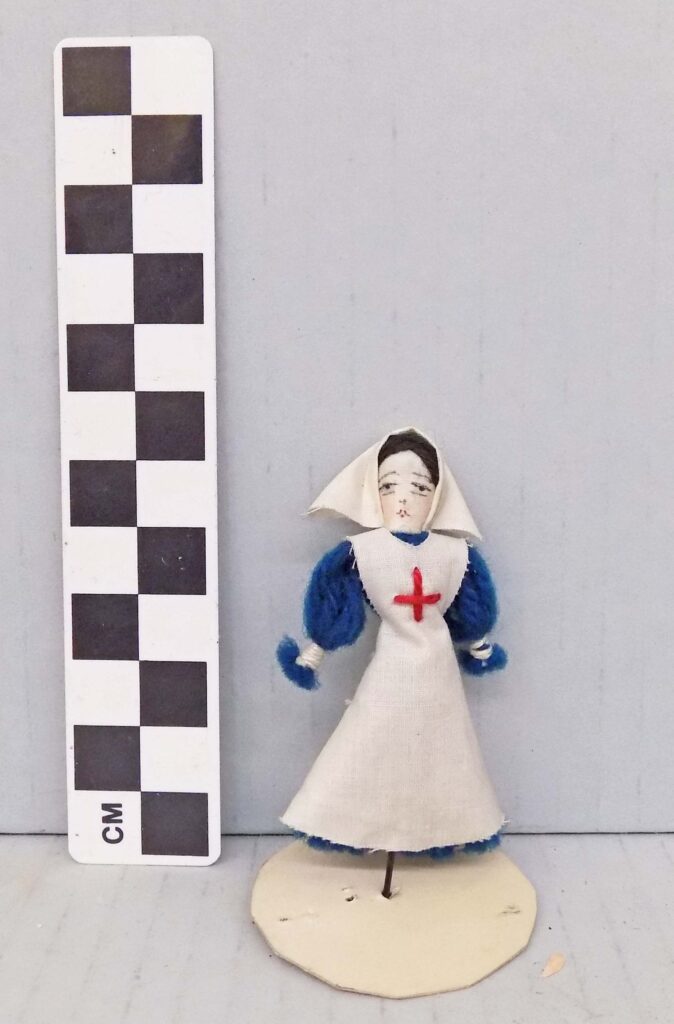
This doll is an “Angel of Mercy.” This nickname was affectionately given to the unsung heroes of the Great War, the nursing sisters, who worked long gruesome hours and attended to the needs of injured soldiers. The casualties of World War I were extensive, but the nurses worked tirelessly to aid in wound cleaning, bacterial-growth prevention, and even assist in emergency surgeries all while fearing for their own wellbeing. This doll was donated in 1918 by Mrs. Virginia Hayes Osburn along with many other ‘war woolies.’ These war woolies were dolls that were made by the Canadian Red Cross Vancouver during the Great War. According to the British Red Cross Museum and Archive, these “wooly” dolls were crafted by the Vancouver Prisoners of War Branch of the Canadian Red Cross to fundraise during World War I.

“I chose this Canadian Red Cross Nurse doll because though she is miniature, her face was expressive, and I wanted to research more about her because the other war woolies she was housed with were depictions of English monarchs; I wanted to tell her story as an unsung female hero of the Great War.”—Caitlin Erb, St. Laurance University Post-Baccalaureate Intern

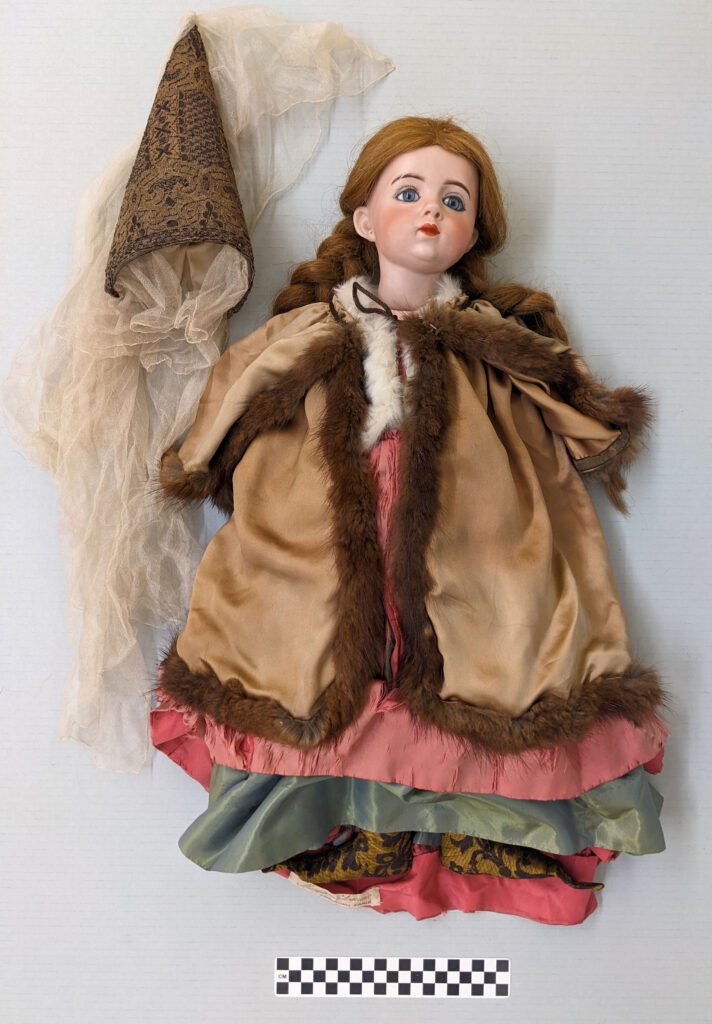
A. Marque Character Doll

black and white photo of two character dolls
Isabeau de Baviere doll

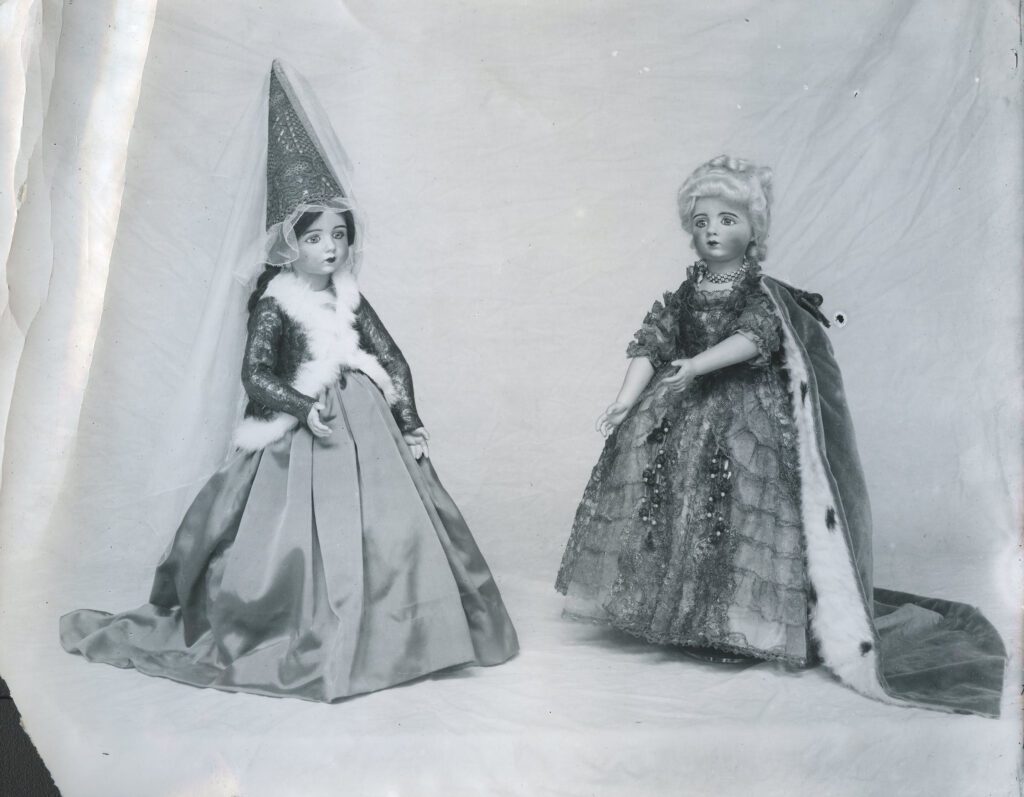
Fashion icon Isabeau de Bavière is one of the five queens that made their way to Carnegie Museum in 1916. After seeing a French character doll exhibit in the Metropolitan Museum in 1915, Herbert DuPuy wrote to the Director of Carnegie Museum, Dr. W.H. Holland, suggesting the addition of such wonderfully crafted dolls into Carnegie’s collection. Less than a year later, five A. Marque and thirty-five other character dolls from the Paris doll company S.F.B.J were part of the museum. 

Isabeau is a rare A. Marque bisque doll, fashioned after the queen of France reigning from 1371-1435, and dressed by the famous couture artist Margaine Lacroix. She gives a glimpse into the accurate historical fashion of the late fifteenth-century nobility. From her undergarments to the recognizable pointed hennin hat of the Medieval period, Isabeau directly copies portraits of the queen. 

“I chose this wonderful doll because of her fascinating history and design; the A. Marque dolls are some of the rarest dolls the museum currently owns, and one of my favorites to admire.”—Elizabeth R. Dragus, Anthropology Volunteer 

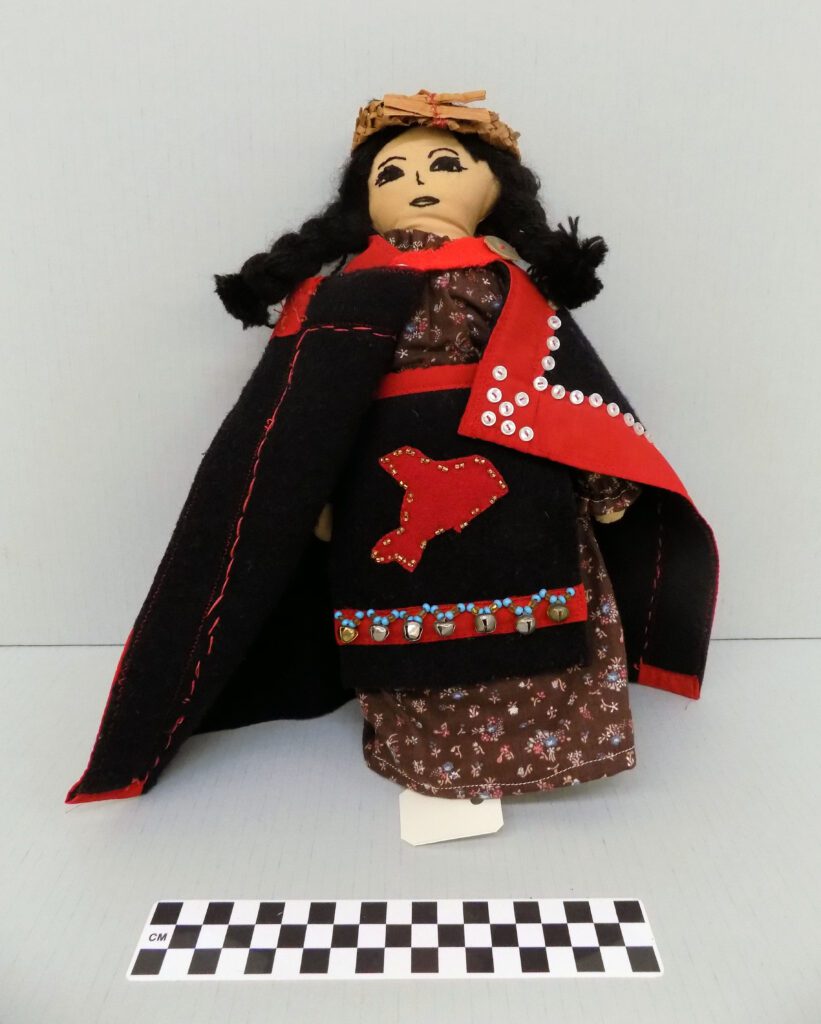
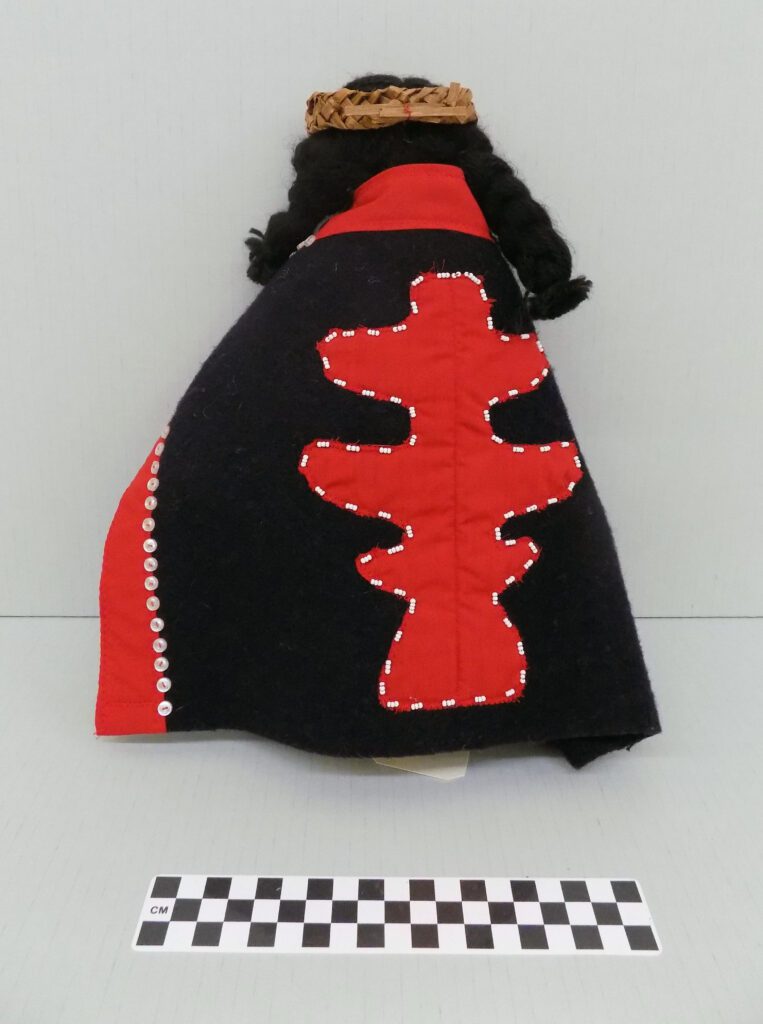
Kwakwa̱ka̱ʼwakw Woman

Kwakwa̱ka̱ʼwakw Woman doll
Kwakwa̱ka̱ʼwakw Woman doll back

The Kwakwa̱ka̱ʼwakw Woman doll was donated by James B. Richardson III, (Carnegie Museum Anthropology Curator Emeritus), in memory of his mother Miriam Davenport Richardson. The doll was made by Debra Bell of the Nimpkish Band of the Kwakwa̱ka̱ʼwakw Nation located in Alert Bay, British Columbia. Debra Bell is one of a very few Northwest Coast Indigenous female doll makers. On a research expedition for Carnegie Museum of Natural History’s Alcoa Hall James Richardson purchased this doll in 1992.

Embroidered on the wool felt blanket is a “Tree of Life” design, symbolic of the coniferous forests of the Pacific Northwest which are full of Sitka spruce, Douglas fir,  yellow cedar, and western red cedar. Collectively, these tree species are the sustenance of Indigenous people, providing lumber for homes, fire for heat, homes for birds, and shelter for mammals. They also sustain waterways and breathe oxygen into the air.

A plaited cedar bark wreath adorns the doll’s head. Yellow cedar is considered the finest cedar in the region and used in traditional ceremonial objects. The tree is found in deep porous soil on slopes, around lakesides, and within estuaries. The oral history of yellow cedar in Northwest cultures derives from this story; “Raven asked a few young women what forest creature they were afraid of. The women replied, ’none.’  Raven then asked if the women were afraid of owls. The women exclaimed, ‘Yes, [they] were terrified of owls!’ Raven (being known as a trickster) hid in some bushes making owl sounds. The young women went running up the slopes. That is why yellow cedar is only found on slopes.” 

Most Northwest tribes believe humans can transform into animals and back again. The red felt killer whale applique embroidered with pairs of amber glass seed beads on the doll’s dress symbolizes one of these stories of human transformation. The killer whale is known as Natsilane and believed to be part of Earth’s creation. Natsilane was drowned by his brothers who wanted control of the world. Left to die, Natsilane was rescued by a sea otter and restored to his legitimate place as leader. Natsilane helped the sea otters find the safest hunting waters in return for saving his life.

The Northwest Coastal native Americans have a fiercely independent culture steeped in storytelling and deeply rooted in the infinite wisdom of nature.  All these attributes can be noted when viewing the Kwakwa̱ka̱ʼwakw Woman doll.

“I was taken by this doll’s face staring out from her collection box with blue glass paperweight eyes and painted eyelashes for numerous reasons. I had lived in Oregon and Washington states for a few years and was always caught by the breathtaking beauty of shorelines and forests. The doll reminded me of that majestic landscape in her blue wool button blanket. Although the button blanket did not appear in the Northwest culture until colonization, the deep color of the wool is reminiscent of the sea and sky in the area.”—Georgia Feild, Archaeology Volunteer and Museum Educator II   

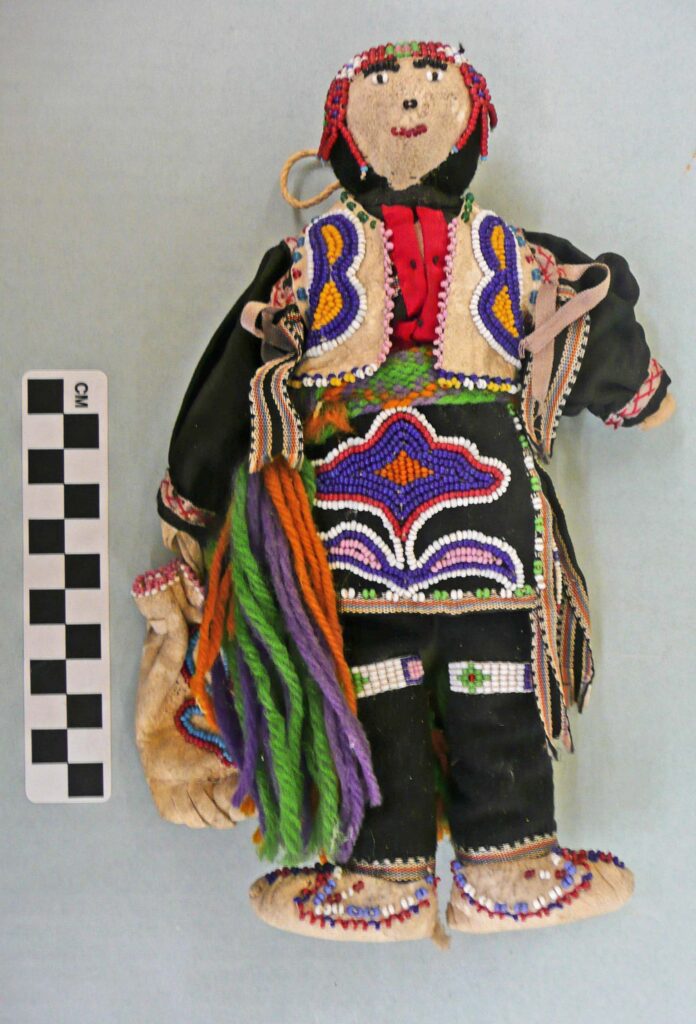
Meskwaki Man

Meskwaki man doll in traditional clothing

“My favorite doll in the collection is the Meskwaki man in traditional clothing, probably made in the 1920s. Part of what caught my eye was the attention to detail. 

The man’s head, moccasins, and bag are made from brain-tanned deerskin, with simplified traditional sewn beadwork designs. His beaded headband is loom-woven, and his body is sewn of cotton muslin. 

He has a satin shirt with silk ribbons [like the ribbon shirts worn today], and wool trousers under his beaded aprons. Originally, men wore loincloths, beaded for special occasions, which evolved into aprons in the last half of the 19th century as men started wearing trousers. 

My favorite part of the outfit is the finger-woven sash. Finger-weaving is a form of oblique interlacing, a sort of wide, flat braid. I was first introduced to finger-weaving in the late 1960s, when I made finger-woven sashes in my dorm room for all my hippie college friends. Finger-weaving was and is found all over eastern North America, where the technique is used to create sash belts, garters, and bags. Colors, designs, and techniques differ in the different cultural areas. The people in the upper Midwest made wide bands which the men wrapped around their heads like turbans and adorned with feathers. [Southeastern men also wore turbans with feathers but preferred to use silk shawls.]

The earliest recorded piece extant of the technique comes from the Craig Mound in Spiro, Oklahoma, and dates to around 850-1450CE. It is currently in the collections of the National Museum of Natural History, Smithsonian Institution.”—Deborah Harding, Anthropology Collection Manager Emeritus 

First Lady Paper Doll

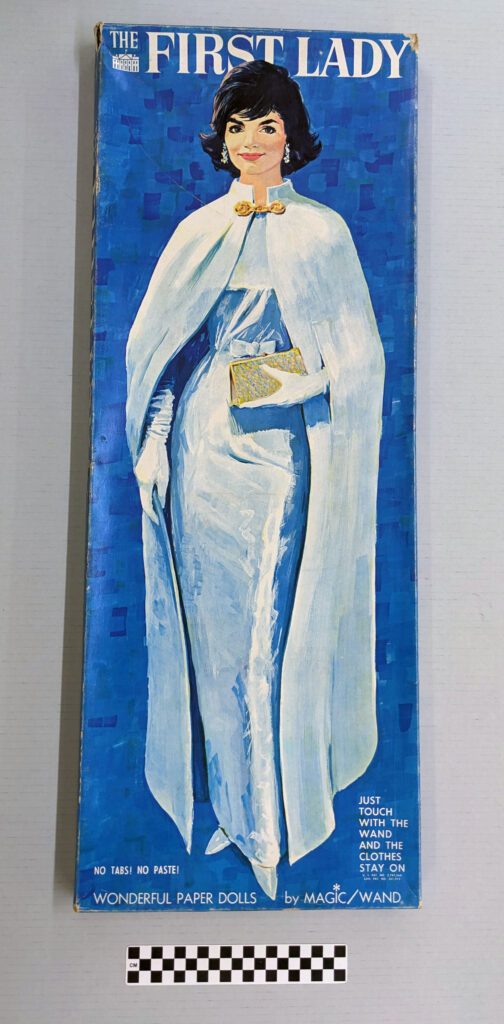
box for a First Lady paper doll
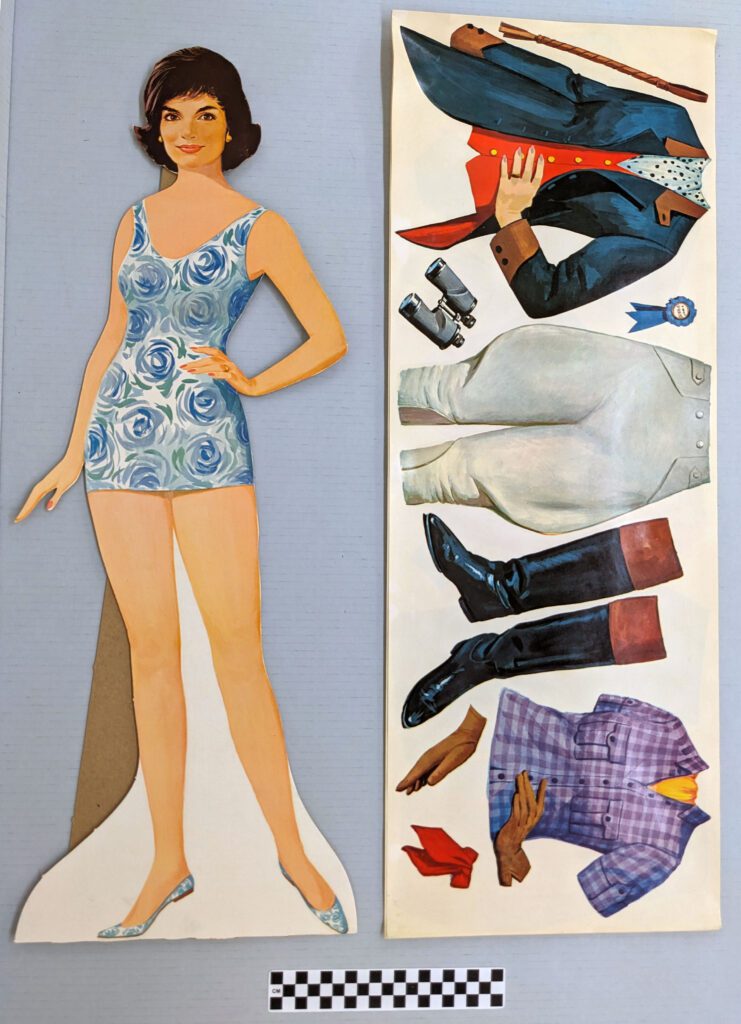
first lady paper doll

This supersized paper doll depicts fashion icon and First Lady Jackie O. It was donated by Dr. Betty Meggers. She and her mother collected dolls from around the world beginning at least as early as the 1930s. She donated more than 1,000 to the museum. As you can see from the box, this paper doll used a “magic wand” to keep the clothes on the doll – no tape or paste required!

“I used to love dressing, playing with, and making paper dolls. I chose paper dolls because they are universally accessible, all it takes to create one is paper and imagination. Manufactured paper dolls come from all over the world and provide people with the opportunity to see, play with, and learn about all different types of people, jobs, and cultures. They are also great for kids like me, who really love fashion. My grandma Kelley had a wonderful set of dolls and paper dolls that I would play with whenever I went to her house. I love the freedom of being able to dress the dolls however I wanted, to change their hair and outfits, and even to design new outfits of my own.”—Lisa Haney, Assistant Curator, Egypt on the Nile

Tibetan Buddhist Doll

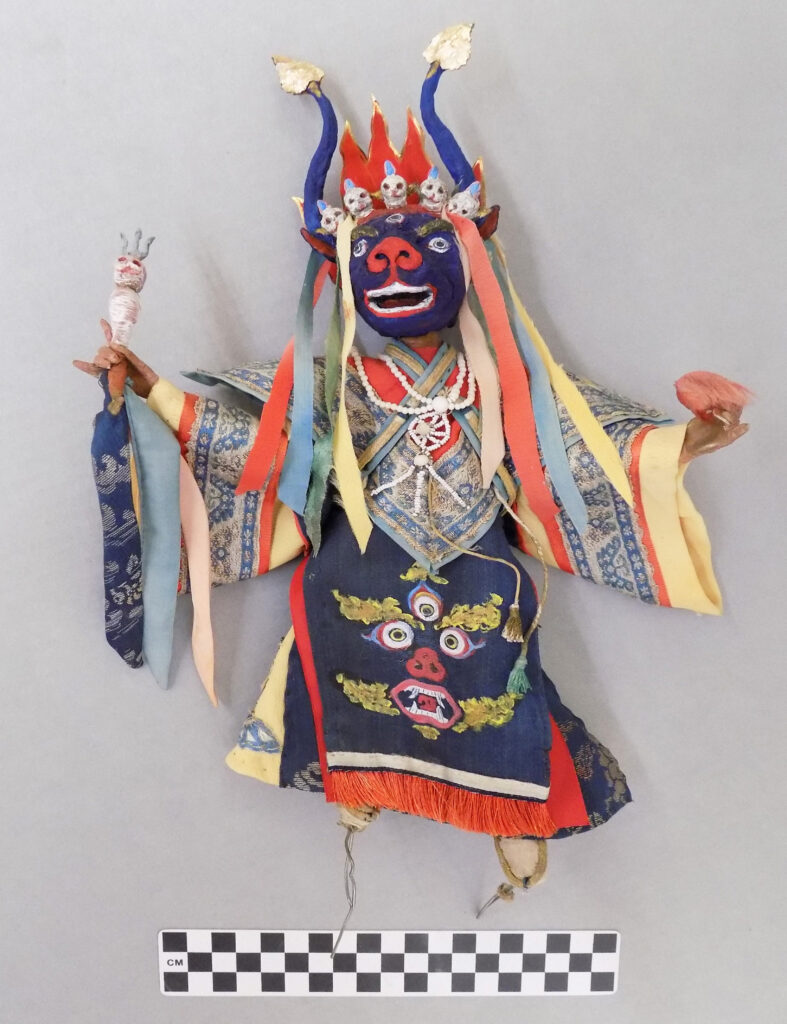
colorful doll of Yamantaka, Destroyer of the God of Death

Yamantaka, “Destroyer of the God of Death.” Not exactly a character you’d think of making into a doll to be used as a plaything, something to cuddle, or as a tool to teach children how to care for babies. However, to practitioners and students of Tibetan Buddhism, this type of doll serves as a visual reminder of the history, values, and lessons that are core to the culture. Although doll-making isn’t a traditional art form in Tibet, Yamantaka shows up in many other visual forms of Tibetan Buddhist art. This unusual doll from the museum’s collection showcases some handicrafts that aretraditional to the culture such as garment-making, tapestry, sculpting, painting, and beading.

Who was Yamantaka and why make a doll of him? The short version of the story is that there was a monk who became wrathful and took on the form of an enraged water buffalo. He caused death and destruction all over Tibet and became known as Yama, The God of Death. The people prayed for someone to stop him and restore peace. A bodhisattva (a deity who helps people) transformed himself into the form of an even bigger, scarier water buffalo to find Yama and convince him to change his ways. By stopping the God of Death, the bodhisattva became known as Yamantaka, the Destroyer of the God of Death. Yamantaka showed mercy on the repentant monk and reminded him to live by the Buddhist principles of compassion, self-control, detachment from ego, and wisdom-seeking. By exemplifying these qualities and restoring peace, Yamantaka was regarded as a protector of Buddhism. A legendary superhero. Someone deserving to have a doll, or rather an action figure, made in his likeness for future generations to aspire to.

“This doll stood out to me at first glance because of its vivid, striking visual impact. Then, as you let your eyes coast over all the details, you become aware that it is just as nuanced as it is bold. For example, the subtle metallic tips on the flames are equally important as the formidable facial expression. For every single thing you see there’s more to the story, and it’s probably not what you’d expect. The doll’s purpose was to preserve, teach, and remind people of the culture. Indeed, it inspired me to seek out and learn about the significance of Yamantaka’s story and, by extension, Tibetan Buddhist traditions and beliefs.”  -Jillian Hanna, Anthropology Volunteer 

Bye Barbie!

Many of our dolls have been used to augment traveling exhibitions and have served as research subjects. It is our great honor to care for them and learn from them. The next time you visit the museum, don’t forget to stop by the Alcoa Hall of American Indians and look for our dolls that are currently on exhibit. 

Related Content

Bringing a Little O-Gah-Pah to Pittsburgh

New Vision of Old Rock Art

Grass Baskets of the Chumash

Sources Consulted

 CMNH accession records

Transformations: Salmon, Bear, Raven, and Humans

Tonga, Britannica.com

Taxidermy Hall of Fame

Bruce Frank Primitive Art

Stichting Nationaal Museum van Wereldculturen

Tibetan Buddhist Art

The Rise of Yamantaka, Destroyer of the Lord of Death

British Red Cross. (2010). Small woolen doll dressed in French military uniform. British Red Cross collection online. https://museumandarchives.redcross.org.uk/objects/8999   

Flexon M. Mizinga, “Marriage and Bridewealth in a Matrilineal Society: The Case of the Tonga of Southern Zambia, 1900-1995,” African Economic History 28 (2000): 53-87.

Malaika P. Yanou, Mirjam Ros-Tonen, James Reed, and Terry Sunderland, “Local knowledge and practices among Tonga people in Zambia and Zimbabwe: A review,” Environmental Science & Policy 142 (April 2023): 68-78.

Wilfrid Laurier University. (2015). Angels of Mercy: Canadian Nurses in the Great War. Youtube. Retrieved July 27th, 2023. from https://www.youtube.com/watch?v=0zITLh6jPYY

Carnegie Museum of Natural History Blog Citation Information

Blog author: Covell-Murthy, Amy; Gaugler, Kristina; Barno, Jim; Smith, Deirdre M.; Zadorozhna Ruban, Lidiia; Heistand, Lily; Castillo, Matí; Erb, Caitlin; Dragus, Elizabeth R.; Feild, Georgia; Harding, Deborah; Haney, Lisa; Hanna, Jillian
Publication date: August 4, 2023

Share this post!

  • Share on Twitter Share on Twitter
  • Share on Facebook Share on Facebook
  • Share on Pinterest Share on Pinterest
  • Share on LinkedIn Share on LinkedIn
  • Share on Reddit Share on Reddit
  • Share via Email Share via Email

Filed Under: Blog Tagged With: Amy Covell-Murthy, anthropology, Kristina Gaugler, Lisa Haney, Science News, SWK2

June 23, 2023 by Erin Southerland

From Collections User To Collections Manager

Introducing Mariana Marques, the New Collection Manager for the Section of Amphibians and Reptiles

by Mariana Marques
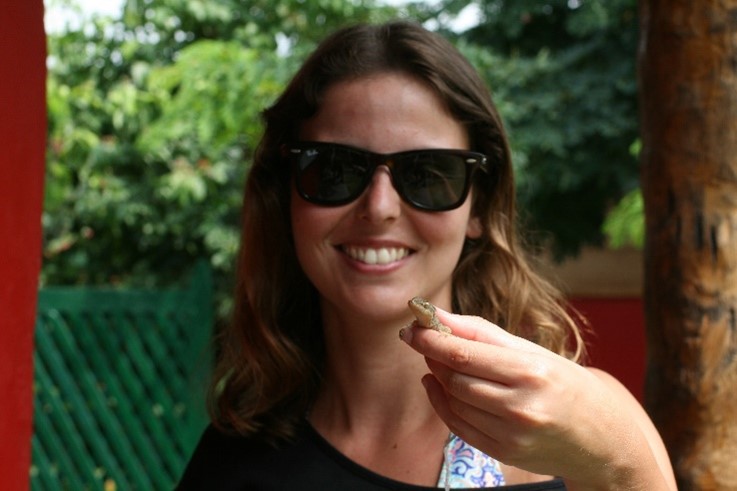
With a Hemidactylus greefii – São Tomé giant gecko, São Tomé island.

I’m not sure when I first entered in a natural history museum, but I know that these establishments have always been my favorite places to visit. I did my bachelor’s degree in biology in the University of Évora, a small and picturesque town in southern Portugal surrounded by one of the most biodiverse habitats of the Iberian Peninsula, the unique savanna-like ecosystem known as the “montado.” In the intervals between classes, I loved to go look for the critters that surrounded the university field station where most of my classes were held. I was lucky enough to be in one of the places with the highest diversity of amphibians and reptiles in the country, and in a natural and unspoiled area which meant that I could easily see good numbers of these animals. Being able to handle and study these animals in the field woke up my passion for herpetology, and I decided that I wanted to become a herpetologist.

I started to collaborate on projects in herpetology, and I was lucky enough to visit the outstanding collections of the Natural History Museum of Paris while I was an undergraduate. Most of the projects I was participating in had a strong taxonomic focus, and therefore specimens were the basis of my research. I had become specialized in measuring snout-vent length, counting scales, and describing the coloration of preserved lizards, frogs, and snakes from across the world. With these, I started to better understand the importance of historical labels, catalog numbers, old publications citing these specimens, and modern databases. 

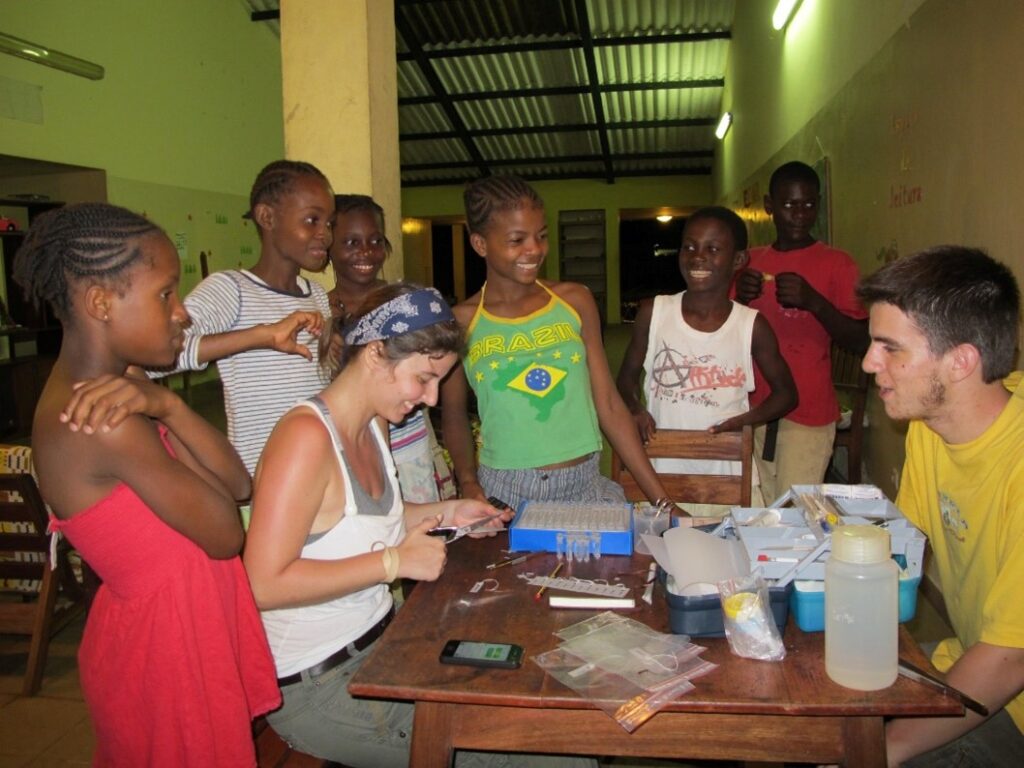
My path turned to Africa during master’s thesis work as I started working with the poorly known fauna of two Portuguese-speaking countries on the continent: Angola, in southwestern Africa, and São Tomé & Príncipe, an island nation in the Gulf of Guinea. For this work, I learned another new skill: specimen collecting. As an apprentice naturalist, I learned where to find species of interest, how to collect them safely, and how to prepare and fix them to become museum specimens. These new experiences gave me an increased appreciation of our collections and their importance. As an MSc and PhD student, I described species new to science, and catalogued and mapped herp diversity to support their conservation. 

Preparing specimens field tags in the company of the young future naturalists at Príncipe island.
Photo by: Luis M.P. Ceríaco, 2015.

Although I’ve visited many collections in Europe, Africa, and the US (including CMNH!), I was mostly based in Portugal. The Portuguese collections had suffered considerable neglect which made most of them almost unusable. However, taxonomists need collections, so together with colleagues, I embarked on the mission of rescuing those collections to make them accessible and usable for researchers. Through this process I learned how a collection should be housed, and best practices for collection management and care. I became a collections manager!

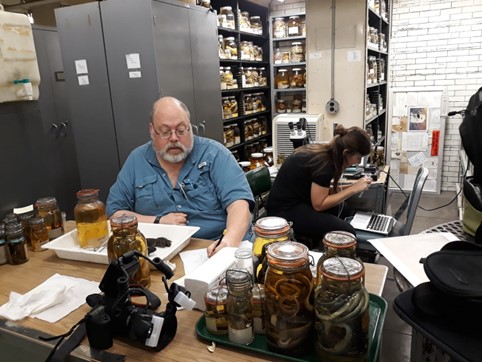
Starting from scratch. Listing all herpetological material at Instituto de Investigação Científica Tropical, Lisboa, Portugal. Photo by: Luis M.P. Ceríaco, 2014.

Currently, while I still love to do research, participate in fieldwork, and describe new species, I love to be taking care of specimens in old jars, making them accessible to researchers and to the public, telling stories about them, and ensuring they are preserved for generations to come. Natural history collections, such as the one we have at Carnegie Museum of Natural History, are fundamental tools for science and conservation, and new promising technologies are showing us that their potential is far beyond my traditional snout-vent length measuring and scale counting.

Becoming the Collection Manager of the Section of Amphibians and Reptiles of Carnegie Museum of Natural History is both a challenge and an honor. And what I find more curious about it, is that in 2018, when I visited the museum and used its collections for my own research, I remember saying to myself: this is a city where I could see myself living!

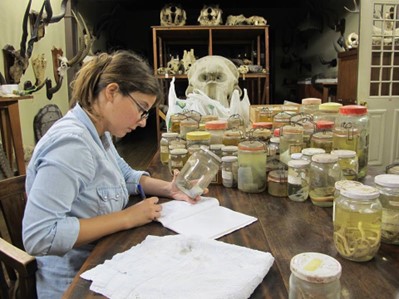
At Carnegie Museum of Natural History, Section of Amphibians and Reptiles in 2018, studying the Angolan material from Pulitzer Expedition, with Aaron Bauer and Luis Ceríaco. Photo by: Luis M.P. Ceríaco, 2018.

Mariana Marques is Collection Manager of Amphibians and Reptiles at Carnegie Museum of Natural History.

Related Content

A Deep Look Inside Reptiles and Amphibians

Sharing a City Park with a Resident Reptile

Is This What They Call Overkill? Toxin and Venom in the Herp World

Carnegie Museum of Natural History Blog Citation Information

Blog author: Marques, Mariana
Publication date: June 23, 2023

Share this post!

  • Share on Twitter Share on Twitter
  • Share on Facebook Share on Facebook
  • Share on Pinterest Share on Pinterest
  • Share on LinkedIn Share on LinkedIn
  • Share on Reddit Share on Reddit
  • Share via Email Share via Email

Filed Under: Blog Tagged With: amphibians and reptiles, herpetology, Mariana Marques, Science News, SWK2

October 29, 2021 by Erin Southerland

Meet the Mysterious Mr. Ernest Bayet

by Joann Wilson and Albert Kollar

Imagine accumulating tens of thousands of fossils? While the exact number of fossils in Bayet’s collection has yet to be determined, estimates range from 20,000 to over 100,000. In 1903, William Holland, Director of the Carnegie Museum, negotiated a blockbuster deal to bring Bayet’s entire collection to Pittsburgh. The deal dazzled the public and made front page news in the New York Times. For over two years, the Section of Invertebrate Paleontology has been uncovering the stories of the collectors and dealers behind Bayet’s magnificent collection. Notable dealers include Lucien Stilwell, Frederick Stearns, and Dr. Friedrich Krantz, to name a few. But what about Bayet himself? What is his story?

Thanks to ongoing translations of the Bayet archive by volunteer Lucien Schoenmakers, we are excited to begin a series introducing Ernest Bayet, the person behind the collection.  

How old was Bayet when he sold his fossil collection?

Bayet, who was Born in 1859, was just 44 years old in 1903 when he sold his collection to the Carnegie Museum.  

How long did Bayet collect fossils?

Archival documents, that in 1903 arrived in Pittsburgh from Brussels with the purchased materials, indicate Bayet acquired the bulk of his collection in under 20 years. Assuming a range of 20,000 -100,000 fossils, Bayet would have acquired fossils at the blistering pace of 1,000-5,000 specimens per year. When you consider the logistics of shipping, along with the perpetual letter writing required to transact deals in the late 19th century, his acquisition rate is an amazing feat. 

Signature on a piece of paper
Is this Ernest Bayet’s signature? Portion of a recently re-discovered fossil label.

Why did Bayet sell his collection?

In July of 1902, Bayet married countess, Maria van der Burch. The Bayet family had their first child in 1903. A second child followed in 1905. Was this a factor in Bayet’s decision to downsize his entire fossil collection? We are not yet sure of Bayet’s plans or motives. For over a century it was rumored that Bayet sold his fossils to pay for a new chateau, or home.  In a letter to Andrew Carnegie dated June 8, 1903, William Holland, then Director of the Carnegie Museum, reported this as a possible explanation for the fossil sale. Although we have yet to verify that a chateau was acquired within that period, such a purchase is a possibility.  

How long did Bayet live?

The Mysterious Mr. Ernest Bayet died in 1935 at the age of 76. What was his life like after the sale? To learn more about Bayet and how his fossils arrived in Pittsburgh, check out Annals of Carnegie Museum’s new publication, “Unraveling the 120 Year Mystery of Ernest Bayet and His Fossil Collection at Carnegie Museum”.

We are continually grateful to volunteer and Netherlands resident Lucien Schoenmakers for ongoing efforts to translate archival Bayet documents. Joann Wilson is an Interpreter in the Education Department at Carnegie Museum of Natural History. Albert Kollar is Collections Manager for the Section of Invertebrate Paleontology. Museum employees are encouraged to blog about their unique experiences and knowledge gained from working at the museum.   

Related Content

Bayet and Krantz: 16 Words

Bayet’s Bounty: The Invertebrates That Time Forgot

From Collector to Director

Carnegie Museum of Natural History Blog Citation Information

Blog author: Wilson, Joann; Kollar, Albert
Publication date: October 29, 2021

Share this post!

  • Share on Twitter Share on Twitter
  • Share on Facebook Share on Facebook
  • Share on Pinterest Share on Pinterest
  • Share on LinkedIn Share on LinkedIn
  • Share on Reddit Share on Reddit
  • Share via Email Share via Email

Filed Under: Blog Tagged With: Albert Kollar, invertebrate paleontology, Joann Wilson, Science News, SWK2

September 24, 2021 by wpengine

Bayet and Krantz: 16 Words (Part 1)

by Joann Wilson and Albert Kollar

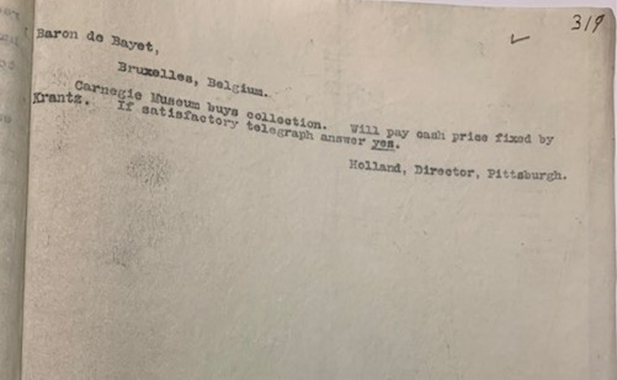
In June of 1903, William Holland, Director of the Carnegie Museum, seized a rare chance to acquire one of the finest private collections in all of Europe. The purchase was made with sixteen words. Within in Holland’s Archives at the Carnegie Museum of Natural History Library, on onion paper so fragile that it appears to float, is a carbon copy of the telegram that influenced the early history of the Paleontology Department. Mysteriously, only one name appears on this fateful cable, and it is not a name that you would expect. The name is “Krantz,” Dr. Friedrich Krantz of Bonn, Germany.

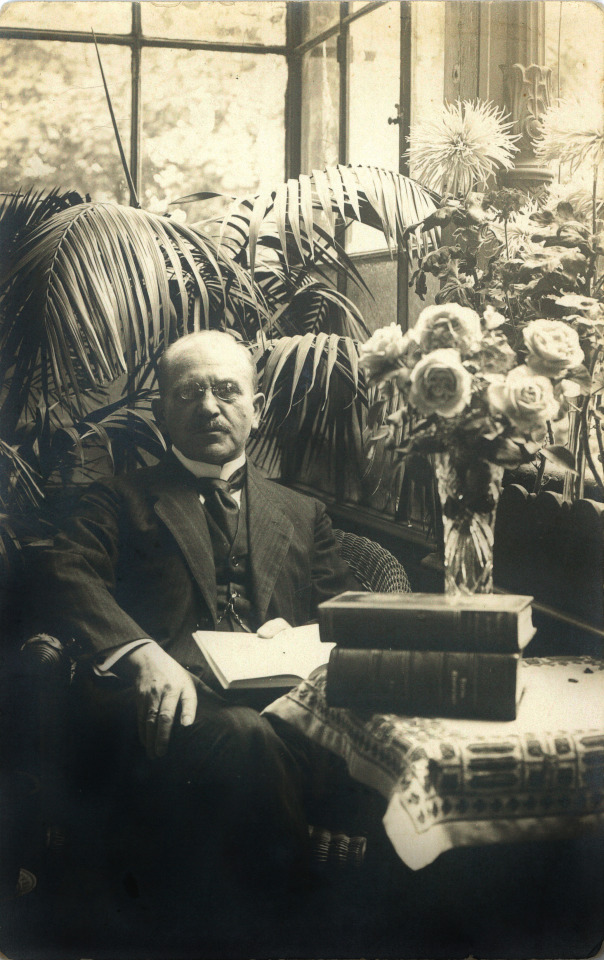
Black and white photo of a man in a suit holding a book surrounded by books and plants.
Dr. Friedrich Krantz sitting in the conservatory, or wintergarten, at his villa in Germany, (date unknown). Permission of Ursula Müller-Krantz, Executive Director, Dr. F. Krantz.

In 1859, Friedrich Krantz was born into a family that operated a geological supply business. In 1888, Krantz graduated with a PhD in geology from the University of Erlangen. That same year, he joined “Dr. A Krantz,” the company founded by his uncle, Adam August Krantz. By 1891, Friedrich Krantz took charge and changed the company name to “Dr. F. Krantz, Rheinisches Mineraliaen Contor.” The company continues operations to this day out of headquarters in Bonn.

Exactly when Ernest Bayet of Brussels and Friedrich Krantz met is uncertain. But thanks to the letters and fossil lists that arrived with the Bayet collection, we know that they corresponded at least three times. The difficult task of translating these documents into English is being handled by volunteer Lucien Schoenmakers, a resident of the Netherlands. Schoenmakers’ translation work here and with other records is contributing critical information to the Section of Invertebrate Paleontology’s multiyear project to fully document the invertebrate portion of the Bayet Collection.

From the archive, we know that Krantz visited Bayet at least once. On July 7th, 1897, Krantz wrote, “I intend to come to Brussels towards the end of next week and will be honored to visit you, I can use the numbered list to give you the exact individual prices for all the objects displayed by me.”

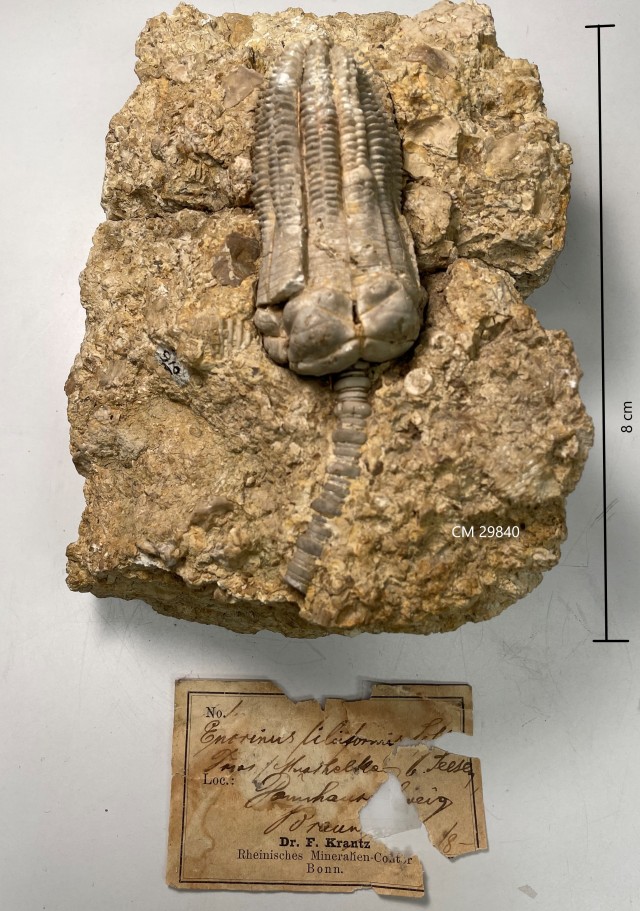
In fact, Bayet may have selected Krantz to act as his agent for the sale because he was so familiar with it. Krantz sold many museum quality specimens to Bayet; many with distinctive, elegant labels.

Fossil specimen with partial label underneath
Encrinus liliiformis Miller (CM 29840): a Triassic crinoid from Brunswick, Germany with Krantz label.

The sale of Baron Ernest Bayet’s fossil collection to the Carnegie Museum in 1903, made front page news in the New York Times, and other papers across the country. In a letter to Andrew Carnegie, thanking him for allocating $25,000 for the purchase, an enormous sum for that time, Holland wrote, “We are never likely to have another such chance, and you have done a most splendid thing in securing it [the Bayet Collection] for our Museum of Paleontology.” That most splendid thing transpired, over a century ago, with just sixteen words:

“Carnegie Museum buys collection. Will pay cash price fixed by Krantz. If satisfactory, telegraph answer yes.”

Photograph of a telegraph that reads: Baron de Bayet, Bruxelles, Belgium, Carnegie Museum buys collection.  Will pay cash price fixed by Krantz.  If satisfactory, telegraph answer yes.
Cable sent from Pittsburgh to Brussels on June 9th or 10th, 1903 offering to buy Baron Ernest Bayet’s fossil collection. “Krantz” refers to Friedrich Krantz of Bonn, Germany, a business man and fossil dealer who acted as Bayet’s negotiating agent.

Part 2 of this series highlights spectacular Krantz specimens within the Bayet collection.

Many thanks for the generous contributions of Ursula Müller-Krantz, Executive Director of Dr. F Krantz Rheinisches Mineraliaen Contor GmbH & Co., Marie Corrado, Carnegie Museum of Natural History Library Manager and Kelsea Collins, Carnegie Museum Library Cataloger. Continued gratitude to volunteer Lucien Schoenmakers’ ongoing effort to translate archival Bayet documents. Joann Wilson is an Interpreter in the Education Department at Carnegie Museum of Natural History and Albert Kollar is Collections Manager for the Section of Invertebrate Paleontology. Museum employees are encouraged to blog about their unique experiences and knowledge gained from working at the museum.

Related Content

Bringing Light to Dark Places

Hunting for Fossil Frogs in Wyoming

A Deeper Look at Dioramas

Carnegie Museum of Natural History Blog Citation Information

Blog author: Wilson, Joann; Kollar, Albert
Publication date: September 24, 2021

Share this post!

  • Share on Twitter Share on Twitter
  • Share on Facebook Share on Facebook
  • Share on Pinterest Share on Pinterest
  • Share on LinkedIn Share on LinkedIn
  • Share on Reddit Share on Reddit
  • Share via Email Share via Email

Share this post!

  • Share on Twitter Share on Twitter
  • Share on Facebook Share on Facebook
  • Share on Pinterest Share on Pinterest
  • Share on LinkedIn Share on LinkedIn
  • Share on Reddit Share on Reddit
  • Share via Email Share via Email

Filed Under: Blog Tagged With: Albert Kollar, invertebrate paleontology, Joann Wilson, Science News, SWK2

September 17, 2021 by wpengine

Hunting For Fossil Frogs In Wyoming

by Amy Henrici

Collection managers at Carnegie Museum of Natural History (CMNH) typically spend their time on collection-based tasks. Sometimes, however, we are called on to clean out the office of a former curator in our respective sections. With the death of Section of Vertebrate Paleontology (VP) Curator Emerita Mary Dawson late last year, I’ve been spending time in her office sorting through numerous items she accumulated during her nearly 58-year career at the museum. While there, I can’t help but think of a conversation we had in her office many years ago when I expressed interest in obtaining a Master of Science degree in geology and paleontology at the University of Pittsburgh.

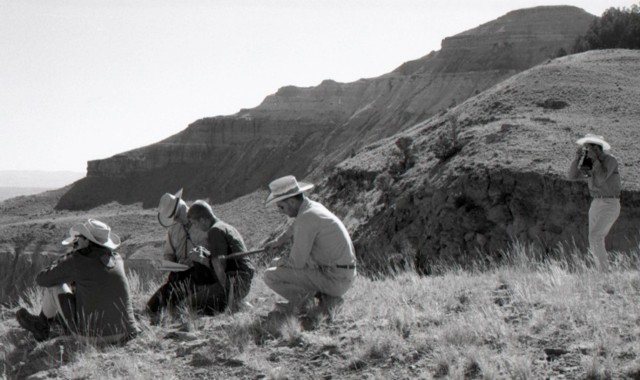
Mary agreed to be my advisor and suggested fossil fishes as a topic for my thesis, because at that time not many paleontologists were studying this group. She arranged for me to join a field crew from our Section led by curators Kris Krishtalka and Richard Stucky who planned to spend the summer of 1984 searching Eocene sediments (~56–34 million years ago) in the Wind River Basin of central Wyoming for fossils of mammals and other vertebrates. She instructed them to take me to the north end of Lysite Mountain, where during a 1965 reconnaissance geologist Dave Love (of the United States Geological Survey [USGS]) and his student Kirby Bay and others showed her some fish fossils.

Black and white candid photo of people on a rocky hillside.
1965 reconnaissance of the north end of Lysite Mountain. The fish locality lies further below the group. Left to right, Dave Foster, USGS geologist Dave Love, Love’s student Kirby Bay, then CMNH VP Curator Craig Black, and Ted Gard. Photo by Mary Dawson, July 28, 1965.

As planned, in late June I set out from Pittsburgh in my un-airconditioned car on a three-day drive to Wyoming to join the crew who had arrived before me. Some of my time in the field was spent assisting the crew in their search for mammal fossils, something I had no experience with. My previous field work involved collecting ancient amphibian, reptile, and dinosaur fossils from the time before most mammals had evolved. Indeed, the first set of “fossils” that I collected on this trip turned out to be fragments of modern rabbit bones that Kris unceremoniously dumped into his ashtray while identifying the day’s haul after dinner. Fortunately, my skills at finding mammal fossils improved.

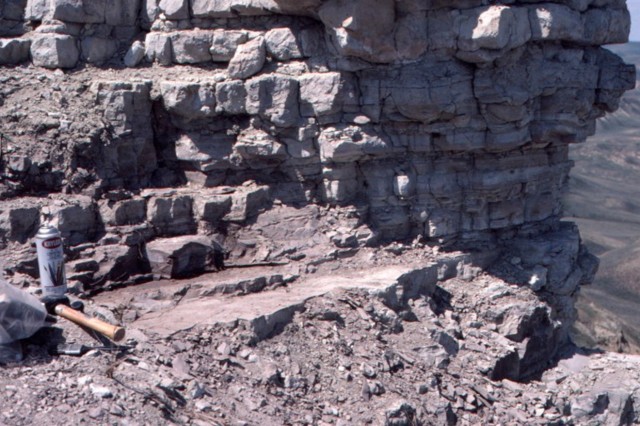
After a few days we went on the first of several reconnaissance trips to Lysite Mountain, which lies north of the Wind River Basin and forms part of the southern escarpment of the Bighorn Basin. To get there we drove deeply rutted and sometimes rocky dirt roads. Once there, the crew spread out in search of fossils. While some of us searched for and found incomplete and disarticulated fish fossils, others discovered a unit that produced frog fossils. When Kris and Richard showed me the frog fossils, they strongly urged me to base my thesis on the frogs instead of the scrappy fish I had collected. I quickly agreed, which was a decision that I never regretted.

We returned to our routine of prospecting for fossils in the Wind River Basin, until the planned arrival of Pat McShea (now my husband and Program Officer in the CMNH Department of Education) via a Trailways bus. The original plan was for Pat and me to drive my car daily to Lysite Mountain, but this was not feasible, given the condition of the roads. Instead the crew dropped us off with our camping gear for four days of fossil frog collecting. This was followed by a second field season in 1986, in which my sister, Ellen Henrici, joined us with her off-road capable SUV.

Rocky landscape with tools set out on the left side of the image.
The frog quarry, with the Bighorn Basin below, to right of quarry. Photo by the author, 1984.

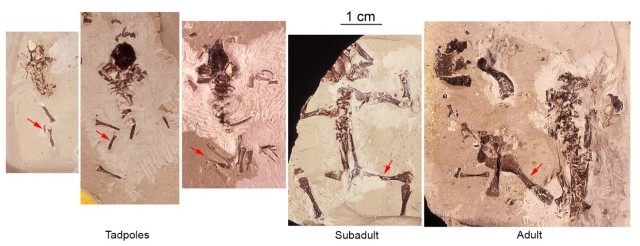
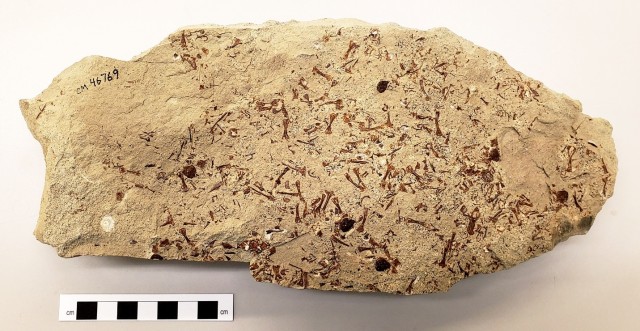
Using a hammer and chisel to pry open pieces of rock, we collected nearly 150 specimens of frog fossils in varying degrees of completeness. The preparation of the fossils and the identification of the various bones took me a long time. I eventually figured out that they were all the same type of frog and represented a new genus and species in the family Rhinophrynidae, which today is known by a single species: Rhinophrynus dorsalis, the Mexican burrowing toad. The fossil collection even includes tadpoles in various stages of development, as well as a mortality layer preserving the scattered bones of many individuals. I named this new genus and species Chelomophrynus bayi in a 1991 paper published in CMNH’s scientific journal, the Annals of Carnegie Museum.

From left to right: three tadpole fossils, a subadult frog fossil, an adult frog fossil
Growth series of Chelomophrynus bayi, arranged in order of maturity from youngest (left) to oldest (right). The red arrow points to the thigh bone (femur). A tail, not preserved, would have been present in the tadpoles. Photos by the author, 2015.

Mortality layer rock sample.
Sample of the extensive mortality layer of Chelomophrynus bayi. Cause of death might have been disease. Photo by the author, 2021.

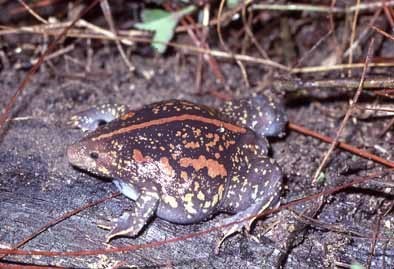
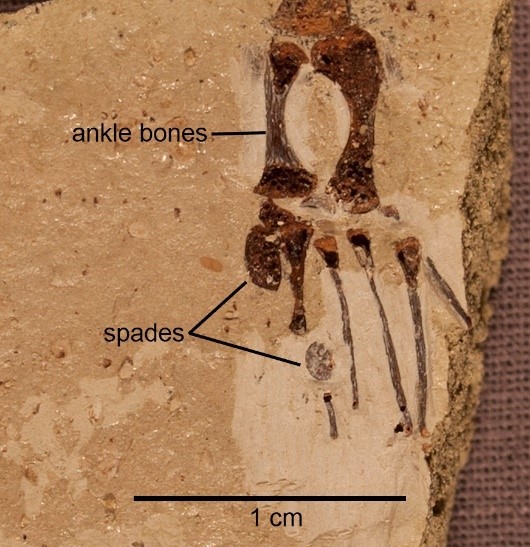
In paleontology, the study of living creatures can inform our understanding of fossils. The Mexican burrowing toad is very unusual in that it spends most of its life underground and only emerges to breed after heavy rain. The species currently inhabits dry tropical to subtropical forests along coastal lowlands in extreme southern Texas southward into Mexico and Central America. It has two bony spades on each hind foot that help it to efficiently dig, hind feet first, into the ground. Once underground, other skeletal specializations enable it to use its front feet and nose to penetrate termite and ant tunnels and then protrude its tongue into the tunnel to catch insects. Chelomophrynus possesses a number of these specializations (though some are not as well developed as in the modern Rhinophrynus), which strongly suggests that it too was able to burrow underground to feed on subterranean insects.

frog on the forest floor
Rhinophrynus dorsalis, the modern Mexican burrowing toad. Image from the CMNH Section of Herpetology.

Partial fossilized frog hind foot with labels for ankle bones and spades.
Partial hind foot of Chelomophrynus bayi, which preserves two bony spades that in life would have been covered in a keratinous sheath and used for digging feet-first into the ground. Photo by the author.

Rhinophrynids once occurred as far north as southwestern Saskatchewan, Canada around 36 million years ago. Their southward retreat to their current range could be because they apparently never developed the ability to hibernate in burrows, which would have protected them from seasonal sub-freezing temperatures which began developing around 34 million years ago.

The oldest rhinophrynid is Rhadinosteus parvus, a frog that lived with dinosaurs. In 1998, I was able to name and describe it based upon several late-stage tadpoles collected earlier from Dinosaur National Monument, Utah, a site where many of the dinosaurs on exhibit in CMNH came from. A cast of Rhadinosteus is displayed in CMNH’s Dinosaurs in Their Time gallery.

Amy Henrici is the Collection Manager in the Section of Vertebrate Paleontology at Carnegie Museum of Natural History. Museum employees are encouraged to share their unique experiences from working at the museum.

Related Content

Super Science Saturday: Scientist Takeover (September 25, 2021)

The Bromacker Fossil Project Part I: Introduction and History

Fossil Matrix Under the Microscope

Carnegie Museum of Natural History Blog Citation Information

Blog author: Henrici, Amy
Publication date: September 17, 2021

Share this post!

  • Share on Twitter Share on Twitter
  • Share on Facebook Share on Facebook
  • Share on Pinterest Share on Pinterest
  • Share on LinkedIn Share on LinkedIn
  • Share on Reddit Share on Reddit
  • Share via Email Share via Email

Share this post!

  • Share on Twitter Share on Twitter
  • Share on Facebook Share on Facebook
  • Share on Pinterest Share on Pinterest
  • Share on LinkedIn Share on LinkedIn
  • Share on Reddit Share on Reddit
  • Share via Email Share via Email

Filed Under: Blog Tagged With: Amy Henrici, Science News, ssstakeover, SWK2, Vertebrate Paleontology

  • Page 1
  • Page 2
  • Go to Next Page »

sidebar

About

  • Mission & Commitments
  • Directors Team
  • Museum History

Get Involved

  • Volunteer
  • Membership
  • Carnegie Discoverers
  • Donate
  • Employment
  • Events

Bring a Group

  • Groups of 10 or More
  • Birthday Parties at the Museum
  • Field Trips

Powdermill

  • Powdermill Nature Reserve
  • Powdermill Field Trips
  • Powdermill Staff
  • Research at Powdermill

More Information

  • Image Permission Requests
  • Science Stories
  • Accessibility
  • Shopping Cart
  • Contact
  • Visitor Policies
One of the Four Carnegie Museums | © Carnegie Institute | Privacy Policy | Terms of Use | Accessibility
Rad works here logo