• Skip to primary navigation
  • Skip to main content
  • Skip to primary sidebar

Carnegie Museum of Natural History

One of the Four Carnegie Museums of Pittsburgh

  • Visit
    • Buy Tickets
    • Visitor Information
    • Exhibitions
    • Events
    • Dining at the Museum
    • Celebrate at the Museum
    • Powdermill Nature Reserve
    • Event Venue Rental
  • Learn
    • Field Trips
    • Educator Information
    • Programs at the Museum
    • Bring the Museum to You
    • Guided Programs FAQ
    • Programs Online
    • Climate and Rural Systems Partnership
  • Research
    • Scientific Sections
    • Science Stories
    • Science Videos
    • Senior Science & Research Staff
    • Museum Library
    • Science Seminars
    • Scientific Publications
    • Specimen and Artifact Identification
  • About
    • Mission & Commitments
    • Directors Team
    • Museum History
  • Tickets
  • Give
  • Shop

Tim Pearce

October 2, 2020 by wpengine

Vampire Squid: Cutest Dracula

The Vampire Squid is your go-to mollusk for Halloween. It’s covered with glow-in-the-dark spots, and it can hoist its cape-like webbed arms over its head to transform into a pumpkin shape complete with outward-pointing fleshy spines. But wait, there’s more. With the largest eyes relative to body size of any animal, this has got to be the cutest Dracula you ever saw. And the scientific name, inspired by the cloak-like webbing and the dark body color, literally translates to “vampire squid from hell.”
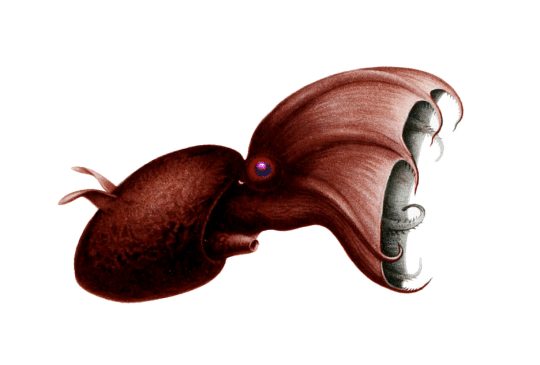
Vampire Squid, showing cloak-like webbing between arms, large eye, and ear-like fins. [Image from Wikimedia Commons]

The Vampire Squid (Vampyroteuthis infernalis) is an extreme deep-water cephalopod more closely related to octopuses than to squids. It is so bizarre that scientists classify it in its own taxonomic order, Vampyromorphida, to show that it differs markedly from other living cephalopods. Like octopuses, it has 8 arms with webbing between them, but unlike octopuses that have suckers on the entire length of the arms, the Vampire Squid bears suckers only on their outermost half. The prominent feature on the arms of the Vampire Squid are fleshy spines or cirri. In addition to the eight arms, it has two velar filaments, in pouches in the webbing, that are analogous (and maybe homologous) to the two long tentacles of squids.

Regarding superlatives, the Vampire Squid has the largest eyes relative to its body size of any other animal, a detail noted in the Guinness World Records. A fully-grown individual can be 28 cm (11 inches) long with eyes 2.5 cm (1 inch) in diameter. Adding to the cuteness factor, they have adorable ear-like fins, which adults use for swimming; juveniles also have fins, but primarily use jet propulsion to move around.

They live in the lightless ocean depths 600-900 m (2000-3000 feet) deep in temperate and tropical oceans world-wide. The ocean at these depths is an oxygen minimum zone with so little dissolved oxygen that most complex organisms cannot survive. But the vampire squid survives perfectly well with a low metabolism and blue blood that is more efficient at carrying oxygen than that of other cephalopods. They use ammonium in their tissues to regulate their buoyancy (ammonium is a wee bit lighter than water), reducing the need for active swimming. Living in the oxygen minimum zone probably helps it to avoid predators.

If disturbed, the Vampire Squid kind of turns itself inside-out into the “pumpkin” or “pineapple” posture by curling its arms and webbing up to cover the body with the spiny cirri pointing outward. Their body is covered by photophores, or light-emitting organs, which they can use to flash a wide range of patterns. In the pumpkin pose, they conceal most of the photophores, but they can light up the tips of the arms and wave them around to distract predators. If it gets really annoyed, the Vampire Squid can release a sticky cloud of luminous mucus that glows for nearly 10 minutes, presumably long enough for the Vampire Squid to make a get-away into the inky darkness.
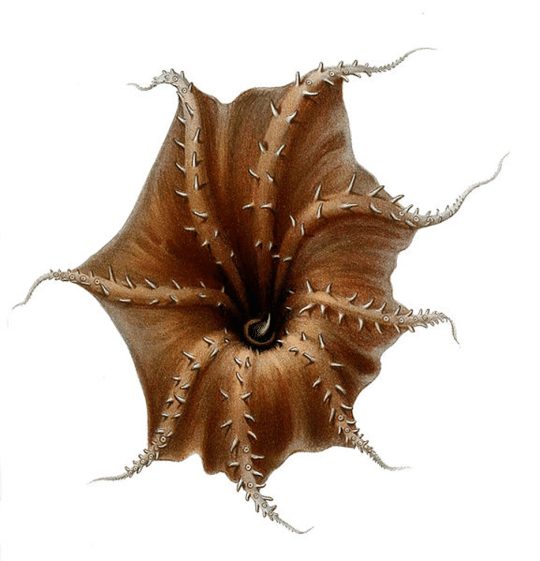
Vampire Squid, underside of arms showing fleshy spines. [Image from Wikimedia Commons]

Much of what we know about their behavior comes from videos made by Remotely Operated Vehicles. It is hard to keep Vampire Squids alive in aquariums at the much lower pressure of our human world, but the Monterey Bay Aquarium succeeded for a while and has some great videos. Aquarium scientists were able to solve the mystery about what the Vampire Squid eats. No, it doesn’t eat blood! It eats detritus (organic debris), also known as marine snow. As the Vampire Squid drifts in the current, any debris that touches an extended filament is moved by the creature’s arms to its mouth. Unusual for being the only known cephalopod to eat non-living food, the Vampire Squid is adapted to eat material that falls through the oxygen minimum zone. Marine snow includes dead bodies, feces, and a lot of mucus from above, and because of the mucus, it is sometimes jokingly referred to as marine snot.

I imagine if Dracula learned about the Vampire Squid, he might exclaim, “I thought it was eating blood, but it’s snot!”

Timothy A. Pearce, PhD, is the head of the mollusks section at Carnegie Museum of Natural History. Museum employees are encouraged to blog about their unique experiences and knowledge gained from working at the museum.

Related Content

Extremely Rapid Evolution of Cone Snail Toxins
Ask a Scientist: Are slugs and snails the same thing?

Chasing Snails in the Great Smoky Mountains

Filed Under: Blog Tagged With: Museum from Home, Science News, Section of Mollusks, Tim Pearce

September 9, 2020 by wpengine

Snails in the Desert

Land snails are leaky bags of water that survive on dry land. Snails lose water through evaporation, and because mucus is more than 90% water, they must expend water just to move, gliding on their silvery slime trails. Most land snails occur in moist environments where they can readily replenish lost water. But some snails live in the desert or other arid areas! How is that even possible?

Several strategies help snails survive in arid situations. For example, some close their aperture with a door or with a mucus sheet, some have small apertures or modify their growth direction to make better seals, some have mucus that inhibits evaporation, and some manage moisture loss by choice of microhabitats.

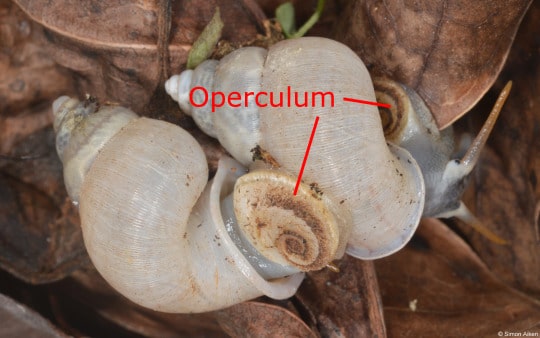
Fig. 1. Two Clydonopoma poloense snails from Dominican Republic showing their opercula. (Photo by S.P. Aiken with permission.)

An operculum, or door, closes the shell in some land snails (Fig. 1), although most land snails lack one. The operculum is attached to the rear of the snail’s tail; when the snail pulls into its shell, the tail withdraws last and positions the operculum to make a tight seal. In addition to protecting the snail from water loss, it also protects from predators.

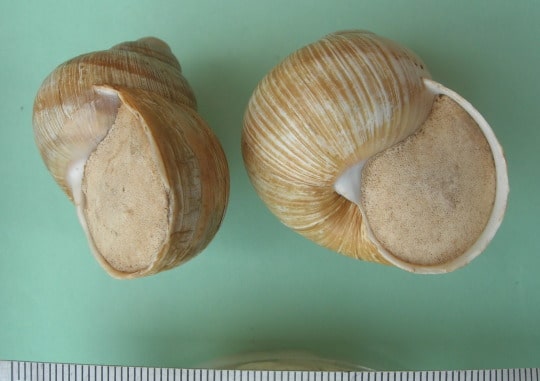
Fig. 2. Two Helix pomatia edible snails from Russia (CM154077) with apertures closed by an opaque epiphragm. (Photo by T.A. Pearce.)

Snails that don’t have an operculum can cover the aperture with a mucus sheet called an epiphragm. In most snails, the epiphragm is thin and clear, but in some species, the epiphragm can be thick and opaque (Fig. 2). During dry periods, snails can form an epiphragm over the aperture or they can make a tight mucus seal between the aperture edges and substrates such as a rock or plant. The seal helps to retard evaporative water loss. Some snails in the desert remain sealed under a rock for years before a rainstorm wakes them.

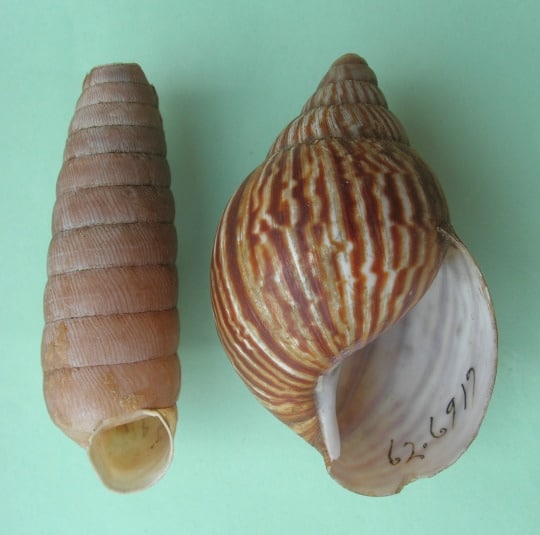
Fig. 3. Coelocentrum gigas from Guatemala CM62.8574 (left); Achatina zebra from Africa CM62.6917 (right). Land snails in drier areas tend to have relatively smaller apertures like the shell on the left. Shells pictured are 8 and 8.5 cm tall, respectively. (Photo by T.A. Pearce.)

Snails of arid areas usually have a relatively small aperture (Fig. 3). The smaller surface-area-to-volume ratio reduces moisture loss through evaporation. Just like you would lose less heat (on a cold day) with your parka zipped up and your hood cinched around your face, the snail loses less water with less of its skin exposed, as in the case of a smaller aperture.

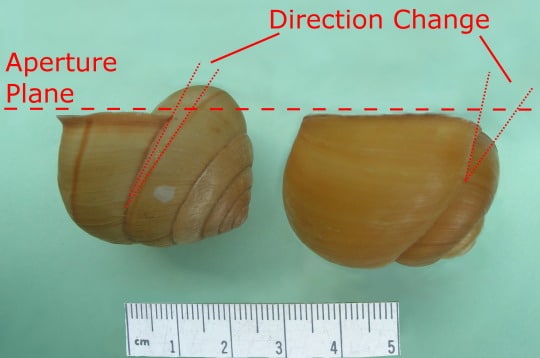
Fig. 4. Ganesella fusca (left) from Japan (CM106167) and Zachrysia guanensis (right) from Cuba (CM152889). Land snails in drier areas tend to have greater change in direction of growth when reaching full size, allowing the plane of the aperture to make a closer seal with flat surfaces. (Photo by T.A. Pearce.)

As growing snails approach their final size, many dip the direction of shell growth toward the shell base (Fig. 4). This results in the plane of the aperture making a tighter seal on a flat surface. Snails of arid areas tend to have shells that make tighter seals on flat surfaces than snails of moister areas.

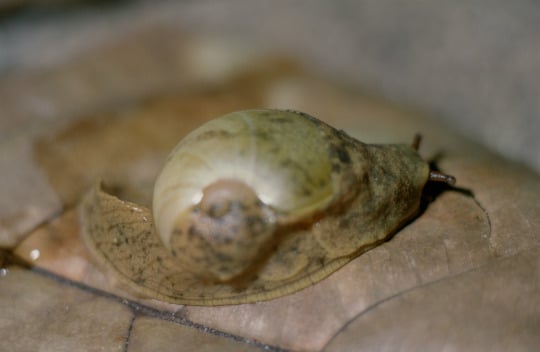
Fig. 5. Urocyclid semi-slug from a dry area in N Kenya. (Photo by T.A. Pearce.)

The mucus of some species retards evaporation. Snails produce different kinds of mucus, for example, the mucus they glide upon to move, sticky or distasteful mucus when irritated, and mucus on their skin that can retard evaporation. One day when I was traveling in northern Kenya during the dry season after at least 6 months without rain, I was surprised to find a semi-slug (a gastropod whose shell is too small to fit the entire body) resting among some dry leaves and soil (Fig 5). It must have had special mucus covering the body that retarded water loss, allowing this species to survive many months of aridity.

Finally, snails influence their moisture loss by choosing their microhabitats. Some snails burrow underground during hot, dry weather to escape the heat. Other snails crawl under moist logs or descend deep into rock piles to avoid the harshest weather.

Why would snails even choose to live in the desert? I’m not sure anyone knows the answer for sure. My guess is that snails might live in a desert because it allows them to escape predators or competitors who can’t or don’t want to live there.

How do they do it? Snails survive in the desert by leaking water a bit more slowly than snails in moist areas.

Timothy A. Pearce, PhD, is the head of the mollusks section at Carnegie Museum of Natural History. Museum employees are encouraged to blog about their unique experiences and knowledge gained from working at the museum.

Related Content

Ask a Scientist: What is the biggest snail?

The Tell-Snail Heart

Happy Ctenophore Day!

Filed Under: Blog Tagged With: Museum from Home, Science News, Section of Mollusks, Tim Pearce

August 20, 2020 by wpengine

First ever American Malacological Society virtual meeting, 13-14 July 2020

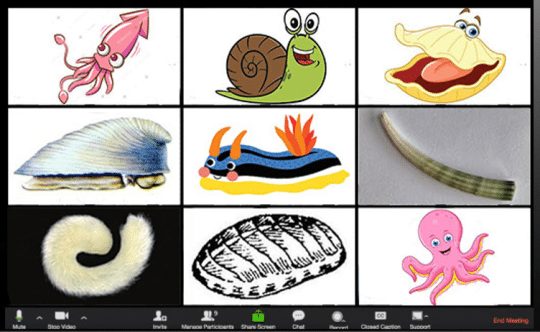
nine cartoon mollusks in a grid

During two days in mid-July the American Malacological Society (AMS) held its 86th annual meeting over Zoom because of COVID-19 concerns. The occasion marked the first time the organization, whose members study mollusks, convened the gathering virtually. Attendance was greater than recent in-person AMS meetings, perhaps because of the low cost of the event (no travel or accommodation costs) and its appeal to people who shun air travel for its immense carbon footprint. There were more than 150 participants, 49 formal presentations, and 18 posters. Remarkably, thirteen presentations were by students.

As usual I enjoyed hearing about my colleagues’ research, rejuvenating old friendships and making new ones, and simply talking with people who already know that mollusks are vitally important. One surprising piece of information I learned from colleagues is that Carnegie Museums of Pittsburgh are ahead of other museums (e.g., Field Museum, University of Florida Museum) in re-opening to the public. Bravo to CMP!

The talk I presented summarized a publication I co-authored with Heather Hulton Van Tassel, Assistant Director of Science and Research at CMNH.  The presentation, titled Is acid precipitation a factor in the decline of the terrestrial tiger snail, Anguispira alternata, in northeastern North America?, “was well-received and elicited some insightful questions. You can hear a 12-minute recording of the talk here:

Current plans are to hold next year’s AMS meeting in Nova Scotia, but if the COVID-19 virus remains a threat, and with the successful outcome of this year’s meeting, we might gather virtually.

Timothy A. Pearce, PhD, is the head of the mollusks section at Carnegie Museum of Natural History. Museum employees are encouraged to blog about their unique experiences and knowledge gained from working at the museum.

Related Content

Ask a Scientist: What is the biggest snail? 

Snail Extinction – Bad Situation Getting Worse

Warm Those Heart Cockles

Filed Under: Blog Tagged With: Museum from Home, Science News, Section of Mollusks, Tim Pearce

August 7, 2020 by wpengine

Mobilizing Millions of Marine Mollusks: Seashells by the Eastern U.S. Seashore

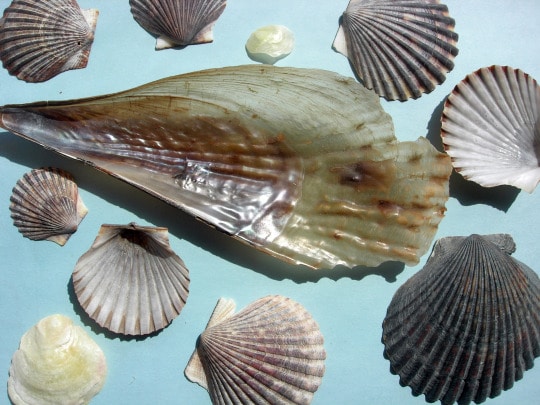
“What a pretty seashell, where did it come from?”

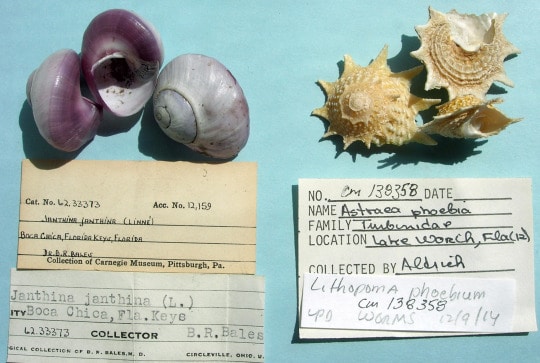
Perhaps the most important information that natural history museums keep about their specimens is where they came from. For many researchers, locality information is more important than the specimen itself. The specimen is useful to verify correct identification, but you can’t look at a specimen to determine where it came from.

As more and more museums share their specimen databases on-line, locality information is being used to document changes in distributions of organisms, including new occurrences of invading species, range shifts due to climate warming, and the disappearance of species becoming locally extinct.

Pretty seashells.

To facilitate uses of locality information, museums are scrambling to georeference their specimens. This term refers to the electronic pairing of the historic recorded location for each collected specimen with an established system of latitude and longitude coordinates. Georeferencing can be tedious and time-consuming, what with interpreting messy handwriting, dealing with misspellings, and tracking down obscure names, some of which have changed over time. Once I spent over an hour and got only two specimens georeferenced.

The US National Science Foundation (NSF) recognizes the importance of georeferenced specimens to facilitate understanding of where species occur and how their distributions change over time. Consequently, NSF has awarded $58,762 to Carnegie Museum of Natural History as one of 14 collaborating museums on a $2.3 million grant for a project titled: Mobilizing Millions of Marine Mollusks of the Eastern Seaboard. The project is spearheaded by Rudiger Bieler at The Field Museum in Chicago.

The main goal of the project is to georeference, and make available online, 535,000 lots representing 4.5 million specimens of marine mollusks (snails, clams, etc.) from the eastern USA. Only 15% of Eastern Seaboard mollusks in museums are currently reliably georeferenced. To facilitate georeferencing and promote standardization, each collaborating museum will focus on georeferencing all lots from particular geographical areas. Notably, for the first time, these museum records will distinguish between live- and dead-collected specimens, important information given that shells of dead mollusks sometimes persist for hundreds of thousands of years, and can be moved by currents and other animals such as hermit crabs. Whether or not a shell was collected alive is therefore crucial information for studies of biotic change using mollusks.

Two lots of East Coast USA seashells ready to georeference.

For CMNH, this award primarily means support for georeferencing our 11,436 lots of marine mollusks from eastern USA. In addition, we will catalog the eastern US part of our backlog, image relevant type specimens, create an exhibit, and, the aspect I am most excited about is creating an IPT, or integrated publishing toolkit, which will allow automatic updates from our in-house database to our web presence in the InvertEBase Symbiota portal.

The grant-funded new public display will interpret our biologically, commercially, and recreationally important marine mollusks from the Eastern Seaboard, and showcase mollusk diversity. The display will appeal to anyone who has beachcombed shells. Labels will describe how scientists use modern and historical specimens to study change in marine ecosystems over time. My hope is that visitors will learn that mollusks are diverse and beautiful, that museum collections are useful, and that evidence-based studies show ecosystem changes.

The Eastern Seaboard region includes 18 states, nearly 6,000 km of coastline, and about 3,000 molluscan species. Boundaries, from Maine to Texas, stretch from the shore outward to the edge of the U.S. Exclusive Economic Zone. The 14 collaborating U.S. collections contain 85% of all Eastern Seaboard marine mollusk museum holdings. These museum holdings average 8 specimens per lot – a lot is one species from one place at one time.

One hundred million mollusk specimens have been documented in natural history collections across North America. Each mollusk species in these collections average 1100 individuals, revealing geographic and morphological variation, and making mollusks among the best sampled group of metazoans, or multi-cellular animals. So far, freshwater and terrestrial mollusks have dominated digitization efforts of mollusks. This project is the first to focus on marine mollusks.

Shells are bio-archives. Shell skeletons record information about the animal and its environmental conditions throughout its life cycle. Shell material can be used to infer past ocean temperatures, seasonal fluctuations, and growth rates. Shell testing can reveal presence of trace elements and pesticides, allowing detection and identification of marine contamination and pollution.

In addition to their use in documenting what lived where and when, mollusks are important in other ways. Shells bring us joy when we find them on the beach. And many of us eat them. In 2016, three of the top 10 most valuable fisheries in the US, worth hundreds of millions of dollars, were mollusks: scallops, clams, and oysters.

Timothy A. Pearce, PhD, is the head of the mollusks section at Carnegie Museum of Natural History. Museum employees are encouraged to blog about their unique experiences and knowledge gained from working at the museum.

Related Content

Ask a Scientist: What is the biggest snail?

The Zebra Mussel and the Shopping Cart

Octopus Mystery: How Do They See Color?

Filed Under: Blog Tagged With: Museum from Home, Science News, Section of Mollusks, Tim Pearce

June 22, 2020 by wpengine

The Zebra Mussel and the Shopping Cart

Zebra mussels (Dreissena polymorpha) are eastern European freshwater bivalves that invaded North America. Something unusual about their biology facilitated this invasion.

In marine waters, many benthic (living on the bottom) animals add their babies to the plankton, the mix of small and microscopic organisms largely adrift in the water column.

The situation is different in freshwater where almost all benthic animals lay their eggs on the bottom. (Freshwater plankton exist, but the organisms that compromise it spend their whole lives as plankton.) I don’t know why marine and freshwater animals differ that way, but they do. Zebra mussels are a major exception to this rule; they live in freshwater, but they put their babies (larvae) in the plankton.

How did zebra mussels invade North America? Partially loaded ships require ballast to safely navigate at sea. Decades ago, ships were loaded with rocks and dirt (and slug eggs) as ballast, and when they reached their intended port these materials were removed and replaced with cargo. That is why so many invasive slugs (essentially all your garden slugs are non-native) arrived first in seaports and spread from there.  Ballast tanks that can be easily filled with water and drained are a design feature of modern ships, and depending upon some ship’s departure points, their ballast water sometimes contains larval zebra mussels. For many years, ships were slow enough that zebra mussel larvae arrived in North America dead, but eventually reductions in ocean crossing time worked in the invaders’ favor.  In 1988 some larval zebra mussels arrived alive in the ballast water pumped out into Lake St. Clair near Detroit. By 1990, zebra mussels had infested all the Great Lakes and now they occur in more than half of the 50 United States.

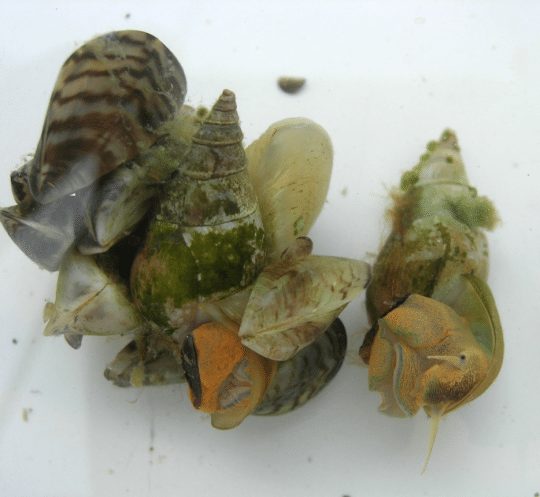
Fig. 1. Freshwater snail (Elimia livescens) colonized by zebra mussels (left) and uncolonized (right). From Douglas Lake, Michigan 30 Aug. 2015 (photo by T.A. Pearce).

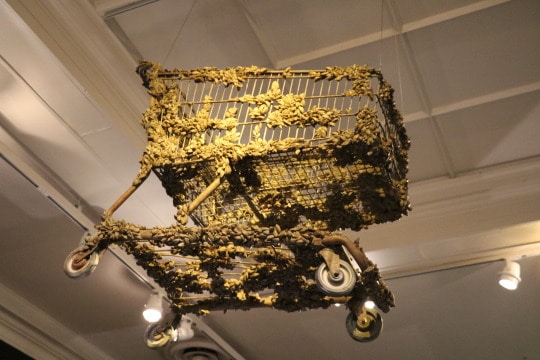
The economic and ecological devastation caused by zebra mussels is legendary. Zebra mussels make threads (byssal threads) for attaching to hard objects. They clog intake pipes of city water supplies and power station cooling pipes, requiring costly removal. They compete with native mussels and young fish for food and can smother or hinder movements of our native mussels, snails (Fig. 1), and crayfish when they settle in large numbers.

Fig. 2. Replica of shopping cart covered in zebra mussels.

A noteworthy item that became encrusted with zebra mussels is a shopping cart that was dredged out of Lake Superior in 2012. A replica of the shopping cart was on display during the We Are Nature exhibit at Carnegie Museum in 2018 (Fig. 2).

Lest you think I am biased against zebra mussels, I will note two possibly positive things you can say about them. First, they filter water efficiently and because they pump up to a liter (quart) per day, they cleaned up the formerly polluted water in Lake Erie. But even that can be negative, because they removed so much plankton from the water that our native species now have a hard time finding enough to eat. Second, because zebra mussels selectively concentrate certain toxic metals, including uranium, they have potential to be used in bioremediation efforts to clean water of this radioactive pollutant (Immel et al. 2016). But those are the only good things you can say about them. Mostly, they wreak havoc.

Literature Cited

Immel, F., Broussard, C., Catherinet, B., Plasseraud, L., Alcaraz, G., Bundeleva, I. & Marin, F. 2016. The shell of the invasive bivalve species Dreissena polymorpha: biochemical, elemental and textural investigations. PloS One, 11(5): e0154264. https://doi.org/10.1371/journal.pone.0154264

Timothy A. Pearce, PhD, is the head of the mollusks section at Carnegie Museum of Natural History. Museum employees are encouraged to blog about their unique experiences and knowledge gained from working at the museum.

Related Content

Oysters Swim Towards a Siren Soundscape

Slowest Process Ever Observed: A Trillion Times Longer Than the Age of the Universe

From Nebraska or Bust, a Truckload of Mollusks

Filed Under: Blog Tagged With: Anthropocene Living Room, Anthropocene Section, Museum from Home, Science News, Section of Mollusks, Tim Pearce

June 1, 2020 by wpengine

What’s So Good About Being a Slug?

When lifestyles or forms evolve multiple times, we often think they must have some benefit. For example, flying creatures evolved at least 4 separate times: birds, bats, insects, and pterosaurs. These 4 separate origins of flight support the idea that there must be an advantage to flying. (You can probably think of some advantages.)

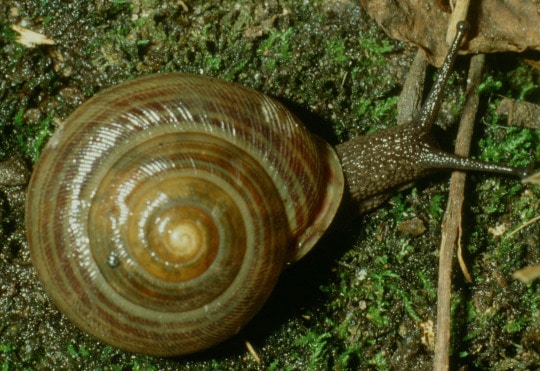
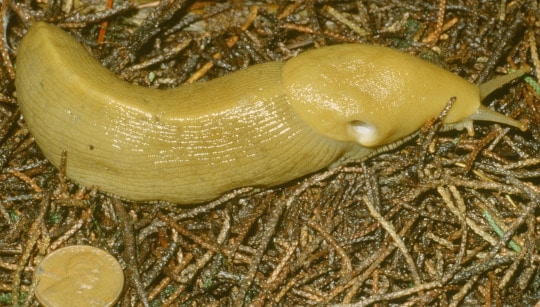
Slugs evolved from snails more than a dozen separate times. By that logic, there must be an advantage to being a slug, but compared to flight, it’s harder to think what the advantage might be. Slugs evolved from snails by reducing the size of the shell and internalizing it (yes, most slugs have an internal shell), and there are likely to be consequences of reducing the shell.

A snail with an external shell large enough for the body to pull back into. Webbhelix multilineata from Ann Arbor, Michigan.

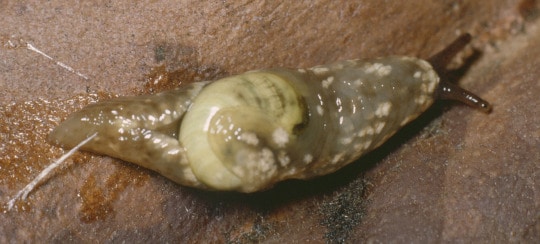
Furthermore, in the lineages leading from snails to slugs, an intermediate stage occurs called a semi-slug (not a slug the size of a semi-truck). In contrast to snails that have an external shell large enough to accommodate the body, or slugs in which the shell is completely internal or absent, semi-slugs have an external shell, but the shell is too small to accommodate the animal’s entire body. Many semi-slugs live on our planet today (for example, Vitrinizonites latissimus lives in the Great Smokey Mountains). Curiously, semi-slugs evolved from snails at least 22 times.

A semi-slug whose external shell is too small for the body to fit into. Family Urocyclidae from Mount Kenya

Let’s consider some possible advantages and disadvantages of these body forms: protection from predators, protection from desiccation (drying out), need for calcium, and fitting into tiny hidey holes. As shown in the table, shells protect snails from predators and from drying out, but the snails still need lots of calcium to build shells, and the rigid shell prevents them from squeezing into tiny hidey holes. Snail score: 2 advantages, 2 disadvantages. Slugs, on the other hand, are not protected from predators or drying out, but have less need for calcium and can fit into tiny hidey holes. Slug score: 2 advantages, 2 disadvantages. However, semi-slugs seem to have all disadvantages: no protection from predators or drying out, a need for calcium, and can’t fit into tiny hidey holes. Semi-slug score: 0 advantages, 4 disadvantages.

Predator protection Desiccation protection Need less calcium Fit in tiny hidey holes
Snail + + – –
Semi-slug – – – –
Slug – – + +

In evolution, every form in a lineage must have at least a limited track record of survival, so how did slugs evolve from snails if they had to go through a life form having so many disadvantages, and how could that evolution have happened so many different times?

A slug with an internal shell (not visible). Ariolimax cf californicus from the Santa Cruz Mountains, California.

Although we don’t know the answer for sure, my studies suggest some possible answers. I examined locations where slugs and semi-slugs evolved from snails. I discovered that many of those events seem to have happened on oceanic islands (40%) and within 35° of the Equator (80%). Islands often have fewer predators and tropical and subtropical islands often have regular moisture inputs (daily rain or fog), so on islands there might be less need of shells or hidey holes for protection from predators or desiccation. I’m not sure what to predict about calcium because many islands are volcanic, with calcium-poor soils, but calcium carbonate would be available from empty seashells washed up on the shore. If calcium were difficult to find, that might favor forms needing less calcium. Evolutionary biologists use the term “relaxed selection” to refer to a situation in which changes to an organism’s environment cause less need to maintain certain forms or behaviors.

It seems likely to me that relaxed selection on tropical islands allowed the evolutionary transition from snails to semi-slugs to slugs by reducing the disadvantages of having, or not having, a shell.

Where better to be sluggish than on a tropical island?

Timothy A. Pearce, PhD, is the head of the mollusks section at Carnegie Museum of Natural History. Museum employees are encouraged to blog about their unique experiences and knowledge gained from working at the museum.

Filed Under: Blog Tagged With: Museum from Home, Science News, Section of Mollusks, slugs, snails, Tim Pearce

  • « Go to Previous Page
  • Page 1
  • Page 2
  • Page 3
  • Page 4
  • Page 5
  • Page 6
  • Interim pages omitted …
  • Page 11
  • Go to Next Page »

sidebar

About

  • Mission & Commitments
  • Directors Team
  • Museum History

Get Involved

  • Volunteer
  • Membership
  • Carnegie Discoverers
  • Donate
  • Employment
  • Events

Bring a Group

  • Groups of 10 or More
  • Birthday Parties at the Museum
  • Field Trips

Powdermill

  • Powdermill Nature Reserve
  • Powdermill Field Trips
  • Powdermill Staff
  • Research at Powdermill

More Information

  • Image Permission Requests
  • Science Stories
  • Accessibility
  • Shopping Cart
  • Contact
  • Visitor Policies
One of the Four Carnegie Museums | © Carnegie Institute | Privacy Policy | Terms of Use | Accessibility
Rad works here logo