• Skip to primary navigation
  • Skip to main content
  • Skip to primary sidebar

Carnegie Museum of Natural History

One of the Four Carnegie Museums of Pittsburgh

  • Visit
    • Buy Tickets
    • Visitor Information
    • Exhibitions
    • Events
    • Dining at the Museum
    • Celebrate at the Museum
    • Powdermill Nature Reserve
    • Event Venue Rental
    • Gift Cards
  • Learn
    • Field Trips
    • Educator Information
    • Programs at the Museum
    • Bring the Museum to You
    • Guided Programs FAQ
    • Programs Online
    • Climate and Rural Systems Partnership
  • Research
    • Scientific Sections
    • Science Stories
    • Science Videos
    • Senior Science & Research Staff
    • Museum Library
    • Science Seminars
    • Scientific Publications
    • Specimen and Artifact Identification
  • About
    • Mission & Commitments
    • Directors Team
    • Museum History
  • Tickets
  • Give
  • Shop

Tim Pearce

June 25, 2019 by wpengine

Sperm Whales and Giant Squid: Just-So Story and Co-Evolution

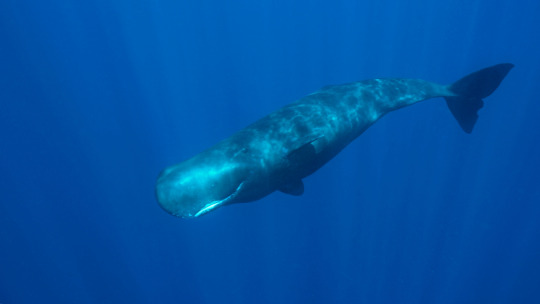
sperm whale underwater

Sperm whales dive to great depths (to more than 2 km or 1.4 mi deep) to catch one of their favorite foods: giant squid. But how did the first sperm whale know it would find giant squids in the ocean depths? The following story is speculation that makes sense but has no facts to support it. Scientists often refer to such stories as just-so stories, named after the stories by author Rudyard Kipling. But while Kipling’s just-so stories are fanciful, my story is plausible.

Before whales evolved, it could be that giant squids lived near the ocean surface. After whales evolved and discovered that squids are tasty, the giant squids might have started living in deeper water, to escape the whale predators. Some whales might have started diving more deeply (and developed specialized physiology allowing them to hold their breath up to 90 minutes and to resist the great pressure at depth) so they could feast on the squid, so the squid might have responded by living deeper still. Cycles like this, between predators and prey, are examples of co-evolution. This cycle could have continued until the squid lived in some of the deepest parts of the ocean, and the sperm whales dove to those great depths to eat the tasty squids. That just-so story might explain why giant squid live at depth, and how sperm whales are able to dive that deep to find them.

Humans hunted sperm whales heavily from the 1700s to the middle 1900s and reduced their numbers possibly to a third what they were historically. Fewer whales would mean less predation pressure on giant squids. With reduced predation pressure, giant squids might venture into shallower water.

It is possible that such a change in squid behavior could lead to more sightings of giant squids over the last few decades (squids caught in fishing nets and caught on cameras). Or it is possible that improvements in technology explains the increased sightings. You might be thinking that humans have interacted with giant squids for centuries – consider the myths of giant squids attacking ships. I agree that humans have known about giant squids for centuries, but I doubt anyone had previously ever seen one alive. Humans are likely to have known about giant squids from examining the gut contents of sperm whales, or possibly from a squid carcass that floated to the ocean surface after it died.
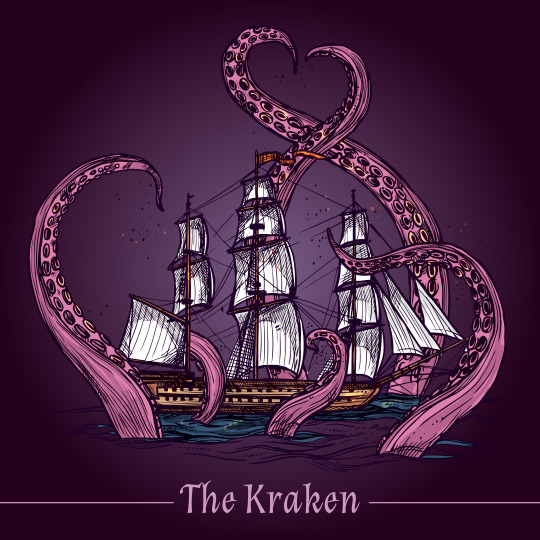
drawing of a kraken devouring a sailing ship

We might never know the real answer to why giant squid live at depth, and why sperm whales are able to dive to such great depths (and how they know squids are there). This co-evolutionary just-so story is a plausible explanation.

Timothy A. Pearce, PhD, is the head of the mollusks section at Carnegie Museum of Natural History. Museum employees are encouraged to blog about their unique experiences and knowledge gained from working at the museum.
Filed Under: Blog Tagged With: Cephalopods, mollusks, Tim Pearce

June 17, 2019 by wpengine

Slowest Process Ever Observed: a Trillion Times Longer Than the Age of the Universe

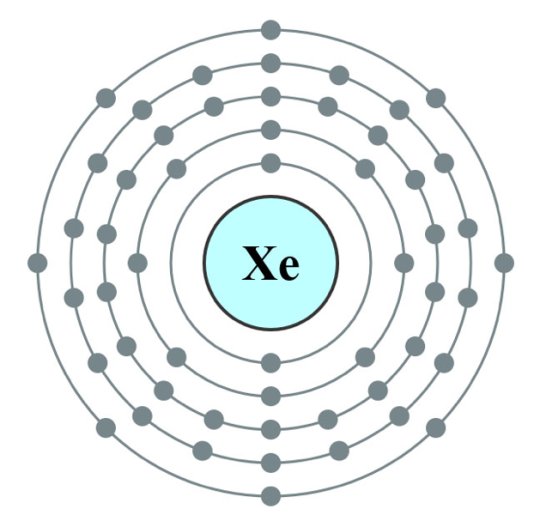
Xenon atom showing electron shells. [figure modified from Wikimedia commons]

Xenon-124, one of the radioactive noble gases, has an extremely long half-life. The half-life of xenon-124, one isotope of xenon, was recently measured to be a trillion times longer than the age of the universe! This is the slowest process ever measured by direct observation. You might well ask who measured such a slow process. Was it a scientist who thought watching paint dry or snail migrations were too exciting? In fact, the half-life was determined as a by-product of the search for dark matter. The XENON1T dark-matter detector in Italy, containing 3.2 metric tonnes of liquid xenon, detected energy release from the decay of 126 xenon-124 atoms over a year, which allowed Aprile et al. (2019) to calculate the half-life.

Speaking of radioactive decay, within the last decade, researchers have reported that the radioactive decay constant (the rate at which a radioactive element decays, thought to be constant – that’s how atomic clocks keep perfect time) is not constant! Certain radioactive elements decay faster when closer to the sun (Jenkins et al. 2012), leading some to speculate that neutrinos could explain the changed decay rate. (Counterintuitively, earth is closer to the sun during northern hemisphere winter.) Neutrinos are tiny particles, abundantly produced by the sun, that interact with essentially nothing and about 100 trillion pass through your body every second). Maybe a particle that doesn’t interact with anything can change something that never changes!

This correlation of neutrinos and radioactive decay rates makes me wonder whether every instance of radioactive decay might result from interaction with a neutrino. Neutrinos are abundant and some elements decay in less than a second, other rates are much longer. If neutrinos influence radioactive decay, perhaps some atoms are easier to hit in just the right way for decay to happen. If so, then I wonder why Xenon-124 is so slow to decay; is its nucleus harder for a neutrino to hit just right? It turns out that the decay of xenon-124 is unusual because it results from two-neutrino double electron capture, which means two electrons from the atom combine with two protons in the same atom, releasing two neutrinos. If neutrinos have an influence, perhaps getting two neutrinos to interact simultaneously with a xenon-124 atom in just the right way to cause decay must be a very rare event.

Reference

Aprile, E., Aalbers, J., Agostini, et al. 2019. Observation of two-neutrino double electron capture in 124Xe with XENON1T. Nature, 568(7753): 532-535. doi.org/10.1038/s41586-019-1124-4

Jenkins, J.H., Herminghuysen, K.R., Blue, T.E., et al. 2012. Additional experimental evidence for a solar influence on nuclear decay rates. Astroparticle Physics, 37: 81-88.

Timothy A. Pearce, PhD, is the head of the mollusks section at Carnegie Museum of Natural History. Museum employees are encouraged to blog about their unique experiences and knowledge gained from working at the museum.
Filed Under: Blog Tagged With: Tim Pearce

May 14, 2019 by wpengine

Horizontal Gene Transfer, the Placenta, and Velvet Worms

Everyone reading this (except you robots out there) inherited genes from their mother and father. This is the predominant way, in multicellular animals and plants, for genes to be transferred from one organism to another, from parent to child, and is called vertical gene transfer. But less commonly, genes can be transferred from an individual unrelated to you, possibly from a different species, and is called horizontal gene transfer. Viruses accomplish horizontal gene transfer naturally, while in the lab, genetic engineers use viruses to transfer genes horizontally to create genetically modified organisms.

The gene syncytin-2, which produces an essential membrane between the mammalian placenta and the developing fetus, appears to have come from retroviruses, who use the gene to produce a membrane around their virus capsule. If our ancestors had not acquired this retrovirus gene, you and I would not be here today. We have to be grateful for horizontal gene transfer.

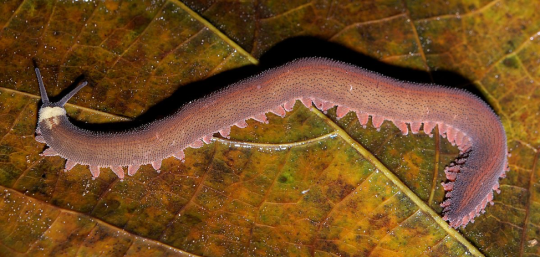
Now for the speculative part of this article. Velvet worms (Onychophora) are a whole phylum (major group) of animals most people have never encountered. They look kind of like a cross between an earthworm and a millipede.

A velvet worm of the genus Oroperipatus. [image from Wikipedia]

Nowadays, they are tropical and terrestrial, but their marine relatives once occurred 500 million years ago. Unusual for their bizarre habit of shooting strings of glue at their prey, some (not all) velvet worms have placentas. That leads me to two questions, the answers to which I do not know. (1) Did retroviruses transfer this essential membrane-producing gene to the velvet worms, as they did for mammals? (2) Do the velvet worms that have a placenta also have a belly button?

To address the question whether retroviruses transferred the gene, researchers could examine whether the syncytin-2 gene occurs in velvet worms, and if so, determine whether the gene’s DNA in velvet worms matches that of the retroviruses? Finding a close DNA match for the syncytin-2 gene in both groups of organisms would be a strong case that the retroviruses are responsible. To determine whether they have a belly button, let’s get some velvet worms and scrutinize their bellies with a microscope.

Timothy A. Pearce, PhD, is the head of the mollusks section at Carnegie Museum of Natural History. Museum employees are encouraged to blog about their unique experiences and knowledge gained from working at the museum.
Filed Under: Blog Tagged With: mollusks, Section of Mollusks, Tim Pearce

May 3, 2019 by wpengine

Is Jabba the Hutt a Slug?

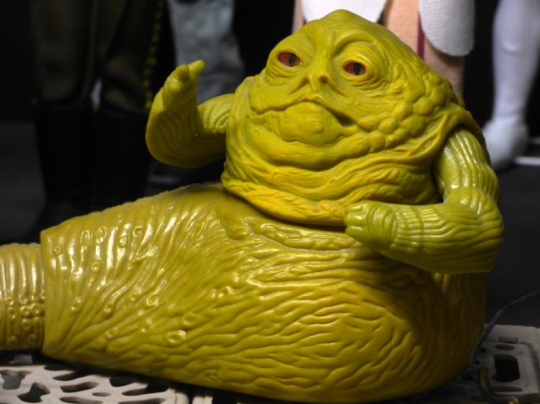
Jabba the Hutt action figure
Image credit: Tomasz Mikołajczyk from Pixabay.

The movie Star Wars introduced us to Jabba the Hutt, with a slug-like body form. In the movie, he was an unsavory character and notorious Crime Lord with a fondness for Princess Leia.

Was Jabba the Hutt a real slug, or did he just look like one? In biology, we know that creatures can look similar either by descent or convergence. Two individuals that look similar by descent implies that their past common ancestor also looked similar. An example of similarity by descent is crows and canaries, that fly and look similar because their common ancestor could fly and looked similar. On the other hand, two individuals that look similar by convergence implies that their past common ancestor looked different, but they acquired their similar features independently. An example of similarity by convergence is birds and bats, that both fly and have wings, but their common ancestor did not fly or have wings.

It is easy to notice that Jabba the Hutt has a body shape like a slug, but I also noticed that he has features of other groups of creatures, for example, he has arms with fingers, as many tetrapod vertebrate animals have.

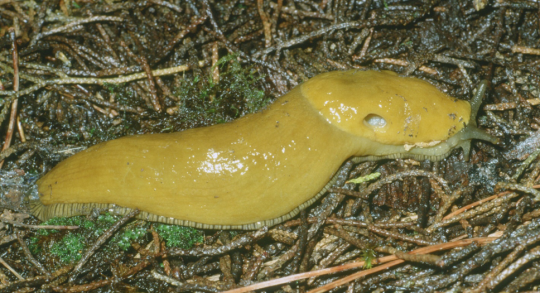
California banana slug (Ariolimax cf californicus), photo by Tim Pearce.

To evaluate whether Jabba the Hutt is slug-like because he is a real slug by descent or due to convergence, let’s compare Jabba the Hutt’s features with those of slugs and tetrapod vertebrates.

Table comparing 10 features of Jabba the Hutt to those of slugs and Tetrapoda

table comparing Jabba the Hutt to slugs vs. tetrapod vertebrates

The table shows that Jabba the Hutt’s features match those of Tetrapoda in 9 out of 10 features (checked off in the table), suggesting he belongs to Tetrapoda vertebrates.

I conclude that Jabba the Hutt was not a slug.

I note that one can find suggestions on the internet that Jabba the Hutt had a skeleton, which is further support for my conclusion that he was not a slug.

Finally, I want to note that slugs can be very nice creatures. Comparing the villainous Jabba to a slug is disrespectful to slugs.

Timothy A. Pearce, PhD, is the head of the mollusks section at Carnegie Museum of Natural History. Museum employees are encouraged to blog about their unique experiences and knowledge gained from working at the museum.

Filed Under: Blog Tagged With: mollusks, Section of Mollusks, Star Wars, Tim Pearce

March 18, 2019 by wpengine

New Zealand, Realm of Birds

I recently returned from three weeks’ vacation on New Zealand’s South Island. I had expected to see bazillions of sheep (I heard there were 7 sheep for every person in New Zealand), but I found that New Zealand is characterized by birds and ferns (and although we saw lots of sheep, many farmers are turning to dairy). In this post, I’ll touch on the birds of New Zealand.

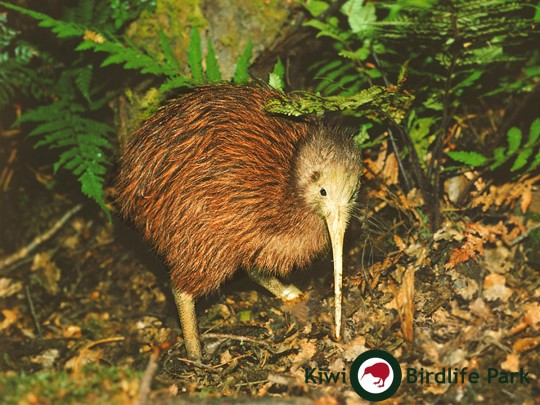
Kiwi bird. Photo courtesy of Kiwi Birdlife Park.

Before humans arrived, the only land mammals on New Zealand were two species of bats and a now-extinct mouse. That left birds to radiate into numerous niches, and without ground-based predators, many birds became flightless and fearless. (The fearsome Haast eagle, with a wingspan up to 3 m or 10 ft, hunted from the air, but is now extinct.)

42% of the bird species have become extinct since year 1300. New Zealand was colonized by humans comparatively recently: Polynesians, who became the Maori people, arrived about year 1300 AD and brought the Polynesian rat, or kiore, which started to harm ground-nesting birds, and the Maori wiped out the large, herbivorous moa birds (evidently, they were tasty). Europeans colonized in the 1800s and brought mammals that further devastated the bird fauna: Norway rats, cats, and stoats (relatives of weasels).

The New Zealand Department of Conservation traps and poisons the mammals, which helps some birds recover. Mammal lovers who oppose the control efforts don’t offer an alternate plan, but without control, even more birds would now be extinct. There is a move toward complete eradication of the introduced mammalian predators by 2050.

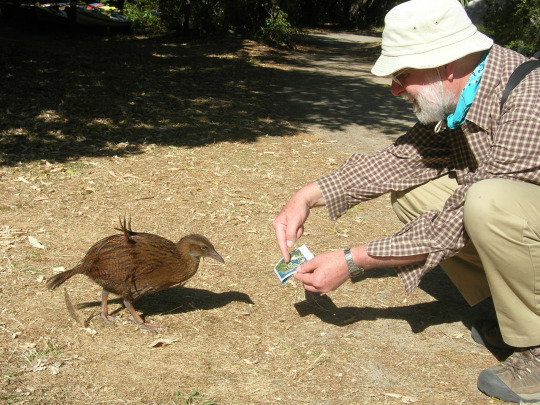
One of the widespread and friendly flightless birds is the weka. It is a member of the rail family and is roughly the size of a chicken. I tried to show one weka how to read a map, but I think it had trouble understanding my U.S. accent (see photo).

weka bird and man with a map
Weka, one of the flightless birds of New Zealand. Photo by Alice W. Doolittle.

Thanks to conservation efforts, five species of kiwi birds still live in New Zealand. They are primarily nocturnal, and we were fortunate to see some at Kiwi Birdlife Park (see photo). The mother kiwi lays an unusually large egg that is about a quarter of her mass (I imagine her saying ouch at egg laying). Recent DNA evidence suggests the kiwi is more closely related to the (extinct) elephant bird of Madagascar than to the (extinct) moa of New Zealand. I believe the large size of the kiwi’s egg relative to its body size could be from evolution shrinking the adult size faster than it shrank the egg size. Kiwis have a very long proboscis, and the Maori name for one of the kiwi species translates to weka with a walking stick. Kiwis are the only bird with nostrils at the end of its proboscis. Given that bill length is measured from the nostrils to the tip, despite its prodigious nasal protuberance, technically the kiwi has the shortest bill of any bird!

Timothy A. Pearce is Curator of Collections, Section of Mollusks at Carnegie Museum of Natural History. Museum employees are encouraged to blog about their unique experiences and knowledge gained from working at the museum.
Filed Under: Blog Tagged With: Anthropocene, Birds, Tim Pearce

February 19, 2019 by wpengine

Octopus mystery: how do they see color?

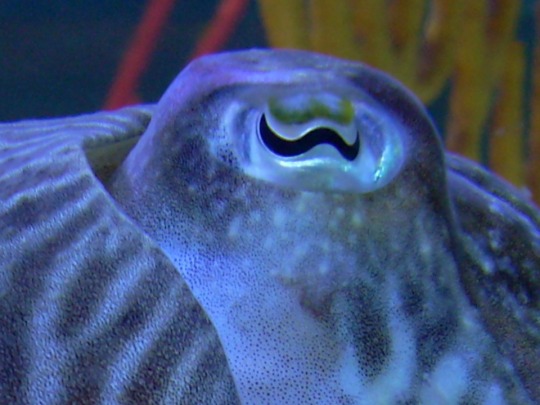
eye of a cuttlefish
Eye of a cuttlefish. Note the W shaped pupil. (Image from Wikimedia Commons)

The eyes of cephalopods like octopus, squid, and cuttlefish possess only one kind of photoreceptor, implying that they are colorblind, being able to see only in greyscale. But wait! They are famous masters of camouflage, being able to blend with their surroundings, and they signal each other in intricate color patterns. These feats suggest that they are not colorblind.

Two main hypotheses to explain this mystery are (1) they also see with their skin (Wardill et al. 2015) or (2) they make use of chromatic aberration (Stubbs & Stubbs 2016).

Cephalopods certainly do possess photosensitive molecules called opsins in their skin, so potential exists for cephalopods to detect light with their skin. However, the photosensitive molecules in the skin are like those in the eyes, so it’s not clear how that would help them see color any better than the eyes do.

Chromatic aberration is the differential bending of light of different wavelengths (colors). That’s how a prism splits white light, and why when your eyes get dilated by the eye doctor, besides things becoming blurry, you also see rainbows around things. Light of different wavelengths passing through a lens has different focal points. For most organisms and for human-made optical devices, chromatic aberration is a problem to be minimized.

The chromatic aberration hypothesis proposes that instead of avoiding chromatic aberration, cephalopods enhance it using their peculiar off-axis pupil shapes. This enhancement allows them to detect color by monitoring image blurring as focus changes. Computer models show that this method of image detection is possible.

Such use of chromatic aberration could explain why cephalopods have such bizarre pupil shapes. The pupil in some octopuses is an elongate slit, and in cuttlefish, it is the shape of a W.

These two hypotheses yield different predictions under certain circumstances, such as colors on a flat field (for which focus would not change). Now we await results of experiments testing between these two possibilities. Then we will have an answer for how cephalopods can see color, despite having the appearance of being color blind. We might need to re-evaluate other creatures that have been labeled colorblind.

Timothy A. Pearce is Curator of Collections, Section of Mollusks at Carnegie Museum of Natural History. Museum employees are encouraged to blog about their unique experiences and knowledge gained from working at the museum.
Literature cited

Kingston, A.C.N., Wardill, T.J., Hanlon, R.T. & Cronin, T.W. 2015. An unexpected diversity of photoreceptor classes in the longfin squid, Doryteuthis pealeii. PLoS ONE 10(9): e0135381. doi.org/10.1371/journal.pone.0135381

Stubbs, A.L. & Stubbs, C.W. 2016. Spectral discrimination in color blind animals via chromatic aberration and pupil shape. Proceedings of the National Academy of Science U.S.A.113: 8206–8211. doi: 10.1073/pnas.1524578113

Filed Under: Blog Tagged With: Cephalopods, mollusks, Section of Mollusks, Tim Pearce

  • « Go to Previous Page
  • Page 1
  • Interim pages omitted …
  • Page 4
  • Page 5
  • Page 6
  • Page 7
  • Page 8
  • Interim pages omitted …
  • Page 11
  • Go to Next Page »

sidebar

About

  • Mission & Commitments
  • Directors Team
  • Museum History

Get Involved

  • Volunteer
  • Membership
  • Carnegie Discoverers
  • Donate
  • Employment
  • Events

Bring a Group

  • Groups of 10 or More
  • Birthday Parties at the Museum
  • Field Trips

Powdermill

  • Powdermill Nature Reserve
  • Powdermill Field Trips
  • Powdermill Staff
  • Research at Powdermill

More Information

  • Image Permission Requests
  • Science Stories
  • Accessibility
  • Shopping Cart
  • Contact
  • Visitor Policies
Stay in the loop! Sign up for our newsletter(s).
One of the Four Carnegie Museums | © Carnegie Institute | Privacy Policy | Terms of Use | Accessibility
Rad works here logo