• Skip to primary navigation
  • Skip to main content
  • Skip to primary sidebar

Carnegie Museum of Natural History

One of the Four Carnegie Museums of Pittsburgh

  • Visit
    • Buy Tickets
    • Visitor Information
    • Exhibitions
    • Events
    • Dining at the Museum
    • Celebrate at the Museum
    • Powdermill Nature Reserve
    • Event Venue Rental
  • Learn
    • Field Trips
    • Educator Information
    • Programs at the Museum
    • Bring the Museum to You
    • Guided Programs FAQ
    • Programs Online
    • Climate and Rural Systems Partnership
  • Research
    • Scientific Sections
    • Science Stories
    • Science Videos
    • Senior Science & Research Staff
    • Museum Library
    • Science Seminars
    • Scientific Publications
    • Specimen and Artifact Identification
  • About
    • Mission & Commitments
    • Directors Team
    • Museum History
  • Tickets
  • Give
  • Shop

We Are Nature 2

January 19, 2022 by Erin Southerland

Don’t Hang Up On Gorillas

by Jo Tauber

As you pass under the acacia tree in the Hall of African Wildlife, keeping wary of the leopard perched in the branches, you may find yourself mesmerized by the soulful eyes and powerful yet peaceful presence of George, the western lowland gorilla. George was a resident of the Pittsburgh Zoo until his death from natural causes in 1979, when he joined the museum’s collections. George is shown proudly standing in a diorama depicting his natural habitat, a patch of tropical forest in the Congo River Basin. While George’s story may be quite different from those of his wild counterparts, his presence here provides an excellent opportunity for learning more about wild gorilla populations and the threats they face.
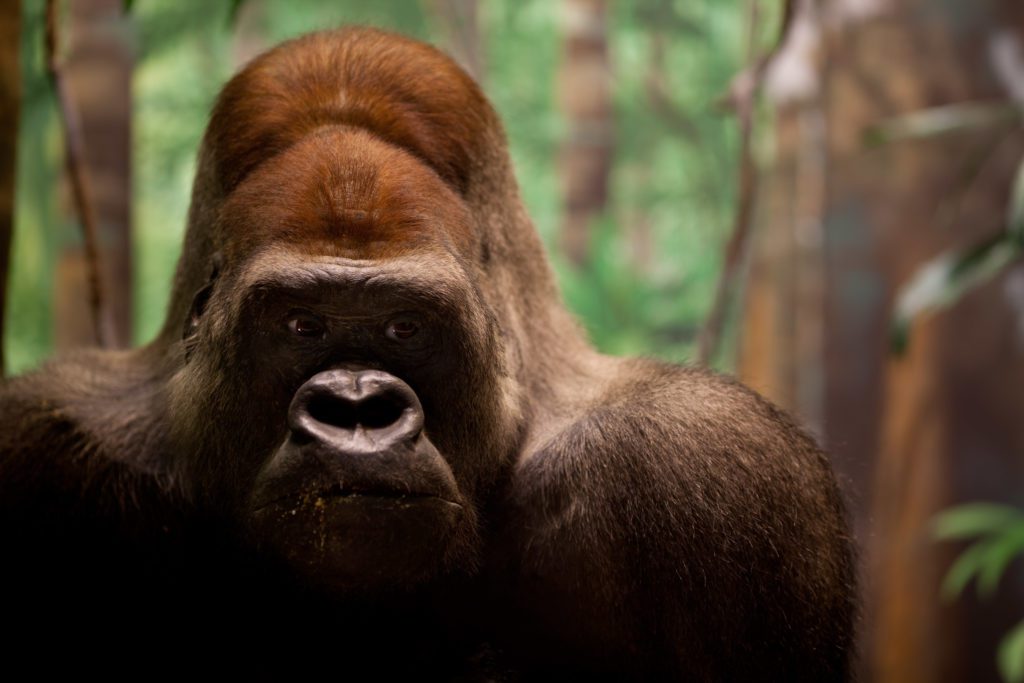
gorilla taxidermy mount
George

Did you know that the mining of a mineral known as coltan has a negative impact on gorilla populations? Or that whatever device you’re reading this blog post on, whether it’s a laptop, cell phone, tablet, or other electronic device, contains tantalum, a product of coltan? Coltan is a shorthand name for columbite-tantalite, which is refined into tantalum, an element used in heat-resistant capacitors in many electronic devices. (Delawala, 2006; Rogers, 2008). If this is new or surprising information, you are not alone–not many people realize the connection between devices like cell phones and the conservation status of these charismatic great apes.

The Congo River Basin is home to two subspecies of gorillas, western lowland gorillas (like George) and eastern lowland gorillas. Unfortunately for both species, much of this area is rich in coltan. There are many factors affecting the conservation status of gorillas, but coltan mining is having a major effect. Both subspecies are critically endangered with fewer than 100,000 western lowland gorillas, and fewer than 4,000 eastern lowland gorillas living in the wild. 

The mining of coltan alters the landscape, which not only reduces viable gorilla habitat, but also allows easier access for poachers who seek to kill or capture gorillas (Redmond, 2001). Poachers can also bring and spread infectious diseases that can affect gorillas and other humans alike (Redmond, 2001). Miners may also hunt gorillas as a food source while they work excavation sites (Redmond, 2001).

Gorillas aren’t the only primate species negatively affected by mining for coltan. Many of the people involved in the mining also suffer greatly. Mining operations are notoriously unsafe, exploit child labor, and require miners to work days over 12 hours long (Rogers, 2008). Coltan has been termed  a “conflict mineral,” meaning the mining of this resource is used to fund the actions of warlords in the ongoing civil war in the Democratic Republic of Congo (Rogers, 2008). 

Before you swear off electronics entirely, there are less drastic, but still impactful actions we can all take to benefit gorillas! We live in a world where technology is a necessity for many of us. Practicing ways to be responsible with the devices we use is the best way to minimize the unintended consequences involved in their creation. Our individual and collective actions can benefit us all, gorillas included. 

One small but important thing to do is keep your electronic gadgets as long as possible, and to recycle them when they need to be replaced. Such actions lessen the need for new coltan to be collected, meaning less mining needs to be done, and less gorilla habitat disrupted. Recycling cell phones also keeps both phones and the precious minerals they contain out of landfills. The EPA estimates that of the average 800 million phones in use annually, only 10% are recycled with the balance contributing to overly full landfills (“Recycle Your Cell Phone. It’s An Easy Call.” 2009).

If you’re wondering how to recycle a cell phone, there is some good news! Carnegie Museum of Natural History is introducing a cell-phone recycling program. When you come to visit us, you can bring unwanted cell phones and drop them in the designated collection bins. Museum staff will then ship them off to be recycled properly. Make sure you also stop by to see George, and the new exhibition We Are Nature, which tells other stories about how humans are impacting our world!

Jo Tauber is the Gallery Experience Manager in CMNH’s Lifelong Learning Department. Museum staff, volunteers, and interns are encouraged to blog about their unique experiences and knowledge gained from working at the museum.

Works Cited

Delawala, I. (2006, January 6). What Is Coltan? ABC News. Retrieved July 11, 2020, from https://abcnews.go.com/Nightline/story?id=128631&page=1

Eastern lowland gorilla. (n.d.). Retrieved July 11, 2020, from https://wwf.panda.org/knowledge_hub/endangered_species/great_apes/gorillas/eastern_lowland_gorilla/

Environmental Protection Agency. (2009). Recycle Your Cell Phone. It’s An Easy Call. [Brochure]. Retrieved March 14, 2021, from https://nepis.epa.gov/Exe/ZyPDF.cgi/P1009IF5.PDF?Dockey=P1009IF5.PDF

Redmond, I. (2001). Coltan Boom, Gorilla Bust: The Impact of Coltan Mining on Gorillas and other Wildlife in Eastern DR Congo.

Rogers, W. (2008, December 2). Coltan, Cell Phones, and Conflict: The War Economy of the DRC. Retrieved July 11, 2020, from https://www.newsecuritybeat.org/2008/12/coltan-cell-phones-and-conflict-the-war-economy-of-the-drc/Society), F., Breuer, T., Greer, D., Jeffery, K., Stokes, E., & Strindberg, S. (2016, January 29). The IUCN Red List of Threatened Species. Retrieved July 11, 2020, from https://www.iucnredlist.org/species/9406/136251508

Western lowland gorilla. (2019, October 03). Retrieved July 11, 2020, from https://nationalzoo.si.edu/animals/western-lowland-gorilla

Related Content

A Gorilla for Our Imagination

Climate Change Never Takes a Holiday: The Phenomenon of the Pizzly Bear

Paradise Found: The Real-Life Residents of Shangri-La

Carnegie Museum of Natural History Blog Citation Information

Blog author: Tauber, Jo
Publication date: January 19, 2022
Share this post!

  • Share on Twitter Share on Twitter
  • Share on Facebook Share on Facebook
  • Share on Pinterest Share on Pinterest
  • Share on LinkedIn Share on LinkedIn
  • Share on Reddit Share on Reddit
  • Share via Email Share via Email

Filed Under: Blog Tagged With: Jo Tauber, We Are Nature 2

January 11, 2022 by Erin Southerland

Paradise Found: The Real-Life Residents of Shangri-La

by Shelby Wyzykowski 

In 1933, when British author James Hilton published the novel Lost Horizon, much of the world was in the midst of the Great Depression, and in some countries there were signs of movement towards another large-scale war. The book became a best-seller in part because it provided a welcome respite from reality. The focal point of the story is a serene paradise called Shangri-La, a fabled land hidden amongst the snow-capped peaks of the Himalayas that is blissfully free of sickness, poverty, conflict, or struggle. The tantalizing tale of a mystical utopia with no shortage of security, beauty, peace, and excited weary readers and piqued their imaginations. 

Sadly, for humankind, the enchanting world of Shangri-La is now, and will likely always be, a dream. However, for some fauna species of Central Asia with homes nestled high up amid the rugged and intimidating terrain of the frigid Himalayan mountains, life does seem to imitate literary art. At great heights within the boundaries of this mysterious and remote part of the world, they have carved out a little piece of heaven for their very own. But, unlike the idyllic scenario presented in Hilton’s fictional novel, living in a real-world paradise is not without its challenges. 

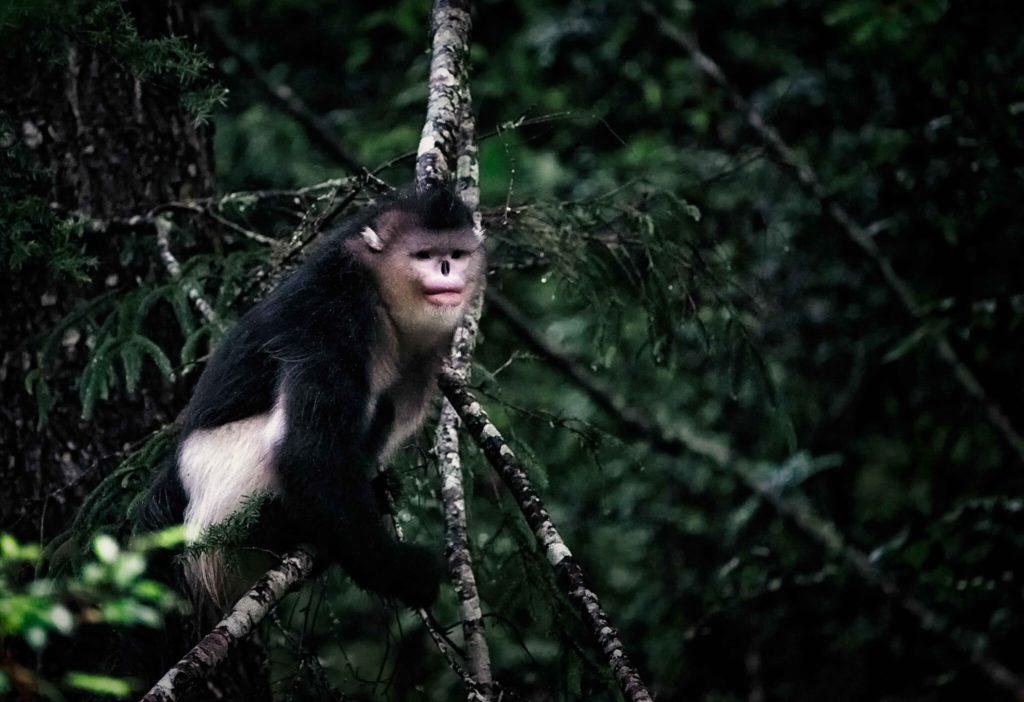
Paradise Found for the Black Snub-Nosed Monkey?

black snub-nosed monkey in a tree
“Black Snub-nosed Monkey” by Rod Waddington is licensed under CC BY-SA 2.0.

The black snub-nosed monkey, the rarest monkey in the world, lives at a higher altitude than any other primate besides humans. The species makes its home at roughly 10,000 to 15,000 feet above sea level in the majestic mountain forests of the Yunnan region in southern China. Lush, Eden-like valleys are their primary residence for much of the year. Here there is an ample supply of food (in the form of leaves) at their fingertips.

However, when winter arrives, they make a move that, at first, seems a bit counterintuitive. For the coldest months of the year, the monkeys choose to live in the highest part of their range. They brave the bone-chilling temperatures higher in the Himalayas because their favorite food, a particularly nourishing variety of lichen, is more abundant there. At high elevations, the monkeys rest on sunny rock outcrops to take advantage any available solar heat. This sensible tactic, along with huddling in groups of up to eight, helps the species survive.

Protecting the Black Snub-Nosed Monkey

Due to poaching and deforestation, the black snub-nosed monkey is considered endangered – even more endangered than the beloved panda. Conservation groups are hoping to make a change for the better as they work to find ways for the monkeys and their neighboring human communities to coexist. One notable development involves a forest monitoring campaign where some local villagers are trained as forest rangers who patrol the monkey habitat, searching for old poaching traps and installing infrared cameras to monitor and protect the small population. These positive and productive efforts are exactly what the black snub-nosed monkeys need in their ongoing struggle to survive in their mountain habitat. If these conservation initiatives are successful, the monkey population has an excellent chance of rebounding and recovering.

Snow Leopards Thrive at the Top

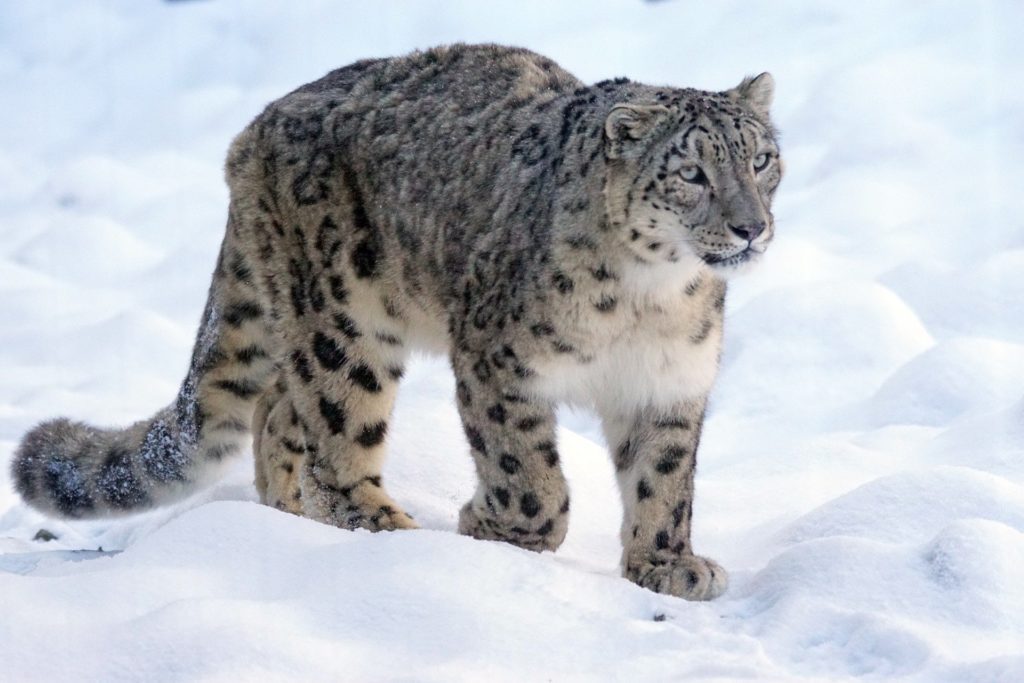
snow leopard in the snow
Image credit Marcel Langthim via Pixabay.

You might think that it’s lonely at the top, but snow leopards are very happy living a solo lifestyle. Mature adults live alone, high up (at elevations of 9,800 to 14,700 feet) in the steep and rocky mountains across Asia. They are perfectly designed to live in such a harsh and rugged environment. Their strong build allows them to effortlessly scale steep slopes, and their powerful hind legs give them the ability to leap six times the length of their body. Their long tail provides them with the agility and balance that is needed to traverse icy, slippery ground. It also does double duty as a soft, furry blanket that can be wrapped around the leopard’s body to provide warmth when sleeping. Appropriately referred to as the “ghost of the mountains,” they have an amazing knack of blending in with their frosty environment. 

Threats to Snow Leopard Survival

Snow leopards thick whitish-gray spotted coat with black rosettes blends in seamlessly with the snowy, jagged cliffs and ravines. However, this gift that provides them with virtual invisibility has also been a curse. In illegal wildlife trade, poached snow leopard pelts bring a high price. Unfortunately, it’s not only law-breaking hunters that set their sights on the cats. As local human development has increased, livestock grazing has expanded into the snow leopard’s range. Argali and Blue Sheep, the snow leopard’s natural prey, have become harder to find (humans hunt these sheep as well); the leopards are forced to prey on livestock for sustenance. In retaliation, snow leopards are often killed by local farmers and herders. 

Snow Leopard Conservation

This magnificent cat’s fate might seem a bit grim, but their future is brightening. In the Eastern Himalayas, conservationists are working with local communities to monitor and protect snow leopards. Predator-proof livestock pens are being installed to reduce the retaliatory killings, and in an attempt to spread the word about the leopard’s plight, leopard awareness programs are being presented to school students and the mountain communities at large. So, things are definitely looking up for the graceful and ghostly snow leopard. 

Meet the Takin 

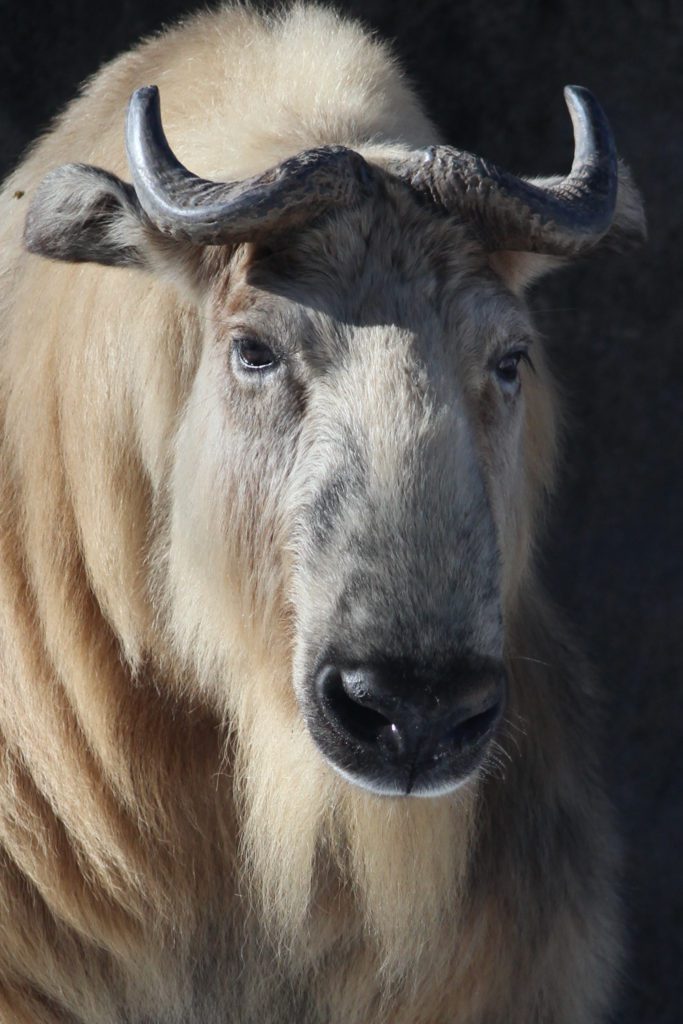
close up of a Takin's face
“Takin in the Soft Light” by Mark Dumont is licensed under CC BY-NC 2.0

The takin almost appears to be an imagined creature from a Star Wars movie, and it would by no means look out of place if it were roaming the windswept tundra of the ice planet of Hoth. Yet this ungulate, which looks like a compilation of a goat, muskox, and a gnu, is quite real.

Weighing up to 770 pounds, you would think that such a bulky bovid could never survive at mountain elevations as high as 14,000 feet. This nimble creature, which is most closely related to wild sheep, is an expert at maneuvering up and down steep rocky slopes. Takins have also adapted to the challenging weather of their lofty, chilly sanctuary. The species’ massive, moose-like snout has large sinus cavities that warm up the cold mountain air. Without this high-elevation adaptation they would lose a large amount of body heat simply by breathing. Another physical adaptation this mammal relies upon to combat the weather is an oily bitter substance they secrete through their skin. The secretion coats the takin’s fur and acts as a natural raincoat during storms and periods of fog.    

The Takin: Sacred and Endangered

Though this remarkable animal’s existence is generally unknown in the Western world, the creature is revered in Asia. The takin is sacred to Tibetan Buddhists, and it is also the national animal of the Kingdom of Bhutan, the landlocked country in the Eastern Himalayas, between China and India. Despite their elevated status, takins are endangered or vulnerable throughout much of their range. Habitat destruction is a major threat, and hunters poach them for food and fur. 

In response to the takin’s dire situation, China’s government has taken steps to ensure that its national treasure will survive. The takin has been given the country’s highest legal protection, and, in 2013, in cooperation with The Nature Conservancy, the Laohegou Land Trust Reserve was established. This tract of land links several existing reserves in China that together sustain a wide array of animals, including the takin, golden snub-nosed monkey, and the giant panda. These linked protected areas, along with some recently established programs promoting ecotourism and eco-friendly agriculture, are slowly transforming the dream of a successful and sustainable takin sanctuary into a reality.

Shangri-La: Fictional or Real Place?

It’s unfortunate that Shangri-La is only a fictional fabrication found within the pages of a book. Yet even though it does not exist in our physical world, Shangri-La does seem to exist for us in spirit. In a pivotal scene in Lost Horizon, one of the novel’s key characters, the High Lama of Shangri-La, foretells of a time when the nations of the world will tear each other apart through war. He proclaims that, after the chaos has finally come to an end, all that will remain are Shangri-La’s messages of wisdom, harmony, and hope for the future. His one great wish is to see this hopeful and harmonious way of life spread throughout the entire world.

In our real world, a genuine spirit of hope for the future is visible in the joint efforts of conservation organizations, governments, and local Himalayan communities as they work together to save endangered mountain species. Their efforts are showing the snub-nosed monkey, snow leopard, and takin the kindness and respect that they so rightfully deserve. These three extraordinary animals have found their own special Shangri-La. And as the self-appointed caretakers of this planet, it is up to us  to continue to help them to flourish in their wintry nirvana for many years to come.

Shelby Wyzykowski is a Gallery Experience Presenter in CMNH’s Lifelong Learning Department. Museum staff, volunteers, and interns are encouraged to blog about their unique experiences and knowledge gained from working at the museum. 

Related Content

Waddling in a Winter Wonderland: How Penguins, Humans, and Other Animals Traverse Ice and Snow

How Do Trees Survive the Winter?

Ice and Snow: The Effects of Temperature

Carnegie Museum of Natural History Blog Citation Information

Blog author: Wyzykowski, Shelby
Publication date: January 12, 2022

Share this post!

  • Share on Twitter Share on Twitter
  • Share on Facebook Share on Facebook
  • Share on Pinterest Share on Pinterest
  • Share on LinkedIn Share on LinkedIn
  • Share on Reddit Share on Reddit
  • Share via Email Share via Email

Filed Under: Blog Tagged With: Shelby Wyzykowski, Super Science, We Are Nature 2

January 11, 2022 by Erin Southerland

Collected on this Day in 1951: Bittersweet

by Mason Heberling
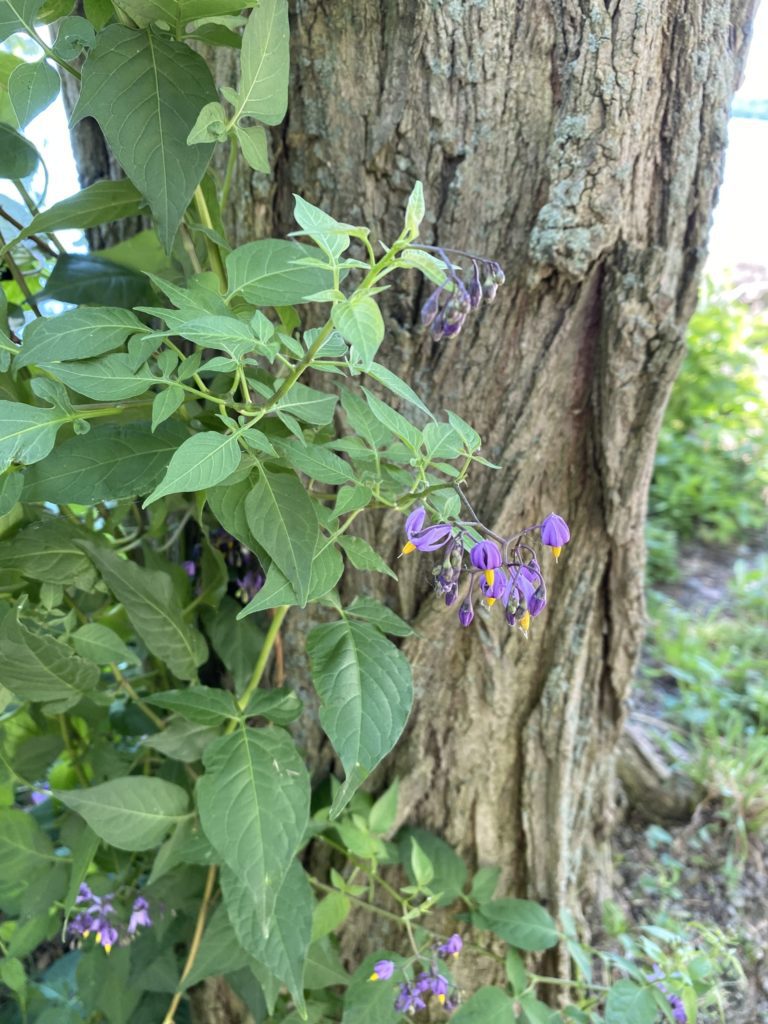
Bittersweet plant in spring

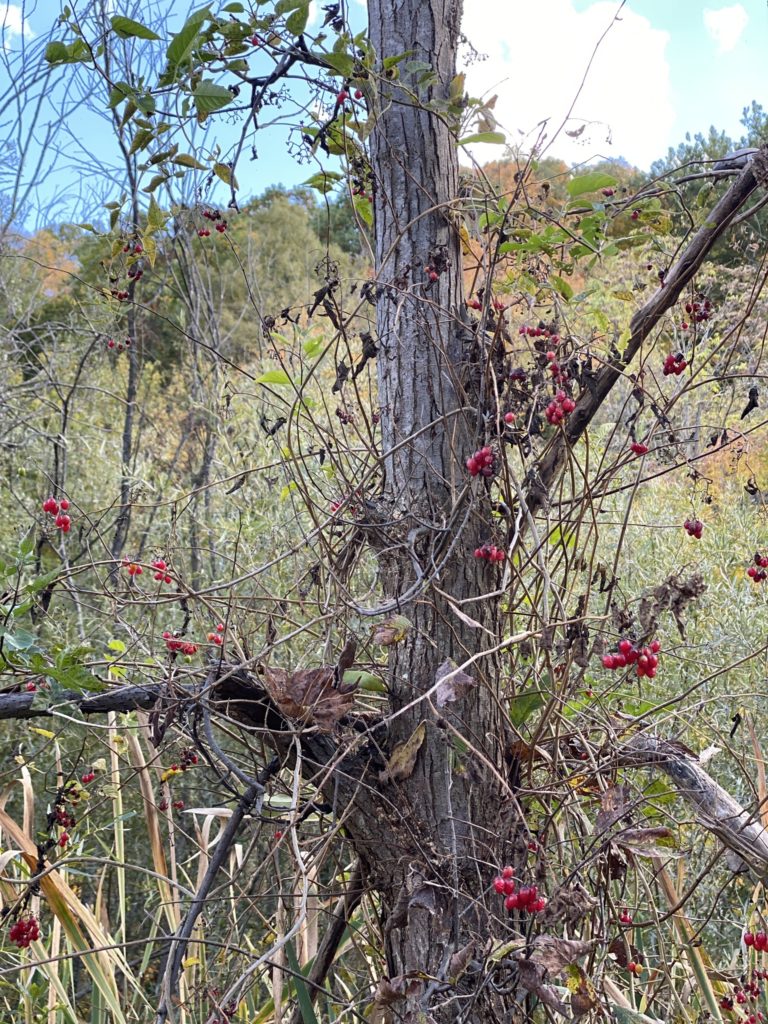
Leaves are gone, but fruits hang on

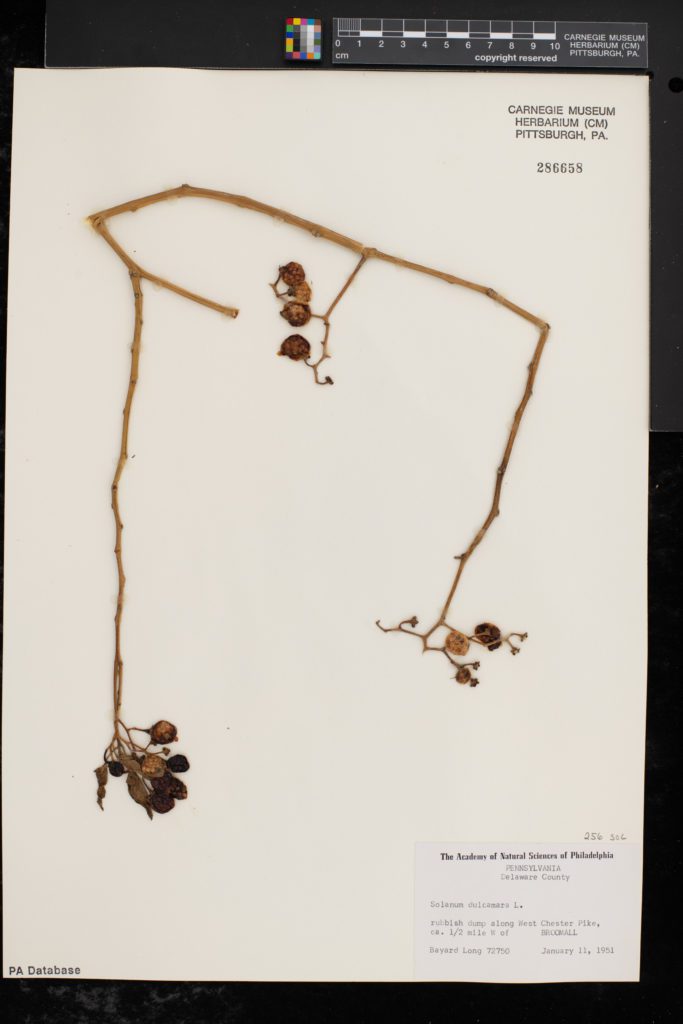
Bittersweet plant specimen on herbarium sheet

This specimen of bittersweet (Solanum dulcamara) was collected by Bayard Long on January 11, 1951 in a “rubbish dump” on West Chester Pike, near Broomall, Pennsylvania (outside of Philadelphia). Bayard Long (1885-1969) was a Philadelphia-area botanist and an active member of the Philadelphia Botanical Club (founded in 1891 and still an active organization). He was a prolific collector and for 56 years served as Curator of the Club’s Local Herbarium, which is housed at the Academy of Natural Sciences. 

Bittersweet nightshade (Solanum dulcamara) is in an herbaceous vine in the potato or nightshade family (Solanaceae), not to be confused with the similarly named Asian bittersweet (Celastrus orbiculatus), which is also a woody vine in the staff vine or bittersweet family (Celastraceae).

Bittersweet is an invasive species, introduced from its native range in Europe and Asia as early as the 1800s. It is common to see climbing along fences in urban areas and elsewhere across North America.

In the winter, its fleshy red berries are commonly still attached to the vines, long after the leaves are gone.

bittersweet plant in the fall

Find this specimen of bittersweet. 

Check back for more! Botanists at the Carnegie Museum of Natural History share digital specimens from the herbarium on dates they were collected. They are in the midst of a three-year project to digitize nearly 190,000 plant specimens collected in the region, making images and other data publicly available online. This effort is part of the Mid-Atlantic Megalopolis Project (mamdigitization.org), a network of thirteen herbaria spanning the densely populated urban corridor from Washington, D.C. to New York City to achieve a greater understanding of our urban areas, including the unique industrial and environmental history of the greater Pittsburgh region. This project is made possible by the National Science Foundation under grant no. 1801022.

Mason Heberling is Assistant Curator of Botany at Carnegie Museum of Natural History. Museum employees are encouraged to blog about their unique experiences and knowledge gained from working at the museum.

Related Content

Plants with Bladders?

Collected on this Day in 1998: Common Chickweed

Collected on this Day in 1925: A Flower with No Leaves?

Carnegie Museum of Natural History Blog Citation Information

Blog author: Heberling, Mason
Publication date: January 11, 2022

Share this post!

  • Share on Twitter Share on Twitter
  • Share on Facebook Share on Facebook
  • Share on Pinterest Share on Pinterest
  • Share on LinkedIn Share on LinkedIn
  • Share on Reddit Share on Reddit
  • Share via Email Share via Email

Filed Under: Blog Tagged With: Botany, Mason Heberling, Science News, Uprooted, We Are Nature 2

January 6, 2022 by Erin Southerland

2021 Rector Christmas Bird Count Results

by Annie Lindsay

All week leading up to the Christmas Bird Count (CBC), the weather forecast threatened heavy rain for December 18, 2021, but that did not deter a group of 34 dedicated birders from going outside and counting birds all day! In fact, after a touch of rain before dawn, the weather cleared, and the day was mostly cloudy, pleasant, and perfect for birding. And what a Christmas Bird Count it was! The birders, along with six people who counted birds visiting their feeders and yards, tallied 7,239 birds of 79 species, broke the high-count records for several species, and added two new species that had never been seen during the Rector CBC before!

ruffed grouse on a branch in winter
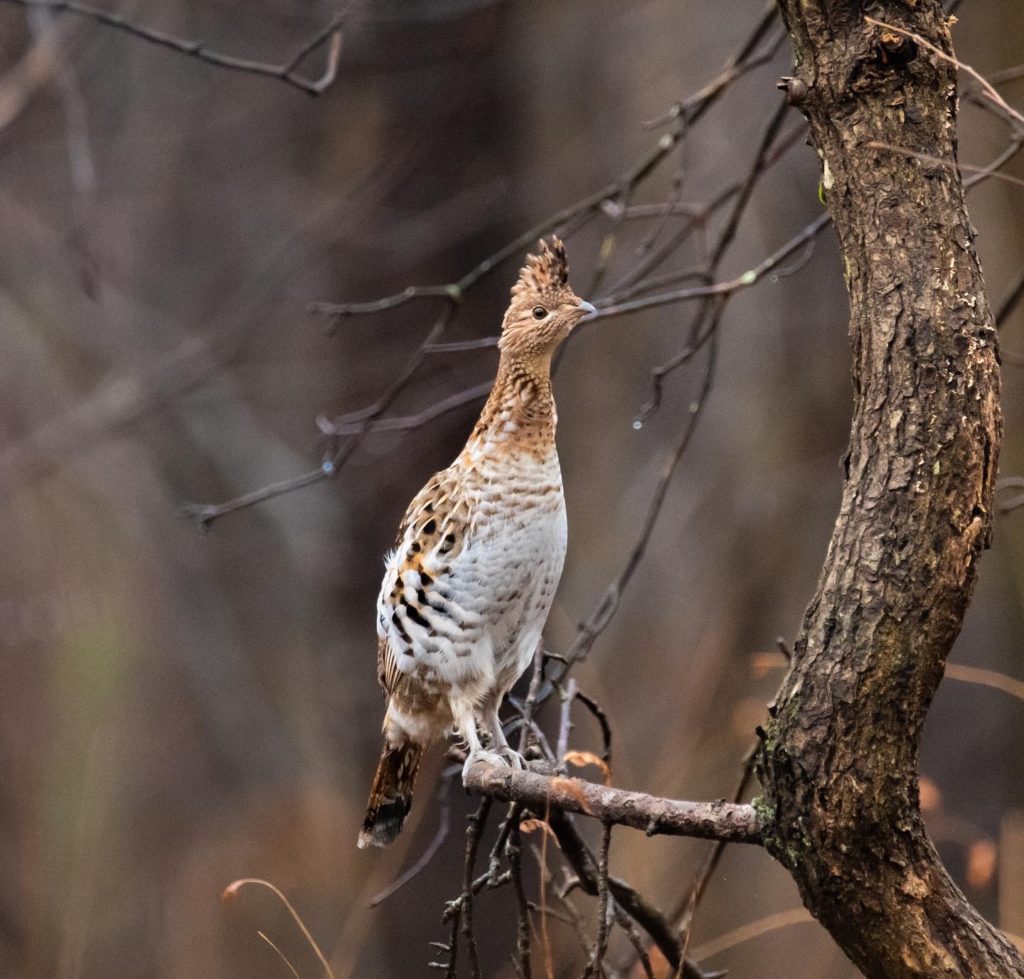
Ruffed Grouse, photo by Alex Busato. Pennsylvania’s state bird can be difficult to find due to its well-camouflaged plumage and declining population, but one posed nicely on Laurel Moutain during this year’s Christmas Bird Count.

Christmas Bird Count History

The CBC is an annual tradition that began on Christmas in 1900. Participants counted birds they saw or heard all day, a step away from previous bird censuses during which people used shotguns to collect and count birds. The original group of 27 birders tallying birds in 25 count circles has now become an international event, sponsored by the National Audubon Society, with nearly 3,000 count circles spread across the Western Hemisphere. The compilers for each count circle choose a date between December 14 and January 5, and participants tally every bird they encounter within a designated 15-mile diameter circle. With such a large geographic range and over 100 years of data, the CBC is one of the largest community science projects. The data gathered has been used to study population trends and over 200 peer-reviewed publications have used CBC data.

The Rector count circle is centered just northwest of Powdermill Nature Reserve. Its variety of habitat types along an elevational gradient is excellent for species diversity. Begun in 1974, the Rector count has consistently tallied more than 50 species every year, with the highest species counts of 88 in 2012 and 80 in 2009. This year’s total of 79 species was the third highest in this count’s history! Although there are core species, like chickadees and cardinals, that we expect to see every year, rarities occasionally pop up, and Rector counters have tallied 131 species since 1974.

2021 Rector Christmas Bird Count Numbers and Highlights

The 2021 count started at 4:30 a.m. with several birders searching for owls. Despite the drizzle, the owlers counted three Great Horned Owls, three Barred Owls, a surprise Northern Saw-whet Owl that was spotted in headlights as it flew across the road, and an incredible 17 Eastern Screech-Owls, a number that shattered the previous record of 11. Off to a great start, the owlers were joined by the bulk of the participants to survey their assigned sectors within the count circle, and there were many surprises in store.

two eastern screech owls held in hands
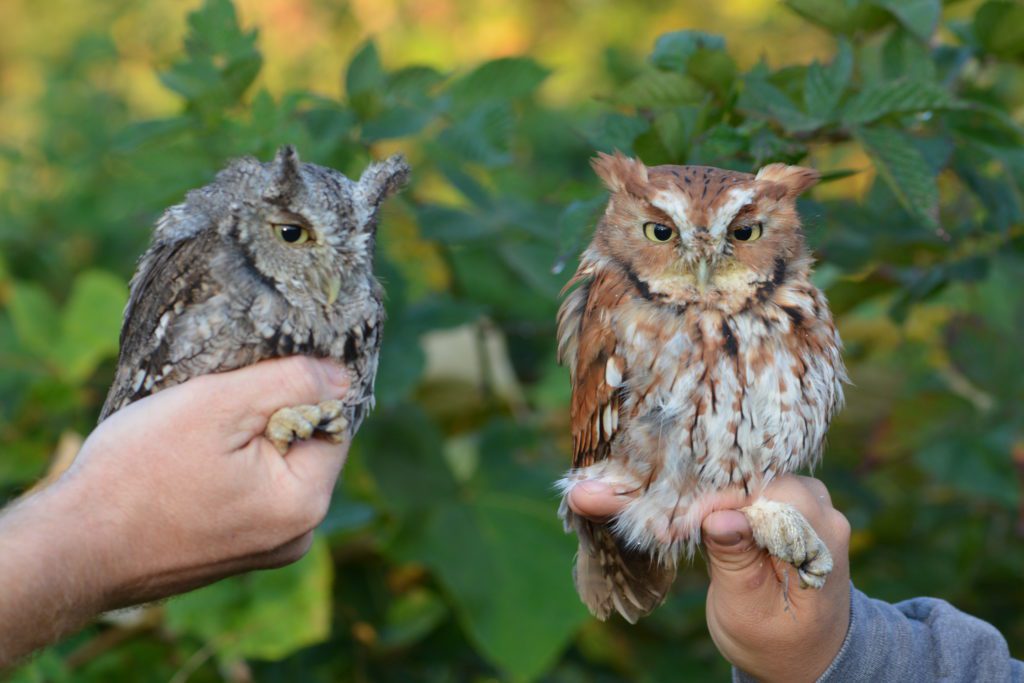
Eastern Screech-Owls, gray morph and red morph. Although not encountered as frequently due to their nocturnal habits, Eastern Screech-Owls are a common species in our area. CBCers shattered the previous high count record for this species during this year’s count, tallying a total of 17 individuals!

At the end of the day, counters met at Powdermill for the tally dinner to report what they’d seen and share stories from the field. As we tallied, we quickly noticed that we were setting new high-count records, or tying existing records, for many species, including Ring-necked Duck, Bufflehead, Red-breasted Merganser, Black Vulture, Eastern Screech-Owl, Northern Saw-whet Owl (tie), Red-bellied Woodpecker, Yellow-bellied Sapsucker, Northern Flicker, Merlin (tie), Common Raven, Ruby-crowned Kinglet (tie), Eastern Bluebird, Hermit Thrush, American Robin, Gray Catbird, Yellow-rumped warbler, White-throated Sparrow, and Eastern Towhee.

The owls certainly set new records due to the increased effort to find them this year: screech owls are a common species in our area, and saw-whets, although quite difficult to find and usually not vocal at this time of year, are likely here in the appropriate habitat.

gray catbird
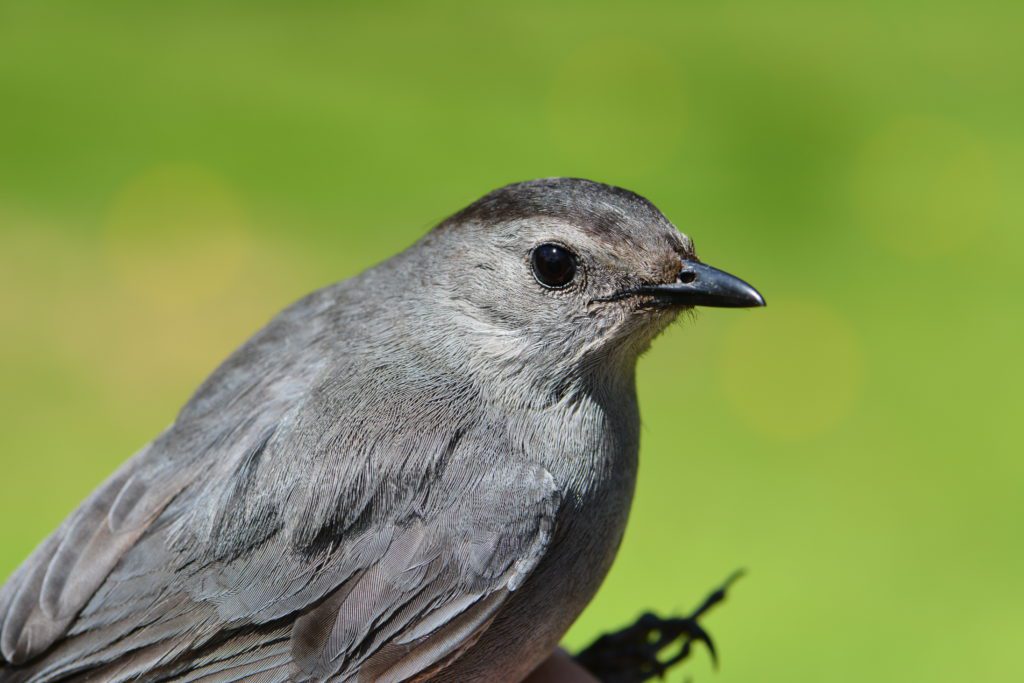
Gray Catbird. A species that winters from coastal Massachusetts through Central America, catbirds have popped up during the Rector Christmas Bird Count in the past. However, this year we tallied three catbirds, which is quite unusual.

We noticed an interesting trend in the species with high counts: most are species that tend to spend the winter a bit south of us, or if they are species that are expected during the Rector CBC, their winter range tends not to extend much farther north of us and we generally do not expect them in high numbers. We speculate that the combination of a late fall, mild temperatures through the end of 2021, and an abundance of berries may have contributed to some individuals of these shorter-distance migrants not migrating as far south as they usually do.

Our biggest surprises were two new species that had never been encountered during the Rector CBC before. The first was a Palm Warbler reported on a farm in Ligonier foraging with a flock of Yellow-rumped Warblers on the edge of a cow pasture. Palm Warblers are seen annually in our area during migration, and we band several of them at Powdermill every year. Many Palm Warblers spend the winter in the southeastern US, but it is not expected in southwest Pennsylvania in the winter. The second species was a Surf Scoter spotted at Donegal Lake. Surf Scoters are a species of duck usually seen in the ocean along the Atlantic and Pacific coasts in winter, or perhaps on the Great Lakes or human-made lakes if they’re forced down by bad weather during migration. This is a very unusual species for our area and an excellent find.

As we submit the Rector count’s data to Audubon and wrap up another CBC, we thank all of the participants and look forward to the 2022 count!

Annie Lindsay is the Bird Banding Program Manager at Carnegie Museum of Natural History’s Powdermill Nature Reserve. Museum employees are encouraged to blog about their unique experiences and knowledge gained from working at the museum.

Related Content

Milestones at Powdermill’s Banding Lab

Bird Safe Glass Installed at Carnegie Museums (Video)

Northern Saw-whet Owl (Video)

Carnegie Museum of Natural History Blog Citation Information

Blog author: Lindsay, Annie
Publication date: January 6, 2022

Share this post!

  • Share on Twitter Share on Twitter
  • Share on Facebook Share on Facebook
  • Share on Pinterest Share on Pinterest
  • Share on LinkedIn Share on LinkedIn
  • Share on Reddit Share on Reddit
  • Share via Email Share via Email

Filed Under: Blog Tagged With: Annie Lindsay, Powdermill Nature Reserve, Science News, We Are Nature 2

December 8, 2021 by Erin Southerland

Climate Change Never Takes A Holiday: The Phenomenon of the Pizzly Bear

by Nicholas Sauer
three polar bears in the snow
Polar bears. Photo by Hans-Jurgen Mager on Unsplash

At this time of year, you’re apt see TV commercials in which cuddly and good-natured polar bears share delicious colas with one another in the spirit of the season. However, neither the mythology nor reality surrounding polar bears—nor bears in general—are quite so idyllic. Even their scientific names possess an element of menace and foreboding. Ursus arctos horribilis—the grizzly—speaks for itself. Ursus maritimus—the polar bear—hints that this predator is as much at home hunting its prey in water as it is on the Arctic ice. In fact, polar bears can swim for several days without stopping. 

Throughout history these creatures have inspired fear in the heart of many a human. Members of the Lewis and Clark Expedition were shocked that none of their party were devoured by grizzlies in the Pacific Northwest. Some Renaissance cartographers labeled the mysterious Arctic realms: hic sunt ursi albi, or “here be white bears” (dragons are overrated anyway). Other Europeans of that era drew polar bears as if they were enormous white wolves with serpentine tails.

The stark whiteness of the polar bear fascinated Ishmael, the narrator of Herman Melville’s 1851 classic Moby Dick: “The irresponsible ferociousness of the creature stands invested in the fleece of celestial innocence and love; and hence, by bringing together two such opposite emotions in our minds, the Polar bear frightens us with so unnatural a contrast.” The white whale of the novel is terrifying in much same way—that such a beast should be the hue of angelic robes is overwhelming to Ishmael. Coincidently, try thinking of Moby Dick as a creature feature, and I bet you won’t find it as intimidating and esoteric a read (it worked for me). 

Grizzly and polar bears have often been misinterpreted and sensationalized by their human neighbors. However, the scientific community in recent decades has begun to regard these two species of bear as complex and vulnerable creatures of great power. Indigenous populations in North America have long understood this. Specifically, the Inuit revere the polar bear for its human-like traits. For instance, both species hunt with patience and intelligence, are capable of play, and demonstrate maternal devotion to cubs. 

Climate Change and Pizzly Bears

Regrettably, climate change is rapidly altering the Arctic ecosystem, putting the polar bears’ long-term future in jeopardy. Polar bears have a highly specialized diet, consisting mainly of seals. Sea ice has long provided the bears with a seal hunting platform, and its late formation and early melt creates progressively more difficult conditions for these bears to hunt their favorite blubbery menu item. Diminished ice cover has forced them to search out other food sources including garbage left behind by humans. In their quest for food, polar bears have come into increased contact with Inuit communities, sometimes resulting in human fatalities. In addition to these confrontations, polar bears are increasingly crossing paths with grizzly bears within the expanding overlap of each species’ geographic range. Polar bears and grizzlies are not so genetically distant from each other to preclude hybridization, and in 2006 the scientific community found that the bears do breed together in the wild. Their shared progeny are known as pizzlies, or grolar bears (which name do you like better?). 

Grizzly bear. Image by Princess Lodges via Flickr.

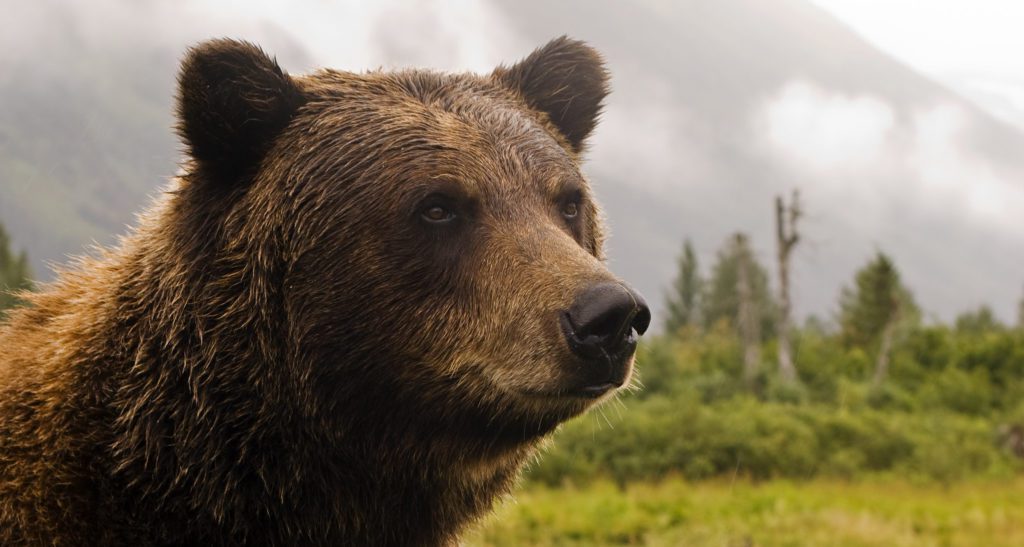
Grizzly bears dominate the territory that they share with polar bears because they are better adapted to the varied climate, terrain, and available food sources. Unlike polar bears, grizzlies follow an opportunistic diet that includes plant tubers and carrion in addition to live prey. Paleontologist Larisa DeSantis of Vanderbilt University posits that the hybrid pizzlies may possess modified skulls and teeth that could plausibly allow them to adopt the indiscriminate feeding habits of the grizzly bear. However, DeSantis points out that the hybrid bears also lose some of the abilities of their parents; for example, pizzlies are not as adept at swimming as their polar bear forbears. 

The twin fear among scientists is that 1) the number of polar bears will dwindle, and 2) hybridization will increase to such an extreme that polar bears will be one day be subsumed into the general grizzly population. The polar bear may face extinction over the next century if nothing is done to conserve the species. Much remains to be discovered about the hybridization of polar bears and grizzlies. What we do know for sure is that pizzlies are a product of profound environmental instability and crisis. Polar bears may star in heartwarming commercials during the holidays—but these creatures and their ecosystem are in grave danger of a different kind of warming, one associated with climate change.

Nicholas Sauer is a Gallery Experience Presenter in CMNH’s Life Long Learning Department. Museum staff, volunteers, and interns are encouraged to blog about their unique experiences and knowledge gained from working at the museum.

References

“Bears on the Lewis and Clark Expedition.” America’s Library. Accessed 29 Sept. 2021. <http://www.americaslibrary.gov/aa/lewisandclark/aa_lewisandclark_bears_2.html>.

Casselman, Anne. “Longest Polar Bear Swim Recorded—426 Miles Straight.” National Geographic. 22 July 2011. <https://www.nationalgeographic.com/science/article/110720- polar-bears-global-warming-sea-ice-science-environment>.

Cockburn, Harry. “Climate crisis pushing polar bears to mate with grizzlies, producing hybrid ‘pizzly’ bears.” The Independent. 15 April 2021. <https://www.independent.co.uk/climate-change/news/pizzly-bear-polar-grizzly-hybrid-b1831847.html>.

Engelhard, Michael. “How Polar Bears Became the Dragons of the North.” Smithsonian Magazine. 31 May 2017. <https://www.smithsonianmag.com/science-nature/polar-bears- dragons-of-the-north-180963502/>.

Melville, Herman. Moby-Dick; or The Whale. 1851. Project Gutenberg. Accessed 29 Sept. 2021. <https://www.gutenberg.org/files/2701/2701-h/2701-h.htm#link2HCH0042>.

“Polar Bear Figurine.” Bristol’s Free Museums and Historic Houses. Accessed 29 Sept. 2021. <https://museums.bristol.gov.uk/narratives.php?irn=11245>.

Strong, Walter. “It’s no surprise for Inuit — Baffin Bay polar bears defy past assumptions with stable population.” CBC.  3 March 2020. <https://www.cbc.ca/news/canada/north/baffin-bay-polar-bears-nunavut-1.5472492>.

Tien, Caroline. “Polar Bear-Grizzly Bear Hybrids Likely to Become More Common Thanks to Climate Change.” Newsweek. 29 April 2021. <https://www.newsweek.com/polar-bear-grizzly-bear-hybrids-likely-become-more-common-thanks-climate-change-1587568>.

Related Content

Waddling in a Winter Wonderland: How Penguins, Humans, and Other Animals Traverse Ice and Snow

Pittsburgh’s Moths Reflect Human Impact of Industry

An Immersive Alaskan Scene

Carnegie Museum of Natural History Blog Citation Information

Blog author: Sauer, Nicholas
Publication date: December 15, 2021

Share this post!

  • Share on Twitter Share on Twitter
  • Share on Facebook Share on Facebook
  • Share on Pinterest Share on Pinterest
  • Share on LinkedIn Share on LinkedIn
  • Share on Reddit Share on Reddit
  • Share via Email Share via Email

Filed Under: Blog Tagged With: HATW, Nicholas Sauer, Super Science, We Are Nature 2

November 12, 2021 by Erin Southerland

Collected on this Day in 1930: Native…or Not?

by Mason Heberling

Though the supercontinent Pangea broke apart many millions of years ago, the Anthropocene is marked by a new kind of Pangea. The globalization of human activities has brought species from around the world into contact which otherwise would never interact. Though the seven continents as they are today may not be physically connected into a single landmass, they are perhaps more connected than they have ever been. 

Some species are intentionally moved from one continent to another, such as the plants in gardens, while other introductions are accidental, mere unintentional passengers of humans increasingly global activities. Introduced species can fundamentally alter the landscape and are regarded as one of the top threats to native biodiversity.

Invasive species are those introduced species which are non-native and spread without human intervention. Many invasive species alter ecosystem functioning and change regional biodiversity. Invasive plant species have become a common part of our landscape. Some were brought over hundreds of years ago by European colonists. Others have arrived much more recently. 

In Pennsylvania, the invasion of some plant species is obvious – that is, a unique species arrives, thrives, and become abundant. These invasive species have no record of being in the area and can spread rapidly, sometimes over the course of a human lifetime or shorter. Many invasive species are still actively spreading across the landscape. For instance, garlic mustard (Alliaria petiolata) is a well-known forest herb from Europe introduced to North America in the mid-1800s. After more than a century, the plant is now common across Pennsylvania’s forests. Another obvious example is giant knotweed (Reynoutria sachalinensis), a native to parts of East Asia, first recorded in western Pennsylvania in the 1920s, and since spread to line many of Pennsylvania’s rivers and streams. You can’t go far in the Pittsburgh region without seeing invasive knotweed.

Other species invasions are less obvious. These so called “cryptic invasions” are the introductions of very closely related species or subspecies which originated elsewhere. 

specimen of common reed on an herbarium sheet

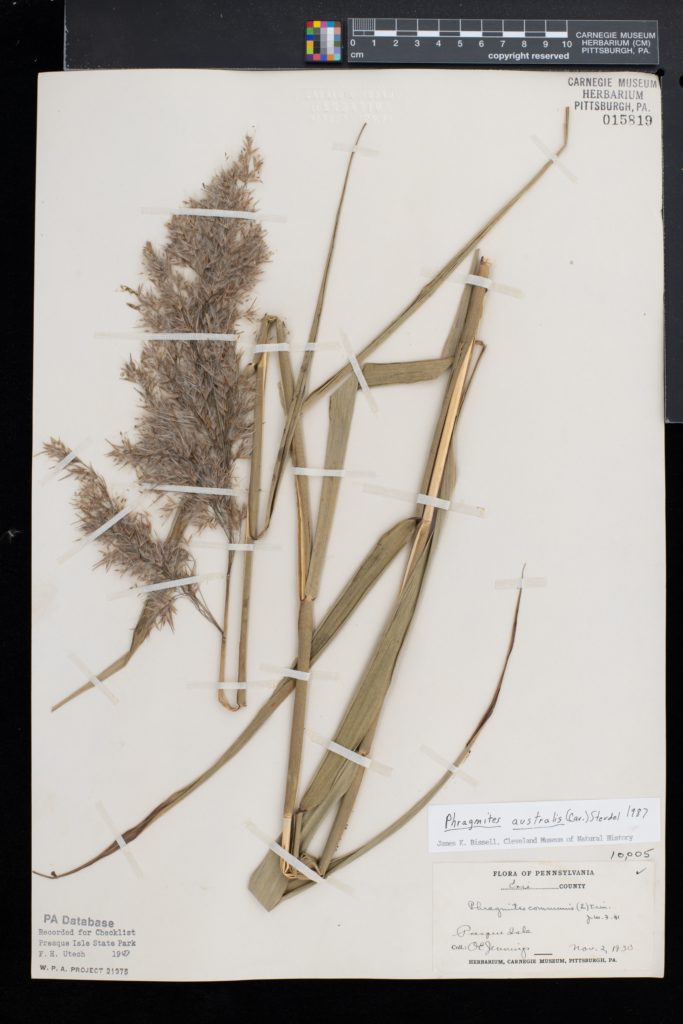
This specimen of common reed (Phragmites australis) tells the tale of a widespread cryptic invasion. The specimen was collected by Carnegie Museum botany curator Otto Jennings on November 2, 1930 along the shores of Lake Erie at Presque Isle, Pennsylvania. Common reed is a major problematic invasive species, crowding out native species in this unique habitat at Presque Isle. When this specimen was collected over 90 years ago, it was not nearly as abundant as it is now. 

common reed plants with trees outside
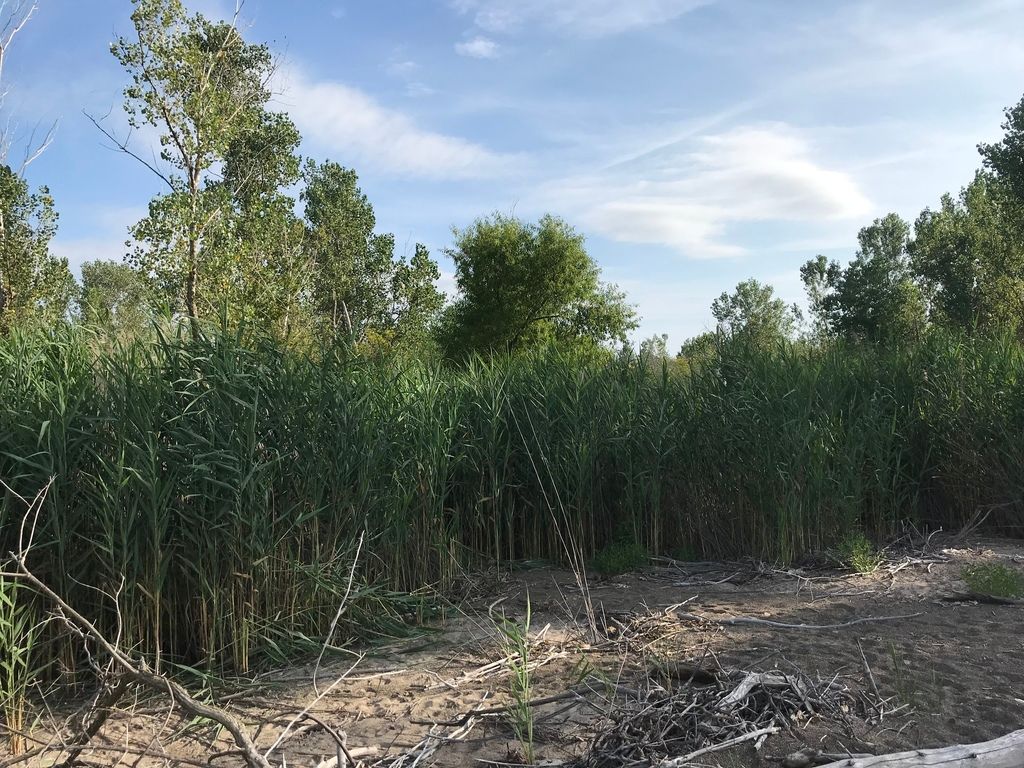
A large stand of Phragmites at Presque Isle State Park, August 2019.

But is it non-native? Common reed, or often simply called Phragmites, has a very widespread distribution, found in wetlands and shores across all continents except Antarctica. It is even a common site along wet areas near highways. Common reed is among the most widely distributed plants in the world.

Reed is non-native to the United States…well, mostly. In the 1800s, botanists considered Phragmites to be a relatively uncommon plant. Evidence from fossils and paleoecological research show that the species has indeed been in North America for many thousands of years. However, it didn’t start to become abundant until the early 1900s and after. Some botanists suggested the sudden success of the species could be due to human disturbance.  A pioneering herbarium-based study from 2002 published in PNAS by Dr. Kristin Saltonstall sequenced DNA from herbarium specimens collected before 1910 and recent collections to show that the spread of Phragmites in the United States was due to the introduction of a non-native strain of the species that originated from Europe. 

Pretty cool, huh? And this finding was made possible with herbarium specimens.

So, is this particular specimen native or not? I don’t actually know, but with expert examination and genetic analysis, we could find out! 

Find this specimen and 149 more in the Carnegie Museum herbarium here.

Check back for more! Botanists at the Carnegie Museum of Natural History share digital specimens from the herbarium on dates they were collected. These scientists are in the midst of a three-year project to digitize nearly 190,000 plant specimens collected in the region, making images and other data publicly available online. This effort is part of the Mid-Atlantic Megalopolis Project (mamdigitization.org), a network of thirteen herbaria spanning the densely populated urban corridor from Washington, D.C. to New York City to achieve a greater understanding of our urban areas, including the unique industrial and environmental history of the greater Pittsburgh region. This project is made possible by the National Science Foundation under grant no. 1801022.

Mason Heberling is Assistant Curator of Botany at Carnegie Museum of Natural History. Museum employees are encouraged to blog about their unique experiences and knowledge gained from working at the museum.

Related Content

The Circle of Life…and Invasion

Ask a Scientist: How do you find rare plants? [Video]

Collected on This Day in 1982: One specimen isn’t always enough!

Carnegie Museum of Natural History Blog Citation Information

Blog author: Heberling, Mason
Publication date: November 12, 2021

Share this post!

  • Share on Twitter Share on Twitter
  • Share on Facebook Share on Facebook
  • Share on Pinterest Share on Pinterest
  • Share on LinkedIn Share on LinkedIn
  • Share on Reddit Share on Reddit
  • Share via Email Share via Email

Filed Under: Blog Tagged With: Botany, collected on this day, Mason Heberling, Science News, Uprooted, We Are Nature 2

  • « Go to Previous Page
  • Page 1
  • Page 2
  • Page 3
  • Page 4
  • Page 5
  • Page 6
  • Go to Next Page »

sidebar

About

  • Mission & Commitments
  • Directors Team
  • Museum History

Get Involved

  • Volunteer
  • Membership
  • Carnegie Discoverers
  • Donate
  • Employment
  • Events

Bring a Group

  • Groups of 10 or More
  • Birthday Parties at the Museum
  • Field Trips

Powdermill

  • Powdermill Nature Reserve
  • Powdermill Field Trips
  • Powdermill Staff
  • Research at Powdermill

More Information

  • Image Permission Requests
  • Science Stories
  • Accessibility
  • Shopping Cart
  • Contact
  • Visitor Policies
One of the Four Carnegie Museums | © Carnegie Institute | Privacy Policy | Terms of Use | Accessibility
Rad works here logo