• Skip to primary navigation
  • Skip to main content
  • Skip to primary sidebar

Carnegie Museum of Natural History

One of the Four Carnegie Museums of Pittsburgh

  • Visit
    • Buy Tickets
    • Visitor Information
    • Exhibitions
    • Events
    • Dining at the Museum
    • Celebrate at the Museum
    • Powdermill Nature Reserve
    • Event Venue Rental
    • Gift Cards
  • Learn
    • Field Trips
    • Educator Information
    • Programs at the Museum
    • Bring the Museum to You
    • Guided Programs FAQ
    • Programs Online
    • Climate and Rural Systems Partnership
  • Research
    • Scientific Sections
    • Science Stories
    • Science Videos
    • Senior Science & Research Staff
    • Museum Library
    • Science Seminars
    • Scientific Publications
    • Specimen and Artifact Identification
  • About
    • Mission & Commitments
    • Directors Team
    • Museum History
  • Tickets
  • Give
  • Shop

Expeditions

January 29, 2018 by wpengine

The Dinosaur of a Lifetime

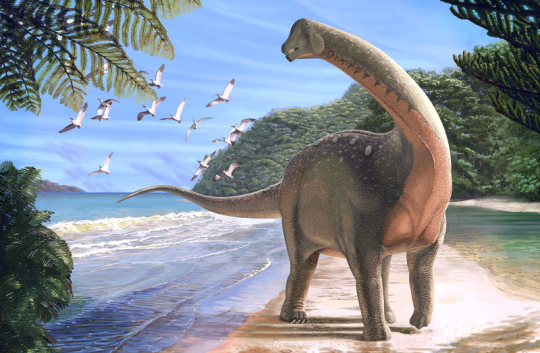
color drawing of a dinosaur on a beach
(Image credit: Carnegie Museum of Natural History / Andrew McAfee)

By Matt Lamanna

January 29, 2018

It might sound a little strange to say, but African dinosaurs have been an important part of my life for a long time. Almost two decades ago, when I was in graduate school at the University of Pennsylvania, and a few years before I took a job here at Carnegie Museum of Natural History, I participated in fossil-hunting expeditions to the Sahara Desert of Egypt. Along with our advisor, my beloved “Boss” Peter Dodson, my fellow students and I had a lot of success, discovering among other fossils the only known skeleton of a new, ~95 million-year-old species that we named Paralititan stromeri in 2001. With a humerus, or upper arm bone, that’s almost as tall as I am, Paralititan is still one of the biggest dinosaurs known to science.

But as fun as those discoveries were to be a part of, some of our team’s most sought-after finds never materialized. In going to Egypt, part of our aim was to find dinosaurs from roughly 80 to 66 million years ago – dinosaurs from the very end of the Cretaceous Period, the third and final time period of the Age of Dinosaurs. Dinosaur fossils of this age are exceedingly rare on all of continental Africa (i.e., Africa excluding the island of Madagascar), not just in Egypt. Surprisingly, however, this has not stopped paleontologists from speculating as to what kinds of dinosaurs might have inhabited Africa at the end of the Cretaceous. Some have proposed that African latest Cretaceous dinosaurs were close relatives of, and therefore similar to, those living on neighboring landmasses at the same time. Other scientists have argued that Africa was an island continent at the end of the Cretaceous, and, because it was cut off from other land areas, it was home to unique dinosaurs that had evolved for millions of years along their own distinctive evolutionary pathways.

Until recently, no one had ever found a reasonably complete dinosaur skeleton from the end of the Cretaceous anywhere on continental Africa. A few isolated bones and minor parts of skeletons had been discovered, but these didn’t tell us much about the dinosaurs to which they belonged – as you can imagine, the more pieces one has of a fossil skeleton, the more one can typically learn about the animal it represents. This, in turn, prevented paleontologists from figuring out whether African latest Cretaceous dinosaurs were truly unique or whether they had close kin on other landmasses. But all of that changed in late 2013, when my friend and colleague Dr. Hesham Sallam of Mansoura University in Egypt—along with his talented students Iman El-Dawoudi, Sanaa El-Sayed, and Sara Saber—discovered the skeleton of a sauropod (long-necked plant-eating dinosaur) at an ~80 million-year-old site in the Dakhla Oasis of the Egyptian Sahara. The dinosaur I’d dreamed about for virtually all of my professional life had finally been found! Even better, Hesham and the team—which also included my close friends Pat O’Connor and Eric Gorscak, plus several other Egyptian and American scientists—invited me to be a part of the study. We soon realized that the creature had a lot to say about the nature of Africa’s last dinosaurs, as its bones suggested close relationships to species living in Europe and Asia at about the same time. These hypotheses were borne out by more rigorous analyses, showing that African latest Cretaceous dinosaurs weren’t island-dwelling weirdos after all – rather, they had close cousins in Eurasia. Today, our team gave the dinosaur its formal scientific name, Mansourasaurus shahinae, and for me, it’s the culmination of a search that’s occupied almost half my life.

Matt Lamanna is a paleontologist and the principal dinosaur researcher at Carnegie Museum of Natural History in Pittsburgh. 

Museum employees are encouraged to blog about their unique experiences and knowledge gained from working at the museum.

Read more about this news on Gizmodo.
Filed Under: Blog Tagged With: dinofest, dinosaur, Matt Lamanna, Vertebrate Paleontology

March 2, 2017 by wpengine

Ancient Egyptian Column Shafts

by Erin Peters

Here at Antinoupolis, the Italian mission has been excavating since the 1930s and has a long and productive residence at
the site. There are a number of publications resulting from the mission’s work and two recent volumes that include scientific publications of the team’s work since 2000–for these resources and more, see The Antinoupolis Foundation’s bibliography. For this 2017 season, the mission has three active excavation areas open, and today I write about one that is in the east of the ancient city near what was once a monumental gate facing the Via Hadriana. Hadrian built this impressive road through the desert as a new trade route, which ran through Antinoupolis to the Nile for river transport.

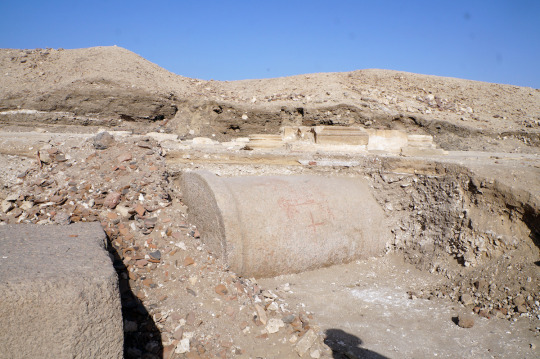
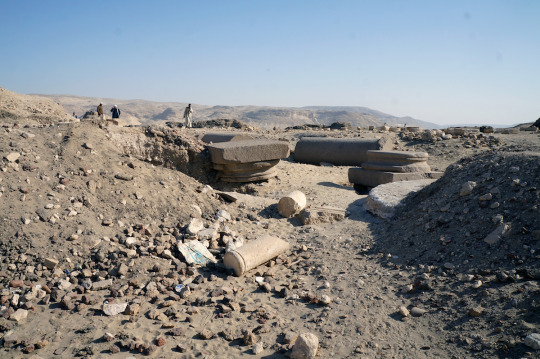
The east gate was monumentalized by huge red granite columns, of which fragments are extant. Two column bases (one upright and one overturned) and three column shaft fragments were known before this season and are an impressive sight to see.

Ancient Egyptian column shafts partially uncovered in an archeology dig
Monumental fragments of red granite column bases and shafts at the east edge of the city


Under supervision of the mission’s architect, Peter Grossman, another section of a column shaft was unearthed this season. This shaft indicates there could be more fragments nearby, possibly under the 4-5th century CE church that Peter’s team is currently excavating, the remains of which you can see above.


Ancient columns being excavated in an archeology dig
View of column shaft fragment excavated this season

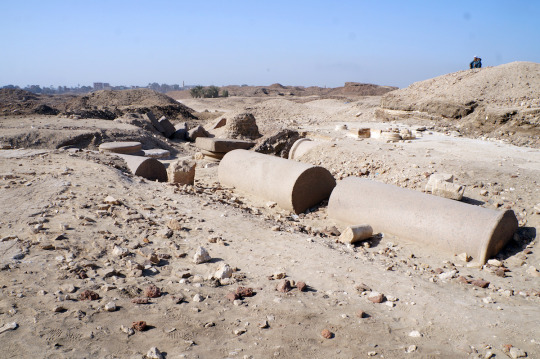
Hopefully some of these shafts will be more visible in the near future and draw visitors to the site as recorded in The Antinoupolis Foundation’s February 10 blog post. The mission’s director, Rosario Pintaudi, has put in an application to the Ministry of Antiquities to re-erect the column. If approved, perhaps the column shaft will be soaring at the east edge of the city by the time I return next year!

Partially burried columns in a row
Fallen column shaft fragments that may be re-erected in the near future

Erin Peters is an assistant curator of science and research at Carnegie Museum of Natural History. She recently traveled to Egypt for an archaeological research study. This is a series of blog posts she wrote while in the field. Check back for more!

Filed Under: Blog Tagged With: ancient egypt, anthropology, egypt, Erin Peters, Walton Hall of Ancient Egypt

November 29, 2016 by wpengine

Fossil Search: Expert Assistance

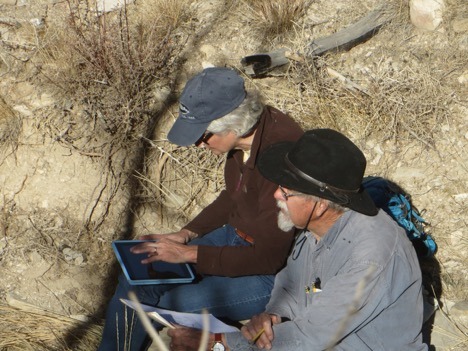
paleontologists using GPS
During a search for the contact point of two different Sheep Pass Formation rock units, Amy Henrici uses GPS-linked topographic maps in her iPad to locate the zone referenced in a stratigraphic map held by Richard Hilton.

by Patrick McShea

The frog fossil expedition workforce doubled briefly with the arrival of a two-person team affiliated with Sierra College in Rocklin, California. Earth Science professor Richard Hilton and field assistant Tina Campbell drove east from the Sacramento area, crossing the Sierra Nevada and a large portion of the Great Basin to meet us for two days of field work. They then proceeded to another fossil locality in the region to retrieve material discovered during earlier summer field work.

The Sheep Pass Formation within the South Egan Wilderness was familiar territory for both. In 2012 and 2013 they participated in larger expeditions to the area that involved not just Carnegie Museum of Natural History and Sierra College, but also the University of Nevada at Las Vegas.

Because Hilton is chairmen of Sierra College’s natural history museum,  our fireside conversations included the potential for using blog posts to broaden the audience for information about paleontological field work. Through the combination of his generosity, two-burner stove, and culinary skills, camp meals also improved.

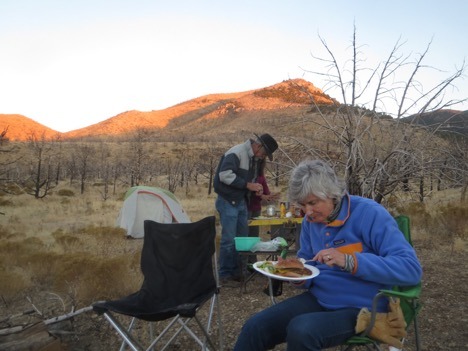
paleontologists eating at campsite
Dinner at dusk, including Caesar salad, baked beans, and hamburgers.

Patrick McShea is a museum educator who is traveling through Nevada with Vertebrate Paleontology Collections Manager Amy Henrici to search for frog fossils. He frequently blogs about his experiences.

Filed Under: Blog Tagged With: Amy Henrici, fossils, frogs, paleontology

November 28, 2016 by wpengine

Shifting Formations

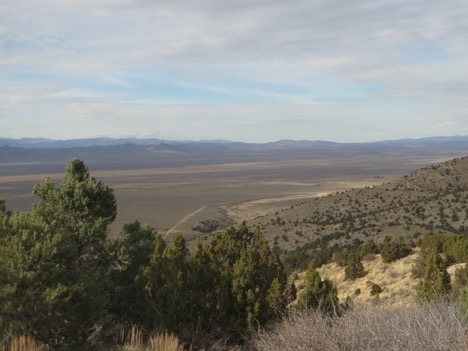
Nevada’s White River Valley from high ground in the South Egan Wilderness.

by Patrick McShea

From Elko, Nevada, the Carnegie Museum of Natural History frog fossil expedition shifted some 125 miles southeast to steep winding canyons within the South Egan Wilderness, a mountainous tract of more than 67,000 acres.

The move involved a change in the age of the rock outcrops we searched. Near Elko our efforts were confined to various associated rock layers, which geologists categorize as the Elko Formation, a thick and wide spread unit which formed some 46 – 39 million years ago during the Eocene Epoch. In the South Egan Wilderness, we explored the Sheep Pass Formation, a sequence of far older rocks which formed during the Late Cretaceous through middle Eocene Epochs some 70-46 million years ago.

Daily procedures were far different in the BLM-managed wilderness than on the outskirts of Nevada’s 15th largest city.

Instead of commuting to outcrops from a motel in Elko’s center, we hiked to rock exposures more than a mile from our simple camp site, proceeding up dry stream beds and ascending eight staircase-like water falls to reach the fossil-bearing units at elevations exceeding 6,700 feet. Evenings were cold, star-filled, and absolutely quiet but for the occasional howls and yips of coyotes.

Because a 2012 wildfire burned over 10,000 acres of sage brush, juniper, and pinyon pine, our camp area was a surreal landscape of charred trees.


Patrick McShea is a museum educator who is traveling through Nevada with Vertebrate Paleontology Collections Manager Amy Henrici to search for frog fossils. He frequently blogs about his experiences.

Filed Under: Blog Tagged With: Amy Henrici, fossils, frogs, paleontology

November 16, 2016 by wpengine

Where to Look for Fossils

Amy Henrici
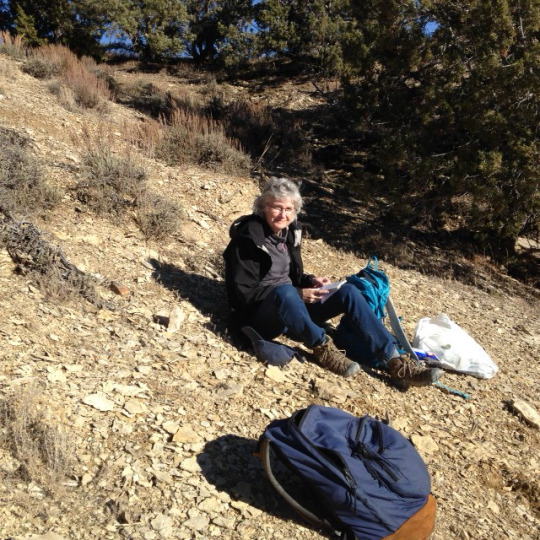
Vertebrate Paleontology Collections Manager Amy Henrici in the field.

As I travelled west from Pittsburgh to meet Carnegie Museum of Natural Hisotry Vertebrate Fossil Collection Manager Amy Henrici for a frog fossil hunting expedition in eastern Nevada, the same question was asked by each of my airplane seat mates.

“How do you know where to look for fossils?“

For the sites we planned to visit the answer was simple. Earlier written reports by geologists mapping rock formations and mineral deposits noted the occasion occurrence of fossils in certain rock layers.

Fossil searches involved locating and visiting sites where such rock layers are exposed on the surface, and then examining fragments that have eroded from these outcrops.The full process, which might stretch over decades, is an example of how published findings allow one branch of science to serve another.

As a geologist friend takes great pleasure in explaining, “Geologists let paleontologists know where fossils are in the multitude rock layers of Earth’s history, in time and in place.”


Patrick McShea is a museum educator who is traveling through Nevada with Vertebrate Paleontology Collections Manager Amy Henrici to search for frog fossils. He frequently blogs about his experiences.

Filed Under: Blog Tagged With: Amy Henrici, expedition, fossils, frogs, geology, museums, paleontology

November 1, 2016 by wpengine

Frog Fossil Hunt in Nevada

frog fossil

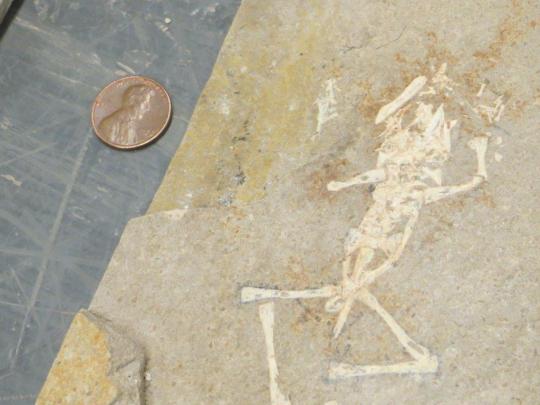
Frog fossil from eastern Nevada.

by Patrick McShea

Dinosaurs get all the attention, but fossils of less glamorous creatures also contribute much to our understanding of evolution and extinction. Consider frogs for example. These widely distributed amphibians first appear in the fossil record roughly 190 million years ago. Since then they have
survived numerous events, including mass extinction, changing climate, and the rearrangement
of continents through plate tectonics.

The study of how frogs adapted to changing environments over vast stretches of time is especially important today in light of dramatic declines of many frog species due to rapid climate change, habitat fragmentation, the global spread of disease, and broad changes in land use.

Frogs are not ignored in Carnegie Museum of Natural History’s Dinosaurs in Their Time.  A rectangular display case near the terminus of Diplodocus carnegeii’s exquisitely tapered tail, a cast featuring tiny frog bones from Dinosaur National Monument shares space with the holotype skull of a Jurassic crocodile.

The bones represent a species that must have sometimes dwelled in the literal shadows of sauropod dinosaurs. The species was named Rhadinosteus parvus in a scientific research paper by Amy Henrici, a paleontologist who is the collection manager for the Carnegie’s Section of Vertebrate Paleontology.

Amy has conducted research and published findings on other frog fossils, and regularly serves as a peer reviewer for the research papers of other scientists studying the frog fossils. This fall, at the annual meeting of the Society of Vertebrate Paleontology (SVP) in Salt Lake City, Amy will be presenting
information about an ongoing study of frog fossils from eastern Nevada.

My interest in her research and publications is deeper than that of an admiring co-worker. Amy and I have been married for 28 years, and several times I have worked as her field assistant. This fall, I’ll fill that
role again when she conducts post-SVP Meeting field work at two sites in eastern Nevada. As a museum educator I plan to post pictures and updates about the fossil-hunting expedition, so stay tuned! More frog posts are coming.

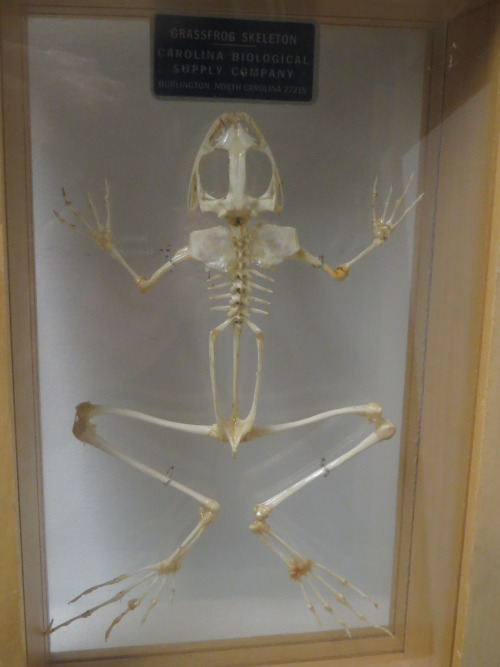
Grass frog skeleton in the CMNH teaching collection

Grass Frog skeleton in the CMNH teaching collection.

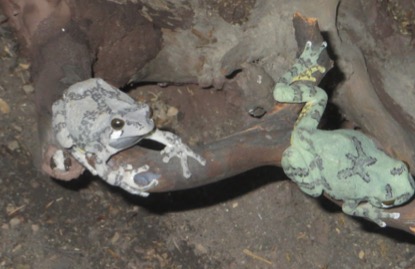
Eastern Gray Tree Frogs in the Pennsylvania Amphibians display on the Daniel G. & Carole L. Kamin T-rex Overlook

(Eastern Gray Tree Frogs in the Pennsylvania Amphibians display on the Daniel G. & Carole L. Kamin T-rex Overlook.)


Patrick McShea works in the Education and Visitor Experience department of Carnegie Museum of Natural History. Museum employees are encouraged to blog about their unique experiences of working at the museum.

Filed Under: Blog Tagged With: Amy Henrici, fossils, Patrick McShea

  • Page 1
  • Page 2
  • Page 3
  • Interim pages omitted …
  • Page 5
  • Go to Next Page »

sidebar

About

  • Mission & Commitments
  • Directors Team
  • Museum History

Get Involved

  • Volunteer
  • Membership
  • Carnegie Discoverers
  • Donate
  • Employment
  • Events

Bring a Group

  • Groups of 10 or More
  • Birthday Parties at the Museum
  • Field Trips

Powdermill

  • Powdermill Nature Reserve
  • Powdermill Field Trips
  • Powdermill Staff
  • Research at Powdermill

More Information

  • Image Permission Requests
  • Science Stories
  • Accessibility
  • Shopping Cart
  • Contact
  • Visitor Policies
One of the Four Carnegie Museums | © Carnegie Institute | Privacy Policy | Terms of Use | Accessibility
Rad works here logo