• Skip to primary navigation
  • Skip to main content
  • Skip to primary sidebar

Carnegie Museum of Natural History

One of the Four Carnegie Museums of Pittsburgh

  • Visit
    • Buy Tickets
    • Visitor Information
    • Exhibitions
    • Events
    • Dining at the Museum
    • Celebrate at the Museum
    • Powdermill Nature Reserve
    • Event Venue Rental
  • Learn
    • Field Trips
    • Educator Information
    • Programs at the Museum
    • Bring the Museum to You
    • Guided Programs FAQ
    • Programs Online
    • Climate and Rural Systems Partnership
  • Research
    • Scientific Sections
    • Science Stories
    • Science Videos
    • Senior Science & Research Staff
    • Museum Library
    • Science Seminars
    • Scientific Publications
    • Specimen and Artifact Identification
  • About
    • Mission & Commitments
    • Directors Team
    • Museum History
  • Tickets
  • Give
  • Shop

Erin Southerland

April 19, 2022 by Erin Southerland

Wonderment Returns

by Joann Wilson

“What if one of us discovers the missing boat?” The full-voiced question arose from a group of fourth-grade students eagerly pointing to an ancient Egyptian funerary boat, a school bus-sized wooden craft over 3,800-years-old. On this frosty January morning, twenty teachers and students from a consortium of four Mercer County schools delighted in their return for in-person tours to Carnegie Museum of Natural History. The COVID-19 pandemic led to a two-year absence, a gap that Megan Shreves, a gifted student teacher at St John Paul/Kennedy Catholic School, emphasized by gently tapping a notebook bearing the date of the group’s last visit, October 2, 2019.  

Katie Olive, a gifted student teacher from Sharon School District, explained that the cultural groups presented in several museum exhibitions, including the Tlingit, Hopi, Lakota, Iroquois, Inuit, and ancient Egyptian Peoples, are also presented in their curriculum. Olive added, “The museum is a fantastic environment to learn in a hands-on setting. We love our Interpreters, year after year, because they are experts in the field!” Her comment is a near textbook recognition of the collective aspirations shared by Museum interpreters. The National Association of Interpretation defines interpretation as “a purposeful approach to communication that facilitates meaningful, relevant, and inclusive experiences that deepen understanding, broaden perspectives, and inspire engagement.” 
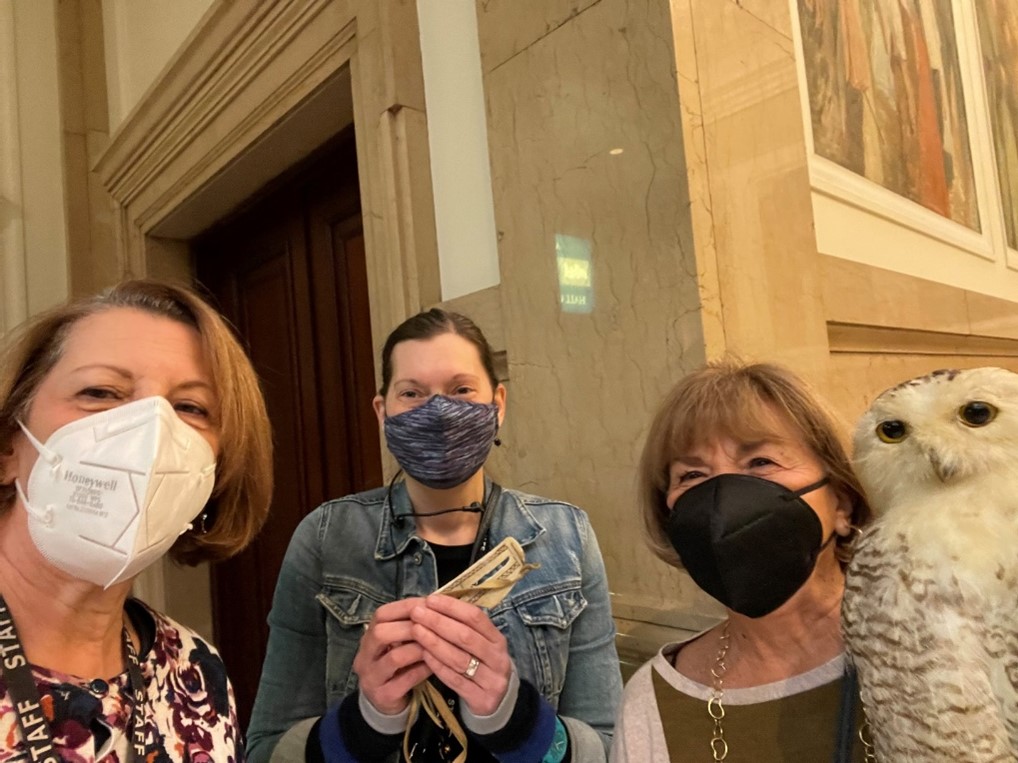
A selfie of three people in a museum.
CMNH Group Program’s Coordinator, Pat Howe, with Interpreter Joann Wilson, holding Inuit snow goggles, and Interpreter, Paula Doebler, holding long-time education collection favorite, the snowy owl. 

Pat Howe, Carnegie Museum of Natural History’s Group Program’s Coordinator, revealed that between the fall of 2021 and this visit in January 2022, the museum had welcomed back over 300 students for guided tours. Guided tours routinely include hands-on activities, observation, and inquiry.  On this day, tours also included a few moments to sketch objects inspiring fascination.
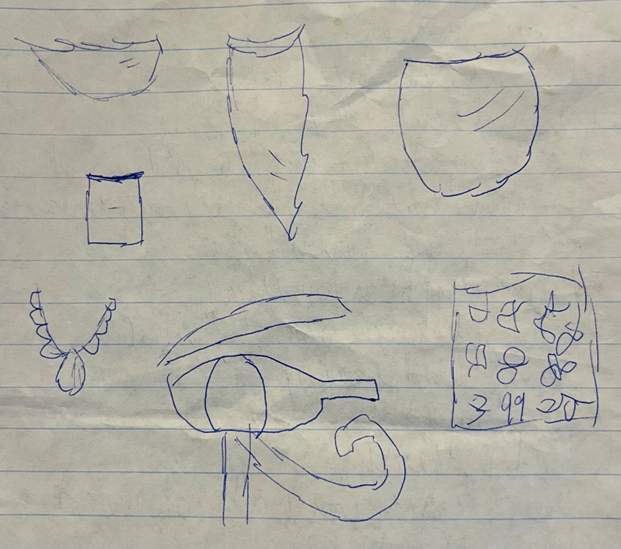
Pen sketches of ancient Egyptian artifacts by a fourth grade student.
Sharon School District student drawing from a January 2022 guided tour about daily life in ancient Egypt.

Which gets us back to that funerary boat. In 1894-1895, during excavation of the tomb of the ancient Egyptian pharaoh Senwosret III, French archeologist Jacques de Morgan discovered five, or perhaps even six, boats buried alongside the structure. However, today, the whereabouts of only four vessels are definitively known. Two boats reside at the Egyptian Museum in Cairo, one is under the stewardship of the Carnegie Museum of Natural History, and another is under the care of the Field Museum in Chicago. Perhaps one day, a student scholar will transport wonderment full circle, and unearth the story of the missing funerary boat or boats.

Thanks to Katie Olive, Sharon gifted teacher, Megan Shreves, St John/Kennedy Catholic gifted teacher, Lindsay Ramage, Hermitage gifted teacher, and June Allenbaugh, Farrell gifted teacher. Joann Wilson is an Interpreter in the Education Department at Carnegie Museum of Natural History. Museum employees blog about their unique experiences and knowledge gained from working at the museum.   

Related Content

Making Time Disappear

March Mammal Madness and Middle School Science Class

Learning From Misinterpretations

Carnegie Museum of Natural History Blog Citation Information

Blog author: Wilson, Joann
Publication date: April 14, 2022
Share this post!

  • Share on Twitter Share on Twitter
  • Share on Facebook Share on Facebook
  • Share on Pinterest Share on Pinterest
  • Share on LinkedIn Share on LinkedIn
  • Share on Reddit Share on Reddit
  • Share via Email Share via Email

Filed Under: Blog Tagged With: Education, Joann Wilson

April 18, 2022 by Erin Southerland

Using iNaturalist in the City Nature Challenge and beyond

by Patrick McShea

Participation in this year’s City Nature Challenge (CNC), April 28–May 1, 2023, is a great way to familiarize yourself with iNaturalist, an innovative cell phone app that powers the annual biological survey of metropolitan areas across the globe. Mastery of the easy-to-use technology during this self-paced bioblitz-style event can create positive outcomes long after the Pittsburgh CNC concludes and in places far beyond the event’s six county territory.          

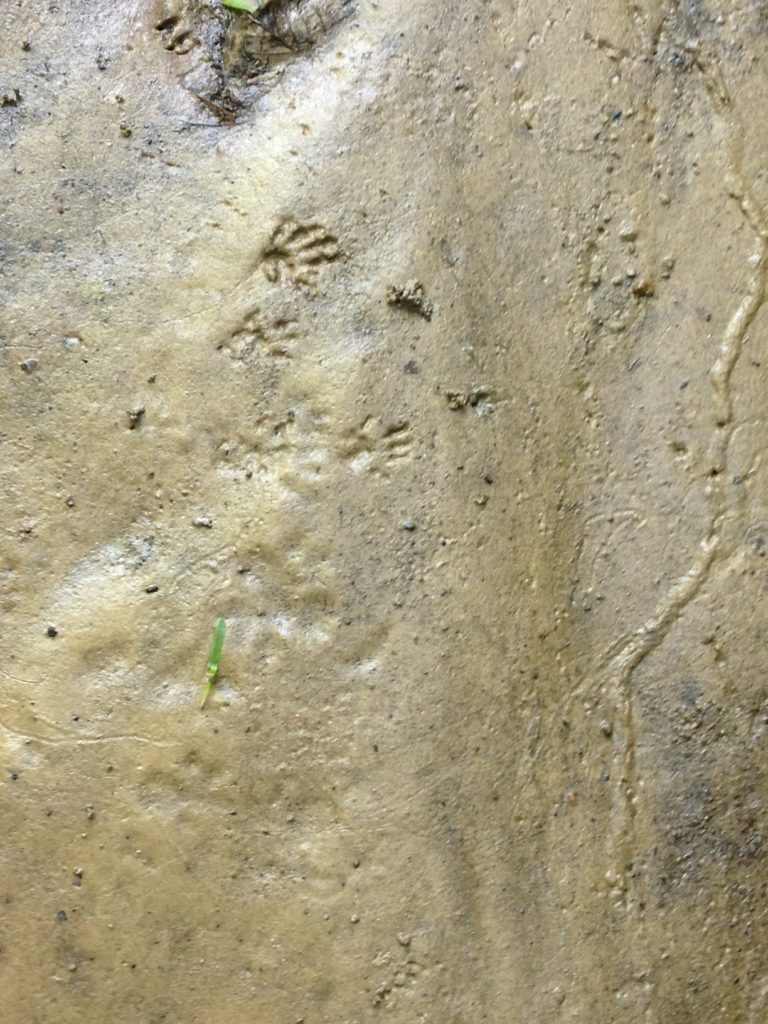
Raccoon tracks in the mud.
During the City Nature Challenge participants can identify observations, such as these raccoon tracks, or rely upon iNaturalist to identify them.

Although 2023 will be the sixth consecutive year for Carnegie Museum of Natural History to serve as a CNC city organizer agency, I didn’t become an active participant in the event until 2021. In 2021, I was among 446 participants who, in using our phone cameras to take and submit pictures, documented 7,045 observations of free-living plants, animals, and fungi in Allegheny, Armstrong, Beaver, Butler, Washington, and Westmoreland Counties. Our collective efforts verified and geo-referenced the presence of 1,219 different species at various locations in the surveyed territory.

My contributions, which came from four half-hour periods over as many days, amounted to only 29 observations, and for each of them I was able to include an accurate name of the observed subject in the submission form’s “What did you see?” line. iNaturalist, which is a joint initiative of the California Academy of Sciences and the National Geographic Society, functions amazingly well in identifying submitted images even when this question is ignored. The app provides users with impressive evidence of its image recognition capabilities by quickly supplying identification suggestions. This digital wizardry is only a starting point, however, because iNaturalist defines itself as “an online social network of people sharing biodiversity information to help each other learn about nature.” 

Whether an observation is tentatively identified by the observer or through the powerful software, higher levels of identification certainty occur hours, weeks, or even months later when other users, who are focused on identifying observations, verify, refine, or even challenge identifications. Consistent verification by such reviewers can raise observations to “research grade,” indicating possible use in future scientific investigations.

Because I didn’t pay close attention to the network aspects of iNaturalist during the CNC, appreciation for my phone’s transformation into far more than a multi-category field guide came months later and more than 500 miles to the northeast during an early fall vacation in the Adirondack Park.

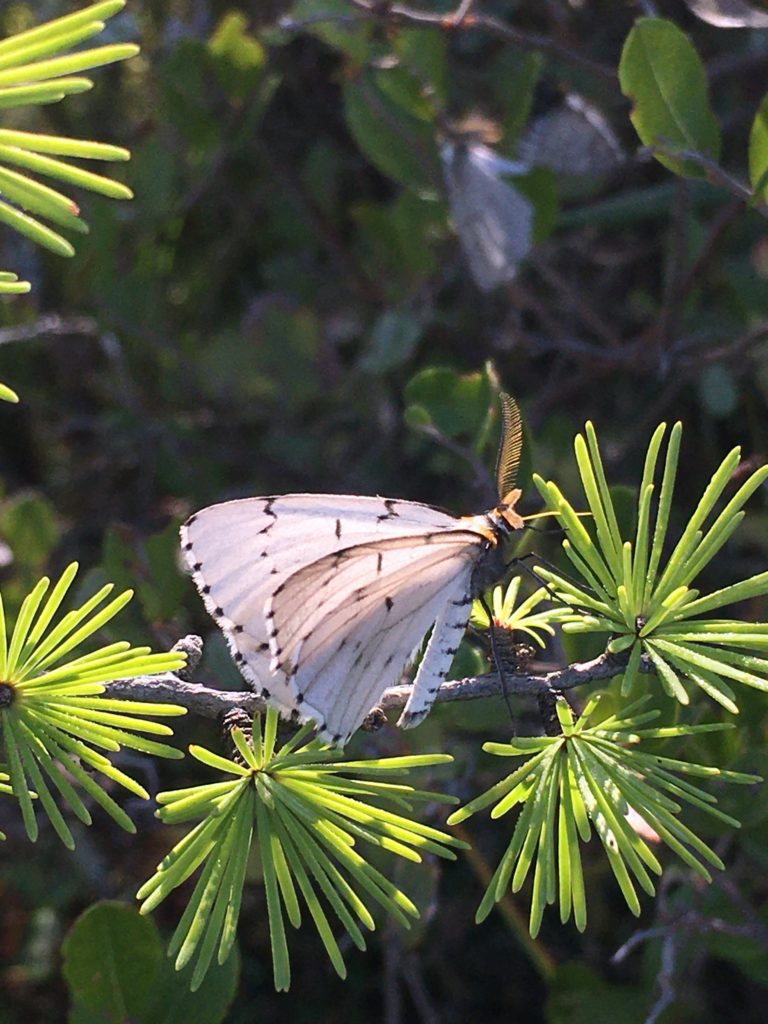
Moth on a branch.
The moth known commonly as the Chain-dotted Geometer on the Boreal Life Trail at the Paul Smith’s College Visitor Information Center.

On a sunny mid-September afternoon, while my wife and I watched for birds and pitcher plants along a bog-crossing boardwalk that is part of the unique 14,000-acre campus of Paul Smith’s College, we were frequently surrounded by white moths with delicate black markings. When one landed close by I took its picture, then immediately submitted it as an iNaturalist observation. “Genus Cingilia,” I saw on the phone screen within 30 seconds. 

Days later, when an email notification informed me that an observation reviewer had refined the identification to “Cingilia catenaria,” or the “Chain-dotted Geometer,” curiosity about the bog moths prompted a visit to BugGuide.net, a reliable site for information about insects and spiders in North America. Here a statement in the “Remarks” section of the species account raised an ecological question: “Locally abundant to the point of being a pest in some years, yet becoming increasingly rare over much of its former range in the Northeast.”

As I wondered whether the numerous bog moths had been a pest-level outbreak, I remembered someone who might be able to answer that question. The observation reviewer had identified herself on iNaturalist. Dr. Janet Mihuc is a professor at Paul Smith’s College who has been conducting a moth biodiversity survey on the college’s lands for the past six years. In an email exchange she was happy to discuss the bog moths and their role in the ecosystem.

I certainly consider C. catenaria common in our area. I am not aware of it being a pest but that may just be because our local bogs have no economic significance to humans so I doubt there is data on the amount of defoliation that the caterpillars can cause. Hopefully the caterpillars are an important food for migrant songbirds before they depart or for resident songbirds. Based on my data, adult moth species diversity peaks in July then drops steadily in August and September. I would expect caterpillar availability to show a similar trend.

Her generous sharing of information was completely inline with my experience as a CMNH educator asking museum scientists for clarification of concepts presented in current exhibits. The fact that the information exchange was brokered by a cell phone app did not diminish the learning that occurred.

Patrick McShea is an Educator at Carnegie Museum of Natural History. Museum employees blog about their unique experiences and knowledge gained from working at the museum.

Related Content

Evidence Counts For Absent Creatures: City Nature Challenge

Go For a Color Walk

Naturally Pittsburgh: Big Rivers and Steep Wooded Slopes

Carnegie Museum of Natural History Blog Citation Information

Blog author: McShea, Patrick
Publication date: April 18, 2022

Share this post!

  • Share on Twitter Share on Twitter
  • Share on Facebook Share on Facebook
  • Share on Pinterest Share on Pinterest
  • Share on LinkedIn Share on LinkedIn
  • Share on Reddit Share on Reddit
  • Share via Email Share via Email

Filed Under: Blog Tagged With: City Nature Challenge, Educator Resources, Pat McShea

April 6, 2022 by Erin Southerland

Reckoning with Indigenous sovereignty and US public lands through place names in national parks

by Dr. Bonnie McGill
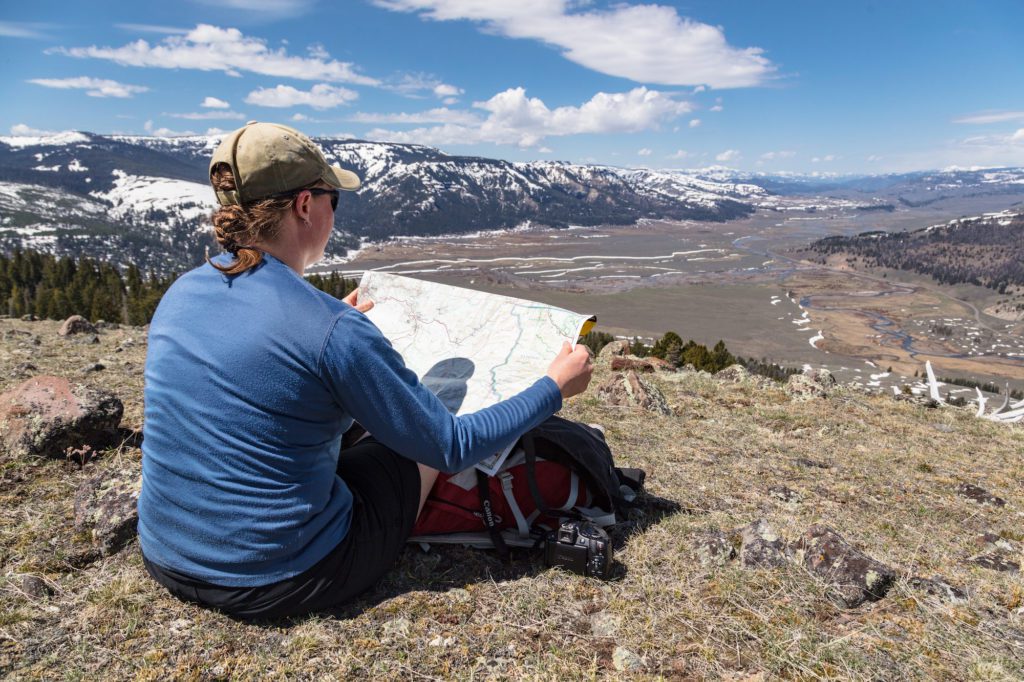
A person looking at a park map is seated on a mountainside overlooking a river valley with snow capped mountains in the background
A hiker at Yellowstone National Park. Public domain photo by the National Park Service / Jacob W. Frank.

US Secretary of the Interior Deb Haaland (a member of the Laguna Pueblo) recently initiated a task force to address derogatory place names on federal lands, including names using “squaw.” As the first Native American to serve in her cabinet-level post, Haaland has a deep understanding of the importance of the task force’s work, but is everyone on board?

Why are place names important? According to a recent study I led, addressing place names could be a starting point for reckoning with the US history of dispossession of Indigenous nations from their homelands. The study, published this spring in People and Nature, demonstrates the dual impacts of problematic place names, e.g., commemorating racial violence while simultaneously erasing longstanding and often spiritually connected Indigenous names for landscape features.

The study: “Words are monuments: Patterns in US national park place names perpetuate settler colonial mythologies including white supremacy”

Many consider national parks our nation’s “best idea”i but don’t realize how park place names cover up the parks’ violent histories. Among the 16 studied national parks and their over 2,200 place names we found: 

  • 52 places named for settlers who committed acts of violence against groups, often populations of Indigenous peoples. For example, Mount Doane in Yellowstone National Park, and Harney River in Everglades National Park, both homelands of Indigenous nations, commemorate individuals who led massacres of Indigenous peoples, including women and children.

  • 205 settler place names replacing recorded traditional Indigenous place names. (This count of replacement names is surely an underestimate because written records are biased toward settler histories, much Indigenous knowledge is maintained through oral traditions, and Indigenous knowledge keepers were rarely consulted when settler maps were made.)

  • 10 racial slurs

  • 214 examples of appropriation from Indigenous languages

  • 107 natural features retaining traditional Indigenous place names

Making meaning

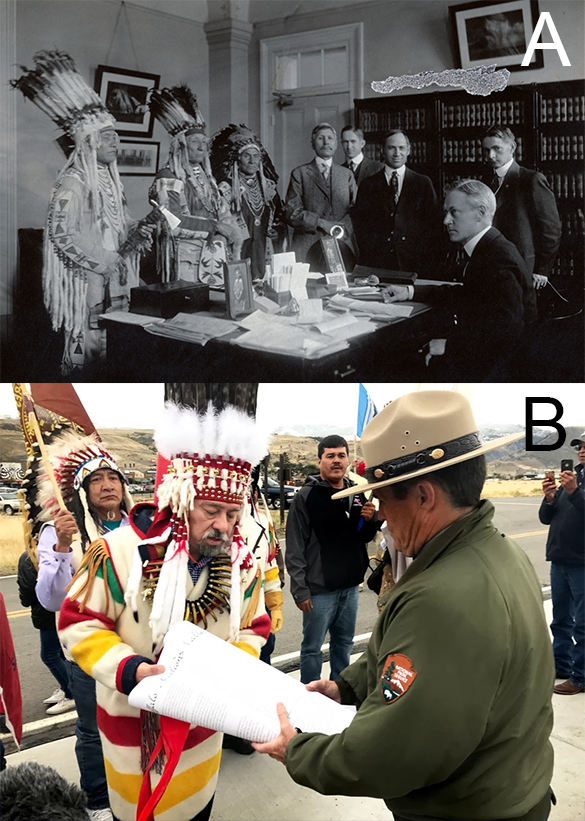
Native American groups including the Blackfeetii and Lakota have called for changing place names at national parks and national monuments for over a century (see pictures below). The research my five co-authors and I conducted was in service to such local and national name-changing campaigns. Place names have been used by colonizers and later settlers as a “technology of power” to justify their occupation of Indigenous lands and hierarchical social structuresiii. In the words of Indigenous scholar Linda Tuhiwai Smith (Ngāti Awa and Ngāti Porou Māori) “renaming the landscape [as part of the colonial project] was probably as powerful ideologically as changing the land”iv. To me, the study’s findings demonstrate how place names in the parks contribute, at a system-wide scale, to the erasure of Indigenous sovereignty over their homelands. Reconciling this wrong will require a system-wide response, such as Secretary Haaland’s task force and future task forces to address more than just derogatory names.

Top image is a historic black and white photo showing three Blackfeet leaders traditionally dressed including feathered headdresses and four white men standing around the desk of Stephen Mather, seated. Bottom image is a color photo showing Chief Grier in traditional dress handing a document to a man dressed in national park uniform and ranger hat with men standing behind Chief Grier, including Lee Juan Tyler wearing a traditional feathered headdress. This photo takes place outdoors with Yellowstone National Park in the background.
Native Americans resist settler colonial place names in national parks. Top: Blackfeet leaders Bird Rattler (far left), Curly Bear (second from left) and Wolf Plume (third from left) meet with Stephen Mather, soon-to-be Park Service director (sitting), and others in Washington, DC in 1915 to protest the use of English-language names in Glacier National Park. Photo courtesy of the National Park Service, Harpers Ferry Center. Bottom: In 2018 Chief Stanley Charles Grier of the Piikani Nation gives a Yellowstone National Park deputy superintendent a declaration from several Indigenous Nations demanding a change to the place names Mount Doane and Hayden Valley. Lee Juan Tyler (Shoshone-Bannock Tribes) and Brandon Sazue, Sr. (Crow Creek Sioux) stand in solidarity with Chief Grier. Individuals shown have given the authors permission to use their image. Photo courtesy of Nate Hegyi of Mountain West News Bureau.

In discussions with Kiaayo Tamisoowo (Bear Returning over the Hill) Chief Stanley Grier (Fig. 1B) of the Piikani Nation and Blackfoot Confederacy, he said that our study has 

shed important light on the true spirit and facts pertaining to National Park Place Names which were in place since time immemorial by our ancestors. To give Place Names [such as Mt. Doane in Yellowstone] to persons who authorized and who carried out the massacre of approximately 173 of my ancestors in 1870 on the Marias River, Montana is an atrocity that only perpetuates the illegitimate honor of persons that would be classified as War Criminals. Hayden Valley ought to be changed to Buffalo Nations Valleyv and Mount Doane to First Peoples’ Mountain.

I also recently spoke with Chief Arvol Looking Horse, spiritual leader of the Lakota, Dakota, and Nakota Great Sioux Nation. For decades Chief Looking Horse has sought to change the name of Devils Tower, the enormous, landscape-dominating igneous rock formation in northeastern Wyoming that is the namesake of Devils Tower National Monument. His proposal to change the name of the geologic feature to Bear Lodge has sat with the US Board of Geographic Names since 2015 due to stalling by congressional representatives from Wyoming. Bear Lodge is a sacred site to many native nations including the Lakota, Dakota, and Nakota. The site’s current name originated from the mistaken settler belief that Native religious rituals conducted there were forms of devil worship. 

When I asked Chief Looking Horse why returning traditional place names is meaningful to him he said, 

We as a people of the Earth are connected to Mother Earth, the source of life. Our history is spiritually connected to the Earth. We take care of the Black Hills, the heart of Mother Earth, through ceremony. Returning place names is needed more than ever because of the global disasters. The name of sacred sites came from the spirit, through ceremony, through prayer. For example, Mato Tipila, Bear Lodge is where the White Buffalo Calf Woman brought us the sacred pipe. I am the 19th generation keeper of the sacred pipe. And yet a soldier can just, out of anger and hatred to our people, rename such a sacred place Devils Tower. In our sacred language we don’t even have a word for devil. Returning Mato Tipila, Bears Lodge is the most important derogatory name for Deb Haaland to address.

Some readers might label this study and its attention to place names as a part of cancel culture. To me, that is a red herring that distracts from the need for the dominant US culture to reckon the US history and living legacies of land dispossession and genocide of Native American peoples, a long process repeatedly marked by instances where peoples were separated from their lands. 

Reckoning with the past is necessary for all peoples to move forward together into a future that is more equitable and sustainable. This concept is a guiding principle for the work we do in the Anthropocene Studies Section at Carnegie Museum of Natural History. Part of my motivation for this work was to understand the kind of restorative actions involved with the reckoning of US history and on-going harms of settler colonialism. 

A closing thought on “wilderness”

In popular US culture, our national parks and wilderness areas are thought of as places to escape; places to be out there with “real nature”. But settlers had to first make national parks and wilderness areas free of human occupation. Much of the awe that current national park lands inspired among European colonizers was in part the result of active ecosystem management by Indigenous peoples living with the land. Many national park ecosystems were dramatically changed with the loss of Native American stewardship (e.g. preventing forest fires)vi. 

As the first and now second edition of “We Are Nature” demonstrate for museum visitors, humans are part of, not separate from, nature. In fact, most of terrestrial Earth has been stewarded for thousands of years by Indigenous peoples. So the idea of an uninhabited “wilderness” is less ecological science and more of a settler colonial myth. That doesn’t mean national parks haven’t come to play an important role in conservation of biodiversity or that we shouldn’t visit national parks. I suggest, however, that we visit with greater awareness of park history and of the peoples for whom those lands are their homelands. I also suggest environmentalists use the term wilderness with care and understand it’s social-cultural implicationsvii.

Get involved

People can take action by getting involved with a national campaign launched at WordsAreMonuments.org by the social justice pop-up museum, The Natural History Museum. Also, check out this new guide on how individuals, community groups, and Tribal Nations can change place names. The public is also invited to comment on potential replacements for derogatory names on federal lands by April 25.

Bonnie McGill, Ph.D. is a science communication fellow for the Climate and Rural Systems Partnership and based in the Anthropocene Studies Section at Carnegie Museum of Natural History. Museum staff, volunteers, and interns are encouraged to blog about their unique experiences and knowledge gained from working at the museum.

Notes


[i] From an essay by Wallace Stegner: “The Best Idea We Ever Had” in Wilderness magazine, Spring 1983 p4-13.

[ii] A note on Blackfeet vs. Blackfoot: The nation in what is now Montana is Aamskapi Pikuni (Blackfeet Nation, including individuals shown in Fig. 1A), a member of Siksikaitsitapi (Blackfoot Confederacy), which also includes the Kainai-Blood Tribe, Siksika, Peigan-Piikani (including Chief Grier in Fig. 1B). 

[iii] Rose-Redwood, R., Alderman, D., & Azaryahu, M. (2017). The urban streetscape as political cosmos. In R. Rose-Redwood (Ed.), The Political Life of Urban Streetscapes: Naming, Politics, and Place (pp. 1–24). London: Routledge. doi: 10.4324/9781315554464

 Alderman, D. H. (n.d.). Commemorative Place Naming: To Name Place, To Claim the Past, ToRepair Futures. In F. Giraut & M. Houssay-Holzschuch (Eds.), Naming Places. London:ISTE-Wiley. Retrieved from https://www.researchgate.net/publication/341412389

[iv] Smith, L. T. (2012). Decolonizing Methodologies: Research and Indigenous Peoples (2nd Ed.). 1025 London: Zed Books Ltd.

[v] The sovereign Tribal Nations of Yellowstone formally requested the Yellowstone Superintendent to support changing Hayden Valley to Buffalo Nations Valley (see Fig. 1B). Ferdinand Hayden was a geologist who led the first federally funded geological survey of Yellowstone in 1871. His report was essential in persuading Congress to establish the national park. His report also called for the forced assimilation or, failing that, extermination of Native Americans. Other writings of his also demonstrate his white supremacist worldview, a tool used by settler colonizers to justify dispossessing Native Americans from their lands.

[vi] Read more about this in: 

Anderson, M. K. (2013). Tending the Wild: Native American Knowledge and the Management of California’s Natural Resources. Oakland: University of California Press; Kimmerer, R. W., & Lake, F. K. (2001). 

Maintaining the Mosaic: The role of indigenous burning in land management. Journal of Forestry, 99(11), 36–41. doi: 10.1093/jof/99.11.36

Kimmerer, Robin W. (2012). Braiding Sweetgrasss : Indigenous Wisdom, Scientific Knowledge and the Teachings of Plants. (1st ed.). Minneapolis: Milkweed Editions

[vii] Fletcher et al. 2021. Indigenous knowledge and the shackles of wilderness. PNAS https://doi.org/10.1073/pnas.2022218118

Related Content

What Does It Mean To Be For a Place?

Climate Change Myth Busting at the Museum

Celebrating Indigenous Peoples’ Day

Carnegie Museum of Natural History Blog Citation Information

Blog author: McGill, Bonnie
Publication date: April 6, 2022

Share this post!

  • Share on Twitter Share on Twitter
  • Share on Facebook Share on Facebook
  • Share on Pinterest Share on Pinterest
  • Share on LinkedIn Share on LinkedIn
  • Share on Reddit Share on Reddit
  • Share via Email Share via Email

Filed Under: Blog Tagged With: Anthropocene, Bonnie McGill, We Are Nature 2

March 31, 2022 by Erin Southerland

The Art of Making Fish Familiar

by Patrick McShea
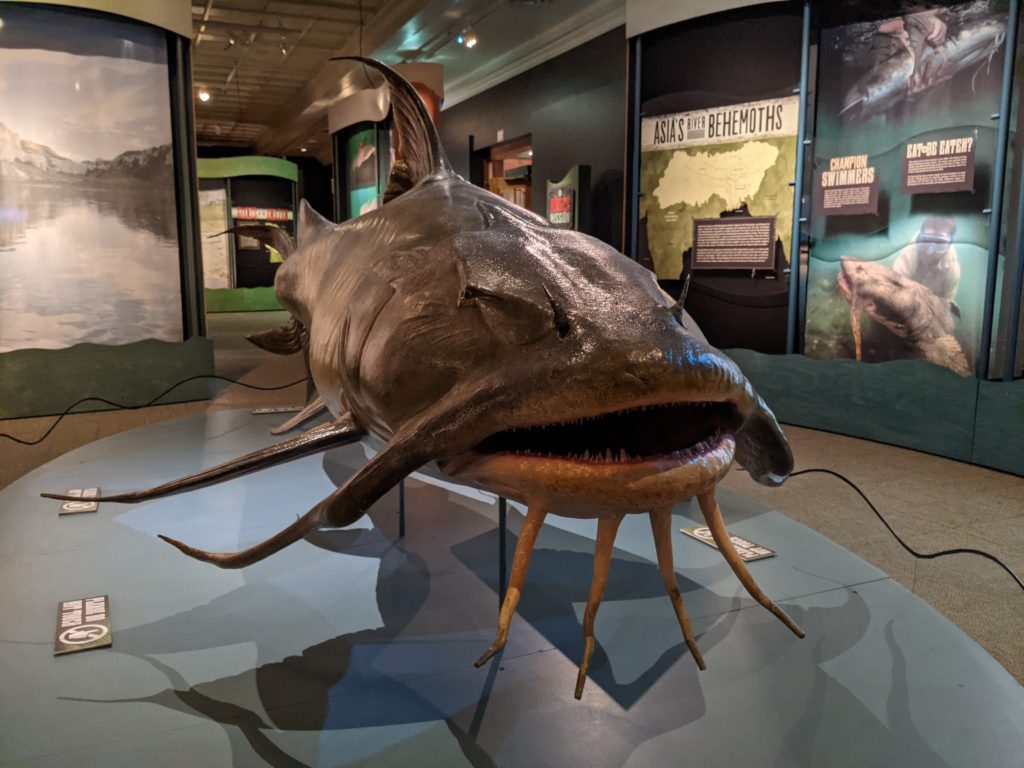
Sculpture of a monster fish in a museum exhibition

Fish in the wild are difficult to observe, even for the scientists who study them. Monster Fish: In Search of the Last River Giants, an exhibition traveled and developed by the National Geographic Society, encourages visitors to learn about this challenge from one such scientist, Dr. Zeb Hogan, host of the popular Nat Geo Wild television show.

In the exhibition, now on view in the R. P. Simmons Family Gallery until April 10, 2022, stunning life-size sculptures, evocative illustrations, and informative panels set the stage for Hogan’s appearance on several well-spaced video screens. Here, in clips with run times of a few minutes, Hogan presents on-the-water, and sometimes in-the-water, reports from six continents about conservation efforts that involve not only other scientists, but also the local people who rely on healthy fish populations for their food or livelihood.

Observing Fish in the Wild

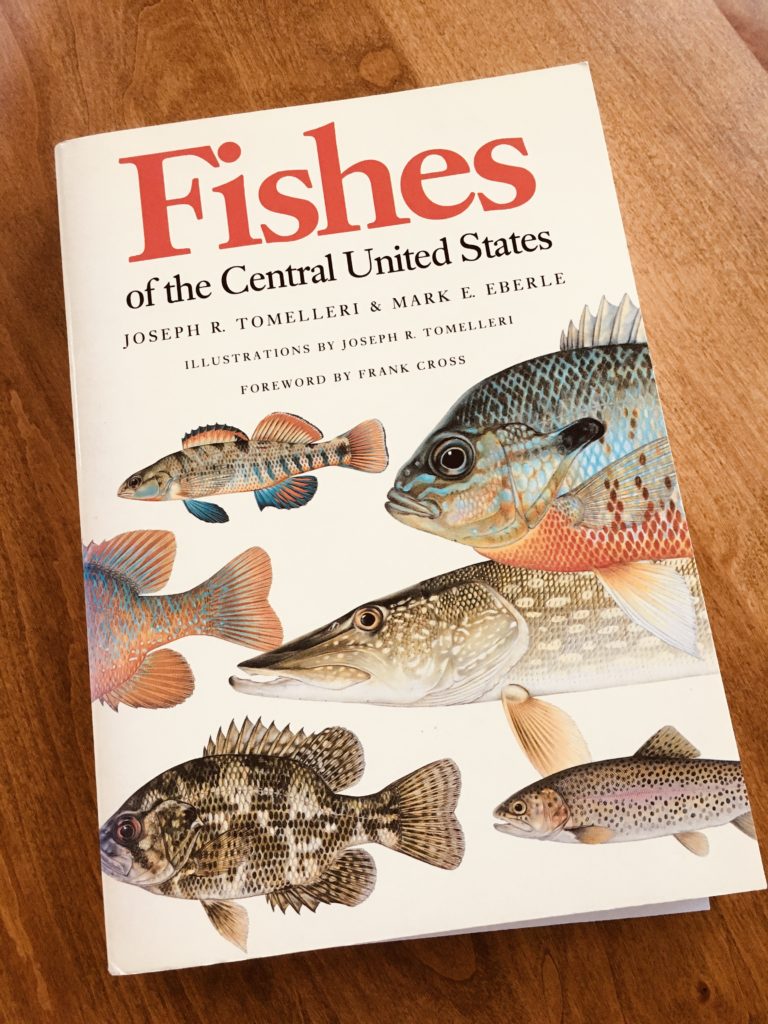
Away from the exhibition, the importance of images in sparking an interest in hard-to-observe wildlife can be noted at a scale where both the creatures involved, and the extravagance of their depictions, are much reduced. By personal example, much of my visual understanding of lesser known fish species in Pittsburgh’s rivers comes from viewing the scientifically accurate, full color, plates in Fishes of the Central United States (University Press of Kansas, 1990), a book illustrated and co-authored by Joseph R. Tomelleri.

Cover of the book "Fishes of the Central United States"

Over the past 36 years, the artist’s detailed portraits of our continent’s finned wildlife have appeared in over a thousand publications ranging from fishing magazines and field guides to outdoor clothing catalogues. Tomelleri’s career as fish artist began in Kansas in 1983 when he and other biology graduate students at Fort Hays State University wondered about the diversity of fish species in a stream that winds through the campus. The resulting student-driven investigation culminated in a publication titled, Big Creek and its Fishes, a work in which Tomelleri had responsibility for fish images. Because the full suite of physical characters that distinguish one fish species from another can rarely be captured in photographs, he used colored pencils in an attempt to accurately render every scale and fin ray.

As the artist’s attention to anatomical detail led to a professional career, his illustration process became standardized. Subjects are collected by seining, through the electrofishing techniques used by fish biologists, or by old-fashioned angling with rod and reel. A captured fish is immediately photographed to record natural colors, then depending upon size, preserved frozen or in a formalin solution that is later replaced with an ethanol solution.

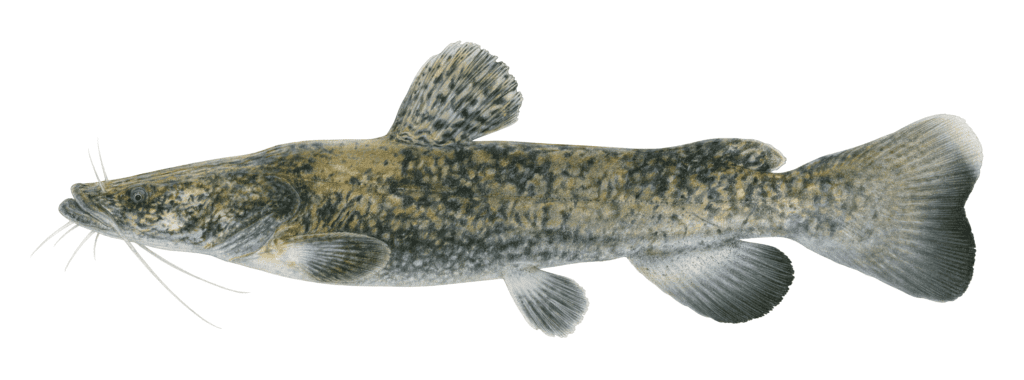
Although Tomelleri says the physical requirements for preservation have limited his experience with “monsters” to creatures three feet long or less, one species account in Fishes of the Central United States makes a case for the frightening aspects of fish that size. A description of Flathead Catfish, a species that recently brought attention to Pittsburgh’s rivers because of the enormous specimens caught and released by local anglers, includes a cautionary warning:

Flatheads breed in natural cavities of river banks, an instinct that leaves them susceptible to illegal hand fishing or “noodling.” Adept noodlers can recognize a big cat’s den by feeling the cleanly swept cavity floor and mound of silt or debris in front of the hole. One may assume that it is the bone-crushing bite of a 60-pound flathead that keeps the slightly squeamish stuck on the bank with rod and reel.

illustration of a flathead catfish
Flathead Catfish. Image credit: Joseph R. Tomelleri

Patrick McShea is an Educator at Carnegie Museum of Natural History. Museum employees are encouraged to blog about their unique experiences and knowledge gained from working at the museum.

Related Content

Fish and the Fourth of July?

Preserving Fossil Treasures: Eocene Fishes from Monte Bolca, Italy

Fish Story

Carnegie Museum of Natural History Blog Citation Information

Blog author: McShea, Patrick
Publication date: March 31, 2022

Share this post!

  • Share on Twitter Share on Twitter
  • Share on Facebook Share on Facebook
  • Share on Pinterest Share on Pinterest
  • Share on LinkedIn Share on LinkedIn
  • Share on Reddit Share on Reddit
  • Share via Email Share via Email

Filed Under: Blog Tagged With: Education, Monster Fish Exhibition, Pat McShea

March 28, 2022 by Erin Southerland

Learning From Misinterpretations

by Patrick McShea

Every job has its awkward moments, even work aiding museum visitors in their interpretation of exhibits. One memorable situation in that realm involved a father explaining skeletal bear remains to his three grade-school-aged children.

The setting was Discovery Basecamp during a busy December weekend in 2012. The exhibition had been established just two months earlier as an experiment in providing museum visitors with opportunities to examine authentic objects from the Educator Loan Collection, the enormous cross-discipline teaching collection that is managed to serve the needs of classroom teachers and other educators. In a section of well-lighted, first floor rear exhibit space, three free-standing racks of wire shelves held two dozen colorful toolboxes containing a wide range of natural history materials for visitors to examine, and the tops of five adjacent tables displayed large sturdy objects for close, hands-on inspection.

I was spending the day welcoming visitors to the space, and training a work-study student from the University of Pittsburgh and another from Carnegie Mellon University to do the same. We aimed to assist visitors in retrieving and returning toolboxes, and whenever asked, to answer questions. Listening to visitor conversations during that time was an important way to evaluate the success of the ongoing experiment. 

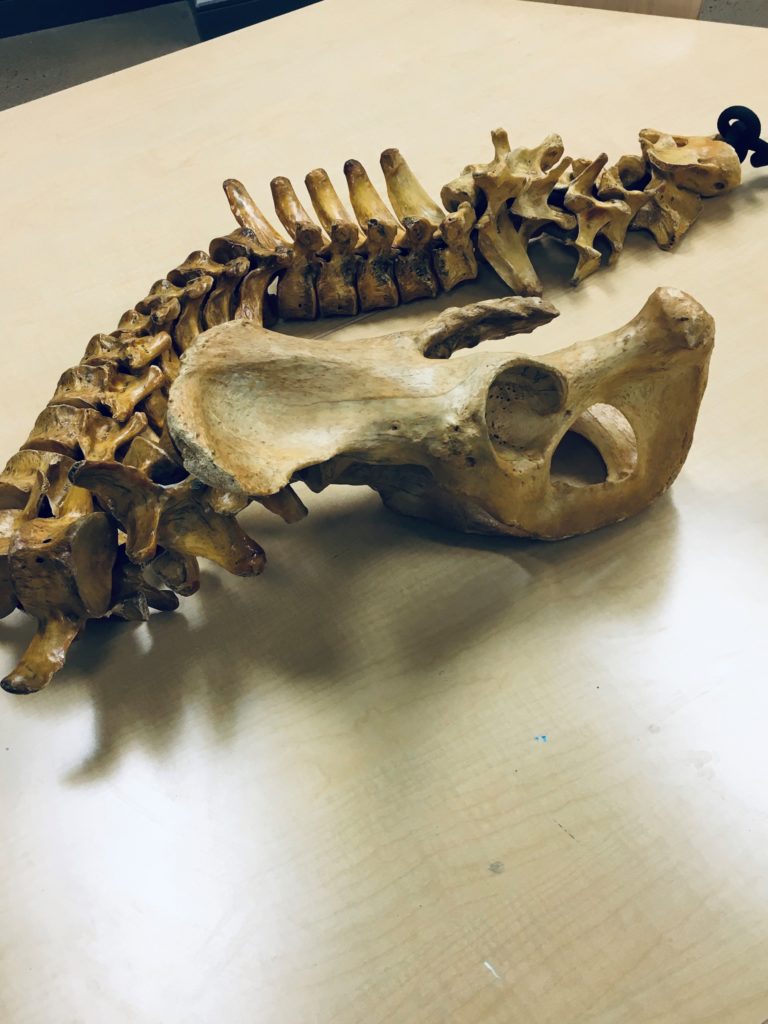
“Hey, let’s look at this,” I heard the father say as he gathered his children around a display table and picked-up one end of a yard-long, rope-linked strand of more than 20 large resin-coated vertebrae. “The tag says ‘bear,’ so let’s see if we can figure this out.” He stretched out the column on the tabletop, and moved both hands to its far end where an irregularly shaped shoebox-sized bone structure anchored the string. The structure, which was not identified on the simple paper tag, was the fused combination of the creature’s sacrum and hip bones, and the father’s unfamiliarity with mammal skeletal anatomy was immediately apparent. He mistook the bear’s butt-end for its skull, explaining to his children how the hip sockets were holes for the eyes, and that it was a shame the animal’s teeth were missing.

Bear vertebrae, sacrum, and hip bones on a table.
For anyone unfamiliar with mammal skeletal anatomy, hip sockets that once secured rounded femur heads might be confused with eye openings.

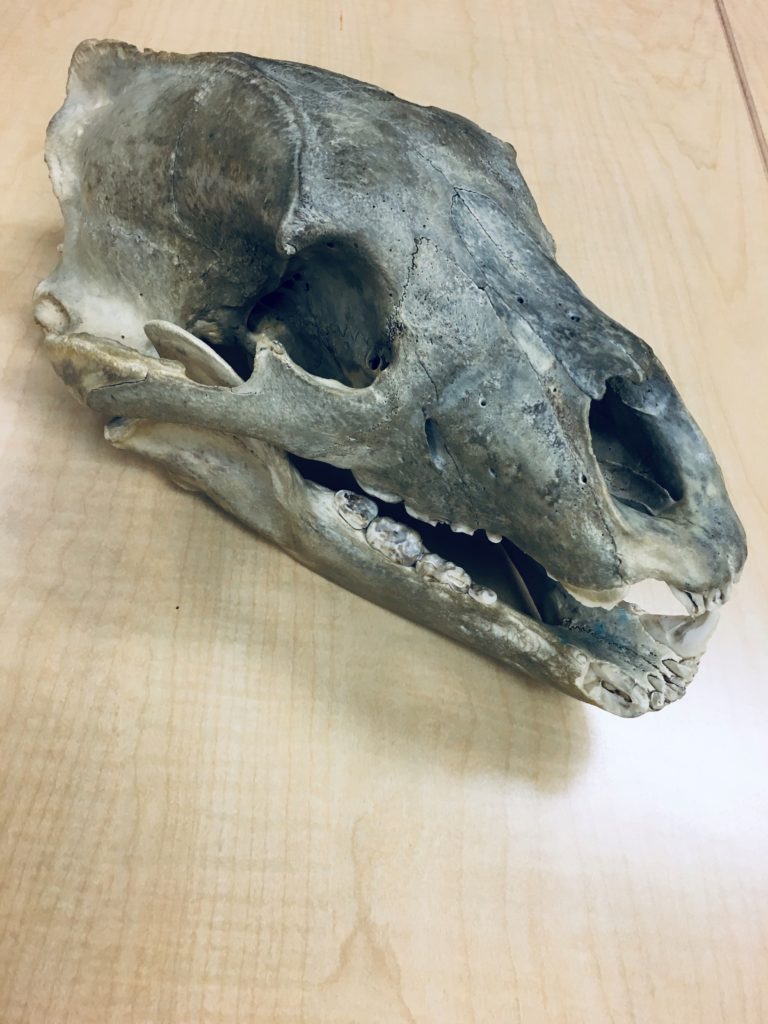
I didn’t correct him. Instead I explained to the work-study students that I’d be down in the loan program’s basement storage area for a few minutes. By the time I returned with a black bear skull, the attractions of the exhibition had pulled the family unit apart. All three children were engaged with toolboxes containing insect material, while their father was examining mineral samples on another table.

Bear skull on a table.
Discoloration and broken and missing teeth mark this American black bear jaw as a long-used teaching specimen.

I approached him holding out the bear skull and saying simply, “Our lack of labels might have caused some confusion a little earlier.” He looked at the skull, glanced back at the table with the vertebrae column, and then, to my great relief, laughed and accepted the skull from me. He called his children back to the original table, and with the skull as a visual aid, offered them a two-minute remedial lesson. I stood as far away from the table as possible.

Patrick McShea works in the Education and Visitor Experience department of Carnegie Museum of Natural History. Museum employees are encouraged to blog about their unique experiences and knowledge gained from working at the museum.

Related Content

Pitt Outreach Efforts Enriched with Museum Materials

March Mammal Madness and Middle School Science Class

African Artifacts: Back Story and Current Use

Carnegie Museum of Natural History Blog Citation Information

Blog author: McShea, Patrick
Publication date: March 28, 2022

Share this post!

  • Share on Twitter Share on Twitter
  • Share on Facebook Share on Facebook
  • Share on Pinterest Share on Pinterest
  • Share on LinkedIn Share on LinkedIn
  • Share on Reddit Share on Reddit
  • Share via Email Share via Email

Filed Under: Blog Tagged With: discovery basecamp, Education, Educator Loan Program, Pat McShea

March 25, 2022 by Erin Southerland

For the Love of Dead Plants

by Koa Reitz

Reposted from Plant Love Stories.

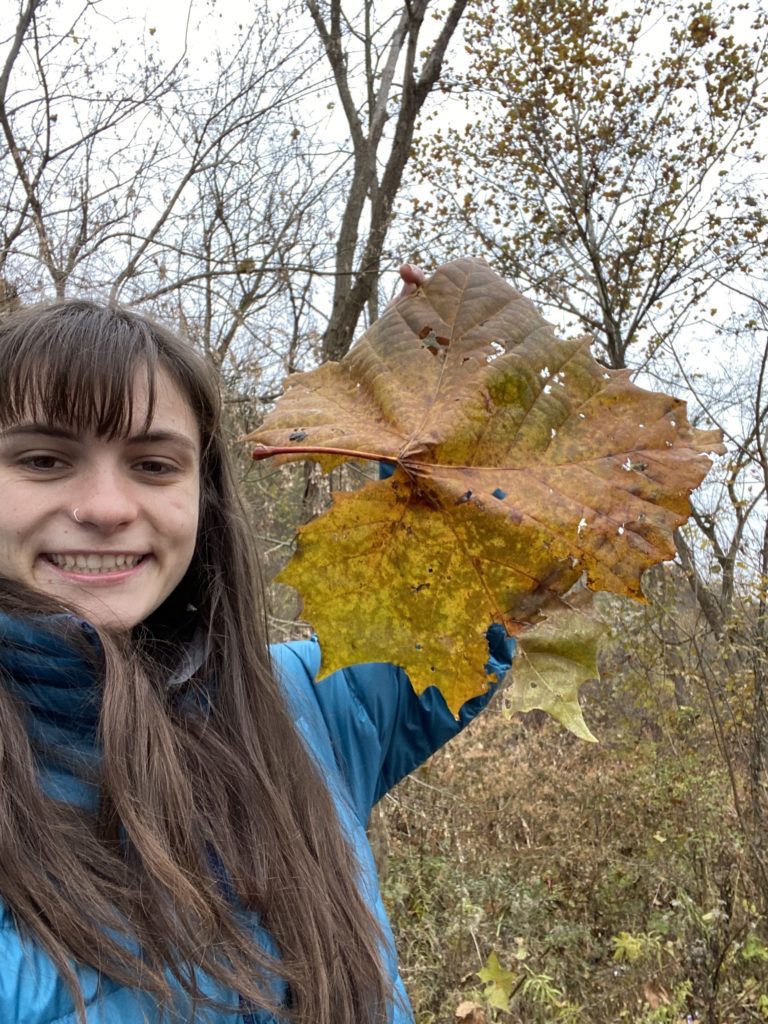
One of my earliest memories as a child is my friend finding a big leaf when we were at the park, and me bursting into tears because I wasn’t the one who found it. Fall was my favorite season because as I walked around, there were plenty of things for me to pick up! I was absolutely captivated by the leaves that fell off of the trees, and would pick up as many as I could. I don’t remember why I was so attached to these leaves–the dead part of the plants around me–but I would always end up with a stack of leaves when I got home.

I think a big part of my obsession with collecting leaves was their colors. But sometimes I would find a particularly big leaf and, as a small child, I was absolutely dumbfounded at the leaf bigger than my head. I had to have them. When I brought the leaves home however, I never kept them, they would sit outside for a while until they would eventually blow away or decompose in the yard. This wasn’t exactly an issue for my young self, as object permanence had yet to fully develop. And there were always more leaves to find!

Person holding a leaf the size of their head.
The author can still find leaves larger than her head! Here, American sycamore (Platanus occidentalis)

As I grew up, I became less and less invested in picking up all of the leaves I saw. I think eventually I saw so many that it was hard to find a new color combination I had yet to see, so leaf searching had lost its allure. I would still stop to look at the leaves when there was a particularly vibrant red, or an exciting combination of green, yellow, and orange all in the same leaf, but I left the leaf where it stood. No more collecting for me.

Until recently, I had no reason to think that collecting plants could have any purpose, scientific or otherwise. Contrary to my thinking, there is a vast and important process of collecting and storing plants, of all kinds, to be used for reference and scientific research. Herbaria are collections of preserved plants dating as far back as hundreds of years ago. These specimens can be used for a variety of things including taxonomic classifications (scientific naming systems), DNA sequencing, and phenological observations. Phenology is the study of the time when certain things in the life cycle of a plant happen. For example, phenology can look at the time in a flowering plant’s life that it begins growing new leaves, when it grows flowers, when it develops its fruit, or when leaves turn colors in the Fall. Phenological data from herbaria have been used to look into the past in ways that wouldn’t be possible without a collection of old, dead, plants. A group of scientists at Boston University used herbarium specimens to determine that a warmer climate led to earlier flowering times. This conclusion has various implications including evidence that a warming planet has concrete impacts on the natural environment and changes how we look at climate science overall. It is important to look to the past if we’re going to make informed decisions about the future, and herbaria are full of accessible and valuable information that can help develop scientific claims of all different kinds. 

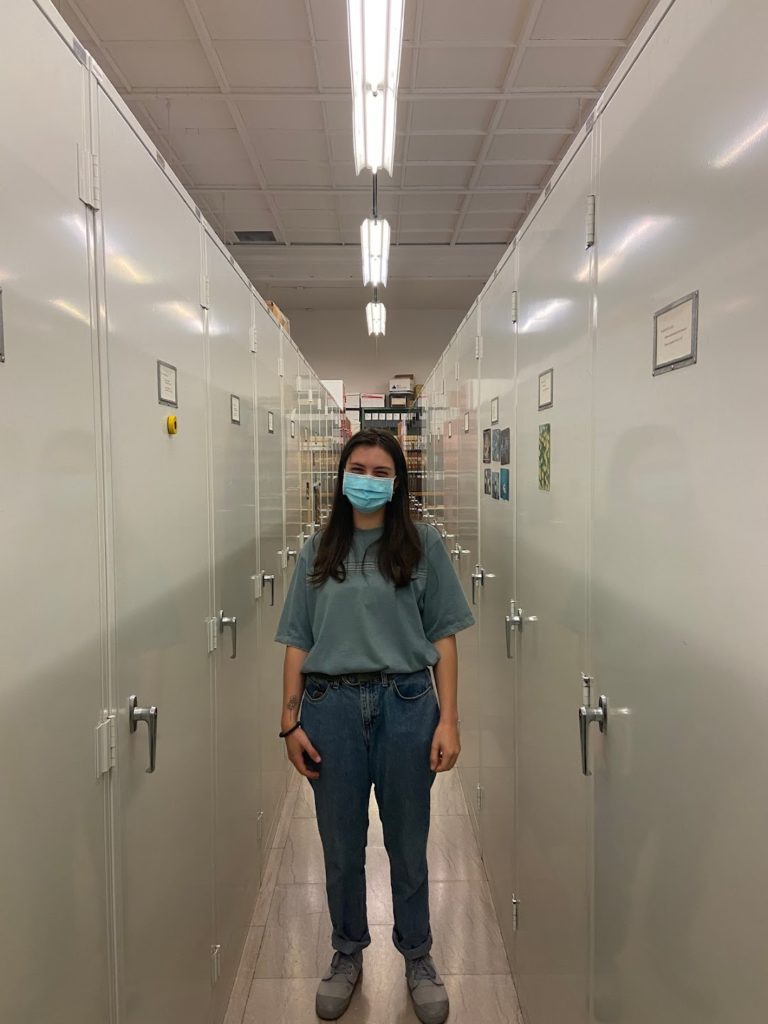
Person standing between metal cabinets.
The author stands among the botanical collections at the Carnegie Museum of Natural History’s herbarium in Pittsburgh, PA.

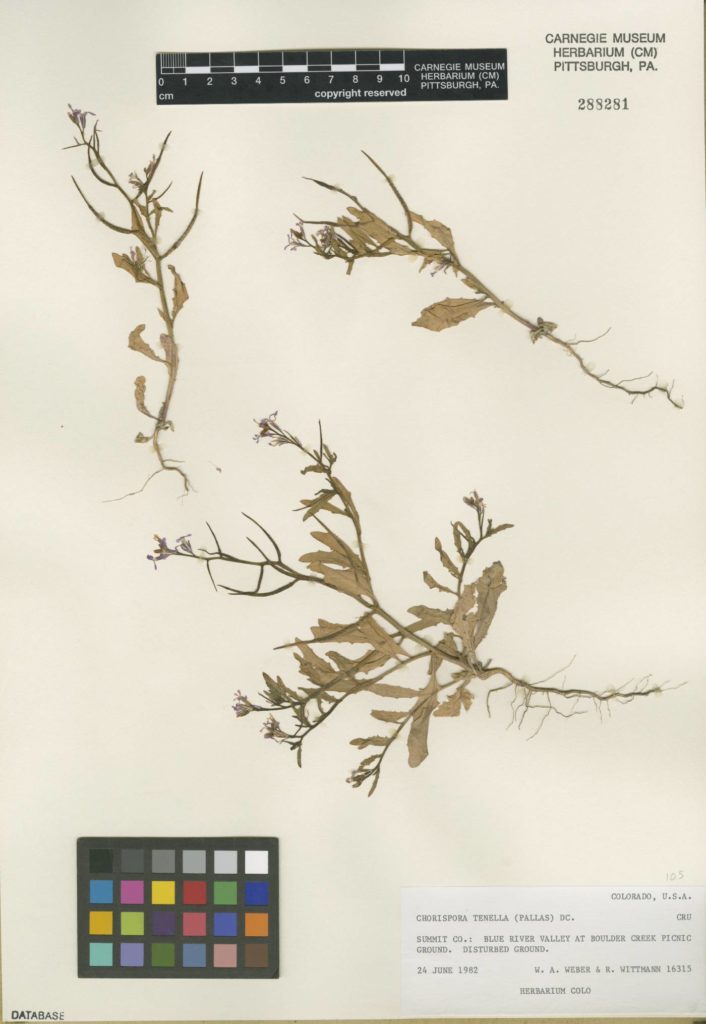
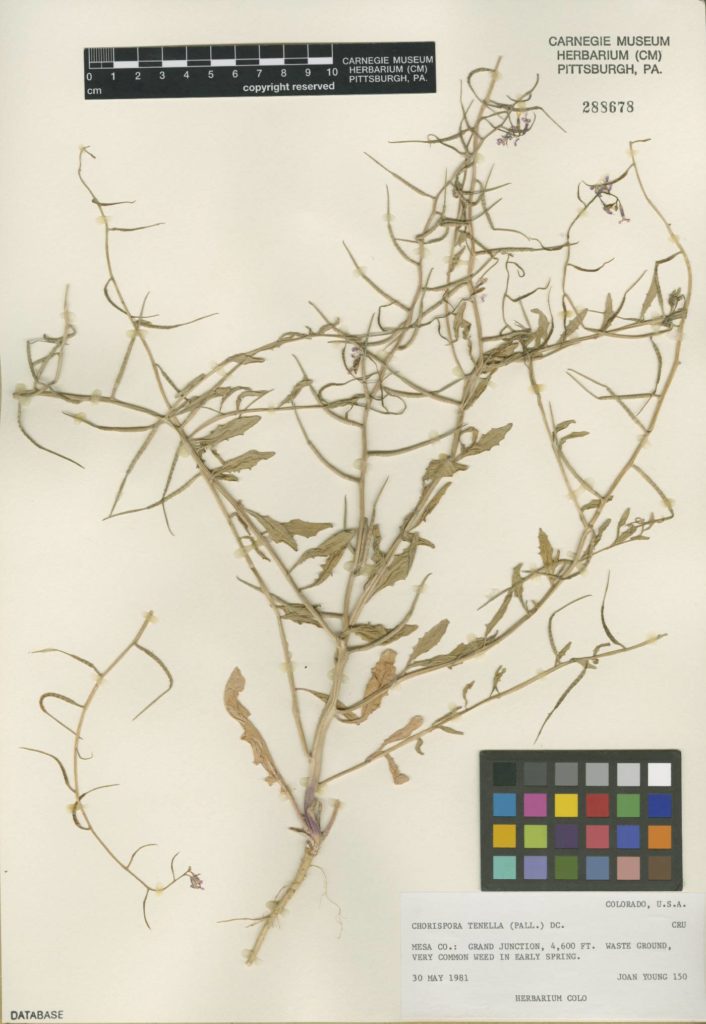
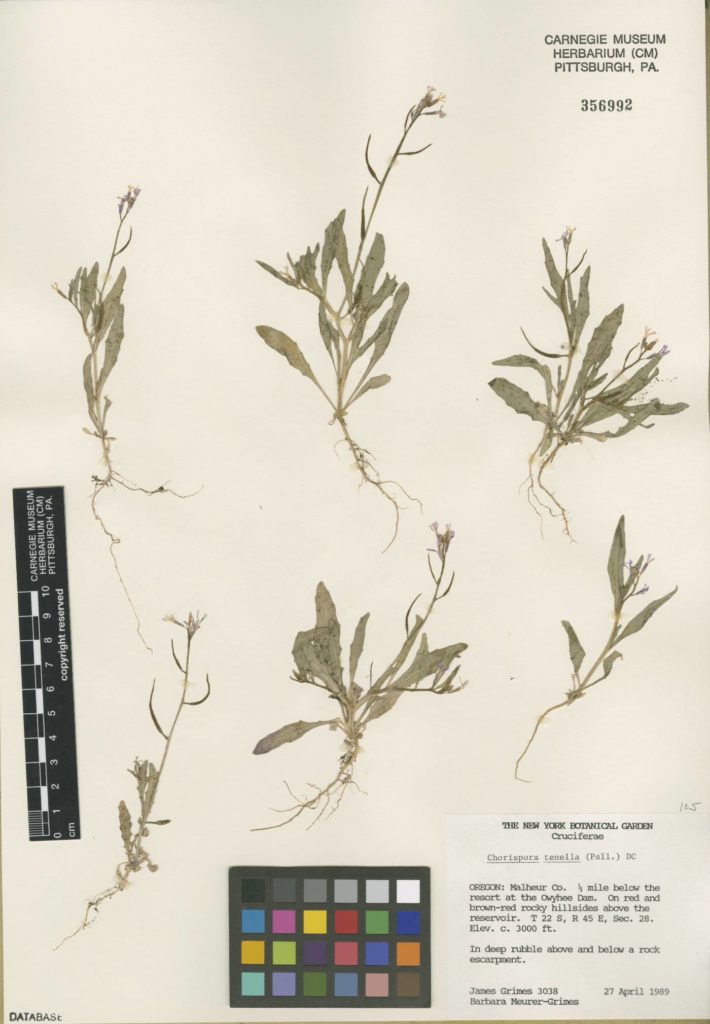
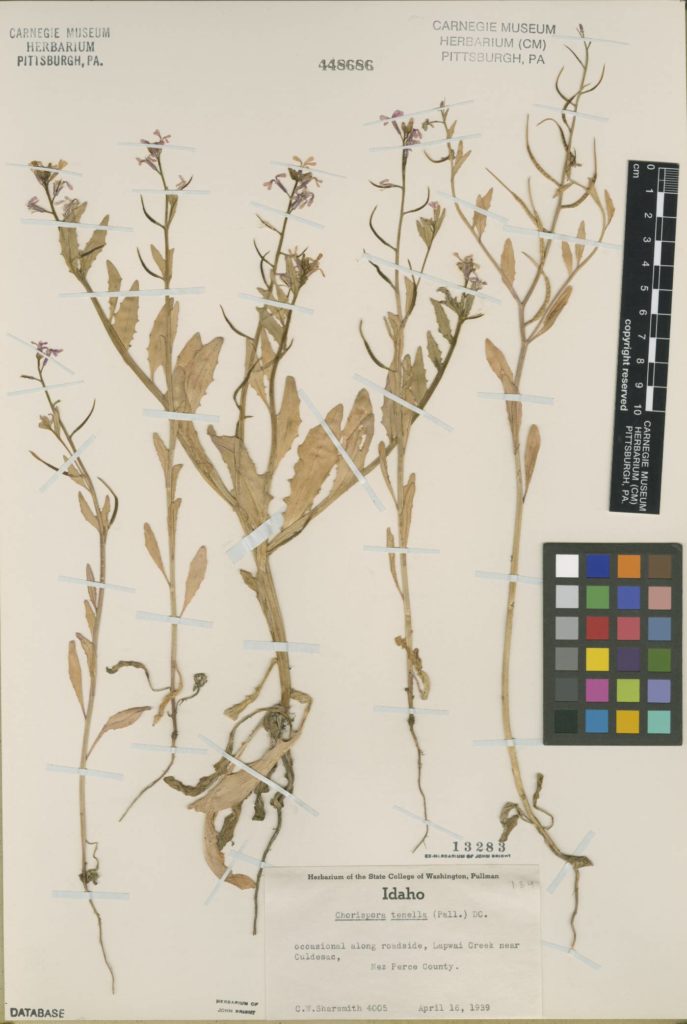
I am particularly interested in Herbaria because of my work in the Carnegie Museum of Natural History’s Herbarium. It was compelling to me to work with scads of cabinets full of dead plant specimens. Currently, I am working on a project where I look at digitized Chorispora tenella (purple mustard) specimens in the Carnegie Museum Herbarium, and herbaria from all over the US. Chorispora tenella is a plant that is invasive in parts of the Western US, and we are looking to see how the phenology has changed over the course of its invasion. There are endless questions about the timing of flowering or the spatial differences in flower or fruit number, just to name a few. I think I started to form a relationship with the plants, as I look at image after image and count the number of flower buds, flowers, and fruits, just as I had formed a relationship with the fallen leaves when I was young. 

Above: purple mustard (Chorispora tenella ) botanical specimens stored at the Carnegie Museum of Natural History.**

There’s so much to learn from these seemingly simple and still specimens. When I do this work, it brings me back to when I was a child and had the (not so permanent) leaf collections of my own. I think there was a part of me as a child that wished to observe what I gathered further, but I had no method or resources to preserve my collections. Now, with herbaria, there’s access to thousands of species of plants that span all over the world. They open up countless lines of study and things to learn and explore, all from dead plants in cabinets. I even find myself collecting and questioning things again, renewing my sense of exploration. And I still make time to find leaves bigger than my head. 

Koa Reitz is an undergraduate student studying Ecology and Evolution at the University of Pittsburgh, and a research intern at the Carnegie Museum of Natural History. Museum employees, interns, and volunteers are encouraged to blog about their unique experiences and knowledge gained from working at the museum.

** To learn more about these natural history specimens, you can visit the Mid-Atlantic Herbaria Consortium. Specimens are as follows (left to right): CM356992 collected in 1989 in Oregon; CM448686 collected in 1939 in Idaho; CM288678 collected in 1981 in Colorado; and CM288281 collected in 1982 in Colorado.

Related Content

Collected On This Day in 1951: Bittersweet

Collected On This Day in 1934: European larch

Sharing Shipping Space with Amphibians and Reptiles

Carnegie Museum of Natural History Blog Citation Information

Blog author: Reitz, Koa
Publication date: March 25, 2022

Share this post!

  • Share on Twitter Share on Twitter
  • Share on Facebook Share on Facebook
  • Share on Pinterest Share on Pinterest
  • Share on LinkedIn Share on LinkedIn
  • Share on Reddit Share on Reddit
  • Share via Email Share via Email

Filed Under: Blog Tagged With: Botany, Koa Reitz, We Are Nature 2

  • « Go to Previous Page
  • Page 1
  • Interim pages omitted …
  • Page 14
  • Page 15
  • Page 16
  • Page 17
  • Page 18
  • Interim pages omitted …
  • Page 24
  • Go to Next Page »

sidebar

About

  • Mission & Commitments
  • Directors Team
  • Museum History

Get Involved

  • Volunteer
  • Membership
  • Carnegie Discoverers
  • Donate
  • Employment
  • Events

Bring a Group

  • Groups of 10 or More
  • Birthday Parties at the Museum
  • Field Trips

Powdermill

  • Powdermill Nature Reserve
  • Powdermill Field Trips
  • Powdermill Staff
  • Research at Powdermill

More Information

  • Image Permission Requests
  • Science Stories
  • Accessibility
  • Shopping Cart
  • Contact
  • Visitor Policies
One of the Four Carnegie Museums | © Carnegie Institute | Privacy Policy | Terms of Use | Accessibility
Rad works here logo