• Skip to primary navigation
  • Skip to main content
  • Skip to primary sidebar

Carnegie Museum of Natural History

One of the Four Carnegie Museums of Pittsburgh

  • Visit
    • Buy Tickets
    • Visitor Information
    • Exhibitions
    • Events
    • Dining at the Museum
    • Celebrate at the Museum
    • Powdermill Nature Reserve
    • Event Venue Rental
    • Gift Cards
  • Learn
    • Field Trips
    • Educator Information
    • Programs at the Museum
    • Bring the Museum to You
    • Guided Programs FAQ
    • Programs Online
    • Climate and Rural Systems Partnership
  • Research
    • Scientific Sections
    • Science Stories
    • Science Videos
    • Senior Science & Research Staff
    • Museum Library
    • Science Seminars
    • Scientific Publications
    • Specimen and Artifact Identification
  • About
    • Mission & Commitments
    • Directors Team
    • Museum History
  • Tickets
  • Give
  • Shop

Erin Southerland

October 29, 2021 by Erin Southerland

Meet the Mysterious Mr. Ernest Bayet

by Joann Wilson and Albert Kollar

Imagine accumulating tens of thousands of fossils? While the exact number of fossils in Bayet’s collection has yet to be determined, estimates range from 20,000 to over 100,000. In 1903, William Holland, Director of the Carnegie Museum, negotiated a blockbuster deal to bring Bayet’s entire collection to Pittsburgh. The deal dazzled the public and made front page news in the New York Times. For over two years, the Section of Invertebrate Paleontology has been uncovering the stories of the collectors and dealers behind Bayet’s magnificent collection. Notable dealers include Lucien Stilwell, Frederick Stearns, and Dr. Friedrich Krantz, to name a few. But what about Bayet himself? What is his story?

Thanks to ongoing translations of the Bayet archive by volunteer Lucien Schoenmakers, we are excited to begin a series introducing Ernest Bayet, the person behind the collection.  

How old was Bayet when he sold his fossil collection?

Bayet, who was Born in 1859, was just 44 years old in 1903 when he sold his collection to the Carnegie Museum.  

How long did Bayet collect fossils?

Archival documents, that in 1903 arrived in Pittsburgh from Brussels with the purchased materials, indicate Bayet acquired the bulk of his collection in under 20 years. Assuming a range of 20,000 -100,000 fossils, Bayet would have acquired fossils at the blistering pace of 1,000-5,000 specimens per year. When you consider the logistics of shipping, along with the perpetual letter writing required to transact deals in the late 19th century, his acquisition rate is an amazing feat. 

Signature on a piece of paper
Is this Ernest Bayet’s signature? Portion of a recently re-discovered fossil label.

Why did Bayet sell his collection?

In July of 1902, Bayet married countess, Maria van der Burch. The Bayet family had their first child in 1903. A second child followed in 1905. Was this a factor in Bayet’s decision to downsize his entire fossil collection? We are not yet sure of Bayet’s plans or motives. For over a century it was rumored that Bayet sold his fossils to pay for a new chateau, or home.  In a letter to Andrew Carnegie dated June 8, 1903, William Holland, then Director of the Carnegie Museum, reported this as a possible explanation for the fossil sale. Although we have yet to verify that a chateau was acquired within that period, such a purchase is a possibility.  

How long did Bayet live?

The Mysterious Mr. Ernest Bayet died in 1935 at the age of 76. What was his life like after the sale? To learn more about Bayet and how his fossils arrived in Pittsburgh, check out Annals of Carnegie Museum’s new publication, “Unraveling the 120 Year Mystery of Ernest Bayet and His Fossil Collection at Carnegie Museum”.

We are continually grateful to volunteer and Netherlands resident Lucien Schoenmakers for ongoing efforts to translate archival Bayet documents. Joann Wilson is an Interpreter in the Education Department at Carnegie Museum of Natural History. Albert Kollar is Collections Manager for the Section of Invertebrate Paleontology. Museum employees are encouraged to blog about their unique experiences and knowledge gained from working at the museum.   

Related Content

Bayet and Krantz: 16 Words

Bayet’s Bounty: The Invertebrates That Time Forgot

From Collector to Director

Carnegie Museum of Natural History Blog Citation Information

Blog author: Wilson, Joann; Kollar, Albert
Publication date: October 29, 2021
Share this post!

  • Share on Twitter Share on Twitter
  • Share on Facebook Share on Facebook
  • Share on Pinterest Share on Pinterest
  • Share on LinkedIn Share on LinkedIn
  • Share on Reddit Share on Reddit
  • Share via Email Share via Email

Filed Under: Blog Tagged With: Albert Kollar, invertebrate paleontology, Joann Wilson, Science News, SWK2

October 22, 2021 by Erin Southerland

Trick or Tweet! Clever Creature Disguises

by Shelby Wyzykowski 

It’s that time of year,

As Winter draws near,

There’s a crisp, fall-fresh chill in the air.

And the trees once so green,

Paint a colorful scene,

With their typical, Autumnal flair.

Everyone dresses up,

Like a monster or pup,

Or anything else in between.

To shout “Trick or Treat!”

And get something so sweet.

Hooray! It must be Halloween!

But be on your guard,

For if you look hard,

You’ll discover a curious thing.

Some animals, too,

Wear disguises (like you!),

Some slither, or flutter, or sing.

It could be oh so thrilling,

And maybe quite chilling,

To learn of the what, why, and how.

So let’s waste no more time,

With these whimsical rhymes,

And talk about some of them now!

Which Snake Is Venomous and Which Is In Disguise?

If you just happen to be a hiker, camper, or all-around outdoorsperson, you might just recognize this catchy saying:

“Red touches yellow,

Kills a fellow,

Red touches black,

Friend of Jack.”

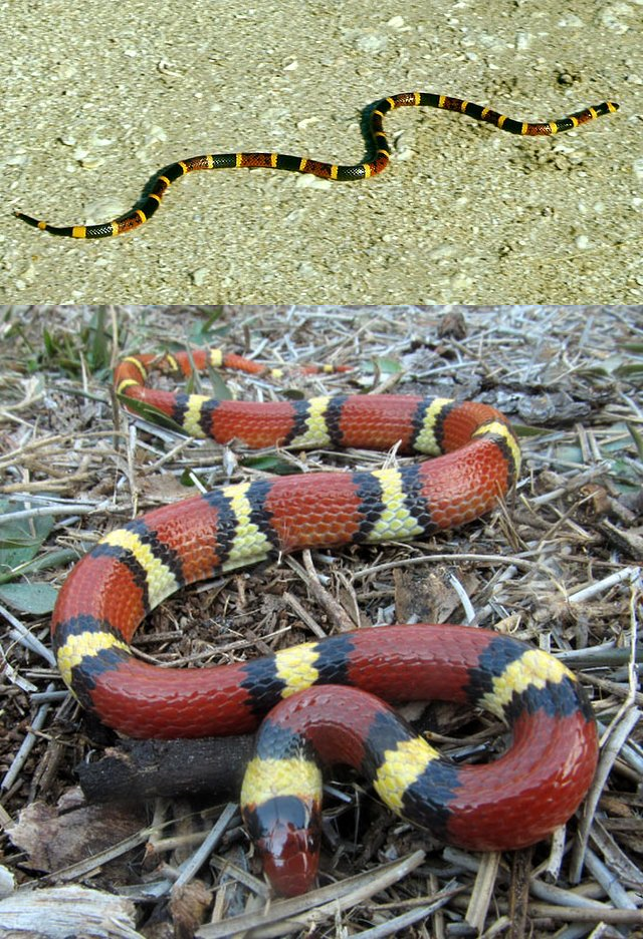
Yes, it’s true that I did just claim that we were finished with rhyming for now, but knowing this pithy poem might just come in handy one day. As a matter of fact, if you are in the forests of the Southeastern U.S. and happen to stumble across a snake sporting vibrant bands of red, yellow, and black, this memorable rhyme could even save your life. It describes the very important differences between two similar-looking snakes, the Eastern Coral snake and the Scarlet Kingsnake.

The venomous and potentially deadly Coral snake has a pattern of red, yellow, and black bands encircling its body. The non-venomous, harmless Kingsnake’s body displays a pattern of red, black, and yellow bands. So, why would a harmless snake evolve in such a way that it intentionally displays bright colors that are easily spotted by predators? Because it’s hoping that a predator will spot it, mistake if for the dangerous Coral snake, and leave it alone.

This evolutionary visual deception is known as Batesian mimicry. Named after the nineteenth century naturalist Henry Walter Bates (in honor of his work with mimicry in Amazonian butterflies), this type of mimicry offers a protective function to the mimic yet offers no benefit to the species being mimicked. Not surprisingly, the more noxious the model animal is (as in the case of the Coral snake, for example), the more mimics it tends to accumulate!

Can you spot the difference? The venomous coral snake is above the harmless scarlet kingsnake!

A Butterfly Dressed Like an Owl

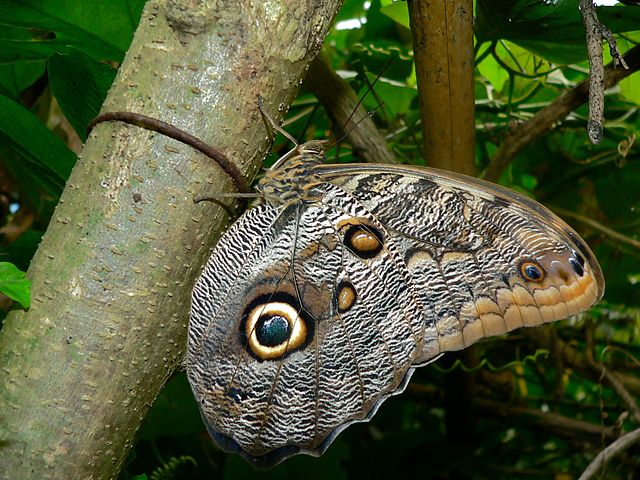
Besides venomous snakes, owls are also apex predators that many smaller predators make a point to avoid, and the Owl Butterfly has evolved to take advantage of this fact. With the conspicuous yellow and black “owl eye” spots in the middle of its hind wings, this giant insect can be easily spotted in the rainforests and secondary forests of Mexico and Central and South America. Smaller animals think twice when they see the face of an owl, and this hesitation gives the large, slow-flying butterfly the time that it needs to escape. But unlike the Scarlet Kingsnake, this butterfly’s wing pattern resembles multiple predatory models. Some small predators can also mistake their “large-pupil” eyespots to be lizards or amphibians, which are two other types of predators that hunt by sight. This multi-purpose disguise makes the Owl Butterfly look intimidating when it is in fact quite timid!

The owl butterfly uses its distinct pattern to fool potential predators.

Zone-tailed Hawk or Turkey Vulture?

But it’s not only prey species that take on other guises to deceive.  Predators want to join in on the costume fun as well.

When a hunter mimics an inoffensive species to get closer to its prey, it is called aggressive mimicry. A prime example of a species that artfully employs this type of trickster predation is the Zone-tailed Hawk. This winged “wolf in sheep’s clothing” looks remarkably like a Turkey vulture.

Turkey vultures, which are scavengers, are not seen as a threat to living creatures, so small prey animals, such as mammals, lizards, and smaller birds, learn to ignore them. Hawks take full advantage of their vulture-like façade and further increase their chances of capturing unsuspecting prey by behaving like Turkey vultures as well. They circle about and fly with their wings slightly raised, rocking back and forth in the same way as vultures. To make the act even more convincing, these raptors often soar and sometimes even roost with vultures! It’s an ingeniously cunning way to stealthily sneak up on prey and make a direct and powerful attack.  

Shrikes Are Excellent Mimics

Another bird that uses an ingenious trick to acquire a well-earned treat is the Northern Shrike. Unlike the Zone-tailed hawk that employs visual and behavioral mimicry to catch its prey, this pretty, seemingly unassuming songbird utilizes vocal mimicry. Like the Sirens of Greek mythology that used irresistibly hypnotic singing to lure in passing ships, shrikes mimic the calls and songs of their intended prey. As soon as their bewitching avian melodies have attracted their target animal to within attack range, they dispatch their prey and commence feeding.

Though the shrike has a falcon-like hooked bill (like a raptor), it still has a songbird’s feet. And since it does not have talons to tear apart its food, it has a unique method of consuming its meal. Shrikes will impale their quarry on sharp objects such as thorns or barbed wire. Once the prey is sufficiently secured, it is easier to tear apart and eat with their strong, sharp bills. They tend to favor starlings, house sparrows, and black-capped chickadees, but they don’t limit themselves solely to songbirds. Voles, mice, bumblebees, and beetles are also favorite choices, and they also catch lizards and frogs on occasion (however reptiles are normally not eaten and are left untouched once impaled).

And it’s not just adults that display this intriguing impaling behavior. Just after fledgling, young shrikes practice their impaling skills by gathering leaves or blades of grass and piercing them onto thorny branches.

Apparently though, impaling is not learned from their parents and is instead an inherited behavior, since juvenile shrikes raised alone in captivity will attempt to fix prey onto anything that is available in their cages. Ornithologists suppose that this impaling behavior has uses other than just the immediate consumption of a meal. They have observed shrikes building up caches of impaled prey in specific vicinities. Caching is a way for shrikes to store up food, similar to squirrels gathering up acorns for the winter. Also, it seems that the larger a male shrike’s cache is, the more females he attracts for mating. In addition, scientists have observed that impaled prey is deliberately positioned in specific patterns as a way to mark the boundaries of a shrike’s territory. It’s an unnerving yet effective deterrent that seems to successfully ward off rival shrikes!

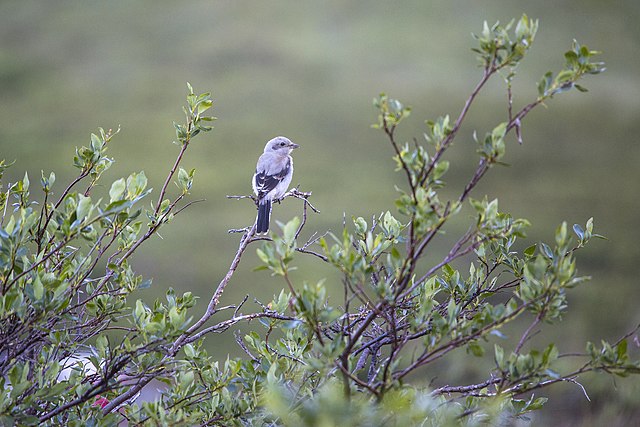
A juvenile Northern shrike, Lanius borealis, sitting on a branch.

Mimic Octopus of Indonesia

A blog post about animal pretenders wouldn’t be complete without mentioning the ultimate master of disguise, the Mimic Octopus of Indonesia. Like other octopuses, it uses chromatospheres (color-changing cells on its skin) to blend in with the shallow, sandy ocean bottom. Yet, unlike other octopuses, this crafty cephalopod is a natural-born shapeshifter. As it forages in the open water in full view of potential predators, it changes color, shape, and how it behaves based on its surroundings. Purportedly, it can mimic up to fifteen sea animals! For example, to disguise itself as the poisonous lion fish, its arms take on black and white bands and flare out and trail behind it. And to mimic the sole, a poisonous flatfish, it turns a mottled brown, arranges its arms in a leaf-shape and undulates its body as it skims along the sand.

Incredibly, scientists think that this marine mollusk can decide which costume to wear based on which predator is floating nearby. They have observed mimic octopuses, when threatened by the territorial damselfish, hide six arms in a hole and raise the other two arms (color-changed to display black and beige bands) in opposite directions. Now appearing to the confused damselfish to be a venomous banded sea snake (a known predator of damselfish), the eight-legged trickster is given the time it needs to make its escape! This use of dynamic mimicry (which is considered Batesian mimicry) is a brilliant tactic that allows the otherwise vulnerable octopus to move about freely while remaining cool, calm, and collected in a jeopardy-laden, predator-rich environment! 


So now you know why,

A creature’s disguise,

Can be such an important thing.

It helps them to thrive,

Or just stay alive,

To see what the next day will bring.

And as you have fun,

On your house-to-house run,

To collect all the candy you’ve earned,

Do make sure you recall,

This blog post, rhymes and all,

And please don’t forget what you’ve learned.

Yes, you should be quite wary,

‘Cause it could be real scary,

To see ghosts, ghouls, and goblins galore.

But remember, beware,

There’s a whole world out there,

Of real creatures that offer much more.

Like the owl butterfly,

And the hawks in the sky,

Or even a shrike or two.

Just know if shrikes could speak,

With those sharp little beaks,

They might shout “Trick or Treat!” right at you!

Happy Halloween!

Shelby Wyzykowski is a Gallery Experience Presenter in CMNH’s Life Long Learning Department. Museum staff, volunteers, and interns are encouraged to blog about their unique experiences and knowledge gained from working at the museum.

Related Content

Booseum: Vampires!

Jack-o-Lantern Chromatography

Spiders as Interior Designers

Carnegie Museum of Natural History Blog Citation Information

Blog author: Wyzykowski, Shelby
Publication date: October 22, 2021

Share this post!

  • Share on Twitter Share on Twitter
  • Share on Facebook Share on Facebook
  • Share on Pinterest Share on Pinterest
  • Share on LinkedIn Share on LinkedIn
  • Share on Reddit Share on Reddit
  • Share via Email Share via Email

Filed Under: Blog Tagged With: booseum, Shelby Wyzykowski

October 20, 2021 by Erin Southerland

It Isn’t Easy Being Different

by Stephen P. Rogers
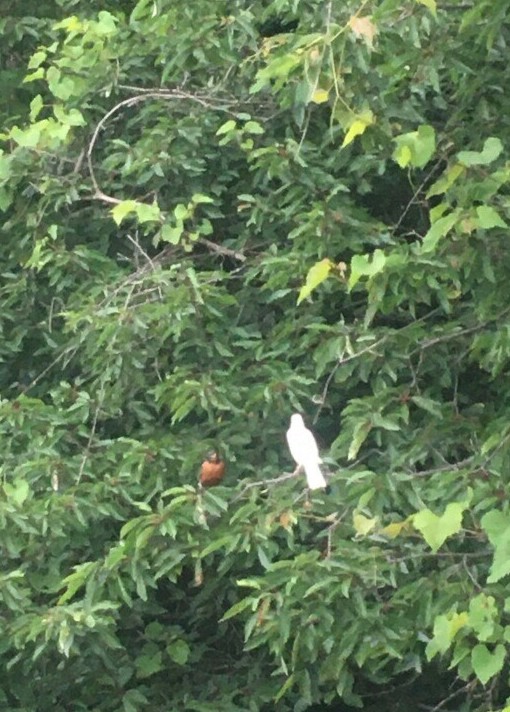
White bird and a robin in a tree

In nature there is always variation among individuals. In fact, the ability of an organism’s genes to pass along variation to a subsequent generation accounts for how species evolve. When enough variation develops among a group of individuals that are in some way isolated from other similar individuals, a new species might evolve. Often, however, a variation leads to such a unique set of features that the individual does not survive long enough to reproduce.

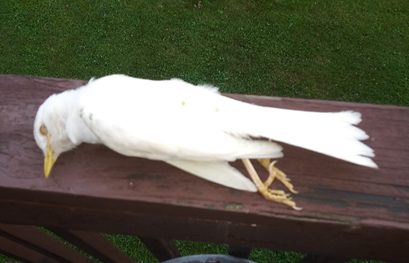
In June, I received a call from a person named Joseph who enjoys watching birds near his home in Plum Borough. He and a neighbor had been watching an albino American Robin in the field behind their apartment complex for a few days. One afternoon three standard colored Robins began harassing this albino and chased it rapidly towards the field’s wooded edge. When Joseph heard a ‘thunk’ as the bird hit a poplar tree, he put on his boots to search for it.  After some effort he found the bird, unfortunately dead. He called the National Aviary to report his find, and a representative he spoke with forwarded his number to me. I visited Joseph to retrieve the rare specimen, and he later sent me pictures of the living bird as well as an immediate post-mortem image showing pink eyes, a feature which designates the creature as a true albino.

albino American Robin laying on its side outdoors

Adding the Albino Robin to the Museum Collection

I contacted Annie Lindsay, Powdermill Nature Reserve’s Banding Program Manager, to ask if she had ever seen an albino at the museum’s field research station. She had not, but reported some encounters with birds bearing leucistic feathers. The term refers to feathers without pigment. Sometimes birds who lose individual feathers when they are not molting replace a lost colored feather with one that is white. I have seen this phenomenon in some birds I have prepared. I have also occasionally prepared birds with leucism, a condition caused by a genetic mutation that results in a partial reduction of color in a bird’s plumage, resulting certain areas white and other areas the typical colors of the species.

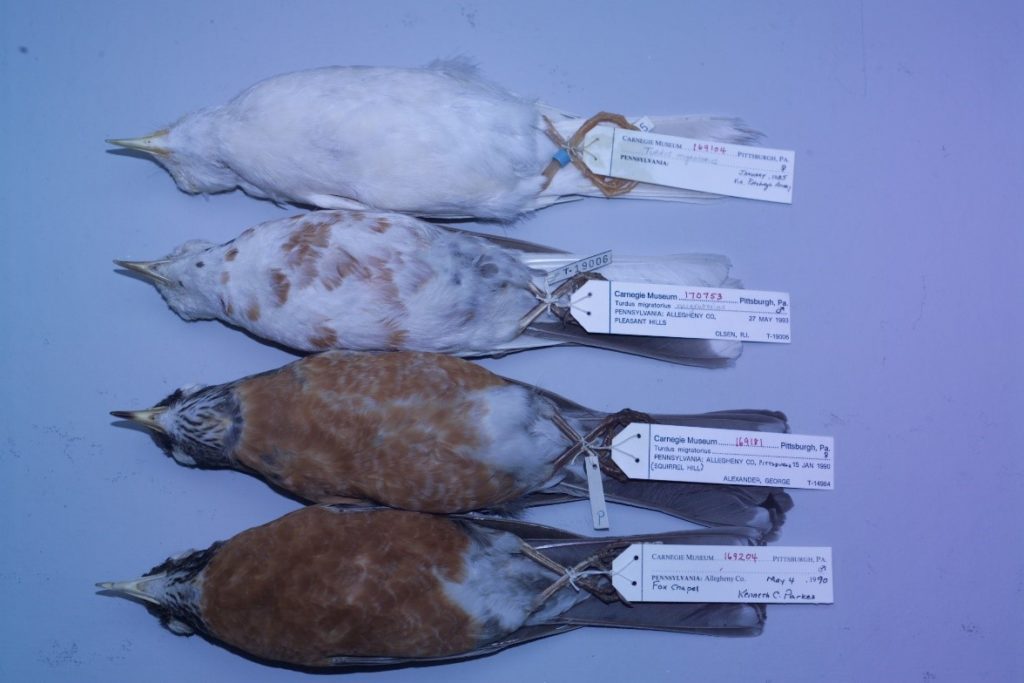
Among the American Robins in the CMNH collection we have an example of both a full albino and a leucistic individual. Both are pictured below alongside a male and female robin in normal coloration. The leucistic bird had been watched for three years before it was found dead. This lifespan can be interpreted as evidence that other robins must have accepted its’ coloration.

Four study skins of American Robins

All of these birds are from the Pittsburgh area, a region which has been the primary source of birds added to the collection for many years. Typical collection addition situations involved vigilant bird watchers who found a bird that had been hit by a car (one of these individuals) or had been found dead near a window. Over the past 40 years I’ve transformed thousands of such feathered accident victims into museum specimens for current and future scientific studies. During this time, I’ve noticed a trend. If a person finds a dead bird, they may or may not contact the museum to see if we want the specimen. However, if it appears to be extra colorful, or rare by distribution, or in the case of the Plum Borough robin, albino, they may make a special effort to reach out to Carnegie Museum of Natural History. The albino American Robin is still in a museum freezer awaiting preparation. Perhaps it may become a taxidermy specimen rather than a study skin.

Stephen P. Rogers is Collection Manager in the Section of Birds at Carnegie Museum of Natural History. Museum employees are encouraged to blog about their unique experiences and knowledge gained from working at the museum.

Related Content

Halloween and Birds

Lights Out for Birds

Turkeys

Carnegie Museum of Natural History Blog Citation Information

Blog author: Rogers, Stephen P.
Publication date: October 21, 2021

Share this post!

  • Share on Twitter Share on Twitter
  • Share on Facebook Share on Facebook
  • Share on Pinterest Share on Pinterest
  • Share on LinkedIn Share on LinkedIn
  • Share on Reddit Share on Reddit
  • Share via Email Share via Email

Filed Under: Blog Tagged With: Birds, Science News, Stephen Rogers

October 15, 2021 by Erin Southerland

Happy Highsmith Halloween! A review of two scary snail short stories by Patricia Highsmith

by Timothy A. Pearce and Alice W. Doolittle

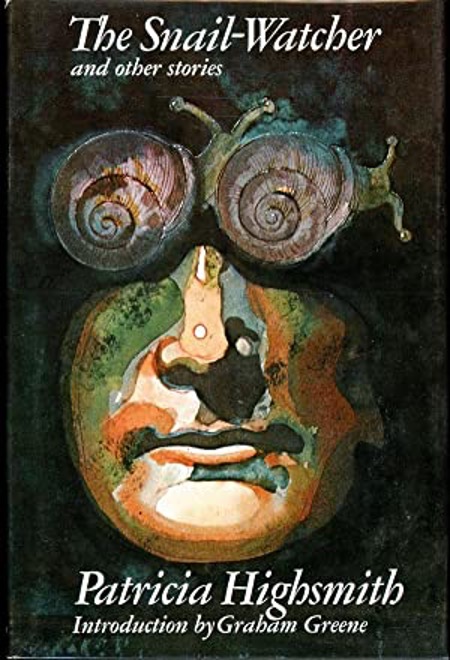
Book cover featuring a face with snails for eyes. Title "The Snail-Watcher and other stories." Author: Patricia Highsmith.

Patricia Highsmith was an accomplished author of thrillers and horror stories from the 1950s to the 1990s. Film buffs might be familiar with Alfred Hitchcock’s Strangers on a Train (1951), which was based on Highsmith’s first novel. The Talented Mr. Ripley (1999), starring Matt Damon, was also based on a Highsmith novel, as was Carol (2015), starring Cate Blanchett.

Highsmith was known to be enchanted with snails. Two short horror stories featuring snails, “The Snail-Watcher” and “The Quest for ‘Blank Claveringi’” are included in her collection The Snail-Watcher and Other Stories (1970, Doubleday, 177pp).

In “The Snail-Watcher,” readers meet Peter Knoppert who finds great delight keeping snails in terraria in his study, and enjoys watching them eat, mate, and reproduce. Scientifically accurate details in the story reflect Highsmith’s own careful observations of snails she kept. The snail population in Knoppert’s study grows rapidly through his diligent care and feeding (the story didn’t mention what the exorbitant weekly lettuce bill must have been) and he adds still more terraria to accommodate the mollusks. One day, after being otherwise occupied for a couple of weeks, Knoppert enters the study to find that the snails have escaped their terraria and are crawling on every surface in the room, including the ceiling. He slips on the slimy mucus and you can guess the gory ending.

In “The Quest for ‘Blank Claveringi,’” scientist Avery Clavering travels to a South Sea island where giant carnivorous snails are rumored to exist. Professor Clavering aims to collect one of this new species and name it after himself. Highsmith did not touch on the fact that among scientists, it is considered tacky to name species after yourself, so it is rarely done in the real world. Still, given Professor Clavering’s arrogant nature, it is believable that he could be egotistical enough to name a species after himself. He doesn’t yet know the genus of the snail, hence the “blank” in the title’s scientific name. He naively dismisses fears of locals from neighboring islands as superstitions, and considers stories of enormous snails to be exaggerations. When he encounters a snail the size of a Volkswagen, however, his plans to take one back alive quickly change. He can easily out-walk the giant beast, but when pursuer becomes the pursued, the slow-motion horror begins. 

It was refreshing to read Highsmith’s accurate anatomical descriptions of the snails: the thousands of teeth in the snail’s radula, the fact that land snails are hermaphrodites, and the descriptions of the snails’ lung being visible within the translucent shell. Even the mention that land snails don’t normally tolerate salt water is accurate, heightening the horror when Professor Clavering learned that the snails on this island did not hesitate to pursue him into the ocean.

So, next time you are in the mood for a thrilling snail horror story, consider one of Patricia Highsmith’s short stories.

Two scary snail jokes for you:

1. Two snails named Gaston and Shelly are telling scary stories. Gaston says, “Psycho Snail isn’t really a snail at all, he is really a hermit slug. He murders snails then wears their shells so he can blend in with other snails and kill again.” Shelly says, “I don’t believe in Psycho Snail.” Gaston says, “You better believe, because *I* am Psycho Snail!” Shelly screams, “Ahhhhh!” Gaston, seeing no reaction, says, “You were supposed to jump and run away in terror.” Shelly says, “I did and I am.”

2. The snail prophet warned that if the snails didn’t behave, the snail God would punish them with a rain of young chickens. Although the snails started behaving only slightly better, the rain of chickens didn’t materialize. One snail said to another, “Phew, looks like we dodged a slug this time!” (I bet you thought I was going to say dodged a pullet!)

Timothy A. Pearce is Curator of Collections and Head of the Section of Mollusks and Alice W. Doolittle is a volunteer in the Section of Mollusks at Carnegie Museum of Natural History. Museum employees and volunteers are encouraged to blog about their unique experiences and knowledge gained from working at the museum.

Related Content

Vampire Squid: Cutest Dracula

The Tell-Snail Heart

Land Snail Webbhelix multilineata Rediscovered Living in Pennsylvania After 72 Years

Carnegie Museum of Natural History Blog Citation Information

Blog author: Pearce, Timothy A.; Doolittle, Alice W.
Publication date: October 14, 2021

Share this post!

  • Share on Twitter Share on Twitter
  • Share on Facebook Share on Facebook
  • Share on Pinterest Share on Pinterest
  • Share on LinkedIn Share on LinkedIn
  • Share on Reddit Share on Reddit
  • Share via Email Share via Email

Share this post!

  • Share on Twitter Share on Twitter
  • Share on Facebook Share on Facebook
  • Share on Pinterest Share on Pinterest
  • Share on LinkedIn Share on LinkedIn
  • Share on Reddit Share on Reddit
  • Share via Email Share via Email

Filed Under: Blog Tagged With: Alice Doolittle, mollusks, Science News, Tim Pearce

October 14, 2021 by Erin Southerland

Grass Baskets of the Chumash

by Phillip Mendenhall

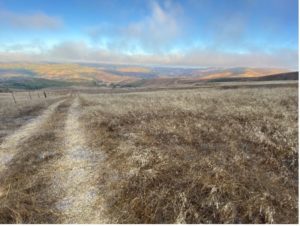
  • field under blue sky with puffy clouds
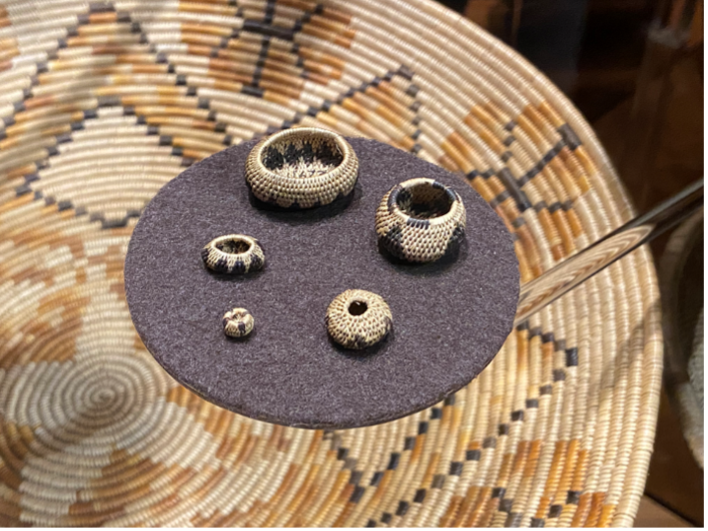
  • woven baskets on a shelf
Left: Chumash archaeological site near Lompoc, CA. Right: Baskets from the Alcoa Hall of American Indians, CMNH.

On archaeological excavations we typically remove overlying vegetation as part of the process of looking for evidence of the past below ground. However, while on an excavation of a prehistoric lithic quarry near the southern California coast this past August, I was reminded of how much knowledge can be observed by orienting oneself in the surrounding landscape. 

Anyone who visits the interior corridors of Alcoa Hall will find themselves confronted by the central displays of grass-weaved baskets obtained from the throughout the US. If someone looks closely enough in the California Basket case, they will see five baskets that measure no larger than a person’s thumbnail. These tiny specimens made sometime before 1938 near Pomo, California, were never meant to be used in any practical way, but were rather meant to display the mastery of the artisan that created them. Without the use of mechanical aids or lenses, the rough, sea-weathered grasses of the central California coast were meticulously threaded with exact precision into a near-microscopic version of their functional counterparts. Motifs that emulate the larger versions are still visible and thoughtfully organized as if they were a hundred times greater than their actual size, a remarkable demonstration of skill that dates back at least 2,000 years in the region.

Baskets, due to their organic components, rarely survive in the archaeological record. We archaeologists are forced underground to look for more tangible artifacts, such as stone tools and pottery to understand past lifeways. This can cause bias in what we believe a group of people used as resources because only a few types of durable artifacts survive from so long ago. However, as many of the Chumash people that I worked with this summer will explain, we who seek to understand better what has happened in the past have only just touched the surface of what lies hidden from our knowledge. 

Phillip Mendenhall is a member of the Cherokee Nation of Oklahoma, a PhD candidate in anthropology at the University of Pittsburgh, and an interpreter at Carnegie Museum of Natural History. His work in North America and southeastern Europe focuses on how native cultures persist in the face of cultural change and colonization. 

Related Content

Celebrating Indigenous Peoples’ Day

An Indigenous Presence: Cultural Survivance and Contemporary American Indian Art and Design

Where the Heck Did That Come From?

Carnegie Museum of Natural History Blog Citation Information

Blog author: Mendenhall, Phillip
Publication date: October 14, 2021

Share this post!

  • Share on Twitter Share on Twitter
  • Share on Facebook Share on Facebook
  • Share on Pinterest Share on Pinterest
  • Share on LinkedIn Share on LinkedIn
  • Share on Reddit Share on Reddit
  • Share via Email Share via Email

Share this post!

  • Share on Twitter Share on Twitter
  • Share on Facebook Share on Facebook
  • Share on Pinterest Share on Pinterest
  • Share on LinkedIn Share on LinkedIn
  • Share on Reddit Share on Reddit
  • Share via Email Share via Email

Filed Under: Blog Tagged With: anthropology, Phillip Mendenhall, Science News

October 11, 2021 by Erin Southerland

Celebrating Indigenous Peoples’ Day

by Amy L. Covell-Murthy

Indigenous Peoples’ Day is observed in the City of Pittsburgh alongside Columbus Day and I would like to suggest some ways to observe the holiday for those who do not claim Indigenous heritage. In a state with no habitable federally recognized Indigenous land, Native people are all too often seen as existing only in the past. While educating yourself on the Indigenous history of the region is an important part of observing the holiday, it’s also important to recognize that many First Nations people live, work, and play in the Greater Pittsburgh Area. Indigenous Peoples’ Day should not be a memorial, but a recognition of the important history and cultural heritage of those who are the past, present, and future caretakers of this land. Here are some things you can do to respectfully celebrate on October 11, 2021. 

Educate Yourself

Learn about the people who have called Pittsburgh home. Many different cultural groups have occupied the Upper Ohio River Valley including but not limited to the Delaware/Lenape, the Haudenosaunee, the Shawnee, and the Wyandotte. The Osage Nation also claims origin in the Ohio River Valley, and you can learn about all these nations on their official websites. I also suggest hitting up your local library to check out books on these groups as well as the cultural traditions and ancestors who came before them. This region was home to those who are often referred to as the Adena, Hopewell, and Monongahela. But keep in mind, we have no idea what they called themselves. Here are some resources:

Haudenosaunee Confederacy

Lenape Nation of Pennsylvania

Eastern Shawnee History

Wyandotte Nation

The Osage Nation

Person in a crowd holding a sign that says "We are still here"
Indigenous Peoples March, January 18, 2019

Educate Yourself Some More

Learn about the history that may have been left out of your primary and secondary school curriculums. You may be unaware of the atrocities that Indigenous people faced in the State of Pennsylvania. Many First Pennsylvanians were forced from their homelands and infected with unfamiliar diseases by colonizers. Later, beginning in 1879, the first assimilation school was created in Carlisle, PA and used as a model for 24 additional institutions whose primary goal was to force Indigenous children to abandon their Native languages and customs. In the 1960s, the building of the Kinzua Dam on the Allegheny River upstream from Warren, PA forced Seneca Nation citizens to move into the State of New York, breaking the 1794 Treaty of Peace and Friendship. Indigenous communities thrive despite these events and institutions, but it is important to recognize and not try to hide these gruesome parts of our shared American history. You can find more information about these examples on these websites: 

Kinzua Dam

Smallpox

Carlisle Indian School Project

Support Local Indigenous Groups

The Council of Three Rivers American Indian Center is a regional intertribal nonprofit that promotes the socio-economic development of the Native American community and others who experience the same type of economic difficulties in the Greater Pittsburgh metropolitan area. One way to support them is to plan to attend their annual Pow Wow that is held just outside of Pittsburgh in Dorseyville in late September. Learn more about their Early Childhood Education, Native American Elders, Veterans, and Employment programs here: 

Council of Three Rivers American Indian Center (website)

Council of Three River American Indian Center (Facebook page)

Honor the Land

gourds, corn, and seeds on a wooden platter on a black counter

Planting Native Pennsylvanian plants is a wonderful way to honor our connection to the Earth and to provide food and shelter for the diverse species who live here. You can learn about how Indigenous People use trees, ferns, flowers, vegetables, fruits, and grasses to enhance their quality of life. The Pennsylvania Department of Conservation and Natural Resources and the Audubon Society of Western Pennsylvania offer suggestions for those who are interested:  

Landscaping with Native Plants

List of Western PA Native Plants

Attend an Online or In Person Event

Many cities around the United States hold events to celebrate Indigenous Peoples’ Day. A quick Google Search can point you in the right direction. I’m going to be learning about the current racial and social landscape from young Black-Indigenous activists at the Smithsonian.  You can tune in to the National Museum of the American Indian at 1 p.m. on October 11th to attend this free webinar titled, Indigenous Peoples’ Day: Black-Indigenous Youth Advancing Social Justice.                        

Support Indigenous Artists, Authors, Film Makers, and Musicians

You have so many options! The Sundance Institute has a version of its 2021 Indigenous Short Film Tour available to stream. It’s an 85-minute program featuring 7 short films. The Carnegie Library of Pittsburgh website offers staff picks and lists of Indigenous authors. My favorite is a list of Indigenous Science Fiction from 2020 which is intended for adults, but they also have lists of Indigenous books for children and teens. Independent Lens presented a list of Indigenous musicians you should know in 2019, which included Raye Zaragoza and Pamyua. You can support Indigenous artists by purchasing art through the online gift shop of the Seneca Iroquois National Museum/Onöhsagwë:de’ Cultural Center.                 

Help Change Derogatory Mascots and Place Names                                                                         

Sign petitions, attend community forums, and advocate for the changing of harmful stereotypes and offensive signage in our community.  From the Cleveland Guardians to Hemlock Hollow Road, there are many instances of this happening around us. The National Congress of American Indians offers a state tracker of schools with offensive mascots, and Pennsylvania has 45 districts and 115 schools who need a change. 

Consider Donating Time or Resources

The Seneca Iroquois National Museum/ Onöhsagwë:de’ Cultural Center is only a few hours’ drive from Pittsburgh and occasionally may be looking for volunteers. Check their website and follow their social media accounts (Instagram and Facebook) for more information.

If you are able, here are just a few organizations who can use your help:

Native American Agriculture Fund

NDN Collective

Honor the Earth

Indigenous Environmental Network

So, join me in unlearning some Columbus Day myths and celebrating the cultural diversity of Indigenous People throughout the history of our region. Remember that the best places to start educating yourself are the local libraries and museums. Carnegie Museum of Natural History offers guided tours of our cultural halls that strengthen the messages we wish to share with the community. Visit the Alcoa Hall of American Indians to learn more about the Tlingit, Lakota, Hopi, and Haudenosaunee, and keep in mind that there are so many other Indigenous groups, traditions, nations, and organizations for you to explore on your own!

Amy L. Covell-Murthy is Archaeology Collection Manager at Carnegie Museum of Natural History. Museum employees are encouraged to blog about their unique experiences and knowledge gained from working at the museum.

Related Content

An Indigenous Presence: Cultural Survivance and Contemporary American Indian Art & Design

Seldom Seen: Archaeological Textiles in the Eastern United States

Queer Eye for Lakota Art

Carnegie Museum of Natural History Blog Citation Information

Blog author: Covell-Murthy, Amy L.
Publication date: October 11, 2021

Share this post!

  • Share on Twitter Share on Twitter
  • Share on Facebook Share on Facebook
  • Share on Pinterest Share on Pinterest
  • Share on LinkedIn Share on LinkedIn
  • Share on Reddit Share on Reddit
  • Share via Email Share via Email

Share this post!

  • Share on Twitter Share on Twitter
  • Share on Facebook Share on Facebook
  • Share on Pinterest Share on Pinterest
  • Share on LinkedIn Share on LinkedIn
  • Share on Reddit Share on Reddit
  • Share via Email Share via Email

Filed Under: Blog Tagged With: Amy Covell-Murthy, anthropology, Science News

  • « Go to Previous Page
  • Page 1
  • Interim pages omitted …
  • Page 20
  • Page 21
  • Page 22
  • Page 23
  • Page 24
  • Go to Next Page »

sidebar

About

  • Mission & Commitments
  • Directors Team
  • Museum History

Get Involved

  • Volunteer
  • Membership
  • Carnegie Discoverers
  • Donate
  • Employment
  • Events

Bring a Group

  • Groups of 10 or More
  • Birthday Parties at the Museum
  • Field Trips

Powdermill

  • Powdermill Nature Reserve
  • Powdermill Field Trips
  • Powdermill Staff
  • Research at Powdermill

More Information

  • Image Permission Requests
  • Science Stories
  • Accessibility
  • Shopping Cart
  • Contact
  • Visitor Policies
One of the Four Carnegie Museums | © Carnegie Institute | Privacy Policy | Terms of Use | Accessibility
Rad works here logo